Original Rainbow Flag (1978)
Rainbow Pride Flag ·
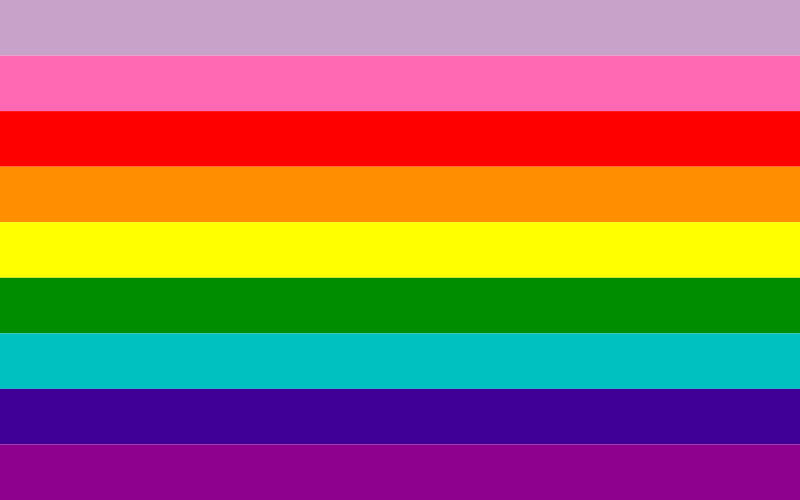
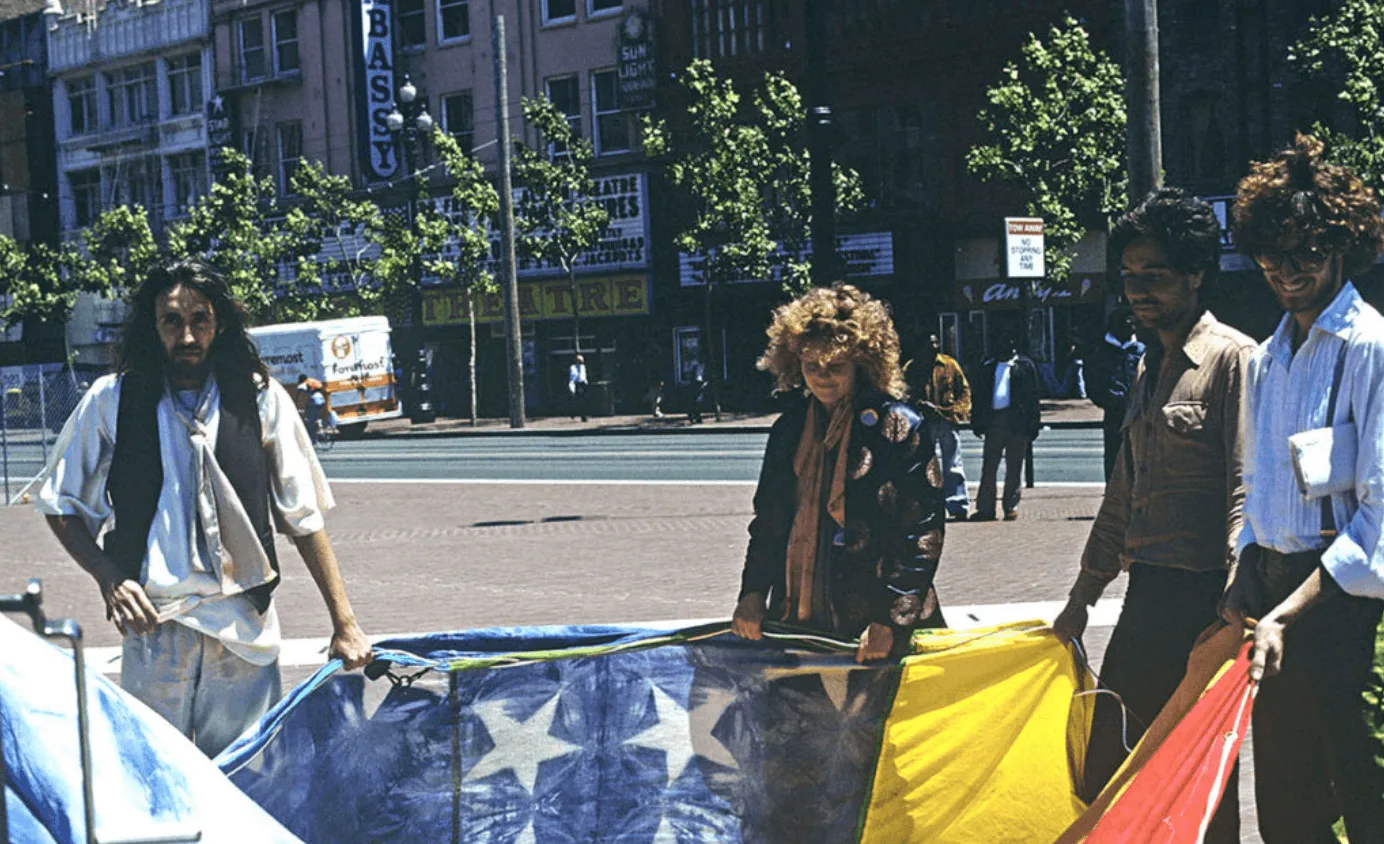
The eight-stripe original, made by Gilbert Baker and Lynn Segerblom in 1978 and sewn with James McNamara, first flown at the San Francisco Gay Freedom Day Parade on 25 June 1978. About thirty volunteers dyed a thousand yards of cotton in trash cans at 330 Grove Street. Each stripe carried an assigned meaning, from hot pink for sex to violet for spirit. Segerblom's status as co-creator is contested by the Baker Estate, and this entry records the dispute rather than resolving it.
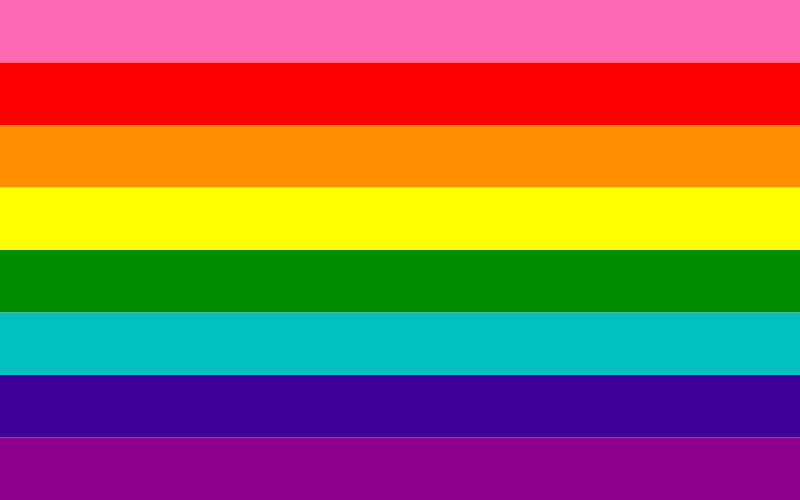
Key facts
- Designer
- Gilbert Baker & Lynn Segerblom
- Created
- First documented public use
- In use
- 1978–present
- Aspect Ratio
- Not standardized
- Ratio Notes
- No creator-issued aspect ratio is documented for this design. The two monumental 1978 flags measured roughly 30 feet by 60 feet, about 1:2, sized for the United Nations Plaza flagpoles rather than to a fixed design ratio; Segerblom has recalled them as larger. [1][2][3][4][5] Any 3:5 rendering shown here is a modern reconstruction and display convention, not a specification of the original.
- Stripes
- 8
- Origin
- San Francisco, California, United States
- Represented Identity
- Gay community, LGBTQ community
Also known as
- Eight-Stripe Rainbow Flag
- Gilbert Baker Rainbow Flag
- Baker Flag (1978)
- Original Pride Flag
Status Canonical Historical Contested
Archive categories Rainbow Pride Flags · Historical and Early Pride Flags
Overview
Baker sought a visible, positive symbol for the community, one that came from nature and represented diversity and inclusiveness.
In his memoir, Baker traces the flag's conception to early 1978: after a Citizen Kane screening at the Strand Theater, filmmaker Artie Bressan Jr. asks Baker to create a new symbol for 'the dawn of a new gay consciousness and freedom.' In his memoir, Baker noted that 'Both he and Harvey [Milk] had brought this up to me before.' [6] Baker's involvement with the Angels of Light, a prominent San Francisco collective known for its large-scale textile and performance work, had made him the natural person to turn to for creating a unifying symbol.
Harvey Milk was one of the first openly gay elected officials in the United States, elected to the San Francisco Board of Supervisors in 1977. Whether he asked Baker for a symbol directly is disputed. The Gilbert Baker Estate's 2019 letter documents such a request in 1977 [7], and general reference accounts repeat it [8]. Baker's New York Times obituary is looser, saying Milk 'joined others in asking Mr. Baker to create an emblem to represent the movement.' [9] Regardless, Baker's memoir names the aforementioned Artie Bressan Jr. as the person who pressed him [6], and his 2008 oral history mentions no request from Milk at all. [10] Lee Mentley, who ran the Gay Community Center at 330 Grove Street and sat on the Pride Foundation executive board, rejects the account: 'He even reached the point where he said, “Harvey Milk came to me and asked me to create a symbol for the movement.” No, Harvey didn't do any such thing at all.' [11] Regardless of official commission, it is uncontested that many in the San Francisco area were calling for a unifying symbol of LGBT pride in the late 1970s. [9][10]
Baker wanted to replace the pink triangle, a symbol rooted in the Nazi concentration camp system. [12][13] The Nazis used the triangle to identify many men imprisoned for alleged violations of Paragraph 175, the German statute criminalizing sexual acts between men. [13] After the Nazis broadened the law in 1935, German courts recorded nearly 25,000 convictions under Paragraph 175 from 1937 through 1939 alone. [13][14]
In his 2008 oral history Baker recalled that 'people around me were saying, We need a logo,' but that the 1976 American Bicentennial's wave of American flags had him 'looking at flags with a new eye': 'Maybe we could have a flag too because we're a people.' [10] Baker felt the triangle was 'emotionally too dark' and the Greek letter lambda 'too obscure.' The rainbow itself came to him later that week while dancing with Cleve Jones at the Winterland Ballroom: 'We were all in a swirl of color and light. It was like a rainbow. A rainbow. That's the moment when I knew exactly what kind of flag I would make.' [6] He wrote in Rainbow Warrior: 'A Rainbow Flag was a conscious choice, natural and necessary. The rainbow came from earliest recorded history as a symbol of hope.' [15][6]
Baker, Lynn Segerblom, and James McNamara led production of two huge flags at the Gay Community Center at 330 Grove Street in San Francisco, with approximately thirty volunteers. [16][17] The building also housed the Gay Liberation Front; the Black Panthers had previously occupied the same space, and the two groups had coexisted. [17]
The Gay Freedom Day Committee provided about $1,000 for materials [7][17], though accounts of its exact path differ. Lee Mentley recalls roughly $1,000–1,200 located through both Harvey Milk's and State Senator Quentin Kopp's offices [11], while earlier reporting describes leftover hotel tax funds secured through Milk. [17] Volunteers purchased about a thousand yards of cotton fabric and bottles of dye. The center had no water heater, so Segerblom heated water in big canning pots and mixed it with cold water in giant trash cans that served as dye vats, using salt with the dyes for each of the eight colors. The dyed fabric was dragged onto the roof to dry. [17] Late-night runs to a nearby laundromat for rinsing were done covertly, since using dye in public machines was prohibited, and they ran a bleach cycle afterward. [17] McNamara sewed the strips together, and the team spent about six weeks making the flags, unsure they would finish in time for the parade. [17][4]
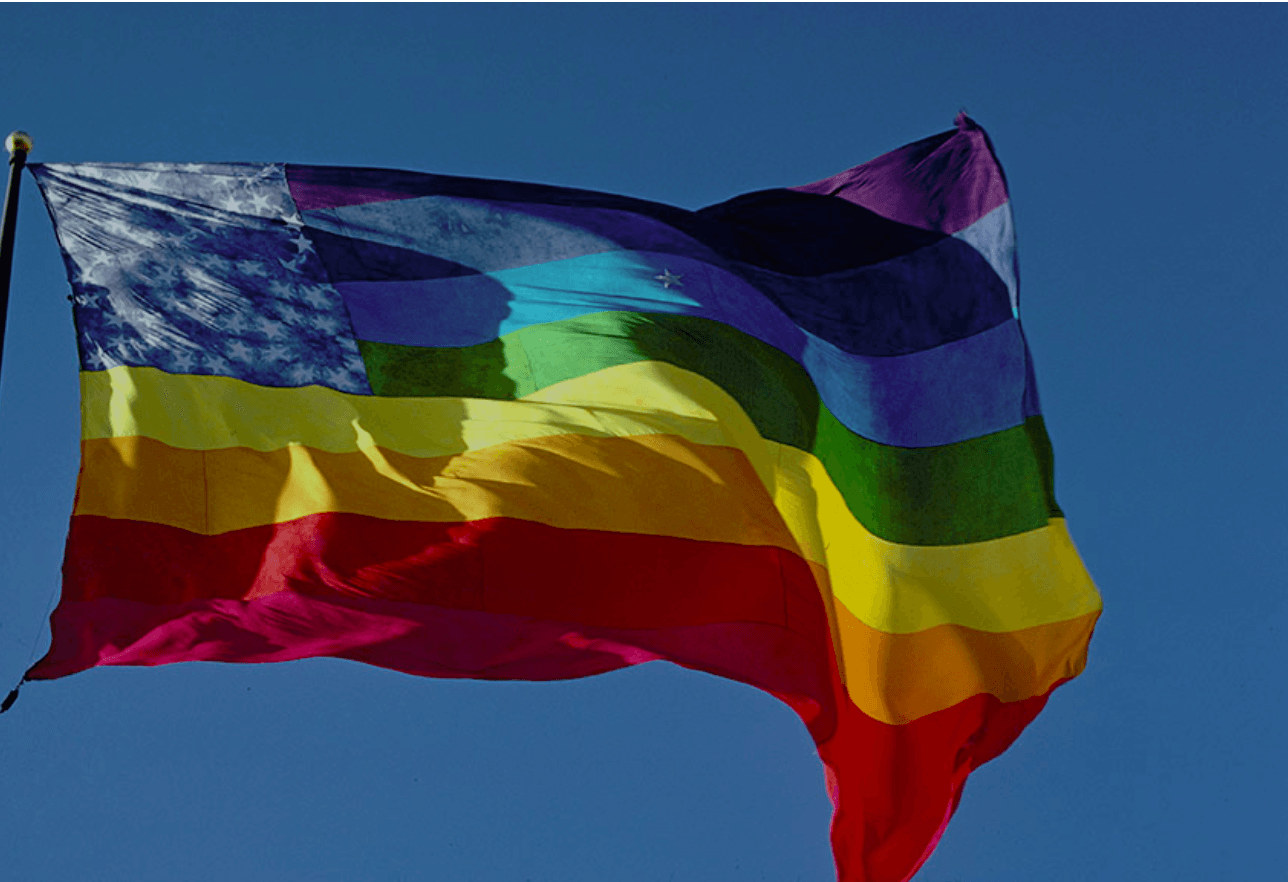
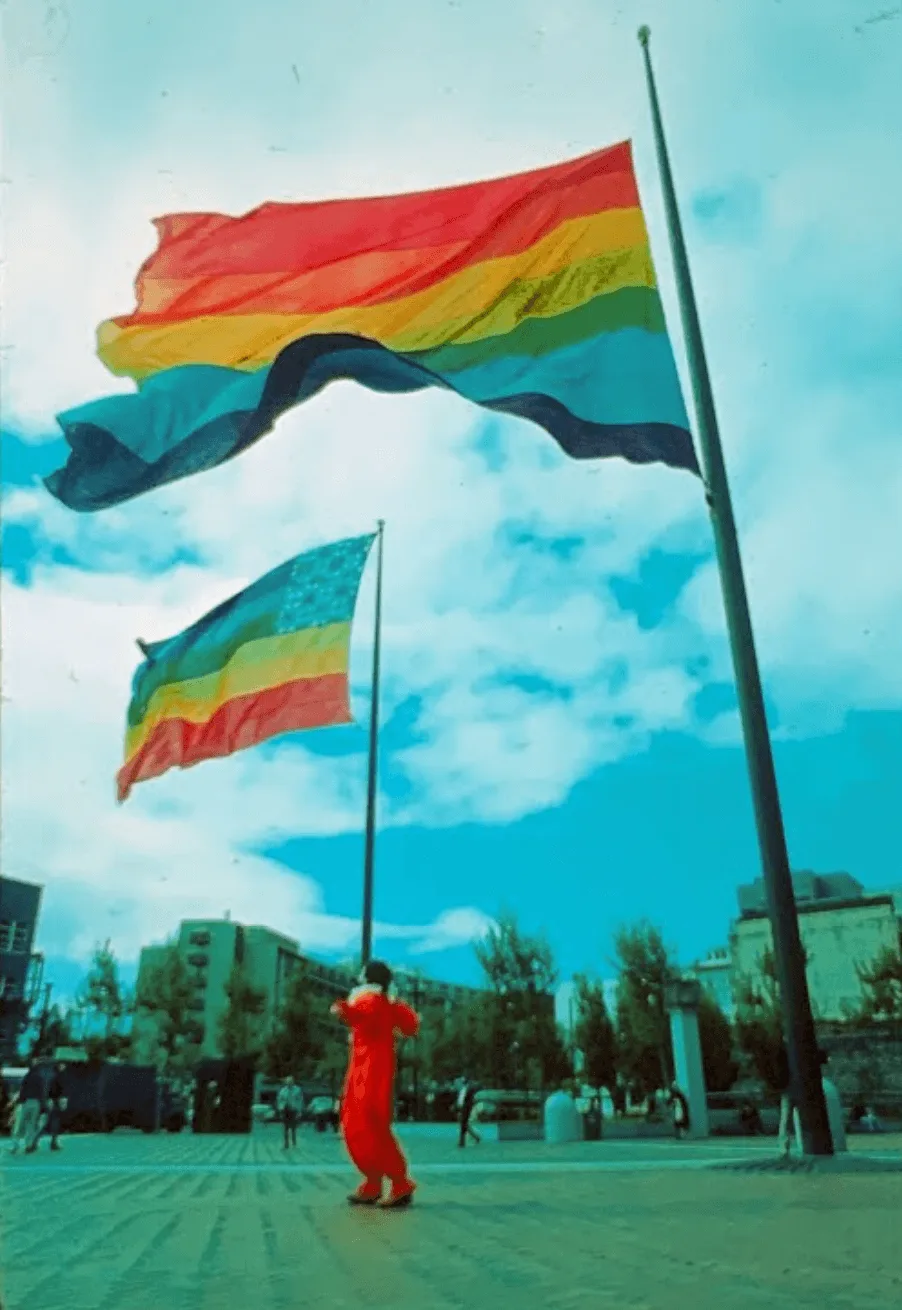
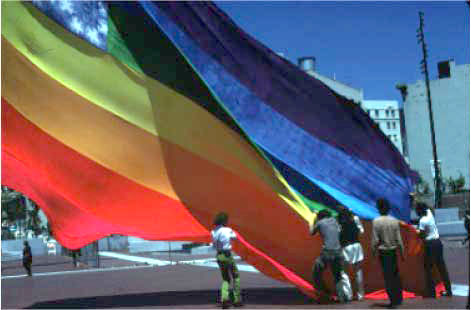
The two monumental flags were documented by the institutions that hold the work as measuring 30 feet by 60 feet each, though Segerblom has recalled the pair as larger. [1][2][3][4] The two were not identical: one carried only the original eight rainbow stripes, while the other, attributed to Segerblom, was a stars-and-stripes variant, 'a rainbow version of the American flag' with, in the Art Newspaper's words, 'a square of blue and white tie-dyed stars' in its upper corner. [1][3][4] Segerblom has described the two as an intentional pair, with the stripe order flipped between them, one pink-topped and one purple-topped. The stars flag's canton was printed using hand-cut star woodblocks, C-clamped and dye-immersed, plus a leftover Angels of Light lamé star (silver one side, gold the other) sewn into its aqua stripe. Within the team the stripes-only flag was called 'James's flag' and the stars flag 'Lynn's Flag' or the 'New American Rainbow Flag.' [11] Each flag was so heavy it required several people to lift and a pickup truck to transport. [8][16]
Beyond the two monumental banners, the team also produced roughly eighteen smaller flags for the plaza's reflecting pool, each a pre-cut white muslin flag handed to an individual artist to paint, dye, or appliqué. [17] One of the two flags, the stars-and-stripes version, was stolen from the community center and never recovered. [18][4] A reward is being offered by the admin of this site for information about this theft: contribute.
Identity & Context
- Represented Identity
- Gay community, LGBTQ community
- Movement
- Gay Liberation Movement, LGBTQ Pride Movement
- National Context
- United States
The flag originates in San Francisco but became a broader pride symbol for the community at large. Conceived at the height of the city’s emergence as a center of gay political power, following Harvey Milk’s historic 1977 election win for a seat on the San Francisco Board of Supervisors. This victory made him one of the first openly gay people to hold public office, a status that would soon end his life in a violent hate crime. [19]
Creators
The Creators
Gilbert Baker
Designer & Vexillographer
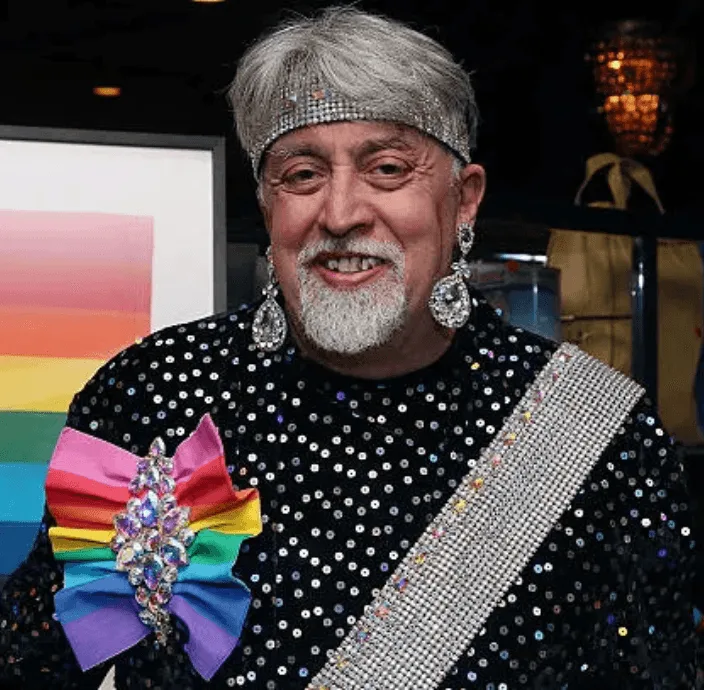
Gilbert Baker (June 2, 1951 -- March 31, 2017) was a self-taught vexillographer, artist, and gay rights activist known for creating the rainbow flag, which became one of the most widely recognized symbols of LGBTQ+ pride worldwide. Baker was born in Chanute, Kansas, and raised in Parsons, Kansas, a Bible Belt town near the Oklahoma border. His grandmother owned a women's clothing store where he first discovered his love of fabric. In his posthumous memoir Rainbow Warrior, Baker wrote that in 1950s Kansas, it was 'not considered normal to imagine greatness and beauty. Being an artist was bad in the same way that homosexuality was bad.' [15] As a child, he secretly danced in his aunt's old prom dress; his parents gave him an Erector Set to channel his creativity into 'more masculine' areas. He described high school as 'horrible,' recalling 'I was always the gay kid... always an outcast,' with art as 'my escape and my high and my passion.' He came out to his parents officially at Christmas 1970/71, followed by five or six years of estrangement. He had two younger sisters. [10]
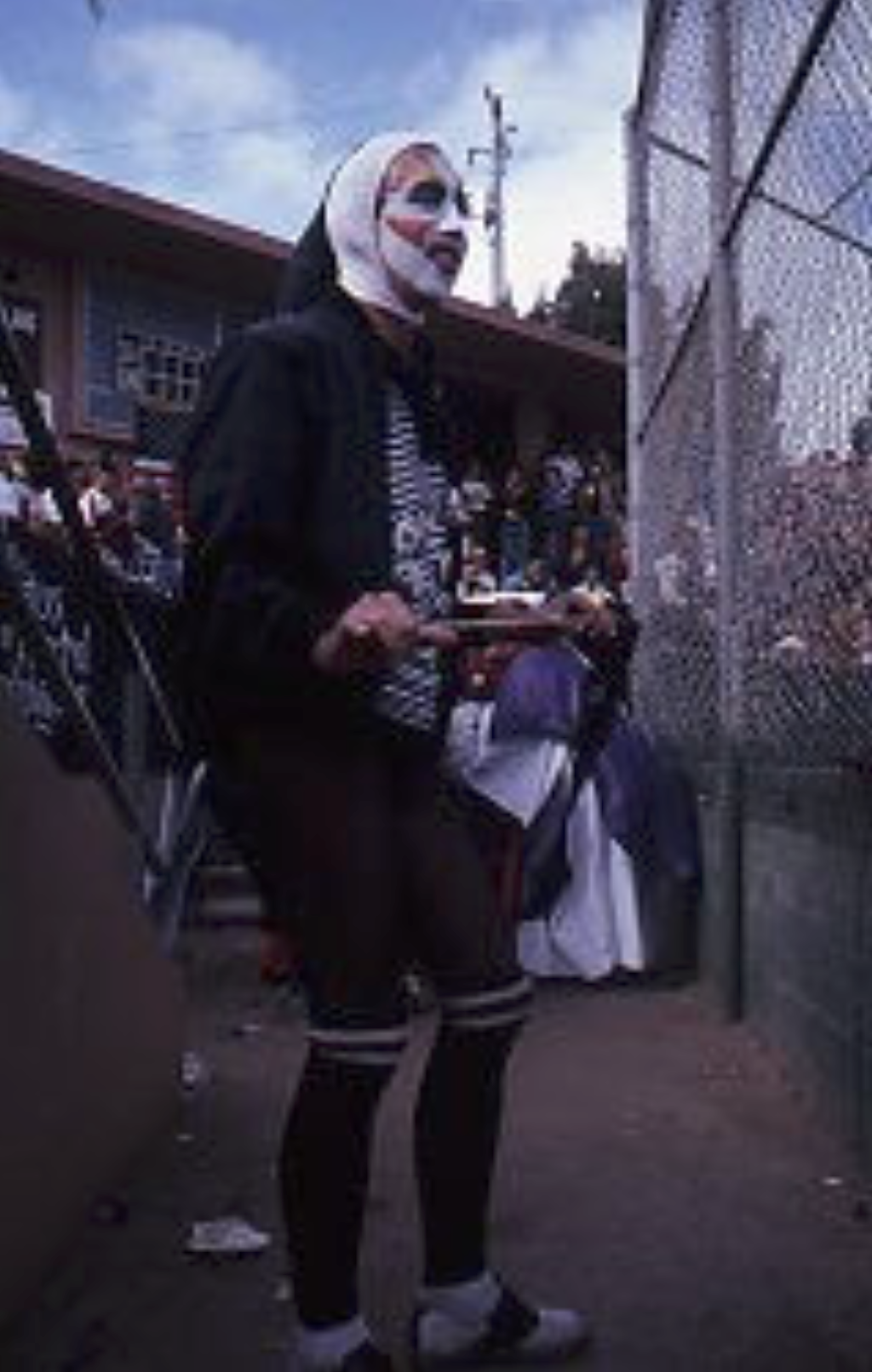
Baker served in the U.S. Army from 1970 to 1972, stationed as a medic in San Francisco, and stayed in the city after his honorable discharge. He worked on California Proposition 19, the first marijuana legalization initiative, and was taught to sew by fellow activist Mary Dunn, using the skill to make banners for gay-rights and anti-war protest marches. [8] Accounts place him at the Presidio of San Francisco, associated with Letterman Army Medical Center, and describe him using the G.I. Bill to return to school. He entered the drag scene under the name 'Busty Ross,' alluding to Betsy Ross. [8][20] He joined the Sisters of Perpetual Indulgence, the drag-nun activist group, and was photographed as Sister Chanel 2001 at a Sisters softball game in 1981. [21] He later left, saying that at first it was 'glamorous and political, but when the Sisters became more organized, it became a tool of the right wing and raised money for Jerry Falwell,' so he stopped. [8]
He met Harvey Milk in 1974; one history of the flag says Milk showed him 'how action could create change,' though the phrase is that writer's rather than a quotation from Baker. [22] After Milk's election in November 1977, Baker set out to make a positive symbol of pride to replace the pink triangle, with Milk among those calling for one.
He was a co-chair of the Decorating Committee for the 1978 Gay Freedom Day parade alongside Lynn Segerblom. [17][23] They received $1,000 from the Gay Freedom Day Committee for the original flag design, and approximately 30 volunteers assisted with the hand-dyeing at the Gay Community Center. [7][17][16]
In 1979, Baker began working at Paramount Flag Company, creating window displays that drew the attention of Mayor Dianne Feinstein, who commissioned him to design flags and banners for her first elected inaugural ceremony. City commissions followed for visits by foreign heads of state and dignitaries, and then for the flags, banners and bunting of the 1984 Democratic National Convention at San Francisco's Moscone Center. Paramount closed in 1987. [24]
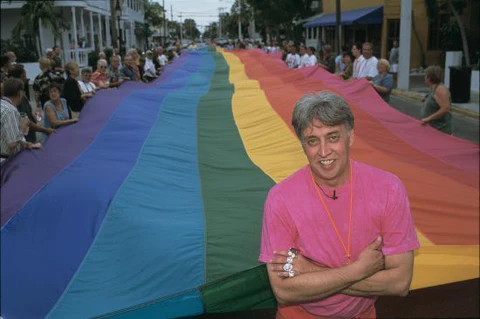
In 1994, he created a mile-long rainbow flag for the 25th anniversary of Stonewall, carried by thousands through New York City. When the Giuliani administration refused a permit for the traditional Fifth Avenue route and a federal court upheld the denial, Baker cut sections from the flag after its First Avenue unfurling, and paraders smuggled them crosstown so the unpermitted Fifth Avenue march coming up from Stonewall could carry the rainbow anyway. [25] In 2003, for the flag's 25th anniversary, he created a 1.25-mile flag stretching sea to sea from the Gulf of Mexico to the Atlantic [24] along Key West's Duval Street, restored to its original eight colors and unfurled on June 15, 2003. [22] About 3,000 volunteers helped unfurl it. In 2015, MoMA acquired examples of the rainbow flag for its permanent design collection, where curators placed it alongside the Creative Commons logo and the recycling symbol. [24][26] On June 9, 2016, Baker was invited to the White House for a reception marking LGBT Pride Month, and personally presented President Obama with a hand-dyed cotton rainbow flag. [24] The flag is held by the Barack Obama Presidential Library, which records Baker as its maker and gifter and dates the object itself to 2013. [27]
Sources variously date Baker's move to New York City to late 1993 or 1994. From 2001 until his death in 2017, he lived at 546 West 150th Street in Harlem. [28]
For decades, Baker alone was credited with creating the flag. Many sources support that it was a three-person collaborative creation between Baker, textile artist Lynn Segerblom, and James McNamara. McNamara died of AIDS in 1999 and received no recognition. Segerblom was more widely acknowledged for her role after Baker's death brought a resurgence of attention to the flag's origin. [17][23][11]
In March 2017, weeks before his death, he created a nine-stripe version adding a lavender stripe to symbolize diversity in response to Trump's election, producing 39 flags for the flag's 39th anniversary. [9] This is an important moment for the canon of pride flags, as many have rejected additions to the flags design over time. Baker, considered the author of the beloved original rainbow design, cosigned the practice of revision himself before passing.
He was found dead at his New York home on March 31, 2017. The medical examiner attributed the death to hypertensive and atherosclerotic cardiovascular disease. He was 65. Cleve Jones, confirming the death, noted Baker had a stroke several years earlier but had not recently been ill. [9]
He deliberately chose not to trademark the flag. San Francisco renamed a portion of the intersection at Market and Castro as Gilbert Baker Way, and Google released a Doodle honoring him on June 2, 2017, the 66th anniversary of his birth. [8]
A flag is different from any other form of art. It’s not a painting, it’s not just cloth. It is the spirit of the movement.
We needed something that expressed us. The rainbow fit us. It’s from nature. It represents all the colors, all the races, all the genders. It’s the rainbow of humanity.
I’d give anything to have been there when they ran those flags up that flagpole. I felt so proud.
A flag translates into everything, from tacky souvenirs to the names of organizations and the way that flags function. I knew instantly when I saw the reaction that it was going to be something. I didn't know what or how or — but I knew. (2008 oral history, quoted in his NYT obituary) [9]
[On the pink triangle:] It was put on us by the Nazis and it really did function as a symbol for our movement and our 'liberation', but it wasn't from us. (2008 KU oral history) [10]
I was certainly keenly aware of flags because of the bicentennial in 1976 and this huge wave of American flags that just washed over the country... And I thought, Maybe we could have a flag too because we're a people. (2008 KU oral history) [10]
I don't have a patent or a copyright, so all those dollars slid away. But it belongs to everybody. (2008 KU oral history) [10]
I'm just this guy from Kansas that had the stroke of luck to be the one to make the flag, and as I say sort of pulled the sword from a stone. (2008 KU oral history) [10]
We were all in a swirl of color and light. It was like a rainbow. A rainbow. That's the moment when I knew exactly what kind of flag I would make. (Rainbow Warrior, ch. 5, via the Gilbert Baker Foundation) [6]
I thought a gay nation should have a flag too, to proclaim its own idea of power. (Rainbow Warrior, ch. 5, via the Gilbert Baker Foundation) [6]
All sexes, all genders, all races, all ages. It's the Rainbow of Humanity. (via the Gilbert Baker Foundation) [29]
Motivations
- To replace the pink triangle, which was rooted in Nazi persecution, with a positive, self-created symbol [30][12]
- To create a universal symbol that belonged to the entire LGBTQ community, not any single organization [8]
- To honor Harvey Milk’s call for visible symbols of gay pride and political presence [31][30][8]
Stated inspirations
- The rainbow as a naturally occurring symbol of diversity and hope[8][30]
- The Rolling Stones' 'She's a Rainbow' and 1960s counterculture, Baker's own stated frame of reference for the rainbow motif[12]
- The 1976 American Bicentennial's 'huge wave of American flags,' which set him looking at flags 'with a new eye,' his own stated account, independently matching the Estate's Bicentennial narrative[10][6][7]
- The American flag and the French revolutionary tricolor, flags born of riot, rebellion, and revolution, with 'the same power of belonging'[6][8]
Broader influences
- Judy Garland's 'Over the Rainbow' is widely speculated to have inspired the flag, but Baker himself deflected this: 'I come from the '60s, so [the flag's] more about the Rolling Stones and their song “She's a Rainbow” … But, I get the Garland thing, and being from Kansas, I double get it' (2008 New York Blade interview, carried by Wikipedia)[12]
- The counterculture movement’s embrace of color, psychedelia, and visual spectacle
- San Francisco’s artistic and activist communities in the late 1970s
Lynn Segerblom
Co-Designer & Dye Artist
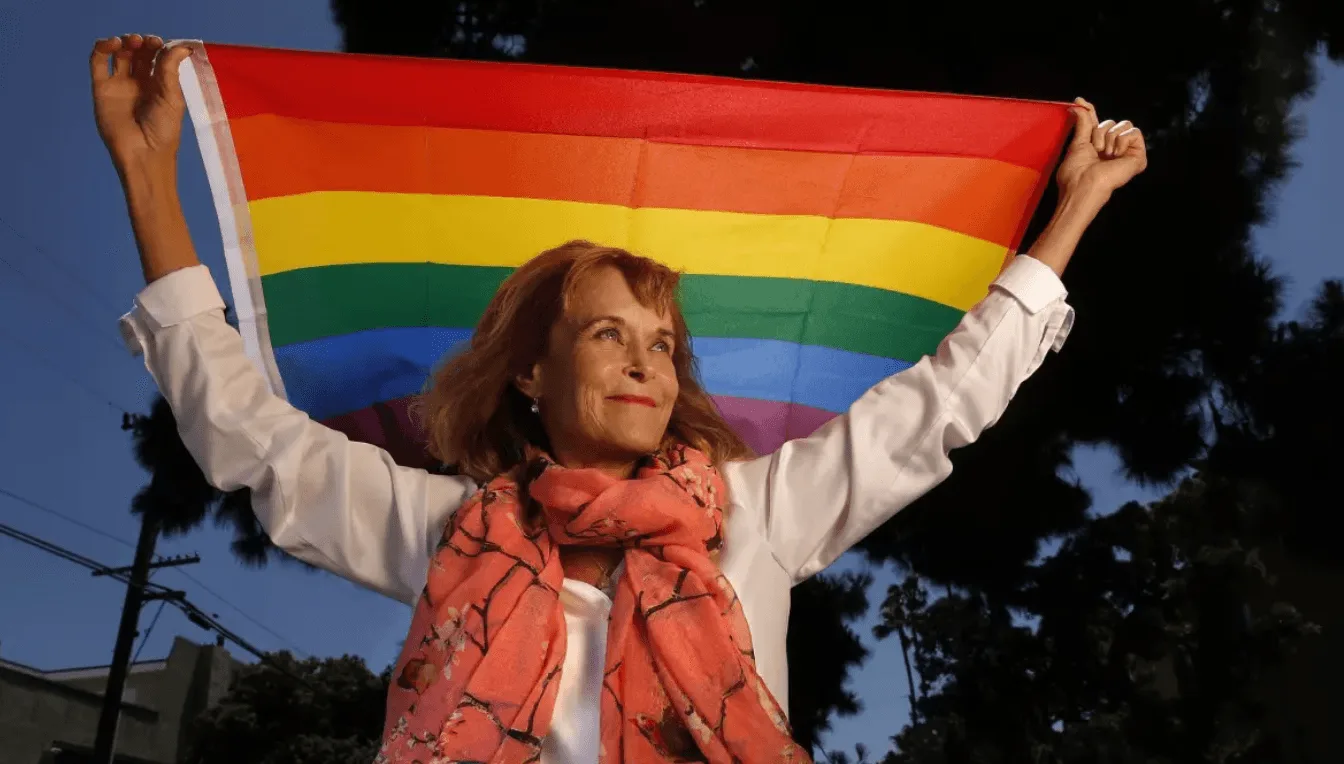
Lynn Segerblom (also known as Faerie Argyle Rainbow) is identified by multiple sources as heterosexual, 'the straight woman who co-created the rainbow flag.' [23][32] In the '70s she was a textile artist, originally from the North Shore of Hawaii, who moved to San Francisco at eighteen and attended the Academy of Art on a summer scholarship she won twice. [17] She had taught herself to dye and hand-paint fabrics in high school, experimenting with dyes, paints, wax, gutta resist, rubber bands, and woodblocks.
By 1977, she was known in San Francisco as 'the rainbow artist,' designing clothes for Capezio's and dyeing yards of silk for fashion designer Lea Ditson. She took the name from Bethany, the Princess of Argyle, who ran a children's theatre group she joined at eighteen and who named her Faerie; she added Argyle for Bethany and Rainbow for herself. She obtained a driver's licence in that name by writing it on the form rather than through any legal change, and returned to her given name around 1980 or 1981. [17]
She was a member of the Angels of Light, a free performance art troupe whose members adopted alternative lifestyles and denied personal credit for their work. Baker knew her from the troupe, and said he called her when he wanted an organic dye process because she 'was the queen of tie-dye.' [26] In February 1978, months before the June parade where the first flags were unveiled, she designed rainbow costumes for an Angels of Light show.
Clinical psychologist Paul Langlotz, who knew the group, later said: 'My assumption had always been, since Lynn's name was Faerie Argyle Rainbow, that the rainbow idea for the flags came out of her nom de plume.' Langlotz has been quoted stating that Segerblom 'literally did the dying of the fabric' and 'came up with the idea,' wording attributed to LGBTQ History Project interviews. [11]
Segerblom served as co-chair of the Decorating Committee for the 1978 Gay Freedom Day parade alongside Baker. [17][23] She developed the dyeing process, concocted all of the color formulas for the dye, provided a crash course in proper dye temperature and fabric agitation, supervised transporting the dyed fabric to a nearby laundromat for rinsing, and did all the dyeing, cutting, ironing, and pinning. [33][23][17]
For decades, Baker alone was credited with creating the flag. Segerblom contends it was a three-person collaborative creation: herself, Baker, and James McNamara, a trained fashion designer who taught Baker to sew and who sewed all the flag strips together. McNamara died of AIDS in 1999 and received no recognition. Writer Adrian Brooks argued: 'Gilbert didn't conceive or design the 1978 flags, his accomplishment lies in transforming what began as local parade decorations into a global icon. But the ubiquitous flags he popularized so brilliantly were his own six-stripe variants of Lynn's original eight-stripe designs.' [11]
The Gilbert Baker Estate called Segerblom's claims of co-creator status 'erroneous' but acknowledged that Baker 'fully honors her contribution in his memoir, Rainbow Warrior'; in a March 2019 letter to Pride LA, the Estate stated that she 'coordinated the dyeing process for the fabrics, while James assisted in sewing the flags,' and maintained Baker as sole designer and creator. [7]
Photographer Dan Nicoletta offered a more balanced view: 'She is identifying something that has eroded over the course of the story.' [17] In June 2024, CBS News featured Segerblom nationally as a 'hidden figure' behind the iconic rainbow flag, bringing her story to a mainstream audience. [32] Additional coverage appeared in the Los Angeles Blade [34] and Metrosource. [35]
James McNamara and I were just written out of the history of the rainbow flag, when — to be perfectly honest — if it wasn't for James's expertise in sewing and patterning, those flags would have never been completed in time. [17]
The color of the rainbow scheme — I came up with that, but whatever. We can say all three of us came up with it. [17]
There were no rainbow flags that year in '77. We brought it in. That was the first. [17]
Those were very large heavy flags. There's no way one person could even carry one of those much less make one all by themselves. [4]
They're a pair. That's why I didn't want them to look exactly the same... On one flag, pink is at the bottom, and purple is at the top... the other one, I flipped it upside down. That's intentional. I wanted to have them be different. [11]
I just wanted a touch of magic, a touch of glitter, a little bit of Angels of Light. [11]
Motivations
- To contribute her textile and dye expertise to a community art project she believed in
Stated inspirations
- Rainbows as her personal symbol since the mid-1970s, when she legally took the name Faerie Argyle Rainbow and used rainbow schemes in costumes and dyed work at 330 Grove from around 1976[17]
- Edgar Cayce's writings on color healing, which she read via her parents' books alongside the Bhagavad Gita[11]
Broader influences
- Natural dye traditions and textile craft techniques
James McNamara
Lead Seamster & Photographer
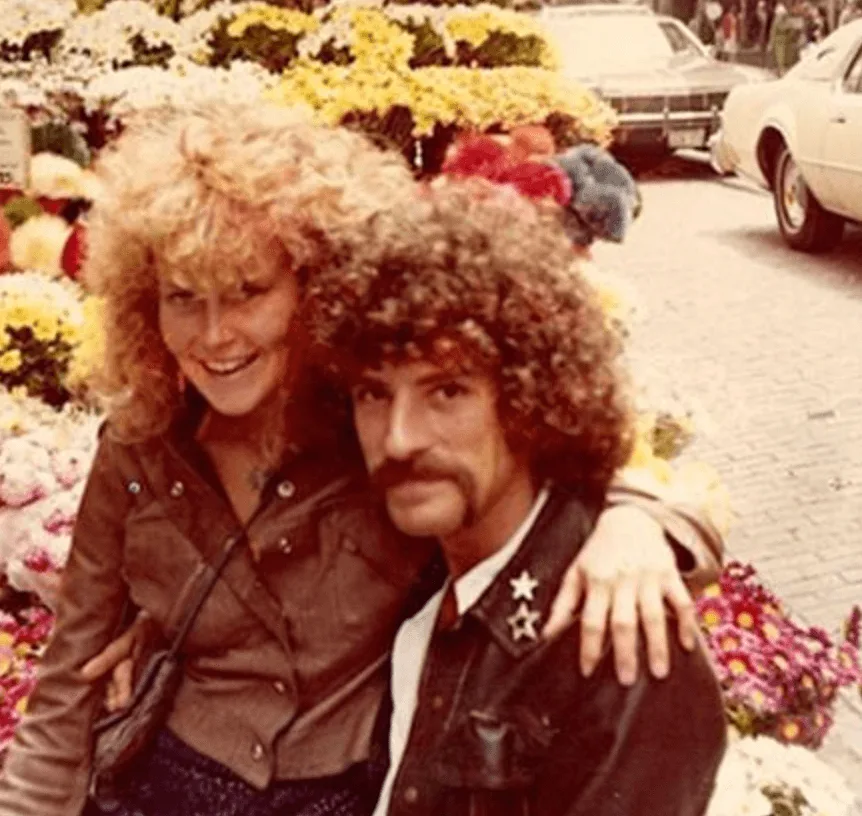
James 'Jimmy' McNamara was the lead seamster behind the original rainbow flags and Gilbert Baker's partner. [8][36] He studied costume design at the Fashion Institute of Technology (FIT) in New York City, honing the sewing skills he would later bring to the flag; his ultimate dream was to become a Broadway costume designer. [36]
During a six-week period in the spring and summer of 1978, at the San Francisco Gay Community Center, he sewed together the many hand-dyed muslin strips Lynn Segerblom had colored, and he is credited with teaching Baker how to sew. [17][36] McNamara was also a photographer: he captured high-quality photographs of the flag's creation and its first flight at the United Nations Plaza, images that remain with the GLBT Historical Society Archives. [36]
Though based in San Francisco in this period, he had deep roots on the East End of Long Island, spending childhood and adult summers in the Sag Harbor and North Haven area, which his cousin Dedi McNamara described as a refuge where he felt accepted. [36] His childhood friend Paul Langlotz places their shared origins in New Jersey ('We had always been outcasts in our own culture in New Jersey'), and Segerblom likewise recalled that near the end of his life 'he went back to New Jersey. That's where he's from.' [17][11]
In 1994, Baker asked McNamara to help sew the Stonewall 25 mile-long flag; according to Langlotz he helped briefly, then quit, hurt at being cut out of the story of the 1978 originals. [11] He died in 1999 of pneumonia from complications of AIDS, in his early forties. [36]
Attribution
- Organization
- 1978 Gay Freedom Day Committee
Attribution notes
Listed as co-primary designers per Segerblom's own account and eyewitness testimony (Paul Langlotz, Adrian Brooks, Dan Nicoletta) that she conceived the rainbow dye concept and developed the entire dyeing process, not merely executed it. The Gilbert Baker Estate disputes co-creator status and maintains Baker as sole designer. Distinct from the three principal creators, the 1978 production drew on a wider circle of helpers, among them Glenne McElhinney, Joe Duran, and Paul Langlotz [2][3], with Robert Guttman also pictured helping raise the flags [17][4], alongside roughly thirty volunteers. [18]
Origin
- Country
- United States
- Region / state
- California
- City
- San Francisco
- Specific Place
- Gay Community Center, 330 Grove Street
- Place Type
- community center
Created in San Francisco, California, on the unceded ancestral homeland of the Ramaytush Ohlone people. [37][38]
Indigenous land context
Ramaytush Ohlone — unceded ancestral homeland (Indigenous name: Ramaytush). The Ramaytush Ohlone are the original peoples of the San Francisco Peninsula; the land now comprising the City and County of San Francisco is Yelamu, home of the Yelamu tribe of the Ramaytush Ohlone. [39] [40] [37] Before the Spanish arrived in 1769 they numbered roughly 1,500 to 2,000 people in ten small tribal groups; by the end of the Mission Period only a few families survived, and the four family lineages documented today all descend from one survivor of the colonization of San Francisco, named Leandra. Those descendants comprise the membership of the Ramaytush Tribe and the staff of the Association of Ramaytush Ohlone. [39] [37] In the words adopted by San Francisco's own commissions, the Ramaytush Ohlone "have never ceded, lost, nor forgotten their responsibilities as the caretakers of this place" [41] [40] and "are not a mythical population of the past, but an integral and active community in the present San Francisco Bay Area region." [40]
Colonial / settler context
The flag was sewn at the Gay Community Center at 330 Grove Street [16] [17] and first flown at United Nations Plaza on June 25, 1978, [12] [42] on land that was never ceded: no treaty of cession exists for the San Francisco Peninsula. [41] [40] Spanish colonization and the mission system, beginning in 1769, dispossessed the Ramaytush Ohlone of this land. [39] [37]
- Land status
- Unceded (no treaty of cession exists)
- Indigenous engagement
- None documented
- Continuing presence
- The Ramaytush Ohlone remain present and active in the San Francisco Bay Area today, represented by the Association of Ramaytush Ohlone. [39]
The flag was made in San Francisco. The strips of fabric were hand-dyed in metal trash cans in the attic of the Gay Community Center, then sewn together on Baker's sewing machine.
Dates & Chronology
- Year Created
- Exact date
- May–June 1978 (six-week production following the May 1978 committee approval, completed for the June 25 debut)
- First public use
- Period in Use
- 1978–present (revived periodically; superseded commercially by 6-stripe version)
The two original flags were first flown at the San Francisco Gay Freedom Day Parade on June 25, 1978, hung from the flagpole at United Nations Plaza in the Civic Center. [12][8][42] Harvey Milk was present at the parade, five months before his assassination. [16]
On November 27, 1978, Milk and Mayor George Moscone were shot and killed inside San Francisco City Hall by Dan White, a former fellow supervisor. Milk was shot five times, including twice in the head. [12][8] On May 21, 1979, White was convicted of voluntary manslaughter rather than first-degree murder, largely through the defense strategy known as the 'Twinkie defense.' Thousands rioted in the streets on what became known as the White Night riots. [12]
The assassination dramatically increased demand for the rainbow flag as a symbol of community solidarity and defiance. [8][16] Baker approached the Paramount Flag Company in San Francisco to mass-produce it, but the hot pink fabric could not be sourced commercially, so the top stripe was dropped, yielding a seven-stripe version. [12][8]
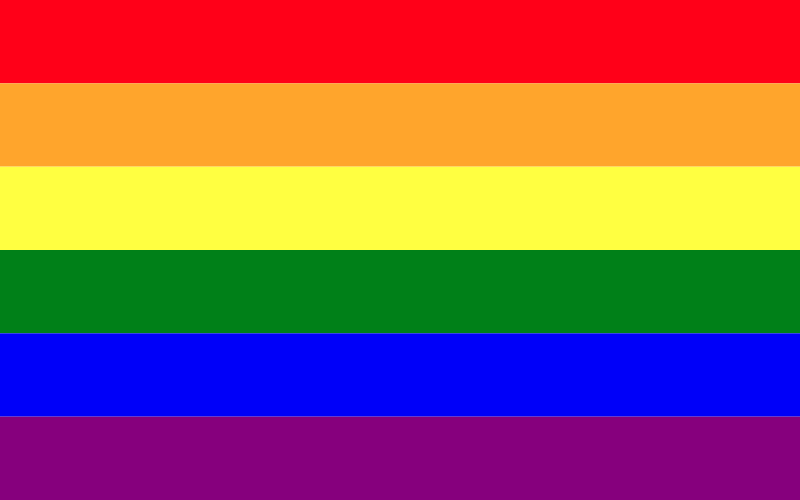
For the 1979 Gay Freedom Day Parade, organizers wanted to hang the flag vertically from lampposts along Market Street; an even number of stripes was needed to split it symmetrically on both sides of each pole. Baker and Paramount vice president Ken Hughes agreed to drop hot pink and turquoise and replace indigo with royal blue, creating the six-stripe version that became the commercial standard. [12][43] Jim Ferrigan, then a Paramount employee, recalled that in this period 'customers bought almost anything striped,' and that Buddhist, Sufi, Tibetan, and cooperativist flags all served as pride flags before the design standardized. [43] Baker always considered the six-stripe version the 'commercial version' and the eight-stripe the original. [8]
Major revisions
1978–1979
Hot pink stripe removed for mass production (fabric unavailable), yielding the 7-stripe transitional version. [12][8] Turquoise then removed and indigo replaced by royal blue for the 1979 parade, creating the 6-stripe standard. [12]
Baker revived the original 8-stripe design for the 25th anniversary, creating a mile-and-a-quarter-long rainbow flag in Key West, Florida. [8]
Baker added a lavender stripe for diversity, creating a 9-stripe update. [8]
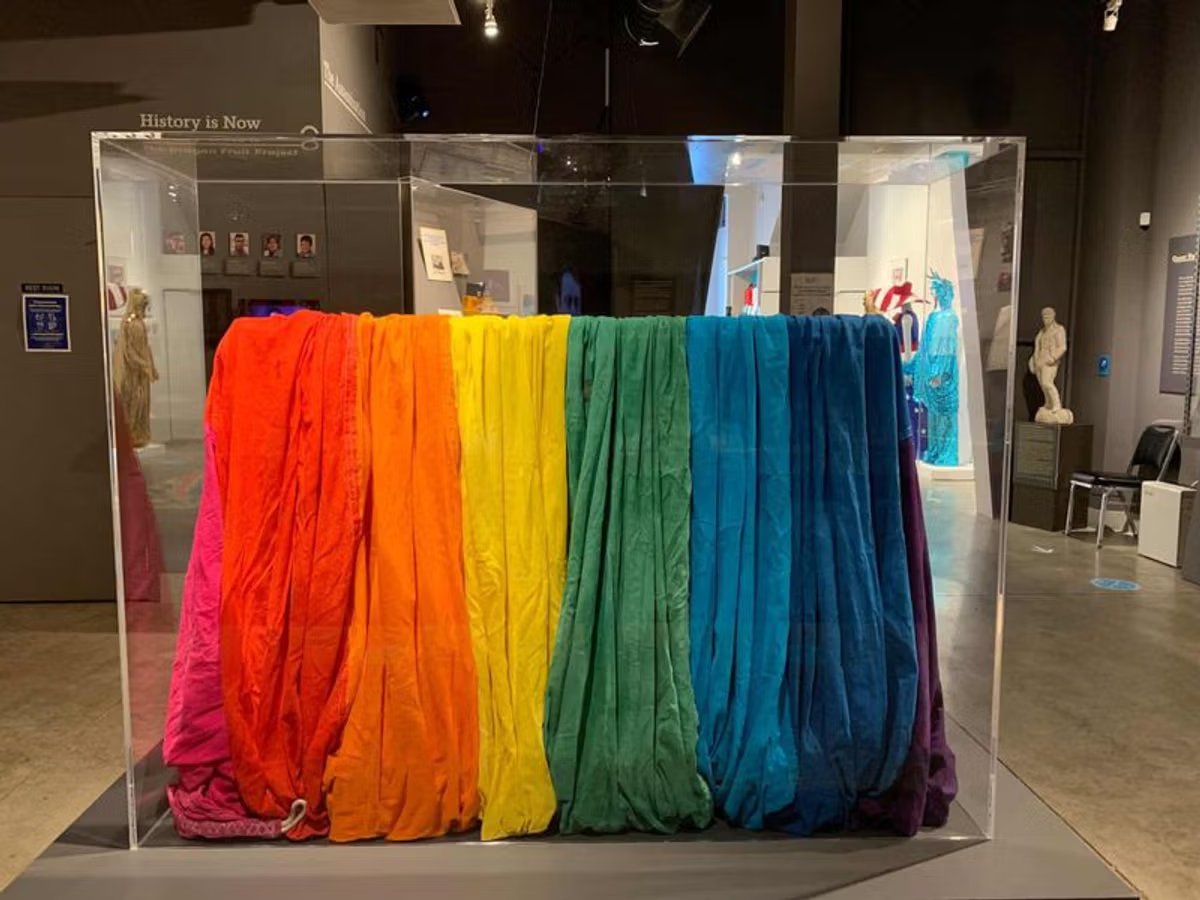
After the 1978 parade, the flags were stored at the Gay Community Center. One flag was stolen and never recovered. The other sustained water damage: Baker found it badly mildewed from a leaky roof and salvaged a roughly ten-by-twenty-eight-foot section, which he kept for decades. [18]
Accounts of the flags' disappearance conflict. Segerblom recalls Baker announcing that both large flags had been stolen, and notes that moving even one required two or three people and a vehicle. Baker's memoir instead suggests the stars-and-stripes flag was stolen from the front of the Gay Community Center around the 1979 parade, possibly by a construction crew working across the street, and describes a struggle over the rainbow flags at the Civic Center takedown. Photographs and video from 1979 show both designs still flying that year. The LGBTQ History Project records that the surviving section later surfaced from Baker's own storage, having been 'quietly rescued' after water damage. [11]
When Baker died in March 2017, his possessions were shipped to his sister Ardonna Baker Cook, and the fragment sat in boxes in her garage. In 2019, Charles 'Charley' Beal, president of the Gilbert Baker Foundation, called Baker's sister looking for a large flag for the Stonewall 50 parade in New York City, and she sent him a big box from the garage. The Foundation carried the fragment in the Stonewall 50 parade without recognizing it as one of the 1978 originals, then Beal folded it up and stored it in his Greenwich Village apartment.
Later that August, vexillologist James Ferrigan, who had worked with Baker at Paramount Flag Company in the late 1970s, contacted Beal and asked about the fragment, which Ferrigan had last seen in Baker's San Francisco apartment in the early 1980s. When Ferrigan described it, Beal realized the fragment was the piece in his closet. In February 2020, Ferrigan inspected the piece in Beal's hotel room and identified Paramount stitching and grommet hardware, declaring it without doubt the original. He prepared a formal vexillological report confirming provenance. GLBT Historical Society executive director Terry Beswick then traveled to New York and personally carried the flag back to San Francisco, packed in a lavender suitcase. [18]
In April 2021, the fragment was donated to the GLBT Historical Society and permanently installed as part of the exhibition 'Performance, Protest and Politics: The Art of Gilbert Baker.' Its colors are described as 'as vibrant as ever,' and it is shown in a glass case. The GLBT Historical Society calls it 'the only known surviving remnant of the two inaugural rainbow flags.' [18][2] The Society also holds one of the sewing machines Baker used.
In 2015, MoMA acquired Baker's rainbow flag for its permanent design collection as a 'Gift of the designer,' ranking the design alongside the Creative Commons logo and the recycling symbol as an internationally recognized design object. MoMA describes the flag it holds, object 728.2015, as 'the contemporary, mass-produced version' (nylon, 36 by 60 inches), not one of the original 1978 hand-dyed cotton flags; its record enters it as a gift of the designer and credits Lynn Segerblom and James McNamara as fabricators. [8][3][44]
Anomalous eight-striped flags (red, orange, yellow-orange, yellow, green, light blue, dark blue, purple) were photographed at San Francisco Pride events between 1980 and 1986: flag makers remembered the original's stripe count but matched a natural rainbow rather than Baker's colors. [43]
Lineage
- Indirect influences
- Pace flag (Italian peace movement), Judy Garland's 'Over the Rainbow', Hippie movement / counterculture color symbolism
This is the earliest design in the Baker-Segerblom rainbow family. It leads directly to the seven-stripe transitional version and to Baker's nine-stripe lavender update of 2017, and to the traditional six-stripe standard as a grandchild through the seven-stripe.
Lineage tree
Every record reachable from this one through documented parent and child relationships: 77 records across 7 generations.
- This record
- Original Rainbow Flag (1978)
- Generation 3
- Rainbow Pride Flag
- Generation 4
- Heterosexual / Straight Pride Flag, Alberta Gay Flag, Argentina Gay Flag, Australia Gay Flag, Brazil Gay Flag, British Columbia Gay Flag, Chile Gay Flag, Dominican Republic Gay Flag, Egypt Gay Flag, European Union Gay Flag, France Gay Flag, India Gay Flag, Italy Gay Flag, Japan Gay Flag, Manitoba Gay Flag, Mexico Gay Flag, Netherlands Gay Flag, New Brunswick Gay Flag, Newfoundland Gay Flag, Northwest Territories Gay Flag, Nova Scotia Gay Flag, Nunavut Gay Flag, Ontario Gay Flag, Panama Gay Flag, Prince Edward Island Gay Flag, Quebec Gay Flag, Russia Gay Flag, Saskatchewan Gay Flag, Switzerland Gay Flag, Tanzania Gay Flag, Texas Rainbow Flag, Yukon Territory Gay Flag, South African Gay Pride Flag, Rainbow Polish Flag (2014, Angela Getler), Heteroflexible Pride Flag, Homoflexible Pride Flag, Philadelphia Pride Flag, Social Justice Pride Flag, Anarcha-Queer Flag (rainbow variant), Canadian Pride Flag, Chicago Pride Flag (Rainbow Stripes, Purple Stars), Gay Pride Flag of Pakistan, Jewish Gay Pride Flag, Palestinian Gay Pride Flag, Rainbow Flag with White Triangle (Sapporo), Rainbow Israel Flag, Turkish Gay Pride Flag, Two-Spirit Pride Flag (2016 Tumblr documentation), Victory Over AIDS Flag (1980s, designer unknown)
- Generation 5
- Two-Spirit Pride Flag (2005, Zoccole), Orange-Pink Lesbian Precursor (2017), Progress Pride Flag, Straight Ally Pride Flag, Two-Spirit Transgender Pride Flag
- Generation 6
- Asexual Ally Flag, Bisexual Ally Flag, Indigiqueer / Two-Spirit Flag (cedar-maw), Intersex-Inclusive Pride Flag, Inclusive Diversity Pride Flag (TransIphis, 2022), Two-Spirit Progress Pride Flag, Utopian Pride Flag #6 (2040 Progress Flag), Gay Mspec Gay Ally Flag, Gay Turigirl Ally Flag, Lesbian Lesboy Ally Flag, Lesbian Mspec Lesbian Ally Flag, Sego Belonging Flag, Jewish Progress Pride Flag (Keshet), Straight Ally Flag (vaultausir), Trans Ally Flag
Colors & Symbolism
Baker conceived the rainbow as a natural symbol of pride, visibility, collective identity, diversity, unity, and hope. Each of the eight stripes carried a specific meaning. Baker's own term for the design was a 'Rainbow of Humanity' spanning all races, genders, sexualities, and ages, in which Queer life is a full spectrum of bodily, emotional, creative, natural, and spiritual experience rather than a single issue. [29]
| Swatch | Hex | Baker's swatch | Baker's | Colour | Meaning |
|---|---|---|---|---|---|
#FF69B4 | #D6006EPantone 225C [29] | Hot Pink | Sex / Sexuality | ||
#FF0000 | #E4002BPantone 185C [29] | Red | Life | ||
#FF8E00 | #FE5000Pantone 021C [29] | Orange | Healing | ||
#FFFF00 | #FFCD00Pantone 122C [29] | Yellow | Sun / Sunlight | ||
#008E00 | #00843DPantone 348C [29] | Green | Nature | ||
#00C0C0 | #009AA6Pantone 3135C [29] | Turquoise | Art / Magic & Art | ||
#400098 | #003DA5Pantone 293C [29] | Indigo | Serenity / Harmony | ||
#8E008E | #A634B2Pantone 2593C [29] | Violet | Spirit |
Wikimedia Commons File:Gay_flag_8.svg [45]
Wording varies across sources. 'Sex' versus 'sexuality,' 'sun' versus 'sunlight,' 'magic & art' versus the singular 'art.' The NYT obituary gives a further variant, with 'blue for peace' where most sources give serenity or harmony. [9] The Gilbert Baker Foundation publishes an expanded gloss for each stripe, pairing the one-word meaning with a keyword triplet: pink/sex (desire, pleasure), red/life (survival, being, vitality), orange/healing (recovery, care, resilience), yellow/sunlight (openness, joy, visibility), green/nature (growth, earth, belonging), turquoise/magic and art (imagination, invention, transformation), indigo/serenity (calm, depth, inner dignity), violet/spirit (memory, transcendence, soul). This is the stewarding body's wording rather than a contemporaneous 1978 document, and it resolves several of the variants: 'serenity' for indigo rather than the obituary's 'peace,' and 'magic & art' rather than mononymous 'art' alone. [29]
The displayed reconstruction follows the Wikimedia Commons SVG (File:Gay_flag_8.svg, 600×400 px), the source of the eight hex values recorded here. [45] The original 1978 flags were hand-dyed, so their exact color values varied and correspond to no standardized digital palette, and no creator-issued official palette is documented. The Commons values are a community-consensus digital convention rather than a creator specification. A separate, creator-linked specification also exists: the Gilbert Baker Foundation states that Baker himself used the Pantone matching system to fix the exact colors of the eight-color flag before his death, and the Foundation has translated those Pantone selections into RGB, CMYK, and HEX (hot pink Pantone 225C, red 185C, orange 021C, yellow 122C, green 348C, turquoise 3135C, indigo 293C, violet 2593C, listed per stripe in the color table). [29] The Foundation values differ markedly from the Commons rendering: the Foundation's red is a crimson (#E4002B) rather than a pure primary, its yellow a gold (#FFCD00), and its indigo a strong blue (#003DA5) rather than a violet-leaning indigo. The two sets differ in kind, the Commons palette a digital community convention and the Pantone values descending from the designer. Two Foundation rows are internally inconsistent as published, with hot pink and yellow each listing an RGB triplet that does not match its own stated HEX. The displayed reconstruction displays the Commons values on the left, and the creator-linked Foundation values on the right.
Design
- Aspect Ratio
- Not standardized
- Ratio Notes
- No creator-issued aspect ratio is documented for this design. The two monumental 1978 flags measured roughly 30 feet by 60 feet, about 1:2, sized for the United Nations Plaza flagpoles rather than to a fixed design ratio; Segerblom has recalled them as larger. [1][2][3][4][5] Any 3:5 rendering shown here is a modern reconstruction and display convention, not a specification of the original.
- Orientation
- horizontal
- Stripe Count
- 8
- Layout
- horizontal stripes
- Stripes (Top → Bottom)
- Hot Pink, Red, Orange, Yellow, Green, Turquoise, Indigo, Violet
The two original 1978 flags were each roughly 30 feet high by 60 feet wide, about a 1:2 proportion, sized as monumental banners for the United Nations Plaza flagpoles rather than to a fixed design ratio. Co-creator Lynn Segerblom has recalled them as larger, at 40 by 50 feet, in the same interview whose introduction gives 30 by 60. [17] [1][2][3][4] The displayed 3:5 ratio is a reconstruction convention drawn from standard vexillological practice, not a creator-issued specification.
Eight horizontal stripes of equal width, ordered top-to-bottom: hot pink, red, orange, yellow, green, turquoise, indigo, violet. No emblems, symbols, or additional markings. [46] The original flags were hand-dyed in metal trash cans. Segerblom describes the dyes as nontoxic Procion fiber-reactive dyes for natural fibers (salt and soda ash added, constant agitation), rather than 'natural dyes' as sometimes reported. [11] Each color strip was dyed separately, then the strips were sewn together on a sewing machine. [8]
Usage & Adoption
- First Users
- San Francisco Gay Freedom Day Parade (1978)
- Organizations
- GLBT Historical Society, Museum of Modern Art (MoMA)
- Geographic Usage
- Worldwide
- Event Usage
- San Francisco Gay Freedom Day Parade (1978), Key West 25th Anniversary Flag (2003)
- Current Status
- revived
The eight-stripe design is the original 1978 Pride flag and the foundation of the rainbow flag family. [31][8] The six-stripe version became the commercial standard, while the eight-stripe original has been revived periodically and remains distinct from that later commercial form.
Image Archive
The Original Flags (1978)
The Designer, Later Years
Reproductions & Museum Holdings
Discourse & Debates
- Debate over whether the flag adequately represents all identities within the LGBTQ+ spectrum
- Whether Lynn Segerblom should be recognized as a co-creator of the rainbow flag or solely as a dye-process contributor. Multiple sources and eyewitnesses, including Adrian Brooks, Paul Langlotz, and Dan Nicoletta, describe her role as central to the flag's physical production, and some, including Langlotz, attribute conceptual input to her, with Langlotz saying she 'came up with the idea.' The Gilbert Baker Estate rejects co-creator status and identifies Baker as the sole designer, while Segerblom's own account describes a three-person collaboration with Baker and James McNamara, whose sewing and production role is separately documented. [17][23][7][11]
- The involvement of a heterosexual woman in creating one of the most widely recognized Queer symbols has itself drawn attention. Segerblom's story gained national visibility through CBS News in June 2024, prompting renewed discussion about collaborative credit in the rainbow flag's creation. [23][32]
- Whether financial incentives affected the attribution over time. Segerblom does not believe Baker acted maliciously but has suggested the story shifted once it became lucrative, recalling that he was 'offered money to confirm the rainbow flags and that was just it. He couldn't resist.' The Gilbert Baker Estate's Charley Beal disputes that reading, saying Baker 'never claimed to have made them himself' and calling Segerblom and McNamara 'heroes' who 'helped create a universal symbol.' [17]
- The Estate's fuller origin account: in its March 2019 letter, the Estate states that Milk asked Baker for a new community symbol in 1977; that Baker, inspired by the proliferation of American flags during the 1976 Bicentennial, decided the symbol should take the form of a flag; and that he conceived the rainbow concept while out dancing with his friend Cleve Jones, observing the diversity of the dancers around them. The letter further asserts that Segerblom's 'narrative continues to change,' that she has used her claims to solicit funding for a documentary and a book, and that the Estate holds 'voluminous archival records from 1978' refuting her allegations. These are the Estate's characterizations; Segerblom has given a different account of both the flag's conception and her role. [7]
- An alternative origin account: at a NAVA conference, former Paramount employee Steve Tyson presented the flag as having grown out of decorative flags he made from Paramount scrap material, later adopted by the community. The claim is reported on FOTW but is not corroborated by any participant account of the 1978 production. [43]
Common misidentifications
- The Pace flag (Italian peace flag) uses similar rainbow colors but in reverse order and is unrelated to LGBTQ+ pride [12]
- The Cusco flag of Peru also uses rainbow stripes but is unrelated to Baker’s design [12]
Criticisms
- Lynn Segerblom's contribution to the original production was absent from most accounts of the flag's creation until historians revisited the story after Baker's death in 2017. Segerblom developed the dye process used to color the fabric. [16]
- The rainbow's framing as a symbol for the whole LGBTQ community has been challenged by communities who felt underrepresented by it. The Philadelphia Pride Flag (2017) and Progress Pride Flag (2018) added stripes for people of color and trans people in response to that critique. [16]
Footnotes & Citations
Sources and footnotes 51 sources
- 1. Museums & Exhibitions A Legacy of Pride: Gilbert Baker and the 40th Anniversary of the Rainbow Flag. SFO Museum. Accessed 2026-07-22
- 2. Museums & Exhibitions The Original Rainbow Flag. GLBT Historical Society via Google Arts & Culture. Accessed 2026-07-22
- 3. Articles & Reports Original 1978 rainbow flag designed by Gilbert Baker acquired by San Francisco's GLBT Historical Society. The Art Newspaper (2021-06-17). Accessed 2026-07-22
- 4. Articles & Reports Artist Who Helped Make Iconic Flag to Appear in Pride Parade. Shia Levitt. KQED (2018-06-23). Accessed 2026-07-25
- 5. Government Gilbert Baker. National Park Service. Accessed 2026-08-08
Documents the two monumental 1978 flags as approximately 60 by 30 feet.
- 6. Organizations Rainbow Flag: Origin story. Gilbert Baker (memoir excerpts); Gilbert Baker Foundation. Gilbert Baker Foundation. Accessed 2026-07-25
- 7. Articles & Reports Letter to the Editor: False Claims of Rainbow Flag Creator. Gilbert Baker Estate. Pride LA (2019-03-26). Accessed 2026-07-24
- 8. Encyclopedias & Reference Gilbert Baker (artist). Wikipedia. Accessed 2026-07-24
- 9. Articles & Reports Gilbert Baker, Gay Activist Who Created the Rainbow Flag, Dies at 65. Matthew Haag. The New York Times (2017-03-31). Accessed 2026-07-25
- 10. Oral history Gilbert Baker Oral History (Under the Rainbow: Oral Histories of GLBTIQ People in Kansas). Gilbert Baker, interviewed by Tami Albin. University of Kansas Libraries / KU ScholarWorks (2008-06-19). Accessed 2026-07-25
A nineteen-page transcript of an interview conducted on 19 June 2008 by Tami Albin, for Under the Rainbow: Oral Histories of GLBTIQ People in Kansas. Baker in his own words.
- 11. Oral history Rainbow Flag. August Bernadicou (ed.). LGBTQ History Project (2024-06-10 (updated 2025-02-17)). Accessed 2026-07-25
An oral history assembling several participants’ accounts, which conflict with one another and with Baker’s memoir on the flags’ fate. The page was updated in 2025.
- 12. Encyclopedias & Reference Rainbow flag (LGBTQ). Wikipedia. Accessed 2026-07-24
- 13. Museums & Exhibitions Paragraph 175 and the Nazi Campaign against Homosexuality. United States Holocaust Memorial Museum, Holocaust Encyclopedia. Accessed 2026-08-07
Conviction totals under Paragraph 175 may count the same person more than once.
- 14. Museums & Exhibitions Paragraph 175 — convictions under the amended statute (lesson, unit 4). Auschwitz-Birkenau State Museum, International Center for Education about Auschwitz and the Holocaust. Accessed 2026-08-08
Gives annual conviction counts of 8,271 (1937), 8,562 (1938) and 7,614 (1939), totalling 24,447. These are convictions, not distinct individuals.
- 15. Reference Rainbow Warrior: My Life in Color. Gilbert Baker. Chicago Review Press (2019). Accessed 2026-03-15 [no stable URL]
- 16. Museums & Exhibitions Performance, Protest and Politics: The Art of Gilbert Baker. GLBT Historical Society. Accessed 2026-03-15
- 17. Articles & Reports Herstory: Meet Lynn Segerblom, One of the Creators of the Original 1978 Rainbow Flag. WeHo Times. Accessed 2026-03-15
- 18. Articles & Reports Long-Lost Fragment of the Original 1978 Rainbow Flag Resurfaces in San Francisco. Nora McGreevy. Smithsonian Magazine (2021-06-16). Accessed 2026-07-25
- 19. Encyclopedias & Reference Harvey Milk. Wikipedia. Accessed 2026-08-07
- 20. Articles & Reports Meet The Man Who Created The Rainbow Flag. Ben Reininga. Refinery29 (2015-06-25). Accessed 2026-08-09
- 21. Archived Sources SISTER CHANEL 2001 Softball Game, Nov 1981. Jean-Baptiste Carhaix (photographer). GLBT Historical Society, via Calisphere (1981). Accessed 2026-08-09
From the Carhaix Papers, a series photographing early members of the Sisters of Perpetual Indulgence.
- 22. Articles & Reports A Brief History of the Rainbow Flag. San Francisco Travel Association. Accessed 2026-08-09
A destination-marketing history. The 'how action could create change' phrase is the writer's, not a quotation attributed to Baker.
- 23. Articles & Reports Lynn Segerblom: The Straight Woman Who Co-Created the Rainbow Flag. Adelante Magazine. Accessed 2026-03-18
- 24. Organizations About Gilbert Baker: Creator of the Rainbow Flag. Gilbert Baker Foundation. Accessed 2026-08-08
The estate's own biography. Authoritative on Baker's career, and the stewarding body's account rather than an independent one.
- 25. Articles & Reports The Mile-Long Rainbow Flag. Warren Boyd Wexler. Fire Island News (2023-06-09). Accessed 2026-07-25
- 26. Museums & Exhibitions Flashback to 2015: MoMA Acquires the Rainbow Flag. Michelle Millar Fisher and Paola Antonelli. MoMA Magazine (2015-06-17 (reprinted 2023-06-02)). Accessed 2026-08-09
An interview with Baker recorded for the MoMA Archives, so his account here is firsthand.
- 27. Archived Sources Rainbow LGBT Flag (artifact DO.120042). Barack Obama Presidential Library, National Archives and Records Administration. Accessed 2026-08-09
Records Baker as both artist and gifter and Obama as intended recipient, and dates the flag 2013; it does not give the presentation date. Rights are marked possibly restricted.
- 28. Organizations Gilbert Baker / Raise the Rainbow Workshop. NYC LGBT Historic Sites Project. Accessed 2026-08-08
Documents Baker's residence at 546 West 150th Street from 2001 until his death in 2017.
- 29. Organizations Colors of the Rainbow Flag / Rainbow Flag: Color Meanings. Gilbert Baker Foundation. gilbertbaker.com. Accessed 2026-07-26
- 30. Articles & Reports Pride Flag Guide. University of Colorado Boulder. Accessed 2026-03-08
- 31. Organizations Pride Flags. Human Rights Campaign. Accessed 2026-03-08
- 32. Articles & Reports Hidden figure behind the iconic rainbow flag. CBS News (2024-06). Accessed 2026-03-18
- 33. Articles & Reports Gilbert Baker may have designed the rainbow flag, but this woman made it happen. Gayle Pitman. LGBTQ Nation (2018-10-03). Accessed 2026-07-25
- 34. Articles & Reports The Woman Behind the Rainbow Flag. Los Angeles Blade (2018-03-02). Accessed 2026-03-18
- 35. Articles & Reports This Is the Mystery Girl Who Helped Create the Rainbow Flag. Metrosource. Accessed 2026-03-18
- 36. Articles & Reports The Man Who Sewed the Original Rainbow Pride Flag Had Deep Roots in Sag Harbor. Cailin Riley. Sag Harbor Express (27east) (2026-05-19). Accessed 2026-07-22
- 37. Organizations Ramaytush Ohlone Land Acknowledgment. American Indian Cultural District (with AICD board member Gregg Castro, Ramaytush Ohlone). American Indian Cultural District, San Francisco. Accessed 2026-07-26
- 38. Organizations Land Acknowledgement. Association of Ramaytush Ohlone. Accessed 2026-03-19
- 39. Tribal nation The Ramaytush Ohlone — Original Peoples of the San Francisco Peninsula. Association of Ramaytush Ohlone. Association of Ramaytush Ohlone. Accessed 2026-07-26
- 40. Government Resolution on Ramaytush Ohlone Land Acknowledgement. San Francisco Commission on the Environment. San Francisco Environment Department (2021-02-01). Accessed 2026-07-26
- 41. Government Ramaytush Ohlone Land Acknowledgment (Resolution 2021-01). San Francisco Public Library Commission. San Francisco Public Library (2021-04-15). Accessed 2026-07-26
- 42. Museums & Exhibitions The two original eight-color rainbow flags flying at United Nations Plaza during San Francisco Gay Freedom Day 1978. Mark Rennie. Gilbert Baker Foundation via Google Arts & Culture. Accessed 2026-07-22
- 43. Community History of the Gay Pride / Rainbow Flag. Flags of the World contributors (Steve Kramer, Jim Ferrigan, Christopher Pinette, Tomislav Todorović, et al.). Flags of the World (FOTW) / CRW Flags (last modified 2025-01-11). Accessed 2026-07-25
- 44. Museums & Exhibitions Gilbert Baker. Rainbow Flag. 1978. Museum of Modern Art. Accessed 2026-07-22
The museum’s own collection record for object 728.2015.
- 45. Databases File:Gay flag 8.svg. Vector graphics by Fibonacci; design credited to Gilbert Baker. Wikimedia Commons. Accessed 2026-07-24
The Wikimedia Commons reconstruction the eight-stripe hex values are taken from, 600 by 400 pixels. It is a community file, not a specification issued by the designer.
- 46. Databases Original Rainbow Flag. Library.LGBT (2021-06-11). Accessed 2026-07-26 · Archived version
An archived capture; the site went offline in July 2026. Published by Albany Pride, Western Australia; it names no author and cites no sources.
- Databases Rainbow flag (1978-06). Wikidata. Accessed 2026-03-08
- Articles & Reports Pride Flags and What They Mean. Outright International. Accessed 2026-03-08
- Articles & Reports How the rainbow became the symbol of gay pride. Los Angeles Times (2018-05-31). Accessed 2026-03-16
- Encyclopedias & Reference History of San Francisco. Wikipedia. Accessed 2026-03-19
- Organizations Ramaytush Territory. Association of Ramaytush Ohlone. Accessed 2026-03-19

Image Sources
- Rendering
- 1978 original
- The two original flags flying at United Nations Plaza on Gay Freedom Day, June 25, 1978, the eight-stripe rainbow flag and the stars-and-stripes variant (a 'rainbow version of the American flag') attributed to Lynn Segerblom. · Credit: Mark Rennie, courtesy of the Gilbert Baker Foundation · Google Arts & Culture / GLBT Historical Society
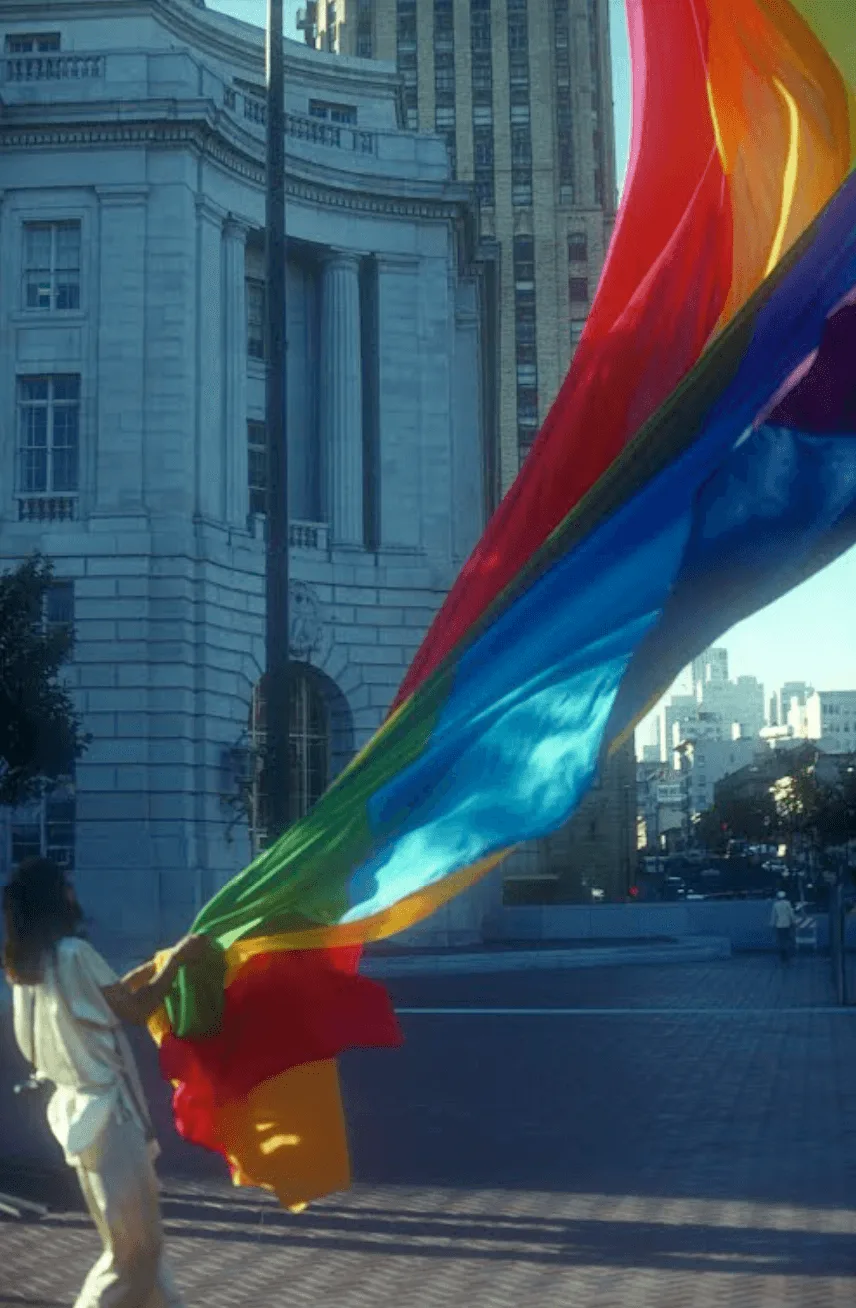
- One of the original eight-stripe rainbow flags in the wind at San Francisco's Civic Center, 1978. · Credit: James McNamara · GLBT Historical Society
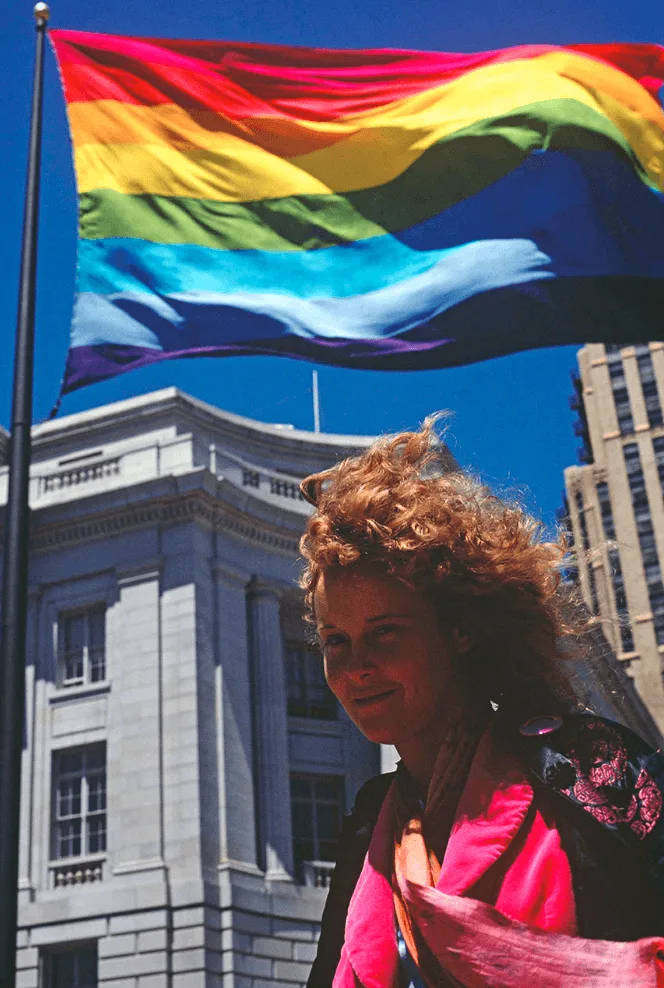
- Lynn Segerblom (Faerie Argyle Rainbow) with one of the original eight-color flags at United Nations Plaza, 1978. · Credit: James McNamara · KQED
- Gilbert Baker, Lynn Segerblom, and Robert Guttman with a volunteer, holding up one of the original rainbow flags, San Francisco, 1978. · Credit: James McNamara, courtesy of Paul Langlotz · WeHo Times
- Gilbert Baker with the mile-and-a-quarter '25 Rainbow Sea to Sea' flag on Duval Street, Key West, 2003, the 25th-anniversary flag, which restored the original eight colors. Identified by visual inference: all eight colors are present and the setting matches Key West. · Credit: Medium via Pridebyonestop.com
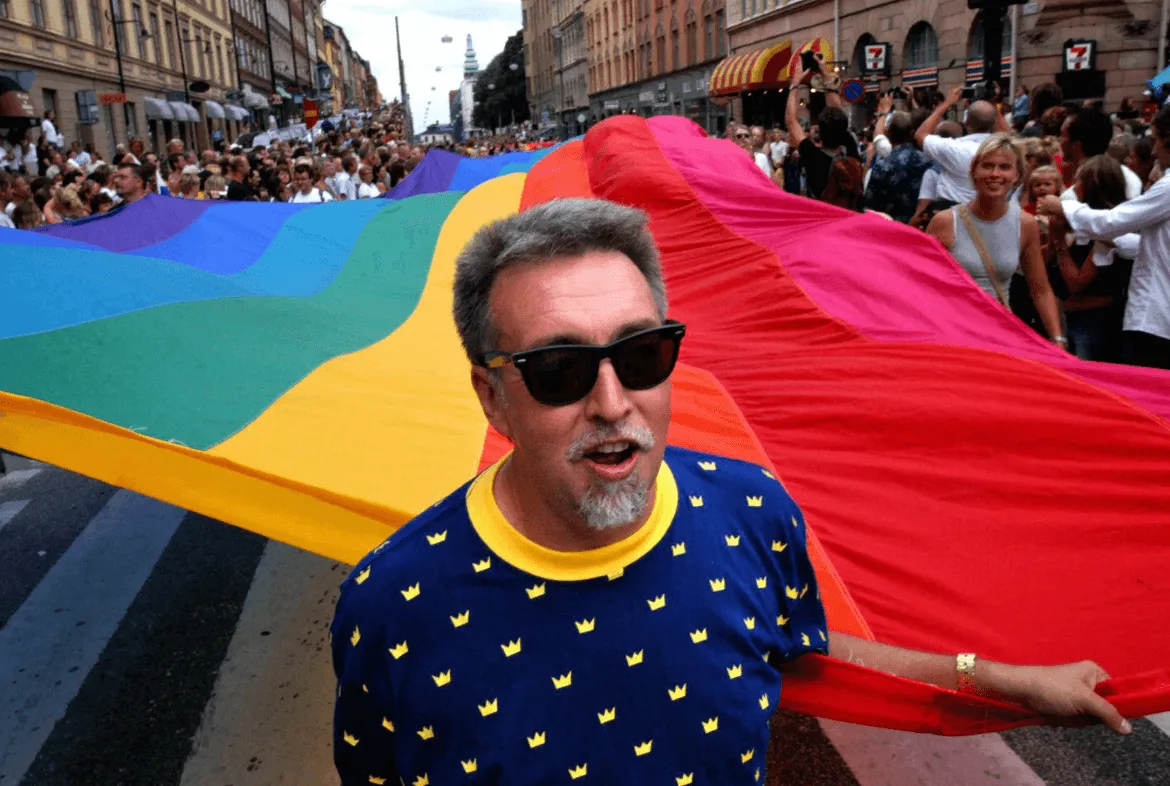
- Gilbert Baker heading the Stockholm Pride Parade, 2003. · Credit: Fredrik Persson/Agence France-Presse, Getty Images
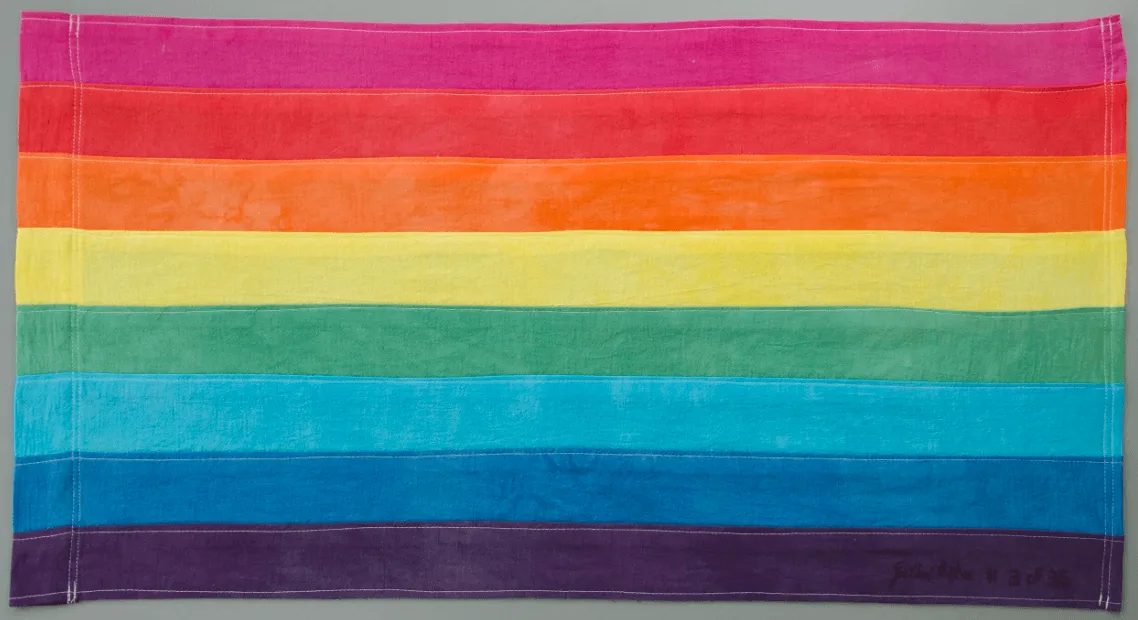
- A fabric flag with eight stripes: hot pink, red, orange, yellow, green, teal, blue, violet. · Credit: MOMA, https://www.moma.org/explore/inside_out/2015/06/17/moma-acquires-the-rainbow-flag/
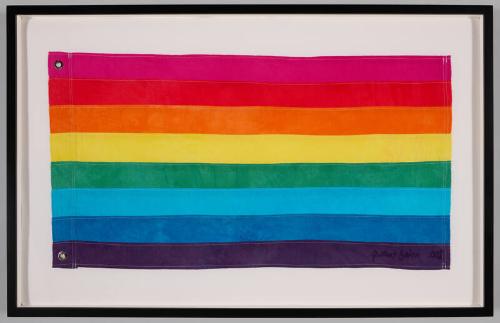
- The hand-dyed cotton eight-stripe rainbow flag Gilbert Baker presented to President Barack Obama at a White House reception marking LGBT Pride Month on June 9, 2016, signed by Baker and framed. Held by the Barack Obama Presidential Library as artifact DO.120042, which dates the flag itself to 2013. · Credit: Barack Obama Presidential Library, National Archives and Records Administration · Barack Obama Presidential Library
- One of the two original 1978 rainbow flags held up by its makers and volunteers in San Francisco. Published with the WeHo Times interview in which Lynn Segerblom set out her account of the flag's creation. · Credit: Photo by James McNamara, courtesy of Paul Langlotz · WeHo Times
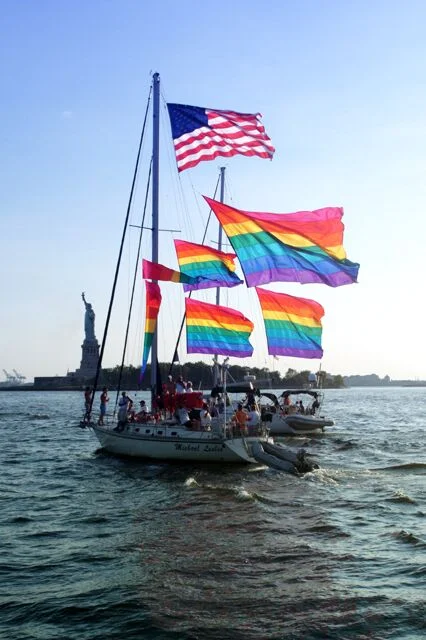
- Rainbow flags flown from a boat in New York Harbour, published with Refinery29's 2015 profile of Baker. Baker sailed with a gay sailing group in the city, and the magazine credits the photograph to him. · Credit: Courtesy of Gilbert Baker, via Refinery29. Reproduced for commentary and education. · Refinery29