Two-Spirit Pride Flag (2016 Tumblr documentation)
Indigenous Pride Flag
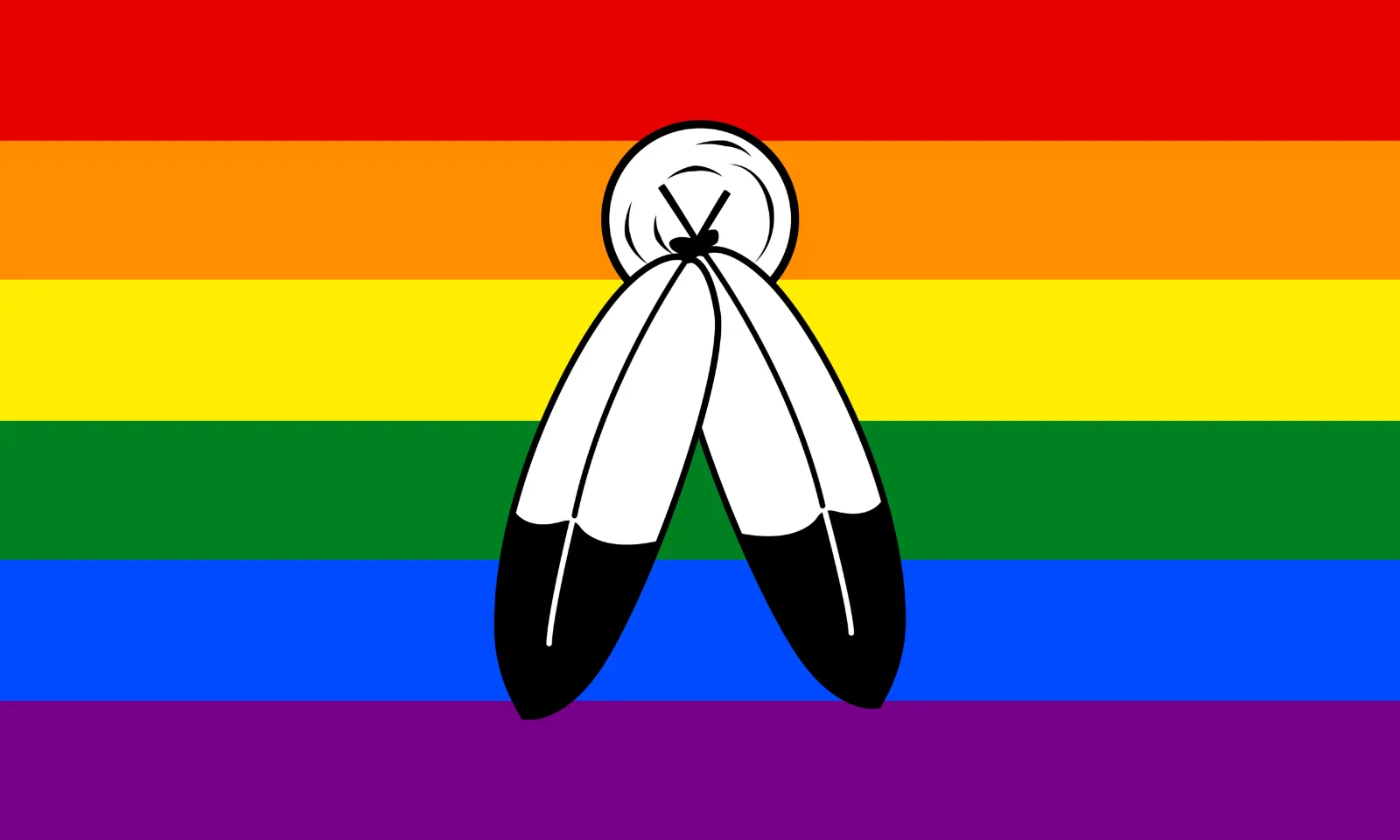
The most widely reproduced Two-Spirit flag: two white black-tipped feathers bound beneath a circle, charged on the standardised six-stripe rainbow field. Its designer is unknown. It reached wide circulation through an anonymous submission to the Tumblr blog ask-pride-color-schemes on 17 December 2016, in which the submitter, writing as a Lakota person, described the emblem as one they had seen around the internet and explained it as two feathers for woman and man with the circle for unity in one. [1] Later guides call that submitter 2Sanon and credit them as the designer, which the contemporaneous record does not support: the blog's own preservation post of January 2017 records the designer as unknown. [2][3]
Key facts
- Designer
- Unknown
- Earliest located documentation
- Aspect Ratio
- 3:5 · standard
- Ratio Notes
- The December 2016 rendering is 5000 by 3000 pixels and the archive's copy 2560 by 1536, both of which reduce to 3:5 and agree with the standard production ratio shown here. [4]
- Stripes
- 6
- Represented Identity
- Two-Spirit
Also known as
- Two-Spirit Pride Flag
- Two-Spirit Flag
- 2S Pride Flag
- 2Sanon Two-Spirit Flag
Archive categories Indigenous Pride Flags
Overview
No statement of intent by a designer has been located. What the record carries is the submitter's explanation of the emblem: "Basically, the two feathers represent woman and man, and the circle represents unity in one." [1]
On 17 December 2016 an anonymous person sent the Tumblr blog ask-pride-color-schemes a single composite image holding four Two-Spirit designs, apologising that Tumblr gave them no way to submit several images at once. One was an existing, more complex flag with two faces, a dreamcatcher, an eagle and the word "2-Spirits" on a rainbow field; the other three were the simplified two-feather-and-circle emblem placed on the rainbow, transgender and nonbinary flags. The submitter identified the complex one as the design the blog had said it found too complex to redraw, and described the rainbow-field version as "an alternative one I've see around the Internet". [1] The emblem was therefore already in circulation by December 2016. Where it came from, and who drew it, remain unestablished.
Identity & Context
- Represented Identity
- Two-Spirit
- Subcommunity
- Indigenous North American people who hold or claim Two-Spirit identity
- Movement
- Two-Spirit visibility, Indigenous Queer pride
- Diaspora Context
- Indigenous communities across the Canada and United States border
- Language Context
- Two-Spirit is an English term, first proposed by Elder Myra Laramee at the Third Annual Inter-tribal Native American, First Nations, Gay and Lesbian American Conference in 1990 as an alternative to the colonial term berdache. [5] Albert McLeod, writing for the Canadian Museum for Human Rights, dates the term's introduction and adoption in North America to 1990 and does not claim to have proposed it himself. [6] Nations have their own words: the submitter who documented this flag gave winkte as the Lakota term. [1]
- Religious Context
- The First Nations Health Authority describes Two-Spirit as "an Indigenous-specific term that is used to self-identify with expressions of gender or sexuality through a pre-colonial lens", existing separately from Western constructs and not equivalent to an LGBTQQIA+ identity, though a person may identify as both. [5]
- Racial / Ethnic Context
- Two-Spirit is Indigenous-specific. Use of the term by non-Indigenous people is inappropriate. [5][7]
- National Context
- Pan-Indigenous in scope, spanning what are now Canada and the United States, with Nation-specific roles and terms varying widely.
Two-Spirit is not a synonym for bigender, nor exclusively a gender identity. It can concern gender, sexuality, spirituality, cultural role, kinship or responsibility, differently by Nation and by person, and McLeod records that not all Indigenous LGBTQI+ people use the label, particularly Inuit people. [5][6] The submitter who documented this flag described it through their own Lakota perspective as an identity in which "a person has the spirit of both woman and man within them", adding that it "could be thought of as a cultural version of bigender". That is one person's account and not a general definition. [1]
Creators
Associated Figures
Anonymous Lakota submitter, later called 2Sanon
Submitter and commentator, not a documented designer
The person who sent the four Two-Spirit designs to ask-pride-color-schemes on 17 December 2016 and explained them. They wrote as a Lakota person, gave winkte as the word used in their tribe, and asked the blog to write image descriptions in future because they were "afraid of botching the descriptions from not knowing what some things are". They identified the complex design as the one the blog had seen before and the feather-and-circle version as one already circulating online. In a follow-up they opened with "This is the Two-Spirit anon", which is where the later nickname 2Sanon comes from. Nothing further about them has been documented, and no claim of authorship by them has been located. [1]
In a way it's actually sort of an umbrella term, as most tribes have a tribe-specific name for Two-Spirit. For example, I'm Lakota, and in my tribe we call it winkte!
From the submission of 17 December 2016, the submitter's own account of the term. [1]
The top right is an alternative one I've see around the Internet (if you Google "two spirit flag", you'll see the one I'm talking about).
The sentence that places the rainbow-field design in circulation before the submission. [1]
Basically, the two feathers represent woman and man, and the circle represents unity in one.
The submitter's explanation of the emblem, quoted again in the blog's January 2017 preservation post. [1][2]
It's most commonly seen with the gay pride flag, though personally I think I'd prefer it with the trans or nonbinary flag background, as seen in my submission above. Two-Spirit is meant to be a gender identity, and I feel like having the gay pride flag might get people confused and think it's a sexuality. That's just me though!
The submitter's stated preference among the four images sent. [1]
In general, Two-Spirit people usually take on a shaman role or something similar in their communities.
From the follow-up message the submitter opened with "This is the Two-Spirit anon". They preface it by saying that roles vary: "It depends on what tribe you look at." [1]
ask-pride-color-schemes
Host blog, responding editor, and renderer of the December 2016 files
The Tumblr ask blog that received the submission, answered it in the same post over the signature "-Hermy", and said it would "start adding the more complex flags as-is to my DA just to keep a record of them". Eight days later, on 25 December 2016, four designs from the submission were published as separate 5000 by 3000 files on the Pride-Flags DeviantArt gallery, and on 29 January 2017 the companion blog pride-color-schemes reissued them with the note "Designed by: Unknown". [1][2][4]
I probably should start adding the more complex flags as-is to my DA just to keep a record of them and then update them when I am able to.
The blog's reply in the same post, 17 December 2016, signed "-Hermy". [1]
Zachary Harden
Renderer of the Flags of the World illustration, 2023
The Flags of the World contributor who drew the illustration that site publishes for this flag, dated 13 September 2023, and who wrote the accompanying note. His rendering is a later drawing of the design and is credited as such wherever it is used here. [3]
Attribution notes
The designer of the two-feather-and-circle emblem and of this flag is unknown. The contemporaneous record separates three roles. The anonymous person who submitted the image to ask-pride-color-schemes on 17 December 2016 described the rainbow-field version as "an alternative one I've see around the Internet", which is a report of something already circulating rather than a claim of authorship; in a follow-up message they signed themselves "the Two-Spirit anon". [1] The blog that received it, ask-pride-color-schemes, and its companion pride-color-schemes, redrew the designs and published them, recording "Designed by: Unknown". [2] Later guides shortened "Two-Spirit anon" to 2Sanon and began printing it as a designer's username: Flags of the World writes that the flag "was first designed in 2016 from a user on Tumblr by the username '2Sanon'", and retailers and listicles repeat it. [3][8][9] That is attribution history, not evidence of authorship.
Origin
- Place Type
- Tumblr submission
- Digital Origin
- Yes
- Origin Type
- first_documentation
- Physical Origin Status
- unknown
Digitally documented. No place of design is recorded, and none is inferred from the submitter's own identity, so this entry carries no map location. [1]
The earliest located appearance is a submission to the Tumblr blog ask-pride-color-schemes on 17 December 2016. No place of design is documented, and none is inferred from the submitter's own Lakota identity. [1]
Indigenous Identity Context
- Territory
- Turtle Island
- Geographic Scope
- pan-Indigenous
- Colonial State
- Canada, United States
- Traditional Knowledge Notice
- Yes
- Affiliation Type
- identity_framework
- Pan-Indigenous
- Yes
Two-Spirit is a modern pan-Indigenous English umbrella term, first proposed by Elder Myra Laramee at the Third Annual Inter-tribal Native American, First Nations, Gay and Lesbian American Conference in 1990 as an alternative to the colonial term berdache. [5] It is not one uniform precolonial identity: what it covers can concern gender, sexuality, spirituality, cultural roles, kinship or responsibilities differently across Nations and individuals, most Nations have their own terms, and not every Indigenous LGBTQI+ person uses the label. [5][6] The Nation and language fields here are left empty because the designer of this flag is not known. The anonymous person who documented it on Tumblr in December 2016 wrote as a Lakota person and gave winkte as the word used in their tribe, which is their own identity rather than the flag's. [1] No design holds pan-Indigenous authority.
Two-Spirit is Indigenous-specific and pan-Indigenous in scope. No Nation affiliation is recorded for this flag, because its designer is unknown. [1][5] [1][5]
Human Interest
The most reproduced Two-Spirit flag has no documented designer
The design is manufactured and sold by commercial flag makers, has been raised by a university, and appears in reference guides as the representative Two-Spirit flag. [8][10][3] No source names the person who drew it. The one contemporaneous document is a Tumblr submission from someone who had seen it online, and the blog that received it recorded its designer as unknown. [1][2]
Dates & Chronology
- Earliest located documentation
- Creation Bounds
- 17 December 2016 is the date of the Tumblr submission that documents the design, not a date of creation. The submitter presents the emblem as something already in circulation, writing that the version on the rainbow field is "an alternative one I've see around the Internet" and pointing to it as what a web search for "two spirit flag" would return. No earlier appearance has been located, and no date of design has been established. [1]
The blog redrew the four designs and published them on its Pride-Flags DeviantArt gallery on 25 December 2016, and reissued them on the pride-color-schemes blog on 29 January 2017 under "Designed by: Unknown". [2][4] From there the rainbow-field version spread. Flags of the World records its use by the University of Waterloo, at Victoria Pride in 2019 and 2021, by the Wabanaki people in 2020, at Thompson Pride in Manitoba in 2022, and at the first Two-Spirit Powwow in Spokane, Washington, in June 2023. [3] The University of Waterloo flew it alongside the Intersex-Inclusive Pride Progress flag through June 2023, the first time it had been raised on that campus. [10] It is manufactured and sold as a three by five foot flag by Flags For Good and others. [8]
The emblem has been carried onto other fields. Flags of the World documents it on Monica Helms's transgender flag, used by the Maskwacis people in Alberta; on the Progress Pride flag, in the version made official at a 2022 Pride Week event in the Regional Municipality of Wood Buffalo, Treaty 8 Territory; and on the New Progress Pride flag used by Cambrian College in Sudbury in June 2022. Flags of the World assigns a separate group of appearances, including Utah Pride in 2019, Fort Erie in 2021 and Pride London Ontario in 2022, to the more complex Two-Spirit design rather than to this one. [3] Other Two-Spirit flags exist independently of this design: Art Zoccole's of 2005 for 2-Spirited People of the 1st Nations in Toronto, a 2021 design by the Twitter user sirieko, and Patrick Hunter's, unveiled in 2024 and promoted by the International Day of Pink as the first Two-Spirit Pride Flag. [11][12]
Lineage
- Direct predecessors
- Rainbow Pride Flag
- Direct children
- Two-Spirit Intersex-Inclusive Progress Pride Flag, Two-Spirit Progress Pride Flag, Two-Spirit Transgender Pride Flag
- Related flags
- Indigiqueer / Two-Spirit Flag (cedar-maw), Progress Pride Flag, Two-Spirit Leather Pride Flag, Two-Spirit Nonbinary Pride Flag (2016 Tumblr documentation), Two-Spirit Pride Flag (2021, sirieko), Two-Spirit Pride Flag (Patrick Hunter)
- Sibling flags
- Alberta Gay Flag, Straight Ally Pride Flag, Anarcha-Queer Flag (rainbow variant), Argentina Gay Flag, Australia Gay Flag, Brazil Gay Flag
+ 44 more
British Columbia Gay Flag, Canadian Pride Flag, Chicago Pride Flag (Rainbow Stripes, Purple Stars), Chile Gay Flag, Dominican Republic Gay Flag, Egypt Gay Flag, European Union Gay Flag, France Gay Flag, Gay Pride Flag of Pakistan, Heteroflexible Pride Flag, Heterosexual / Straight Pride Flag, Homoflexible Pride Flag, India Gay Flag, Italy Gay Flag, Japan Gay Flag, Jewish Gay Pride Flag, Manitoba Gay Flag, Mexico Gay Flag, Netherlands Gay Flag, New Brunswick Gay Flag, Newfoundland Gay Flag, Northwest Territories Gay Flag, Nova Scotia Gay Flag, Nunavut Gay Flag, Ontario Gay Flag, Palestinian Gay Pride Flag, Panama Gay Flag, Philadelphia Pride Flag, Prince Edward Island Gay Flag, Quebec Gay Flag, Rainbow Flag with White Triangle (Sapporo), Rainbow Israel Flag, Rainbow Polish Flag (2014, Angela Getler), Russia Gay Flag, Saskatchewan Gay Flag, Social Justice Pride Flag, South African Gay Pride Flag, Switzerland Gay Flag, Tanzania Gay Flag, Texas Rainbow Flag, Turkish Gay Pride Flag, Two-Spirit Pride Flag (2005, Zoccole), Victory Over AIDS Flag (1980s, designer unknown), Yukon Territory Gay Flag
The field is the standardised six-stripe rainbow flag, which is what this design charges the emblem on. The emblem itself is not derived from an earlier flag in the record: it was already circulating when the December 2016 submission documented it, and its origin is unknown. The transgender-base and nonbinary-base versions are not children of this one. All three arrived in the same submission, on the same day, each placing the same emblem on a different existing flag, and neither the rainbow version nor the others has priority in the record. Later flags that carry the emblem, on the Progress Pride flag, the New Progress Pride flag and the transgender flag, are documented as taking it from this design and are recorded as its descendants. Art Zoccole's 2005 flag is eleven years earlier and no source connects the designs; the 2021 sirieko and 2024 Hunter flags are separate Two-Spirit designs rather than derivatives.
Lineage tree
Every record reachable from this one through documented parent and child relationships: 7 records across 5 generations.
- Ancestors -3
- Original Rainbow Flag (1978)
- Ancestors -2
- Seven-Stripe Rainbow Flag (1978)
- Ancestor
- Rainbow Pride Flag
- This record
- Two-Spirit Pride Flag (2016 Tumblr documentation)
Colors & Symbolism
An Indigenous emblem on a Queer flag. The two feathers and the circle carry the Two-Spirit meaning and the six-stripe rainbow field carries the Queer one; the explanation on record is the submitter's, and it is short. [1]
| Colour | Hex |
|---|---|
| Red | #E40303 |
| Orange | #FF8C00 |
| Yellow | #FFED00 |
| Green | #008026 |
| Blue | #004DFF |
| Violet | #750787 |
| White (feathers and circle) | #FFFFFF |
| Black (feather tips and outlines) | #000000 |
Measured from the 5000 by 3000 December 2016 rendering [4]
The woman-and-man reading is the account of one anonymous person writing from a Lakota perspective in 2016. It is not a general statement about Two-Spirit identity, which is not confined to a masculine and feminine pair, and the emblem is not documented as representing a universal Indigenous spiritual tradition. The six bands are the standardised six-stripe rainbow field and their meanings belong to that flag rather than to this one; the submission explains only the emblem. [1]
No palette was published with the design. The values here are measured from the 5000 by 3000 rendering the receiving blog published on 25 December 2016, whose six bands hold the standard six-stripe values exactly. [4] The archive's own 2560 by 1536 copy is not the file to measure: its bands read #E50000, #FF8D00, #FFEE00, #008121, #004CFF and #760188, each displaced a step or two from the published values by a lossy stage somewhere in its history.
Design
- Aspect Ratio
- 3:5 · standard
- Ratio Notes
- The December 2016 rendering is 5000 by 3000 pixels and the archive's copy 2560 by 1536, both of which reduce to 3:5 and agree with the standard production ratio shown here. [4]
- Orientation
- horizontal
- Stripe Count
- 6
- Layout
- horizontal stripes with center symbol
- Stripes (Top → Bottom)
- Red, Orange, Yellow, Green, Blue, Violet
- Center Symbol
- Two white feathers with black tips, bound beneath a circle
Six bands of equal depth, with the emblem centred and reaching from the second band into the fifth. The two feathers cross at the binding and splay downward, each white along the shaft and solid black over the lower third. The circle sits above the binding and is drawn as an open ring with a light spiral inside it. [4]
The base is the standardised six-stripe rainbow field, not a variant of it. The emblem is drawn in white and black and is not tinted to the stripes it crosses. [4]
Six equal horizontal bands in the standard rainbow sequence, red, orange, yellow, green, blue and violet. At the centre, two white feathers with black tips hang crossed beneath a white circle outlined in black, bound where they meet.
Usage & Adoption
- Organizations
- University of Waterloo, which raised it on campus for the first time in June 2023 [10], Flags For Good, which manufactures and sells it as a three by five foot flag [8]
- Geographic Usage
- Canada, United States
- Online Usage
- Tumblr, where it was documented and reissued [1][2], DeviantArt, where the receiving blog published its rendering [4], Reference guides and listicles, which reproduce it as the representative Two-Spirit flag [9][3]
- Event Usage
- Victoria Pride, British Columbia (2019 and 2021), per Flags of the World [3], Wabanaki people (2020), per Flags of the World [3], Thompson Pride, Manitoba (2022), per Flags of the World [3], First Two-Spirit Powwow, Spokane, Washington (June 2023), per Flags of the World [3]
- Current Status
- widely circulated, unofficial
Documented circulation is wide and unofficial. It covers institutional flag-raisings, Pride events, commercial manufacture and reference guides, and it does not amount to adoption by Two-Spirit communities generally: no Two-Spirit organisation is documented as having adopted this design, and no design holds pan-Indigenous authority. Good Good Good, which reproduces it, puts the same point plainly: "The flag is not an official agreed-upon design, but it is the most commonly seen Two-Spirit Pride Flag." [9][3] The event reports above are Flags of the World's, cited there to Flickr, news and social-media pages that have not been read here.
Image Archive
Renderings
Discourse & Debates
- Whether a single Two-Spirit flag is appropriate at all, given the range of Two-Spirit traditions across Nations. [7]
- Whether non-Indigenous people should display the flag. [7]
- Whether a rainbow base implies an equivalence between Two-Spirit identity and Western LGBTQ categories that misrepresents it. Two-Spirit people quoted by the University of Waterloo made the related point about flags flown side by side: Amy Smoke said "Indigenous ways of sexual orientation and gender expression were here long before the 2SLGBTQIA+ acronym", and Leith Bulford that "members of the broader LGBTQIA+ community must also acknowledge and respect the contextual and cultural differences of our experiences". [7][10]
Common misidentifications
- 2Sanon is a nickname for the anonymous submitter, formed from their own "This is the Two-Spirit anon", and is widely printed as the name of the designer. The design's authorship is not established. [1][3]
- The four images in the December 2016 submission are sometimes described as four designs by one person. Three of them place one emblem on three existing flags, and the fourth is a separate and more complex design that predates the submission. [1]
- Two-Spirit flags are often conflated with one another: Art Zoccole's of 2005, this one, the 2021 sirieko design and Patrick Hunter's of 2024 are distinct flags with distinct authorship. [11][12]
- Two-Spirit is frequently conflated with being gay and Indigenous. It covers cultural and spiritual roles that do not map onto Western categories of sexuality or gender. [7][5]
Criticisms
- No single flag can carry the range of Two-Spirit identities across hundreds of Nations, each with its own understanding of gender and role, and a pan-Indigenous symbol necessarily flattens those differences. [7]
- The woman-and-man reading of the two feathers has been questioned as reinstating the binary that Two-Spirit identity complicates. [7]
Two-Spirit, also written Two Spirit, 2S and two-spirit, is an Indigenous-specific term adopted in 1990 to replace the colonial term berdache. [5] The related term Indigiqueer, coined by TJ Cuthand and popularised by Joshua Whitehead, does not rest on a two-part gender framework. [7]
Footnotes & Citations
Sources and footnotes 12 sources
- 1. Social media I apologize for the big image, there doesn't seem to be an option to submit multiple images in one submission. Anonymous submitter, with a reply signed "-Hermy". ask-pride-color-schemes (Tumblr) (2016-12-17). Accessed 2026-08-16
The contemporaneous submission. It carries the composite image of four designs, the submitter's explanation, their statement that the rainbow-field version was already circulating, and the blog's reply.
- 2. Social media Two-spirit. pride-color-schemes. pride-color-schemes (Tumblr) (2017-01-29). Accessed 2026-08-16
The blog's preservation post, which reissues the designs, quotes the submission and records "Designed by: Unknown".
- 3. Reference "Two Spirits" Gay Pride Flags. Zachary Harden and Tomislav Todorović. Flags of the World (2023-09-30). Accessed 2026-08-16
Contributions dated 13 and 14 September 2023. It carries the usage record and the 2Sanon-as-designer attribution, and assigns a separate group of appearances to the more complex Two-Spirit design.
- 4. Image file page Two-spirit (2). Pride-Flags. DeviantArt (2016-12-25). Accessed 2026-08-16
The receiving blog's own rendering of the rainbow-base design, 5000 by 3000, published eight days after the submission and carrying a Creative Commons Attribution 3.0 licence. The colour values here are measured from it.
- 5. Organizations 2S/LGBTQQIA+. First Nations Health Authority. First Nations Health Authority. Accessed 2026-08-16 · Archived version
- 6. Museums & Exhibitions The Re-emergence of 2Spirit People in the 21st Century. Albert McLeod. Canadian Museum for Human Rights (2025-02-26). Accessed 2026-08-16 · Archived version
- 7. Encyclopedias & Reference Two-spirit. Wikipedia. Accessed 2026-03-18
- 8. Retail listing Two Spirit Pride Flag. Flags For Good. Accessed 2026-08-16
A manufacturer's listing. It documents commercial production and repeats the 2Sanon attribution.
- 9. Articles & Reports What Is the Two-Spirit Pride Flag & What Does It Mean?. Good Good Good. Accessed 2026-08-16
A guide that credits 2Sanon as designer and also states that the flag is not an official agreed-upon design.
- 10. News Waterloo raises Two-Spirit flag on campus for the first time. Emily Brant, Office of Indigenous Relations. Waterloo News, University of Waterloo (2023-06-08). Accessed 2026-08-16
- 11. Encyclopedias & Reference Two Spirit. LGBTQIA+ Wiki. Accessed 2026-03-18
- 12. Organizations Honouring the Two-Spirit Pride Flag. International Day of Pink. Accessed 2026-08-16
This page is about Patrick Hunter's 2024 design, which it presents as the first Two-Spirit Pride Flag. It is cited here only for that later flag.
Image Sources
- Rendering
- compressed archive copy of the December 2016 rendering
- A later third-party rendering of the design, drawn for Flags of the World by Zachary Harden and dated 13 September 2023. The same page records the flag's spread: the University of Waterloo's first campus raising, Victoria Pride in 2019 and 2021, the Wabanaki people in 2020, Thompson, Manitoba in 2022, and the first Two-Spirit Powwow in Spokane, Washington in June 2023. [3] · Credit: Zachary Harden, Flags of the World · Flags of the WorldRights Rendering by Zachary Harden for Flags of the World, credited to him and to that site.