Philadelphia Pride Flag
Inclusive Pride Flag ·
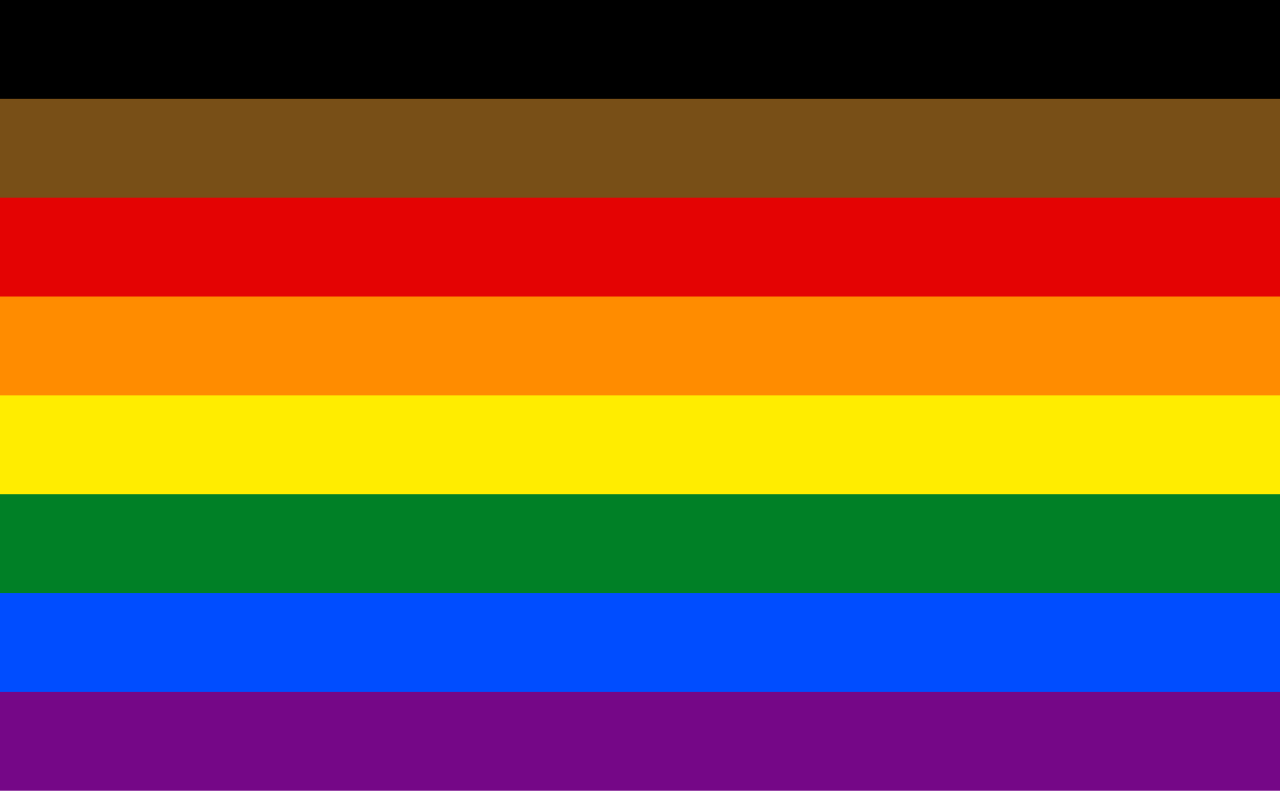
An eight-stripe 2017 variant of the six-stripe rainbow flag that adds black and brown stripes to foreground racial inclusion and respond to racism within LGBTQ spaces. Created as part of Philadelphia’s More Color More Pride campaign.
Key facts
- Designer
- Tierney
- Created
- First documented public use
- In use
- 2017–present
- Aspect Ratio
- 3:5 · standard
- Stripes
- 8
- Origin
- Philadelphia, Pennsylvania, United States
- Represented Identity
- LGBTQ community, LGBTQ people of color
Also known as
- More Color More Pride Flag
- Philadelphia People of Color-Inclusive Flag
- Philly Pride Flag
- Philly Rainbow Flag
- Gay Pride Flag (Philadelphia)
Status Variant
Archive categories Inclusive and Progress Pride Flags · Regional and Language-Specific Pride Flags
Overview
To foreground racial diversity, equality, and inclusion in LGBTQ community life, especially for Black and brown Queer and trans people, and to respond directly to documented racism in Philadelphia’s LGBTQ nightlife.
The flag emerged from a crisis of racial exclusion in Philadelphia’s Gayborhood, a roughly sixteen-block area around 13th Street between Walnut and Pine Streets in Center City, but the pattern it responded to stretched back decades. In December 1976, the Philadelphia Gay News exposed racist practices at Club Barracks baths, where management required all prospective members of color to fill out an application taking ‘up to a month to process’ after complaints the club was becoming ‘too dark.’
In 1984, a Coalition on Lesbian-Gay Bar Policies formed after community members observed racial segregation; their 1986 report, ‘Racial Discrimination in Lesbian and Gay Bars in Philadelphia,’ documented a ‘culture of exclusivity’ and found that bars complied with recommendations until the spotlight faded, then reverted. [1] By the 2010s, all eight owners of the eleven Gayborhood bars were white men, and discriminatory door policies had calcified: bans on Timberland boots, athletic gear, hooded sweatshirts, durags, and flat-brimmed caps, items predominantly associated with Black urban culture, were selectively enforced against people of color while white patrons wearing similar items were admitted. Black patrons reported being asked for two or three forms of ID, or being told venues were at capacity when they clearly were not. [2]
On May 7, 2015, Ernest Owens, a Black Queer journalist (University of Pennsylvania BA, USC Annenberg MA), published ‘Black Not Fetch Enough for Woody’s?’ in Metro Philadelphia, it became the publication’s most-read piece and established a public record of complaints that city officials had ignored. [2]
On September 23, 2016, the Black and Brown Workers Collective (BBWC), formed in February 2016 by Shani Akilah Robin, organized a march through the Gayborhood, tying Timberland boots to iCandy’s door and leaving pairs on the doormat. Four days later, a 21-second video surfaced showing iCandy owner Darryl DePiano repeatedly using the N-word while complaining that Black patrons were ‘the only ones’ who asked for free drink tickets. BBWC members staged a sit-in at the bar, joined by Philadelphia’s Black Lives Matter chapter, blocking the bar area and preventing patrons from ordering. Philadelphia Gay News barred iCandy from advertising; Stonewall Sports, Philly Pride, OutFest, and the City of Brotherly Love Softball League all severed ties. [3][2]
On October 25, 2016, close to 400 people attended a hearing by the Philadelphia Commission on Human Relations; owners of 11 bars were subpoenaed and more than 50 individuals testified. The Commission’s January 2017 report, ‘Inform, Monitor, Enforce,’ found discrimination ‘prevalent for decades,’ ordered 11 bars and two nonprofits (Mazzoni Center and Philadelphia FIGHT) to complete fair practices training within 90 days and implicit bias training within 120 days, though legal experts questioned whether the order would hold up in court. [4]
In February 2017, Director of LGBT Affairs Nellie Fitzpatrick was fired; AJ Hikes replaced her in March and partnered with Tierney, a Philadelphia-based advertising agency working pro bono, to create the More Color More Pride campaign. [5][6]
In June 2017, Mayor Jim Kenney signed a unanimously passed bill giving the Commission power to issue cease-operations orders to businesses that discriminate. [7] iCandy ultimately closed in September 2018; Tabu purchased the building at 254 S. 12th Street, with owner Jeff Sotland stating the goal was to ‘bring people back to the neighborhood who had left because they didn’t feel it was a safe space.’ [8]
Identity & Context
- Represented Identity
- LGBTQ community, LGBTQ people of color
- Subcommunity
- Black LGBTQ people, brown LGBTQ people
- Movement
- Pride movement, anti-racism within LGBTQ communities, intersectional inclusion
- Diaspora Context
- Later broader use beyond Philadelphia
- Racial / Ethnic Context
- People of color inclusion
- National Context
- United States; Philadelphia
Strongly place-specific in origin, later broader in circulation. The campaign responded to documented racial discrimination in Philadelphia’s LGBTQ nightlife, including the iCandy controversy of September 2016 and a Philadelphia Commission on Human Relations investigation that ordered 11 bars to undergo implicit bias training.
Creators
The Creator
AJ Hikes
Campaign leader / Executive Director, Office of LGBT Affairs
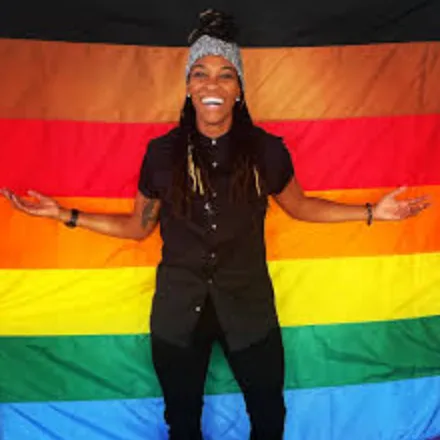
AJ Hikes (formerly Amber Hikes; they/them) is a Black, Queer, nonbinary activist born in Okinawa, Japan, to a military family. They grew up across Japan, Hawaii, Georgia, Louisiana, and Delaware before earning a BA in English from the University of Delaware in 2006 and an MSW from the University of Pennsylvania in 2008. Before entering city government, they served as the youngest Upward Bound director in the country at UPenn.
In March 2017, Hikes was appointed Executive Director of Philadelphia's Office of LGBT Affairs, replacing Nellie Fitzpatrick, who had been dismissed amid complaints of slow responses to discrimination complaints. The Office of LGBT Affairs partnered with Tierney, a Philadelphia-based advertising agency, on a pro bono basis to design the new flag; official municipal design credit goes to Tierney. [6][5] Hikes led the campaign and served as its public face, reportedly tearing up the first time they saw Tierney's flag design, saying: 'Seeing an image like this flag instills so much pride in me as a queer black woman.' They received racist death threats after the flag's public launch. Philadelphia Gay News named them Person of the Year in 2017, and both Philadelphia Magazine and Out Magazine listed them among their 100 Most Influential People in 2018. Hikes left city government in July 2019 to become the ACLU's first-ever Chief Equity and Inclusion Officer, later serving as Deputy Executive Director for Strategy and Culture. [5][9]
Seeing an image like this flag instills so much pride in me as a queer black woman.
Motivations
- To make racial inclusion visually explicit within the pride flag
- To respond to documented racism in Philadelphia's LGBTQ nightlife
Attribution
- Organization
- Philadelphia Office of LGBT Affairs
- Commissioned By
- City of Philadelphia / Office of LGBT Affairs
Attribution notes
Official City of Philadelphia material states the Office of LGBT Affairs partnered with Tierney, a Philadelphia-based advertising agency, on a pro bono basis to design the new flag. Key creatives at Tierney included Teri Terbec (Creative Director), Diane DiCicco, and Patrick Hardy (EVP). [10] AJ Hikes (formerly Amber Hikes), newly appointed Executive Director of the Office of LGBT Affairs, was the commissioner and public champion of the campaign, not the graphic designer. Hikes has clarified that Tierney 'came to me' and 'had already been working on plans for a flag', Tierney approached Hikes with the concept. [10][11] The design credit in official municipal records goes to Tierney. [6][5] The flag was not patented or trademarked. [10]
Origin
- Country
- United States
- Region / state
- Pennsylvania
- City
- Philadelphia
- Specific Place
- City Hall launch context
- Place Type
- municipal inclusivity campaign
Created in Philadelphia, Pennsylvania, on the ancestral homeland of the Lenni Lenape people, part of Lenapehoking. [12][13]
Indigenous land context
Lenni Lenape — ancestral homeland (Lenapehoking) (Indigenous name: Lenapehoking). The land now known as Philadelphia is part of Lenapehoking, the ancestral homeland of the Lenni Lenape people. Archaeological and oral-history evidence dates occupation to roughly 10,000 years ago. The Lenape were displaced by Quaker and other colonial settlers beginning in the late 17th century. The fraudulent Walking Purchase of 1737 was a pivotal dispossession event. Today, Lenape communities are found in Oklahoma, Kansas, Wisconsin, Ontario, and New Jersey. Pennsylvania, despite once being a center of Lenape culture, is one of a handful of U.S. states that neither contains a reservation nor officially recognizes any Native group within its borders. [12][13][14]
Colonial / settler context
The More Color More Pride campaign was launched at City Hall on Lenapehoking, the stolen homeland of the Lenni Lenape people. The Lenape were dispossessed through colonial settlement and the fraudulent Walking Purchase of 1737. The campaign addressed racial exclusion within LGBTQ+ spaces without engaging the Indigenous land dispossession on which it operated. [13][14]
- Land status
- Colonized (dispossessed through colonial settlement and treaty fraud)
- Indigenous engagement
- None documented
- Continuing presence
- Lenape communities in Oklahoma, New Jersey, Wisconsin, and Ontario; Pennsylvania has no state-recognized tribes and contains no reservations
The flag is tied directly to Philadelphia’s More Color More Pride campaign and to a local response to documented racism within LGBTQ spaces. [7] On September 29, 2016, a video surfaced of iCandy nightclub owner Darryl DePiano repeatedly using a racial slur to describe Black customers; protesters from the Black and Brown Workers Collective staged a sit-in hours later. [2] In January 2017, the Philadelphia Commission on Human Relations released its report ‘Inform, Monitor, Enforce,’ which found racial discrimination in the Gayborhood had been ‘prevalent for decades’ based on testimony from 49 people, and ordered 11 bars to undergo implicit bias training. [4]
Dates & Chronology
- Year Created
- First public use
- Period in Use
- 2017–present
The flag was raised over Philadelphia City Hall during Pride Month in June 2017. [7] The campaign generated over 272 million earned media impressions from 38 or more media placements, including coverage in CNN, NBC News, Out, the Philadelphia Inquirer, the New York Post, and Vox; on social media, it reached 6.8 million people with 2,480 hashtag mentions. [9] The campaign was formally recognized by the Shorty Awards in the Social Good category. [9] The flag subsequently appeared on Nike and Converse sneakers, in the second season finale of FX’s Pose, and in LEGO’s ‘Everyone Is Awesome’ Pride set. [10][6][15]
In June 2018, Portland-based designer Daniel Quasar used the Philadelphia flag as direct inspiration for the Progress Pride Flag. [6][15]
Major revisions
Served as a direct conceptual basis for the Progress Pride Flag by Daniel Quasar.
A city-origin inclusive variant that introduced the practice of adding identity-specific stripes to the rainbow flag. Its influence is directly visible in the Progress Pride Flag, which incorporated the black and brown stripes alongside transgender flag colors. The black stripe's meaning shifted as it migrated from this flag to the Progress flag: in the Philadelphia context it represents racial inclusion only; in Quasar's Progress flag the same element acquired a second meaning, HIV/AIDS remembrance, drawn from a separate genealogy (Leonard Matlovich's 'Victory Over AIDS' flag, as documented by the V&A). In popular understanding, the later dual reading has largely overwritten the earlier race-only reading.
Lineage
- Direct predecessors
- Rainbow Pride Flag
- Indirect influences
- Original Rainbow Flag (1978)
- Direct children
- Progress Pride Flag, Orange-Pink Lesbian Precursor (2017)
- Related flags
- Disability-Inclusive Pride Flag, Progress+ Flag (Disabled Queer Transmasc Variant), Gilbert Baker Nine-Stripe Rainbow Flag, Seven-Stripe Rainbow Flag (1978)
- Sibling flags
- Alberta Gay Flag, Straight Ally Pride Flag, Anarcha-Queer Flag (rainbow variant), Argentina Gay Flag, Australia Gay Flag, Brazil Gay Flag
+ 44 more
British Columbia Gay Flag, Canadian Pride Flag, Chicago Pride Flag (Rainbow Stripes, Purple Stars), Chile Gay Flag, Dominican Republic Gay Flag, Egypt Gay Flag, European Union Gay Flag, France Gay Flag, Gay Pride Flag of Pakistan, Heteroflexible Pride Flag, Heterosexual / Straight Pride Flag, Homoflexible Pride Flag, India Gay Flag, Italy Gay Flag, Japan Gay Flag, Jewish Gay Pride Flag, Manitoba Gay Flag, Mexico Gay Flag, Netherlands Gay Flag, New Brunswick Gay Flag, Newfoundland Gay Flag, Northwest Territories Gay Flag, Nova Scotia Gay Flag, Nunavut Gay Flag, Ontario Gay Flag, Palestinian Gay Pride Flag, Panama Gay Flag, Prince Edward Island Gay Flag, Quebec Gay Flag, Rainbow Flag with White Triangle (Sapporo), Rainbow Israel Flag, Rainbow Polish Flag (2014, Angela Getler), Russia Gay Flag, Saskatchewan Gay Flag, Social Justice Pride Flag, South African Gay Pride Flag, Switzerland Gay Flag, Tanzania Gay Flag, Texas Rainbow Flag, Turkish Gay Pride Flag, Two-Spirit Pride Flag (2005, Zoccole), Two-Spirit Pride Flag (2016 Tumblr documentation), Victory Over AIDS Flag (1980s, designer unknown), Yukon Territory Gay Flag
Situated between the traditional six-stripe rainbow flag and the Progress Pride Flag in the Baker-Segerblom-rainbow lineage.
Lineage tree
Every record reachable from this one through documented parent and child relationships: 17 records across 7 generations.
- Ancestors -3
- Original Rainbow Flag (1978)
- Ancestors -2
- Seven-Stripe Rainbow Flag (1978)
- Ancestor
- Rainbow Pride Flag
- This record
- Philadelphia Pride Flag
Colors & Symbolism
A revised rainbow pride flag that makes racial inclusion visually explicit and responds to racism within LGBTQ communities. The black and brown stripes represent the presence and contributions of people of color who have always been part of the LGBTQ community but whose visibility the standard rainbow flag did not guarantee.
| Colour | Hex | Meaning |
|---|---|---|
| Black | #000000 | Black people and people of color inclusion |
| Brown | #784F17 | Brown people and people of color inclusion |
| Red | #E40303 | Life |
| Orange | #FF8C00 | Healing |
| Yellow | #FFED00 | Sunlight |
| Green | #008026 | Nature |
| Blue | #004DFF | Serenity |
| Violet | #750787 | Spirit |
flagcolorcodes.com
This flag has no official digital palette. Color values shown are approximate.
The black and brown stripes represent people of color inclusion broadly. Some sources collapse the two stripes into a single description; precise per-source wording is preserved in the claims section.
Library.LGBT provides a hex sequence, but no official campaign design asset has been sourced to confirm canonical palette values.
The six rainbow bands are the 1979 six-stripe values unchanged; the black and brown are the additions. The entry's vector carries all eight exactly.
Design
- Aspect Ratio
- 3:5 · standard
- Orientation
- horizontal
- Stripe Count
- 8
- Layout
- horizontal stripes
- Stripes (Top → Bottom)
- Black, Brown, Red, Orange, Yellow, Green, Blue, Violet
An eight-stripe pride flag adding black and brown above the traditional six-stripe rainbow. No emblems or additional markings. Eight equal-width horizontal stripes.
Usage & Adoption
- First Users
- Philadelphia Office of LGBT Affairs / City Hall launch
- Geographic Usage
- Philadelphia, Broader United States, International circulation
- Online Usage
- Widespread
- Event Usage
- City Hall flag raising (2017), Pride events
- Current Status
- active
Initially a local municipal initiative, the design was adopted broadly and directly influenced the Progress Pride Flag. The campaign generated over 272 million earned media impressions and was recognized by the Shorty Awards in the Social Good category. [9] At the 2018 Met Gala, themed 'Heavenly Bodies: Fashion and the Catholic Imagination', Lena Waithe wore a Carolina Herrera cape incorporating black and brown stripes alongside the rainbow, a direct reference to the Philadelphia flag; she told the New York Times: 'The theme to me is, like, be yourself. You were made in God's image, right?' In the Season 2 finale of FX's Pose (August 2019), the character Damon waves a Philadelphia flag with black and brown stripes during Blanca's lip sync to Whitney Houston's 'The Star-Spangled Banner', a deliberate anachronism, since the show is set in 1991. Director Janet Mock explained: 'I made the choice to include this flag because it is an under-seen symbol, and I want more people to see its existence on such a wide platform.' LEGO's 'Everyone Is Awesome' set (#40516, 2021), its first LGBTQIA+ product, designed by VP of Design Matthew Ashton, features 11 monochrome figures mirroring the Philadelphia flag's color scheme. Nike's 2020 BeTrue collection and Converse Pride sneakers incorporated the flag's palette. Philadelphia itself painted rainbow crosswalks in the Gayborhood incorporating the black and brown stripes.
Image Archive
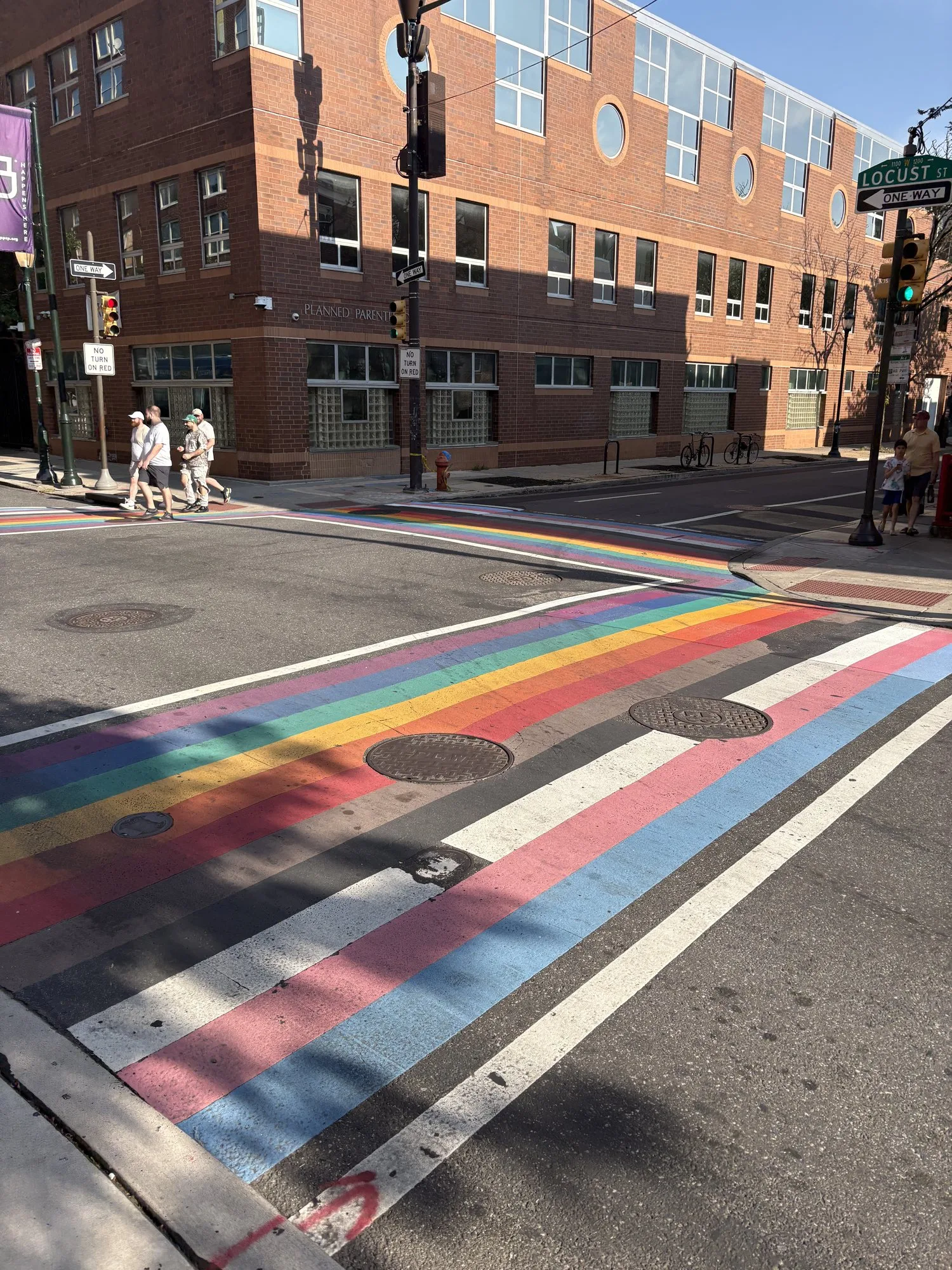
Street crosswalk mural, 12th/13th and Locust Streets, daytime
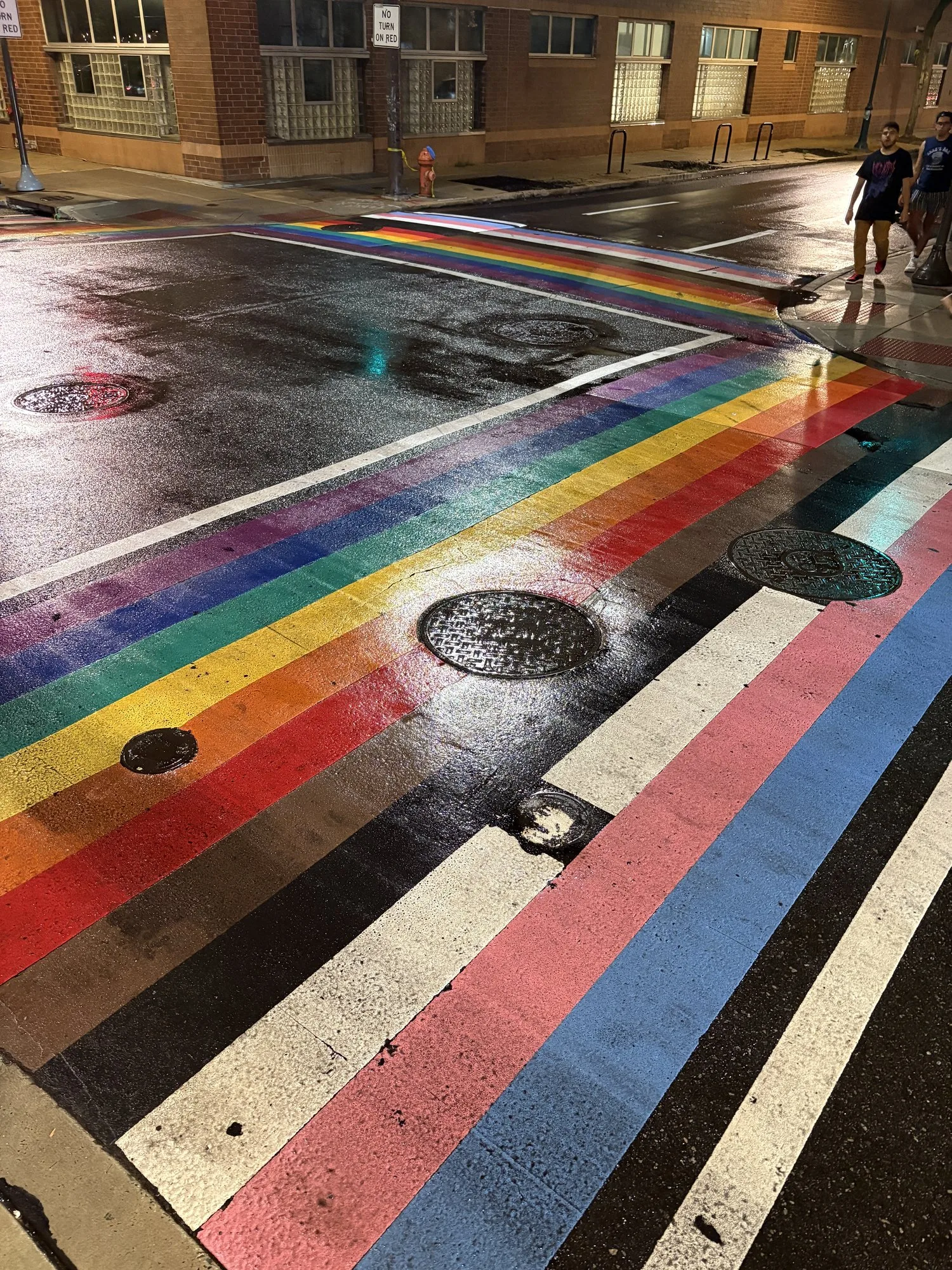
Street crosswalk mural, 12th/13th and Locust Streets, nighttime
Discourse & Debates
- Whether explicit racial marking was needed in the pride flag
- Whether symbolism can or should address institutional exclusion
- Whether the Philadelphia flag should be classified as a variant of the rainbow, a standalone political symbol, or a design predecessor
Common misidentifications
- Often confused with the original Baker eight-stripe flag because both use eight stripes
- Original Baker 8-stripe versus Philadelphia 8-stripe
- Local city campaign symbol versus universal pride flag
- The black and brown stripes here represent racial inclusion, distinct from the later black-stripe HIV/AIDS reading in some Progress Pride Flag interpretations
Criticisms
- The flag was raised at City Hall on a Thursday; by Friday, Hikes had death threats. The threats came from across the country, 'often from LGBTQ people themselves who identified as white, and more often white gay men.' Hikes received messages like 'How dare you desecrate our flag this way!' and 'How dare you take this conversation and make it about race.' They later reflected: 'I cannot forget that I received hate mail and death threats for two stripes on a flag.' [5] When Manchester, England adopted the flag for its 2019 Pride celebration, it reignited the same debate internationally; a 2018 Stonewall report had shown that 51% of BAME LGBT people in the UK experienced racism within the gay community.
- Some critics questioned whether the flag's symbolic gesture substituted for material change, whether a new flag could address the structural racism documented in the Commission's report, or whether it risked satisfying the demand for action with an image. Supporters countered that the flag's virality drew national attention to racism in Queer spaces that quieter advocacy had not.
Also known as the More Color More Pride flag. The Philadelphia qualifier distinguishes it from the original eight-stripe Baker design.
Footnotes & Citations
Sources and footnotes 19 sources
- 1. Articles & Reports Gayborhood Racism: Deja Vu All Over Again?. Philadelphia Magazine (2016-10-25). Accessed 2026-03-15
- 2. Articles & Reports No Shade: The Gayborhood Is the Most Racist Place in the City. Ernest Owens. Philadelphia Magazine (2016-10-08). Accessed 2026-03-15
- 3. Databases Rainbow (Philadelphia Variant). Library.LGBT. Accessed 2026-03-08
- 4. Government Inform, Monitor, Enforce: Addressing Racism and Discrimination in Philadelphia's LGBTQ Community. Philadelphia Commission on Human Relations. City of Philadelphia (2017-01). Accessed 2026-03-15 [no stable URL]
- 5. Encyclopedias & Reference AJ Hikes. Wikipedia. Accessed 2026-03-11
- 6. Official City and Office of LGBT Affairs Kick-Off Pride Month. City of Philadelphia. Accessed 2026-03-08
- 7. Official More Color, More Pride. City of Philadelphia (2017-06-08). Accessed 2026-03-08
- 8. Articles & Reports Tabu to replace iCandy, the Gayborhood bar where owner used racial slur. Philadelphia Inquirer (2018-06-27). Accessed 2026-03-15
- 9. Award More Color More Pride. The Shorty Awards (Social Good Category). Accessed 2026-03-11
- 10. Articles & Reports The Story Behind Philadelphia's New Pride Flag. Good Good Good. Accessed 2026-03-18
- 11. Articles & Reports Philly Pride Flag: Black and Brown Stripes Added to Rainbow. Philadelphia Magazine (2017-06-08). Accessed 2026-03-18
- 12. Organizations Penn and the Lenape. Penn Museum. Accessed 2026-03-19
- 13. Academic Land Acknowledgment. University of Pennsylvania. Accessed 2026-03-19
- 14. Government The Walking Purchase. Delaware Tribe of Indians. Accessed 2026-03-19
- 15. Organizations LGBTQ+ Pride Flags. Human Rights Campaign. Accessed 2026-03-08
- Organizations AJ Hikes bio. ACLU. Accessed 2026-03-08
- Databases Pride Flag Identification Guide. PrideFlags.org. Accessed 2026-03-08
- Official City and Office of LGBT Affairs Kick-Off Pride Month. City of Philadelphia. Accessed 2026-03-18
- More Color More Pride. Tierney / City of Philadelphia. More Color More Pride campaign (2017-06-08). Accessed 2026-07-24
Image Sources
- Rendering
- philadelphia-2017
- The Pride flag crosswalk at 13th and Locust, in the heart of Philly's Gayborhood. Shot in daytime. · Credit: Will Montgomery · Photographed by Will Montgomery
- The same crosswalk after dark, its stripes catching the streetlight. · Credit: Will Montgomery · Photographed by Will Montgomery