Palestinian Gay Pride Flag
Rainbow Pride Flag · By December 2020 to the present
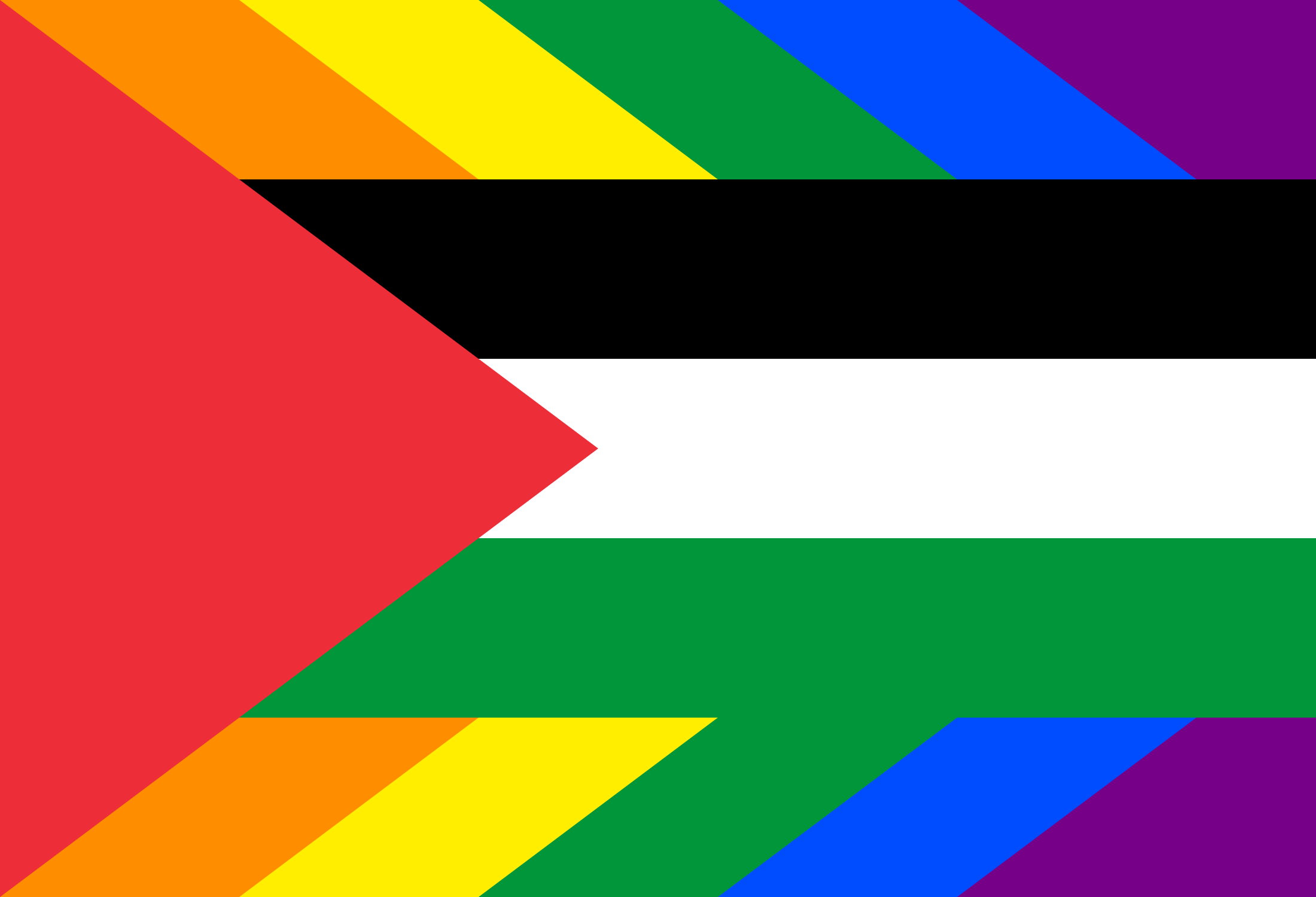
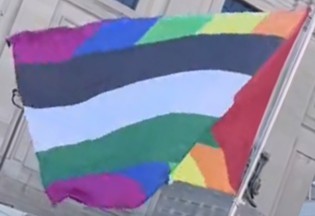
The flag of Palestine with a rainbow added above and below: the red hoist chevron and the black, white and green bands kept, and a band at top and bottom cut into orange, yellow, green, blue and purple wedges that repeat the chevron’s slope. Hannah Simpson of the Etsy shop ChangedMe claims the design as her own copyrighted work and was selling it as an enamel pin by 18 December 2020. A physical flag carrying the design was photographed at a Brooklyn rally on 28 October 2023, the earliest located record of it flown in public. Zack Wardi saw it there, could not trace the maker, and drew his own version, which he released under CC0. [1][2][3]
Key facts
- Designer
- Hannah Simpson
- Earliest located first-party record
- Documented
- By December 2020 to the present
- Aspect Ratio
- Not standardized
- Ratio Notes
- No ratio is published for the design. 22:15 and 2:1 are Wardi's two reconstructions, not the designer's specification, and the ratio of the flag photographed in Brooklyn is not securely measurable from the single available image. [2][3]
- Stripes
- 5
- Represented Identity
- Queer and LGBTQ Palestinians
Also known as
- Multi-stripes Palestinian LGBTQ Flag
Status Variant
Archive categories Regional and Language-Specific Pride Flags
Overview
Simpson's listing gives her reason: to draw attention to Queer Palestinians, whom she describes as unable to live openly. [1]
A reworking of the flag of Palestine in which the national bands are kept and the field around them is opened into a rainbow. Simpson describes the intent in her listing: “This Pride ensign of the Palestinian flag is an original copyrighted design, weaving the rainbow into traditional Arab colors”. She frames the pin as a response to an online exchange about her politics and says she wanted to know “what can I do with a pin shop to draw awareness to the cause?” [1] Wardi describes his own later method differently, as a reconstruction: “I based this design on the flag of Palestine and used the colors of the rainbow pride flag, but kept the red and green from the flag of Palestine.” [2]
Identity & Context
- Represented Identity
- Queer and LGBTQ Palestinians
- Movement
- Palestinian solidarity
- National Context
- Palestine
The design addresses Queer and LGBTQ Palestinians broadly rather than gay men alone. Flags of the World files it as a “Multi-stripes Palestinian LGBTQ” flag, the Reddit post that circulated it was captioned “Queers For Palestine”, and Simpson's listing addresses “lesbian, bisexual, gay, transgender, queer, and other kinds of Palestinians”. The designer sells it under the product title “Palestine Progress Pride “#WeWantToLive” Rainbow Pin”. The entry keeps the title under which the design is catalogued in Wardi's repository while recording the broader terms. [2][3][1]
The design joins a national flag to a Queer one. Its only documented use is at a solidarity rally in the United States; no use in Palestine, and no adoption by a Palestinian organisation, has been documented for this design. [2][3]
Creators
The Creators
Hannah Simpson
Attributed designer
Zack Wardi
Redrew the design; not its author
Zack Wardi (he/him/pup) is a Palestinian in the diaspora who lives and works on the Haldimand Tract in Canada, which he names as "the traditional territory of the Neutral, Anishinaabeg, and Haudenosaunee peoples." [4] He describes himself as a cloud systems developer and runs arabi.gay, a Mastodon server. [5] He did not design this flag. He saw it carried at a rally in Brooklyn, searched for its author without success, then drew his own vector of it in two proportions and dedicated both to the public domain under CC0 1.0. [2]
I first saw this design at a Brooklyn Rally and posted on Reddit, and tried for a while to find the original creator of the flag, but had no luck. So I decided to design one myself.
On how the vector came to be drawn.
I based this design on the flag of Palestine and used the colors of the rainbow pride flag, but kept the red and green from the flag of Palestine.
On his method in redrawing it.
I created an alternative version with propotions of 2:1 to keep the chevron occupying one third of width the flag. I think this is closer to the original design.
On the second of his two renderings. Spelling as published.
I live and work on the Haldimand Tract, the traditional territory of the Neutral, Anishinaabeg, and Haudenosaunee peoples.
His own land acknowledgment, given on his links page.
Tomislav Todorović
Later renderer, 2024
Attribution
- Organization
- ChangedMe
Attribution notes
Hannah Simpson, who trades as ChangedMe, claims the design as hers: her listing calls it “an original copyrighted design” and “an original artwork, designed, sold, and shipped by an actual transgender woman”, and describes redrawing it after requests from buyers. The claim is first-party and it is contemporaneous, appearing in a listing captured on 18 December 2020, nearly three years before the design was photographed in Brooklyn. No competing claim of authorship has been located. [1]
Two later people drew the design without claiming it. Zack Wardi saw it at the Brooklyn rally and wrote: “I first saw this design at a Brooklyn Rally and posted on Reddit, and tried for a while to find the original creator of the flag, but had no luck. So I decided to design one myself.” His files are redrawings. [2] Tomislav Todorović drew the design for Flags of the World on 18 September 2024 from a photograph located by William Garrison; that image is likewise a later rendering. [3]
Origin
- Origin Type
- first_documented_use
- Physical Origin Status
- unknown
First documented in Brooklyn, New York, on the ancestral homeland of the Lenape people, known as Lenapehoking. [6]
Indigenous land context
Lenape — ancestral homeland (Lenapehoking), at the site of first documented use (Indigenous name: Lenapehoking). The New York City Commission on Human Rights acknowledges "the land politically designated as New York City to be the homeland of the Lenape (Lenapehoking) who were violently displaced as a result of European settler colonialism over the course of 400 years," describes the Lenape as "a diasporic people that remain closely connected with this land and are its rightful stewards," and records that the city has one of the largest urban Native American and Indigenous populations in the United States. This entry records that context for the site of first documented use only; where the flag was designed is unknown. [6] [6]
Colonial / settler context
- Land status
- Colonized
- Indigenous engagement
- None documented
- Continuing presence
- Lenape diaspora communities in Oklahoma, Wisconsin, Ontario and New Jersey; New York City has one of the largest urban Indigenous populations in the United States [6]
Where the design was made is not recorded. The designer sells from the United States, but no source states where she drew it. Its earliest documented appearance in public is Brooklyn, New York, on 28 October 2023, which is a place of use rather than of design. [1][2][3]
Dates & Chronology
- Earliest located first-party record
- Documented
- By December 2020 to the present
- Creation Bounds
- The design existed by 18 December 2020, the date of the earliest located capture of Hannah Simpson's Etsy listing for it, which already describes it as an established design with an earlier variant behind it. [1] Simpson's own account places the work earlier still, and the listing's own text refers to a previous version she had replaced, but no record from before December 2020 has been located and no independent source fixes the year of design. A physical flag carrying the design was photographed at a rally in Brooklyn, New York on or about 28 October 2023, which is the earliest located record of the design flown in public. [2][3]
Sold as an enamel pin through Simpson's Etsy shop from at least December 2020, where a Palestine Pride category holding a single item appears in shop captures of October 2022 and January 2026. [1][7] A physical flag carrying the design was photographed at a rally in Brooklyn, New York on or about 28 October 2023; Flags of the World records the sighting from a photograph located by William Garrison, and a rendering of the design was posted to the r/QueerVexillology subreddit the same night. [3][2] No organization has been documented adopting it.
Major revisions
before 2020-12-18
Simpson states that her original version placed the Palestinian colours in inverted order, green above black, and that she later made the standard order the main listing after buyers asked for it, keeping the earlier design on sale separately as a “vertically inverted” variant. [1]
Flags of the World's page records an earlier and different object: at a 2019 demonstration in Haifa by members of the Palestinian LGBTQ community, against homophobic violence and for Palestinian and Queer liberation, a rainbow flag was carried with a Palestinian flag attached across two of its stripes. Todorović examined the photographs and concluded the Palestinian flag “occupies a bit less than two stripes of the rainbow flag, is attached not quite symmetrically, and there is a fold which reveals that it was not stuck completely when it had been attached. Due to this last feature, perhaps this is not supposed to be considered a single flag with a new design.” The Haifa photographs are credited to Amir Levy. That object is not this design. [3]
Flags of the World cites, for the Brooklyn photograph, a website whose editorial position is hostile to the people the flag represents. This entry records the sighting and its date through Flags of the World and does not link that source.
Lineage
- Direct predecessors
- Rainbow Pride Flag
- Sibling flags
- Alberta Gay Flag, Straight Ally Pride Flag, Anarcha-Queer Flag (rainbow variant), Argentina Gay Flag, Australia Gay Flag, Brazil Gay Flag
+ 44 more
British Columbia Gay Flag, Canadian Pride Flag, Chicago Pride Flag (Rainbow Stripes, Purple Stars), Chile Gay Flag, Dominican Republic Gay Flag, Egypt Gay Flag, European Union Gay Flag, France Gay Flag, Gay Pride Flag of Pakistan, Heteroflexible Pride Flag, Heterosexual / Straight Pride Flag, Homoflexible Pride Flag, India Gay Flag, Italy Gay Flag, Japan Gay Flag, Jewish Gay Pride Flag, Manitoba Gay Flag, Mexico Gay Flag, Netherlands Gay Flag, New Brunswick Gay Flag, Newfoundland Gay Flag, Northwest Territories Gay Flag, Nova Scotia Gay Flag, Nunavut Gay Flag, Ontario Gay Flag, Panama Gay Flag, Philadelphia Pride Flag, Prince Edward Island Gay Flag, Quebec Gay Flag, Rainbow Flag with White Triangle (Sapporo), Rainbow Israel Flag, Rainbow Polish Flag (2014, Angela Getler), Russia Gay Flag, Saskatchewan Gay Flag, Social Justice Pride Flag, South African Gay Pride Flag, Switzerland Gay Flag, Tanzania Gay Flag, Texas Rainbow Flag, Turkish Gay Pride Flag, Two-Spirit Pride Flag (2005, Zoccole), Two-Spirit Pride Flag (2016 Tumblr documentation), Victory Over AIDS Flag (1980s, designer unknown), Yukon Territory Gay Flag
Two components, only one of which has an entry here. The national flag of Palestine supplies the red hoist chevron and the black, white and green bands, which keep their usual order through the centre. The six-stripe Rainbow Pride Flag supplies the colours of the bands added above and below, each cut into wedges that repeat the chevron’s slope. The designer describes the work as weaving the rainbow into the traditional Arab colours; the later reconstructor names the same two sources for his redrawing. [1][2]
Simpson records one revision of her own: an earlier version placed the Palestinian colours in inverted order, green above black, which she says she chose in order to elevate future prosperity over present suffering. She replaced it as the main listing after buyers asked for the standard order, and kept the earlier design on sale separately. That earlier version is a variant within this design family rather than a separate lineage. [1]
Lineage tree
Every record reachable from this one through documented parent and child relationships: 4 records across 4 generations.
- Ancestors -3
- Original Rainbow Flag (1978)
- Ancestors -2
- Seven-Stripe Rainbow Flag (1978)
- Ancestor
- Rainbow Pride Flag
- This record
- Palestinian Gay Pride Flag
Colors & Symbolism
Simpson's listing gives the design's meaning in her own words, reading the Palestinian colours through Arab and Muslim tradition: the rainbow is woven “into traditional Arab colors that honor the submission to Islam (red), the suffering of humanity, particularly of queers who live in secrecy (black), the prosperity and vision for the future (green), and the peace and love of the Prophet Muhammad (white) that runs centrally through the design. The rainbow colors are tender and muted, evoking the hospitality of the arab muslim and christian households.” This is the designer's published statement rather than a community reading, and no independent source corroborates it. [1]
| Colour | Hex |
|---|---|
| Green (Palestinian band) | #009639 |
| White (Palestinian band) | #FFFFFF |
| Black (Palestinian band) | #000000 |
| Red (hoist chevron) | #ED2E38 |
| Orange (rainbow wedge) | #FF8D00 |
| Yellow (rainbow wedge) | #FFEE00 |
| Blue (rainbow wedge) | #004CFF |
| Purple (rainbow wedge) | #770088 |
Read from the vector this entry publishes. No palette has been published for the design; these are the maker's chosen values.
This flag has no official digital palette. Color values shown are approximate.
- Red chevron
- Submission to Islam, in the designer's reading. [1]
- Black band
- The suffering of humanity, and particularly of Queer people living in secrecy, in the designer's reading. [1]
- White band
- The peace and love of the Prophet Muhammad, running centrally through the design, in the designer's reading. [1]
- Green band
- Prosperity and a vision for the future, in the designer's reading. [1]
- Added rainbow stripes
- Described by the designer as tender and muted, evoking the hospitality of Arab Muslim and Christian households. [1]
The reading above is the designer's own, published in a commercial listing alongside her political commentary. It is recorded here as her statement. How the flag was understood by the people who carried it in Brooklyn is not documented. The one documented public appearance was at a rally under the banner of Queer solidarity with Palestine, which is context for how the flag was used rather than a statement of what its parts mean.
No palette has been published for the design. Wardi's vector uses #009639 for the green, the value carried by the Wikimedia Commons file for the flag of Palestine that he names as his source; that is his choice, not a designer specification. [2] Simpson describes her rainbow colours only in words, as tender and muted. [1]
The table above was empty until 16 August 2026 and is now read from the vector itself. The black band carries no fill attribute in that file and so renders in the SVG default, black; it is recorded here as the value it paints rather than as a stated specification.
Design
- Aspect Ratio
- Not standardized
- Ratio Notes
- No ratio is published for the design. 22:15 and 2:1 are Wardi's two reconstructions, not the designer's specification, and the ratio of the flag photographed in Brooklyn is not securely measurable from the single available image. [2][3]
- Orientation
- horizontal
- Stripe Count
- 5
- Layout
- horizontal bands with a hoist chevron and chevron-cut rainbow bands
- Stripes (Top → Bottom)
- Rainbow band, cut into orange, yellow, green, blue and purple wedges from hoist to fly, Black, White, Green, Rainbow band, cut into orange, yellow, green, blue and purple wedges from hoist to fly
- Additional Symbols
- Red chevron at the hoist
Five horizontal bands of equal depth, each a fifth of the hoist. The middle three are the flag of Palestine's black, white and green. The top and bottom bands are each divided into five wedges in orange, yellow, green, blue and purple, running hoist to fly, whose leading edges are cut at the same slope as the red chevron at the hoist, so they read as chevrons nested behind it. The chevron's point reaches the middle of the flag. Measured from Wardi's vector. [2] The same five-band construction is visible in the photographed flag and in the designer’s enamel pin. [3][1]
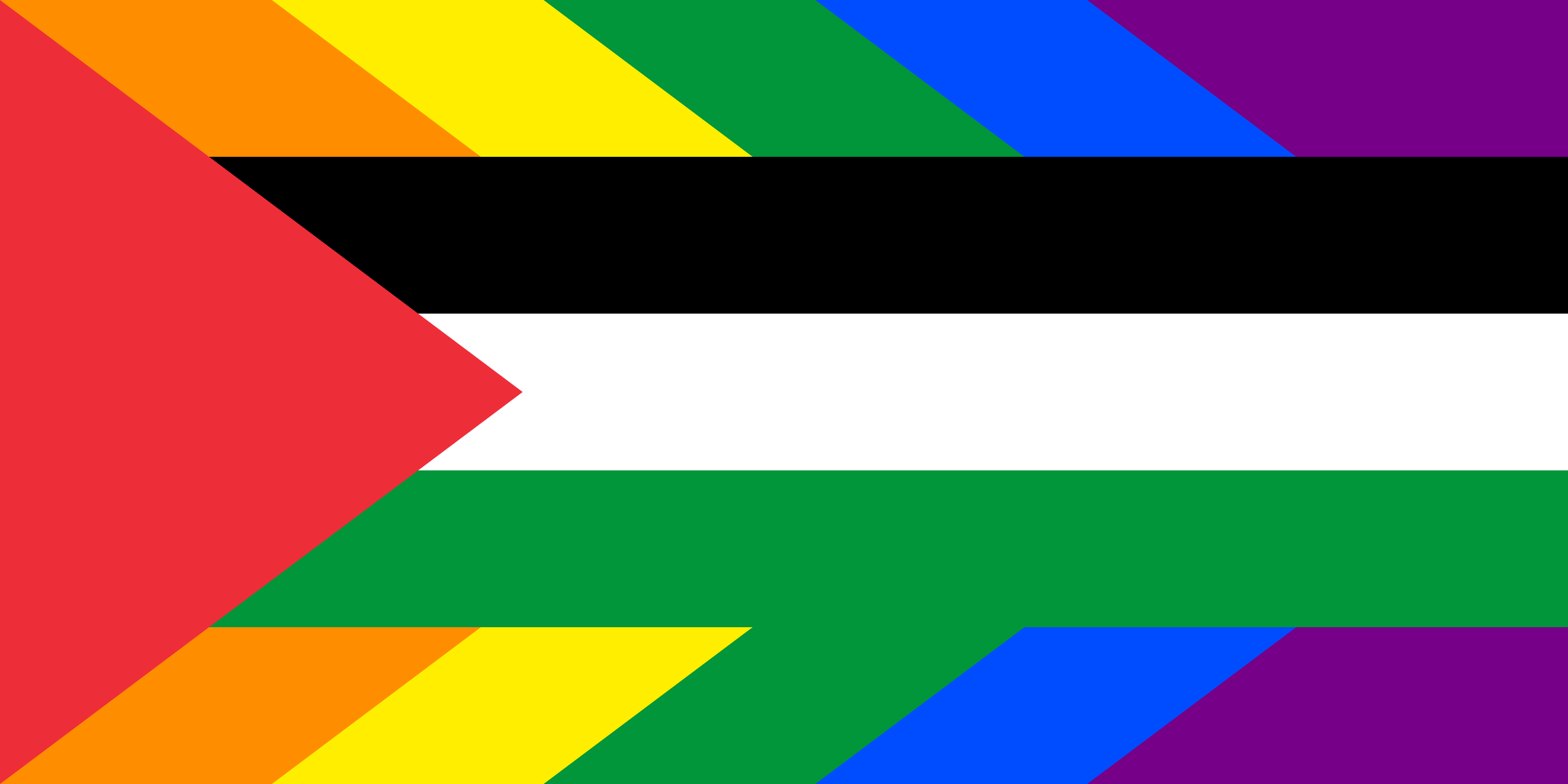
No construction sheet by the designer has been located, and the proportions of the photographed flag cannot be measured reliably from the one available image. Two later reconstructions exist, both by Zack Wardi and both his own. The flag of Palestine is a horizontal tricolour at 2:1; his main version is 22:15 “because I added two more stripes of the same height and expanded the chevron keeping its aspect ratio.” He also drew an alternative at 2:1 “to keep the chevron occupying one third of width the flag,” which he thinks “is closer to the original design,” while noting that its rainbow parallelograms are then almost but not quite rhombi: one side measures 5.2 units against the other's 5. Neither ratio is a specification for the design itself. [2]
A red chevron at the hoist, its point reaching the centre of the flag, over five horizontal bands of equal depth. The middle three carry the flag of Palestine's black, white and green. The top and bottom bands each run orange, yellow, green, blue and purple from hoist to fly, divided by diagonals parallel to the chevron, so the rainbow reads as a series of chevrons behind the red one. Every colour of the six-stripe rainbow flag is present: red in the hoist chevron, the other five in the outer bands. Wardi's principal rendering is at 22:15; his alternative is at 2:1, the proportion of the flag of Palestine. [2]
Usage & Adoption
- Geographic Usage
- United States
- Online Usage
- Sold as an enamel pin through the Etsy shop ChangedMe, listed by 18 December 2020 and still carried in January 2026 [1][7], A rendering posted to the r/QueerVexillology subreddit on 29 October 2023 [2]
- Current Status
- Commercially available; one documented case of public use
Two kinds of circulation are documented and they should not be added together. The designer has sold the design commercially since at least December 2020, which establishes availability and nothing more. [1] Separately, one case of public use is documented: a physical flag at a Brooklyn rally on or about 28 October 2023, recorded through a photograph located for Flags of the World and through a rendering posted to Reddit the same night. [2][3] No adopting organization has been identified, and the designer's statement that she sold a flag for that event has not been verified.
Image Archive
Later reconstructions
Documented use, 2023
Discourse & Debates
Common misidentifications
- Conflated with the rainbow flag carried at the 2019 Haifa demonstration, which was a Palestinian flag attached across two stripes of a rainbow flag rather than a single integrated design. [3]
- Wardi's 22:15 vector and Todorović's Flags of the World drawing are both reproduced as though they were the original artwork. Both are later reconstructions by people who did not design the flag, and their proportions are their own. [2][3]
The design reaches its readers through two settings that do not share a politics, and the record keeps them apart.
At the Brooklyn rally the flag was carried in a demonstration for Palestine, and the Reddit post that circulated it was captioned “Queers For Palestine”. Read there, it is a Palestinian LGBTQ solidarity flag. [2]
The designer's own published framing is different. Simpson's listing sets the design against Hamas, whom she holds responsible for Palestinian suffering, describes the pin as prompted by an exchange with someone who called her a Zionist, and closes: “Holding queer palestinians in our hearts, and doing what we can to elevate their stories, is an embodiment of Zionism.” She sells a companion pin combining the Israeli and Palestinian designs. [1]
No source records what the people who carried the flag in Brooklyn understood by it, or whether they knew where the design came from. The designer's framing is documented and hers; it does not establish how the flag was read by others.
Footnotes & Citations
Sources and footnotes 8 sources
- 1. Retail listing Palestine Progress Pride “#WeWantToLive” Rainbow Pin. Hannah Simpson (ChangedMe). Etsy. Accessed 2026-08-16 · Archived version
The designer's own listing for the design, read in full from a capture of 18 December 2020. It carries her claim to the design, her reading of its colours, her account of an earlier vertically inverted version, and her political framing. The live page is not reachable from this archive's tooling; the capture is the copy read.
- 2. Designer page palestinian-gay-pride-flag. Zack Wardi. GitHub. Accessed 2026-08-16 · Archived version
Wardi's own repository, carrying his account of seeing the design in Brooklyn, his statement that he could not find its creator, his construction notes for both proportions, and the CC0 1.0 dedication over his drawings. It also links the Reddit post, whose author is DeBaers and whose attached image is a rendering rather than a photograph of the rally.
- 3. Databases Pro-Palestinian LGBTQ flags. ian macdonald (editor); flag documentation by Tomislav Todorović, with photographs located by William Garrison. Flags of the World (2024-10-12). Accessed 2026-08-16
A signed contributor page rather than vetted reference text. Cited here for the 2019 Haifa object and Todorović's analysis of it, for the Brooklyn sighting dated about 28 October 2023, for the name “Multi-stripes Palestinian LGBTQ”, and as the host of the only located photograph of the flag in use. The page's own source for that photograph is not linked from this entry.
- 4. Primary statement Zack Wardi (personal links page). Zack Wardi. wardi.pink. Accessed 2026-08-16
Wardi's own links page, cited for his self-description, pronouns and land acknowledgment.
- 5. Primary statement zackwardi (GitHub profile README). Zack Wardi. GitHub. Accessed 2026-08-16
Wardi's GitHub profile, cited for his occupation and for arabi.gay.
- 6. Government CCHR Land Acknowledgement. New York City Commission on Human Rights. Accessed 2026-08-16
The city's own land acknowledgment, cited for the Lenape homeland at the site of first documented use.
- 7. Retail listing ChangedMe. Hannah Simpson. Etsy. Accessed 2026-08-16 · Archived version
The shop page naming Hannah Simpson as owner, with a Palestine Pride category holding one item. Read from captures of 21 October 2022 and 29 January 2026.
- Articles & Reports Why I painted a rainbow flag on Israel's apartheid wall. Khaled Jarrar. The Electronic Intifada (2015-07-02). Accessed 2026-08-16 · Archived version
A signed first-person account by the artist, published in an advocacy outlet, cited here for his own actions, words and definition of pinkwashing and not as neutral reporting.
Image Sources
- Rendering
- hero image is a later reconstruction, not the designer's artwork
- Zack Wardi's 22:15 reconstruction, drawn after seeing the design in Brooklyn · Credit: Zack Wardi, CC0 1.0 · GitHub · verifiedRights Wardi released his vector under the CC0 1.0 Universal public-domain dedication, whose full text is in the repository. The dedication covers his drawing only. It does not reach the underlying design, which Simpson claims as copyrighted. [2][1] Rights information
- Wardi's alternative reconstruction at 2:1, drawn so the chevron occupies a third of the flag's width. He considers it closer to the design he saw in Brooklyn, and notes that its rainbow parallelograms fall just short of rhombi, one side measuring 5.2 units against the other's 5. [2] · Credit: Zack Wardi, CC0 1.0 · GitHub · CC0 1.0 Universal (Public Domain Dedication)
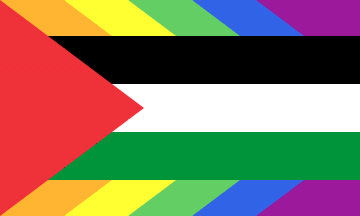
- The design on a physical flag at a rally in Brooklyn, New York, on or about 28 October 2023. This is the earliest located photograph of the flag in public use. Flags of the World published it from a photograph located by William Garrison on 1 November 2023. [3] · Credit: Photographer not identified; located by William Garrison for Flags of the World · Flags of the World
- Tomislav Todorović's rendering for Flags of the World, 18 September 2024, drawn from the Brooklyn photograph. A later vexillological drawing, not the designer's artwork. [3] · Credit: Tomislav Todorović, Flags of the World · Flags of the World