Two-Spirit Transgender Pride Flag
Indigenous Pride Flag · Photographed in use 25 July 2022
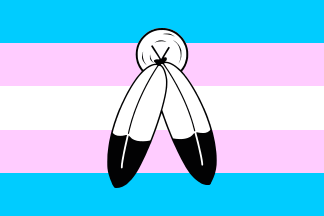
Monica Helms's Transgender Pride Flag charged with the two-feather-and-circle device credited to the Tumblr user 2Sanon. Who combined the two, and when, is not documented; the earliest use located is Danielle Paradis's photograph for APTN of Jack Saddleback holding the flag toward the chiefs of Treaty 6 as they entered for Pope Francis's apology to residential school survivors at Maskwacis, Alberta, on 25 July 2022. Flags of the World, which records the design from that photograph, describes it as used by the Maskwacis people; the photograph shows one person. [1][2]
Key facts
- Designer
- Unknown
- Earliest documented use
- Documented
- Photographed in use 25 July 2022
- Aspect Ratio
- Not standardized
- Ratio Notes
- No ratio is published for this design, and nobody is identified as having made it who could publish one. Zachary Harden’s rendering for Flags of the World is 324 by 216 pixels, a ratio of 3:2, which is that drawing’s proportion and the proportion Flags of the World draws most flags at. [1] The cloth flag in the Maskwacis photograph is held open by hand at a slight angle, so no proportion can be measured from it. [2]
- Stripes
- 5
Status Variant
Archive categories Gender Identity Pride Flags · Indigenous Pride Flags
Overview
A base flag with a device added, and the addition is undocumented. The device was made to be transferable, and the post that circulates it names this base among its intended ones: “It’s usually put over the general pride flag but it can also be put on the #transgender or #nonbinary flags.” [3] A later post describes it the same way, as “the traditional pride flag (or the trans or nonbinary flag) with the symbol of a circle, denoting oneness, and two feathers, signifying female and male”. [4] Who acted on that, and when, is not recorded. [1]
Identity & Context
Two-Spirit is a pan-Indigenous umbrella term; 2-Spirited People of the 1st Nations records that the elder teachings behind it belong to many Nations, and the meaning of the term is Indigenous communities’ to give. The scope of the term is not the scope of this graphic: what is documented for this particular combination of the device with the Transgender Pride Flag is one photograph, at one event, in Treaty 6 Territory. This entry describes a flag, not the tradition.
Creators
Creator unknown
No identification located
Who set the two-feather-and-circle device on the Transgender Pride Flag is not documented. Flags of the World records only that the device “was added” to “the transgender flag by Monica Helms”. [1]
The contributions that are documented separate cleanly. Monica Helms designed the Transgender Pride Flag in 1999 and is the designer of the base rather than a co-designer of this combination. The device is credited to a Tumblr user posting as 2Sanon. Zachary Harden drew the vexillological rendering for Flags of the World on 13 September 2023. Danielle Paradis photographed the flag in use for APTN, and Jack Saddleback is the earliest documented user. [1][2]
The credit to 2Sanon rests on later posts by other people. The one Flags of the World cites, published by madeinchinaassembledinuk on 29 June 2021, says “This particular Two Spirit Pride flag was designed by 2Sanon in 2016. The two feathers represent woman and man, and the circle represents unity in one”, and ends “The information given has been researched to the best of my ability but if anything is incorrect, please let me know and I will correct it.” [3] A later post by iammisthaven gives a day: “This flag design was initially submitted by Tumblr user 2Sanon on December 17th, 2016.” [4] Neither cites a source, and 2Sanon’s own submission has not been recovered, so its wording, its publication context and the symbolism attached to it are documented only at second hand.
Contribute information about who designed this flag.
Attribution
- Primary Designer
- Unknown
Origin
The place recorded here is where the flag was photographed in use, not where it was made. No site of design has been documented, so no place is plotted for this record. [2]
Indigenous land context
Louis Bull Tribe — One of the four First Nations that make up Maskwacis, where the flag was photographed in use [2]
Montana First Nation — One of the four First Nations that make up Maskwacis, where the flag was photographed in use [2]
Samson Cree Nation — One of the four First Nations that make up Maskwacis, where the flag was photographed in use [2]
Ermineskin Cree Nation — One of the four First Nations that make up Maskwacis, where the flag was photographed in use [2]
Colonial / settler context
Maskwacis lies in Treaty 6 Territory, in the province of Alberta, Canada. [2]
No place of origin is documented. The earliest documented use is at Maskwacis, Alberta, in Treaty 6 Territory; a place of use is not a place of design, and no source places the making of this combination anywhere. [2]
Indigenous Identity Context
- Nation
- Not established. No Nation is documented for the maker of this design.
- Territory
- Treaty 6 Territory (place of the documented use)
- Geographic Scope
- Not established for this design. The documented circulation is one use, at Maskwacis, in Treaty 6 Territory.
- Colonial State
- Canada
- Traditional Knowledge Notice
- Yes
The flag’s one documented appearance is at Maskwacis, Alberta, on 25 July 2022, when Pope Francis apologised to residential school survivors. Jack Saddleback held it toward the chiefs of Treaty 6 as they entered, wearing a medallion of a rainbow and a medicine wheel, and was there supporting grandparents who had been through residential school. Maskwacis, formerly Hobbema, is made up of the Louis Bull, Montana, Samson and Ermineskin First Nations; that is the place of the photograph, not a record of any of those Nations adopting the design. The device on the flag is credited to a Tumblr user and belongs to no Nation in any source located. [1][2]
Dates & Chronology
- Earliest documented use
- Documented
- Photographed in use 25 July 2022
- Creation Bounds
- No date of creation is documented. Monica Helms's Transgender Pride Flag dates to 1999, and the device is dated to 2016 in later posts, which bounds the combination below and no further. [3] The post that circulates the device, published in June 2021, already names the transgender flag as one of the bases it can be put on, so the combination was described before it was photographed; that is not evidence that this artifact existed then. [3] The earliest use located is the photograph taken at Maskwacis on 25 July 2022, which documents a use rather than the first use. [2]
The flag appears in APTN’s coverage of Pope Francis’s apology to residential school survivors at Maskwacis, Alberta, on 25 July 2022, the first formal event of the papal visit. Approximately 2,000 guests attended, almost all Survivors of residential or day schools, along with elders and knowledge keepers. The ceremony opened with a grand entrance from the chiefs of Treaty 6, the current chiefs entering from the east and the former chiefs from the south. [2]
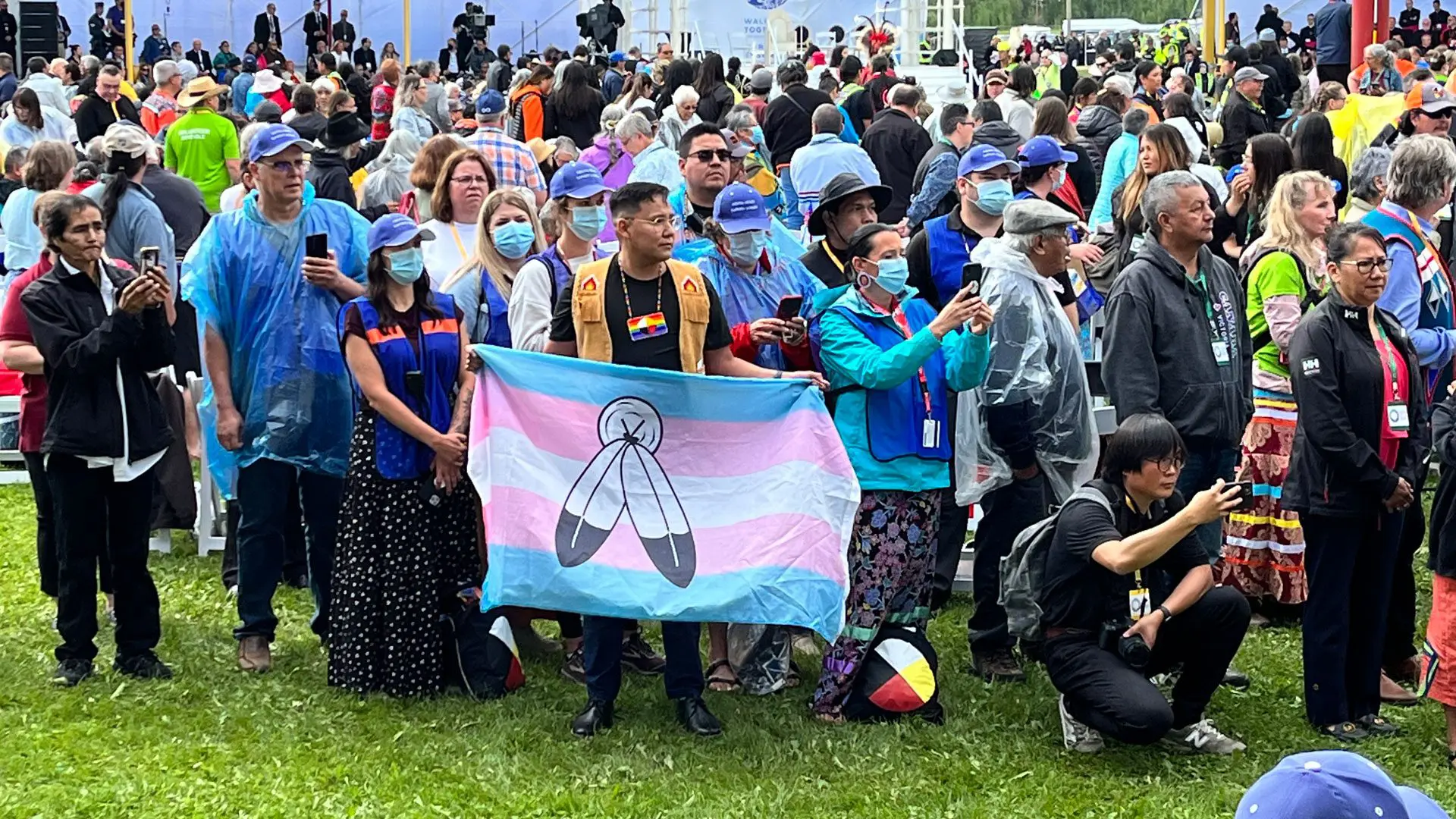
Danielle Paradis photographed Jack Saddleback holding the flag at that moment, captioned “Jack Saddleback holding Two-Spirit flag at the beginning of the chief’s procession.” APTN reports that he wore a medallion featuring a rainbow and a medicine wheel, and that “He held a Two-Spirit flag towards the chiefs as the grand entry began.” Saddleback was there supporting grandparents who went through residential school, and told APTN: “For me, it is important to be here. I’ve had a lot of complex emotions about actually attending because we need to be able to have the lived history. The one that got systematically attacked by this Catholic church system.” He also said: “Prior to colonization we had an understanding of gender diversity and we understood that people are people— however they are born.” [2]
APTN calls the flag simply a Two-Spirit flag and does not distinguish it from the rainbow-based version. [2] Flags of the World names the base directly, as “the transgender flag by Monica Helms”, and the photograph agrees: the five stripes of light blue, pink, white, pink and light blue are unambiguous in it. [1][2]
The same Flags of the World sentence says the flag “has been used by the Maskwacis people of Alberta”, and cites that photograph for it. The photograph shows one person holding one flag at one event. Maskwacis, formerly known as Hobbema, is made up of the Louis Bull, Montana, Samson and Ermineskin First Nations; no source records any of them creating, adopting or commissioning this design. [1][2]
Lineage
- Direct predecessors
- Transgender Pride Flag, Two-Spirit Pride Flag (2016 Tumblr documentation)
Two designs meet in this flag. The field is Monica Helms’s Transgender Pride Flag of 1999, named as such by Flags of the World and unmistakable in the photograph. [1][2] The charge is the two-feather-and-circle device credited to 2Sanon, made to be moved between base flags: “It’s usually put over the general pride flag but it can also be put on the #transgender or #nonbinary flags.” [3]
The rainbow-based Two-Spirit Pride Flag is the device’s earliest and best-known application rather than this flag’s parent. Flags of the World documents four combinations, on the rainbow flag, the Progress flag, the New Progress flag and this one, and each stands in the same relation to the others: applications of one device to different bases. [1]
Lineage tree
Every record reachable from this one through documented parent and child relationships: 6 records across 5 generations.
- Ancestors -4
- Original Rainbow Flag (1978)
- Ancestors -3
- Seven-Stripe Rainbow Flag (1978)
- Ancestors -2
- Rainbow Pride Flag
- This record
- Two-Spirit Transgender Pride Flag
Colors & Symbolism
The base flag and the device each carry their own meanings, and no source states a meaning for the combination.
- Two feathers bound beneath a circle
- “The two feathers represent woman and man, and the circle represents unity in one.” The wording is from the 2021 post that credits the device to 2Sanon, not from 2Sanon. Flags of the World reports the same sentence as coming from “the author”, but the text it links is that third-party post. [1][3]
No meaning is stated anywhere for the combination itself. The base flag carries Monica Helms’s documented meanings and has its own entry.
The palette is the base flag's; no separate specification exists for the combined design.
Design
- Aspect Ratio
- Not standardized
- Ratio Notes
- No ratio is published for this design, and nobody is identified as having made it who could publish one. Zachary Harden’s rendering for Flags of the World is 324 by 216 pixels, a ratio of 3:2, which is that drawing’s proportion and the proportion Flags of the World draws most flags at. [1] The cloth flag in the Maskwacis photograph is held open by hand at a slight angle, so no proportion can be measured from it. [2]
- Orientation
- horizontal
- Stripe Count
- 5
- Layout
- base flag with central device
- Center Symbol
- Two feathers bound beneath a circle
The Transgender Pride Flag’s five-stripe geometry, light blue, pink, white, pink and light blue, with the two-feather device centred: a circle crossed by fine lines, and beneath it two feathers, white with black tips, hanging from a knot and splaying outward. Read from the Flags of the World rendering and confirmed against the photograph taken at Maskwacis, in which the same circle and pair of feathers are legible on the cloth. [1][2]
Usage & Adoption
- Earliest documented user
- Jack Saddleback, Maskwacis, Alberta, 25 July 2022 [2]
- Geographic Usage
- Maskwacis, Alberta, Treaty 6 Territory [2]
- Event Usage
- Pope Francis's apology to residential school survivors, Maskwacis, Alberta, 25 July 2022. Held by Jack Saddleback toward the chiefs of Treaty 6 during the opening procession. [2]
- Current Status
- unknown
One documented case of use: one person, at one event. Flags of the World records no other and none has been located, which bounds what has been found rather than what happened. [1][2]
Image Archive
The documented use, 2022
Later rendering, 2023
Discourse & Debates
- Later designers have published alternatives without faulting this one. iammisthaven, redesigning the Two-Spirit flag for Pride Month 2025, gave as the reason that “the Two-Spirit flag should foster pan-Indigenous solidarity and reject the colonial labels placed upon Indigenous LGBTQIA+ individuals”, and that the community should have options. [4]
Criticisms
- The method this flag uses, a device laid on an existing pride flag, has been criticised from within Two-Spirit design, though the criticism on record addresses the rainbow version rather than this one. The artist inkwellsartist called the best-known version “lackadaisical to be blunt, it is just the regular rainbow flag with two feathers on it and for me it just says ‘oh yeah native people are here too’ it does not feel genuine”, and published an alternative intended to be “identifiably indigenous not to just fall into the background”. [5]
Community reception
A contributor to the Flags of the World page, Samuel Edwards, wrote that “the flag with the transgender colors in the background would be most appropriate, as that is what most users of the flag are trying to convey.” That is one contributor’s opinion on a discussion page, and no source establishes what most users intend. [1]
No source gives this design a name of its own. Flags of the World files it as the “Transgender variant” and labels its image “[Two-feather Transgender flag]”; APTN calls it a Two-Spirit flag. [1][2]
The post that circulates the device sets out what the term Two-Spirit is and is not: it is “a modern, pan-Indian umbrella term used by some indigenous North Americans to describe Native people in their communities who fulfill a traditional third gender or other gender variant ceremonial and social role in their cultures”, and “shouldn’t be used interchangeably with ‘LGBT Native American’ or ‘Gay Indian’ as the title isn’t a modern, self-chosen term of personal gender and/or sexual identity, but is a sacred, spiritual, and ceremonial role that is recognised and confirmed by the Elders of the Two Spirit’s ceremonial community.” It dates the term to the 1990 Indigenous lesbian and gay international gathering in Winnipeg, chosen to replace the anthropological term “berdache”. [3] Two-Spirit is given elsewhere as an English translation of the Anishinaabemowin term niizh manidoowag, agreed at that 1990 gathering. [4]
Footnotes & Citations
Sources and footnotes 6 sources
- 1. Reference "Two Spirits" Gay Pride Flags. Zachary Harden, Tomislav Todorović and Samuel Edwards. Flags of the World (2023-09-30). Accessed 2026-08-11
The only vexillological source located for this variant, and the source of its rendering. Contributor-written, signed and dated per paragraph; the paragraph on this flag is one sentence by Tomislav Todorović, 13 September 2023, which cites the APTN photograph.
- 2. News Mixed reaction from survivors greets Pope's apology. Danielle Paradis. APTN News (2022-07-25). Accessed 2026-08-11
Reports the event and carries the photograph of the flag in use, with its caption and photographer credit. The article names the flag only as a Two-Spirit flag.
- 3. Social media This particular Two Spirit Pride flag was designed by 2Sanon in 2016. madeinchinaassembledinuk. Tumblr (2021-06-29). Accessed 2026-08-11
The post Flags of the World cites for the device, published 29 June 2021 and cross-posted from Instagram. Written by a third party crediting 2Sanon five years after the date it gives, not by 2Sanon, and it says its information was “researched to the best of my ability”.
- 4. Social media Redesigning the Two-Spirit Flag for Pride Month 2025. iammisthaven. Tumblr. Accessed 2026-08-11
Dates the 2Sanon design to 17 December 2016 and names the transgender and nonbinary flags among its standard bases. A designer publishing alternatives, not the original designer; it cites no source for the date, and the link is to the blog rather than to a post permalink.
- 5. Social media Happy indigenous history month. inkwellsartist. Tumblr. Accessed 2026-08-11
Criticises the device-on-a-base approach and publishes an alternative. Credits the best-known version to 2Sanon and a second design to miigwan. The link is to the blog rather than to a post permalink.
- 6. Reference Disclaimers and Copyright. Flags of the World (2023-11-18). Accessed 2026-08-16
The site’s published copyright terms, cited for the conditions on reuse of contributor artwork.
Image Sources
- Rendering
- FOTW contributor rendering
- The photograph of the flag in use at Maskwacis, 25 July 2022, published by APTN News. Copyrighted news photograph; no reuse licence is stated and none has been located. [2]
- The flag rendering, drawn for Flags of the World and dated there 13 September 2023. Contributor artwork, copyright the contributor under the site’s published terms. [1][6]
- “Jack Saddleback holding Two-Spirit flag at the beginning of the chief’s procession.” Maskwacis, Alberta, 25 July 2022, at Pope Francis’s apology to residential school survivors. Saddleback, in the tan vest and rainbow medallion, holds one edge; the flag is held open between him and a second person APTN does not name. This is the photograph Flags of the World cites, and the earliest documented use of the design. [2] · Credit: Danielle Paradis / APTN · APTN News
- The design as drawn for Flags of the World by Zachary Harden, dated there 13 September 2023. A vexillological rendering made after the photograph, 324 by 216 pixels; not the 2022 artifact. [1] · Credit: Zachary Harden, Flags of the World · Flags of the World