Victory Over AIDS Flag (1980s, designer unknown)
Inclusive Pride Flag · By June 1988 at latest
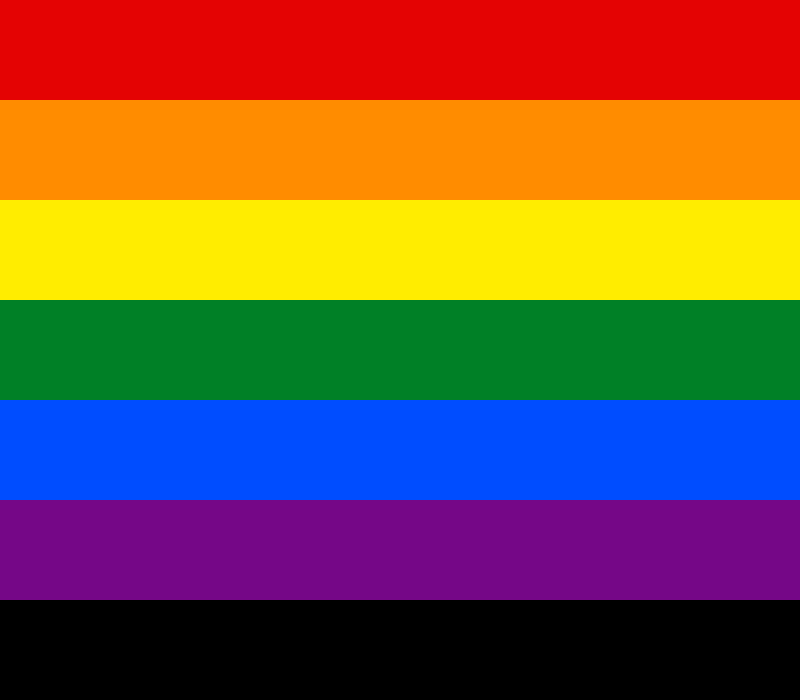
A six-stripe rainbow flag with a single black stripe added at the bottom, used during the AIDS pandemic to mourn those lost to AIDS and to stand with people living with HIV. Secondary flag guides attribute the origin to an unnamed San Francisco organization in the 1980s, and no source names an individual designer. Those guides consistently associate Sgt. Leonard Phillip Matlovich (1943 to June 22, 1988) as the flag's most public advocate and as the author of the directive that the black stripes be ceremonially burned in Washington, D.C. once a cure for AIDS was found. This is an early documented example of reading a black stripe on a pride flag as AIDS mourning, a reading the Progress Pride Flag (2018) also carries among its black stripe's meanings, though no direct design descent is documented.
Key facts
- Designer
- Unknown
- In use
- By June 1988 at latest
- Aspect Ratio
- 3:5
- Stripes
- 7
- Origin
- San Francisco, California, United States
- Represented Identity
- AIDS memorial and people living with HIV
Also known as
- Victory over AIDS Pride Flag
- Black-Stripe Rainbow Flag
- AIDS Memorial Rainbow Flag (informal)
Status Canonical Historical
Archive categories Inclusive and Progress Pride Flags · Historical and Early Pride Flags
Overview
To create a visual marker of mourning and solidarity within the existing rainbow flag, by adding a single black stripe at the bottom. The black stripe stood for those lost to AIDS and for those living with HIV. Secondary sources attribute to Matlovich the directive that this stripe be removed and ceremonially burned once a cure was found. [1][2]
The Victory Over AIDS flag emerged during the AIDS pandemic in the United States, as deaths mounted through the 1980s and the epidemic drove new forms of political mobilization, including ACT UP (founded 1987) and the AIDS Memorial Quilt, created by the NAMES Project Foundation (1987). Better-known AIDS memorial works of the period are well attributed, but no individual creator or organizing body for this flag is named in the available sources. [3][1][2]
Identity & Context
- Represented Identity
- AIDS memorial and people living with HIV
- Subcommunity
- AIDS activism
- Movement
- 1980s AIDS activism in the United States
The flag is closely associated with U.S. AIDS activism of the 1980s and with the LGBT communities most heavily affected by the early years of the pandemic.
Creators
The Creator
Unknown
Designer
No individual designer is named in any of the available sources. Secondary sources state that the flag was 'suggested by a San Francisco organization' or 'a San Francisco group,' without identifying the organization, and give the year of creation only as 'sometime in the 1980s.' [3][1][2] If you can identify the designer or the organization, please share what you know: contribute.
Sgt. Leonard Phillip Matlovich
Advocate; the burning-ritual directive is attributed to him (not the flag's designer)
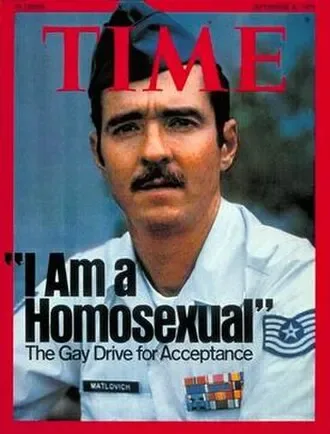
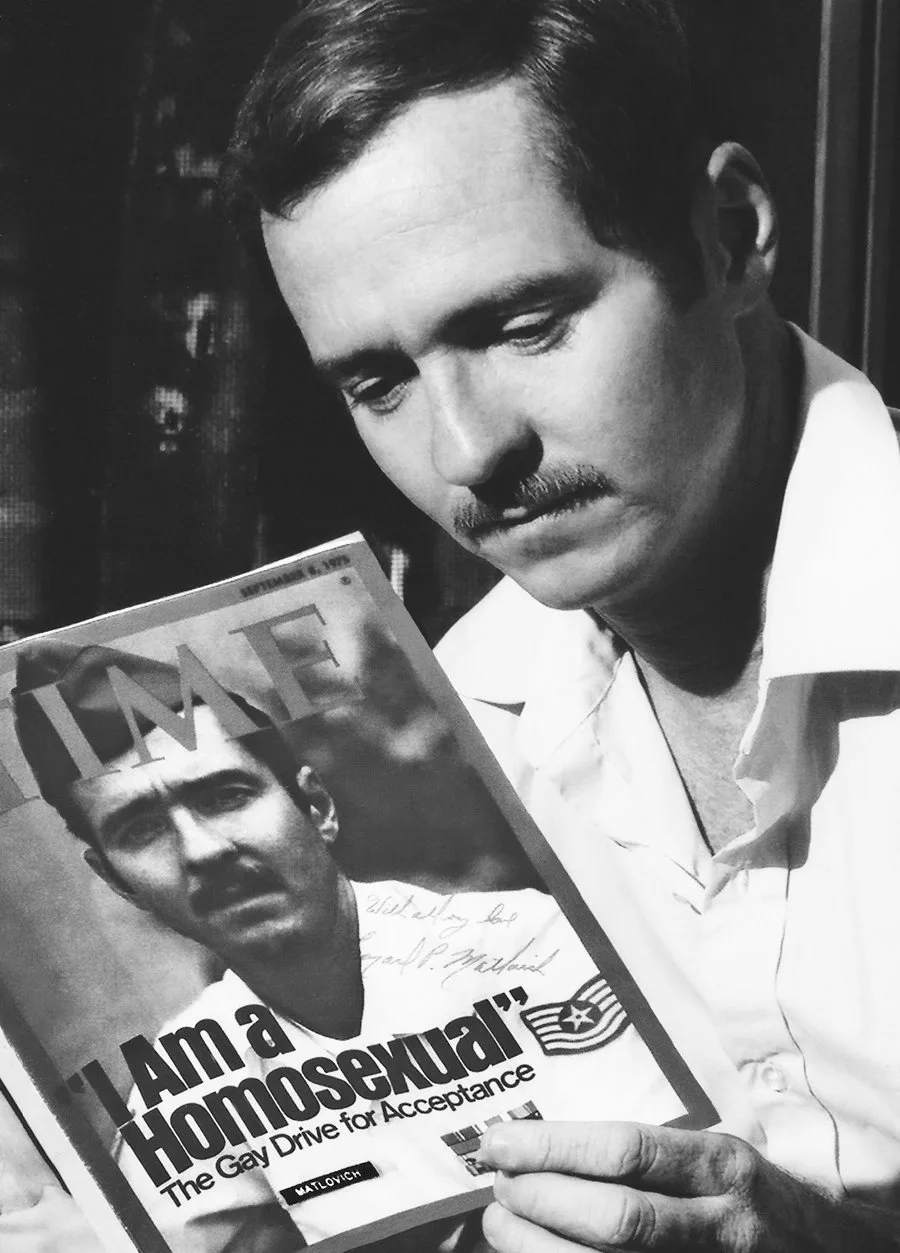
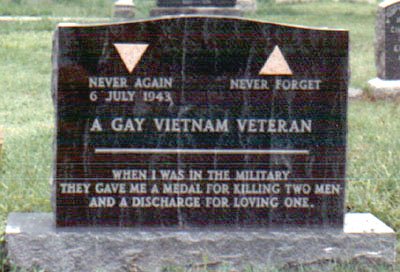
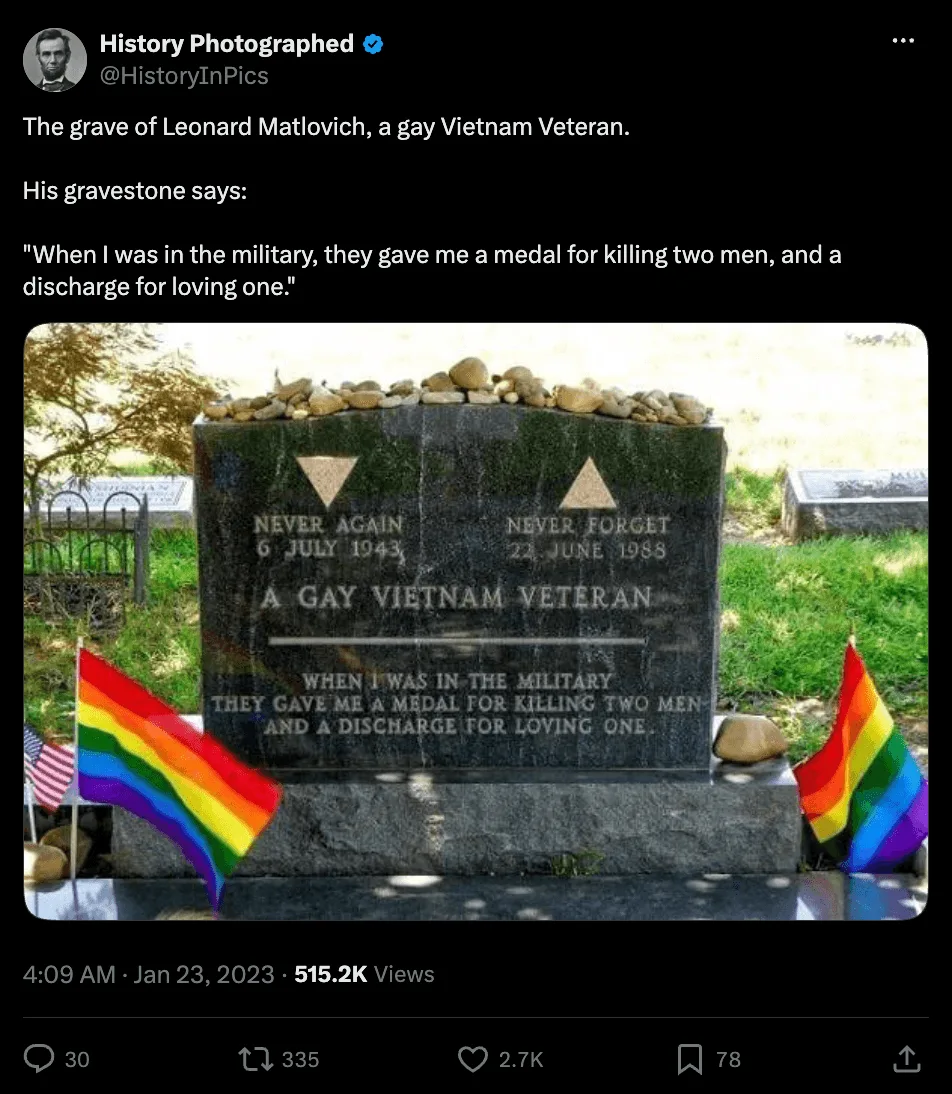
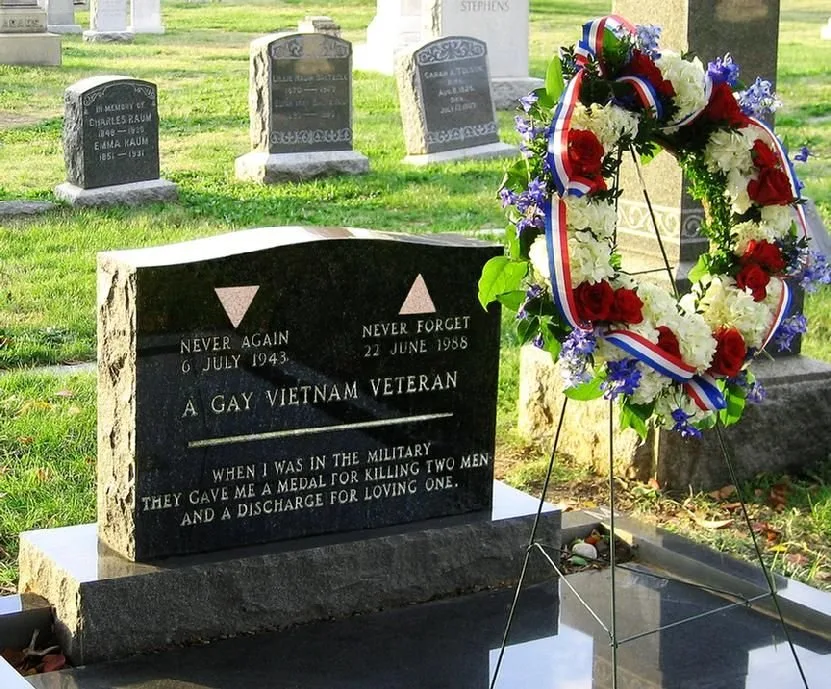
Leonard Phillip Matlovich (July 6, 1943, Savannah, Georgia, to June 22, 1988, Los Angeles) was a U.S. Air Force technical sergeant and Vietnam War veteran. He served three tours, was wounded by a landmine at Da Nang, and was awarded the Bronze Star and Purple Heart. Working with the activist Frank Kameny, he set out to become a deliberate test case against the military's ban on gay service members. His March 6, 1975 letter to his Langley AFB commander put him on the September 8, 1975 cover of Time, the first named openly gay person on the cover of a U.S. newsmagazine. Discharged that October, he won a 1980 reinstatement order and settled for $160,000. He was diagnosed with HIV/AIDS in September 1986 and became a prominent AIDS activist. His last public speech, at the March on Sacramento on May 7, 1988, was built around the rainbow flag. He is buried at Congressional Cemetery in Washington, D.C., beneath a stone that bears no name: 'When I was in the military, they gave me a medal for killing two men and a discharge for loving one.' [5] [6]
Matlovich's grave has become a continuing memorial site. In 2010 activists held a vigil there before chaining themselves to the White House fence in protest of 'Don't Ask, Don't Tell.' [5] His epitaph circulates beyond the cemetery: StoryCorps quoted it on October 29, 2015 for an NPR Morning Edition segment in which a friend recalled him. [7] Of the 1975 Time cover, Randy Shilts wrote: 'It marked the first time the young gay movement had ever made the cover of a major newsweekly. To a cause still struggling for legitimacy, the event was a major turning point.' [5]
The directive associated with this flag, that the black stripes be removed and burned in Washington when a cure is found, appears only in the flag-guide tradition. [3] Neither his standard biography nor his memorial record mentions the flag. [5] [6] The grave anchors the cemetery's LGBT section and remains an active memorial site: annual LGBTQ veterans' observances, the start of the DC Front Runners Pride Run 5K, a wedding at the graveside in 2011, and roughly 800 virtual tributes left on Find a Grave, continuing into 2026. [6][8]
And I want you to look at the flag, our rainbow flag, and I want you to look at it with pride in your heart, because we too have a dream. And what is our dream? Ours is more than an American dream. It's a universal dream. (last public speech, March on Sacramento, May 7, 1988) [5]
Motivations
Attribution
- Organization
- Unnamed San Francisco organization (per secondary sources)
Attribution notes
No individual designer is named in any of the available sources. Secondary sources state that the flag was 'suggested by a San Francisco organization' or 'a San Francisco group,' without identifying the organization. [3][1][2] The year of creation is not consistently documented. Secondary sources give only 'sometime in the 1980s.' Sgt. Leonard Phillip Matlovich (born July 6, 1943; died of AIDS-related complications June 22, 1988) is consistently associated with the flag as its most public advocate. Those secondary sources attribute to him the proposal that, when a cure for AIDS was found, the black stripes be removed from all surviving flags and ceremonially burned in Washington, D.C. This directive is the source of the flag's name. Matlovich is documented as the flag's advocate and the person to whom the directive is attributed, not as its designer. [1][2]
Origin
- Country
- United States
- Region / state
- California
- City
- San Francisco
- Place Type
- Activist organization
Origin attributed to a San Francisco organization (not identified by name), on the unceded ancestral homeland of the Ramaytush Ohlone people. [9] [10]
Indigenous land context
Ramaytush Ohlone — unceded ancestral homeland. The Ramaytush Ohlone are the original peoples of the San Francisco Peninsula. [10] [11]
Colonial / settler context
San Francisco is an attributed origin, not a confirmed production site: secondary flag guides credit the flag to an unnamed San Francisco organization, and the located sources do not document where it was designed or made. [3] [1] [2] The city stands on the unceded homeland of the Ramaytush Ohlone; no treaty of cession exists. [12] [13] No relationship between the flag, its unidentified creators, and the Ramaytush Ohlone is documented.
- Land status
- Unceded (no treaty of cession exists)
- Indigenous engagement
- None documented
- Continuing presence
- The Ramaytush Ohlone remain present and active in the region today. [10]
Multiple secondary sources state the flag was 'suggested by a San Francisco organization' or 'a San Francisco group.' The organization is not identified by name in any available source. [3][1][2]
Dates & Chronology
- Period in Use
- By June 1988 at latest; in use 1980s–present
- Creation Bounds
- No documented creation date. Upper bound June, 1988: the accounts that describe the flag involve Leonard Matlovich, who died that month, so the flag must predate it for his involvement to be possible.
The flag is largely historical now. [3] The reading of a black stripe on a pride flag as mourning for those lost to AIDS recurs in the Progress Pride Flag (2018), whose designer Daniel Quasar states that its black stripe represents, among other meanings, community members living with and lost to AIDS. Quasar built the Progress design on the Philadelphia flag, whose black and brown stripes represent people of color. No documented design descent runs from the Victory Over AIDS flag to the Philadelphia (2017) or Intersex-Inclusive Progress (2021) flags. [14]
The flag is one of the few pride designs meant to be modified at a future date. The directive attributed to Matlovich calls for the black stripes to be removed and ceremonially burned in Washington, D.C. once a cure for AIDS is found. As of 2026, no cure has been found and the directive has not been carried out.
Lineage
- Direct predecessors
- Rainbow Pride Flag
- Indirect influences
- Original Rainbow Flag (1978)
- Related flags
- Progress+ Flag (Disabled Queer Transmasc Variant), Inclusive Diversity Pride Flag (TransIphis, 2022)
- Sibling flags
- Alberta Gay Flag, Straight Ally Pride Flag, Anarcha-Queer Flag (rainbow variant), Argentina Gay Flag, Australia Gay Flag, Brazil Gay Flag
+ 44 more
British Columbia Gay Flag, Canadian Pride Flag, Chicago Pride Flag (Rainbow Stripes, Purple Stars), Chile Gay Flag, Dominican Republic Gay Flag, Egypt Gay Flag, European Union Gay Flag, France Gay Flag, Gay Pride Flag of Pakistan, Heteroflexible Pride Flag, Heterosexual / Straight Pride Flag, Homoflexible Pride Flag, India Gay Flag, Italy Gay Flag, Japan Gay Flag, Jewish Gay Pride Flag, Manitoba Gay Flag, Mexico Gay Flag, Netherlands Gay Flag, New Brunswick Gay Flag, Newfoundland Gay Flag, Northwest Territories Gay Flag, Nova Scotia Gay Flag, Nunavut Gay Flag, Ontario Gay Flag, Palestinian Gay Pride Flag, Panama Gay Flag, Philadelphia Pride Flag, Prince Edward Island Gay Flag, Quebec Gay Flag, Rainbow Flag with White Triangle (Sapporo), Rainbow Israel Flag, Rainbow Polish Flag (2014, Angela Getler), Russia Gay Flag, Saskatchewan Gay Flag, Social Justice Pride Flag, South African Gay Pride Flag, Switzerland Gay Flag, Tanzania Gay Flag, Texas Rainbow Flag, Turkish Gay Pride Flag, Two-Spirit Pride Flag (2005, Zoccole), Two-Spirit Pride Flag (2016 Tumblr documentation), Yukon Territory Gay Flag
A memorial variant of the six-stripe rainbow flag (1979): the standard six stripes with a black mourning stripe added below. It does not continue the design lineage forward and has no documented descendants. No direct design descent is documented to the Philadelphia (2017), Progress (2018), or Intersex-Inclusive Progress (2021) flags. Quasar's Progress black stripe includes AIDS memorialization among several meanings, which creates a thematic parallel rather than a documented design influence. [14]
Lineage tree
Every record reachable from this one through documented parent and child relationships: 4 records across 4 generations.
- Ancestors -3
- Original Rainbow Flag (1978)
- Ancestors -2
- Seven-Stripe Rainbow Flag (1978)
- Ancestor
- Rainbow Pride Flag
- This record
- Victory Over AIDS Flag (1980s, designer unknown)
Colors & Symbolism
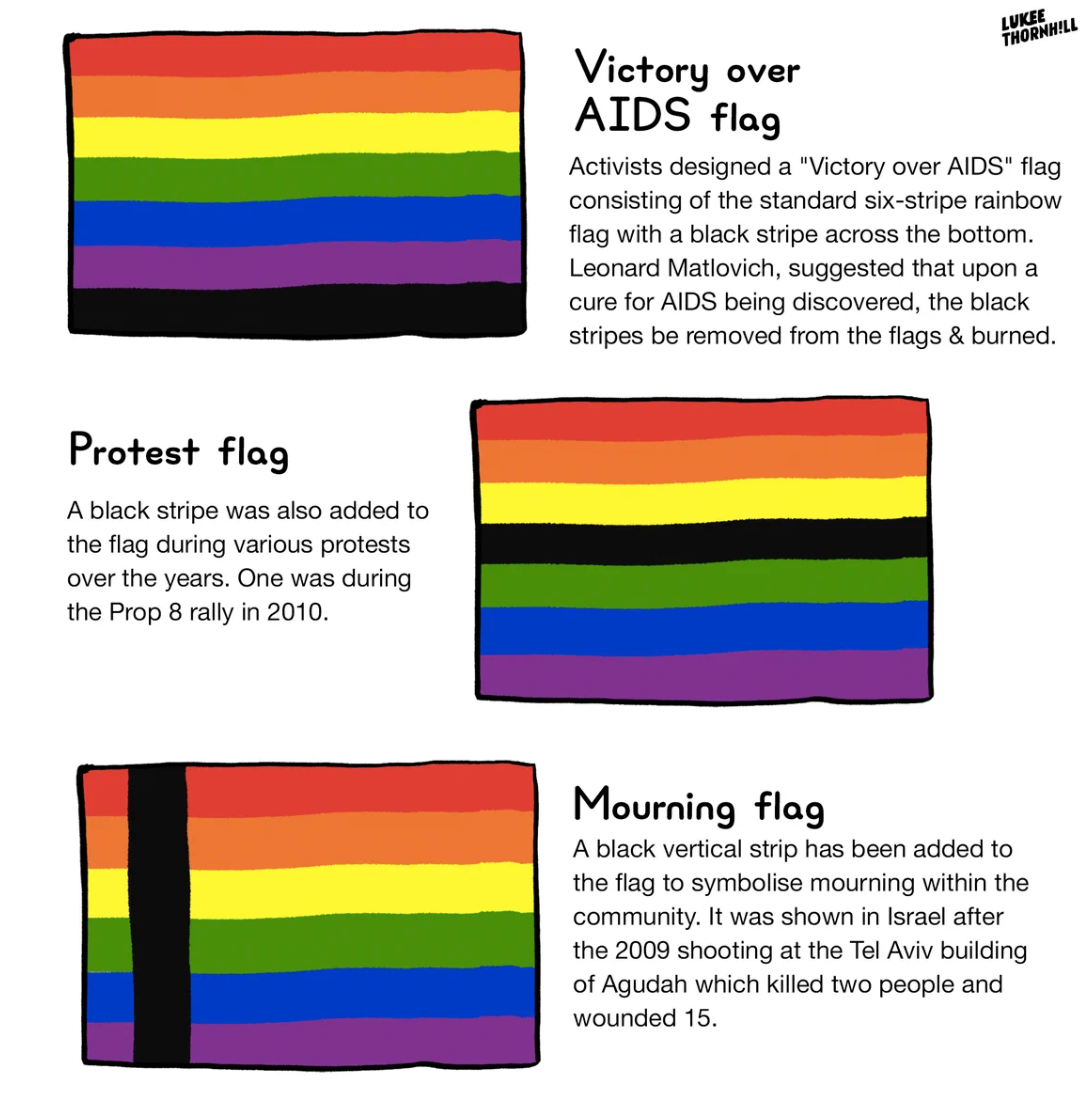
A black stripe added to the bottom of the six-stripe rainbow flag, signifying mourning for those lost to AIDS and solidarity with people living with HIV. Secondary sources attribute to Matlovich the directive that the black stripe be removed and ceremonially burned once a cure for AIDS is found. [1][2]
| Colour | Hex | Meaning | Note |
|---|---|---|---|
| Red | #E40303 | Inherited from the six-stripe rainbow pride flag (life). [3] | Commons rendering convention [15] |
| Orange | #FF8C00 | Inherited from the six-stripe rainbow pride flag (healing). [3] | Commons rendering convention [15] |
| Yellow | #FFED00 | Inherited from the six-stripe rainbow pride flag (sunlight). [3] | Commons rendering convention [15] |
| Green | #008026 | Inherited from the six-stripe rainbow pride flag (nature). [3] | Commons rendering convention [15] |
| Blue | #004DFF | Inherited from the six-stripe rainbow pride flag (harmony). [3] | Commons rendering convention [15] |
| Violet | #750787 | Inherited from the six-stripe rainbow pride flag (spirit). [3] | Commons rendering convention [15] |
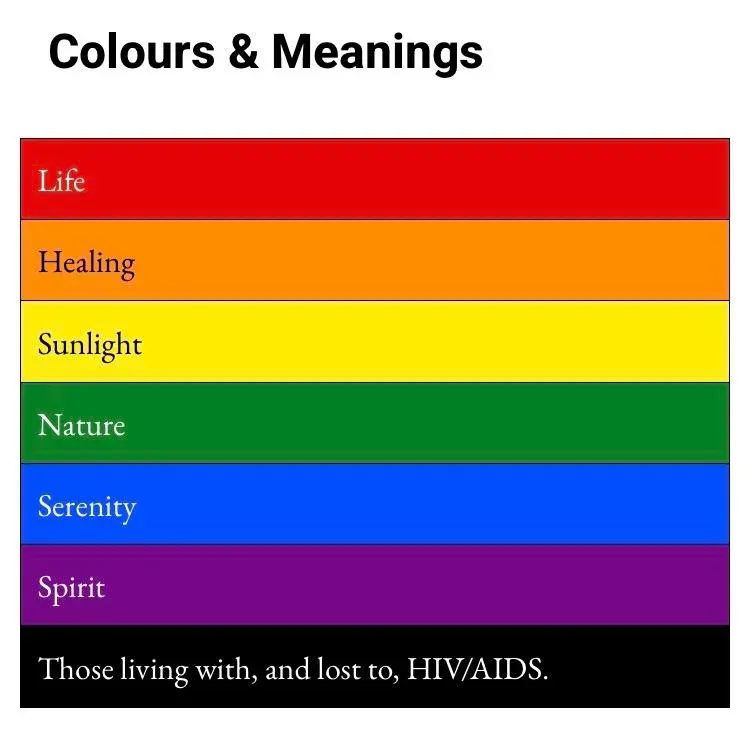
| Black | #000000 | Mourning for those lost to AIDS and solidarity with people living with HIV. [1][2] | Black stripe as documented [15] [16] |
This flag has no official digital palette. Color values shown are approximate.
Sources differ on the black stripe's emphasis: EuroGay.net (translated at FOTW) gives 'AIDS awareness,' while Jasewells.com gives commemoration, 'the black stripe commemorates those we have lost to AIDS.' [3] Both agree the stripe was meant to be removed once a cure was found.
No palette specific to this flag is documented in the available sources, and the two references that publish values disagree. The table follows the Wikimedia Commons rendering. [15] FlagColorCodes publishes a different set, violet #732982 against #750787 and blue #004CFF against #004DFF, with Pantone equivalents, but states no basis for them and labels the fifth stripe 'indigo,' a color dropped from the rainbow flag in 1979. [17] Neither palette is documented as originating with the flag's unknown designer or manufacturer. In the 1980s, cloth flags would have used whatever rainbow stock was available, plus black. The reconstruction uses the Commons file's nominal 777 x 480 proportions.
Design
- Aspect Ratio
- 3:5
- Orientation
- horizontal
- Stripe Count
- 7
- Layout
- horizontal_stripes
- Stripes (Top → Bottom)
- Red, Orange, Yellow, Green, Blue, Violet, Black
Seven horizontal stripes of equal height. The first six stripes match the standard six-stripe rainbow pride flag (the 1979 Traditional version, after the hot pink and turquoise were dropped). A single black stripe is added at the bottom. [3][1]
Seven equal horizontal stripes. No aspect ratio was specified by the designer. Flags are manufactured at the standard 3:5 (three feet by five), the ordinary commercial flag size, which is a production convention rather than a design specification. Owner-attested from physical copies; no read source states a ratio.
The only modification from the standard six-stripe rainbow flag is the added black stripe at the bottom, which carries the flag's distinctive meaning. [3][1]
Usage & Adoption
- Online Usage
- Documented historically in pride flag guides including Library.LGBT, the Pride Flag Wiki, the Wikipedia rainbow flag article, and the Flags of the World vexillological database. [3][1][2]
- Event Usage
- Public advocacy by Sgt. Leonard Matlovich, before his death in June 1988: secondary sources consistently present him as the flag's most public advocate, through his proposal that the black stripes be removed and ceremonially burned in Washington, D.C. once a cure for AIDS was found. No specific event, venue, or organization is documented. [3] [1] [2], Guatemala Pride 2010 (Orgullo Guatemala; violet nearly white on the photographed flag) [3], Guatemala Pride 2011 (unusually light violet) [3]
- Current Status
- historical
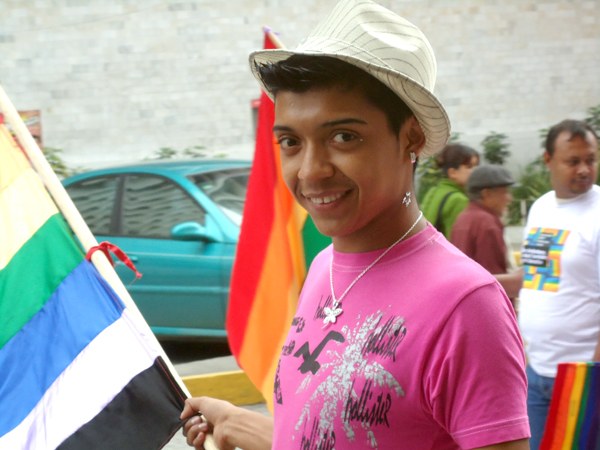
Largely historical. [3] It is now encountered mainly through pride flag guides rather than in current physical use. The reading of a black stripe as AIDS mourning recurs in the Progress Pride Flag, where Daniel Quasar independently assigns that meaning to the black stripe among others, but no design descent from this flag to the Philadelphia, Progress, or Intersex-Inclusive Progress flags is documented. [1][14]
Image Archive
Leonard Matlovich
The Grave
Community Documentation
Discourse & Debates
- No designer has been identified. Matlovich is the best-known person associated with the flag, but the available evidence does not establish him as its designer.
- Whether the black stripe in the Progress Pride Flag (2018) inherits this flag's HIV/AIDS meaning, the Philadelphia flag's racial-justice meaning, or both. Daniel Quasar's own statement gives his black stripe both readings: people of color and community members living with and lost to AIDS.
Common misidentifications
- Sometimes confused with later inclusive pride flags whose black stripes carry partly different meanings. The Victory Over AIDS flag's black stripe is specifically about HIV/AIDS mourning and the burning ritual. The Philadelphia and Progress flags' black stripes carry additional meanings.
Sometimes referred to informally as the AIDS Memorial Pride Flag or the Black-Stripe Rainbow Flag. 'Victory Over AIDS Flag' is the title used by the flag-guide sources, taken from the directive about removing and burning the stripe when a cure is found. [1]
Footnotes & Citations
Sources and footnotes 23 sources
- 1. Victory Over AIDS. Library.LGBT (2021-06-11). Accessed 2026-07-26 · Archived version
An archived capture; the site went offline in July 2026. Published by Albany Pride, Western Australia; it names no author and cites no sources.
- 2. Victory Over AIDS Flag. Pride Flag Wiki contributors. Pride Flag Wiki (Fandom). Accessed 2026-04-07
- 3. Black-Striped Variations of the Gay Pride Rainbow Flag. M. Schmöger (2001), Tomislav Todorović (2014); page editor Randy Young. Flags of the World (last modified 2021-07-31). Accessed 2026-04-07
- 4. Image file page File:Matlovich time cover.jpg (Wikipedia non-free file page). Time (cover); file page by Wikipedia contributors. Wikipedia (cover 1975-09-08). Accessed 2026-07-26
- 5. Encyclopedias & Reference Leonard Matlovich. Wikipedia contributors. Wikipedia (last edited 2026-05-03). Accessed 2026-07-26
- 6. Archived Sources Leonard Phillip 'Mat' Matlovich Jr. (Find a Grave Memorial 2660). Find a Grave contributors. Find a Grave (memorial added 1998-04-25). Accessed 2026-07-26
- 7. Social media StoryCorps post quoting the Matlovich epitaph, promoting an NPR Morning Edition segment. StoryCorps. Facebook (2015-10-29). Accessed 2026-07-26
- 8. Archived Sources Leonard P. Matlovich (Historical Marker Database). Submitted by Devry Becker Jones; marker photographs by Devry Becker Jones (CC0). The Historical Marker Database (HMdb.org) (submitted 2019-10-29, last revised 2023-01-30). Accessed 2026-07-26
- 9. Academic UCSF Land Acknowledgment. University of California, San Francisco. Accessed 2026-03-30
- 10. Tribal nation The Ramaytush Ohlone — Original Peoples of the San Francisco Peninsula. Association of Ramaytush Ohlone. Association of Ramaytush Ohlone. Accessed 2026-07-26
- 11. Organizations Ramaytush Ohlone Land Acknowledgment. American Indian Cultural District (with AICD board member Gregg Castro, Ramaytush Ohlone). American Indian Cultural District, San Francisco. Accessed 2026-07-26
- 12. Government Ramaytush Ohlone Land Acknowledgment (Resolution 2021-01). San Francisco Public Library Commission. San Francisco Public Library (2021-04-15). Accessed 2026-07-26
- 13. Government Resolution on Ramaytush Ohlone Land Acknowledgement. San Francisco Commission on the Environment. San Francisco Environment Department (2021-02-01). Accessed 2026-07-26
- 14. Rainbow flag (LGBTQ). Wikipedia (last edited 2026-06-25). Accessed 2026-04-07
- 15. Image file page File:Victory over AIDS Flag.svg. Unknown designer; vectorized by Zt-freak (2017), simplified by Keymap9 (2019). Wikimedia Commons (2017-06-15). Accessed 2026-07-26
A Wikimedia Commons file, tagged as ineligible for copyright. It is a reconstruction, not a photograph of a made flag.
- 16. Community The Victory Over AIDS Flag (r/vexillology). u/masterdeluxe655. Reddit (2023-11). Accessed 2026-07-26
- 17. Reference Victory over AIDS Flag Color Codes. FlagColorCodes.com (SIMPLYGRAPHIX Network). FlagColorCodes.com. Accessed 2026-07-26
- 18. Social media The grave of Leonard Matlovich, a gay Vietnam Veteran. History Photographed (@HistoryInPics). X (Twitter) (2023-01-23). Accessed 2026-07-26
- 19. Community Black stripes on the Pride flag (illustrated explainer). Lukee Thornhill (@ProphecyGay). X (Twitter) (2021-06-30). Accessed 2026-07-26
- Victory over AIDS flag. Wikidata. Accessed 2026-04-07
- Encyclopedias & Reference Variations of the Gay Pride Rainbow Flag (1). FOTW contributors (M. Schmöger, Steve Kramer, Tomislav Todorović, et al.); page editor Randy Young. Flags of the World (last modified 2023-09-30). Accessed 2026-07-26
- Community Gay Symbols — Rainbow Pride and Related Symbols (the Rainbow Icon Archive). Jase Wells. jasewells.com (Rainbow Icon Archive) (page predates its earliest capture; quoted by FOTW August 2001; capture read circa 2007 (164 captures, 2004-12-28 to 2026-02-19)). Accessed 2026-07-26 · Archived version
- Books Out in All Directions: A Treasury of Gay and Lesbian America. Lynn Witt, Sherry Thomas and Eric Marcus, eds.. Warner Books, New York, 1995, p. 435 (1995) [no stable URL]


Image Sources
- Rendering
- 1980s standard
- Matlovich with an autographed copy of his Time cover, 1975. [5] · Credit: Photographer unrecorded · via Find a Grave (memorial 2660) · fair use pending permission · Find a Grave
- The headstone photographed in 2001. [6] · Credit: Rick Mize · via Find a Grave · fair use pending permission · Find a Grave
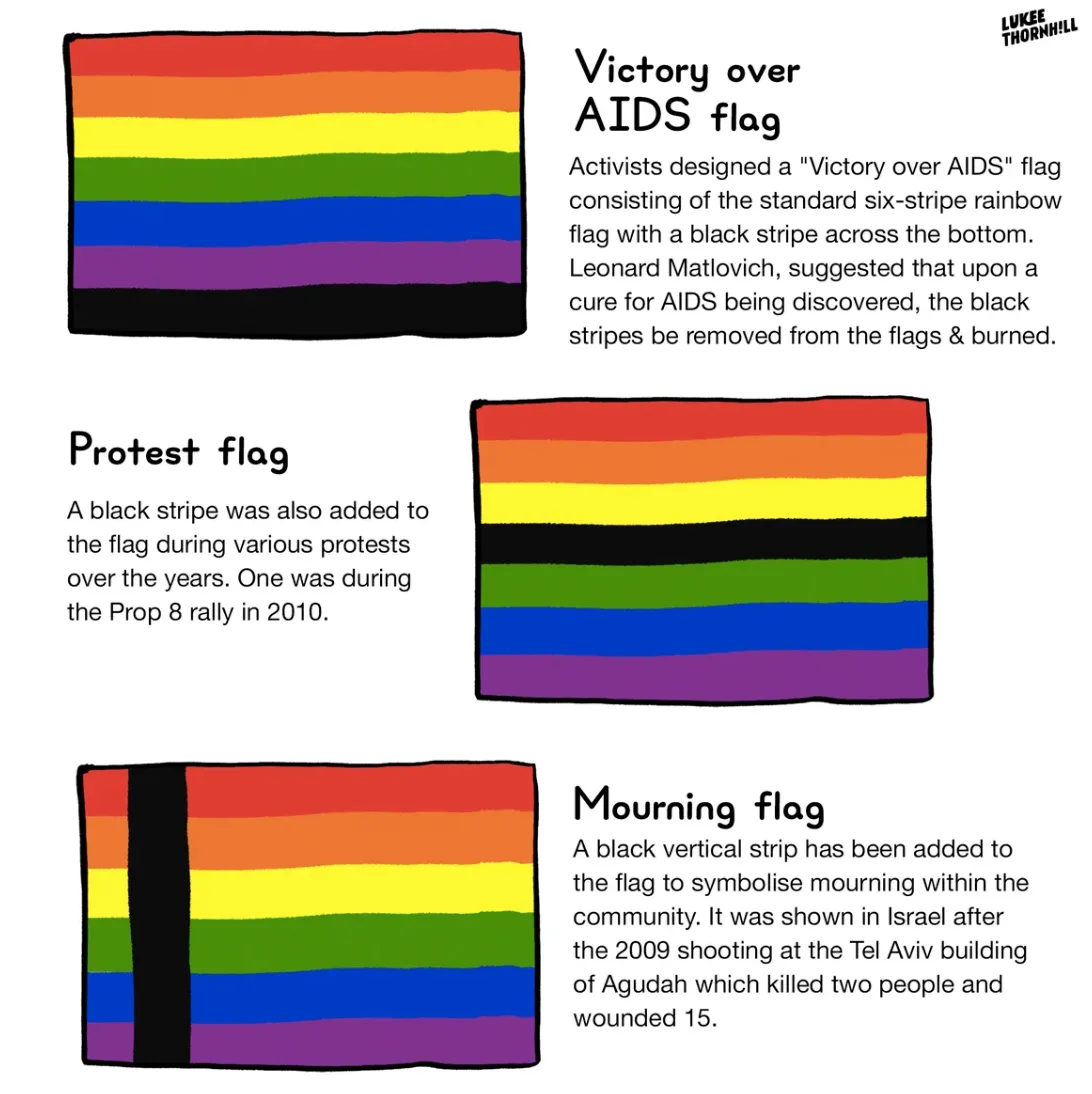
- Lukee Thornhill's illustrated explainer of the three black-stripe rainbow flags, 2021: Victory over AIDS, the Prop 8 protest flag of 2010, and the mourning flag flown in Israel after the 2009 Tel Aviv Agudah shooting. The three designs and their stripe placements correspond to the black-stripe variants documented at Flags of the World. [19] · Credit: Lukee Thornhill (@ProphecyGay), reproduced with credit · X (Twitter)
- The grave circulating on social media: a January 23, 2023 post reproducing the epitaph, recorded at 515,200 views, 2,700 likes and 335 reposts. Visitors leave stones along the top of the stone and rainbow flags at its base. [18] · Credit: Screenshot of @HistoryInPics post · grave photographer unidentified · fair use pending permission · X (Twitter)
- A community 'Colors & Meanings' graphic from the r/vexillology discussion of the flag, 2023. The black stripe is glossed 'Those living with, and lost to, HIV/AIDS.' [16] · Credit: u/masterdeluxe655, via r/vexillology · Reddit
- The grave at Congressional Cemetery with a memorial wreath. The nameless stone, reading 'When I was in the military they gave me a medal for killing two men and a discharge for loving one,' anchors the cemetery's LGBT section. [6] [8] · Credit: Maxim Dunlap · via Find a Grave · fair use pending permission · Find a Grave