Indigiqueer / Two-Spirit Flag (cedar-maw)
Indigenous Pride Flag ·
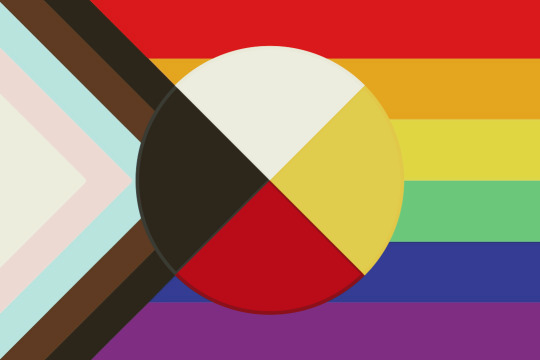
Posted by the Tumblr user cedar-maw on 9 September 2021, this design places a quartered near-black, cream, yellow, and red circle over a muted Progress Pride layout. The same post includes a version bearing the Métis Infinity. cedar-maw titled it "Indigiqueer / Two-Spirit flag" and restricted it to Native people. [1] Documented circulation is the post and later Tumblr reblogs; broader adoption has not been established. [2]
Key facts
- Designer
- cedar-maw
- Created
- First documented publication
- Aspect Ratio
- 2:3 · apparent
- Ratio Notes
- Measured, not creator-stated. The base artwork as served by Tumblr is 1079 × 719 pixels, approximately 2:3 (3:2 width to height) but not exactly. The repository copy of the Métis Infinity variant is 540 × 360, exactly 2:3; the Tumblr reblog derivatives inspected are 500 × 333, approximately 2:3. No ratio was published by the creator. [1]
- Stripes
- 6
- Represented Identity
- Indigiqueer and Two-Spirit, following the creator's title
Status Proposed
Archive categories Indigenous Pride Flags
Overview
cedar-maw published two versions in one Tumblr post on 9 September 2021. Both combine a muted Progress Pride layout with a large four-part circle in near-black, cream, yellow, and red. The second adds a cream Métis Infinity. The post responds to cedar-maw's difficulty finding Native pride flags that were not limited to Two-Spirit identity, while naming the design "Indigiqueer / Two-Spirit flag" and stating, "This flag is for Natives only." [1]
The title pairs the two terms rather than dividing them. TJ Cuthand coined "Indigequeer" in 2004 for the Vancouver Queer Film Festival's Indigenous and Two-Spirit program and later welcomed the "Indigiqueer" spelling. [3] Joshua Whitehead helped popularize the latter form and describes it in relation to, rather than as a replacement for, Two-Spirit identity. [4] Later circulation is documented through Tumblr reblogs. [5] [2] Broader community or institutional adoption has not been established.
Identity & Context
- Represented Identity
- Indigiqueer and Two-Spirit, following the creator's title
- Subcommunity
- Indigenous Queer and Two-Spirit people
- Diaspora Context
- Pan-Indigenous: the post is tagged for First Nations, Inuit, Métis and Native American people, "and other north american indigenous folx ofc." [1]
- Language Context
- TJ Cuthand coined "Indigequeer" in 2004 while programming the Vancouver Queer Film Festival's Indigenous and Two-Spirit program: "in 2004 I made that word up to title the Vancouver Queer Film Festival's Indigenous/two-spirit program I had programmed. Except I spelled it 'Indigequeer' (because Indigenous has an E after the G)." Cuthand explained the choice: "some LGBTQ Indigenous people don't feel as comfortable with the two-spirit title because it implies some dual gender stuff, which some people just don't feel describes their identity. I know a lot of people don't ID with the Queer label either." Cuthand accepted the later spelling: "I'm really fine with it being spelled with an i instead of an e." [3]
- Racial / Ethnic Context
- The creator restricted the flag: "This flag is for Natives only." [1]
Joshua Whitehead, Ojibwe and Cree from Peguis First Nation, who identifies as Two-Spirit and Indigiqueer, helped popularize the "Indigiqueer" spelling, which titles his poetry collection. Whitehead uses both terms and has described Indigiqueer as "just the kind of a braiding of the two" and "a contemporary mode of thinking for Indigenous peoples," while disclaiming coinage. [4] These accounts document overlapping uses, not a single rule governing every Indigenous person or Nation.
Creators
The Creator
cedar-maw
Designer and original poster
cedar-maw is the pseudonymous Tumblr account credited with designing and publishing the flag. In the original post, cedar-maw described making the design after having difficulty finding Native pride flags that were not specifically Two-Spirit flags. The post does not state a physical creation place or Nation affiliation. [1]
I never see ndn pride flags that aren't specifically for 2S folx, so I thought I'd make one up myself. It's not perfect but I'm humble
The caption of the original post.
This flag is for Natives only.
The closing line of the original post.
Motivations
- Difficulty finding Native pride flags that were not specifically Two-Spirit flags. [1]
Attribution notes
cedar-maw is a pseudonymous Tumblr account name. The post does not state a physical creation place or Nation affiliation, and no located source establishes either. [1]
Origin
- Place Type
- online community / social media platform
- Digital Origin
- Yes
- Origin Type
- first_publication
- Physical Origin Status
- unknown
Digital origin on Tumblr; no verified physical location.
First documented publication: posted on Tumblr by cedar-maw on 9 September 2021, both versions in the same post. [1] Later documented recirculation is through Tumblr reblogs, including indigarchive and Beyond MOGAI Pride Flags in February 2024. [5] [2] The physical place where the artwork was made is unknown.
Indigenous Identity Context
- Related Nations
- Métis Nation
- Geographic Scope
- pan-Indigenous (with a Métis-marked variant)
- Nations / Communities
- Métis Nation
- Affiliation Type
- design symbol (variant)
- Pan-Indigenous
- Yes
cedar-maw published the design after having difficulty finding Native pride flags that were not specifically Two-Spirit flags, titled it "Indigiqueer / Two-Spirit flag," tagged it for First Nations, Inuit, Métis and Native American people, and restricted it to Native people. One of the two versions bears the Métis Infinity; the post does not state the creator's Nation affiliation or location. [1]
The Métis Infinity on the variant identifies that version with the Métis Nation. No located source establishes the creator's Nation affiliation; the post is tagged for First Nations, Inuit, Métis and Native American people. [1] [1]
Dates & Chronology
- Year Created
- First documented publication
- Creation Bounds
- Made no later than 9 September 2021, when cedar-maw published both versions in one Tumblr post. The post documents publication; the exact day the artwork was made is not separately documented. [1]
The design's documented circulation is primarily online. The original Tumblr post had accumulated 629 notes by August 2026 and was reblogged through Indigenous identity and pride-flag archive accounts, including indigarchive and Beyond MOGAI Pride Flags in February 2024. [1] [5] [2] Engagement counts and archival reblogs document visibility, not community-wide adoption. No institutional adoption, documented physical manufacture, or broad community endorsement has been located.
Two-Spirit pride flags predate this design, including Angel Zoccole's 2005 flag and the 2016 2Sanon flag. No specific Two-Spirit flag has been identified as a visual source for cedar-maw's design. The connection is contextual and terminological: the creator discussed the perceived absence of Native pride flags beyond designs specifically associated with Two-Spirit identity. [1]
Lineage
- Direct predecessors
- Progress Pride Flag
The background reuses Daniel Quasar's Progress Pride Flag: the six stripes and the five-band hoist chevron are unmistakable in the artwork. That relationship is a conclusion from visual construction, not a creator statement. [1] [7] No specific Two-Spirit flag has been identified as a visual source for cedar-maw's design; the Two-Spirit flags listed here are related historical and identity-context records, not parents or documented influences.
Lineage tree
Every record reachable from this one through documented parent and child relationships: 7 records across 6 generations.
- Ancestors -5
- Original Rainbow Flag (1978)
- Ancestors -4
- Seven-Stripe Rainbow Flag (1978)
- Ancestors -3
- Rainbow Pride Flag
- Ancestors -2
- Transgender Pride Flag, Philadelphia Pride Flag
- Ancestor
- Progress Pride Flag
- This record
- Indigiqueer / Two-Spirit Flag (cedar-maw)
Colors & Symbolism
The post does not explain the individual colors or sectors of the four-part circle. Its near-black, cream, yellow, and red construction visually recalls medicine-wheel imagery, but no single set of directional, seasonal, ceremonial, racial, or life-stage meanings applies across Indigenous Nations, and none was published with this flag. [1]
| Colour | Hex | Note |
|---|---|---|
| Rainbow Red (stripe) | #D9191B | Dominant flat fill measured from the surviving 500 × 333 Tumblr PNG derivative [1] |
| Rainbow Orange (stripe) | #E4A51F | Dominant flat fill measured from the surviving 500 × 333 Tumblr PNG derivative [1] |
| Rainbow Yellow (stripe) | #DFD641 | Dominant flat fill measured from the surviving 500 × 333 Tumblr PNG derivative [1] |
| Rainbow Green (stripe) | #6BC87A | Dominant flat fill measured from the surviving 500 × 333 Tumblr PNG derivative [1] |
| Rainbow Blue (stripe) | #343C93 | Dominant flat fill measured from the surviving 500 × 333 Tumblr PNG derivative [1] |
| Rainbow Purple (stripe) | #7F2D82 | Dominant flat fill measured from the surviving 500 × 333 Tumblr PNG derivative [1] |
| Chevron Near-Black | #2D261B | Dominant flat fill measured from the surviving 500 × 333 Tumblr PNG derivative; shared with the circle's near-black sector [1] |
| Chevron Brown | #5E3B22 | Dominant flat fill measured from the surviving 500 × 333 Tumblr PNG derivative [1] |
| Chevron Light Blue | #B9E4DE | Dominant flat fill measured from the surviving 500 × 333 Tumblr PNG derivative [1] |
| Chevron Pink | #ECD9D2 | Dominant flat fill measured from the surviving 500 × 333 Tumblr PNG derivative [1] |
| Chevron Inner Cream | #ECEDDC | Dominant flat fill measured from the surviving 500 × 333 Tumblr PNG derivative [1] |
| Circle Near-Black (hoist sector) | #2D261B | Dominant flat fill measured from the surviving 500 × 333 Tumblr PNG derivative; shared with the chevron's near-black band [1] |
| Circle Cream (top sector) | #ECEDDE | Dominant flat fill measured from the surviving 500 × 333 Tumblr PNG derivative; slightly different from the chevron's inner cream [1] |
| Circle Yellow (fly sector) | #E0CD4E | Dominant flat fill measured from the surviving 500 × 333 Tumblr PNG derivative [1] |
| Circle Red (bottom sector) | #BA0B18 | Dominant flat fill measured from the surviving 500 × 333 Tumblr PNG derivative [1] |
This flag has no official digital palette. Color values shown are approximate.
- Four-part circle (near-black, cream, yellow, red)
- cedar-maw published no explanation of the circle's sectors or colours. The construction visually recalls medicine-wheel imagery; meanings for such imagery differ among Indigenous Nations, and none is stated in the post. [1]
- Métis Infinity (variant)
- cedar-maw identified the second version through the symbol: "one w the Métis Infinity." The Métis Nation of Ontario describes the Infinity on the Métis flag as a symbol that "represents the immortality of the nation" and, at the centre of the flag's field, "represents the joining of two cultures." That is contextual symbolism from a Métis Nation source, not a separate statement by cedar-maw about the variant. [1] [6]
- Muted Progress Pride background
- The background visibly derives from Daniel Quasar's Progress Pride Flag. Quasar's published account supplies the inherited meanings: the rainbow stripes kept for the Baker flag's meanings of life, healing, sunlight, nature, harmony/peace and spirit; the light blue, pink and white from Monica Helms's Transgender Pride Flag; the black and brown from Philadelphia's More Color, More Pride flag; and a chevron pointing away from the hoist "to show forward movement." These are the Progress Pride Flag's documented meanings, not statements by cedar-maw. [7]
cedar-maw's only published statements about the design are its title, the difficulty that prompted it, and the Native-only boundary; none assigns colour or sector meanings. [1]
cedar-maw published no palette. These are measured artifact values: the dominant flat fills of the surviving 500 × 333 Tumblr PNG derivative of the base version, which also contains antialiasing and edge colours around the flat fills. The two cream values differ slightly in the inspected artifact, and the chevron and circle share one near-black. The repository JPEGs carry compression artifacts and were not used for sampling. [1]
Design
- Aspect Ratio
- 2:3 · apparent
- Ratio Notes
- Measured, not creator-stated. The base artwork as served by Tumblr is 1079 × 719 pixels, approximately 2:3 (3:2 width to height) but not exactly. The repository copy of the Métis Infinity variant is 540 × 360, exactly 2:3; the Tumblr reblog derivatives inspected are 500 × 333, approximately 2:3. No ratio was published by the creator. [1]
- Orientation
- horizontal
- Stripe Count
- 6
- Layout
- Progress Pride layout with centered four-part circle
- Stripes (Top → Bottom)
- Red, Orange, Yellow, Green, Blue, Purple
- Center Symbol
- Large circle divided diagonally into four sectors: cream above, yellow toward the fly, red below, near-black toward the hoist
- Additional Symbols
- Five-band Progress Pride chevron at the hoist, Cream Métis Infinity across the circle's center (variant)
The design uses six muted horizontal rainbow stripes with a five-band Progress Pride chevron at the hoist. A large circle is centered over the field and divided diagonally into four sectors: cream above, yellow toward the fly, red below, and near-black toward the hoist. A subtle dark border surrounds the circle. In the 1079 × 719 artwork the circle's center sits within a few pixels of the field's center; archive measurement. [1]
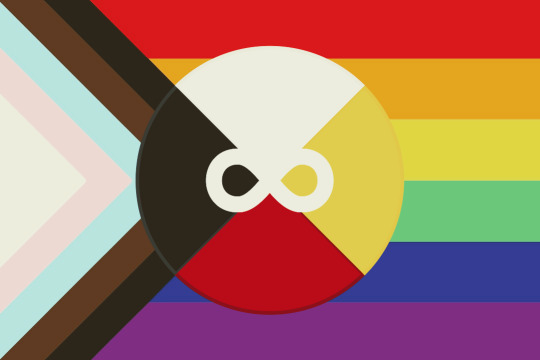
cedar-maw posted two images in the same Tumblr post. The base version contains the four-part circle. The Métis Infinity variant adds a cream horizontal Infinity across the circle's center; the symbol spans the central division rather than sitting only inside the near-black sector. [1]
Six muted horizontal rainbow stripes with a five-band Progress Pride chevron at the hoist, and a large centered circle divided diagonally into cream, yellow, red and near-black sectors. The variant adds a cream Métis Infinity across the circle's center. [1]
Usage & Adoption
- Online Usage
- Tumblr: the original post (629 notes by August 2026) and reblogs through Indigenous identity and pride-flag archive accounts, including indigarchive and Beyond MOGAI Pride Flags [1] [5] [2]
- Current Status
- online circulation only
Documented circulation is primarily online: the original post and later Tumblr reblogs. Engagement counts and archival reblogs document visibility, not community-wide adoption. [1] [2] cedar-maw stated that the flag is for Native people only; that is the creator's cultural-use boundary, not a copyright licence. [1] No institutional adoption, documented physical manufacture, or broad community endorsement has been located.
Image Archive
Creator-Posted Versions
Discourse & Debates
- cedar-maw's title uses Indigiqueer and Two-Spirit together, while the caption describes difficulty finding Native pride flags that were not specifically Two-Spirit flags. The pairing is the creator's own and is preserved as posted. [1]
- Cuthand's and Whitehead's accounts of Indigiqueer differ and relate: Cuthand coined the earlier spelling for a film program and framed it around discomfort some LGBTQ Indigenous people feel with dual-gender readings of Two-Spirit; Whitehead, credited with popularizing the later spelling, calls it "just the kind of a braiding of the two" and "a contemporary mode of thinking for Indigenous peoples," and disclaims coining it. [3] [4]
- cedar-maw restricted the flag to Native people: "This flag is for Natives only." [1]
- The Métis Infinity appears in one of the two versions, identifying that variant with a specific Nation inside a post tagged pan-Indigenous. [1]
Common misidentifications
- Distinct from the Two-Spirit pride flags of 2005 (Angel Zoccole), 2016 (2Sanon), 2021 (sirieko), and Patrick Hunter's design: those are related historical and identity-context records, and none has been identified as a visual source for this design.
2-Spirited People of the 1st Nations, a Toronto Two-Spirit organization, describes Two-Spirit as an ancient teaching of people "gifted among all beings because they carried two spirits: that of male and female," and writes that today "Two-Spirited people are Native people who are gay, lesbian, bisexual, transgendered, other gendered, third/fourth gendered individuals." [8] That is one organization's teaching; understandings differ among Nations. Cuthand's and Whitehead's accounts of Indigiqueer document overlapping uses of the two terms, and cedar-maw's title uses both. [3] [4] [1]
Source Posts
Tumblr
Indigiqueer / Two-Spirit flag, one w the Métis Infinity
I never see ndn pride flags that aren't specifically for 2S folx, so I thought I'd make one up myself. It's not perfect but I'm humble
Footnotes & Citations
Sources and footnotes 8 sources
- 1. Primary statement Indigiqueer / Two-Spirit flag, one w the Métis Infinity. cedar-maw. Tumblr (2021-09-09). Accessed 2026-08-13
The original post: both flag versions, the title, the caption, the Native-only statement, and tags for First Nations, Inuit, Métis and Native American people, "and other north american indigenous folx ofc." 629 notes at the 13 August 2026 capture.
- 2. Social media Reblog at Beyond MOGAI Pride Flags. beyond-mogai-pride-flags. Tumblr (2024-02-11). Accessed 2026-08-13
A surviving February 2024 reblog carrying the complete original text, reblogged from indigarchive.
- 3. Blogs & Personal Sources Indigequeer/Indigiqueer. TJ Cuthand. tjcuthand.com (2017-05-12). Accessed 2026-08-13
Cuthand's own account of coining "Indigequeer" in 2004 for the Vancouver Queer Film Festival's Indigenous and Two-Spirit program, the reasoning behind it, and acceptance of the later "Indigiqueer" spelling.
- 4. Interview Indigiqueer (All My Relations podcast, with Joshua Whitehead and Billy-Ray Belcourt). Matika Wilbur and Adrienne Keene, hosts. All My Relations. Accessed 2026-08-13
Episode page and transcript. Whitehead, Ojibwe and Cree from Peguis First Nation, describes Indigiqueer as "just the kind of a braiding of the two" and "a contemporary mode of thinking for Indigenous peoples," disclaims coining the term, and is credited by the hosts with popularizing it.
- 5. Social media Reblog at indigarchive. indigarchive. Tumblr (2024-02). Accessed 2026-08-13
A surviving February 2024 reblog by an Indigenous identity archive account, reblogged from radiomogai.
- 6. Organizations Symbols and Traditions. Métis Nation of Ontario. Métis Nation of Ontario. Accessed 2026-08-13
The Métis Nation of Ontario on the Infinity: it "represents the immortality of the nation" and, in the centre of the flag's field, "represents the joining of two cultures."
- 7. Designer page What's The Story Behind The "Progress" Pride Flag?. Daniel Quasar. progress.gay. Accessed 2026-08-13
Quasar's own account of the Progress Pride Flag's construction and inherited meanings, cited for the background this design visibly reuses.
- 8. Organizations History. 2-Spirited People of the 1st Nations. 2spirits.org. Accessed 2026-08-13
The organization's account of the Two-Spirit teaching and its present-day scope, quoted in this entry as one organization's teaching.
Image Sources
- Rendering
- base version
- Credit: Design and artwork: cedar-maw. The repository images are Tumblr-served derivatives of the creator's upload, not the original upload files · Tumblr
- Base version posted by cedar-maw on Tumblr on 9 September 2021. It combines a muted Progress Pride field with a centered four-part circle. Repository copy: 1079 × 719 JPEG, a Tumblr-served derivative of the creator's upload. [1] · Credit: cedar-maw · Tumblr
- Variant posted in the same Tumblr entry. A cream Métis Infinity spans the center of the four-part circle. Repository copy: 540 × 360 JPEG, a downscaled Tumblr-served derivative of the creator's upload. [1] · Credit: cedar-maw · Tumblr