5790/2029 Pride Flag
Right to Assemble ·
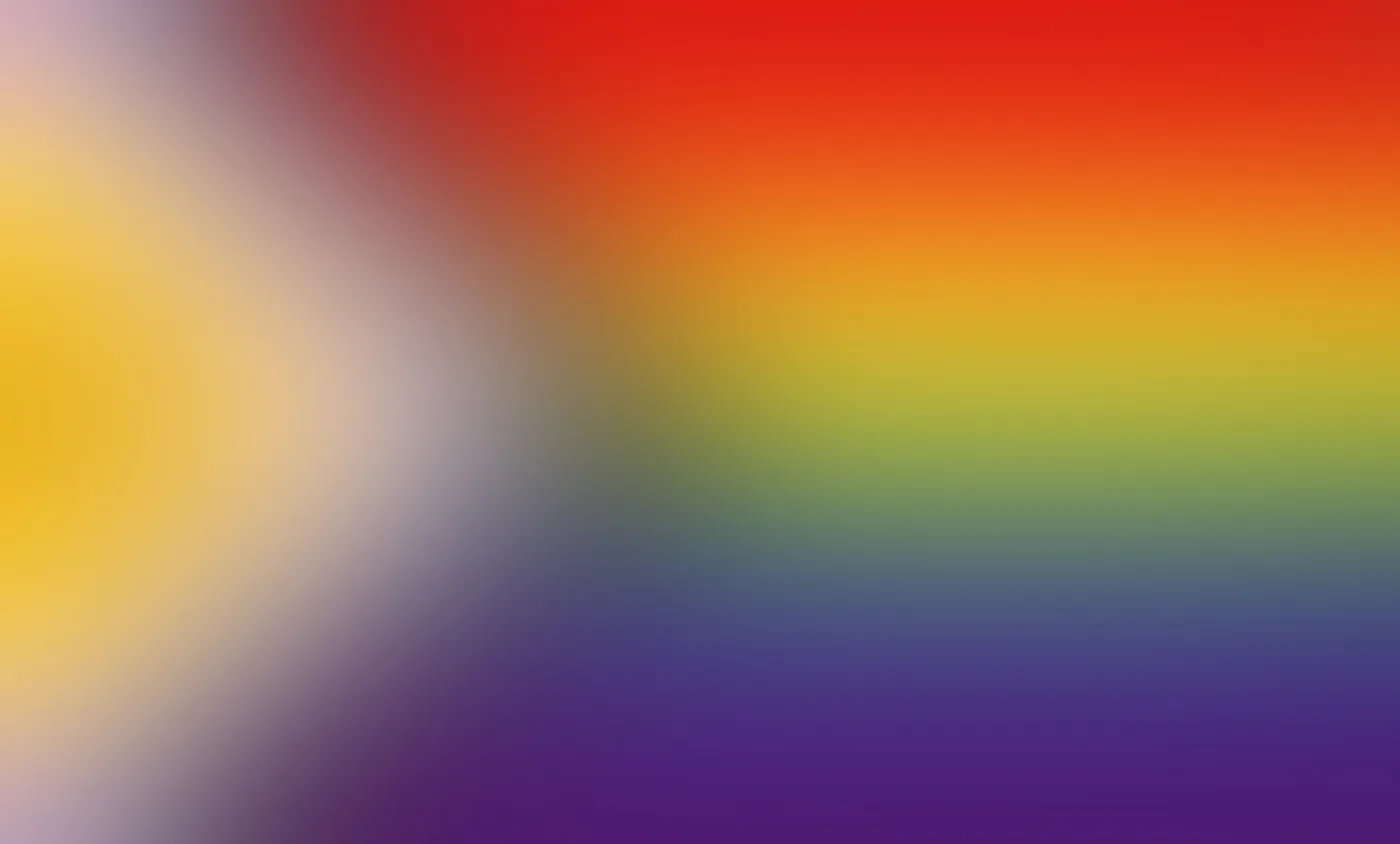
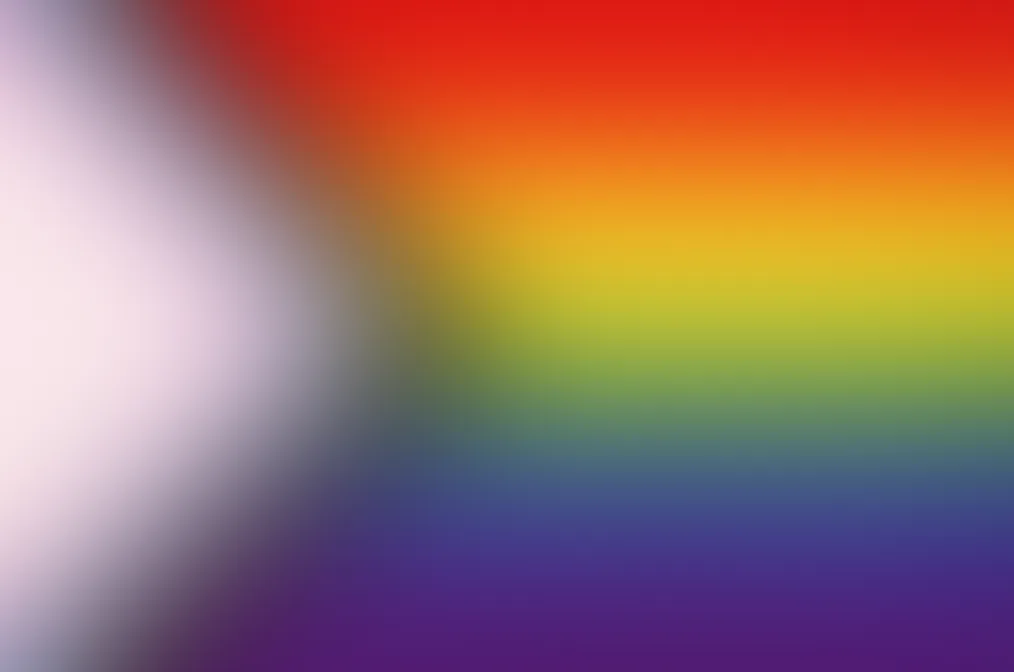
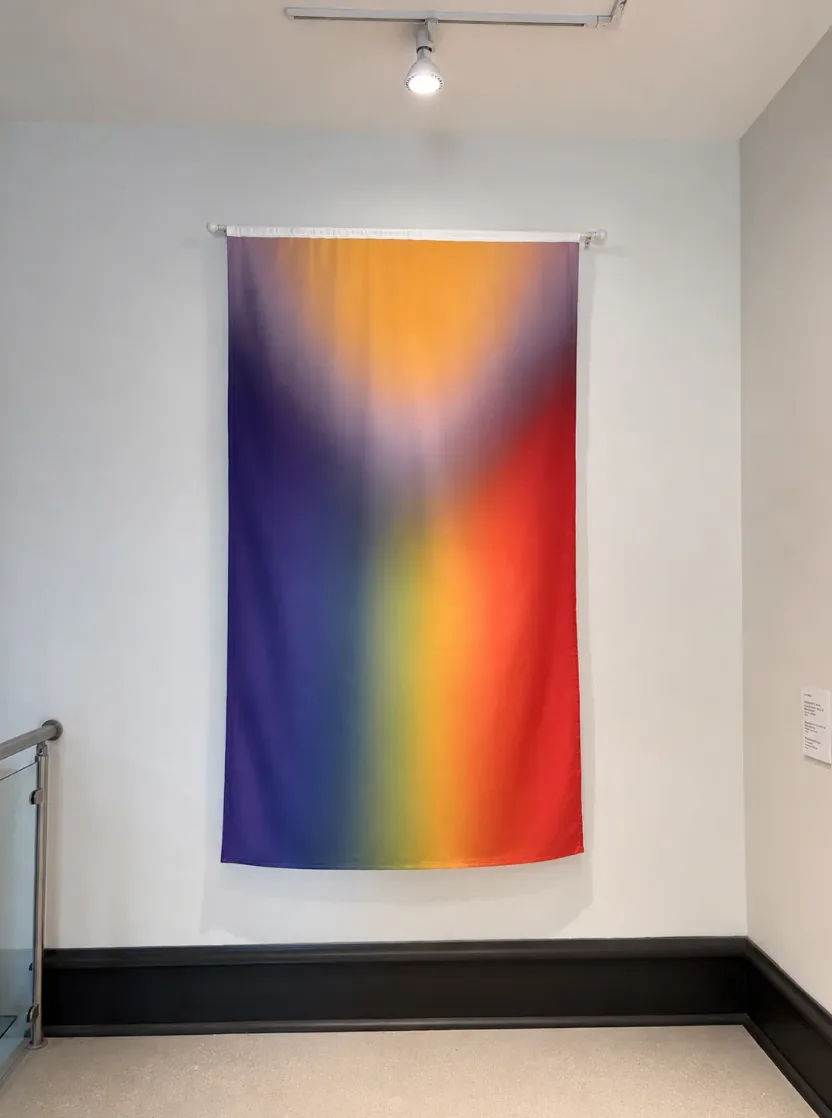
A laser-printed nylon flag by Will Montgomery, 53 by 85 inches, shown in his exhibition Right to Assemble at The Center on Addison in Chicago in June 2026 and hung there as a tall banner. Its title pairs the Hebrew year 5790 with the Gregorian year 2029, two calendar labels that overlap without coinciding: 5790 begins at sundown on 9 September 2029 and runs on into 2030. The work takes Valentino Vecchietti's Intersex-Inclusive Progress Pride Flag and, in Montgomery's caption, blurs it "to the degree of a 20/30 stigmatism", continuing the method of his Utopian Pride Flag #6. The blur is total: none of the source flag's thirteen colours survives anywhere in the work. [1]
Key facts
- Designer
- Will Montgomery
- Created
- First exhibited
- In use
- 2026
- Aspect Ratio
- 53:85 · documented
- Ratio Notes
- From the artist's own checklist for Right to Assemble, which gives the work as "Laser printed nylon, 53" x 85"". That is 53 high by 85 wide, within a third of a per cent of 5:8. The piece was hung as a tall banner in the exhibition, rotated from the proportion in which it is described. The artist's print file, 18900 by 11400 pixels, and the web master, 1400 by 844, agree with each other at 1.66:1; printed at 85 inches wide that proportion gives about 51 inches, so the checklist's 53 inches describes the finished object rather than the file. [1] The print file is not held by this archive and has not been inspected; its dimensions rest on the artist's statement. [2]
- Origin
- Chicago, Illinois, United States
- Represented Identity
- 2SLGBTQIAP+ community (speculative / Utopian framing)
Archive categories Speculative and Utopian Flags
Overview
The flag belongs to a sustained artistic investigation into the pride flag as a cultural, political and aesthetic object. Montgomery reimagines the pride flag from a Utopian perspective, treating visual clarity as a metaphor: blurring the source flag's hard boundaries stands in for the softening of arbitrary categorizations within the Queer collective. [1]
The 5790/2029 Pride Flag extends the method of Montgomery's Flags for Utopia series (2022–2025), which reimagines the pride flag as a speculative, future-facing object. Where the earlier Utopian Pride Flag #6 (2040 Progress Flag) blurred the Progress Pride Flag "to the degree of 20/40 vision," this later work takes the Intersex-Inclusive Progress Pride Flag as its source and blurs it "to the degree of a 20/30 stigmatism." The flag's title dates the future it looks toward in two calendars, which overlap without being coextensive. Hebrew year 5790 begins at sundown on 9 September 2029 and runs to the eve of Rosh Hashanah 5791 on 27 September 2030, so it covers the final months of Gregorian 2029 and most of 2030. [3] The series it develops, Flags for Utopia, is documented as closing in 2025; this work was made in 2026 for Right to Assemble. [1]
Identity & Context
- Represented Identity
- 2SLGBTQIAP+ community (speculative / Utopian framing)
- Movement
- Queer futurism, Queer art practice
- National Context
- United States
The work represents the 2SLGBTQIAP+ community through a speculative, Utopian lens. It exists within Will Montgomery's broader artistic practice rather than as a symbol produced for or adopted by a specific subcommunity.
Creators
The Creator
Will Montgomery
Artist & Writer
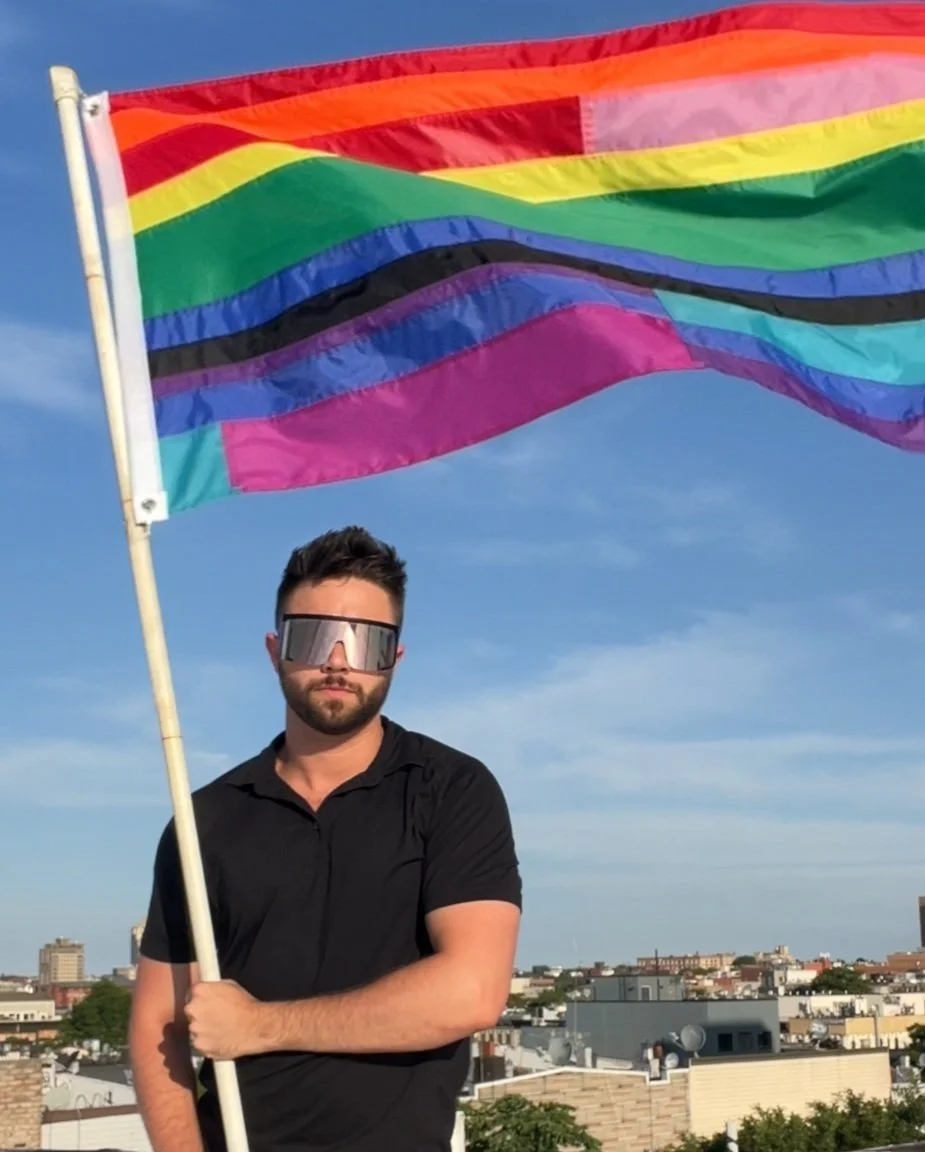
Will Montgomery (he/any) is an artist, futurist and Queer archivist based in Chicago. He holds a BFA in fine art from New York University and is pursuing an MA in art education at the School of the Art Institute of Chicago. This flag is his own work, and Montgomery is also the host and editor of this database. [4]
"Intersex-Inclusive Progress Flag blurred to the degree of a 20/30 stigmatism", Will Montgomery, Right to Assemble (2026) [1]
"by keeping the pride flag a living symbol, constantly experimenting and changing it, we are pushing the culture forward, remembering not to stay stagnant.", Will Montgomery, artist talk at the School of the Art Institute of Chicago, Spring 2026 [5]
Stated inspirations
Attribution notes
Will Montgomery designed, printed and exhibited the work. No collaborator, fabricator or commissioner is named for it: the flag was laser-printed on nylon and shown in an exhibition the artist took part in. He is also the host and editor of this database. [1][4]
Origin
- Country
- United States
- Region / state
- Illinois
- City
- Chicago
- Place Type
- city
- Physical Origin Status
- Made in Chicago per the artist. [2] Recorded at city level. The Center on Addison is where the work was first exhibited, not where it was made.
Exhibited in Chicago, Illinois, on the traditional homeland of the Council of the Three Fires (Ojibwe, Odawa, and Potawatomi).
Indigenous land context
Council of the Three Fires (Ojibwe, Odawa, and Potawatomi) — traditional and historical homeland (Indigenous name: Niswi-mishkodewin). Exhibited in Chicago, the traditional homeland of the Council of the Three Fires — the Ojibwe, Odawa, and Potawatomi Nations — and also historically home to the Miami, Ho-Chunk, Menominee, and Sac and Fox peoples. The 1833 Treaty of Chicago forced the migration of Odawa, Potawatomi, and Ojibwe peoples west of the Mississippi River. [6][7]
Colonial / settler context
Chicago was incorporated as a U.S. city in 1837 following the Treaty of Chicago (1833), which forced the removal of Odawa, Potawatomi, and Ojibwe peoples from the region. [7]
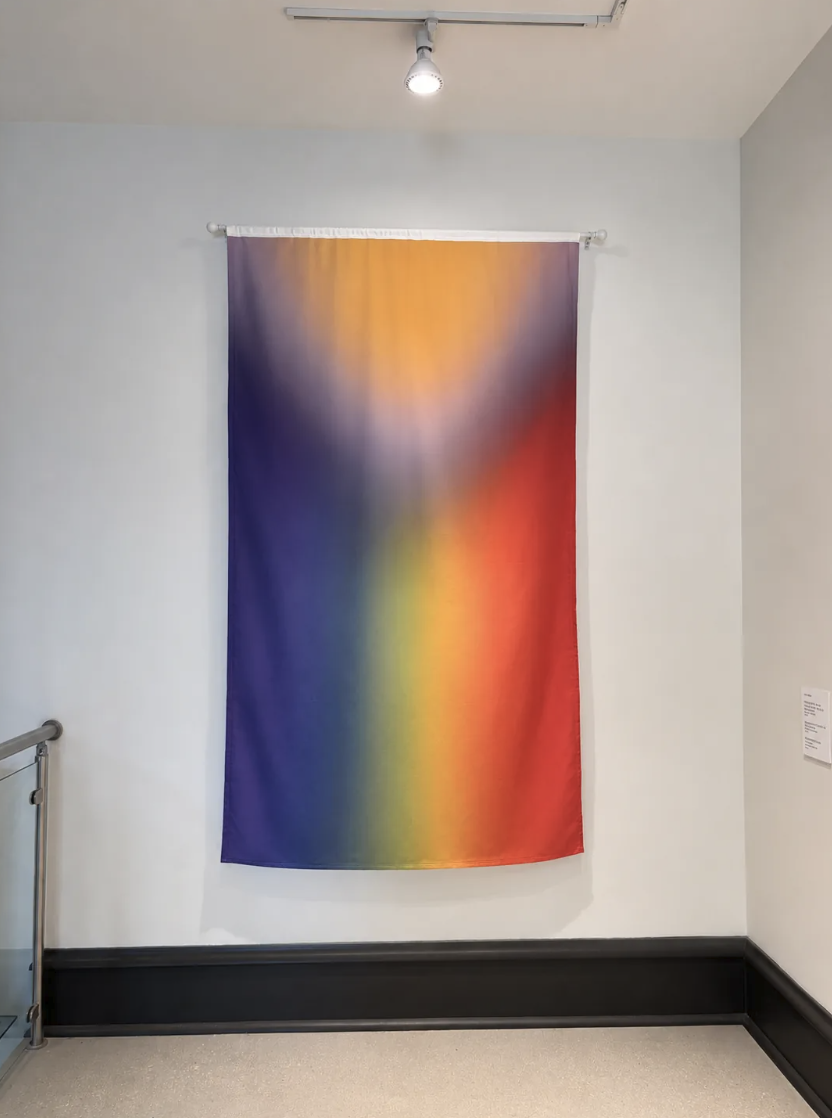
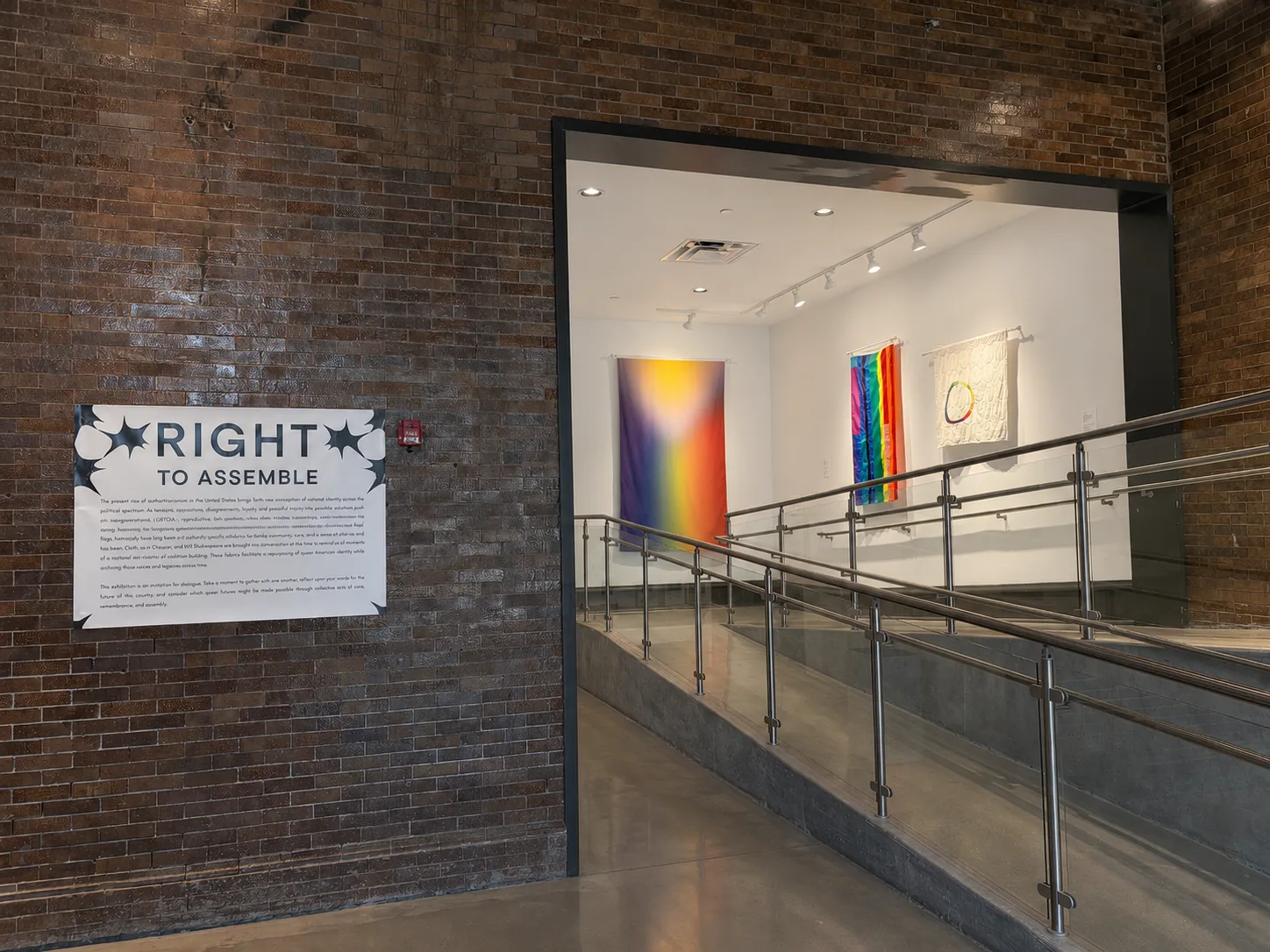
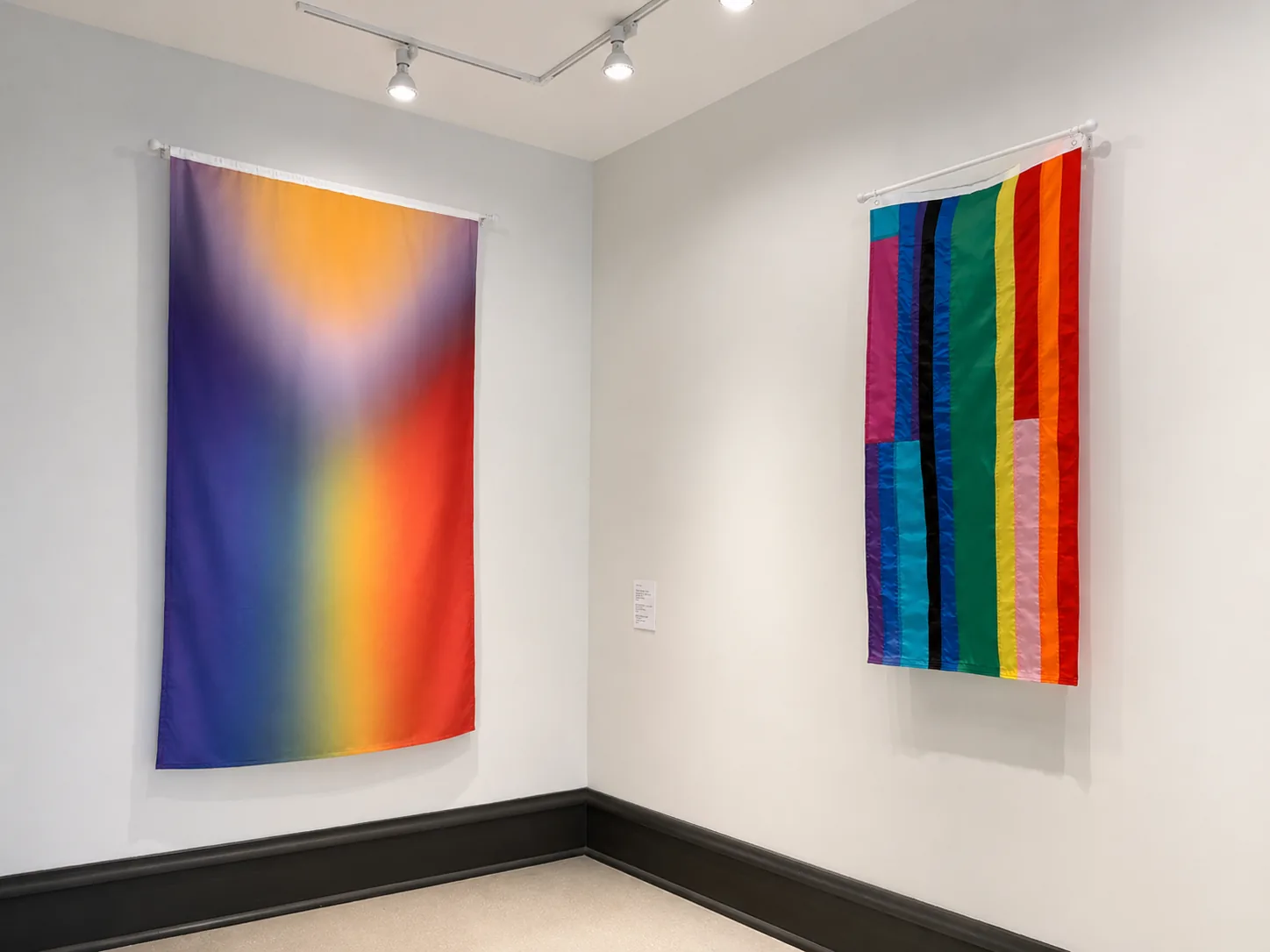
Shown in Right to Assemble, an intergenerational LGBTQIA+ exhibition at The Center on Addison, Chicago, in June 2026. The exhibition brought the work of What Will Have Been Ours, Quilt Church, and Will Montgomery into conversation, examining textile arts as a method for coalition building amid the present rise of authoritarianism in the United States. In the installation, the 5790/2029 Pride Flag hung alongside Utopian Pride Flag #25. [1] The work was made in Chicago; the venue is where it was first shown. [2]
Dates & Chronology
- Year Created
- Year Designed For
- 2029
- First exhibited
- Period in Use
- 2026
The work exists within a fine-art practice and has not been adopted as a community pride flag. It was exhibited at The Center on Addison, Chicago, in June 2026 as part of Right to Assemble. [1]
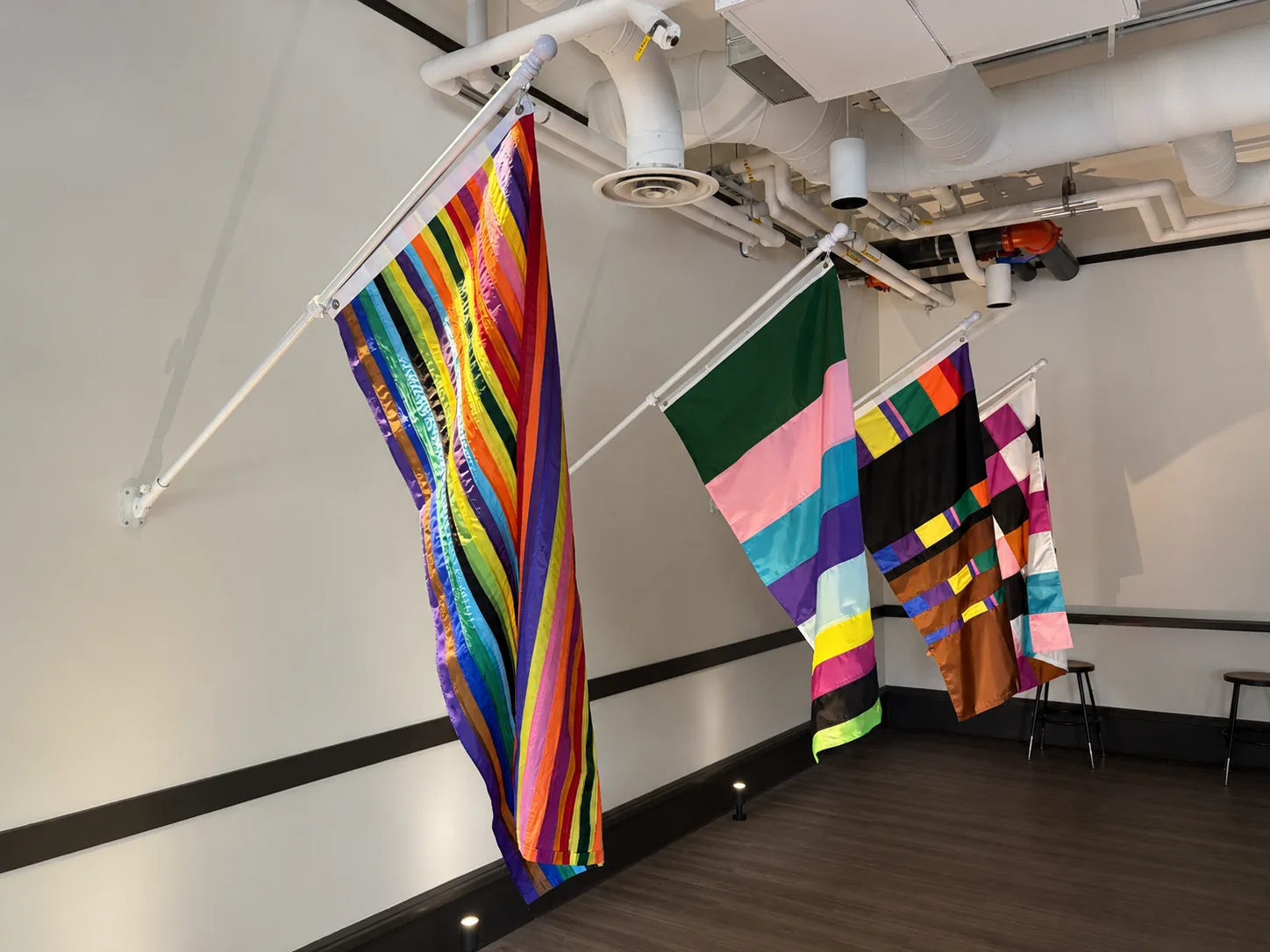
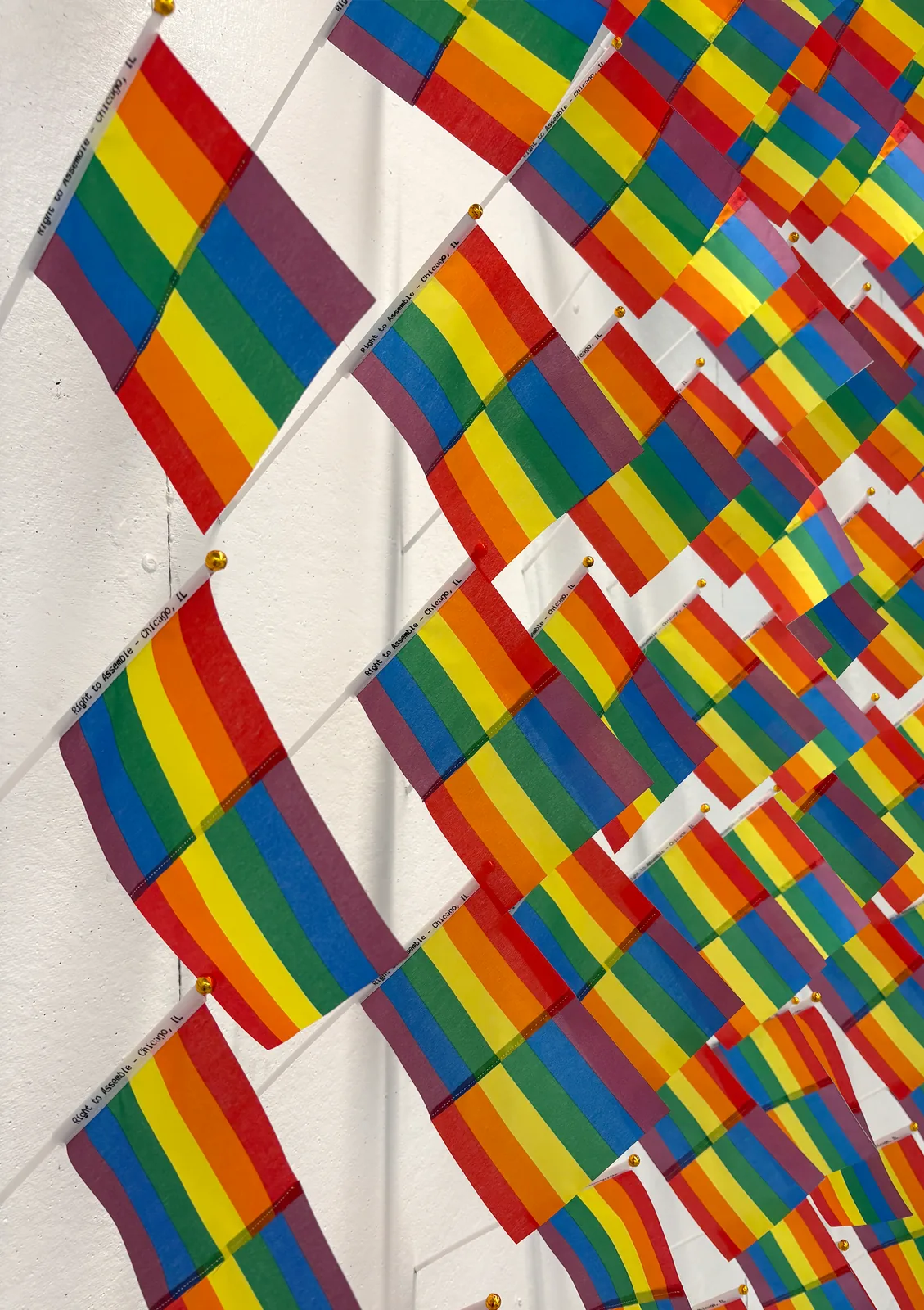
Right to Assemble also included Montgomery's inverted, silkscreened Hand-held Pride Heraldry Flags (edition of 100, 5" x 8") and four earlier Utopian Pride Flags (#17, #31, #13, #18, 2022–2025). The exhibition framed textile assemblage — quilts and flags — as a method of coalition building and a way of archiving Queer visions "amid systemic erasure." [1]
Lineage
- Direct predecessors
- Intersex-Inclusive Pride Flag
- Indirect influences
- Utopian Pride Flag #6 (2040 Progress Flag)
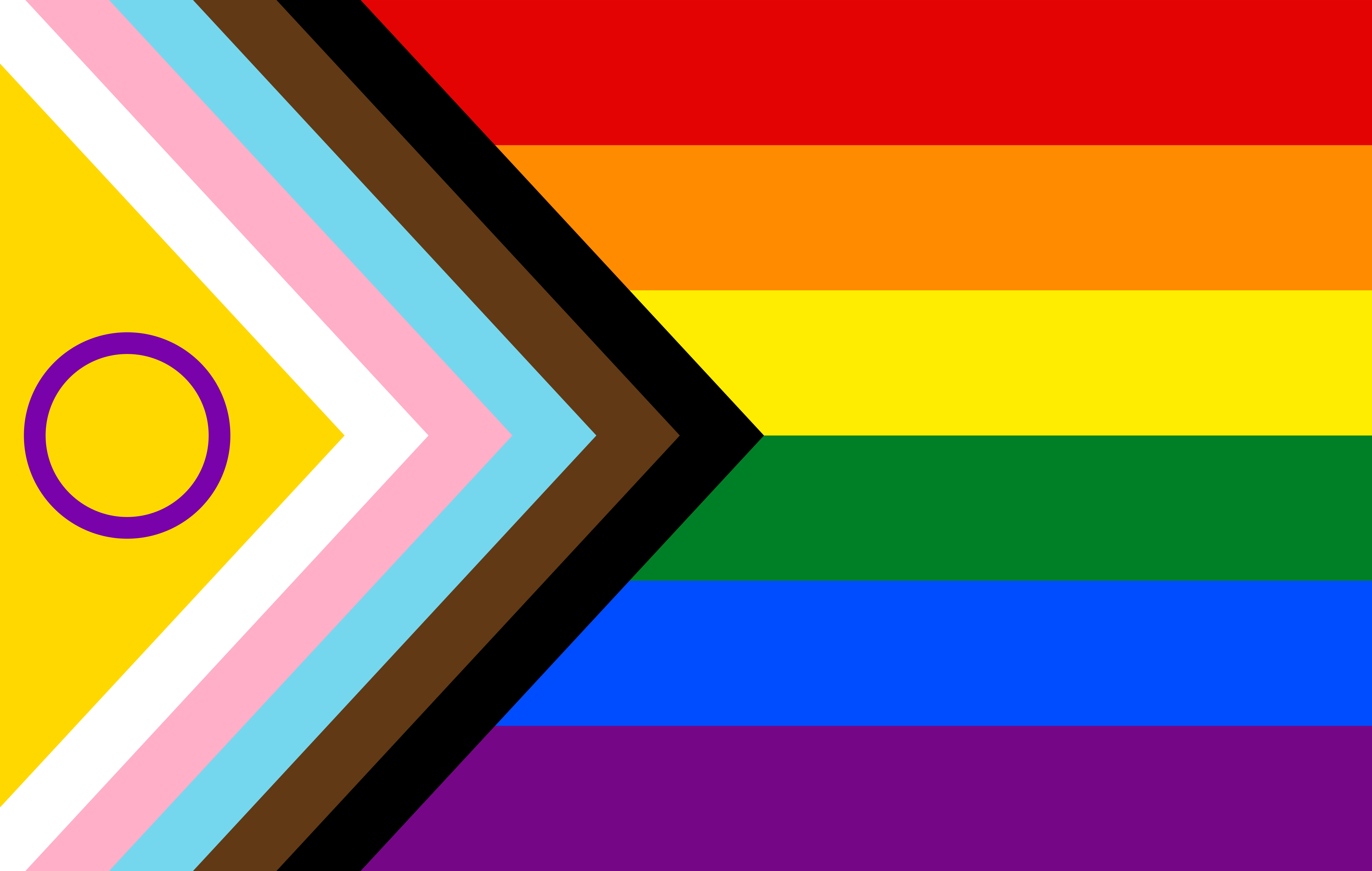
The image source is the Intersex-Inclusive Progress Pride Flag (Valentino Vecchietti, 2021), the source design whose colours and geometry it blurs; that design is itself built on Daniel Quasar's 2018 Progress Pride Flag and on the intersex symbol designed by Morgan Carpenter in 2013.

Its method descends from Montgomery's own Utopian Pride Flag #6 (2040 Progress Flag), which established the practice of blurring a Progress-family flag to a stated degree of vision. Where #6 blurred Quasar's 2018 flag to 20/40 vision, this work blurs the intersex-inclusive version to a 20/30 astigmatism. #6 is a methodological precursor within the artist's own work rather than a second image source: none of its geometry is carried over, and it blurs a different flag. [1]
Lineage tree
Every record reachable from this one through documented parent and child relationships: 9 records across 7 generations.
- Ancestors -6
- Original Rainbow Flag (1978)
- Ancestors -5
- Seven-Stripe Rainbow Flag (1978)
- Ancestors -4
- Rainbow Pride Flag
- Ancestors -3
- Transgender Pride Flag, Philadelphia Pride Flag
- Ancestors -2
- Intersex Pride Flag, Progress Pride Flag
- Ancestor
- Intersex-Inclusive Pride Flag
- This record
- 5790/2029 Pride Flag
Colors & Symbolism
The flag inherits its entire color vocabulary from the Intersex-Inclusive Progress Pride Flag but dissolves every boundary between its elements, so that no stripe, chevron, or symbol begins or ends cleanly. This blurring enacts the "20/30 stigmatism" named in the artist's description: the categories pride flags conventionally separate — life, healing, nature, harmony, trans identity, racial justice, intersex inclusion — are presented as continuous and overlapping rather than discrete. The deliberate loss of sharp boundaries is the work's central statement. [1]
| Colour | Source-design reference palette | Meaning | Note |
|---|---|---|---|
| Red | #E40303 | Life (inherited from the rainbow pride flag tradition). | Inherited from rainbow. This is the source flag's published value, not a value sampled from this work. |
| Orange | #FF8C00 | Healing (inherited from the rainbow pride flag tradition). | Inherited from rainbow. This is the source flag's published value, not a value sampled from this work. |
| Yellow | #FFED00 | Sunlight (inherited from the rainbow pride flag tradition). | Inherited from rainbow. This is the source flag's published value, not a value sampled from this work. |
| Green | #008026 | Nature (inherited from the rainbow pride flag tradition). | Inherited from rainbow. This is the source flag's published value, not a value sampled from this work. |
| Blue-Indigo | #004DFF | Harmony (inherited from the rainbow pride flag tradition). | Inherited from rainbow. This is the source flag's published value, not a value sampled from this work. |
| Violet | #750787 | Spirit (inherited from the rainbow pride flag tradition). | Inherited from rainbow. This is the source flag's published value, not a value sampled from this work. |
| Black | #000000 | Those lost to and living with HIV/AIDS, and marginalized communities of colour (inherited from the Progress Pride Flag chevron). | Inherited from Progress Flag chevron (POC / HIV-AIDS). This is the source flag's published value, not a value sampled from this work. |
| Brown | #613915 | Marginalized communities of colour (inherited from the Progress Pride Flag chevron). | Inherited from Progress Flag chevron (POC). This is the source flag's published value, not a value sampled from this work. |
| Light Blue | #74D7EE | Trans identity (inherited from the Progress Pride Flag chevron). | Inherited from Progress Flag chevron (transgender). This is the source flag's published value, not a value sampled from this work. |
| Pink | #FFAFC8 | Trans identity (inherited from the Progress Pride Flag chevron). | Inherited from Progress Flag chevron (transgender). This is the source flag's published value, not a value sampled from this work. |
| White | #FFFFFF | Trans identity (inherited from the Progress Pride Flag chevron). | Inherited from Progress Flag chevron (transgender). This is the source flag's published value, not a value sampled from this work. |
| Yellow (intersex) | #FFD800 | Intersex inclusion (inherited from the Intersex-Inclusive Progress Pride Flag emblem). | Inherited from the Intersex-Inclusive Progress Flag emblem. This is the source flag's published value, not a value sampled from this work. |
| Purple (intersex) | #7902AA | Intersex inclusion (inherited from the Intersex-Inclusive Progress Pride Flag emblem). | Inherited from the Intersex-Inclusive Progress Flag emblem. This is the source flag's published value, not a value sampled from this work. |
The stripe and symbol meanings are inherited from the Intersex-Inclusive Progress Pride Flag and are intentionally blurred. Individual meanings should be read as tendencies within a gradient rather than as discrete symbolic assignments. [1]
The values listed are the archive's reference palette for the source design, Valentino Vecchietti's 2021 Intersex-Inclusive Progress Pride Flag. They are read from this archive's own redrawn SVG of that flag rather than from an official Vecchietti specification, and the Intersex-Inclusive Progress Pride Flag entry records them as provisional. Neither this artwork nor its source has a separately published flat-colour palette. [1]
None of them survives the blur. Measured against the digital master, not one of the thirteen occurs in a single pixel of the work, and the distances are large: the nearest pixel to the source flag's blue-indigo is 143 out of 255 away, to its black 133, to its white 117, to its green 109 and to its light blue 108. No channel in the file reaches either extreme, running red 68 to 243, green 26 to 198 and blue 18 to 183, so pure black and pure white cannot occur in it at all. Mean saturation falls from 0.73 across the source palette to 0.56 across the work.
What the file holds instead, reduced to ten regions, is led by a red at #D32D1B over about a sixth of the surface, an olive grey at #808367, a deep violet at #4C2476 and a blue-violet at #4E4B79, with the remainder running through tans and golds. These are measurements of the digital master rather than of the printed nylon.
Zero exact matches does not mean the colours are absent from view: it means no pixel equals those exact triplets. The inherited symbolism in the table describes the source design's meanings, not what any particular pixel of this artwork represents.
Design
- Aspect Ratio
- 53:85 · documented
- Ratio Notes
- From the artist's own checklist for Right to Assemble, which gives the work as "Laser printed nylon, 53" x 85"". That is 53 high by 85 wide, within a third of a per cent of 5:8. The piece was hung as a tall banner in the exhibition, rotated from the proportion in which it is described. The artist's print file, 18900 by 11400 pixels, and the web master, 1400 by 844, agree with each other at 1.66:1; printed at 85 inches wide that proportion gives about 51 inches, so the checklist's 53 inches describes the finished object rather than the file. [1] The print file is not held by this archive and has not been inspected; its dimensions rest on the artist's statement. [2]
- Orientation
- horizontal
- Layout
- other
The work has no stripes, chevrons or emblems with edges. Every element of the source flag survives only as a soft region of colour, so stripe count and stripe order do not apply. In the Right to Assemble installation it hung as a tall vertical banner, turned ninety degrees from the horizontal proportion its dimensions describe. [1]
A 53 by 85 inch laser-printed nylon flag that takes the Intersex-Inclusive Progress Pride Flag as its source and applies a uniform blur, described in the artist's caption as "to the degree of a 20/30 stigmatism". The published caption carries that spelling [sic]; Montgomery gives the intended term as astigmatism, and the archive uses it outside direct quotation. [2] The chevron, rainbow field and intersex emblem remain legible as soft shapes and colour regions but lose their hard edges, merging into a continuous gradient. [1]
A figure such as 20/40 is a visual-acuity fraction: it describes what a viewer sees at twenty feet against what normal vision resolves at forty. [8] It measures sharpness at distance and is not itself a measurement of astigmatism, which is a refractive error caused by an irregularly shaped cornea or lens. [9] The blur is an artistic treatment described by that figure, not a clinical simulation or a calibrated filter.
A continuous colour gradient with no hard edges, carrying the rainbow field, chevron and intersex emblem of the Intersex-Inclusive Progress Pride Flag as soft overlapping regions. Laser-printed nylon, 53 by 85 inches. [1]
Usage & Adoption
- First Users
- Will Montgomery (artist)
- Geographic Usage
- Chicago, Illinois (The Center on Addison, 2026)
- Online Usage
- willmontgomery.art
- Event Usage
- Right to Assemble exhibition (2026)
- Current Status
- active
This is an artwork, not a community-adopted flag. Usage is limited to the artist's own exhibitions and installations.
Image Archive
The flags it descends from
In the exhibition
Discourse & Debates
Common misidentifications
- Not to be confused with the Utopian Pride Flag #6 (2040 Progress Flag), the earlier work whose blurring method this piece extends. That flag blurs the Progress Pride Flag to 20/40 vision; this one blurs the Intersex-Inclusive Progress Flag to a 20/30 astigmatism.
This record documents an artwork that takes the form of a flag rather than a community-adopted identity flag. Its creator, Will Montgomery, is also the host and editor of this database. The entry is written under that relationship and discloses it so readers can evaluate the entry accordingly.
Footnotes & Citations
Sources and footnotes 10 sources
- 1. Designer page Right to Assemble. Will Montgomery. willmontgomery.art (2026). Accessed 2026-07-10
The artist's project page for Right to Assemble, carrying the exhibition description and the checklist line for this work with its medium, dimensions and caption.
- 2. Primary statement Statement by the artist on the making, print file and blur description of the 5790/2029 Pride Flag (unpublished, 12 August 2026). Will Montgomery. Unpublished creator statement to this database (2026-08-12). Accessed 2026-08-13 [no stable URL]
- 3. Reference Rosh Hashana 2029 / ראש השנה 5790. Hebcal. Accessed 2026-08-12
- 4. Designer page About. Will Montgomery. willmontgomery.art. Accessed 2026-07-10
The artist's biography page.
- 5. Primary statement Artist talk. Will Montgomery. School of the Art Institute of Chicago (2026). Accessed 2026-08-12 [no stable URL]
Montgomery's talk at the School of the Art Institute of Chicago, Spring 2026. Quoted from the artist's own notes of the talk; no recording, transcript or programme has been published.
- 6. Official Land Acknowledgment Statement. Chicago Park District. Accessed 2026-07-10
- 7. Official Land Acknowledgement Resolution. Office of the City Clerk, City of Chicago. Accessed 2026-07-10
- 8. Organizations Visual Acuity. American Optometric Association. Accessed 2026-08-12
- 9. Organizations Astigmatism. American Optometric Association. Accessed 2026-08-12
- 10. Designer page Home of the Progress Pride Flag. Daniel Quasar. progress.gay. Accessed 2026-08-12
Image Sources
- Rendering
- 5790/2029 Pride Flag, 2026
- Credit: Will MontgomeryRights Copyright Will Montgomery. Reproduced by the artist, who is also the editor of this database. Credit required; not available for free reproduction.
- Credit: Valentino VecchiettiRights Reproduced from the archive's own record of the source flag.
- The Intersex-Inclusive Progress Pride Flag, designed by Valentino Vecchietti in 2021. This is the image the work blurs, and the source of all thirteen of its listed colours. [1] · Credit: Valentino Vecchietti · Encycloflaggia
- Utopian Pride Flag #6, the 2040 Progress Flag, by Will Montgomery. The parent of the method rather than of the image: it established blurring a Progress-family flag to a stated degree of vision, in that case 20/40. [1] · Credit: Will Montgomery · Encycloflaggia
- The 5790/2029 Pride Flag installed at Right to Assemble, The Center on Addison, Chicago, June 2026. Laser-printed nylon, 53" x 85" — the Intersex-Inclusive Progress Flag blurred to the degree of a 20/30 astigmatism, hung as a tall banner alongside Utopian Pride Flag #25. · Credit: Will Montgomery · Will Montgomery Studio
- Installation view 1 of Right to Assemble: the 5790/2029 Pride Flag and Utopian Pride Flag #25 from the gallery entrance, the exhibition title on the brick wall. The caption is the project page's own. [1] · Credit: Will Montgomery · Will Montgomery Studio
- Installation view 2 of Right to Assemble: the 5790/2029 Pride Flag beside Utopian Pride Flag #25, the sewn work it hung alongside. The caption is the project page's own. [1] · Credit: Will Montgomery · Will Montgomery Studio
- The four earlier Utopian Pride Flags shown in the same exhibition, nearest to furthest #17, #31, #13 and #18, 2022 to 2025, recycled pride flags and deadstock denier nylon. [1] · Credit: Will Montgomery · Will Montgomery Studio
- The Hand-held Pride Heraldry Flags shown in the same exhibition: inverted, silkscreened hand-held nylon pride flags, an edition of 100 at 5 by 8 inches. [1] · Credit: Will Montgomery · Will Montgomery Studio