Gilbert Baker Nine-Stripe Rainbow Flag
Rainbow Pride Flag ·
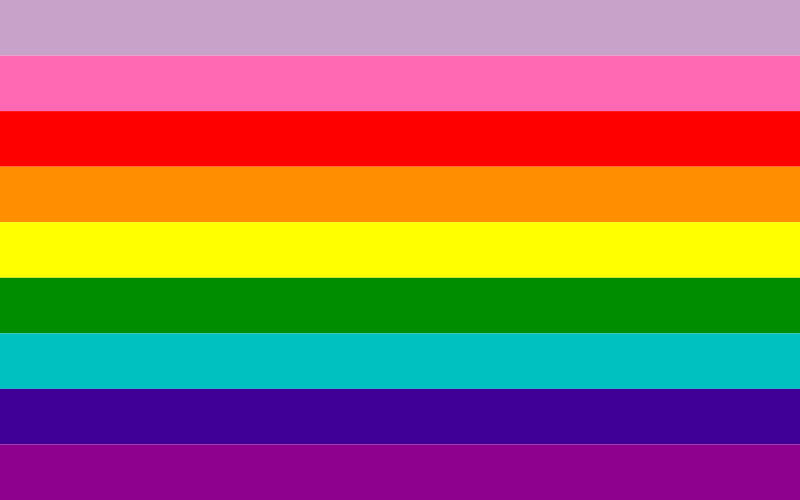
Gilbert Baker's final rainbow-flag variation, documented in March 2017, restores the original eight stripes and adds lavender above them for diversity. Baker developed it in New York during the opening months of the Trump administration, shortly before his death, and made a limited run intended for display in San Francisco. [1][2]
Key facts
- Designer
- Gilbert Baker
- Created
- First documented public appearance
- In use
- 2017–present
- Aspect Ratio
- 3:5 · standard
- Ratio Notes
- The 3:5 figure is the archive's production specification for its reconstruction. No creator-issued aspect ratio for the 2017 design has been located; the photographed textile and the commercial reproductions vary in proportion. [2][3]
- Stripes
- 9
- Origin
- New York City, New York, United States
- Represented Identity
- LGBTQ community
Also known as
- 9 Color Diversity Flag
- Diversity Flag
- 2017 9 Stripe Gilbert Baker Rainbow Pride Flag
Status Historical Variant
Archive categories Rainbow Pride Flags · Historical and Early Pride Flags
Overview
A San Francisco Bay Times article published on 9 March 2017 reported that Gilbert Baker was adding lavender to the eight-color rainbow design. Baker described the new stripe as representing diversity "in the age of Trump." The article says he had wanted to add lavender for some time and connected the timing to the 2016 presidential election. The nine equal bands run from lavender at the top through hot pink, red, orange, yellow, green, turquoise, indigo, and violet. [1]
A 31 March obituary reported that Baker had hand-sewn 39 examples for the rainbow flag's 39th anniversary and planned to display them in San Francisco that June. [2] The Gilbert Baker Foundation later recalled finding 60 freshly ironed nine-color flags in his Harlem apartment, so the records do not support one uncontested production total. [4] The design remains a historical variant rather than the standard rainbow flag, but Baker-made examples survive in institutional collections and commercial reproductions remain available. [5][3]
Identity & Context
- Represented Identity
- LGBTQ community
- Movement
- Inclusivity discourse within pride symbolism
Made in New York during the opening months of the Trump administration. Baker connected the new stripe to that moment, telling the Bay Times that another colour was needed "to represent diversity in the age of Trump". [1]
Creators
The Creator
Gilbert Baker
Designer and flag-maker
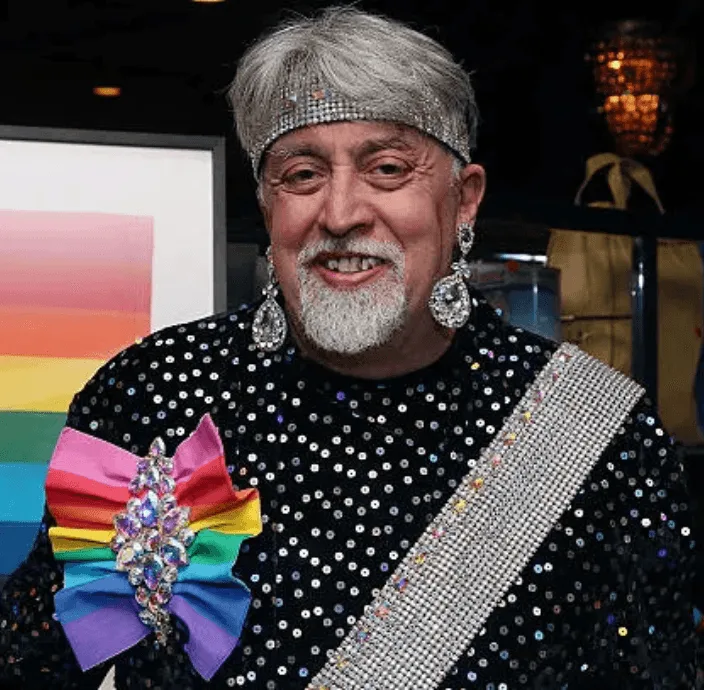
Gilbert Baker (1951–2017) was an American artist, activist, and flag-maker central to the history of the rainbow flag. He created the original eight-color design in San Francisco in 1978, and in March 2017, in New York, adapted it by adding a lavender stripe for diversity. [1][2]
The nine-color design was Baker's own late variation. Its attribution should not displace Lynn Segerblom, James McNamara and the volunteer team from the collaborative design and production history of the 1978 parent flag, which the original rainbow flag entry records in full.
Attribution notes
Baker made the original rainbow flag in San Francisco in 1978 and this design in New York in 2017, and refused to trademark either. [6][7] The Gilbert Baker Foundation states that "before his death, Gilbert Baker used the Pantone matching system to define the exact colors of the original eight-color Rainbow Flag", and has converted those values into other colour systems. [8] That specification covers the eight colours this flag inherits. It does not cover the lavender, and the Foundation's pages on the flag and its colours do not describe the nine-stripe design.
Origin
- Country
- United States
- Region / state
- New York
- City
- New York City
- Place Type
- city
- Physical Origin Status
- Recorded at city level. Baker's New York home is documented; the room and moment of the design's conception are not.
Created in New York City, on the ancestral homeland of the Lenape people, known as Lenapehoking. [9][10]
Indigenous land context
Lenape (Munsee-speaking) — ancestral homeland (Lenapehoking) (Indigenous name: Lenapehoking). The land now designated as New York City is part of Lenapehoking, the homeland of the Lenape people. The word "Manhattan" derives from the Munsee Lenape language. The Lenape were violently displaced through European settler colonialism. [9][10]
Colonial / settler context
New York City is part of Lenapehoking, the Lenape homeland. The Lenape were violently displaced through European settler colonialism. [9][10] [9]
- Land status
- Colonized
- Indigenous engagement
- None documented
- Continuing presence
- Lenape diaspora communities in Oklahoma, Wisconsin, Ontario, and New Jersey; NYC has one of the largest urban Indigenous populations in the United States
Baker lived in a garden apartment at 546 West 150th Street in Hamilton Heights from 2001 until his death. [11][12] After he died on 31 March 2017, Charley Beal of the Gilbert Baker Foundation described finding fabric scraps on the floor, scissors on the sewing machine and an ironing board draped with 60 freshly ironed nine-color flags in that apartment. [4] Those facts establish a New York home-workshop context. No inspected source states where Baker first conceived the design, and the address is recorded as his residence rather than as an attested place of creation. San Francisco is where the flags were to be displayed, not where they were made. [2]
Dates & Chronology
- Year Created
- Exact date
- First documented public appearance
- Period in Use
- 2017–present
Less widely flown than the six-stripe form. The design is manufactured and sold; the archive holds one retail listing. [3] No formal adoption by an organization has been located, and no evidence has been found that Baker's own flags were flown at the June 2017 San Francisco Pride they were intended for. A plan is recorded; the event is not. [2]
Baker moved from San Francisco to New York City in 1994 and lived at 546 West 150th Street from 2001 until his death. [11] The nine-stripe flag was his last. [2]
Two 2017 designs approached inclusion differently and are sometimes conflated. Baker added a single lavender stripe for broad diversity to his own eight-color design, documented on 9 March. [1] Philadelphia unveiled the More Color, More Pride flag on 8 June, adding black and brown stripes to the six-color flag to foreground Black and brown LGBTQ communities. [13] That unveiling followed Baker's death by more than two months and cannot be the context in which he worked. Baker's remarks to the Bay Times did address racism and sexism in the Queer community, but no located source describes lavender as a stripe for any single constituency. [1]
Lineage
- Direct predecessors
- Original Rainbow Flag (1978)
- Related flags
- Disability-Inclusive Pride Flag, Intersex-Inclusive Pride Flag, Philadelphia Pride Flag, Progress+ Flag (Disabled Queer Transmasc Variant), Progress Pride Flag, Rainbow Pride Flag, Inclusive Diversity Pride Flag (TransIphis, 2022)
- Sibling flags
- Seven-Stripe Rainbow Flag (1978)
Branches directly from the original eight-stripe record rather than from the six-stripe commercial form: the 2017 design restores the complete eight-color parent sequence and adds one new lavender band above it. [1]
The parent record credits Gilbert Baker, Lynn Segerblom, James McNamara and the volunteer production team. This derivative is Baker's alone. The Philadelphia, Progress and Intersex-Inclusive Progress flags are contextual comparisons of the same period, not ancestors of this design. [13]
Lineage tree
Every record reachable from this one through documented parent and child relationships: 2 records across 2 generations.
- Ancestor
- Original Rainbow Flag (1978)
- This record
- Gilbert Baker Nine-Stripe Rainbow Flag
Colors & Symbolism
Eight colours Baker assigned to shared human experience, with a ninth added in 2017 for diversity. [8][1]
| Swatch | Hex | Baker's swatch | Baker's | Colour | Meaning | Note |
|---|---|---|---|---|---|---|
#C8A2C8 | — | Lavender | Diversity. The 2017 addition. Baker told the Bay Times that another colour was needed "to represent diversity in the age of Trump", and that he had wanted to add lavender for some time. The Gilbert Baker Foundation does not describe this stripe. [1] | The 2017 addition. Baker specified eight colours and this flag has nine, so no creator value exists for the ninth. The value shown is the archive reconstruction's own choice for a lavender band. | ||
#FF69B4 | #D6006EPantone 225C [8] | Hot Pink | Sex. "Hot pink placed the human body at the center of pride, celebrating intimacy and sexual freedom." [8] | Inherited from the eight-stripe original. Hex: Wikimedia Commons digital convention. Pantone and its conversion: Gilbert Baker Foundation. [8] | ||
#FF0000 | #E4002BPantone 185C [8] | Red | Life. "Red reflects life itself: the objective of being visible and fully present as you interact with the world." [8] | Inherited from the eight-stripe original. Hex: Wikimedia Commons digital convention. Pantone and its conversion: Gilbert Baker Foundation. [8] | ||
#FF8E00 | #FE5000Pantone 021C [8] | Orange | Healing. "Orange represents our need for self-care as we push back against oppression in the ongoing battle for justice and equality." [8] | Inherited from the eight-stripe original. Hex: Wikimedia Commons digital convention. Pantone and its conversion: Gilbert Baker Foundation. [8] | ||
#FFFF00 | #FFCD00Pantone 122C [8] | Yellow | Sunlight. "Yellow radiates a warm, uplifting energy, nourishing the spirit and helping truth and hope emerge from the darkness." [8] | Inherited from the eight-stripe original. Hex: Wikimedia Commons digital convention. Pantone and its conversion: Gilbert Baker Foundation. [8] | ||
#008E00 | #00843DPantone 348C [8] | Green | Nature. "Green symbolizes organic vitality, mirroring the natural world in its perpetual cycle of renewal." [8] | Inherited from the eight-stripe original. Hex: Wikimedia Commons digital convention. Pantone and its conversion: Gilbert Baker Foundation. [8] | ||
#00C0C0 | #009AA6Pantone 3135C [8] | Turquoise | Magic and art. "Turquoise represents the mystical space where fantasy meets reality, inspiring us to infuse our lives with art and enchantment." [8] | Inherited from the eight-stripe original. Hex: Wikimedia Commons digital convention. Pantone and its conversion: Gilbert Baker Foundation. [8] | ||
#400098 | #003DA5Pantone 293C [8] | Indigo | Serenity. "Blue symbolizes a profound state of inner peace, calm and emotional tranquility, combatting external chaos and challenges." The Foundation's sentence for this stripe calls it blue, and the Pantone it gives, 293C, is a blue. [8] | Inherited from the eight-stripe original. Hex: Wikimedia Commons digital convention. Pantone and its conversion: Gilbert Baker Foundation. [8] | ||
#8E008E | #A634B2Pantone 2593C [8] | Violet | Spirit. "Violet lifts the flag into the spiritual. It speaks to memory, purpose, and the belief that liberation is not only political, but soulful." [8] | Inherited from the eight-stripe original. Hex: Wikimedia Commons digital convention. Pantone and its conversion: Gilbert Baker Foundation. [8] |
This flag has no official digital palette. Color values shown are approximate.
The eight inherited readings are the Gilbert Baker Foundation's, in its words. It describes Baker as having treated colour "as a symbolic language rather than mere decoration", and states that the stripes "did not correspond to any L, G, B, T, or Q identity": Baker saw the community "as something larger and more unified: a 'Rainbow of Humanity,' representing all races, genders, and sexualities". It quotes him: "All sexes, all genders, all races, all ages. It's the Rainbow of Humanity." [8]
The lavender is the exception. Its meaning comes from Baker himself as reported in March 2017, not from the Foundation, whose pages on the flag, its history and its colours do not mention a ninth stripe, a lavender stripe, the year 2017 or the flags he was sewing. [1][8] That silence is not evidence against the design, which contemporaneous reporting describes; it is a gap in the source a reader would most expect to carry it.
The hex values shown are the archive reconstruction palette. For the eight inherited stripes they are the Wikimedia Commons digital convention, which is what the archive also displays for the 1978 original, so the same eight stripes render identically on both entries. They are not a specification for Baker's hand-sewn 2017 textiles.
A second palette exists for those eight, and it descends from the designer: the Gilbert Baker Foundation states that "before his death, Gilbert Baker used the Pantone matching system to define the exact colors of the original eight-color Rainbow Flag", and has converted those selections into RGB, CMYK and hex. [8] It is shown here as an inherited reference for the eight older colours. It is not evidence that any particular 2017 flag was made to those values.
The two sets are not close. The Foundation's red is a crimson, #E4002B, rather than a pure primary; its yellow a gold, #FFCD00; its indigo a strong blue, #003DA5, which its own sentence for that stripe calls "Blue". Two of its rows are internally inconsistent as published: hot pink and yellow each list an RGB triplet that does not match the hex printed beside it. [8]
The lavender has neither. No creator-issued digital or Pantone value for it has been located, and none has been sampled from a photograph, which would turn a JPEG artefact into a specification.
Design
- Aspect Ratio
- 3:5 · standard
- Ratio Notes
- The 3:5 figure is the archive's production specification for its reconstruction. No creator-issued aspect ratio for the 2017 design has been located; the photographed textile and the commercial reproductions vary in proportion. [2][3]
- Orientation
- horizontal
- Stripe Count
- 9
- Layout
- horizontal stripes
- Stripes (Top → Bottom)
- Lavender, Hot Pink, Red, Orange, Yellow, Green, Turquoise, Indigo, Violet
Nine horizontal stripes of equal depth, each a ninth of the flag, with no charge and no additional device. The order from the top is lavender, hot pink, red, orange, yellow, green, turquoise, indigo and violet: the eight-stripe 1978 sequence with lavender placed above it rather than inserted into it. [1][2]
The flags Baker made were sewn, not printed. A Gilbert Baker Foundation video shows him sewing the 39th-anniversary nine-color flags. [14] Charley Beal described the apartment after Baker's death: fabric scraps on the floor, scissors on the sewing machine, an ironing board draped with sixty freshly ironed nine-color flags. [4]
Nine horizontal stripes of equal depth: lavender, hot pink, red, orange, yellow, green, turquoise, indigo and violet.
Usage & Adoption
- Current Status
- niche / historical variant
Less widely flown than the six-stripe form. The design is manufactured and sold, and the archive holds one retail listing for it. [3] No documented flying of one of Baker's own 39 flags has been located, including at the San Francisco Pride of June 2017 they were intended for. [2]
Discourse & Debates
- Often mentioned in relation to debates around inclusion and whether the rainbow flag needed revision
Common misidentifications
- Often overlooked entirely in simplified pride-flag guides
- Confused with the Philadelphia and Progress flags, which are separate designs by other people and postdate this one. [13]
The archive files this as the Gilbert Baker Nine-Stripe Rainbow Flag. It also circulates as the 9 Color Diversity Flag and the Diversity Flag, and the current commercial reproduction is sold as the 2017 9 Stripe Gilbert Baker Rainbow Pride Flag. [3]
Footnotes & Citations
Sources and footnotes 14 sources
- 1. Articles & Reports Our Enduring LGBTQ Symbols. Patrick Carney. San Francisco Bay Times (2017-03-09). Accessed 2026-08-14
The contemporaneous source for the design's existence by 9 March 2017, for the lavender stripe's meaning, and for Baker's own framing of it. Carney quotes him: "We need another color to represent diversity in the age of Trump."
- 2. Articles & Reports Gilbert Baker, "Gay Betsy Ross," creator of the Rainbow Flag, dies in NYC. Los Angeles Blade (2017-03-31). Accessed 2026-03-17
- 3. Retail listing Gilbert Baker Pride Flag | 9-Stripe Rainbow Banner. Flags For Good. Accessed 2026-03-17
A retailer's listing, evidence that the design is manufactured and sold, and nothing more.
- 4. Organizations Flag in the Map virtual exhibit. Charley Beal. Gilbert Baker Foundation. Accessed 2026-08-14
Carries the Foundation president's first-hand account of the apartment after Baker's death, including sixty freshly ironed nine-color flags.
- 5. Museums & Exhibitions Baker-made 2017 Diversity Pride flag on display. Kansas Museum of History. Accessed 2026-08-14
Evidence of a surviving institutional example. The post could not be loaded for reading from the archive's environment.
- 6. Organizations Gilbert Baker. Gilbert Baker Estate. Accessed 2026-03-11
- 7. Encyclopedias & Reference Gilbert Baker (artist). Wikipedia. Accessed 2026-03-17
- 8. Organizations Color Meanings. Gilbert Baker Foundation. gilbertbaker.com. Accessed 2026-08-14
The designer's foundation on the eight original colours: a meaning and a sentence for each, a quotation from Baker, and the Pantone specification it states Baker himself defined before his death, converted to RGB, CMYK and hex. It does not mention the nine-stripe design.
- 9. Museums & Exhibitions The People of Native New York. Smithsonian National Museum of the American Indian. Accessed 2026-03-30
- 10. Government CCHR Land Acknowledgment. New York City Commission on Human Rights. Accessed 2026-03-30
- 11. Reference Gilbert Baker and Raise the Rainbow Workshop. NYC LGBTQ Historic Sites Project. Accessed 2026-08-14
Supports Baker's residence at 546 West 150th Street from 2001 until his death. It does not identify a place of creation for the 2017 design.
- 12. Articles & Reports LGBTQ History Fun Fact: Gilbert Baker, the Creator of the Rainbow Flag, Once Lived on This Block in West Harlem. The Curious Uptowner. Accessed 2026-03-17
- 13. Government More Color, More Pride. City of Philadelphia (2017-06-08). Accessed 2026-08-14
Dates the Philadelphia flag's unveiling to 8 June 2017, after Baker's death.
- 14. Video & Media Gilbert Baker Sewing 39th anniversary 9 color Rainbow Flags in 2017. Photographed by Richard Ferrara. Gilbert Baker Foundation. YouTube. Accessed 2026-08-14
Visual primary evidence of Baker sewing the nine-color flags. Photography credited on the video to Richard Ferrara. Cited, not reproduced.
Image Sources
- Rendering
- Archive reconstruction
- Credit: Design by Gilbert Baker; reconstruction drawn by Encycloflaggia