Anarcha-Queer Flag (rainbow variant)
Political / Protest Flag · Documented from November 2012 to July 2022
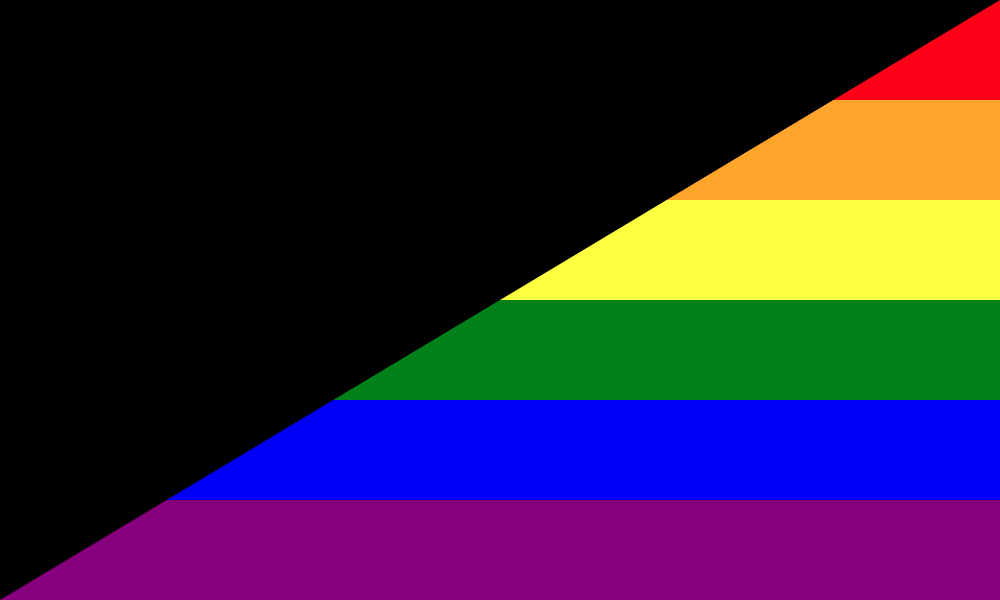
The rainbow flag halved diagonally with the black flag of anarchism, a variant of the pink and black Anarcha-Queer Flag. [1] No designer, creation date or place of creation is documented. Its earliest documented use is a Moscow demonstration on 24 November 2012, and the record runs to Bristol Pride on 9 July 2022. [1][2]
Key facts
- First documented public use
- In use
- Documented from November 2012 to July 2022
- Aspect Ratio
- 3:5 · standard
- Ratio Notes
- No original specification survives. 3:5 is the archive's practical reference reconstruction, not a creator-specified or official proportion; photographs and source renderings show other shapes.
- Stripes
- 6
- Represented Identity
- Queer anarchism
Also known as
- Queer anarchist rainbow flag
Archive categories Rainbow Pride Flags · Protest and Political Pride Flags
Overview
A rainbow-and-black variant of the Anarcha-Queer Flag. Flags of the World states the derivation directly: "Less frequently, the Anarcha-Queer flags are derived from the Rainbow Flag by combining with the black flag of Anarchism." Todorović records it as carried less frequently than the pink and black flag and usually alongside it. No designer, date or place of creation is recorded. The family history of the pink and black design is set out in the base entry. [1]
Identity & Context
- Represented Identity
- Queer anarchism
- Subcommunity
- Queer anarchists, anti-authoritarian Queer activists
- Movement
- Queer anarchism, Queer liberation, anti-state Queer politics
Creators
Creator unknown
No identification located
No designer is documented, and no date or place of creation is recorded. Tomislav Todorović drew the renderings on the Flags of the World page and wrote its text; he is the source's author and illustrator, not the flag's designer. The Wikimedia Commons file was uploaded by the editor Liftarn, which is likewise not evidence of authorship. [1]
Contribute information about who designed this flag.
Origin
Moscow, Russia (site of first documented use)
No creation date, place or designer is recorded. The earliest documented use is a demonstration in Moscow on 24 November 2012, which is a place of use rather than an established origin. [1]
Dates & Chronology
- First public use
- Period in Use
- Documented from November 2012 to July 2022
The earliest known use is a demonstration in Moscow on 24 November 2012, where these flags were parted from bottom hoist to top fly with the black field above the line and the rainbow beneath it, red at the top. They were carried jointly with the pink and black anarcha-queer flags and with other anarchist flags. A further photograph of the same joint use was taken in Russia by the middle of 2013, place and date not recorded, and the flags were carried again in Moscow at the May Day demonstration in 2014. The latest sighting Todorović records is Warsaw in August 2018. [1]
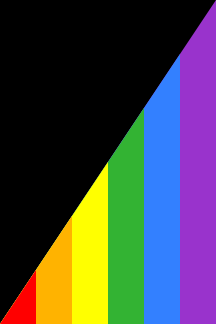
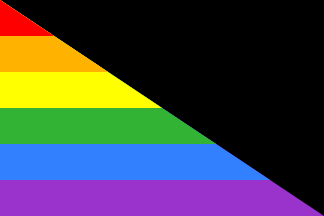
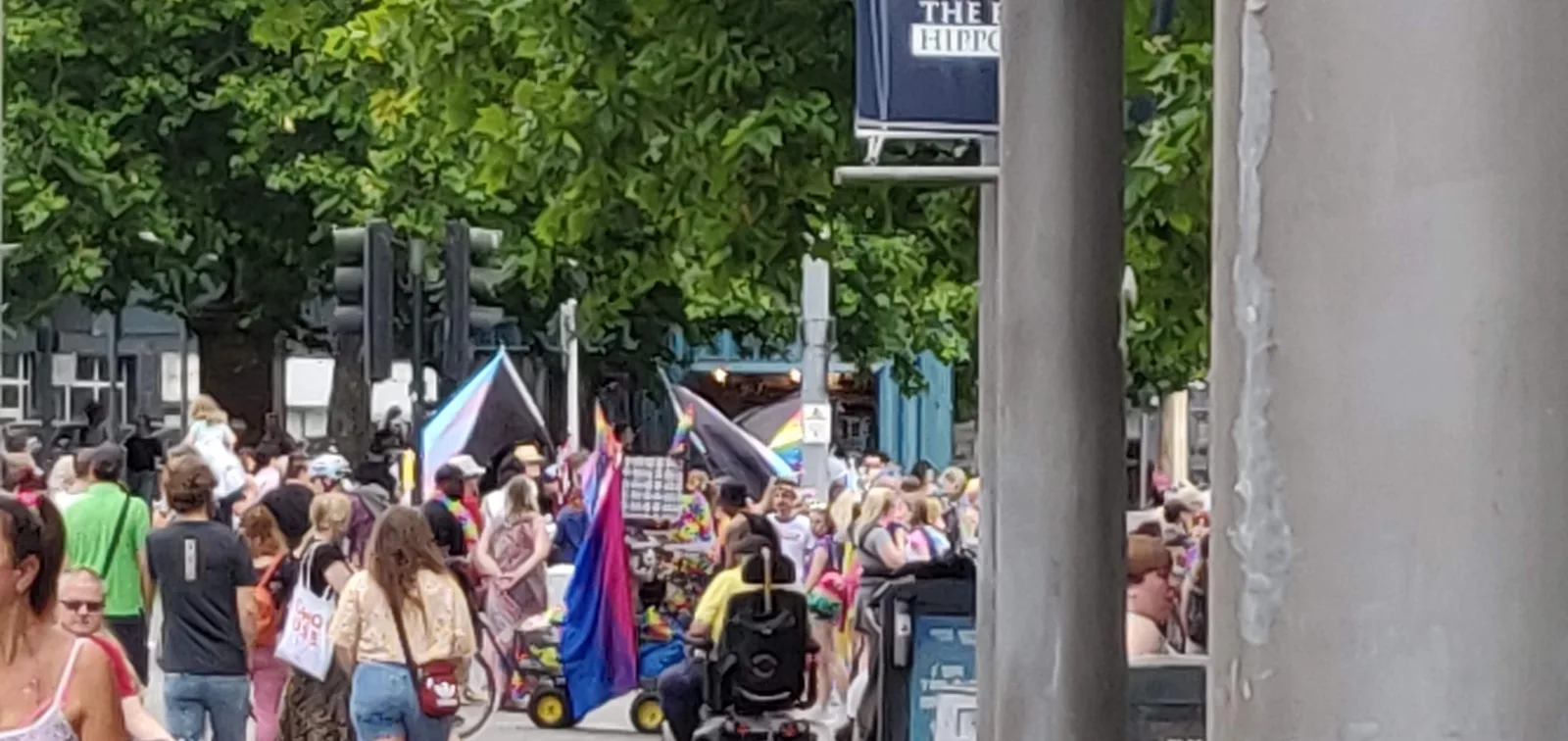
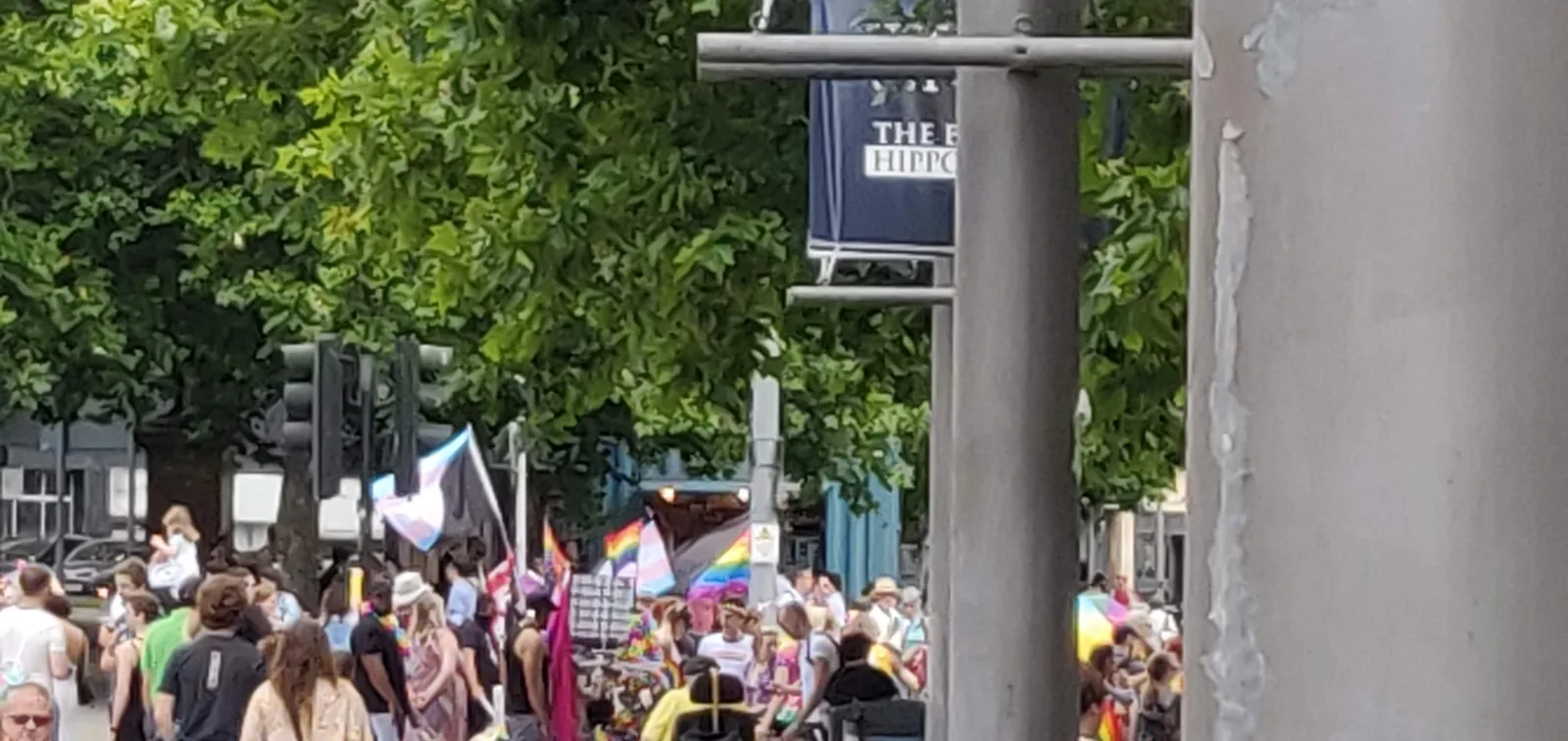
Two further forms are recorded. In Ankara in December 2015 the flag flew again with other anarchist flags, including pink and black ones, on a flag wider than it was long, which Todorović notes is often the case in Turkey; it was parted from bottom hoist to top fly with black above, but its rainbow stripes ran vertically, red next to the hoist. At Bristol Pride on 9 July 2022 the partition ran the other way, from top hoist to bottom fly, with black above the rainbow and red at the top. The flagstaff was not visible in the photograph, and Todorović read the design from the way the flag was flying. [1]
One date in the source is unresolved. A photograph published in 2017 is said to have possibly been taken at "the same 2014 event," but the footnote it points to documents the demonstration of 24 November 2012. The source does not reconcile the two. This entry follows the footnote. [1]
Lineage
- Direct predecessors
- Anarcha-Queer Flag, Rainbow Pride Flag
- Sibling flags
- Alberta Gay Flag, Straight Ally Pride Flag, Anarcha-Queer Flag (transgender variant), Argentina Gay Flag, Australia Gay Flag, Brazil Gay Flag
+ 45 more
British Columbia Gay Flag, Canadian Pride Flag, Chicago Pride Flag (Rainbow Stripes, Purple Stars), Chile Gay Flag, Dominican Republic Gay Flag, Egypt Gay Flag, European Union Gay Flag, France Gay Flag, Gay Pride Flag of Pakistan, Heteroflexible Pride Flag, Heterosexual / Straight Pride Flag, Homoflexible Pride Flag, India Gay Flag, Italy Gay Flag, Japan Gay Flag, Jewish Gay Pride Flag, Manitoba Gay Flag, Mexico Gay Flag, Netherlands Gay Flag, New Brunswick Gay Flag, Newfoundland Gay Flag, Northwest Territories Gay Flag, Nova Scotia Gay Flag, Nunavut Gay Flag, Ontario Gay Flag, Palestinian Gay Pride Flag, Panama Gay Flag, Philadelphia Pride Flag, Prince Edward Island Gay Flag, Quebec Gay Flag, Rainbow Flag with White Triangle (Sapporo), Rainbow Israel Flag, Rainbow Polish Flag (2014, Angela Getler), Russia Gay Flag, Saskatchewan Gay Flag, Social Justice Pride Flag, South African Gay Pride Flag, Switzerland Gay Flag, Tanzania Gay Flag, Texas Rainbow Flag, Turkish Gay Pride Flag, Two-Spirit Pride Flag (2005, Zoccole), Two-Spirit Pride Flag (2016 Tumblr documentation), Victory Over AIDS Flag (1980s, designer unknown), Yukon Territory Gay Flag
Two parents. Flags of the World states the derivation directly: these flags "are derived from the Rainbow Flag by combining with the black flag of Anarchism." It keeps the black half and the diagonal partition of the pink and black Anarcha-Queer Flag, which is its other parent, and takes its second half from the six-stripe Rainbow Pride Flag. [1]
Its siblings are the other flags descending from those parents, among them the transgender Anarcha-Queer variant, which shares the same base flag. Flags carried together at the same march are recorded as use, not as genealogy. [1]
Lineage tree
Every record reachable from this one through documented parent and child relationships: 5 records across 4 generations.
- Ancestors -3
- Original Rainbow Flag (1978)
- Ancestors -2
- Seven-Stripe Rainbow Flag (1978)
- Ancestor
- Rainbow Pride Flag, Anarcha-Queer Flag
- This record
- Anarcha-Queer Flag (rainbow variant)
Colors & Symbolism
Black for anarchism combined with the rainbow for Queer liberation, in the same halved form the anarchist movement uses for its other tendencies. [1]
| Colour | Hex |
|---|---|
| Black | #000000 |
| Red | #FF0018 |
| Orange | #FFA52C |
| Yellow | #FFFF41 |
| Green | #008018 |
| Blue | #0000F9 |
| Violet | #86007D |
Working reference values inherited from the parent flags, not a historical specification [1]
The source explains the combination but publishes no statement of meaning from any maker.
No historical production specification exists. The rainbow values are the archive's standardized working colours for the six-stripe Rainbow parent, carried here for consistency of reproduction; nothing records the unknown variant maker choosing them. [1]
Design
- Aspect Ratio
- 3:5 · standard
- Ratio Notes
- No original specification survives. 3:5 is the archive's practical reference reconstruction, not a creator-specified or official proportion; photographs and source renderings show other shapes.
- Orientation
- horizontal
- Stripe Count
- 6
- Layout
- diagonal_bisection
A diagonal partition with a plain black field on one side and the rainbow stripes on the other. The Moscow flags of 2012 were parted from bottom hoist to top fly with black above and the rainbow beneath, red at the top. The Bristol Pride flags of 2022 were parted the other way, from top hoist to bottom fly, black still above the rainbow. A further variant photographed in Ankara in December 2015 ran the rainbow stripes vertically, red next to the hoist, on a flag wider than it was long, which the source notes is common for flags in Turkey. [1]
Usage & Adoption
- First Users
- Anarchists at a Moscow demonstration, 24 November 2012, carrying these flags jointly with the pink and black anarcha-queer flags [1]
- Geographic Usage
- Russia (Moscow, 2012 and May Day 2014; a further photograph from mid-2013), Turkey (Ankara, December 2015), Poland (Warsaw, August 2018), United Kingdom (Bristol, 9 July 2022)
- Event Usage
- Moscow demonstration, 24 November 2012, the earliest known use [1], Russia, by mid-2013, place and date not recorded [1], Moscow May Day demonstration, 2014 [1], Ankara, December 2015, in the vertical-stripe form [1], Warsaw, August 2018 [1], Bristol Pride, 9 July 2022 [1]
- Current Status
- In use as of the last documented sighting in 2022
Carried by anarchists rather than adopted by any organisation, and usually alongside other anarchist flags. The source describes the design as used "less frequently" than the pink and black form. One date in the source is unresolved: a photograph published in 2017 is said to possibly show "the same 2014 event," while the footnote it points to documents the demonstration of 24 November 2012. The two cannot both be right and the source does not reconcile them; this entry reports the 2012 date, which the footnote supports, and leaves the discrepancy visible. [1]
Image Archive
Variants
Bristol Pride, 9 July 2022


Discourse & Debates
- The relationship between the anarcha-Queer flag (pink/black) and the anarcha-feminist flag (magenta or purple/black) is sometimes debated. Both use the same diagonal bisection format. The choice of pink versus purple signals different political emphases: Queer liberation versus feminist politics, though many activists see these as deeply intertwined.
Common misidentifications
- May be confused with the anarcha-feminist flag, which uses a similar format but with dark magenta or purple (#88008F) instead of pink.
- The pink in the anarcha-Queer flag is sometimes confused with the purple/magenta of the anarcha-feminist flag, especially in low-quality reproductions.
- The flag is sometimes generically labeled as an "anarchist flag" without the Queer-specific context.
"Anarcha-Queer" (sometimes "Queer anarchism" or "anarcho-Queer") describes the intersection of anarchist anti-state politics with Queer liberation. It is distinct from, though related to, anarcha-feminism. The prefix "anarcha-" follows the convention established by anarcha-feminism.
Footnotes & Citations
Sources and footnotes 3 sources
- 1. Anarcha-Queer (Queer Anarchism) — Pink and black flags of Anarchism. Tomislav Todorović. Flags of the World (FOTW) (2022-11-18). Accessed 2026-08-09
- 2. File:Bristol Pride 2022 113550.jpg. OwenBlacker. Wikimedia Commons (2022-07-09). Accessed 2026-08-11
Photograph of Bristol Pride, released under CC0 1.0.
- 3. File:Bristol Pride 2022 113554.jpg. OwenBlacker. Wikimedia Commons (2022-07-09). Accessed 2026-08-11
Photograph of Bristol Pride, released under CC0 1.0.
Image Sources
- Rendering
- standardized reconstruction at 3:5
- Standardized reconstruction at the archive’s 3:5 reference proportion, rebuilt from clean geometry. · Credit: Encycloflaggia · Design documented by Flags of the WorldRights Archive rendering. The underlying design has no identified designer and no located rights statement. Tomislav Todorović’s own renderings remain his and are credited to him where they appear in the Image Archive.
- The Ankara form, December 2015. Parted from bottom hoist to top fly with black above, but the rainbow stripes running vertically, red next to the hoist, on a flag wider than it is long, which Todorović notes is often the case in Turkey. [1] · Credit: Tomislav Todorović / Flags of the World · Flags of the World
- The Bristol Pride form, 9 July 2022, parted from top hoist to bottom fly. The flagstaff was not visible in the photograph and Todorović read the design from the way the flag was flying. [1] · Credit: Tomislav Todorović / Flags of the World · Flags of the World
- Bristol Pride, 9 July 2022. Both Anarcha-Queer variants are visible in the crowd: the transgender-and-black form left of centre and the rainbow-and-black form to its right. Photographed by OwenBlacker. [2] · Credit: OwenBlacker · Wikimedia Commons · CC0 1.0
- Bristol Pride, 9 July 2022, moments after the previous frame. Both Anarcha-Queer variants are again visible, the transgender-and-black and the rainbow-and-black. Photographed by OwenBlacker. [3] · Credit: OwenBlacker · Wikimedia Commons · CC0 1.0