Rainbow Israel Flag
Rainbow Pride Flag
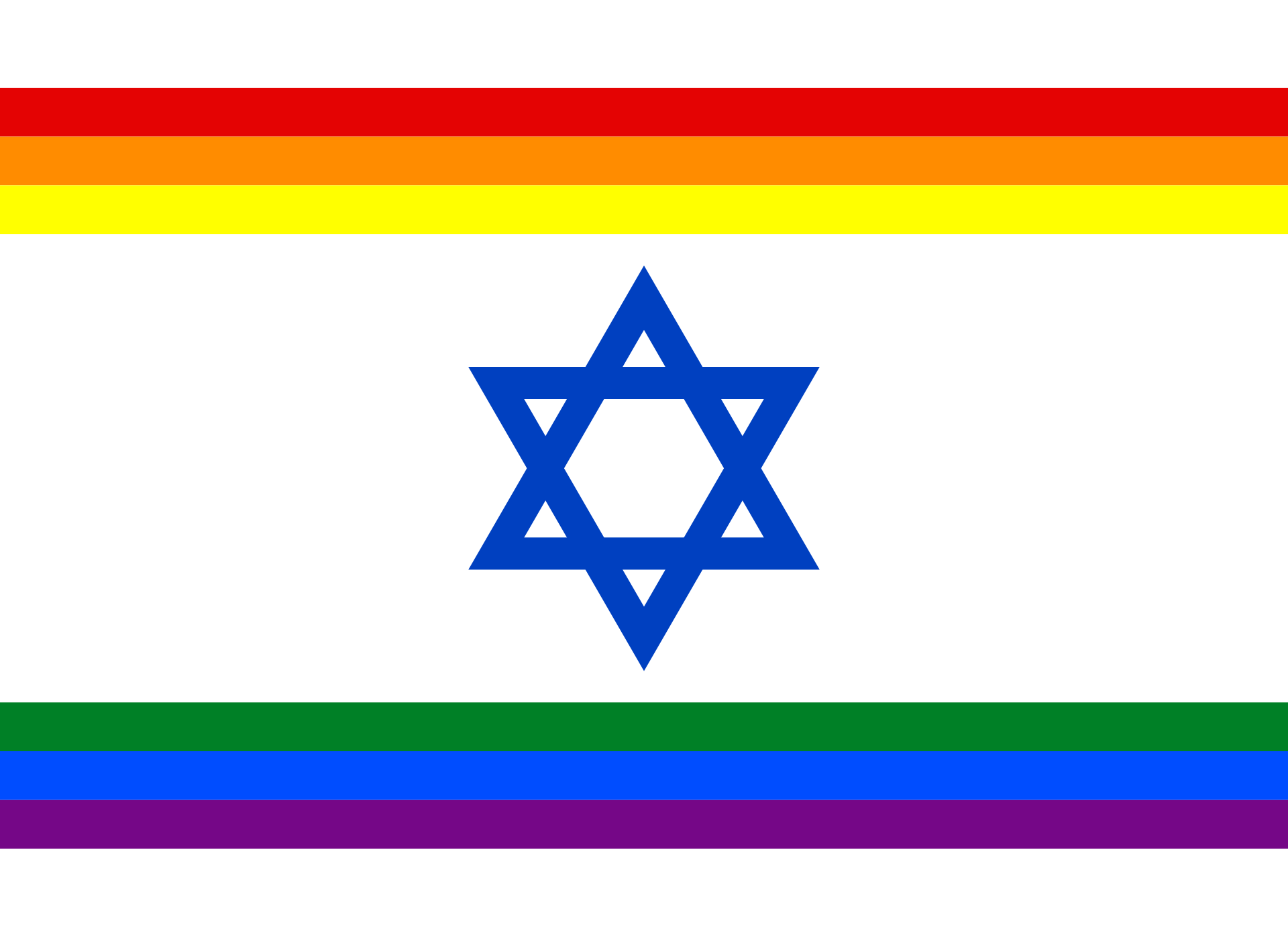
The Israeli national flag with each of its two blue bands replaced by three narrow rainbow bands, keeping the white field and the blue Magen David. Wikimedia Commons user Technion uploaded the earliest located file on 31 March 2008; it names no designer. [1] A Jewish contingent carried the design at San Francisco Pride in 2009 and 2010, and its organizers reported that the 2009 flags were distributed by the Israeli Consulate. [2][3] Later photographs place it at Pride events and political protests inside Israel in 2023. This is not an official flag of the State of Israel. Its title describes the design’s visual relationship to the Israeli national flag and its documented community use, not any formal government adoption. No formal adoption, state commission or state authorship has been located. [1][2]

Key facts
- Designer
- Unknown
- First located online publication
- Documented circulation
- 2008 to present online, with physical use documented from 2009
- Aspect Ratio
- 8:11
- Stripes
- 6
- Represented Identity
- Queer and LGBTQ people associated with Israel and with Jewish communities
Also known as
- Rainbow Israeli Flag
- Israeli LGBT Flag
- Jewish gay flag
Status Variant
Archive categories Rainbow Pride Flags · Historical and Early Pride Flags · Religious and Spiritual Pride Flags
Overview
The design’s making is undocumented. It first appears as a Wikimedia Commons file uploaded on 31 March 2008, built on the public-domain SVG of the Israeli national flag and naming no author. [1]
Identity & Context
- Represented Identity
- Queer and LGBTQ people associated with Israel and with Jewish communities
- Diaspora Context
- The earliest located physical documentation comes from an organized Jewish community contingent in San Francisco, so the diaspora is part of the flag’s history rather than a later footnote. [2][3]
- National Context
- Israel, as the flag’s visual reference
The Commons file describes the design as a "rainbow flag representing the gay, lesbian, bisexual, and transgender community in Israel". [1] Its documented users are wider than that: Queer Jewish communities in the diaspora, Israeli Pride marchers, anti-government protesters, a consulate, and at least one soldier. What the flag means changes with who carries it and where. It should not be read as a religious flag, a citizenship flag or a state-aligned symbol by default.
Creators
Associated Figures
Technion
Uploader and initial SVG contributor
The Wikimedia Commons user who uploaded the earliest located file on 31 March 2008 at 14:04 UTC and, on 1 April at 15:12, replaced its rainbow values with colours taken from another Commons image. The file’s author field is blank. [1]
Fry1989
Later SVG contributor
The Wikimedia Commons user who revised the file on 24 October 2009, on 2 and 10 June 2010, and on 21 July 2011. The 2011 revision is the version the file now serves. [1]
Attribution notes
No designer is documented. The Commons file page states that it is lacking author information, and its code is derived from the public-domain SVG of the Israeli national flag. [1] Technion uploaded the earliest located file and made the 1 April 2008 colour revision; Fry1989 made the later revisions. Neither is documented as the designer. Nothing establishes that the Commons file produced the flags photographed in San Francisco: the digital file and the photographed flags share a design, not a documented production chain. [1][2]
Origin
- Digital Origin
- Yes
- Physical Origin Status
- Unknown. No source records where the design was made.
The physical place of creation is unknown. The first located publication is Wikimedia Commons, on 31 March 2008. [1] Israel is the design’s national reference, not its documented origin: the flag adapts the Israeli national flag, but nothing places its making there or anywhere else. The earliest documented physical use is San Francisco, on 28 June 2009. [2][3] Flags of the World treated the design as a Jewish rather than Israeli flag for years precisely because every located use was in the diaspora; use inside Israel was recorded only in 2023. [2][4]
Dates & Chronology
- First located online publication
- Documented circulation
- 2008 to present online, with physical use documented from 2009
- Creation Bounds
- When and where the design was made is unknown. The earliest located publication is the Wikimedia Commons upload of 31 March 2008 at 14:04 UTC. [1] The date shown in the file’s summary, 1 April 2008, belongs to a revision rather than the first upload: on that day at 15:12 Technion replaced the rainbow values with colours taken from another Commons image. [1] Fry1989 revised the file again on 24 October 2009, twice in June 2010, and on 21 July 2011. [1] The earliest located physical use is 28 June 2009 at San Francisco Pride. [2][3][5]
The earliest located physical documentation is San Francisco Pride on 28 June 2009, where the Jews March for Pride contingent assembled. [5] Its organizers reported more than 700 participants from more than 60 organizations, and that rainbow Israeli flags were distributed by the Consulate. [3] Flags of the World identifies this exact design, the one that follows the national flag most closely, in photographs from that parade and again from San Francisco Pride in 2010. [2] Use inside Israel was not verified in the early documentation. Flags of the World recorded it there only in 2023, at Jerusalem, Tel Aviv and Haifa Pride events and among the flags carried at that year’s political protests. [4] No adoption by a government or a national LGBTQ organization has been located. This is not an official flag of the State of Israel. Its title describes the design’s visual relationship to the Israeli national flag and its documented community use, not any formal government adoption. No formal adoption, state commission or state authorship has been located. [1][2]
Major revisions
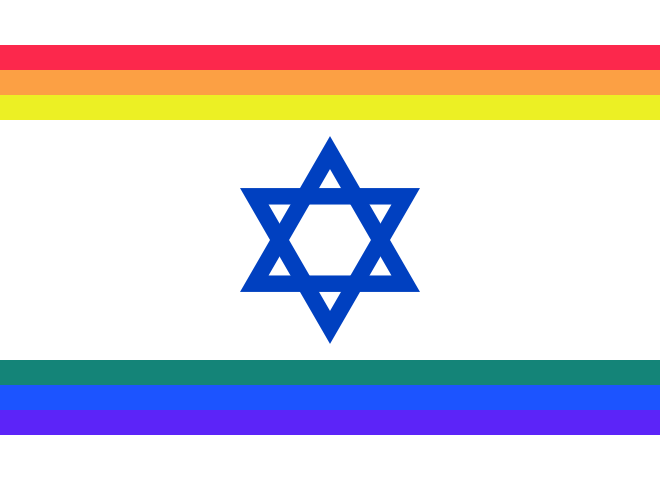
Technion replaced the rainbow values the day after upload, recording that the colours were taken from a referenced image. [1]
The contributor Fry1989 uploaded a set of "more complimentary colours" at 2000 by 1455 pixels, then reverted within two minutes, noting a failure of upload and an intention to make a variant instead. [1]
A further colour change of 2 June 2010 was reverted eight days later "as per request". [1]
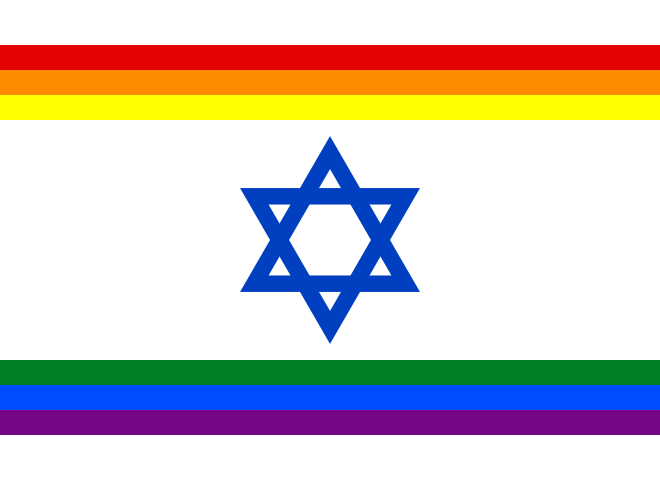
The last revision left both palettes in the file: each band still carries its 2008 value as a fill attribute, overridden by a style rule in the six-stripe flag's standard values, which is what renders. [1]
Flags of the World called this a Jewish rather than an Israeli gay flag for more than a decade, on the reasoning that every located use was in the diaspora and none demonstrated citizenship rather than ethnicity or religion as the thing represented. [2] That classification changed in 2023, when the design was verified in use inside Israel. [4] Several related Star of David and rainbow designs circulate under overlapping names, and the names have been applied inconsistently. This record covers the design that follows the national flag most closely: white field, blue Magen David, three narrow rainbow bands where each blue band would be. [2]
Lineage
- Direct predecessors
- Rainbow Pride Flag
- Sibling flags
- Alberta Gay Flag, Straight Ally Pride Flag, Anarcha-Queer Flag (rainbow variant), Argentina Gay Flag, Australia Gay Flag, Brazil Gay Flag
+ 44 more
British Columbia Gay Flag, Canadian Pride Flag, Chicago Pride Flag (Rainbow Stripes, Purple Stars), Chile Gay Flag, Dominican Republic Gay Flag, Egypt Gay Flag, European Union Gay Flag, France Gay Flag, Gay Pride Flag of Pakistan, Heteroflexible Pride Flag, Heterosexual / Straight Pride Flag, Homoflexible Pride Flag, India Gay Flag, Italy Gay Flag, Japan Gay Flag, Jewish Gay Pride Flag, Manitoba Gay Flag, Mexico Gay Flag, Netherlands Gay Flag, New Brunswick Gay Flag, Newfoundland Gay Flag, Northwest Territories Gay Flag, Nova Scotia Gay Flag, Nunavut Gay Flag, Ontario Gay Flag, Palestinian Gay Pride Flag, Panama Gay Flag, Philadelphia Pride Flag, Prince Edward Island Gay Flag, Quebec Gay Flag, Rainbow Flag with White Triangle (Sapporo), Rainbow Polish Flag (2014, Angela Getler), Russia Gay Flag, Saskatchewan Gay Flag, Social Justice Pride Flag, South African Gay Pride Flag, Switzerland Gay Flag, Tanzania Gay Flag, Texas Rainbow Flag, Turkish Gay Pride Flag, Two-Spirit Pride Flag (2005, Zoccole), Two-Spirit Pride Flag (2016 Tumblr documentation), Victory Over AIDS Flag (1980s, designer unknown), Yukon Territory Gay Flag - Lineage confidence
- unknown
Two direct visual sources. The Israeli national flag is the structural source: the Commons file derives its code from the public-domain national flag SVG and cites the 1948 proclamation for its dimensions. [1] The six-stripe Rainbow Pride Flag is the chromatic and symbolic source, and the 1 April 2008 revision took its replacement colours from a photograph of a rainbow flag. [1]
Related designs are separate artifacts, not versions of this one: a Jewish rainbow flag with a Magen David on a rainbow field, white-field variants with rainbow borders, a design placing the Israeli flag in the canton of a rainbow field, rainbow-patterned Magen David variants, and a later Progress Pride version. Similar names have been used for materially different layouts, and metadata inherited between those Commons files says nothing about this one. [2][4]
Lineage tree
Every record reachable from this one through documented parent and child relationships: 4 records across 4 generations.
- Ancestors -3
- Original Rainbow Flag (1978)
- Ancestors -2
- Seven-Stripe Rainbow Flag (1978)
- Ancestor
- Rainbow Pride Flag
- This record
- Rainbow Israel Flag
Colors & Symbolism
The design carries the Israeli national flag’s structure and substitutes the rainbow for its blue bands, so it reads as Pride symbolism placed inside national imagery. No statement of intended meaning by a designer has been located. [1]
| Swatch | Hex | 2008 revision swatch | 2008 revision | Colour | Placement | Note |
|---|---|---|---|---|---|---|
#E40303 | #FC284C | Red | Upper group | Band 1 of three. [1] | ||
#FF8C00 | #FCA044 | Orange | Upper group | Band 2 of three. [1] | ||
#FFFF00 | #ECF024 | Yellow | Upper group | Band 3 of three. [1] | ||
#008026 | #148478 | Green | Lower group | Band 1 of three. [1] | ||
#004DFF | #1C54FF | Blue | Lower group | Band 2 of three. [1] | ||
#750787 | #5C24F8 | Violet | Lower group | Band 3 of three. [1] | ||
#0040C0 | #0040C0 | Magen David blue | Carried unchanged from the Israeli national flag, in the same blue. [1] | Unchanged across both revisions, carried from the national flag SVG. [1] | ||
#FFFFFF | #FFFFFF | Field | Field | Unchanged across both revisions. [1] |
- The two groups of three rainbow bands
- They occupy the positions of the national flag’s two blue bands. [1]
The only published description is the Commons file’s own, which calls it a rainbow flag representing the gay, lesbian, bisexual and transgender community in Israel. [1] Its documented uses do not all carry that meaning, and no source records what the unknown designer intended.
Two palettes belong to two revisions of one file, and the current file carries both at once. Its markup still holds the 1 April 2008 fill values while CSS style declarations override them, so a parser that reads only the fill attributes reports the historical palette while the file renders the current one. [1] The first column above is what the current revision renders and what this entry’s artwork shows; the second is the 1 April 2008 revision, preserved in the gallery. Neither is official. Both are states of a particular digital file.
Design
- Aspect Ratio
- 8:11
- Orientation
- horizontal
- Stripe Count
- 6
- Layout
- white field with a central charge between two groups of three rainbow bands
- Stripes (Top → Bottom)
- red, orange, yellow, green, blue, violet
- Center Symbol
- Magen David
- Additional Symbols
- Three rainbow bands above the charge and three below
The SVG declares a nominal 660 by 480 pixels over a 220 by 160 viewBox, so the proportion is 8:11 in conventional flag notation, 11:8 as width to height. It is not 3:5. [1] On a white field 220 by 160 units, the upper bands begin at y=15, 23.333333 and 31.666666 and the lower at y=120, 128.333333 and 136.666666, each about 8.333333 units deep. The order runs red, orange, yellow above and green, blue, violet below. The Magen David is centred at x=110, y=80, drawn as two overlapping outlined triangles stroked 5.5 units wide in #0040C0, at a radius the file computes as 20 times the square root of 3, less the stroke width. [1] The six bands form two groups of three separated by the white field, not one uninterrupted six-stripe band.
The geometry is inherited from the Israeli national flag: the SVG cites the Provisional Council of State proclamation of 28 October 1948 for the 220 by 160 dimensions and derives its code from the public-domain national flag file. That makes the national flag a direct structural source rather than a resemblance. [1]
A white flag with a blue Magen David at the centre, three narrow rainbow bands across the upper field in red, orange and yellow, and three across the lower field in green, blue and violet.
Usage & Adoption
- Organizations
- Israeli Consulate, reported by the 2009 event organizers as having distributed the flags. [3]
- Online Usage
- The Commons file illustrates fourteen pages across six Wikipedias, among them the English Pride flag and LGBTQ symbols articles and the Czech article on LGBT rights in Israel. [1]
- Event Usage
- San Francisco Pride, 28 June 2009. [2][3][5], San Francisco Pride, 2010. [2], Pride events and political protests in Israel, 2023. [4]
- Current Status
- In documented circulation
Distribution by a state institution is not adoption by one. The 2009 organizers reported that the Consulate distributed the flags; that is state-associated distribution and nothing more. [3] Flags of the World separately records a single display near Gaza in about October 2023 by an Israeli tanker, described there as not a protest flag. That is individual use in a military setting; no source establishes authorization or institutional issue, and it is not evidence that any armed force adopted the design. [4] Community and protest use is documented separately from both. [4]
Image Archive
File Revisions
Discourse & Debates
Common misidentifications
- Distinct from the Jewish gay pride flag, which places the Star of David on the six-stripe rainbow rather than adapting the national flag of Israel.
- Several Star of David and rainbow designs circulate under overlapping names. The Commons file Israel-rainbow-flag.jpg, which places the Israeli flag in the canton of a rainbow field, is a different design, as is the later Progress Pride Rainbow flag of Israel. Inherited Commons metadata on those files is not evidence about this one. [2][4]
- The 1 April 2008 date in the Commons summary is a revision date, not the first upload. [1]
- The current file renders one palette while its markup still carries another. [1]
Flags of the World used Jewish gay flag for this design while every located use was in the diaspora, and Israeli LGBT flag has been applied inconsistently across several related layouts. [2] The Commons file’s own description element reads "Rainbow Israeli Flag"; the 2009 organizers wrote of "rainbow Israeli flags". [1][3]
Footnotes & Citations
Sources and footnotes 10 sources
- 1. Image file page File:Rainbow Israel.svg. Uploaded by Technion; later revisions by Fry1989. Wikimedia Commons (2008-03-31). Accessed 2026-08-14
The earliest located digital file and its full revision history. The author field carries no designer; the page records the code as derived from the public-domain Israeli national flag SVG.
- 2. Reference Gay Pride/Rainbow Flags: Religious Variants. Flags of the World; entries by Tomislav Todorović and Marc Pasquin. Flags of the World (2023-09-30). Accessed 2026-08-14
Identifies this design among several Jewish rainbow flags and records its appearance at San Francisco Pride in 2009 and 2010.
- 3. Report Jews March For Pride Bay Area 2009: Recap, Lessons Learned & Highlights. Jews March For Pride Bay Area organizers. SlideShare (2010-02-01). Accessed 2026-08-14
The organizers’ own report on the 2009 contingent, the source for the participation figures and for the statement that rainbow Israeli flags were distributed by the Consulate.
- 4. Reference LGBQT Flags (Israel). Flags of the World; entries by Tomislav Todorović, Esteban Rivera and William Garrison. Flags of the World (2025-05-31). Accessed 2026-08-14
Records the design’s later appearance inside Israel, at Jerusalem, Tel Aviv and Haifa Pride events and at the 2023 protests, and a single military-context display near Gaza.
- 5. News Benefits & social events, week of 25 June 2009. J. The Jewish News of Northern California (2009-06-25). Accessed 2026-08-14
Contemporaneous listing for "Jews March for Pride", the Jewish contingent of the San Francisco LGBT Pride Parade, Sunday 28 June 2009.
- Articles & Reports Beyond Propaganda: Pinkwashing as Colonial Violence. alQaws for Sexual & Gender Diversity in Palestinian Society. alQaws (2020-10-18). Accessed 2026-08-14
Palestinian analysis of pinkwashing, written from two decades of organizing in Palestine.
- Articles & Reports No Pride Without Dignity. alQaws for Sexual & Gender Diversity in Palestinian Society. alQaws (2021-06-24). Accessed 2026-08-14
alQaws on Pride symbolism and Israeli state promotion of LGBTQ visibility.
- Articles & Reports Reflecting on Queerness in Times of Genocide. alQaws and Queers in Palestine. alQaws (2024-06-06). Accessed 2026-08-14
Written in June 2024, and the one alQaws text that addresses rainbow flags in a military setting directly.
- Official The Origins and Evolution of the Palestine Problem, Part II: 1947 to 1977. United Nations. United Nations. Accessed 2026-08-14
The United Nations’ own history of the period, used for the 1948 and 1967 chronology.
- Legislation or court Summary of the Advisory Opinion of 19 July 2024: Legal Consequences arising from the Policies and Practices of Israel in the Occupied Palestinian Territory, including East Jerusalem. International Court of Justice. International Court of Justice (2024-07-19). Accessed 2026-08-14
The Court’s summary of its advisory opinion, which uses the term Occupied Palestinian Territory.
Image Sources
- Rendering
- Current Commons revision, 21 July 2011
- Raster derivative of the current Commons revision of 21 July 2011 · Credit: Encycloflaggia, after the Wikimedia Commons file · Wikimedia Commons · verifiedRights The Commons file is offered under GPL, LGPL, GFDL or CC BY-SA 3.0 at the reuser’s election. This derivative follows CC BY-SA 3.0. Rights information
- The 1 April 2008 revision by Technion, whose rainbow values were taken from another Commons image: #FC284C, #FCA044, #ECF024, #148478, #1C54FF and #5C24F8. [1] · Credit: Technion · Wikimedia Commons · GPL, LGPL, GFDL or CC BY-SA 3.0 at the reuser’s election
- The current Commons revision, uploaded by Fry1989 on 21 July 2011. Its rainbow colours are declared through style attributes that override the 2008 values still present in the markup. [1] · Credit: Fry1989, on a file uploaded by Technion · Wikimedia Commons · GPL, LGPL, GFDL or CC BY-SA 3.0 at the reuser’s election