Two-Spirit Pride Flag (2005, Zoccole)
Indigenous Pride Flag ·
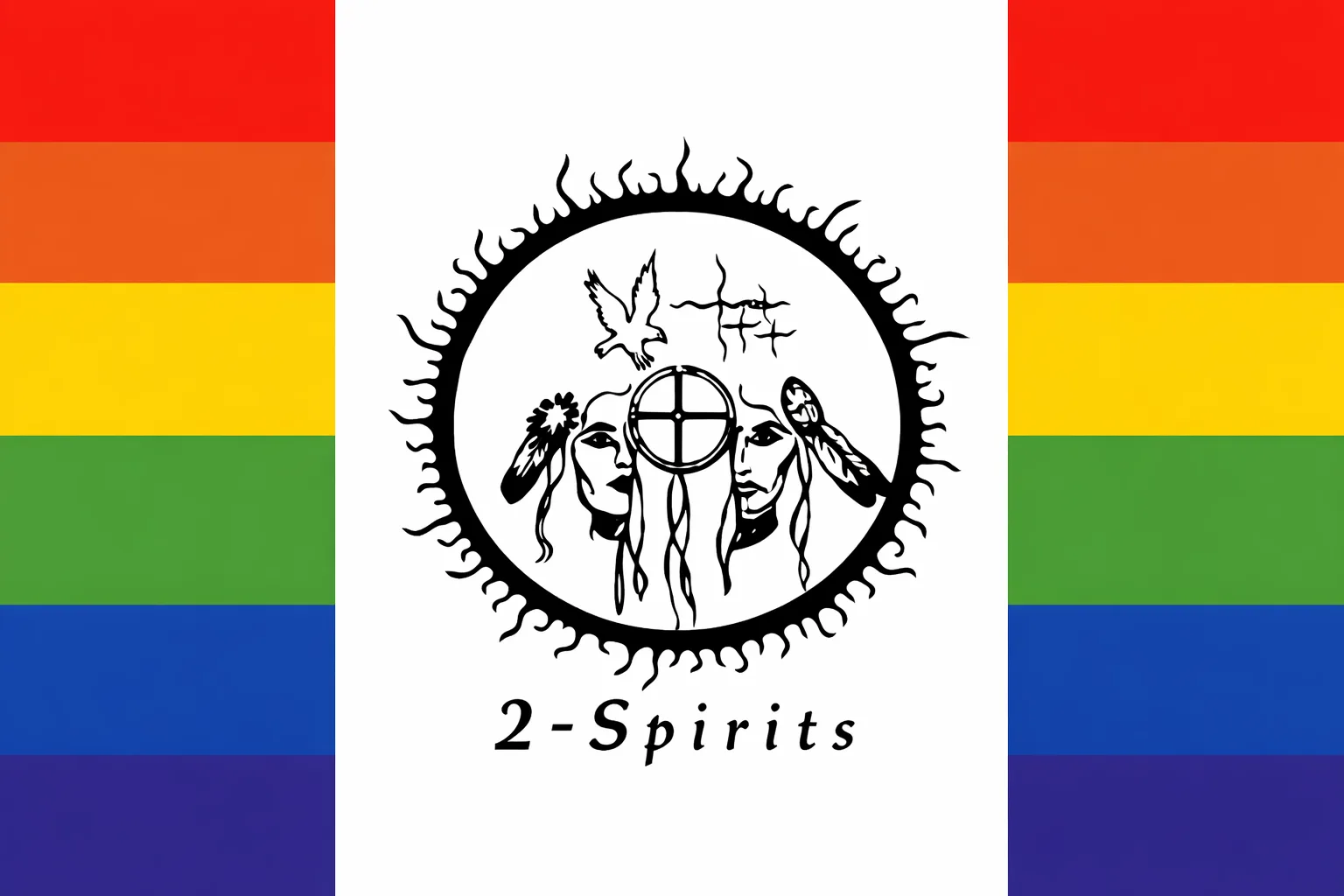
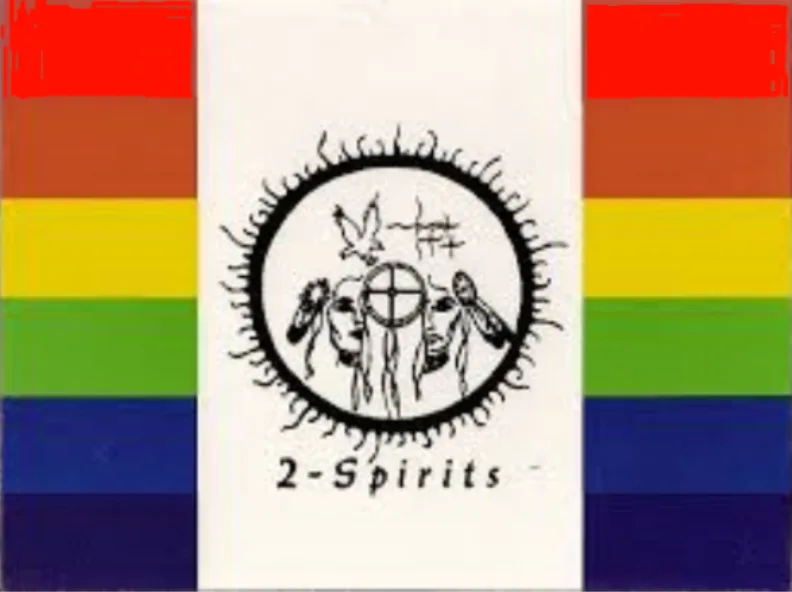
Designed in 2005 by Anishinawbe Ogokwe activist Art Zoccole for Toronto's 2-Spirited People of the 1st Nations, this is the earliest known purpose-built and attributed Two-Spirit pride flag. The design places the organization's black emblem on a white central field framed by rainbow-striped panels. [1][2]
Key facts
- Designer
- Art Zoccole
- Created
- First documented public use
- By 2 June 2005, on 2SPFN's flag-raising page
- In use
- Documented 2005 through at least 2023
- Aspect Ratio
- 3:2 · reconstruction
- Origin
- Toronto, Ontario, Canada
- Represented Identity
- Two-Spirit
Also known as
- 2SPFN Flag
- 2-Spirited People of the 1st Nations Flag
- Two-Spirit Pride Flag
Status Historical
Archive categories Indigenous Pride Flags
Overview
Art Zoccole designed the flag in 2005 for 2-Spirited People of the 1st Nations, the Toronto organization he led as Executive Director. It is the earliest known purpose-built and attributed Two-Spirit pride flag: earlier banners were used by Two-Spirit organizations, but no earlier design has been documented as a named, purpose-made Two-Spirit flag with a known designer. [1][2]
It was made as that organization's flag rather than as a symbol adopted across Two-Spirit communities, and it carries 2SPFN's own emblem. The organization had been working in Toronto since the late 1980s, much of it in response to the HIV/AIDS crisis in the city's Indigenous community, and Zoccole was its Executive Director through the years around the flag's making. [3][4] The design is documented in use in 2005, 2014 and 2023.
Identity & Context
- Represented Identity
- Two-Spirit
- Subcommunity
- Indigenous Two-Spirit people, particularly those connected to 2SPFN in Toronto and the Greater Toronto Area
- Movement
- Two-Spirit visibility, Indigenous Queer organizing, HIV/AIDS prevention in Indigenous communities
- Diaspora Context
- Urban Indigenous community in Toronto; many 2SPFN members are Indigenous people living away from their home Nations, and the organization's 2004 study was of self-identified Two-Spirit Aboriginal youth in the city. [3][4]
- Language Context
- Two-Spirit is an Indigenous-specific term. The First Nations Health Authority describes it as "used to self-identify with expressions of gender or sexuality through a pre-colonial lens," and states that Two-Spirit identities "exist separately from Western constructs of sexuality and gender, and are not equivalent to an LGBTQQIA+ identity," while an Indigenous person may self-identify as both. Elder Myra Laramee first proposed the term in 1990, at the Third Annual Inter-tribal Native American, First Nations, Gay and Lesbian American Conference, as an alternative to the colonial term berdache. [5] The gathering was in Winnipeg. [6] The FNHA writes the acronym as 2S/LGBTQQIA+, the slash marking that distinction, and records that limited engagement of Two-Spirit people in research has led to "an inaccurate conflation of their experiences with those of the broader LGBTQQIA+ community." Quoting the Two-Spirit Dry Lab, it adds that the term "is meant to facilitate Indigenous Peoples' connections with Nation-specific expressions and roles of gender and sexual diversity," and that it is "a way for Indigenous Peoples to reconnect with their traditional languages, ways and cultures within a pre-Colonial setting." What the term describes therefore varies among people and Nations, and it replaces neither Nation-specific terms nor their teachings. [5] Albert McLeod, who helped found Two-Spirited People of Manitoba and began organizing in Winnipeg in 1986, writes that the term "was introduced and adopted in North America in 1990," and that "not all Indigenous LGBTQI+ people ascribe to this identity or label, particularly the Inuit." [7]
- Religious Context
- 2SPFN integrates ceremony-based programming and cultural reclamation into its services. [8]
- Racial / Ethnic Context
- 2SPFN serves First Nations, Inuit and Métis Two-Spirit people in Toronto; the flag is that organization's, and does not stand for all three peoples collectively. The First Nations Health Authority records that in many First Nations 2S/LGBTQQIA+ people "have traditionally held important and respected roles in our communities," and that colonialism created "a disconnection between 2S/LGBTQQIA+ people and these traditional identities and roles, as well as the erasure of recognition for these identities through the introduction of homophobia, transphobia and sexism." [5] McLeod argues those differences have to be held within "a distinctions-based approach, because LGBTQI+ identities, histories and roles may be perceived differently among First Nations, Inuit and Métis communities." [7]
- National Context
- Canadian Indigenous context, specifically Toronto's urban Indigenous community
The flag is tied to one organization and one city. Its history sits in Toronto's urban Indigenous community, where many 2SPFN members live at a distance from their home Nations.
Creators
The Creator
Art Zoccole
Designer
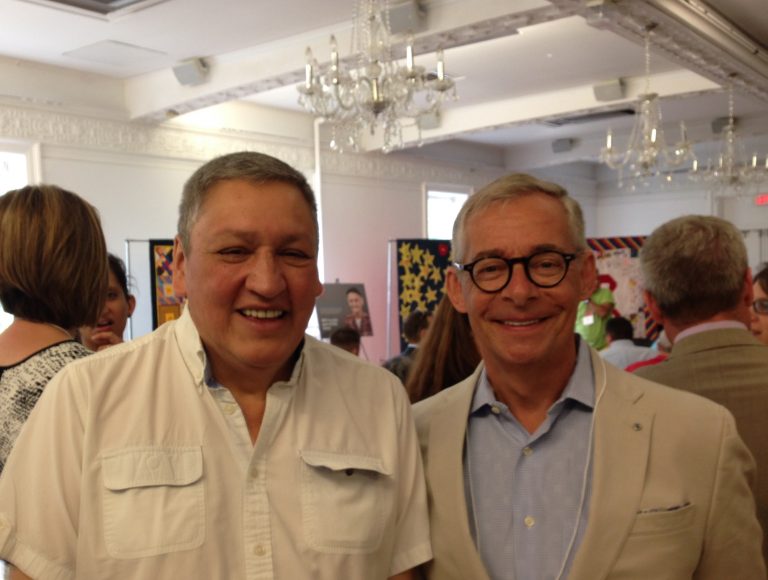
Art Zoccole is Anishinawbe Ogokwe from Lac des Mille Lacs First Nation in northwestern Ontario. He came out at twenty-six, studied accounting in Thunder Bay, and moved to Toronto in the 1970s, working for Indigenous organizations in education. As AIDS reached Toronto's Indigenous community in the 1980s, he and his friends formed impromptu care teams, "the Two-Spirit guys, the gay men," joined next by Two-Spirit women; when home communities refused the bodies of the dead for fear the disease would return with them, the Toronto community devised its own celebrations of life across nations. He recounts that the organization began when the playwright Tomson Highway approached him: "We should start an organization for gay people." [4]
As Executive Director of 2-Spirited People of the 1st Nations he was Principal Investigator on the organization's 2004 community-based study of the holistic health of Two-Spirit youth in Toronto, which grounded its work in the Ownership, Control, Access and Possession model of Aboriginal research. [3] He served on the Ministerial Council on HIV/AIDS, the National Aboriginal Council on HIV/AIDS, and the Executive Committee of the Canadian Rainbow Health Coalition, and helped establish the Red Road HIV/AIDS Network and, with Laverne Monette, the Indigenous satellite of the 2006 World AIDS Conference in Toronto. [3][4] He helped launch the Two-Spirit HIV/AIDS Wellness and Longevity Study (2SHAWLS), a team project with Dr. David Brennan at the University of Toronto. [4][9]
Zoccole speaks openly of living with HIV, diagnosed around 2005. He nearly died at St. Michael's Hospital, where the Toronto community brought the Two-Spirit drum, sweetgrass and cedar to his room and his sister gave him her eagle feather. "The care that you are providing is also going to help me, so both of them together are going to make me better," he told his doctors; he walked out a week later. [4]
Casey House gave him its 2016 Casey Award, which recognises leadership in HIV/AIDS and social justice. Presenting it, Brian Shackleton, chair of the award committee, described the conditions Zoccole had organised against: gay men with AIDS "were reluctant to find support from their Aboriginal communities when they fell ill, they were fearful of sharing their status and having to acknowledge their sexuality," and for the dead, "some communities mistakenly believed that HIV was transmissible after death and were reluctant to accept the bodies of those who perished from AIDS." Zoccole describes his own work as "having a voice in his community to remind people that this disease is still very much present and that more work needs to be done." Casey House dates the founding of 2-Spirited People of the First Nation to 1989 and credits Zoccole as a co-founder, and records that he chaired the Canadian Aboriginal AIDS Network. [10]
In my language, the word to describe me is Ogokwe and it translates into wise woman. [6]
We started in 1989, and we were finally incorporated in 1995, six years later. [4]
Motivations
Documented design sources
Attribution
- Organization
- 2-Spirited People of the 1st Nations (2SPFN)
- Commissioned By
- 2-Spirited People of the 1st Nations
Attribution notes
Art Zoccole is Anishinawbe Ogokwe from Lac des Mille Lacs First Nation in northwestern Ontario; in his own account, "the word to describe me is Ogokwe and it translates into wise woman." [6] He served as Executive Director of 2-Spirited People of the 1st Nations and has worked for decades in Indigenous community organizing and HIV/AIDS advocacy in Canada. [3][4] He designed the flag for the organization while leading it; no separate commissioning document has been located, and the commission is recorded on the strength of the flag being 2SPFN's, carrying 2SPFN's emblem, and made by its Executive Director. [1][3]
Origin
- Country
- Canada
- Region / state
- Ontario
- City
- Toronto
- Place Type
- Organizational creation
The flag was made in Toronto, on land the Mississaugas of the Credit First Nation describe as their treaty lands and territory in southern Ontario. [11] Treaty No. 13, the Toronto Purchase of 1805, covered 250,830 acres and was itself an attempt to settle a disputed 1787 transaction whose deed was found blank; Canada settled the claim in 2010 for $145 million. [12] The land is also the traditional territory of the Huron-Wendat and the Haudenosaunee. [13] Zoccole's own Nation, Lac des Mille Lacs First Nation, is in northwestern Ontario, far from the city where he made the flag.
Indigenous land context
Mississaugas of the Credit First Nation — treaty lands and territory (Treaty No. 13, the Toronto Purchase, 1805) [11][12]
Colonial / settler context
- Land status
- Treaty lands and territory of the Mississaugas of the Credit First Nation
- Indigenous engagement
- Flag designed by an Indigenous creator for an Indigenous organization
- Continuing presence
- The Mississaugas of the Credit First Nation continue to hold and describe these treaty lands and territory. [11]
Made in Toronto for 2-Spirited People of the 1st Nations, which took that name at its 1992 Annual General Meeting "to honour our ancestral past and reclaim our Aboriginal identity." [2] Toronto rests on the combined record rather than on a single sentence: the organization's September 2004 report gives its address as 43 Elm Street, Toronto, Zoccole had lived and organized in the city since the 1970s and led 2SPFN there, and the flag is documented on the organization's Toronto flag-raising page. [3][4][14] The day and the place of its design are not recorded.
Indigenous Identity Context
- Nation
- Anishinaabe (Ojibwe), Lac des Mille Lacs First Nation
- Related Nations
- Anishinaabe, Ojibwe, Saulteaux
- Territory
- Treaty 3 Territory / Northwestern Ontario
- Cultural Area
- Subarctic / Great Lakes
- Language Group
- Anishinaabemowin (Ojibwe)
- Geographic Scope
- nation-specific (organizational)
- Colonial State
- Canada
- Traditional Knowledge Notice
- Yes
Art Zoccole, Anishinawbe Ogokwe from Lac des Mille Lacs First Nation, designed this flag for 2-Spirited People of the 1st Nations, the Toronto organization he led. It was made as that organization's flag, carrying its emblem, and documents the work of Two-Spirit people organizing in a city far from many of their home Nations. It does not speak for every Two-Spirit person or every Nation.
Dates & Chronology
- Year Created
- First public use
- By 2 June 2005, on 2SPFN's flag-raising page
- Period in Use
- Documented 2005 through at least 2023
Use is documented within the organization the flag was made for, and the emblem it carries remains 2SPFN's logo. [14][15][2] The organization continues its work with Two-Spirit and Indigenous Queer and transgender communities in Toronto. [8]
A rainbow banner carrying a quartered black, white, red and yellow disc appears in a 2SPFN event photograph from 2004. What is documented is an earlier banner used by the organization: the photograph does not establish a separate name, a designer, or a purpose-made identity flag, and it does not displace the 2005 design's standing as the earliest known purpose-built and attributed Two-Spirit pride flag. [14]
Zoccole's flag is documented on 2SPFN's flag-raising page by 2 June 2005, photographed again in 2014, and carried at the Toronto Two Spirits Pow-wow on 27 May 2023. [14][15] The emblem it carries is older than the flag: it heads the cover of the organization's September 2004 report to the Wellesley Central Health Corporation, and it remains 2SPFN's logo today. [3][2]
2SPFN's own records give different dates for its beginnings and incorporation. In a 2018 oral history Zoccole recalled the group beginning in 1989 and incorporating in 1995, and described the Ontario government refusing it incorporation "because we are a gay organization": "We started in 1989, and we were finally incorporated in 1995, six years later." Its archived account describes a gathering in January 1989 at the 519 Church Street Community Centre attended by about eighty people from several Nations. Other organizational records give earlier founding dates and different formalization dates: the 2004 Wellesley report says the organization "was founded in 1985 and officially incorporated as a non-profit Aboriginal service organization in 1992," and its current research page dates its inception to 1990. [4][16][3][17]
Lineage
- Direct predecessors
- Canadian Pride Flag, Rainbow Pride Flag
- Related flags
- Indigiqueer / Two-Spirit Flag (cedar-maw), Two-Spirit Leather Pride Flag, Two-Spirit Nonbinary Pride Flag (2016 Tumblr documentation), Two-Spirit Pride Flag (2021, sirieko)
- Sibling flags
- Alberta Gay Flag, Straight Ally Pride Flag, Anarcha-Queer Flag (rainbow variant), Argentina Gay Flag, Australia Gay Flag, Brazil Gay Flag
+ 43 more
British Columbia Gay Flag, Chicago Pride Flag (Rainbow Stripes, Purple Stars), Chile Gay Flag, Dominican Republic Gay Flag, Egypt Gay Flag, European Union Gay Flag, France Gay Flag, Gay Pride Flag of Pakistan, Heteroflexible Pride Flag, Heterosexual / Straight Pride Flag, Homoflexible Pride Flag, India Gay Flag, Italy Gay Flag, Japan Gay Flag, Jewish Gay Pride Flag, Manitoba Gay Flag, Mexico Gay Flag, Netherlands Gay Flag, New Brunswick Gay Flag, Newfoundland Gay Flag, Northwest Territories Gay Flag, Nova Scotia Gay Flag, Nunavut Gay Flag, Ontario Gay Flag, Palestinian Gay Pride Flag, Panama Gay Flag, Philadelphia Pride Flag, Prince Edward Island Gay Flag, Quebec Gay Flag, Rainbow Flag with White Triangle (Sapporo), Rainbow Israel Flag, Rainbow Polish Flag (2014, Angela Getler), Russia Gay Flag, Saskatchewan Gay Flag, Social Justice Pride Flag, South African Gay Pride Flag, Switzerland Gay Flag, Tanzania Gay Flag, Texas Rainbow Flag, Turkish Gay Pride Flag, Two-Spirit Pride Flag (2016 Tumblr documentation), Victory Over AIDS Flag (1980s, designer unknown), Yukon Territory Gay Flag
Two documented parents. The six-stripe rainbow flag supplies the rainbow itself, repeated in full at both the hoist and the fly. The Canadian Pride Flag supplies the structure: rainbow panels at the edges, a white center, and an emblem in that center. Flags of the World describes this design as the Canadian Pride Flag with the maple leaf replaced by 2SPFN's emblem. [1] Neither parent displaces the other; the rainbow flag is the older and more general source, the Canadian Pride Flag the immediate model.
Later Two-Spirit flags, including the 2016 design by 2Sanon, are recorded as related: no source has been located showing that their designers worked from this flag.
Lineage tree
Every record reachable from this one through documented parent and child relationships: 5 records across 5 generations.
- Ancestors -4
- Original Rainbow Flag (1978)
- Ancestors -3
- Seven-Stripe Rainbow Flag (1978)
- Ancestors -2
- Rainbow Pride Flag
- Ancestor
- Canadian Pride Flag
- This record
- Two-Spirit Pride Flag (2005, Zoccole)
Colors & Symbolism
The flag joins 2SPFN's own emblem to the rainbow of Queer pride: the emblem occupies the white center, framed by rainbow bands at hoist and fly. [1] The emblem's elements are described in the Design section from the artwork itself. No statement of intended symbolism by Zoccole or 2SPFN has been located, and the entry does not supply one.
| Colour | Hex | Note |
|---|---|---|
| White (field) | #FFFFFF | The reconstruction's field value. |
| Red (rainbow stripe) | #E40303 | Conventional six-stripe rainbow value, approximate. |
| Orange (rainbow stripe) | #FF8C00 | Conventional six-stripe rainbow value, approximate. |
| Yellow (rainbow stripe) | #FFED00 | Conventional six-stripe rainbow value, approximate. |
| Green (rainbow stripe) | #008026 | Conventional six-stripe rainbow value, approximate. |
| Blue (rainbow stripe) | #004DFF | Conventional six-stripe rainbow value, approximate. |
| Violet (rainbow stripe) | #750787 | Conventional six-stripe rainbow value, approximate. |
This flag has no official digital palette. Color values shown are approximate.
- 2SPFN emblem, centered on the white field
- The organization's own emblem, in use on its publications from at least 2004 and still its logo. [3][2]
- Rainbow panels at hoist and fly
- The six-stripe rainbow of Queer pride. [1]
No official palette has been published. The rainbow values are the conventional six-stripe approximations used for reference, not sampled from the flag: the surviving photograph has aged too far to sample. The emblem's colors have not been independently verified.
Design
- Aspect Ratio
- 3:2 · reconstruction
- Orientation
- horizontal
- Layout
- Central logo on white field with rainbow edge stripes
- Center Symbol
- 2-Spirited People of the 1st Nations (2SPFN) organizational logo
- Additional Symbols
- Horizontal rainbow stripes along left and right edges
The layout is a vertical triband: a rainbow panel at the hoist, a white pale through the center carrying the organization's emblem, and a rainbow panel at the fly. Each rainbow panel runs six horizontal bands, red, orange, yellow, green, blue and violet from top to bottom, the full height of the flag. Read from the circulating copy of the flag; that copy is aged, and its band colors have shifted too far to sample as values.
The emblem, lettered 2-Spirits beneath in script, is a circle rimmed with flame-like rays. Within it are two faces in profile facing away from one another, each wearing feathers; between them a four-quadrant circle with strands hanging below it; a bird with spread wings above; and a cluster of slender upright marks to the bird's right. These are the elements as the image shows them.
No construction sheet or official proportion has been located. The artwork this entry displays is a modern redrawn reconstruction at 3:2, checked against the source image and against the emblem as 2SPFN publishes it today; that ratio is the reconstruction's, not a documented specification. The surviving photograph is of a hanging flag and does not settle the physical proportion. 2SPFN's own artwork remains the authority.
A white central field carrying the emblem of 2-Spirited People of the 1st Nations, framed by panels of six horizontal rainbow bands at the hoist and the fly. [1]
Usage & Adoption
- First Users
- 2-Spirited People of the 1st Nations (2SPFN), Toronto
- Organizations
- 2-Spirited People of the 1st Nations (2SPFN)
- Geographic Usage
- Toronto, Ontario, Canada
- Event Usage
- Toronto Two Spirits Pow-wow, 27 May 2023 [15]
- Current Status
- Active; documented in use 2005 through at least 2023
The flag is 2SPFN's organizational flag, documented in the organization's own use rather than as a symbol adopted across Two-Spirit communities. Its emblem remains the organization's logo, and the flag was carried at the Toronto Two Spirits Pow-wow in 2023. [2][15]
Image Archive
The Wellesley Report (2004)
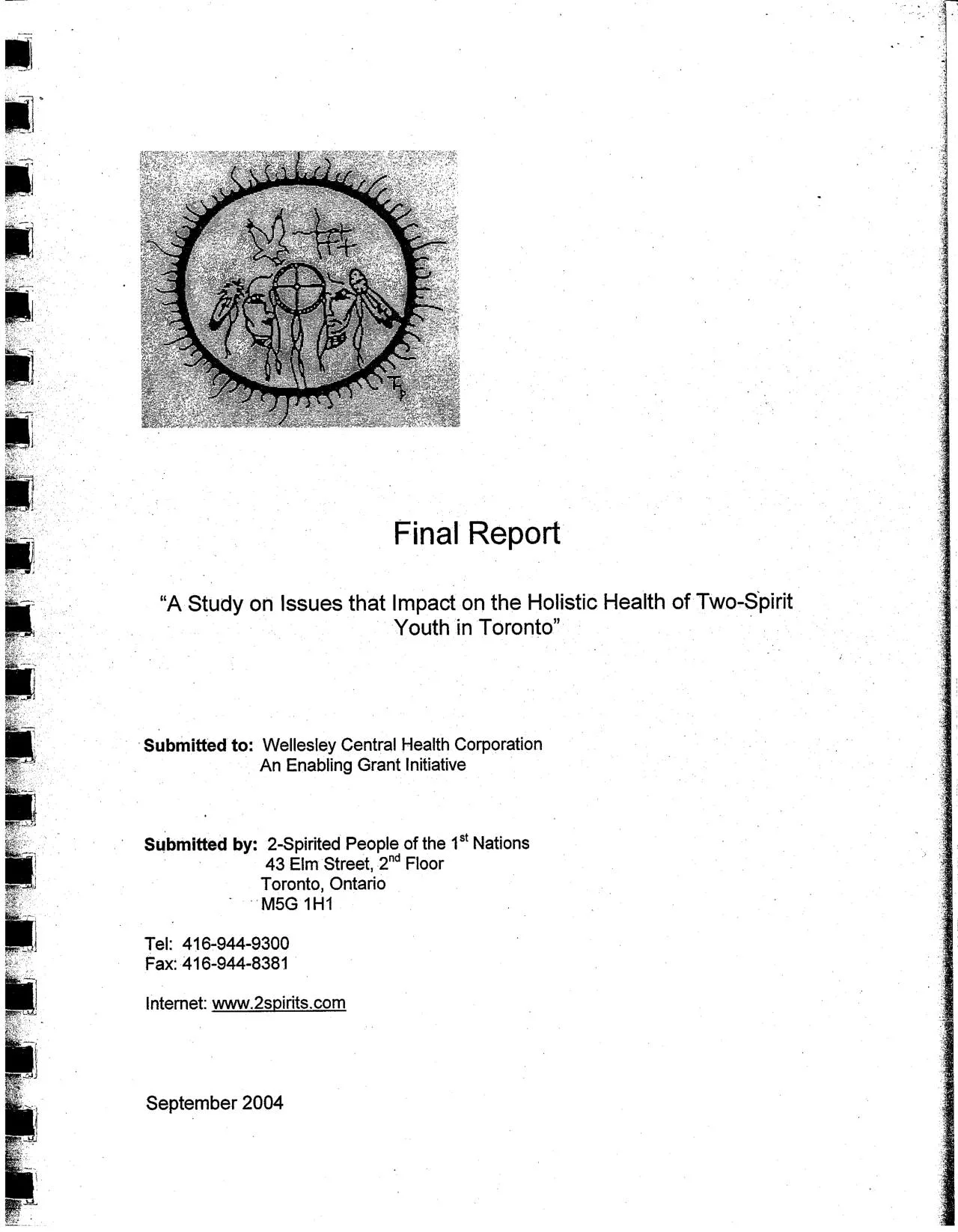
The emblem in this image is verifiable against the organization's current logo. The entry's displayed artwork is a reconstruction drawn from it.
Discourse & Debates
Common misidentifications
- Not the 2016 design by 2Sanon, a separate flag by a separate designer.
The organization's own name keeps its historical spelling, 2-Spirited People of the 1st Nations. Two-Spirit is the more common spelling today and is used elsewhere in this entry.
Footnotes & Citations
Sources and footnotes 17 sources
- 1. Reference "Two Spirits" Gay Pride Flags. Flags of the World (FOTW). Accessed 2026-03-18
- 2. History, 2-Spirited People of the 1st Nations. 2-Spirited People of the 1st Nations. Accessed 2026-08-05
- 3. Report Final Report: "A Study on Issues that Impact on the Holistic Health of Two-Spirit Youth in Toronto". 2-Spirited People of the 1st Nations; Art Zoccole, Principal Investigator. Submitted to Wellesley Central Health Corporation; later distributed by the Wellesley Institute (2004-09). Accessed 2026-08-05
- 4. Archived Sources "HIV in My Day," Interview 21: Art Zoccole, 30 January 2018. Art Zoccole (interviewee); Sandy Lambert (interviewer); Ben Klassen (also present). HIV in My Day oral history project, UVic Vault, University of Victoria Libraries (2018-01-30). Accessed 2026-08-05
- 5. Organizations 2S/LGBTQQIA+. First Nations Health Authority. First Nations Health Authority. Accessed 2026-08-07 · Archived version
- 6. News Two-spirit Persons (Western Gazette feature, reposted by Organisation Intersex International). The Gazette (University of Western Ontario), via OII Intersex News (2009-02-13). Accessed 2026-08-05
- 7. Museums & Exhibitions The Re-emergence of 2Spirit People in the 21st Century. Albert McLeod. Canadian Museum for Human Rights (2025-02-26). Accessed 2026-08-07 · Archived version
- 8. Organizations Mission and Vision. 2-Spirited People of the 1st Nations. 2spirits.org. Accessed 2026-08-05
- 9. Academic The 2SHAWLS study foregrounds Indigenous knowledges and experiences. University of Toronto, Factor-Inwentash Faculty of Social Work. Accessed 2026-08-05
- 10. Award Art Zoccole — The Casey Award. Casey House; tribute by Brian Shackleton, chair of the Casey Award committee. Casey House (2016). Accessed 2026-08-09
- 11. Government Treaty Lands and Territory. Mississaugas of the Credit First Nation. mncfn.ca. Accessed 2026-08-05
- 12. Government The Toronto Purchase, Treaty No. 13 (1805). Mississaugas of the Credit First Nation. mncfn.ca. Accessed 2026-08-05
- 13. Academic Land Acknowledgement. University of Toronto. Accessed 2026-03-19
- 14. Reference Canadian First Nations flags (visual chronology; 2SPFN banners and flag-raising). Flags of the World contributors. Flags of the World (FOTW). Accessed 2026-08-05
- 15. Image file page Toronto Two Spirits Pow-wow, 27 May 2023 (editorial photographs). Shutterstock editorial photography (2023-05-27). Accessed 2026-08-05 [no stable URL]
- 16. Organizations Who We Are (archived organizational account). 2-Spirited People of the 1st Nations. 2spirits.com. Accessed 2026-08-05
- 17. Organizations About 2-Spirits Research. 2-Spirited People of the 1st Nations. 2spirits.org. Accessed 2026-08-05
Image Sources
- Rendering
- two-spirit-2005-zoccole
- Cover of the final report, September 2004. The organization's emblem, the same design the flag carries, sits at its head, a year before the flag; the cover lists 2SPFN's address at 43 Elm Street, Toronto, and its then web address, www.2spirits.com. [3] · Credit: 2-Spirited People of the 1st Nations · Wellesley Institute
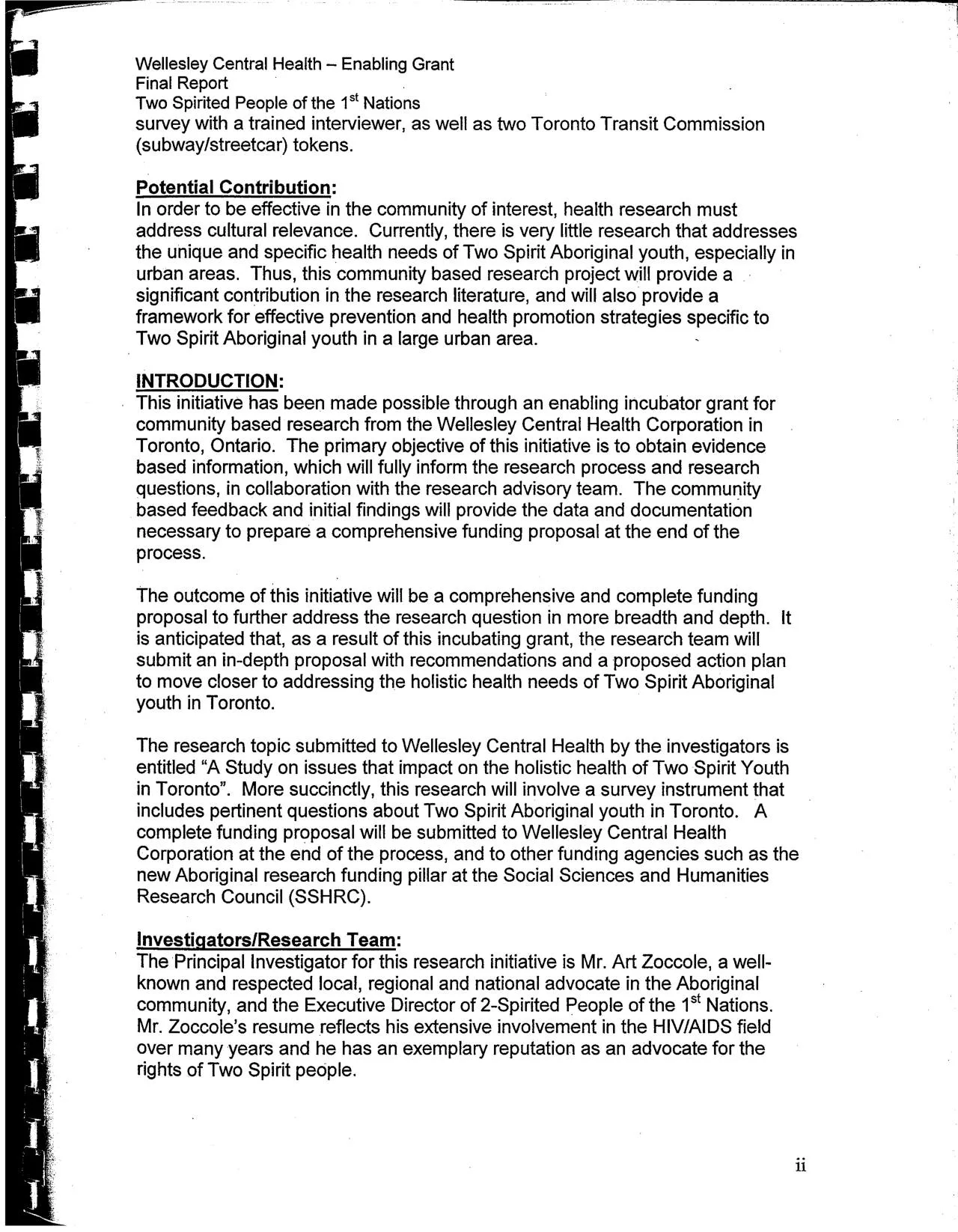
- Potential contribution and the research team: Art Zoccole, Executive Director of 2SPFN, as Principal Investigator. [3] · Credit: 2-Spirited People of the 1st Nations · Wellesley Institute
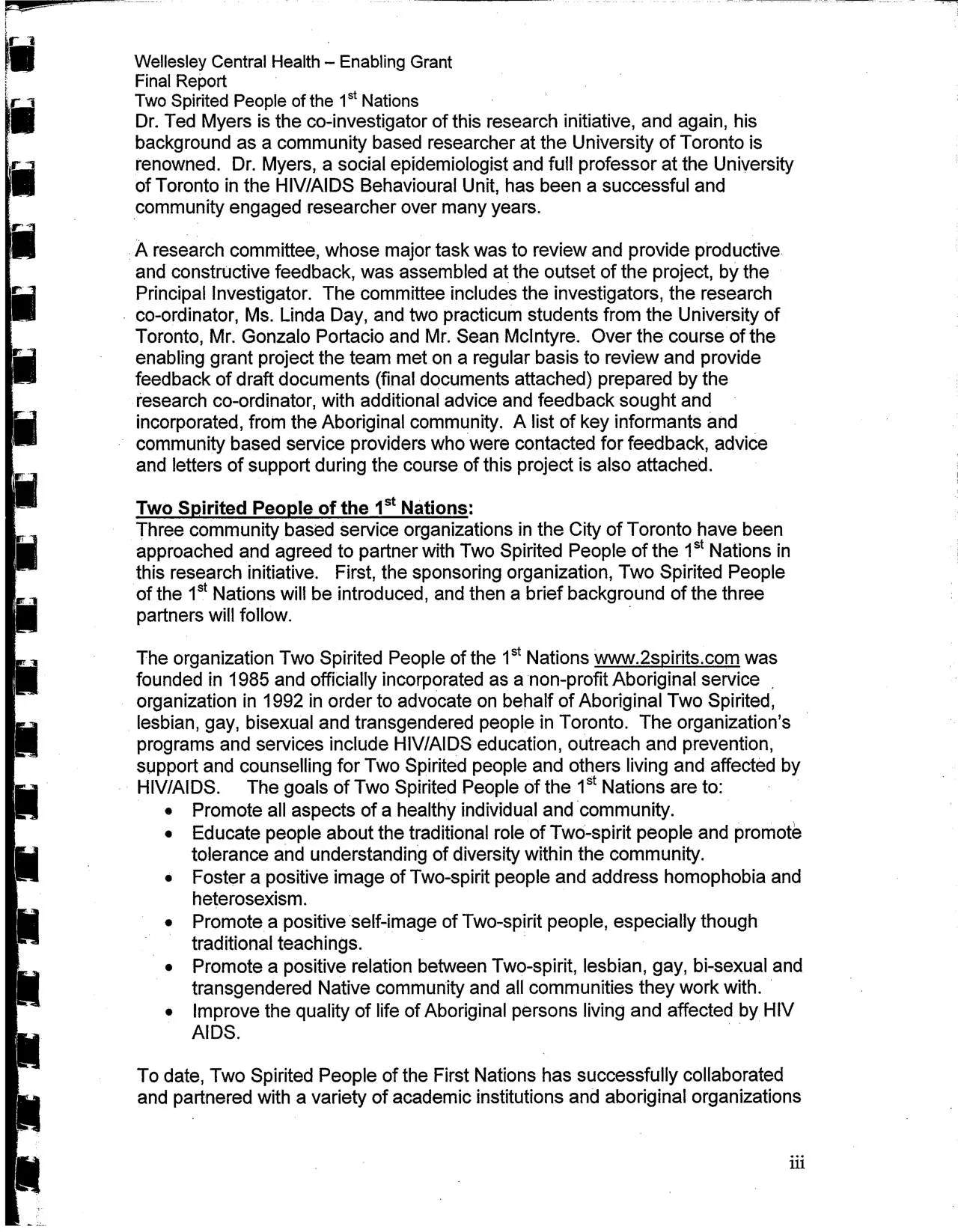
- The research team and the organization: co-investigator Dr. Ted Myers of the University of Toronto, and 2SPFN's own account of itself as "founded in 1985 and officially incorporated as a non-profit Aboriginal service organization in 1992," with its goals. [3] · Credit: 2-Spirited People of the 1st Nations · Wellesley Institute
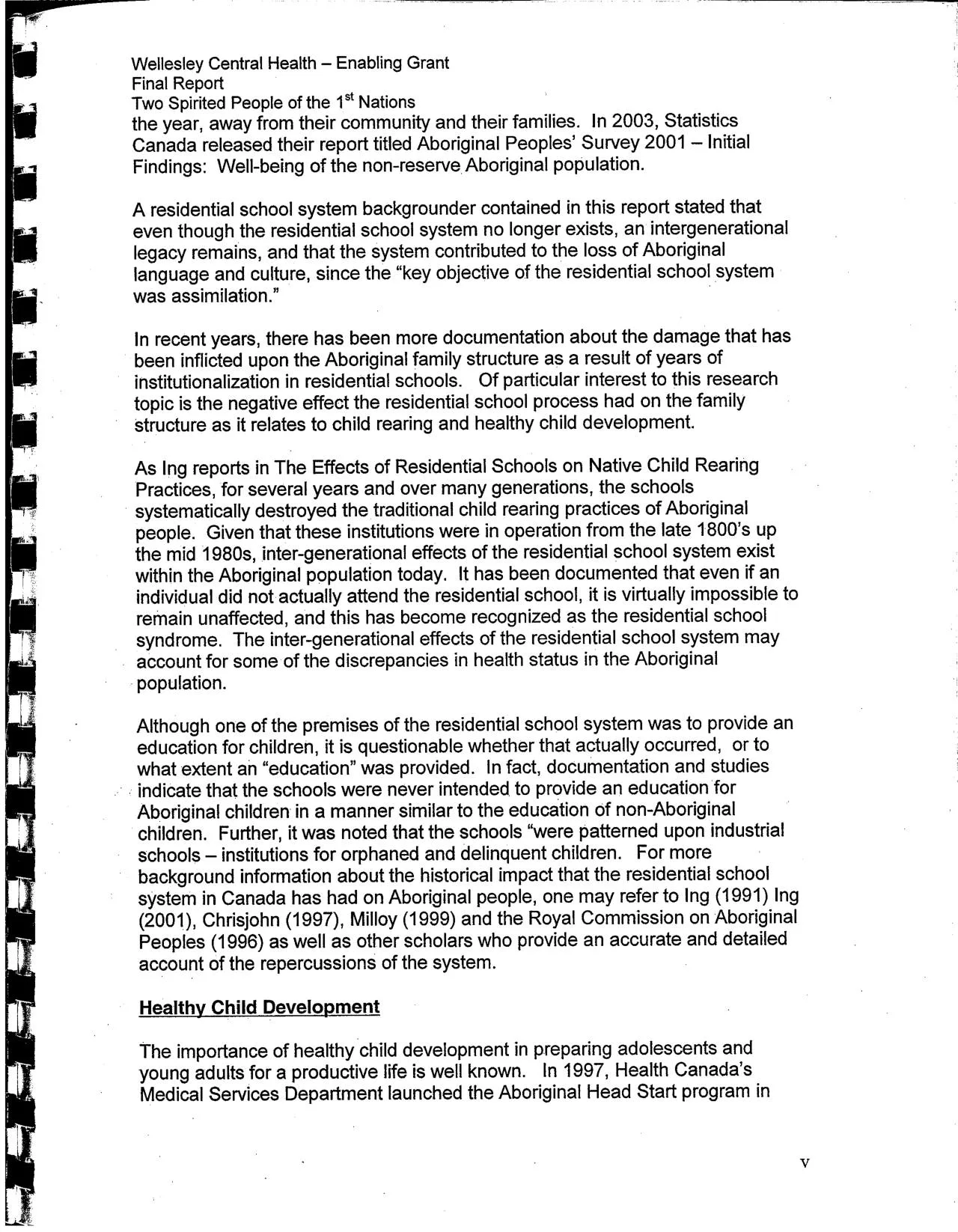
- The residential school system's intergenerational effects, as the report frames the health context. [3] · Credit: 2-Spirited People of the 1st Nations · Wellesley Institute
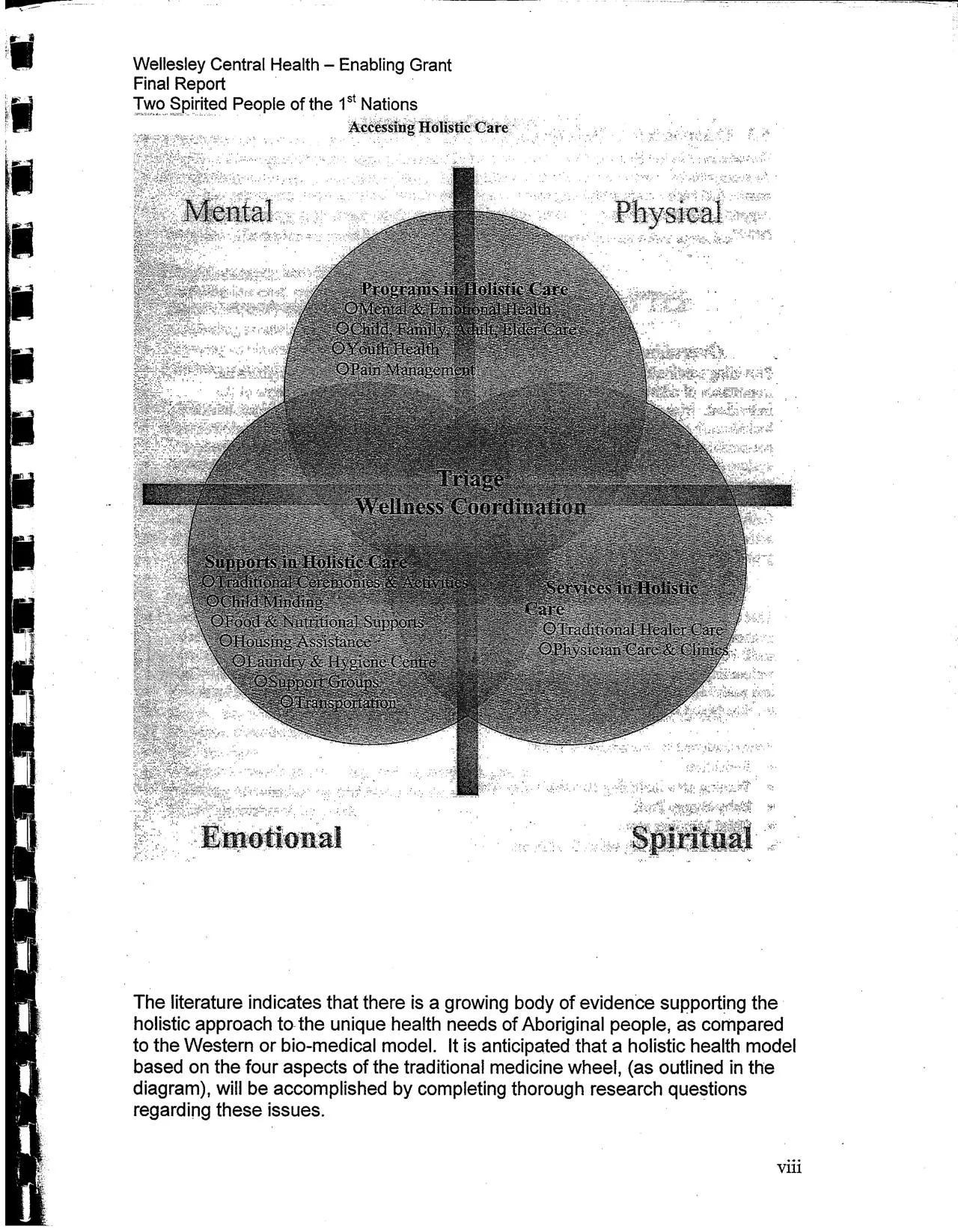
- Figure 1: holistic care organized by the four aspects of the medicine wheel, mental, physical, emotional, and spiritual. [3] · Credit: 2-Spirited People of the 1st Nations · Wellesley Institute
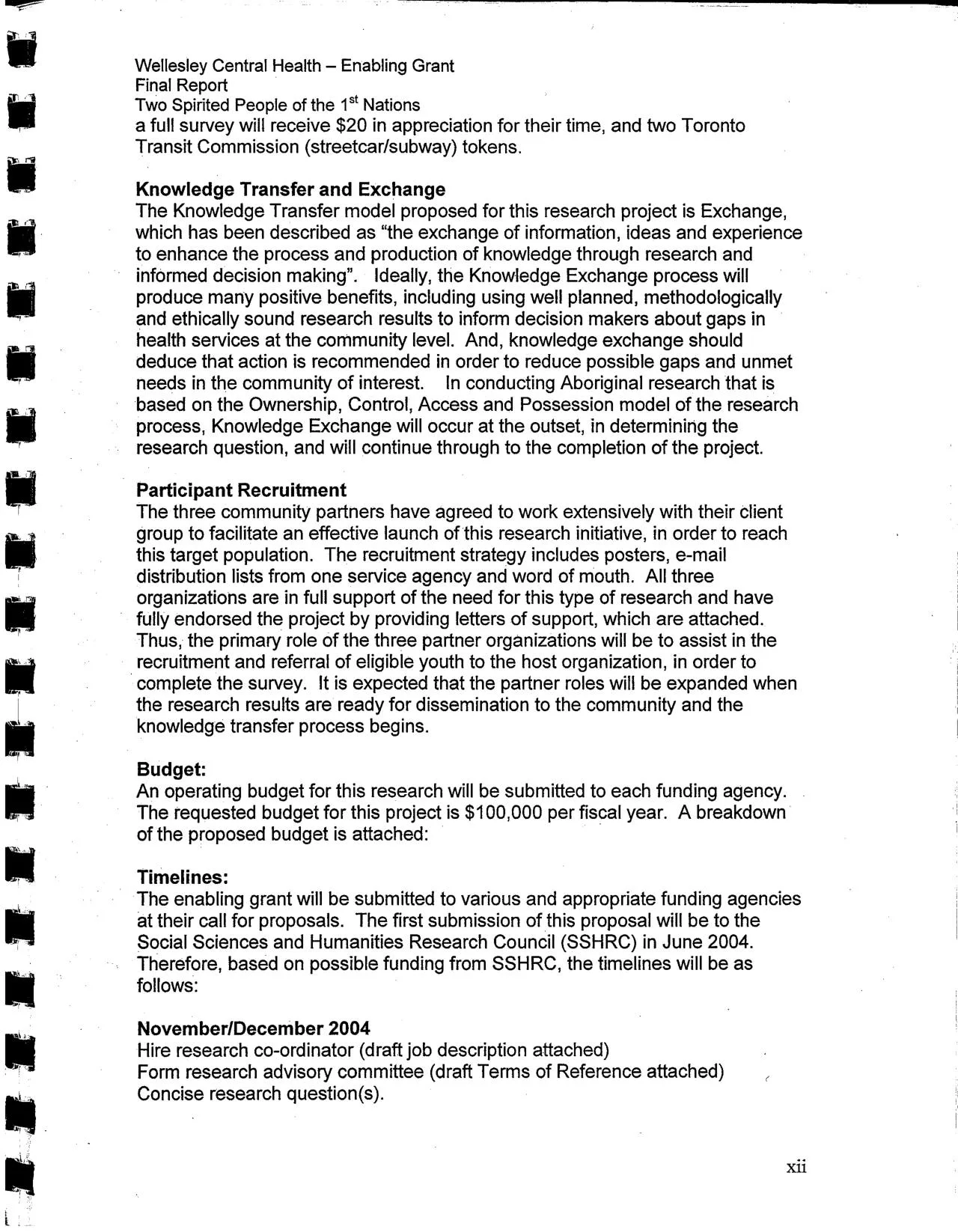
- Knowledge transfer grounded in the Ownership, Control, Access and Possession (OCAP) model of Aboriginal research. [3] · Credit: 2-Spirited People of the 1st Nations · Wellesley Institute
- 2SPFN flag-raising page, 2 June 2005 · Credit: Design by Art Zoccole; image published by 2-Spirited People of the 1st Nations; photographer not identified · 2-Spirited People of the 1st Nations