Heterosexual / Straight Pride Flag
Political / Protest Flag ·
A six-stripe black-and-white heterosexual flag was described on the Flags of the World mailing list in February 2001 as a proposed design formally derived from the six-stripe Rainbow Pride Flag by removing its colors. No designer or original proposal source has been identified, and the 2001 record does not establish physical display; later photographs document the design at Pride events from 2017 onward. The same striped field later became part of the Straight Ally Pride Flag. [1]

Key facts
- Designer
- Unknown
- Created
- First documented public use
- Photographed at Mexico City Pride, 2017
- In use
- Proposed design documented February 2001
- Aspect Ratio
- 3:5 · standard
- Stripes
- 6
- Represented Identity
- Heterosexuality
Also known as
- Straight Pride Flag
- Heterosexual Flag
Status Proposed Contested
Archive categories Protest and Political Pride Flags
Overview
Not documented. No source reviewed states the designer's reason, and the readings that exist are readers' inferences from the form. [1]
Formally the design is the six-stripe rainbow flag with the color removed, and that reference was recognized at the point it was first documented. Steve Kramer wrote to the Flags of the World mailing list on 5 February 2001: "I have seen a proposed flag for heterosexuals. I believe the design was six horizontal stripes, N-W-N-W-N-W. The obvious reference is to the Rainbow Flag, essentially removed of its color." He could not find it again four years later, and wrote in 2005 that it was "essentially, suggested by political conservatives who were generally opposed to the symbolism of a flag for a sexual orientation anyway," adding that conservatives had "rhetorically suggested such a symbol many times since, indicating that perhaps that is its main value." The day before his first post, Antonio Martins had described the absence the proposal answered: "the reason for non-existence of a flag for heterosexuals is the same that explains the general absence of specific symbology for any majority, either ethnic, social, etc." [1]
Identity & Context
- Represented Identity
- Heterosexuality
- Movement
- Documented use runs both ways: the design appears among other orientation flags at Pride events, and "straight pride" is also a contested political slogan with a history of oppositional use. No source establishes which the unidentified designer intended.
Heterosexuality is a sexual orientation. "Straight pride" is a separate thing: a contested political slogan that has been used in several unrelated contexts, and one that LGBTQ+ organizations reject as a framing of heterosexuality as analogous to marginalized identities. [2] Kath Browne and Catherine Nash use the term heteroactivism for organized political opposition that defends heterosexual family norms rather than attacking Queer people directly; the concept describes some contexts in which straight-pride symbols appear, and is not evidence about any particular display of this flag. [3]
Creators
The Creator
Unknown
Designer, unknown
No designer is identified in the sources reviewed. The earliest located reference is Steve Kramer's description of a proposed six-stripe black-and-white design on the Flags of the World mailing list, dated 5 February 2001. Where he saw it, and who made it, he does not say. [1]
Broader influences
- The six-stripe rainbow flag, whose form this design carries without its color. Steve Kramer called it "the obvious reference"; that is his reading of the design, not the unknown designer's stated intent.[1]
Attribution notes
No designer is identified in the sources reviewed. Steve Kramer described a six-stripe black-and-white design on the Flags of the World mailing list on 5 February 2001 — "I have seen a proposed flag for heterosexuals" — and could not find it again four years later. The message records a proposal in circulation, not its author, its date or a physical flag. [1]
Origin
Origin location not documented. The earliest located record is a 2001 Flags of the World mailing-list description.
The design's place, medium and date of origin are unknown. The earliest located documentation is Steve Kramer's description of a proposal on the Flags of the World mailing list, 5 February 2001. [1]
Dates & Chronology
- Year Created
- First public use
- Photographed at Mexico City Pride, 2017
- Period in Use
- Proposed design documented February 2001; photographed in use from 2017
- Creation Bounds
- 2001 is a documentation bound used as this record's sort year, not an established creation date. The design was already in circulation when Steve Kramer described it to the Flags of the World mailing list on 5 February 2001 — "I have seen a proposed flag for heterosexuals" — so it existed by then and no earlier bound has been found. That message describes a proposal, not a flag known to have been made or displayed; the earliest photographed display is sixteen years later. [1]
Photographed displays begin in 2017, sixteen years after the design was first described: Mexico City Pride in 2017 (carried with the colors reversed), the Channel Islands Pride mast at St Peter Port, Guernsey, in September 2018 and September 2020, and the Diversity Parade in Curitiba, Brazil, in 2022 — in each case among other orientation flags. Tomislav Todorovic reads those appearances as showing "its use as the symbol of heterosexuality, viewed simply as one sexual orientation among many." Circulation is otherwise digital. [1]
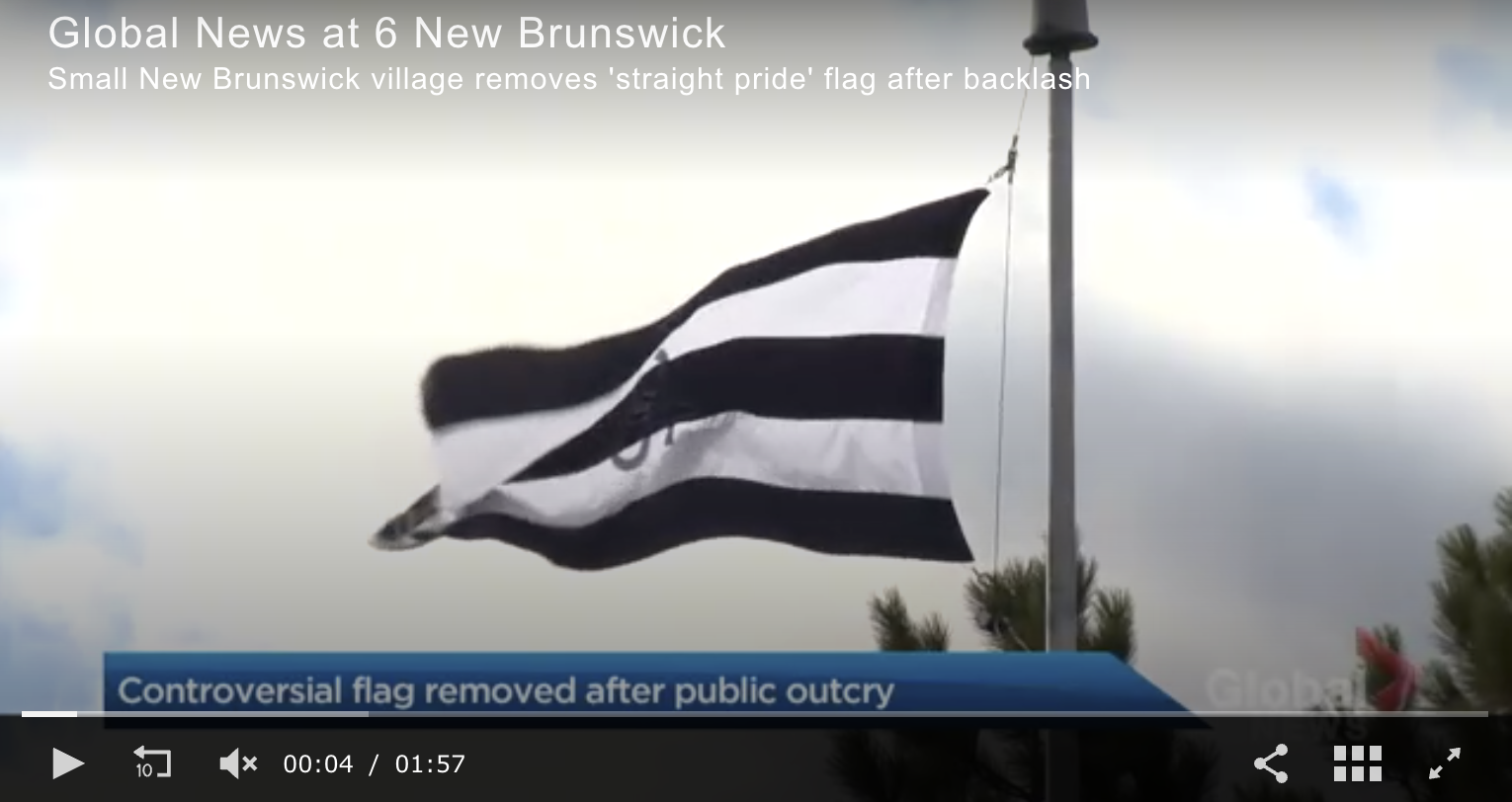
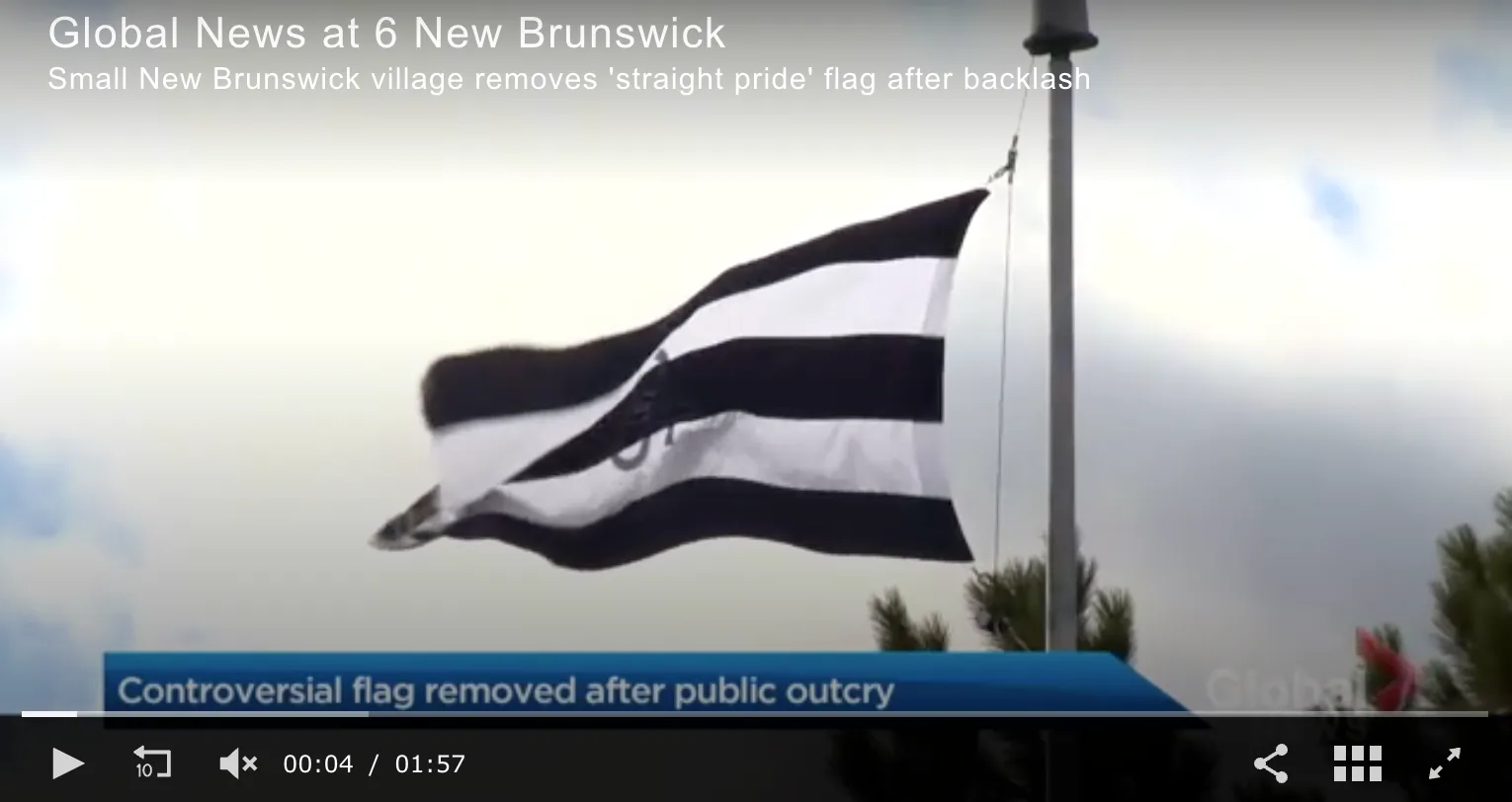
A separate straight-pride flag conceived locally by Glenn Bishop was raised in Chipman, New Brunswick, in October 2018. Its alternating black-and-white field is formally similar, and it is regularly confused with this design, but Bishop's own contemporary account gives it an independent origin: he told the Canadian Press that he came up with it himself and a friend made it, that the black and white stripes were not meant as a response to the rainbow stripes of the Pride flag, and that he thought of them as a background for the intertwined male and female symbols the flag carries. [5] It is not documented use of the six-stripe design and no source establishes descent from it.
The episode itself is short and well reported. The village council voted unanimously to raise the flag, months after Chipman's first LGBT Pride flag that June; Mayor Carson Atkinson framed the vote as accepting "a flag provided by the straight community" alongside the Pride flag accepted earlier. Local Queer residents read it very differently. Justin Fudge, a hair stylist who is gay and had lived in Chipman for more than eight years, said that "all of a sudden this atrocity is waving in the wind"; he tied a large Pride flag to his car and drove through the village. The flag came down the following afternoon and a Canadian flag went up in its place, after a response council said included "personal attacks and threats" against councillors. [6][7][4]
Lineage
- Direct predecessors
- Rainbow Pride Flag
- Direct children
- Straight Ally Pride Flag
- Sibling flags
- Alberta Gay Flag, Anarcha-Queer Flag (rainbow variant), Argentina Gay Flag, Australia Gay Flag, Brazil Gay Flag, British Columbia Gay Flag
+ 43 more
Canadian Pride Flag, Chicago Pride Flag (Rainbow Stripes, Purple Stars), Chile Gay Flag, Dominican Republic Gay Flag, Egypt Gay Flag, European Union Gay Flag, France Gay Flag, Gay Pride Flag of Pakistan, Heteroflexible Pride Flag, Homoflexible Pride Flag, India Gay Flag, Italy Gay Flag, Japan Gay Flag, Jewish Gay Pride Flag, Manitoba Gay Flag, Mexico Gay Flag, Netherlands Gay Flag, New Brunswick Gay Flag, Newfoundland Gay Flag, Northwest Territories Gay Flag, Nova Scotia Gay Flag, Nunavut Gay Flag, Ontario Gay Flag, Palestinian Gay Pride Flag, Panama Gay Flag, Philadelphia Pride Flag, Prince Edward Island Gay Flag, Quebec Gay Flag, Rainbow Flag with White Triangle (Sapporo), Rainbow Israel Flag, Rainbow Polish Flag (2014, Angela Getler), Russia Gay Flag, Saskatchewan Gay Flag, Social Justice Pride Flag, South African Gay Pride Flag, Switzerland Gay Flag, Tanzania Gay Flag, Texas Rainbow Flag, Turkish Gay Pride Flag, Two-Spirit Pride Flag (2005, Zoccole), Two-Spirit Pride Flag (2016 Tumblr documentation), Victory Over AIDS Flag (1980s, designer unknown), Yukon Territory Gay Flag
The Rainbow Pride Flag is the direct parent as a matter of form: this design is the six-stripe rainbow rendered without color, and the earliest located description says so, calling the rainbow flag "the obvious reference... essentially removed of its color." That is an observed formal derivation recognized by the flag's first documentarian, not a statement of intent by the unidentified designer, and no creator statement exists either way. [1]
The Straight Ally Pride Flag is a direct descendant: it sets a rainbow chevron on this black-and-white field, and Flags of the World describes its construction as "Using the black-white 'colors' of the heterosexual flag as a field." The formal relationship does not make the two flags' politics identical. [1]
The Chipman flag of 2018 is not in this lineage. Its designer describes an independent origin, and formal similarity alone is not descent.
Lineage tree
Every record reachable from this one through documented parent and child relationships: 13 records across 6 generations.
- Ancestors -3
- Original Rainbow Flag (1978)
- Ancestors -2
- Seven-Stripe Rainbow Flag (1978)
- Ancestor
- Rainbow Pride Flag
- This record
- Heterosexual / Straight Pride Flag
- Children
- Straight Ally Pride Flag
Colors & Symbolism
The flag carries no symbol and no text, and no single meaning is documented for it. On Flags of the World its describers read it variously, from "the yin and the yang of male and female" to a "complementary uniformity flag" to "a heterosexual supremacy flag." [1] The phrase "straight pride" has often been used in reactionary and anti-LGBTQ contexts; some documented displays instead present the flag as one orientation flag among many. [1][2]
| Colour | Hex | Meaning |
|---|---|---|
| Black | #000000 | No creator-assigned symbolic meaning is documented. [1] |
| White | #FFFFFF | No creator-assigned symbolic meaning is documented. Kramer noted only that black and white "are not colors of the rainbow." [1] |
Standard rendering value. [8]
No creator statement of meaning is documented, and the readings above are readers' rather than the designer's. [1]
No creator-issued palette is known. Black #000000 and white #FFFFFF are the archive's standard rendering values for the design.
Design
- Aspect Ratio
- 3:5 · standard
- Orientation
- horizontal
- Stripe Count
- 6
- Layout
- horizontal stripes
- Stripes (Top → Bottom)
- black, white, black, white, black, white
Six equal horizontal stripes alternating black and white, carrying no symbol and no text. Kramer's 2001 description is "six horizontal stripes, N-W-N-W-N-W," black first; later documented displays occur both ways up, and no creator statement establishing a required orientation has been found. [1]
No creator-issued construction sheet is known. The flag is presented at the archive's standard 3:5.
Six equal horizontal stripes alternating black and white, carrying no symbol and no text.
Usage & Adoption
- Geographic Usage
- Photographed Pride displays in Mexico, Guernsey (Channel Islands) and Brazil
- Online Usage
- Documented circulation includes digital flag guides, community discussion, and reproduction across social media.
- Event Usage
- Mexico City Pride 2017, Channel Islands Pride 2018, Channel Islands Pride 2020, Curitiba Diversity Parade 2022
- Current Status
- active
Sporadic. Four photographed Pride displays between 2017 and 2022, alongside digital circulation in flag guides and community discussion. [1]
Image Archive
A Separate Design, for Comparison
Reception
Discourse & Debates
- Competing readings of the design include an orientation flag shown among other orientation flags, an oppositional political symbol, a monochrome inversion or satire of the rainbow flag, and an unnecessary majority-pride symbol. Tomislav Todorovic's summary of the photographed Pride appearances is that they show "its use as the symbol of heterosexuality, viewed simply as one sexual orientation among many." [1][10]
Common misidentifications
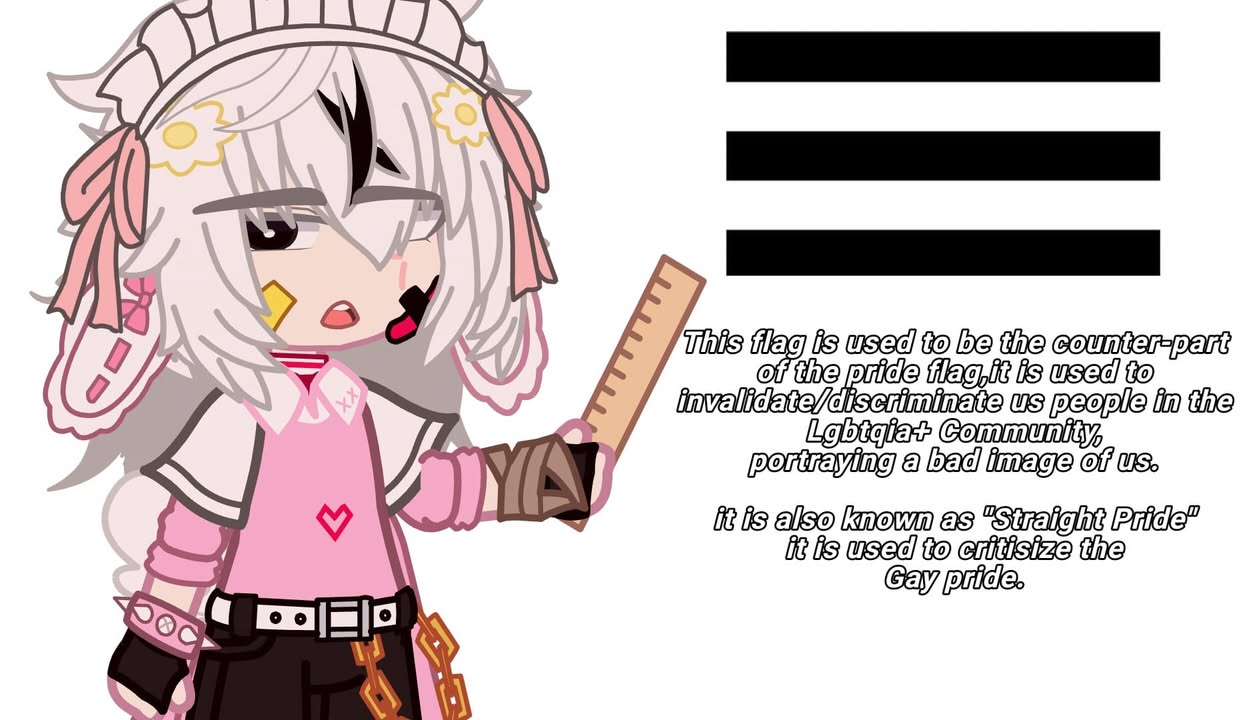
- Frequently confused with the Straight Ally Pride Flag, which sets a rainbow chevron on the same black-and-white field. [10][9]
- Several unrelated designs circulate under the phrase "straight pride" and are separate flags, not variants of this one: the 2019 Boston parade used a blue-and-pink design with interlocked gender symbols that its organizers call "the blue and pink flag," and a Russian "Real Family" flag and a "Super Straight" flag are different again. [1][11]
- The flag raised at Chipman, New Brunswick, in 2018 is a separate design. Its originator, Glenn Bishop, told the Canadian Press he conceived it himself and that its black and white stripes were not a response to the rainbow flag but a background for its intertwined gender symbols. [5]
- The Straight Ally Pride Flag uses this design's field with a rainbow chevron added; the two are regularly mistaken for one another. [10][9]
Criticisms
- Queer publications describe the straight flag as reactionary and harmful. PinkNews calls it "a copy of the Pride flag but wiped of colour and meaning," created "as a direct attempt to mimic and troll the Pride flag." [11] INTO places it in "a homophobic movement with the goal of diminishing LGBTQ+ voices," arguing that "because heterosexual individuals are not marginalized for their sexual orientation the use of a flag such as the one above can be used to harm oppressed communities." [2]
- The flag's own documentarians did not agree on what it meant. Readings on Flags of the World range across "an anti-gay flag," "the yin and the yang of male and female," a "complementary uniformity flag," and "a heterosexual supremacy flag." [1]
Community reception
Discussion inside Queer spaces is largely an argument about heterosexuality rather than about the design. A 2024 r/AskLGBT thread was opened by someone asking why the flag is so dull: "It just speaks to me like 'Oh, you're straight? Boring. Here's your flag, loser.'" The most upvoted reply set the terms: "Heterosexuality doesn't really need a flag... You're not going to get hate crimed or bullied for being straight." One reply ran against that consensus and raised a use others had not: "some queer people (trans people, asexual people, etc etc) might be straight in addition to having a queer identity, so the flag can be useful for them," adding that a colorless design is helpfully "instantly distinguishable" from a Queer flag. [10]
"Straight pride" is a contested political slogan rather than a recognized identity category, and the phrase carries a documented history of reactionary and anti-LGBTQ use. Heterosexuality itself is a sexual orientation, and some documented displays of this flag present it as one orientation symbol among others. [1][2]
Editorial note
This entry covers the alternating black-and-white striped design documented by February 2001. Other flags described as 'straight pride' are separate designs.
Footnotes & Citations
Sources and footnotes 11 sources
- 1. Reference Heterosexual Flags. Flags of the World contributors: Steve Kramer, Antonio Martins, David Kendall, Eugene Ipavec, Tomislav Todorovic, Martin Karner. Flags of the World (2025-03-22). Accessed 2026-08-03
- 2. News The Ally Pride Flag. Eloisa De Farias. INTO. Accessed 2026-08-03
- 3. Academic Heteroactivism: Beyond Anti-Gay. Kath Browne and Catherine J. Nash. ACME: An International Journal for Critical Geographies (2017-01-01). Accessed 2026-08-08
- 4. Video & Media Small New Brunswick village removes 'straight pride' flag after backlash. Global News at 6 New Brunswick (2018-10-22). Accessed 2026-08-03
- 5. News Small New Brunswick village removes 'straight pride' flag after backlash. The Canadian Press. Global News (2018-10-22). Accessed 2026-08-08
- 6. News New Brunswick village removes 'straight pride' flag amid backlash. Elizabeth Fraser. CBC News (2018-10-22). Accessed 2026-08-03
- 7. News A New Brunswick Village Flew a Straight Pride Flag. Mack Lamoureux. VICE (2018-10-22). Accessed 2026-08-03
- 8. Encyclopedias & Reference Straight flag. Wikipedia. Accessed 2026-04-26
- 9. Social media Correct straight flag for queer support. Kaveh TheArchitect, posting to The Gacha Club. Facebook, The Gacha Club group (2022-06-05). Accessed 2026-08-03 [no stable URL]
- 10. Social media About the heterosexuality flag (r/AskLGBT discussion thread). Reddit users, original poster since deleted. Reddit, r/AskLGBT (2024-07-26). Accessed 2026-08-03
- 11. News Yes, a 'straight' Pride flag does exist - and it's as ugly as the politics behind it. Emily Maskell. PinkNews (2025-06-02). Accessed 2026-08-03
Image Sources
- Rendering
- Six alternating black and white stripes; no creator-issued specification located
- Glenn Bishop's separate Chipman flag on its pole, from Global News coverage of its removal, 22 October 2018. A comparison, not this design. [4] · Credit: Global News, 22 October 2018. Rights undetermined; low-resolution news still reproduced for documentation under fair use. · Global News at 6 New Brunswick
- The first of two slides from a June 2022 post to a Gacha Club fan group, made to stop people using the wrong flag. Its author's stated reason: "I've seen alot of people using the wrong straight flag that shows support/respect to the queer people!" [9] · Credit: Kaveh TheArchitect, The Gacha Club Facebook group, 5 June 2022. Rights undetermined; low-resolution screenshot reproduced for commentary under fair use. · Facebook, The Gacha Club group