South African Gay Pride Flag
Regional Pride Flag ·
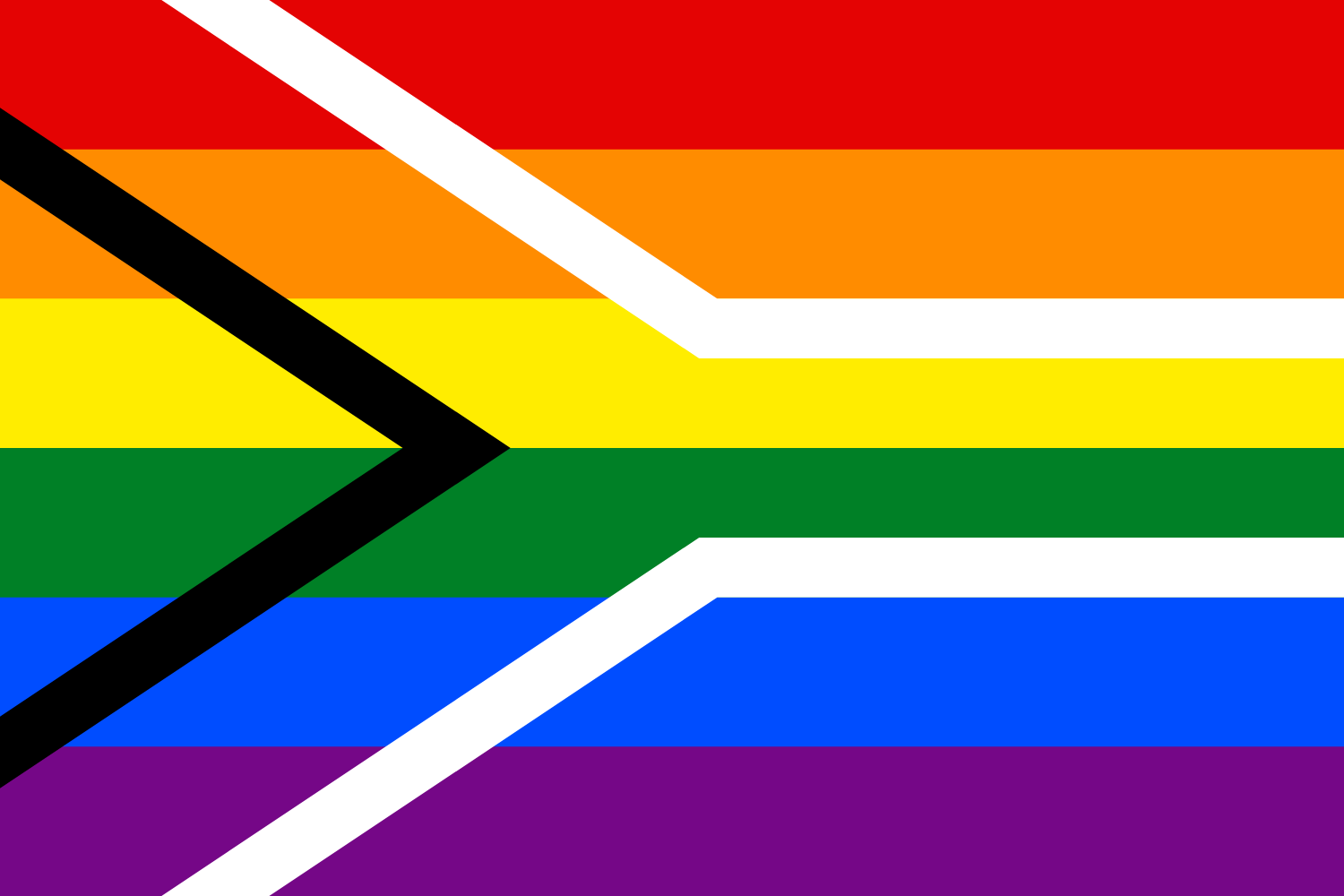
Eugene Brockman's hybrid of the six-stripe rainbow flag and the South African national flag, launched at the Mother City Queer Project in Cape Town on 18 December 2010 with the claim that Queer South Africans "put the dazzle into our rainbow nation." The Bureau of Heraldry registered it on 20 July 2012 as the flag of an association. It was not made a national symbol, though it was reported worldwide as one. [1][2][3]

Key facts
- Designer
- Eugene Brockman
- Created
- First documented public use
- In use
- 2010 to at least 2014
- Aspect Ratio
- 2:3
- Ratio Notes
- The registered blazon gives no proportion. [4] The 2:3 recorded here is the shape of the Commons reconstruction and of the manufactured example photographed at Cape Town Pride in 2014; no source issued by Brockman or by the Bureau of Heraldry specifies it. [5][6]
- Stripes
- 6
- Origin
- Cape Town, South Africa
- Represented Identity
- LGBTQ+ South Africans
Also known as
- Gay Flag of South Africa
- GLBT Flag of South Africa
Status Historical Variant
Archive categories Rainbow Pride Flags · Regional and Language-Specific Pride Flags
Overview
Brockman tied the design to South Africa's account of itself: "I truly believe we (the LGBT community) put the dazzle into our rainbow nation and this flag is a symbol of just that." [1]
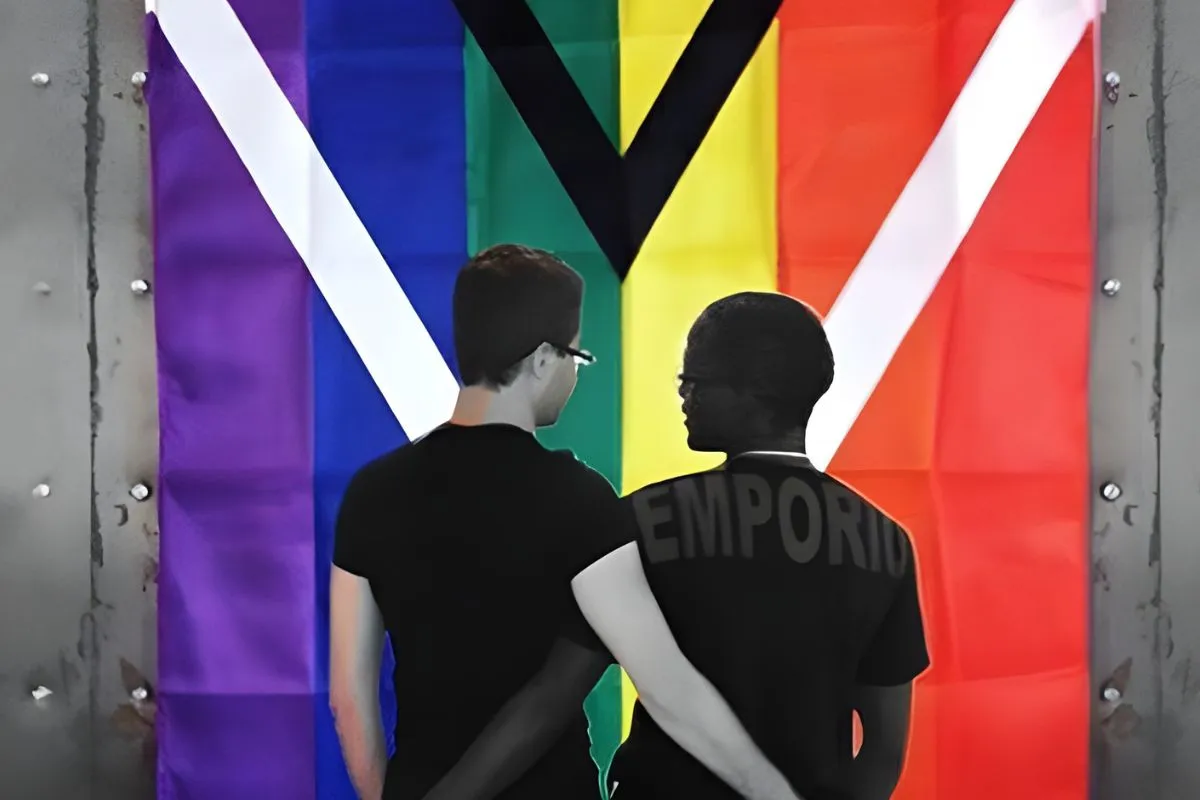
Eugene Brockman designed the flag as a hybrid of the six-stripe rainbow flag and the South African national flag adopted in 1994, and launched it on 18 December 2010 at the Mother City Queer Project costume party, held that year at the new Cape Town Stadium. [1][7]
The idea came from outside the country: Brockman spent most of his twenties in Tokyo and the flag began there. [8]
He named the pressures behind the timing. "There has been a clear slide in GLBT rights: South Africa's UN Ambassador's vote, the continuous corrective rape and eroding GLBT rights in Uganda and Malawi made me feel the need to act immediately." [9] The flag's own website, read by Flags of the World in January 2011, gave it two purposes: to celebrate and maintain the liberties and the right to marry under the South African constitution, and to address workplace discrimination, corrective rape, and the myth of the un-Africanness of homosexuality. [10]
Identity & Context
- Represented Identity
- LGBTQ+ South Africans
- National Context
- South Africa
The flag is titled for gay South Africans and was registered under the period name "the flag of the GLBTI Association of South Africa," but Brockman described a GLBT community purpose throughout. [9][4] Period terminology is kept in quotations and in the legal name.
Creators
The Creator
Eugene Brockman
Designer; managing director of P2-INK; co-founder of the Gay Flag of South Africa non-profit
Cape Town designer, publishing as Eugene "Huge" Brockman, and managing director, founder and creative director of P2-INK. He explained the name himself: "Huge is short for Eugene, because I dreams BIG!" [8]
He spent most of his twenties in Tokyo, having followed Henry Bantjez there, working first in ESL teaching and then in executive search and recruitment, and doing some modelling. He was a founding member and deputy director of the South African Chamber of Commerce in Japan. The flag began there, in homesickness; he gives his own account of it in the quotation below. [9][11][8]
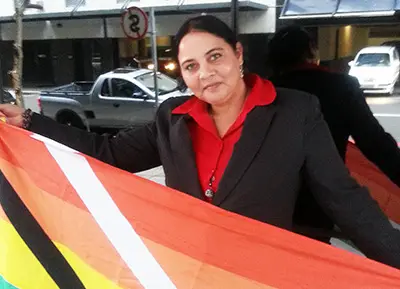
He wrote features for MambaOnline: in May 2013 he reported the assault of a young gay man, Ameer Abbas, in Mitchells Plain on Mother's Day, and the campaign his mother Shireen mounted when police recorded it as common assault and fined the attacker R150. Cape Town Pride passed the family's request for help to Brockman and to the Gay Flag of South Africa, and he advised her to lodge a hate-crimes complaint with an equality court. [12]
During my stay here homesickness sparked the idea of the GLBT flag of South Africa and how to have it promote the GLBT community's causes.
Huge is short for Eugene, because I dreams BIG!
There has been a clear slide in GLBT rights: South Africa's UN Ambassador's vote, the continuous corrective rape and eroding GLBT rights in Uganda and Malawi made me feel the need to act immediately.
Henry Bantjez
Co-founder and chief executive of P2-INK; co-founder of the Gay Flag of South Africa non-profit. Business and fundraising partner, not a designer of the flag.
Chief executive and founder of P2-INK alongside Brockman, and named by LGBTQ Nation as co-founder with him of the Gay Flag of South Africa non-profit. [8][11] He described his own contribution as business rather than design: "I assist P2-INK with my experience in corporate consulting for consumer brands and a Master's Degree in Psychology." [8]
He gave the flag's revenue a specific destination. "My dream is to raise funds through selling flags so that we can build a house for ladies in the townships to have a save haven when they are on the run in fear of their lives. I know how the flag can bring together our pink community accross races and be an agent for good." [8] Whether the house was built is not recorded. His surname appears as Bantjes in LGBTQ Nation's report; this entry follows the spelling he uses himself. [11]
My dream is to raise funds through selling flags so that we can build a house for ladies in the townships to have a save haven when they are on the run in fear of their lives.
Attribution
- Organization
- P2-INK; Gay Flag of South Africa (non-profit)
Attribution notes
Eugene Brockman, who publishes as Eugene "Huge" Brockman, designed the flag and drove its distribution. [1][9] He conceived it abroad, during the years he spent in Tokyo; his own account of that is in his profile. The P2-INK about page describes "a two man operation" working from their apartment and names Brockman as managing director, founder and creative director and Henry Bantjez as chief executive and founder. [8] Brockman, writing in January 2011, put it as "P2-INK consists of my fiancée and I, operating out of our one bedroom apartment, with two laptops, a hoard of boxes, a dream and a shrinking savings account." [9] Bantjez is credited with the flag's business and fundraising side, not with its design.
His surname is spelled two ways in the sources. The P2-INK page, where he writes in the first person, gives Bantjez; LGBTQ Nation, naming him as co-founder of the later non-profit, gives Bantjes. This entry follows the self-published spelling. [8][11]
Origin
- Country
- South Africa
- City
- Cape Town
- Specific Place
- Cape Town Stadium, Green Point
- Place Type
- stadium
- Origin Type
- first_publication
- Physical Origin Status
- unknown
Publicly launched at Cape Town Stadium on Green Point Common. Archaeological reporting identifies the Common as part of a coastal landscape used seasonally by Khoekhoe pastoralists for grazing and camping before Dutch settlement; Company expansion after 1652 displaced Khoekhoe communities from grazing land, and Green Point was declared a white group area under apartheid on 11 June 1965.
Indigenous land context
Khoekhoe (Khoena) pastoralist communities of the Cape Peninsula and Table Bay — seasonal grazing and camping landscape at Green Point Common. Named at the level the sources support. Archaeological reporting on the Green Point precinct describes a coastal plain used seasonally for grazing and camping, and the broader Table Bay record documents Khoekhoe pastoral movement and the Goringhaicona or Camissa trading community led by Autshumao. That establishes shared seasonal use rather than an exclusive attribution to one community for the precise stadium site, and this entry does not claim more. [13][14][15] [13][14][15]
Colonial / settler context
Cape Town Stadium stands on Green Point Common. Archaeological reporting on the precinct identifies the Green Point coastal plain as a seasonal grazing and camping landscape used by Khoekhoe pastoralists before Dutch settlement, with camping continuing into the colonial period. [13] The wider Table Bay record documents Khoekhoe seasonal pastoral use and the Goringhaicona, the Camissa trading community led by Autshumao. [14][15]
Dutch East India Company settlement from 1652 progressively excluded Khoekhoe communities from grazing land and dispossessed them of land and cattle. [14] Under apartheid the pattern was written into law. The Group Areas Act of 1950 gave the government power to demarcate where each racial group could live and own property. [16] Green Point was declared a white group area on 11 June 1965, while District Six, Woodstock and Salt River were left unzoned. [17] [13][14][16][17][15]
- Land status
- An Indigenous seasonal-use and cultural landscape. The sources reviewed do not establish exclusive title, a treaty, a cession, or an unceded status for the site, and this entry does not assert one. [13][14]
- Indigenous engagement
- None documented. No Indigenous community involvement in the flag's design or in its launch appears in the sources reviewed. Recorded as a fact about the record.
Pending Review The land claims follow the specification supplied with this entry's audit. None of the five sources was opened from the build environment, and each says so in the bibliography. Wanted: the archaeological report's own wording on Green Point seasonal use, and confirmation of the 11 June 1965 group-area declaration.
Three places, and only two of them are documented. The idea came to Brockman in Tokyo, where he was living: "during my stay here homesickness sparked the idea of the GLBT flag of South Africa and how to have it promote the GLBT community's causes." [8] Where he executed the final design is not recorded in any located source. The flag was launched publicly at the Mother City Queer Project at Cape Town Stadium on 18 December 2010. [1][18]
Brockman was explicit that the flag's national scope was an aim rather than a starting point: "I just happen to live in Cape Town and as such there are geographical limitations. The GLBT flag of South Africa was launched at MCQP because it was an immediate platform to the national GLBT community as people from across the country attend." He described contacting clubs and venues in Johannesburg, Durban and Bloemfontein, Mr Gay South Africa, the Pink Loerie Mardi Gras and Joburg Pride, giving flags away free, and planning to move to Johannesburg. [9]
Dates & Chronology
- Year Created
- First public use
- Period in Use
- 2010 to at least 2014; later online circulation documented
- Creation Bounds
- Launched publicly on 18 December 2010. [1][18] Brockman, writing five weeks later, described the launch as an opportunity he took rather than a date he planned around: "Launching at MCQP became a viable option and I acted on it." [9] No date is documented for the design work itself, and no place either. The 2012 date attached to the flag in some accounts is the heraldic registration, not the design.
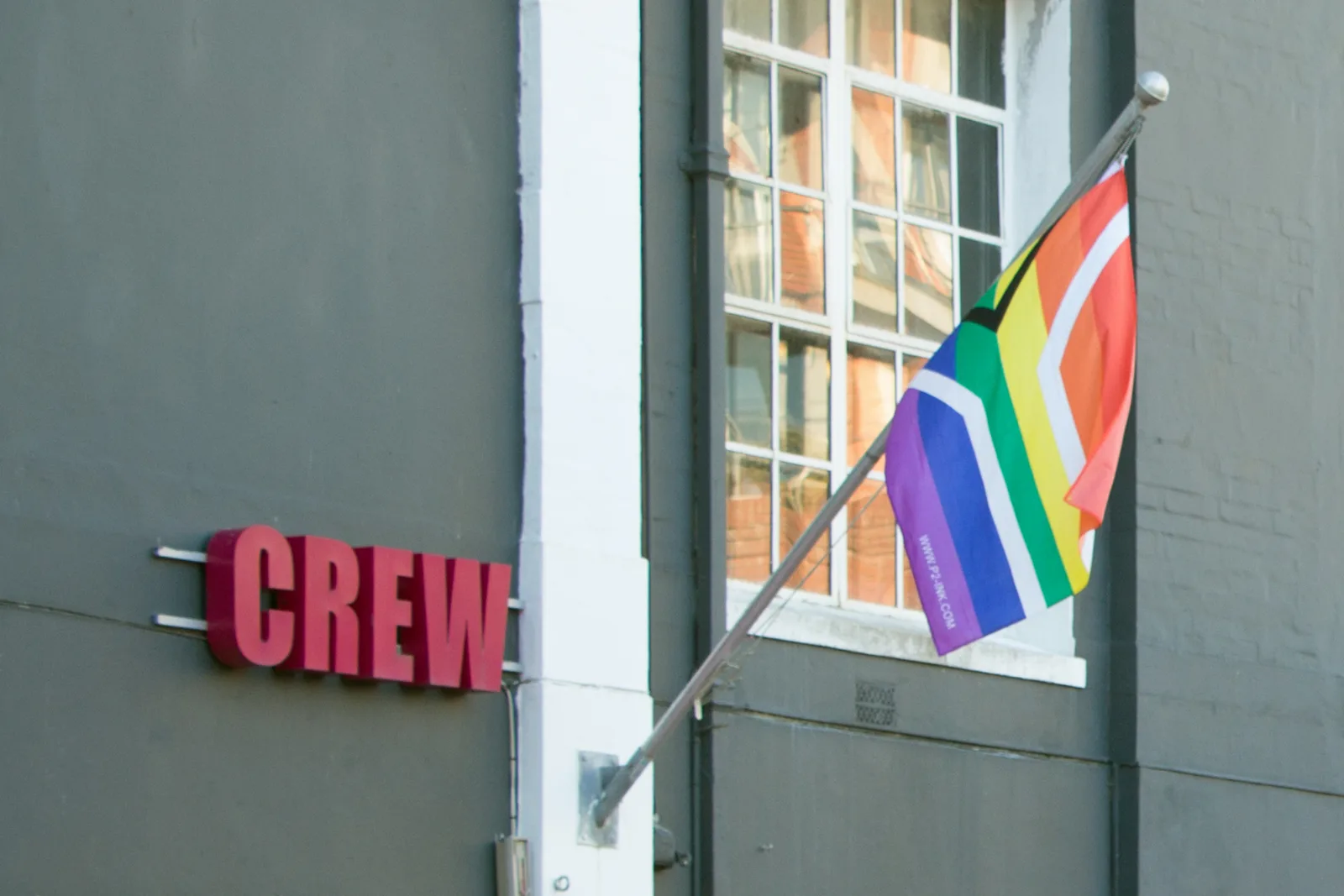
Adoption began locally and fast. By late January 2011 De Waterkant, Cape Town's gay village, was flying the flag, and the board and executive committee of Cape Town Pride had taken it up; Brockman had joined Pride as a volunteer at the invitation of its festival director Gareth Dallas, and directed early proceeds to Cape Town Pride and to Luleki Sizwe, the organisation working against corrective rape. [9] The flag was still flying in De Waterkant in June 2014, outside the Crew nightclub on Napier Street. [19]
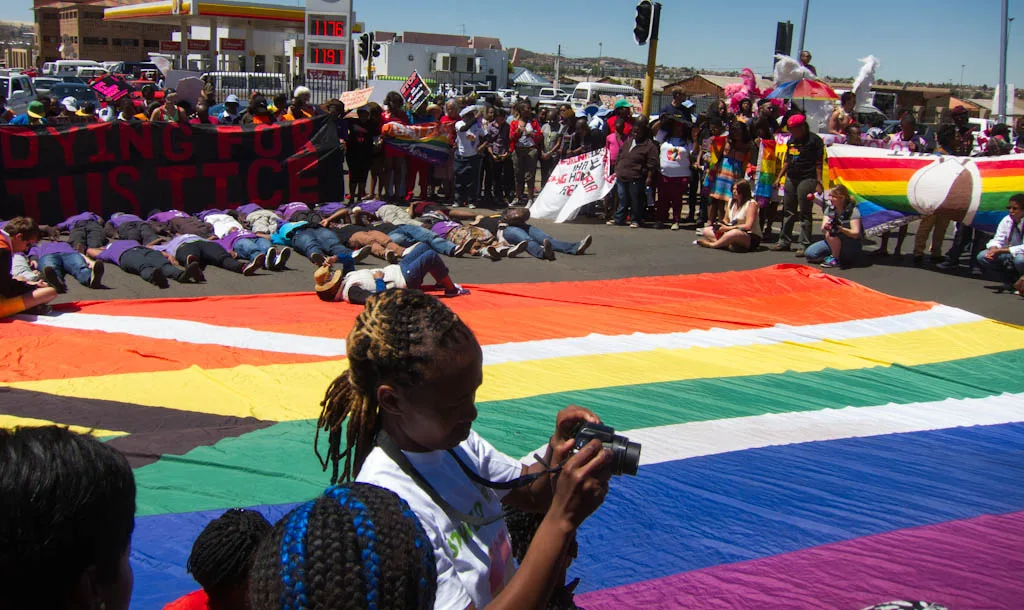
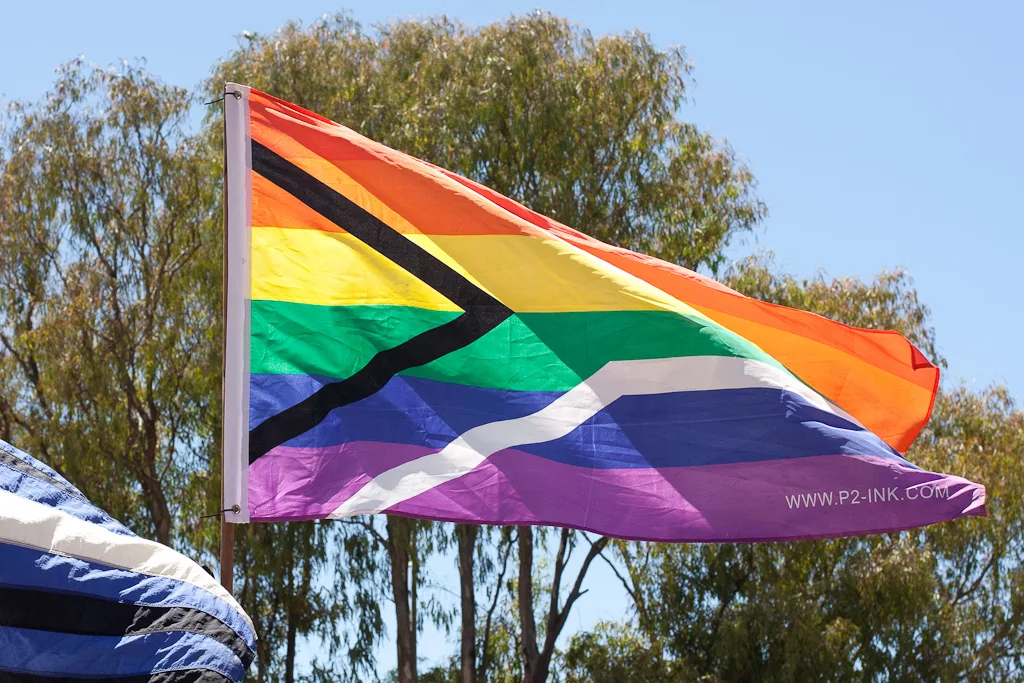
It reached the country's largest Queer gatherings within two years. A giant version was carried at Soweto Pride in September 2012, at a march whose participants staged a die-in against violence against lesbians. [20][1] Manufactured flags carrying the P2-INK web address were flying at Cape Town Pride in March 2014. [6] In 2012 the Gay Flag of South Africa non-profit ran a national tour town to town, campaigned against calls by Phathekile Holomisa of the Congress of Traditional Leaders to remove sexual-orientation protection from the Constitution, and was invited to the Constitutional Court by Justice Edwin Cameron. [3][11]
The flag's best-known episode is a registration that was widely misreported, including by the people who obtained it.
On 20 July 2012 it was registered at South Africa's Bureau of Heraldry as a heraldic flag representing the LGBT Association of South Africa, published in the Government Gazette. [1] In October the non-profit announced that the flag had been recognised by government as South Africa's official gay flag, and the announcement travelled. TimesLIVE reported that the Department of Arts and Culture had approved the registration and quoted Mava Mothiba of the bureau saying there had been no objections. [21] LGBTQ Nation went further, under the headline "South Africa first to recognize gay flag as an official national symbol," reporting that the flag had been "approved and accepted as the country's official gay flag" and calling South Africa "the first country in the world to officially recognize a gay flag, and likely any official LGBTI symbol." [11]
It was not a national symbol. In February 2013 OUT Africa Magazine put the question to the bureau, and MambaOnline reported the answer from Marcel van Rossen, its deputy director in the Department of Arts and Culture: the flag is registered and protected only as the official flag of the Gay Flag organisation. "The flag is not a national symbol at all. It is not the gay flag of South Africa either. There is no such thing," he said, adding that "any claim that it is a national symbol is false." The magazine called the news a shocking revelation and accused the organisation of misrepresentation. [3]
Brockman accepted the correction and apologised. "As the Bureau of Heraldry registered the Coat of Arms, the Protea, Springbok, Blue Crane etc. as national symbols we were under the assumption that they had the power to declare the Gay Flag of SA as a national symbol," he told MambaOnline, calling it "an honest mistake as we are novices at governmental registration processes for heraldry." He added: "It was our understanding at the time that we had reached the goal of becoming a national symbol. It turned out that we were only a leap closer to that goal." He maintained a narrower claim, that the flag was "the first gay flag or gay emblem to be officially recognised by a government's heraldry," and said pursuing national-symbol status through the Presidency was "now firmly set as a life goal of mine." [3] No independent confirmation of the narrower priority claim has been located, and no outcome of an application to the Presidency has been reported.
Lineage
- Direct predecessors
- Rainbow Pride Flag
- Sibling flags
- Alberta Gay Flag, Straight Ally Pride Flag, Anarcha-Queer Flag (rainbow variant), Argentina Gay Flag, Australia Gay Flag, Brazil Gay Flag
+ 44 more
British Columbia Gay Flag, Canadian Pride Flag, Chicago Pride Flag (Rainbow Stripes, Purple Stars), Chile Gay Flag, Dominican Republic Gay Flag, Egypt Gay Flag, European Union Gay Flag, France Gay Flag, Gay Pride Flag of Pakistan, Heteroflexible Pride Flag, Heterosexual / Straight Pride Flag, Homoflexible Pride Flag, India Gay Flag, Italy Gay Flag, Japan Gay Flag, Jewish Gay Pride Flag, Manitoba Gay Flag, Mexico Gay Flag, Netherlands Gay Flag, New Brunswick Gay Flag, Newfoundland Gay Flag, Northwest Territories Gay Flag, Nova Scotia Gay Flag, Nunavut Gay Flag, Ontario Gay Flag, Palestinian Gay Pride Flag, Panama Gay Flag, Philadelphia Pride Flag, Prince Edward Island Gay Flag, Quebec Gay Flag, Rainbow Flag with White Triangle (Sapporo), Rainbow Israel Flag, Rainbow Polish Flag (2014, Angela Getler), Russia Gay Flag, Saskatchewan Gay Flag, Social Justice Pride Flag, Switzerland Gay Flag, Tanzania Gay Flag, Texas Rainbow Flag, Turkish Gay Pride Flag, Two-Spirit Pride Flag (2005, Zoccole), Two-Spirit Pride Flag (2016 Tumblr documentation), Victory Over AIDS Flag (1980s, designer unknown), Yukon Territory Gay Flag
Formally a hybrid of two parents. The field and its six bands are the six-stripe rainbow flag; the pall, the horizontal Y issuing from the hoist, is taken from the South African national flag adopted in 1994. The registered blazon describes both elements together. [4][2] Flags of the World, reading the flag's own website in January 2011, described it the same way: the rainbow flag as a background with the white and black outline of the national flag superimposed. [10]
Only one of those parents is a record in this archive. The six-stripe flag is carried as the direct predecessor; the South African national flag has no entry here, and rather than invent one or file a real formal parent as a vague influence, the second parentage is stated here in words.
Lineage tree
Every record reachable from this one through documented parent and child relationships: 4 records across 4 generations.
- Ancestors -3
- Original Rainbow Flag (1978)
- Ancestors -2
- Seven-Stripe Rainbow Flag (1978)
- Ancestor
- Rainbow Pride Flag
- This record
- South African Gay Pride Flag
Colors & Symbolism
The rainbow flag read through South Africa's account of itself as the rainbow nation, with the national flag's pall laid over it. [1][9]
| Colour | Hex | Meaning |
|---|---|---|
| Red | #E40303 | Life, in the meanings Gilbert Baker gave the parent rainbow flag. Brockman published no per-stripe meanings for this design; the six bands and their readings are carried over unchanged from the six-stripe flag. [7][22] |
| Orange | #FF8C00 | Healing, inherited from the six-stripe rainbow flag. |
| Yellow | #FFED00 | Sunlight, inherited from the six-stripe rainbow flag. |
| Green | #008026 | Nature, inherited from the six-stripe rainbow flag. |
| Blue | #004DFF | Serenity, inherited from the six-stripe rainbow flag. |
| Purple | #750787 | The spirit of the community, inherited from the six-stripe rainbow flag. |
Wikimedia Commons SVG source code, read directly [5]
This flag has no official digital palette. Color values shown are approximate.
- Pall (the horizontal Y)
- Taken from the South African national flag of 1994, where the converging pall is read as the coming together of diverse peoples. The registered blazon describes it as a white pall with the edge to the hoist in black. No separate meaning has been published for the element as it appears on this flag. [1]
The blazon registered in 2012 names six colours, red, orange, yellow, green, blue and purple, and specifies no values and no meanings. [1] The six-stripe flag's published meanings are inherited by inheritance of the design, not by any statement from Brockman, who described the flag's purpose in political rather than chromatic terms. [9]
The registered blazon names the six colours and specifies no values: red, orange, yellow, green, blue and purple. [4][2] The hex values listed are read from the Wikimedia Commons reconstruction's SVG source and are the modern Commons rainbow set, a rendering convention rather than a palette issued by Brockman or by the Bureau of Heraldry. [5] Some six-stripe rainbow sources call the sixth band violet; this entry follows the blazon and calls it purple throughout.
Design
- Aspect Ratio
- 2:3
- Ratio Notes
- The registered blazon gives no proportion. [4] The 2:3 recorded here is the shape of the Commons reconstruction and of the manufactured example photographed at Cape Town Pride in 2014; no source issued by Brockman or by the Bureau of Heraldry specifies it. [5][6]
- Orientation
- horizontal
- Stripe Count
- 6
- Layout
- horizontal stripes with overlaid pall
- Stripes (Top → Bottom)
- Red, Orange, Yellow, Green, Blue, Purple
- Center Symbol
- Pall (horizontal Y) taken from the South African national flag, drawn in white with a black triangle at the hoist
The blazon registered in the Government Gazette in 2012 reads: "A field divided horizontally into six equal bands of red, orange, yellow, green, blue and purple, surmounted horizontally from the hoist of a white pall in umbra the edge to the hoist in black." [1] Flags of the World, describing the design from the P2-INK site in January 2011, put it as the rainbow flag as a background with the white and black outline of the South African national flag superimposed. [10] The Commons file matches: a 720 by 480 viewBox, six equal bands of 80 units, white pall arms springing from a point on the hoist edge to the top and bottom fly corners, and a black wedge occupying the hoist as far as the pall's centre point at 273 units. [5]
Manufactured flags carry the design as blazoned. The example photographed at Cape Town Pride in March 2014 is printed on a single panel with a white hoist sleeve and carries the P2-INK web address in the lower fly. [6]
The six-stripe rainbow field carries the pall, the horizontal Y, of the South African national flag, issuing from the hoist. In the Commons file the pall is drawn in two colours rather than the national flag's four: the two arms running to the fly are white, and the wedge at the hoist is black. The national flag's green pall and its red, blue, gold and green fields are dropped; what is borrowed is the shape. Description read from the Commons file's own source code. [5]
Usage & Adoption
- First Users
- Mother City Queer Project, Cape Town, 18 December 2010 (launch) [1]
- Organizations
- Cape Town Pride, whose board and executive committee took up the flag by January 2011 [9], Gay Flag of South Africa, the non-profit formed around it [3][11], Crew nightclub, De Waterkant, Cape Town, flying it in June 2014 [19]
- Geographic Usage
- Cape Town (De Waterkant, Cape Town Pride), Soweto, Johannesburg
- Event Usage
- Mother City Queer Project, Cape Town Stadium, 18 December 2010 [1], Soweto Pride, 29 September 2012, carried as a giant flag at a die-in against violence against lesbians [20], Cape Town Pride, 1 March 2014 [6]
- Current Status
- active
Taken up quickly in Cape Town and carried at the country's larger Pride events within two years. By December 2013 MambaOnline reported it as a common sight at Pride events around South Africa, used in campaigns and on two national bus tours. [3] The latest documented physical use located is Cape Town Pride in March 2014 and the flag flying in De Waterkant that June; circulation since then is online. It is not an official symbol of South Africa. [6][19][3]
Image Archive
Documented use
.jpg)
.jpg)
.jpg)
Discourse & Debates
- MambaOnline published an article by Jason Fiddler on 19 January 2011 questioning the appropriateness of the venture. Brockman answered it at length four days later, and that reply is the fullest statement of his aims on record. [9]
- Brockman argued that a committee process would have produced nothing: "If a similar model to that of the Pride flag of the USA was followed and the concept was put to the community, there would have been discussion upon discussion, with little action taken." He also declined the word official at that stage: "We have not stated that the GLBT flag of South Africa is the 'official' queer flag. However, we have asked the community to see its value and to adopt it." [9]
- He drew the parallel with the national flag itself, noting that Fred Brownell's 1994 design followed a failed national competition of over 7,000 entries and took years to be accepted: "in 1995 white people were still flying the Oranje blanje blou at the Rugby World cup, yet today the majority of South Africans have come to love the flag." [9]
Common misidentifications
- Widely reported in October 2012 as South Africa's official national gay flag, and as a world first. The Bureau of Heraldry stated in February 2013 that the registration covers the flag of the organisation only. [3][11][21]
Criticisms
- That a single company should not own a community symbol. Writing in the comments on Brockman's January 2011 response, a reader signing as Concerned accepted the stated intentions but objected to the structure: "the trademark and subsequent initial beneficiary is a private entity ... there is no obligation to have accounts audited/publicized or causes democratically decided upon," concluding that it would remain "a private venture, inherently non-transparent by nature." [9]
- That the flag was unnecessary and commercial. After the 2013 correction a commenter signing as Dean wrote: "An opportunist group who is in it to make money out of us. Why do we need one? We are divided as it already is ... the Gilbert Baker flag is adequate." [3]
- That the design is a mishmash. A commenter signing as Bob: "Quite frankly, I think the flag is ugly and not a true reflection of the gays of South Africa ... Its just a mishmash of the two flags." [3]
Editorial note
Brockman quoted the activist Ndumie Funda, whose partner died after a corrective rape and who had gathered 140,000 signatures petitioning the government, on why such a flag was wanted: "Our government constitution is highly inclusive, but in practicality it is not. By hanging the GLBT flag of South Africa in our streets and houses we can intimidate perpetrators of corrective rape, plus the government as it reminds them that we are not going anywhere. We are also citizens of this country and therefore we demand justice and equality for all." [9]
Footnotes & Citations
Sources and footnotes 23 sources
- 1. Encyclopedias & Reference Gay flag of South Africa. Wikipedia contributors. Wikipedia (2026-06-02). Accessed 2026-08-10
- 2. Government Government Notice 541: Bureau of Heraldry, registration of heraldic representations. Bureau of Heraldry, Department of Arts and Culture. Government Gazette No. 35517, vol. 565 (2012-07-20). Accessed 2026-08-11
Government Notice 541, at page 7 of the gazette: the Bureau of Heraldry gives notice under section 11 of the Heraldry Act, 1962 (Act No. 18 of 1962) that "(H4/3/1/4127) The flag of the GLBTI Association of South Africa, as published under Government Notice No. 377 of 11 May 2012" has been registered.
- 3. News Gay Flag of SA Not a National Symbol. Staff Writer. MambaOnline (2013-02-27). Accessed 2026-08-10
- 4. Government Government Notice 377: Bureau of Heraldry, application for registration of a heraldic representation. Bureau of Heraldry, Department of Arts and Culture. Government Gazette No. 35313, vol. 563 (2012-05-11). Accessed 2026-08-11
Government Notice 377, at page 13 of the gazette, carries the application: "APPLICANT: GLBTI Association of South Africa H4/3/1/4127. FLAG: A rectangular flag proportion 2:3 the field divided horizontally into six equal bands of red, orange, yellow, green, blue and purple, surmounted horizontally" by a white pall in outline from the hoist, in black. The Afrikaans text gives the same description.
- 5. Image file page File:Gay Flag of South Africa.svg. Htonl (Wikimedia Commons). Wikimedia Commons (2012-01-16). Accessed 2026-07-26
- 6. Image file page File:20140301-IMG 2321 (12886046384).jpg. Samantha Marx. Wikimedia Commons (2014-03-02). Accessed 2026-08-10
- 7. Articles & Reports The history of the South African gay flag unfurled. Nereesha Patel. The South African (2025-10-07). Accessed 2026-08-10
- 8. Primary statement Who we are!. Eugene "Huge" Brockman and Henry Bantjez. P2-INK (2011). Accessed 2026-08-10 · Archived version
- 9. Primary statement SA LGBT Flag – The Response. Eugene "Huge" Brockman, introduced by Roberto Igual. MambaOnline (2011-01-23). Accessed 2026-08-10
- 10. Reference South African "Gay" flag. Bruce Berry. Flags of the World (2011-01-25). Accessed 2026-08-10
- 11. News South Africa first to recognize gay flag as an official national symbol. Melanie Nathan. LGBTQ Nation (2012-10-06). Accessed 2026-08-10
- 12. Primary statement Everybody Wants a Mother Like That. Eugene "Huge" Brockman. MambaOnline (2013-05-30). Accessed 2026-08-10
- 13. Report Granger Bay Boulevard, Annexure A: Archaeological Impact Assessment. South African Heritage Resources Agency (SAHRIS). Accessed 2026-08-11
Heritage assessment covering the Green Point precinct in which the stadium stands. Not read: the host does not complete a connection.
- 14. Reference Table Bay. South African History Online. Accessed 2026-08-11
- 15. Museums & Exhibitions Krotoa. Cape Town Museum. Accessed 2026-08-11
- 16. Reference Cape Town: the Segregated City. South African History Online. Accessed 2026-08-11
- 17. Reference Timeline of the Group Areas Act and selected related pieces of legislation. South African History Online. Accessed 2026-08-11
A timeline of the Group Areas Act and related legislation. It dates the Green Point proclamation to 11 June 1965, spelling it "Greenpoint", and attributes the entry to the South African Institute of Race Relations survey for 1965, page 184.
- 18. Archived Sources South African gay flag revealed at MCQP. Cape Town Pride. Accessed 2026-08-11 · Archived version
Cape Town Pride's own announcement of the launch. Not read: the page returns HTTP 403.
- 19. Image file page File:De Waterkant 6 (cropped).jpg. HelenOnline (Helen Riding). Wikimedia Commons (2014-06-21). Accessed 2026-08-10
- 20. Image file page File:Soweto Pride 2012 (8036294929).jpg. Charles Haynes. Wikimedia Commons (2012-09-29). Accessed 2026-08-10
- 21. News Gay flag for a 'queer' South Africa. Denise Williams. TimesLIVE (2012-10-08). Accessed 2026-08-10
- 22. Encyclopedias & Reference Rainbow flag (LGBTQ). Wikipedia contributors. Wikipedia. Accessed 2026-07-24
- Encyclopedias & Reference Gay flag of South Africa. Wikipedia contributors. Wikipedia. Accessed 2026-08-11
Image Sources
- Rendering
- community reconstruction
- Reconstruction of the Gay Flag of South Africa · Credit: Htonl, released into the public domain, via Wikimedia Commons · Wikimedia Commons · reconstruction
- Soweto Pride, 29 September 2012. The flag is spread across the road at a die-in against violence against lesbians, the banner behind it reading "DYING FOR JUSTICE." It is the earliest documented use of the flag at scale outside Cape Town. [20] · Credit: Charles Haynes · Wikimedia Commons · CC BY-SA 2.0
- Shireen Abbas holding the flag, photographed for Brockman's MambaOnline feature of 30 May 2013. Her son Ameer was assaulted in Mitchells Plain while buying Mother's Day gifts; police recorded it as common assault and the attacker paid a R150 fine. Cape Town Pride passed her request for help to Brockman and to the Gay Flag of South Africa, and she pursued a hate-crime case through the courts. "I want my son to be free to be himself," she said. [12] · Credit: MambaOnline · MambaOnline
- Cape Town Pride, 1 March 2014. A manufactured example, printed on a single panel with a white hoist sleeve, carrying the web address of Brockman's company P2-INK in the lower fly. It is direct evidence of the distribution model he set out in 2011, in which sales through the company were to fund Queer causes. [6][9] · Credit: Samantha Marx · Wikimedia Commons · CC BY 2.0
- The flag outside Crew nightclub at 30 Napier Street, De Waterkant, Cape Town, photographed on 21 June 2014. De Waterkant had been flying it since January 2011, when Brockman cited the neighbourhood as the first to take it up in solidarity. [19][9] · Credit: Helen Riding (HelenOnline) · Wikimedia Commons · CC BY-SA 3.0