Texas Rainbow Flag
Regional Pride Flag ·
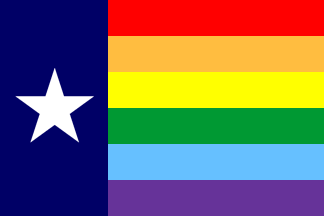
The flag of Texas with its white and red fields replaced by six rainbow colours, the blue hoist and white star kept. Flags of the World traces it to GayJourney.COM, marked as Greg Gomes's work, and records one photograph of it in use, at a Dallas rally on 28 November 2008, together with four web shops then selling it. [1] An earlier pink-triangle Texas design is held here as a variant.
Key facts
- Designer
- Greg Gomes
- Created
- Documented use
- Documented physical use 28 November 2008
- Aspect Ratio
- 2:3
- Ratio Notes
- Two proportions are recorded and they disagree. The web shops Todorović names all sold the flag at 3:5. The one photographed flag, at the Dallas rally, is 2:3, which is also the proportion of the state flag and of the image on GayJourney.COM. This entry gives 2:3, the proportion of the only documented physical flag. [1]
- Stripes
- 6
- Represented Identity
- LGBTQ
Also known as
- Texas Gay Flag
Status Variant
Archive categories Regional and Language-Specific Pride Flags
Overview
The Texas state flag with its white and red fields replaced by six rainbow colours, keeping the blue hoist and its white star. Tomislav Todorović traced the design to GayJourney.COM, where it was marked as the work of the site's author, Greg Gomes, and drew it from a photograph of the only physical example he could find. [1] That photograph, from a rally in Dallas on 28 November 2008, is the single documented case of the flag being flown; Todorović also reported that four web shops were selling it at the time.
Identity & Context
- Represented Identity
- LGBTQ
- National Context
- United States; Texas
Creators
The Creator
Greg Gomes
Designer and publisher
Greg Gomes is credited as the designer of the flags marked on his own pages, and as the publisher of the two sites that carried them. He ran Gay Journey at gayjourney.com, whose footer carries a copyright range beginning in 2002, and the later Gay Flags of the World at gayflags.biz, 2005 to 2011. Both published from American Dimensions, PO Box 573, McKinney, Texas 75070, and both ran the same four series of gay flags: general, national, United States state, and Canadian provincial. A post-office box is a mailing address. It does not establish where Gomes lived, and no source states where any of these files was drawn.
He marked his own designs with a symbol before the flag name, which is what separates the flags he made from the flags he catalogued. The marking is per flag and not every flag carries it: of the forty-seven on the national page, Azerbaijan, Canada and the United States do not. [2] His terms for reuse were set out on the same page, in his own words: the marked designs were his and Gay Journey’s property and protected by copyright; anyone wishing to use one was to contact him and say where it would be used, credit the design to him, and make the flag a clickable link back to gay_flags.htm. He also stated that the marked designs were not for sale through the page. [2]
Outside his own sites the collection was noticed twice on Flags of the World. Francisco Santos wrote on 14 May 2003 that GayJourney.COM carried “lots of rainbows: from Argentina to Wales, EU, UNO, US states, Canadian provinces and general gay flags,” and added that “perhaps not all of these flags are actually used in the real word.” Richard Knipel wrote on 14 June 2004 that most of the flags, “with ‘GJ’ underneath, were designed by the site’s author, Greg Gomes,” and that it was “hard to say how many of these are flying somewhere.” [3] Tomislav Todorović, reading the state series in 2015, recorded that the Wyoming flag was “not marked as his creation,” unlike most images.
One property of the collection recurs across the individual flags and is recorded here rather than on each of them: of the twenty-nine files recovered from the two sites, fifteen share one identical set of six sampled rainbow values, across both the Canadian and the national series. The rainbow arrives in these designs as a fixed component of the collection rather than as a choice made for each flag.
The thirty-one entries held here are not his complete output. Gay Journey and Gay Flags of the World carried further national, United States state, Canadian and general designs for which no artwork has been recovered, and the archive builds entries only for flags it can see. No biographical source about Gomes has been located beyond the two sites and the Texas post-office box, and no photograph of him has been found.
Attribution
- Organization
- Gay Journey
Attribution notes
Tomislav Todorović records that the design’s earliest appearance was at GayJourney.COM, "and is marked as having been designed by the site’s author, Greg Gomes." The attribution is the site’s own marking, read by Todorović, rather than a statement by Gomes read here. [1] Gomes’s publication, marking convention and reuse terms are set out in the creator record below.
Origin
- Digital Origin
- Gay Journey (gayjourney.com)
- Origin Type
- creation place unknown; published online
- Physical Origin Status
- Not documented.
Represents Texas. The design was not made there: it was published through a McKinney, Texas post-office address and the place it was drawn is not documented. [1]
Indigenous land context
Caddo — inhabitants of the Collin County area before settlement. Branches of the Caddo inhabited the area of present-day Collin County, where McKinney is the county seat, before the arrival of the first White settlers, and had withdrawn from the county by the mid-1850s. Land grants offered by the Peters colony drew settlers in. [4][5]
Anadarko, Caddo, Ioni, Kichai, Tawakoni, Tonkawa, Waco and Penateka Comanche — confined to two Texas reservations in 1854 and removed from the state in 1859. In February 1854 the Texas legislature set aside approximately 70,000 acres for two reservations: the Brazos Reserve, for the Anadarko, Caddo, Ioni, Kichai, Tawakoni, Tonkawa, Waco and other peoples, about 1,110 in all, and the Clear Fork Reserve for the Penateka Comanche. On 11 June 1859 the state and federal governments agreed to move them north of the Red River into Indian Territory, and about 1,000 people were escorted across the river out of Texas on 1 September. [6]
Colonial / settler context
McKinney, the address on the publisher's page, is the county seat of Collin County, established there in 1848. [5] Branches of the Caddo inhabited the county before settlement and had withdrawn by the mid-1850s, as land grants from the Peters colony drew settlers onto the blackland prairie. [4] Statewide the policy was expulsion before it was containment: Mirabeau B. Lamar, as president of the Republic, held that the Cherokee had no just claim to their lands and wanted Indigenous peoples destroyed or driven out. [6] In February 1854 the legislature set aside about 70,000 acres for two reservations, the Brazos Reserve for the Anadarko, Caddo, Ioni, Kichai, Tawakoni, Tonkawa and Waco and the Clear Fork Reserve for the Penateka Comanche; five years later, on 11 June 1859, the state and federal governments agreed to move them out, and about 1,000 people were escorted north of the Red River into Indian Territory on 1 September. [6] The lone star Gomes kept is the emblem of the Republic that carried out that policy. The McKinney post-office box places the publisher in Texas but does not establish that Gomes lived there, where he drew the file, or that any Texas community authorised the design. [4][5][6]
- Indigenous engagement
- None documented. No source records Gomes consulting, or being asked by, any of the Nations or governments named here.
The flag represents Texas, and the publisher's address was in Texas: American Dimensions, PO Box 573, McKinney. A post-office box is a mailing address. It does not establish that Gomes lived in Texas, where he drew the file, or that any Texas community authorised the design. [1]
Dates & Chronology
- Year Created
- Documented use
- Documented physical use 28 November 2008; commercial manufacture reported at four web shops; current status unknown.
- Creation Bounds
- Four different things are recorded here and they are not the same date. The copyright range on Gay Journey begins in 2002, and the site's flag section is in the Internet Archive from 28 October 2002, which bounds the collection rather than this design. [1] Collection-level publication is documented from outside the sites twice: Francisco Santos described GayJourney.COM on Flags of the World on 14 May 2003 as carrying "lots of rainbows: from Argentina to Wales, EU, UNO, US states, Canadian provinces and general gay flags," and Richard Knipel wrote again on 14 June 2004. Neither report lists or dates an individual flag. [3] Direct documentation of this individual design has not been dated. No source dates the design itself, and no flag in the collection carries a date of its own. The year given is the earliest year the collection is documented in publication.
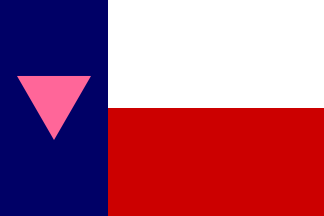
A pink-triangle variant of the Texas flag, which has its own entry, was presented at Chris Pinette's website as an LGBT flag that was gaining popularity at the time. Todorović dates it from the Internet Archive: the earliest capture of that page is 23 May 2000 and the latest 21 September 2005, the later one repeating the original text. From that he infers the flag was already in use during the 1990s and had since fallen out of use, replaced by designs such as the rainbow flag above. The inference is his; no 1990s use is documented. [1]
Lineage
- Direct predecessors
- Rainbow Pride Flag
- Sibling flags
- Alberta Gay Flag, Straight Ally Pride Flag, Anarcha-Queer Flag (rainbow variant), Argentina Gay Flag, Australia Gay Flag, Brazil Gay Flag
+ 44 more
British Columbia Gay Flag, Canadian Pride Flag, Chicago Pride Flag (Rainbow Stripes, Purple Stars), Chile Gay Flag, Dominican Republic Gay Flag, Egypt Gay Flag, European Union Gay Flag, France Gay Flag, Gay Pride Flag of Pakistan, Heteroflexible Pride Flag, Heterosexual / Straight Pride Flag, Homoflexible Pride Flag, India Gay Flag, Italy Gay Flag, Japan Gay Flag, Jewish Gay Pride Flag, Manitoba Gay Flag, Mexico Gay Flag, Netherlands Gay Flag, New Brunswick Gay Flag, Newfoundland Gay Flag, Northwest Territories Gay Flag, Nova Scotia Gay Flag, Nunavut Gay Flag, Ontario Gay Flag, Palestinian Gay Pride Flag, Panama Gay Flag, Philadelphia Pride Flag, Prince Edward Island Gay Flag, Quebec Gay Flag, Rainbow Flag with White Triangle (Sapporo), Rainbow Israel Flag, Rainbow Polish Flag (2014, Angela Getler), Russia Gay Flag, Saskatchewan Gay Flag, Social Justice Pride Flag, South African Gay Pride Flag, Switzerland Gay Flag, Tanzania Gay Flag, Turkish Gay Pride Flag, Two-Spirit Pride Flag (2005, Zoccole), Two-Spirit Pride Flag (2016 Tumblr documentation), Victory Over AIDS Flag (1980s, designer unknown), Yukon Territory Gay Flag - Lineage confidence
- high
Two visual sources, one of which the lineage graph can hold and one of which it cannot. The six-stripe Rainbow Pride Flag is a direct Pride-flag parent and is registered as one. The Flag of Texas is the second visual source, and it is recorded as a structured source-flag relationship in Design rather than as a graph node, because the graph accepts only Encycloflaggia entries and no Pride entry should be invented to create one. The relationship here is: source flag with fields replaced by rainbow stripes. Flags of the World describes the method this whole class of flag follows as "taking an existing flag and 'merging' it with the Rainbow Flag or various GLBT symbols to represent GLBT members of the group the existing flag represents." [3] The other Gomes flags are siblings by collection rather than by descent: one designer, one operation, four series published together under one set of terms. A shared designer is a collection relationship and not a substitute for parentage.
Lineage tree
Every record reachable from this one through documented parent and child relationships: 4 records across 4 generations.
- Ancestors -3
- Original Rainbow Flag (1978)
- Ancestors -2
- Seven-Stripe Rainbow Flag (1978)
- Ancestor
- Rainbow Pride Flag
- This record
- Texas Rainbow Flag
Colors & Symbolism
No published statement of meaning has been located for this stub.
No palette has been published. Todorović drew his rendering from the Dallas photograph and noted that the orange and blue read much lighter than on most rainbow flags, and that the flag carries two shades of blue. [1] No values are sampled here: the artwork this entry would sample is the FOTW rendering, not a file from the designer's own page. These are working values sampled from the surviving artwork at the centre of each band, not published specifications; the collection-level note on the recurring Gomes rainbow values is carried in the creator record rather than repeated on each flag.
Design
- Aspect Ratio
- 2:3
- Ratio Notes
- Two proportions are recorded and they disagree. The web shops Todorović names all sold the flag at 3:5. The one photographed flag, at the Dallas rally, is 2:3, which is also the proportion of the state flag and of the image on GayJourney.COM. This entry gives 2:3, the proportion of the only documented physical flag. [1]
- Orientation
- horizontal
- Stripe Count
- 6
- Layout
- horizontal_stripes_with_hoist_panel
- Additional Symbols
- White star on the blue hoist panel
No construction sheet has been located. The image held here is Todorović's rendering for Flags of the World, 324 by 216 pixels, which is the 2:3 of the photographed Dallas flag and of the Texas state flag. No file from Gomes's own page has been recovered for this design, so unlike the other thirty entries in this series the artwork here is a third party's drawing rather than the designer's own. Todorović notes that the design uses two shades of blue, and that its orange and blue are much lighter than on most rainbow flags, shades he took from the Dallas photograph. [1]
Two ratios are recorded and they disagree. The web shops Todorović names all sold the flag at 3:5. The one photographed flag, at the Dallas rally, is 2:3, which is the ratio of the state flag and of the image on GayJourney.COM. This entry gives 2:3, the ratio of the only documented physical flag. [1]
The Texas state flag with its white and red fields replaced by six rainbow colours, keeping the blue hoist and its white star. Todorovic notes that it uses two shades of blue, and that the orange and blue of the rainbow are much lighter than on most rainbow flags. [1]
Source flag and visual comparison
- Source flag
- Flag of Texas
- Jurisdiction
- Texas
- Relationship
- source flag with fields replaced by rainbow stripes
- Elements retained
- the blue hoist panel and its white star
- Elements altered
- the white and red fields, replaced by six rainbow colours
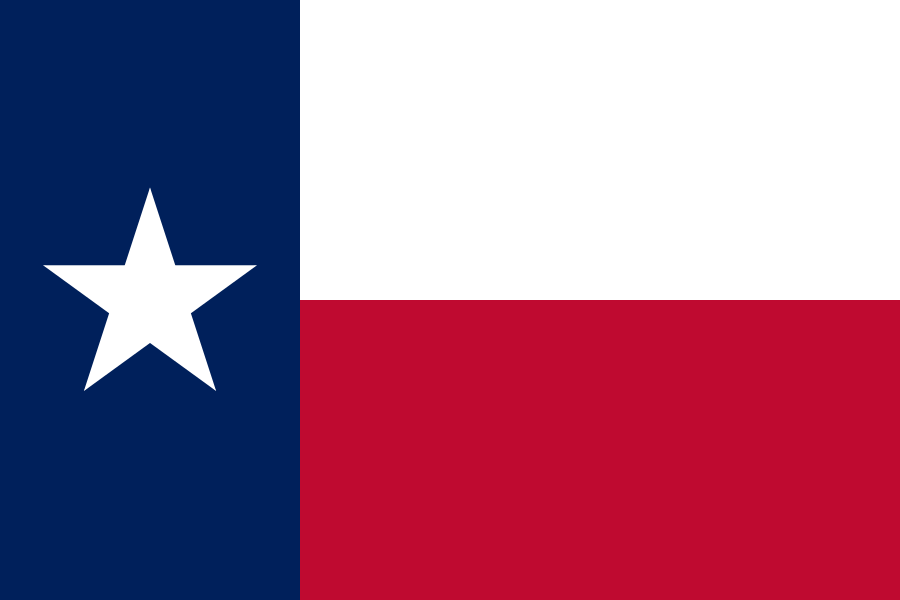
The Texas state flag, adopted 25 January 1839, is a blue hoist panel bearing a white star with white over red at the fly. Todorović notes that the derived design uses two shades of blue, and that its orange and blue are much lighter than on most rainbow flags, shades he took from the Dallas photograph. [1]
Usage & Adoption
- Geographic Usage
- United States
- Online Usage
- GayJourney.COM [1]
- Event Usage
- A rally in Dallas, Texas, 28 November 2008 [1]
- Current Status
- unknown
One documented case of physical use: a flag photographed at a rally in Dallas, Texas on 28 November 2008. Todorović also reported that the flag was then sold by four web shops, ADL Books, Just Pride, Always Proud and Over the Rainbow Shop, all at 3:5 and with somewhat different colour shades from the site original. [1] Whether it is manufactured or flown now has not been verified.
Image Archive
Variants
Source Flag and Visual Comparison

Footnotes & Citations
Sources and footnotes 7 sources
- 1. Databases Texas Flags of Sexual Orientation (U.S.). rick wyatt (editor); flag documentation by Tomislav Todorović. Flags of the World (2016-02-27). Accessed 2026-08-10
A signed contributor page rather than vetted reference text. Its dated sightings and design descriptions are cited here; contributor inference is attributed to the contributor and date.
- 2. Designer page National Gay Flags Of The World. Greg Gomes. Gay Journey / American Dimensions, McKinney, Texas. Accessed 2026-08-10 · Archived version
The designer's own page, read in full, carrying the marking convention and his reuse terms.
- 3. Databases Variations of the Gay Pride Rainbow Flag (1). randy young (editor); reports by Steve Kramer, Francisco Santos and Richard Knipel. Flags of the World (2023-09-30). Accessed 2026-08-10
Read in full. Cited for Kramer's description of the merging method this class of flag follows, and for the two dated outside notices of the Gomes collection, 14 May 2003 and 14 June 2004.
- 4. Encyclopedias & Reference Collin County. Handbook of Texas. Texas State Historical Association. Accessed 2026-08-11
- 5. Encyclopedias & Reference McKinney, TX. Handbook of Texas. Texas State Historical Association. Accessed 2026-08-11
- 6. Encyclopedias & Reference American Indian Relations. Handbook of Texas. Texas State Historical Association. Accessed 2026-08-11
- Image file page File:Flag of Texas.svg. Paul B. Joiner. Wikimedia Commons. Accessed 2026-08-11
The file-description page for the source-flag comparison image in this entry's gallery, read for its licence, authorship and restriction metadata.
Image Sources
- Rendering
- as rendered by Tomislav Todorović for Flags of the World, 2010
- The Texas rainbow flag as drawn by Tomislav Todorović for Flags of the World, 15 April 2010, from the photograph of the flag at the Dallas rally. · Credit: Rendering by Tomislav Todorović for Flags of the World; design by Greg Gomes · Flags of the World, Texas Flags of Sexual Orientation (U.S.)Rights Two rights positions apply to this image and they are not the same. The underlying design is Gomes's, published by Gay Journey under the reuse terms set out in Rights. The drawing is Todorović's, made for Flags of the World, which asserts copyright over its pages and their images; no reuse licence is stated for it and none has been sought. Published at the site owner's direction with the rendering's rights status recorded as undetermined. It is a rendering of the design, not a photograph of a flag in use. [1]
- The earlier Texas design: the state flag with its white star replaced by a pink triangle, the white and red fields left alone. It was presented at Chris Pinette's website as an LGBT flag gaining popularity at the time. Todorović drew it on 5 July 2015 and dated it from the Internet Archive's captures of that page, the earliest on 23 May 2000 and the latest on 21 September 2005. [1] · Credit: Tomislav Todorović / Flags of the World · Flags of the World
- Flag of Texas (Texas), the source flag for this design. The Texas state flag, adopted 25 January 1839, is a blue hoist panel bearing a white star with white over red at the fly. Todorović notes that the derived design uses two shades of blue, and that its orange and blue are much lighter than on most rainbow flags, shades he took from the Dallas photograph. [1] Relationship: source flag with fields replaced by rainbow stripes. Retained: the blue hoist panel and its white star. Altered: the white and red fields, replaced by six rainbow colours. · Credit: Paul B. Joiner · Wikimedia CommonsRights Public domain. Wikimedia Commons marks this file with an insignia restriction: it depicts a flag, coat of arms, seal or other official insignia whose use is restricted in many countries independently of copyright. Reproduced here as a comparison for the Gomes design, not as a representation of any government.