Rainbow Flag with White Triangle (Sapporo)
Rainbow Pride Flag · 2006–2019 documented intermittently
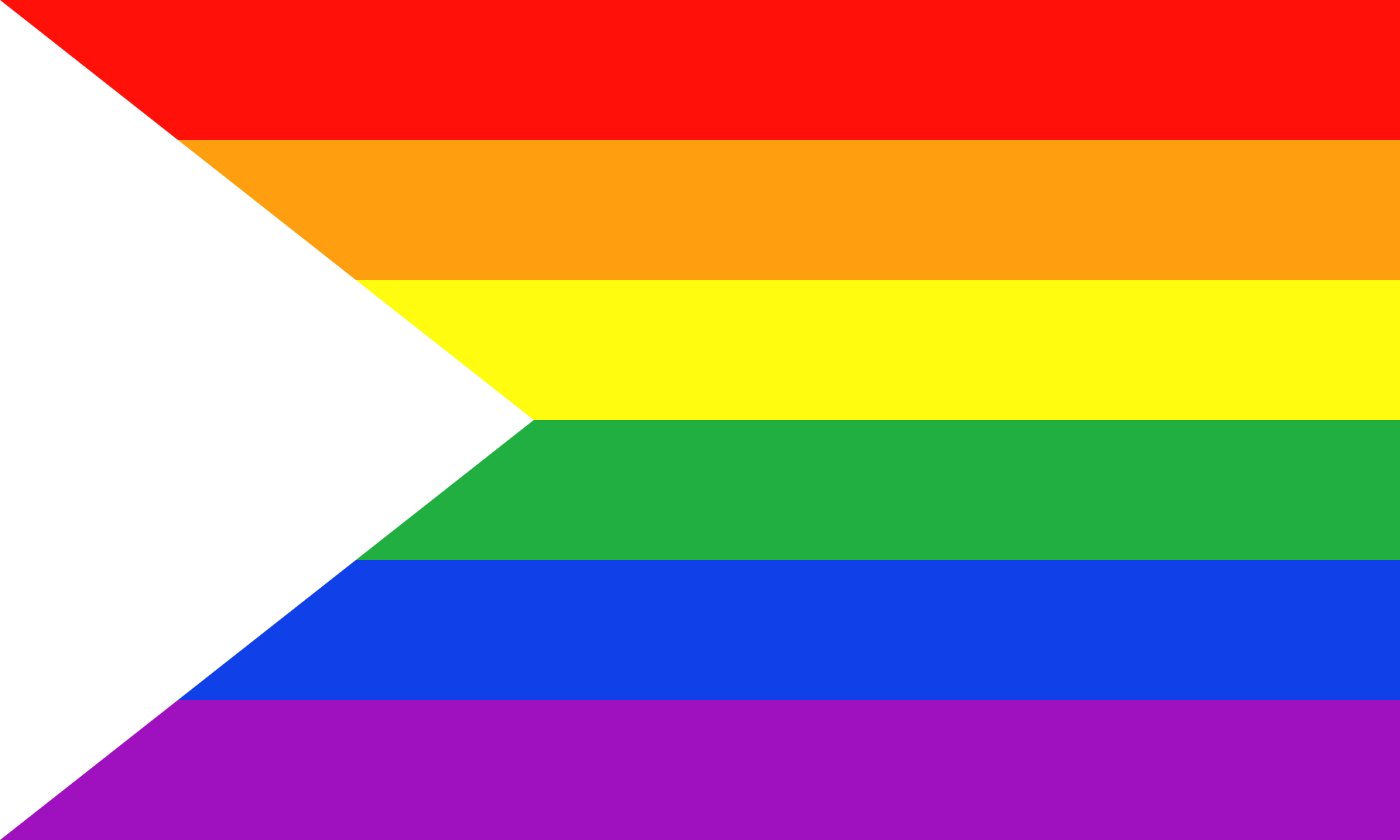
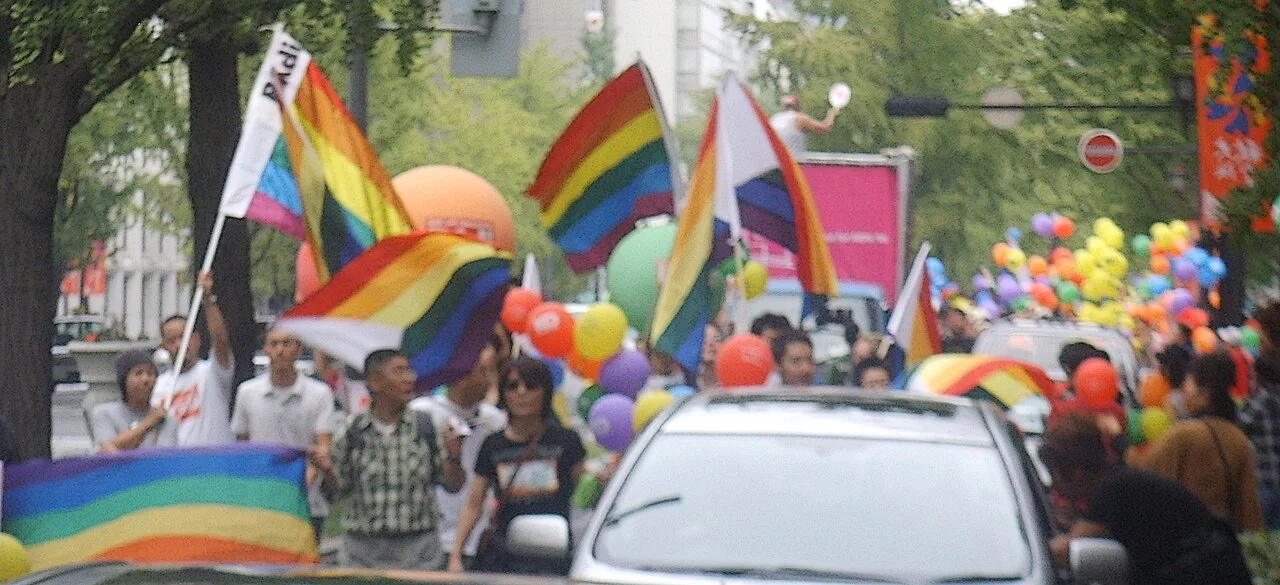
A six-stripe rainbow flag with a white triangle at the hoist, photographed by Sailko at Osaka's first Pride parade, the Kansai Rainbow Parade of 22 October 2006, and documented in Sapporo from 14 September 2008 through 2019. [1][2][3][4] Supporters carried it through Ayako Fuchigami's April 2019 campaign in Sapporo, which made her the first openly transgender person elected to a prefectural assembly in Japan. [4][5] Its maker, creation date, original palette, proportions and original symbolism are unestablished: the credit to Hironori Nishizawa, the 5:3 proportion and the white triangle's mourning meaning all reach the record through a Wikimedia Commons reconstruction of 2021. [6]
Key facts
- First documented public use
- Documented use
- 2006–2019 documented intermittently
- Aspect Ratio
- Unspecified
- Ratio Notes
- No maker's construction sheet or aspect-ratio specification has been located. The Flags of the World illustration of 27 August 2016 is 324 by 216 pixels, or 3:2; the Wikimedia Commons reconstruction is 1600 by 960, or 5:3. [3][6] The 5:3 image on this page follows the Commons reconstruction, so that proportion is a rendering format rather than a documented historical one.
- Stripes
- 6
- Represented Identity
- LGBTQ
Status Variant
Archive categories Rainbow Pride Flags · Regional and Language-Specific Pride Flags
Overview
The earliest located photographs of the design were taken at the Kansai Rainbow Parade in Osaka on 22 October 2006, described by the photographer and by Flags of the World as the city's first Pride parade. The clearest of the three, Sailko's panorama along Midosuji, shows several six-stripe rainbow flags carrying a white triangle at the hoist. [1][3] The same parade also carried a separate rainbow design with a white vertical panel at the hoist, the top of it covered by an added white patch bearing a black inscription; the two are different flags and should not be merged. [3]
The white-triangle design was photographed again at the Sapporo Rainbow March on 14 September 2008. [2][3] In 2019 the Asahi Shimbun described it as a distinctive Sapporo flag and traced it to an unnamed gay man, born in 1964, who had worked for the rights of sexual minorities in the city. The freely available portion of that article does not disclose his name, and no located evidence connects him to the later attribution to Hironori Nishizawa. [4][6]
Identity & Context
- Represented Identity
- LGBTQ
- National Context
- Japan; Osaka and Sapporo
Documented in use in Osaka and in Sapporo, Hokkaido. The Asahi Shimbun sets the design against the plain six-colour flag used at the Tokyo parade and elsewhere in Japan, treating it as Sapporo's own. [4]
Creators
Creator unknown
No identification located
A Wikimedia Commons file uploaded by Kautr on 22 April 2021 states that Hironori Nishizawa made several designs and that one of them was a white triangle at the hoist of the flag. The file supplies no primary citation for that attribution, and no source contemporary with the flag's documented use names him. [6]
The Asahi Shimbun's parade-eve feature of 14 September 2019 traces the Sapporo flag to a gay man born in 1964 who worked in the city for the rights of sexual minorities, and its headline presents the flag as left behind by a son who chose death. His name lies in the article's subscription-only portion, which is unread. [4] Nothing located joins the two accounts, so the historical designer remains unconfirmed and Nishizawa is carried here as a later attribution rather than a credit.
The documented contributions around the flag are separable. Sailko photographed the Osaka parade of 22 October 2006. [1] Alex Williams, whose Flickr account is MagicSword!, photographed the Sapporo Rainbow March of 14 September 2008. [2] Tomislav Todorović drew the Flags of the World illustration of 27 August 2016 and reported the flag's use there in 2016 and again in 2020. [3] Nobuhiro Shirai reported and photographed the 2019 Asahi feature, and the Asahi Shimbun distributed the 6 April 2019 campaign photograph through Getty Images. [4][5] Kautr drew the Commons reconstruction and supplied both the attribution and the reading of the white; VulpesVulpes42 rebuilt that file as a true vector on 12 August 2023 and edited its colours minutes later. [6]
Contribute information about who designed this flag.
Origin
- Origin Type
- Unknown
- Physical Origin Status
- Unknown. Osaka is the first documented place of use, Sapporo the later geographic association; neither is a documented place of creation.
Where the design was made is not documented. The earliest located photographs place it at the Kansai Rainbow Parade in Osaka on 22 October 2006, which documents use rather than design or manufacture. [1][3] The Asahi Shimbun, previewing the 2019 Sapporo parade, treats the design as the city's own, writing that the Sapporo flag has its own unique design and tracing it to a gay man who worked in Sapporo for the rights of sexual minorities. [4] Kautr's Commons description of April 2021 called the design only a pride flag variant; the words Sapporo, Japan were added to it on 2 February 2026. [6] Neither account establishes where the flag was made, and the two documented cities are two years and 1,000 kilometres apart.
Dates & Chronology
- First public use
- Documented use
- 2006–2019 documented intermittently
- Creation Bounds
- Undated as a design. The flag was already in use at Osaka on 22 October 2006, so the design existed before that date. [1][3] The maker reported by the Asahi Shimbun was born in 1964; the freely readable portion of that report does not date the design. [4] The Wikimedia Commons file carrying the designer credit was uploaded on 22 April 2021 and gives no date for the design itself. [6]
Documented use runs from 2006 to 2019 across two Japanese cities. Sailko photographed the flag at the Kansai Rainbow Parade in Osaka on 22 October 2006. [1][3] Alex Williams photographed it at the Sapporo Rainbow March on 14 September 2008. [2][3] Nobuhiro Shirai photographed it at the Sapporo Rainbow Pride parade in Chuo Ward on the afternoon of 7 October 2018. [4] In the April 2019 campaign for the Hokkaido Prefectural Assembly the flag accompanied Ayako Fuchigami: on 4 April supporters in Higashi Ward held it up as she made her appeal beneath it, saying, in translation, “I just want to live a normal life. We want to create a society where diverse people can have their opinions reflected”, and an Asahi photograph of 6 April, distributed by Getty Images, shows it flying behind her stump speech. She won the seat and became the first openly transgender person elected to a prefectural assembly in Japan. [4][5][3] On 26 August 2019 Shirai photographed the flag flying by the Sapporo TV Tower, and on 14 September the paper previewed the following day's parade, the nineteenth counted overall, writing that the rainbow flag raised there differs slightly from the common six-colour design. [4] No photograph has been located from the Sapporo march between 2009 and 2017; the located record is silent for those years rather than negative. [3]
The artwork that carries the design online has its own history, and it is not the flag's. Kautr uploaded a 400 by 240 pixel automatic vectorisation to Wikimedia Commons on 22 April 2021 and replaced it on 11 May with a 1600 by 960 version that was a raster image embedded in an SVG wrapper; Commons tagged that file as a false SVG in August 2022. On 12 August 2023 VulpesVulpes42 replaced it with a 484-byte true vector and, three minutes later, edited its colours. The description was amended twice more, in October 2025 and on 2 February 2026, the second edit adding the words Sapporo, Japan. [6]
Lineage
- Direct predecessors
- Rainbow Pride Flag
- Sibling flags
- Alberta Gay Flag, Straight Ally Pride Flag, Anarcha-Queer Flag (rainbow variant), Argentina Gay Flag, Australia Gay Flag, Brazil Gay Flag
+ 44 more
British Columbia Gay Flag, Canadian Pride Flag, Chicago Pride Flag (Rainbow Stripes, Purple Stars), Chile Gay Flag, Dominican Republic Gay Flag, Egypt Gay Flag, European Union Gay Flag, France Gay Flag, Gay Pride Flag of Pakistan, Heteroflexible Pride Flag, Heterosexual / Straight Pride Flag, Homoflexible Pride Flag, India Gay Flag, Italy Gay Flag, Japan Gay Flag, Jewish Gay Pride Flag, Manitoba Gay Flag, Mexico Gay Flag, Netherlands Gay Flag, New Brunswick Gay Flag, Newfoundland Gay Flag, Northwest Territories Gay Flag, Nova Scotia Gay Flag, Nunavut Gay Flag, Ontario Gay Flag, Palestinian Gay Pride Flag, Panama Gay Flag, Philadelphia Pride Flag, Prince Edward Island Gay Flag, Quebec Gay Flag, Rainbow Israel Flag, Rainbow Polish Flag (2014, Angela Getler), Russia Gay Flag, Saskatchewan Gay Flag, Social Justice Pride Flag, South African Gay Pride Flag, Switzerland Gay Flag, Tanzania Gay Flag, Texas Rainbow Flag, Turkish Gay Pride Flag, Two-Spirit Pride Flag (2005, Zoccole), Two-Spirit Pride Flag (2016 Tumblr documentation), Victory Over AIDS Flag (1980s, designer unknown), Yukon Territory Gay Flag - Lineage confidence
- unknown
The six-stripe rainbow flag carried in full, with a white isosceles triangle added at the hoist. The derivation is visual: no creator statement documenting it has been located. Flags of the World sets the design beside an existing family, the rainbow flags charged with a pink triangle at the hoist, writing “Only the triangle is white here”. That is a comparison within a design family rather than a documented line of descent, and the pink-triangle designs have no record of their own here yet. [3] The Commons description presents the design as one of several by Nishizawa; the others have not been located. [6]
Lineage tree
Every record reachable from this one through documented parent and child relationships: 4 records across 4 generations.
- Ancestors -3
- Original Rainbow Flag (1978)
- Ancestors -2
- Seven-Stripe Rainbow Flag (1978)
- Ancestor
- Rainbow Pride Flag
- This record
- Rainbow Flag with White Triangle (Sapporo)
Colors & Symbolism
No creator statement explaining the white triangle has been located. The Wikimedia Commons file description of April 2021 reads: “The white color has come to include the meaning of mourning for those who died in hate crimes and coexistence with friends who still struggle with various sufferings.” The single reference attached to that sentence is a Sapporo Rainbow Pride goods page, which carries no supporting text in the located capture of 14 April 2021; the file's other reference belongs to a different sentence and is an archived Flags of the World page. The reading is therefore unverified, and it was published fifteen years after the earliest photograph of the flag. [6][7]
| Colour | Hex |
|---|---|
| Red | #FF1008 |
| Orange | #FF9F10 |
| Yellow | #FFFC10 |
| Green | #20AF40 |
| Blue | #1040E7 |
| Violet | #9F10BF |
| White (triangle) | #FFFFFF |
Fill used in the 2021–2023 Commons reconstruction; not a documented designer specification. [6]
This flag has no official digital palette. Color values shown are approximate.
No palette has been published for the design. The values above are the fills in the current Wikimedia Commons file, set by VulpesVulpes42 on 12 August 2023; Kautr's own 2021 vectorisation of the same design used different ones, among them #FC140C for the red and #24AC44 for the green. The 2016 Flags of the World illustration uses a third set: #FF0000, #FF9900, #FFFF00, #009900, #0000FF and #660099. None of the three is a designer specification. [6][3] The photographs cannot settle the question, being affected by lighting, distance, fabric curvature and JPEG processing; Flags of the World records only that the bottom stripe is purple, the shades being otherwise hard to judge. [3]
Design
- Aspect Ratio
- Unspecified
- Ratio Notes
- No maker's construction sheet or aspect-ratio specification has been located. The Flags of the World illustration of 27 August 2016 is 324 by 216 pixels, or 3:2; the Wikimedia Commons reconstruction is 1600 by 960, or 5:3. [3][6] The 5:3 image on this page follows the Commons reconstruction, so that proportion is a rendering format rather than a documented historical one.
- Orientation
- horizontal
- Stripe Count
- 6
- Layout
- horizontal stripes with hoist triangle
- Stripes (Top → Bottom)
- red, orange, yellow, green, blue, violet
- Additional Symbols
- White isosceles triangle at the hoist
Six approximately equal horizontal stripes, red at the top through violet at the bottom, with a white isosceles triangle whose base is the whole hoist edge and whose apex points toward the fly. That much is secure from the photographs. [1][3] The two renderings place the apex differently: the Flags of the World illustration sets it at 108 pixels of 324, exactly one third of the length, while the Commons file runs its triangle to x=610 of 1600, or 38.1 per cent. Both divide the field into exact sixths. Neither figure is a documented specification. [3][6]
No maker's construction sheet or designer specification has been located. Flags of the World notes of the photographed flags that “it is not easy to determine the color shades precisely”, establishing only that the bottom stripe is purple. [3]
The six-stripe rainbow flag with a white isosceles triangle at the hoist, its base on the hoist edge and its point toward the fly.
Usage & Adoption
- Geographic Usage
- Osaka, Japan, Sapporo, Hokkaido, Japan
- Event Usage
- Kansai Rainbow Parade, Osaka, 22 October 2006, photographed by Sailko [1][3], Sapporo Rainbow March, 14 September 2008, photographed by Alex Williams [2][3], Sapporo Rainbow Pride parade, 7 October 2018, photographed by Nobuhiro Shirai [4][3], Hokkaido Prefectural Assembly election campaign, April 2019: 4 April in Higashi Ward and 6 April with Ayako Fuchigami [4][5][3], Sapporo TV Tower, 26 August 2019, photographed by Nobuhiro Shirai [4], Sapporo Rainbow Pride parade, 15 September 2019, the nineteenth counted overall, previewed on its eve with this flag as the one raised there [4]
- Current Status
- Regional rainbow variant; documented intermittently through 2019.
Documented intermittently between 2006 and 2019, at Pride parades in Osaka and Sapporo, in Sapporo streets and in an election campaign. No photograph has been located from the Sapporo march between 2009 and 2017, and no located source records the flag's retirement or its adoption by any organization. [3][4]
Image Archive
Photographs of the flag in use


Discourse & Debates
Common misidentifications
- Distinct from the rainbow flag with a white stripe at the hoist, a separate design photographed at the same Osaka parade in October 2006 and reported from 1996 as denoting that “all are included”. In the 2006 photograph the top of its white stripe carries an added white patch bearing a black inscription, which Flags of the World reads as a later addition rather than part of the original flag. [3][1]
- The title is archival and descriptive rather than a name supplied by the maker. Kautr's Commons description of April 2021 called the design only a pride flag variant, and the words Sapporo, Japan were added to it on 2 February 2026. [6] The Asahi Shimbun's report of 2019 is the earlier source for the Sapporo association, while the earliest located photographs are from Osaka. [4][1]
Footnotes & Citations
Sources and footnotes 7 sources
- 1. Image file page File:First gay pride in osaka, oct 2006, 03.JPG. Sailko. Wikimedia Commons (2006-10-22). Accessed 2026-08-14
The earliest located photograph of the flag: 1818 by 831 pixels, capture metadata 22 October 2006, described by the photographer as “First gay pride in osaka” and, in Japanese, as 関西レインボーパレード2006, the Kansai Rainbow Parade 2006. Two companion frames exist: number 02, taken four minutes earlier, and number 01, whose capture metadata reads 23 October 2006 from a different camera. Released under CC BY-SA 3.0 or the GFDL at the reuser's choice.
- 2. Image file page Sapporo Rainbow March 2008. Alex Williams. Flickr (2008-09-14). Accessed 2026-08-14
The photograph Flags of the World cites for the 2008 Sapporo use, taken 14 September 2008 by the Flickr account MagicSword!, whose stated name is Alex Williams, and belonging to a seventeen-item album of that march. All rights reserved, so it is cited here rather than reproduced.
- 3. Reference Even More Variations of the Gay Pride Rainbow Flag (3). Tomislav Todorović; ed. Randy Young. Flags of the World (2020-05-21). Accessed 2026-08-14
The record of the design in use. Of the earliest appearance it says the flags with this design “were photographed in October 2006 at the first Gay Pride in Osaka, Japan”, and it names a photograph for each later occasion: the Sapporo Rainbow March of 2008, the Asahi Shimbun's 2018 and 2019 photographs, and Ayako Fuchigami's campaign. Reported by Tomislav Todorović on 27 August 2016 and 21 May 2020; page last modified 13 January 2024. Its illustration is 324 by 216 pixels.
- 4. News 死を選んだ息子、残したレインボー旗 札幌の空に舞う日 (The Rainbow Flag Left Behind by a Son Who Chose Death: The Day It Dances in the Sapporo Sky). Nobuhiro Shirai. The Asahi Shimbun (Asahi Shimbun Digital) (2019-09-14). Accessed 2026-08-14 · Archived version
A parade-eve feature tracing the flag to its maker, a gay man born in 1964 who worked in Sapporo for the rights of sexual minorities; the headline presents the flag as left behind by a son who chose death. Its photographs, both by Shirai, date the 2018 parade to 7 October and show the flag by the Sapporo TV Tower on 26 August 2019. In Japanese, behind a subscription wall: the freely readable opening, 646 of 4,002 characters, was read in translation, and the maker's name lies in the unread portion. This is the article Flags of the World cites for the 2018 and 2019 uses.
- 5. Image file page Ayako Fuchigami delivers a stump speech against a backdrop of a rainbow flag (editorial photograph 1142115642). The Asahi Shimbun. Getty Images, The Asahi Shimbun collection (2019-04-06). Accessed 2026-08-14
The campaign photograph Flags of the World cites: taken 6 April 2019 in Sapporo, credited "The Asahi Shimbun via Getty Images", showing the white-triangle flag flying behind Fuchigami as she speaks. The caption records that she "became Japan's first openly transgender person elected to a prefectural assembly".
- 6. Image file page File:Rainbow Flag with white triangle.svg. Kautr; later versions by VulpesVulpes42. Wikimedia Commons (2021-04-22). Accessed 2026-08-14
The reconstruction that carries the designer credit and the reading of the white, uploaded fifteen years after the design's earliest documented appearance. Its description cites two references: an archived Flags of the World page, attached to the opening sentence, and a Sapporo Rainbow Pride goods page, attached to the sentence about the white. Four file versions between 2021 and 2023 and two later description edits are listed in the file history.
- 7. Organizations GOODS / グッズ. Sapporo Rainbow Pride. Accessed 2026-08-14 · Archived version
The page the Wikimedia Commons description cites for the meaning it gives the white. Cited here for what the located capture of 14 April 2021 does not contain: no text supporting that reading appears on it.
Image Sources
- Rendering
- Archive rendering based on the 2021–2023 Wikimedia Commons reconstruction
- Archive rendering based on the Wikimedia Commons file, drawn by Kautr on 22 April 2021 and rebuilt as a true vector by VulpesVulpes42 on 12 August 2023. The licence covers that file; the historical design's own rights status is unestablished. [6] · Credit: Kautr; vector rebuild and colour edit by VulpesVulpes42 · Wikimedia Commons · CC BY-SA 4.0 (Commons file only)
- The earliest located photograph of the design, on Midosuji, Osaka. Commons 1280-pixel rendition of Sailko's 1818 by 831 original. [1] · Credit: Sailko · Wikimedia Commons · CC BY-SA 3.0 or GFDL, at the reuser’s choice