Trans Ally Flag
Ally flags · Documented from 21 June 2014
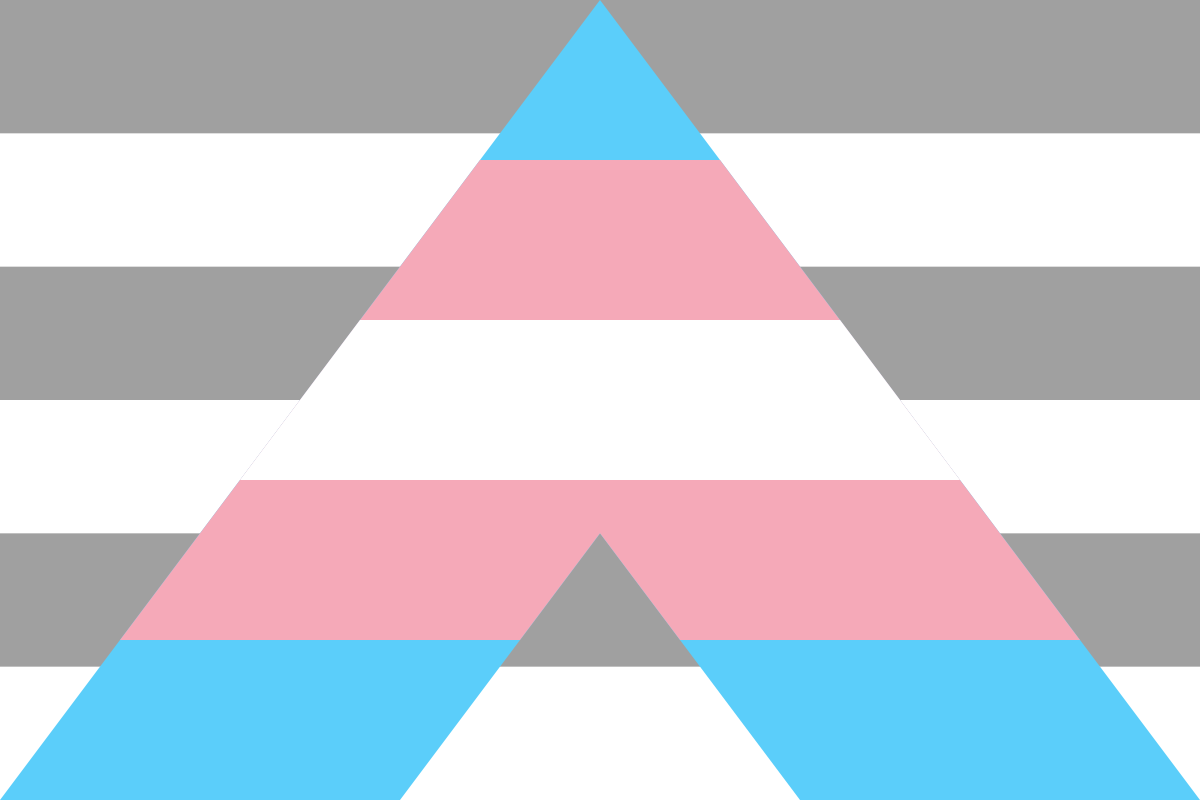
The earliest located Trans Ally Flag was uploaded to Wikimedia Commons by Saraputnam on 21 June 2014 under the name "Trans* Ally Flag". It places a five-band trans-coloured A over six alternating grey and white bands, although later reconstructions changed its proportions, palette and field pattern. A black-and-near-white five-band rendering was uploaded to the LGBTQIA+ Wiki in April 2022 and used by Suit Up Maine in a guide produced with MaineTransNet, which documents circulation by two Maine advocacy organizations rather than formal adoption, authorship or geographic origin. [1][2][3]

Key facts
- Designer
- Attributed to Saraputnam
- Earliest located publication
- Documented
- Documented from 21 June 2014
- Aspect Ratio
- 3:2 · reconstruction
- Ratio Notes
- The three artifacts differ. Saraputnam’s 2014 raster is 128 by 90 pixels, a ratio of 64:45. Nikki’s 2021 vector is a nominal 1200 by 800, exactly 3:2, which regularizes the original. The later rendering is 1024 by 683, close to but not exactly 3:2. The ratio shown is the 2021 reconstruction’s, since that file is the entry’s display artwork. [1][4][2]
- Stripes
- 6
Also known as
- Trans* Ally Flag
- Transgender Ally Flag
Archive categories Gender Identity Pride Flags · Ally and Solidarity Pride Flags
Overview
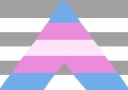
The earliest located artifact is a 128 by 90 pixel JPEG uploaded to Wikimedia Commons on 21 June 2014, described as "Trans* Ally Flag" and identified as own work. Nothing about the design’s making accompanies it. [1]
Identity & Context
An ally flag is flown by people outside the community it supports. This entry documents the flag, not a claim about the identities of the people who fly it. "Trans*" is preserved as the historical wording of the 2014 upload, not as current preferred terminology. [1]
Creators
Associated Figures
Saraputnam
Attributed maker and uploader of the earliest located artifact
Saraputnam is the Wikimedia Commons account that uploaded the earliest located Trans Ally Flag on 21 June 2014, a 128 by 90 pixel JPEG described as "Trans* Ally Flag", identified as own work and released under CC BY-SA 3.0. On 25 June 2014 the account added the wording "Transgender Ally Flag" to the file page. The own-work declaration supports attribution for that artifact; overall design authorship remains unconfirmed, and no statement about the design has been located from the account. [1]
Nikki
Vector reconstructor (2021)
Nikki is the Wikimedia Commons contributor who uploaded a reconstructed vector of the flag on 22 March 2021 under CC0, at a nominal 1200 by 800 pixels. The vector keeps the grey and white field but regularizes the ratio and geometry and substitutes the familiar modern transgender-flag palette, so it is a normalized reconstruction rather than a pixel-faithful conversion of the 2014 image. The filename carries the typo "Trangender ally flag.svg". Nikki is not the original designer. [4]
Bigender
Uploader of the later black-and-near-white rendering (2022)
Bigender is the LGBTQIA+ Wiki account that uploaded a distinct 1024 by 683 pixel black-and-near-white rendering of the flag on 17 April 2022. The file page supplies no creator, no source and no file-specific licence, and the designer of that rendering is not documented. Bigender is not identified as the original designer. [2]
Attribution notes
Saraputnam is the earliest attributed maker and uploader: the 2014 Commons record identifies the source as "own work" and names Saraputnam as author, which supports attribution for the earliest located artifact. Overall design authorship is unconfirmed, and no creator statement, design explanation or account of the flag’s origin has been located. Nikki drew the 2021 vector reconstruction and Bigender uploaded the later black-and-near-white rendering to the LGBTQIA+ Wiki; neither is the original designer, and the designer of that later rendering is not documented. Nothing identifies the LGBTQIA+ Wiki, Suit Up Maine or MaineTransNet as the designer. [1][4][2]
Origin
- Origin Type
- online publication
- Physical Origin Status
- Origin place unknown.
No place of design is documented. The flag’s documented life is digital: Wikimedia Commons from June 2014, a 2021 vector reconstruction, and later circulation through the LGBTQIA+ Wiki and Wikipedia userboxes. Suit Up Maine and MaineTransNet are Maine organizations, which documents later organizational use rather than creation or geographic origin, and no map location is recorded. [1][4][3]
Dates & Chronology
- Earliest located publication
- Documented
- Documented from 21 June 2014
- Creation Bounds
- The design’s creation date is not documented. The earliest located publication is Saraputnam’s Wikimedia Commons upload of 21 June 2014, which establishes publication by that date and not creation or first use. Four days later, on 25 June 2014, Saraputnam added the wording "Transgender Ally Flag" to the file page. Nikki uploaded a reconstructed vector on 22 March 2021, and a distinct black-and-near-white rendering was uploaded to the LGBTQIA+ Wiki by Bigender on 17 April 2022. Suit Up Maine’s Trans Ally Guide carries page metadata dated 1 June 2022 and displays that rendering; the image URL contains a /2021/05/ upload path, which is a content-management path rather than evidence of public availability in May 2021. [1][4][2][3]
Suit Up Maine displays the later rendering in a Trans Ally Guide that the organization states it created in collaboration with MaineTransNet; the guide’s page metadata is dated 1 June 2022. The LGBTQIA+ Wiki describes the flag as adopted and used by both organizations, but the page it cites documents collaborative publication and display rather than a formal adoption. From 2021 the CC0 vector also circulates as Wikipedia userbox art. [3][5][4]
Major revisions
Saraputnam added the wording "Transgender Ally Flag" to the Commons file page, four days after the upload. [1]
Nikki uploaded a reconstructed vector under CC0, keeping the grey and white field while regularizing the ratio and geometry and substituting the modern transgender-flag palette. [4]
Bigender uploaded a distinct 1024 by 683 black-and-near-white rendering to the LGBTQIA+ Wiki, with no creator, source or file-specific licence stated. [2]
Three materially different artifacts circulate under this name: Saraputnam’s 2014 raster, Nikki’s 2021 vector reconstruction, and a later black-and-near-white rendering. They differ in ratio, field pattern, palette and stripe count, and the later files are not reproductions of the 2014 image. [1][4][2]
Lineage
- Direct predecessors
- Straight Ally Pride Flag, Transgender Pride Flag
- Sibling flags
- Anarcha-Queer Flag (transgender variant), Asexual Ally Flag, Bisexual Ally Flag, Chicago Trans Pride Flag, Cisgender Ally Flag, "Fuck Around and Find Out" Trans Pride Flag
+ 11 more
Lesbian Lesboy Ally Flag, Gay Mspec Gay Ally Flag, Lesbian Mspec Lesbian Ally Flag, Nonbinary Trans Flag (2026, cirrus42), Progress Pride Flag, Sego Visibility Flag, Straight Ally Flag (vaultausir), Transgender Pride Flag with Transgender Symbol, Transneutral Pride Flag, Gay Turigirl Ally Flag, Two-Spirit Transgender Pride Flag
A visual hybrid of two designs: the Straight Ally Flag supplies the striped field and the large A construction, and the Transgender Pride Flag supplies the five-band blue, pink, white, pink, blue sequence carried inside the A. The derivation is structural, read from the artifact itself, because the 2014 uploader identified no sources in writing. [1][5]
The listed sibling flags are derived automatically from shared parents rather than from any documented design relationship, and later A-based ally designs are comparisons rather than members of a documented family with this flag. [5]
Lineage tree
Every record reachable from this one through documented parent and child relationships: 7 records across 6 generations.
- Ancestors -5
- Original Rainbow Flag (1978)
- Ancestors -4
- Seven-Stripe Rainbow Flag (1978)
- Ancestors -3
- Rainbow Pride Flag
- Ancestors -2
- Heterosexual / Straight Pride Flag
- This record
- Trans Ally Flag
Colors & Symbolism
| Colour | Hex | Note |
|---|---|---|
| Grey (field, 2014 raster and 2021 vector) | #A0A0A0 | The exact fill in the 2021 SVG source, and the dominant measured fill of the 2014 raster. [4][1] |
| White (field) | #FFFFFF | The alternating field band in the 2014 raster and the 2021 vector. [4][1] |
| Light blue (A, 2021 vector) | #5BCEFA | Exact fill in the 2021 SVG source; the standard transgender-flag value. [4] |
| Pink (A, 2021 vector) | #F5A9B8 | Exact fill in the 2021 SVG source; the standard transgender-flag value. [4] |
| Blue (A, 2014 raster) | #71ADEB | Dominant pixel measurement from the compressed 2014 JPEG. [1] |
| Lavender-pink (A, 2014 raster) | #EC8BDC | Dominant pixel measurement from the compressed 2014 JPEG. [1] |
| Pale centre (A, 2014 raster) | #FFE4F7 | Dominant pixel measurement from the compressed 2014 JPEG. [1] |
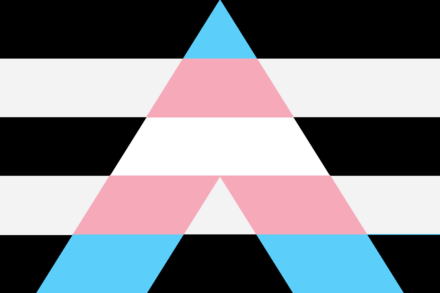
| Black (field, later rendering) | #000000 | Principal measured fill of the later black-and-near-white rendering. [2] |
| Near-white (field, later rendering) | #F3F3F4 | Principal measured fill of the later black-and-near-white rendering. [2] |
No creator-authored statement of symbolism has been located. The design visibly combines the A-shaped construction associated with ally flags with the colours associated with the Transgender Pride Flag; that relationship is legible in the artifact, but the 2014 uploader supplied no explanation. The LGBTQIA+ Wiki describes the construction without assigning the elements meanings. [1][5]
No designer-issued palette has been located, and the three artifacts do not share one. The 2021 vector’s values are exact fills read from its SVG source and are the standard transgender-flag hexes. The 2014 values are dominant pixel measurements from a compressed JPEG that decodes to more than two thousand colours; they differ too substantially from the later standardized palette to be explained by JPEG artifacting alone, so the 2021 vector’s colours are a substitution rather than a recovery. The later rendering’s field measures #000000 and #F3F3F4 with its A in #5BCFFA, #F6AAB9 and #FFFFFF. [4][1][2]
Design
- Aspect Ratio
- 3:2 · reconstruction
- Ratio Notes
- The three artifacts differ. Saraputnam’s 2014 raster is 128 by 90 pixels, a ratio of 64:45. Nikki’s 2021 vector is a nominal 1200 by 800, exactly 3:2, which regularizes the original. The later rendering is 1024 by 683, close to but not exactly 3:2. The ratio shown is the 2021 reconstruction’s, since that file is the entry’s display artwork. [1][4][2]
- Orientation
- horizontal
- Stripe Count
- 6
- Layout
- striped field with letter-A chevron
- Stripes (Top → Bottom)
- grey, white, grey, white, grey, white
- Center Symbol
- A large letter A rising from the lower corners to an apex at the top centre, carrying five horizontal bands in the transgender flag’s sequence
The three documented artifacts are materially different.
Saraputnam’s 2014 raster, 128 by 90 pixels at 64:45, carries six equal horizontal bands alternating grey and white, charged with a large A-shaped open chevron containing five horizontal colour bands. Measured from the file. [1]
Nikki’s 2021 vector is a nominal 1200 by 800 at 3:2. Its field is six equal bands, each one sixth of the hoist, and the five colour bands inside the A are each one fifth of the hoist, read from the SVG source, whose viewBox is 90 by 60 with field bands of 10 units and A bands of 12. It keeps the grey and white field but regularizes the ratio and geometry and substitutes the modern transgender-flag palette, so it is a reconstruction rather than a pixel-faithful conversion. [4]
The later rendering is 1024 by 683 and has a five-band field alternating black and near-white, with five trans-coloured bands in the A. [2]
The construction follows the Straight Ally Flag: a striped field charged with a large central A, with the A’s colours replaced by the transgender flag’s bands. No designer construction sheet or specification has been located. [5]
Usage & Adoption
- Online Usage
- Wikipedia userboxes, carrying the 2021 CC0 vector
- Current Status
- Documented organizational display
Documented organizational use: Suit Up Maine, in a Trans Ally Guide produced with MaineTransNet. No formal adoption record has been located. [3][5]
Image Archive
The three documented versions


Footnotes & Citations
Sources and footnotes 5 sources
- 1. Image file page File:Trans* Ally Flag 2014-06-21 01-01.jpg. Saraputnam. Wikimedia Commons (2014-06-21). Accessed 2026-08-21
The earliest located artifact and its Commons record: a 128 by 90 pixel JPEG uploaded 21 June 2014, described "Trans* Ally Flag", identified as own work with author Saraputnam, licensed CC BY-SA 3.0. The wording "Transgender Ally Flag" was added to the file page on 25 June 2014. The file was downloaded and measured for this entry.
- 2. Image file page File:Trans ally.png. Uploaded by Bigender. LGBTQIA+ Wiki (2022-04-17). Accessed 2026-08-14
The later black-and-near-white rendering, 1024 by 683 pixels, uploaded 17 April 2022 with no creator, source or file-specific licence stated. The same PNG appears in Suit Up Maine’s guide; which copy came from which is not documented.
- 3. Organizations Trans Ally Guide. SuitUpMaine. SuitUpMaine (2022-06-01) · Archived version
The organization’s ally guide, whose page metadata is dated 1 June 2022. It states the guide was created with MaineTransNet and displays the later 1024 by 683 rendering without a visible image credit or licence. The live site was in maintenance when checked; the archived capture is linked.
- 4. Image file page File:Trangender ally flag.svg. Nikki. Wikimedia Commons (2021-03-22). Accessed 2026-08-21
The 2021 vector reconstruction: uploaded 22 March 2021 by Nikki at a nominal 1200 by 800, released CC0, its filename typo original. Its SVG source carries the exact fills and the field and A band fractions cited here, and its global-usage record lists the userbox pages.
- 5. Community Allies. LGBTQIA+ Wiki contributors. LGBTQIA+ Wiki (2025-09-06). Accessed 2026-08-03
The page documenting the ally-flag family. It describes this flag’s construction, states the designer is unknown, and reports that MaineTransNet and Suit Up Maine adopted and used the flag; the page it cites for that does not document a formal adoption. It can support what the wiki reports, but not design authorship, formal adoption, or a 2014 creator statement.
Image Sources
- The display artwork is Nikki’s 2021 vector reconstruction, which regularizes the 2014 raster’s ratio and geometry and substitutes the modern transgender-flag palette. The earliest located artifact, Saraputnam’s 2014 raster, is preserved in the gallery. [4][1] · Credit: Nikki · Wikimedia Commons · CC0 vector, 2021Rights CC0 (Creative Commons Zero, public domain dedication) for the 2021 vector file. Rights in the underlying design are not independently established.
- The earliest located artifact: Saraputnam’s 128 by 90 pixel raster, uploaded to Wikimedia Commons on 21 June 2014 as "Trans* Ally Flag" and identified as own work. Six grey and white field bands, and an A whose colours differ substantially from the later standardized transgender palette. [1] · Credit: Saraputnam · Wikimedia Commons
- Nikki’s 2021 reconstruction, uploaded to Wikimedia Commons on 22 March 2021 under CC0. It keeps the grey and white field but regularizes the original’s ratio and geometry to 3:2 and substitutes the modern transgender-flag palette, so it is a normalized vector rather than a conversion of the 2014 image. [4] · Credit: Nikki · Wikimedia Commons
- The later black-and-near-white rendering, uploaded to the LGBTQIA+ Wiki by Bigender on 17 April 2022 and displayed in Suit Up Maine’s Trans Ally Guide. Five field bands rather than six, and a black field rather than grey. The copy shown is a 440 pixel thumbnail; the file page supplies no creator, source or file-specific licence, so its reuse basis is undocumented and it is not used as this entry’s display artwork. [2][3] · Credit: Uploaded by Bigender; designer not documented · LGBTQIA+ Wiki