Heteroflexible Pride Flag
Identity Pride Flag ·
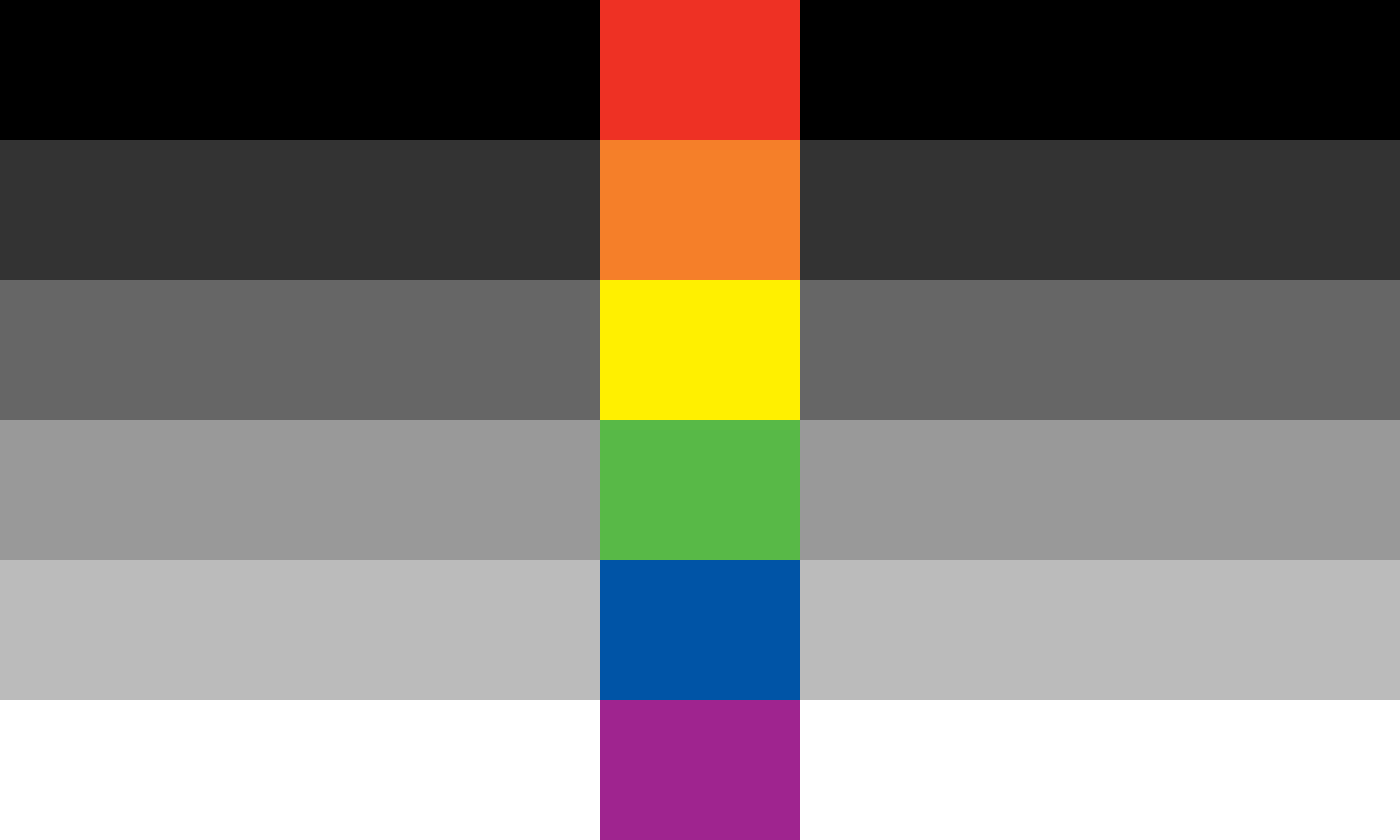
Published with its homoflexible counterpart by an anonymous submitter to the Tumblr blog Pride Flags For Us on 13 February 2015, the heteroflexible flag places a vertical six-colour rainbow band over six horizontal greyscale bands. The creator described heteroflexibility as predominantly different-gender attraction with possible same-gender attraction. [1] The widely reproduced vector is Nikki’s 2021 CC0 redraw, not the original file. [2]

Key facts
- Designer
- Anonymous submitter to Pride Flags For Us
- Created
- First documented publication
- Documented circulation
- 2015 to present
- Aspect Ratio
- Variable
- Stripes
- 6
- Represented Identity
- heteroflexible people
Also known as
- Heteroflexible flag
- Hetero-flexible flag
Archive categories Sexual & Romantic Orientation Pride Flags
Overview
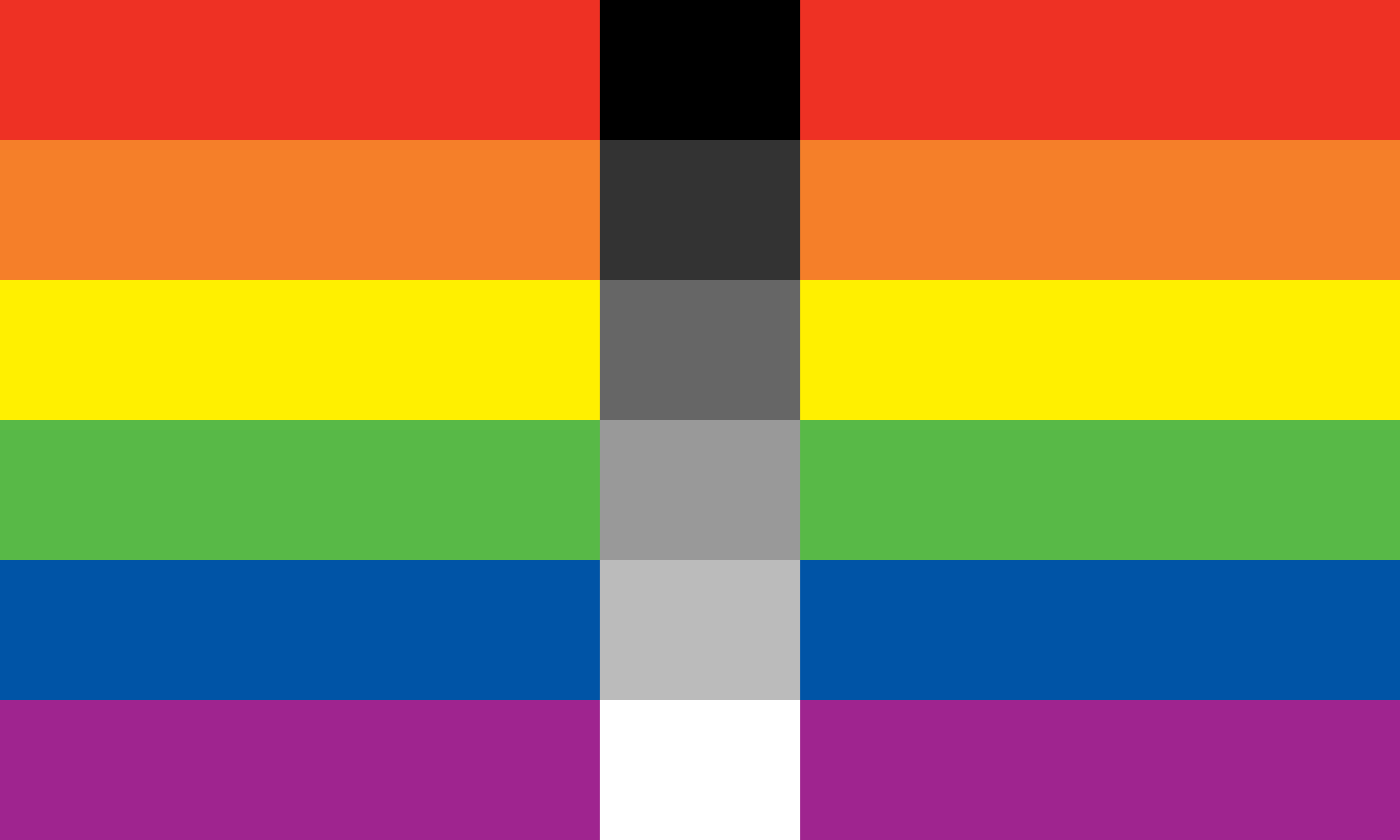

Both flags were made by the same person and published in one submission to Pride Flags For Us on 13 February 2015, at 8:57 in the evening. The post is tagged as a submission and carries the creator’s account of the construction: the homoflexible flag is the six-stripe rainbow flag with the central stripe taken from a six-band greyscale flag for heterosexuality, and the heteroflexible flag is the reciprocal, the identity described as the opposite. [1]
Identity & Context
- Represented Identity
- heteroflexible people
Heteroflexible generally describes someone whose attraction is predominantly toward a different gender but can sometimes include people of the same or a similar gender. Homoflexible describes the reciprocal pattern: predominantly same-gender or similar-gender attraction with occasional attraction to another gender. Usage varies. Some people also identify under the bisexual or multisexual umbrella, while others use these labels independently. [4]
The terms homoflexible and heteroflexible predate these flags. Merriam-Webster treats both as compounds built from the shortened forms homo and hetero plus flexible, rather than from the corresponding classical prefixes: homoflexible “is not a prefix plus a base word but is a compound of the word homo (‘homosexual’) and the word flexible”, and heteroflexible “is derived from the shortening, not the prefix”. Its discussion reproduces a use of homoflexible in The New York Times on 11 May 2002, in Tamar Lewin’s report of a student “who described himself as ‘homoflexible’”, and a use of heteroflexible in The Buffalo News on 20 December 2002, “HOT TERM BEING BANDIED ABOUT ON CAMPUS: Heteroflexible, the condition of being not fully bisexual but open to adventure”. These citations document use of the terms by those dates; they do not necessarily establish their coinage, and Merriam-Webster files both under Words We’re Watching rather than as dictionary entries. [5] Elasexual and anisosexual are separate terms with their own flags. They are sometimes offered as near equivalents, and this entry does not treat them as alternate names for this design.
Creators
The Creators
Anonymous submitter to Pride Flags For Us
Designer
Pride Flags For Us
Original publisher and host
Pride-Flags
Later republisher
Koromilo
Wikimedia uploader, 2019
Nikki
Vectorizer and rendering author, 2021
Attribution
- Organization
- Pride Flags For Us
Attribution notes
The designer is anonymous but documented. The original post is tagged as a submission and opens in the first person, “I made homoflexible and heteroflexible flags”, and it explains how the two designs are constructed. No name appears anywhere on the archived page. [1] Pride Flags For Us published and hosted the submission; the DeviantArt account Pride-Flags, the Commons uploader Koromilo and the Commons contributor Nikki each handled the files later and none of them designed the flags. [6][7][2][8]
Origin
Digital. The designs were first published on Tumblr, by Pride Flags For Us. [1] Where the creator was is not documented, and the host blog, the later uploaders and the merchants who sell copies do not establish it.
Dates & Chronology
- Year Created
- First documented publication
- Documented circulation
- 2015 to present
- Creation Bounds
- Both designs existed by 13 February 2015, when they were published together in a single anonymous submission to Pride Flags For Us, timestamped 8:57pm with no timezone shown on the archived page. [1] The post does not record when the drawing work was done, so the interval between design and publication is undocumented. The July 2015 DeviantArt posts, which both entries previously gave as the first documented appearance, are reposts by a collecting account five months later. [6]
Circulation runs through reference works and reposts rather than documented physical use. The pair was reposted to DeviantArt in July 2015, a raster copy of this design reached Wikimedia Commons in 2019, and Nikki’s 2021 vectors are the copies that reference works now display. [6][8][2] No photograph of either flag in physical use has been located.
13 February 2015: both designs are published together in an anonymous submission to Pride Flags For Us, timestamped 8:57pm. [1] 15 March 2015: the blog shows this design again in an answer signed ~James, timestamped 11:06pm, in reply to a reader asking whether a heteroflexible flag existed: “Nothing official, but yes!” The image in that post is a separate Tumblr file that is pixel-identical in visible content to the February raster, so it documents recirculation on the original host rather than a second artifact. [9] 3 July 2015, Pacific time: the Pride-Flags account reposts the pair separately to DeviantArt, homoflexible at 23:40:28 and heteroflexible at 23:40:40. These are circulation records, not first appearances. [6][7] 26 November 2019: Koromilo uploads a 512 by 307 raster copy of this design to Wikimedia Commons. [8] 22 March 2021: Nikki publishes separate CC0 vector redraws of both designs. [2][3] July 2024: Crimson designs and posts a separate redesign pair for both identities.
Lineage
- Direct predecessors
- Rainbow Pride Flag
- Companion flags
- Homoflexible Pride Flag
- Related flags
- Heteroflexible Pride Flag (Crimson, 2024)
- Sibling flags
- Alberta Gay Flag, Straight Ally Pride Flag, Anarcha-Queer Flag (rainbow variant), Argentina Gay Flag, Australia Gay Flag, Brazil Gay Flag
+ 44 more
British Columbia Gay Flag, Canadian Pride Flag, Chicago Pride Flag (Rainbow Stripes, Purple Stars), Chile Gay Flag, Dominican Republic Gay Flag, Egypt Gay Flag, European Union Gay Flag, France Gay Flag, Gay Pride Flag of Pakistan, Heterosexual / Straight Pride Flag, Homoflexible Pride Flag, India Gay Flag, Italy Gay Flag, Japan Gay Flag, Jewish Gay Pride Flag, Manitoba Gay Flag, Mexico Gay Flag, Netherlands Gay Flag, New Brunswick Gay Flag, Newfoundland Gay Flag, Northwest Territories Gay Flag, Nova Scotia Gay Flag, Nunavut Gay Flag, Ontario Gay Flag, Palestinian Gay Pride Flag, Panama Gay Flag, Philadelphia Pride Flag, Prince Edward Island Gay Flag, Quebec Gay Flag, Rainbow Flag with White Triangle (Sapporo), Rainbow Israel Flag, Rainbow Polish Flag (2014, Angela Getler), Russia Gay Flag, Saskatchewan Gay Flag, Social Justice Pride Flag, South African Gay Pride Flag, Switzerland Gay Flag, Tanzania Gay Flag, Texas Rainbow Flag, Turkish Gay Pride Flag, Two-Spirit Pride Flag (2005, Zoccole), Two-Spirit Pride Flag (2016 Tumblr documentation), Victory Over AIDS Flag (1980s, designer unknown), Yukon Territory Gay Flag
The six-stripe Rainbow Pride Flag is the parent of both designs, but it enters each one differently. In the homoflexible flag it is the whole field, with one stripe exchanged; in the heteroflexible flag it supplies the central band only, over a greyscale field. The creator sets the two out as an exchange of the same two components. [1]
The Homoflexible Pride Flag is this design’s paired counterpart, not its parent or its child. Both were made by the same person and published in one submission, and neither is derived from the other, which is why they are recorded as companion flags rather than through the lineage. They are reciprocal in concept but not pixel-exact inversions: in the archived originals this flag’s central band measures about 32 pixels and its counterpart’s about 35. Nikki’s 2021 redraws regularise both to one seventh of the width, which is where the appearance of exact symmetry comes from. [1][10][2][3]
The creator also refers to a flag for heterosexuality drawn as six graduated greyscale bands. No record in this archive represents that design: the Heterosexual / Straight Pride Flag entry is the 2001 alternating black-and-white flag, a different design, so no lineage link is made to it. Crimson’s 2024 pair and the bambi heteroflexible variant are later alternatives rather than revisions, and the separate elasexual and anisosexual flags belong to their own traditions.
Lineage tree
Every record reachable from this one through documented parent and child relationships: 4 records across 4 generations.
- Ancestors -3
- Original Rainbow Flag (1978)
- Ancestors -2
- Seven-Stripe Rainbow Flag (1978)
- Ancestor
- Rainbow Pride Flag
- This record
- Heteroflexible Pride Flag
Colors & Symbolism
By the reciprocal logic of the same submission, this design reverses the arrangement of its counterpart: the greyscale field is predominant while a rainbow band supplies the flexible same-gender component. The creator states the construction rule for the homoflexible flag and calls this one “the opposite of homoflexible”, but gives no separate stripe-by-stripe account of it. [1]
| Swatch | Nikki 2021 | 2015 original swatch | 2015 original | Colour | Placement | Note |
|---|---|---|---|---|---|---|
#000000 | #000000 | Black | Field | Field band 1 of six. [2][10] | ||
#333333 | #424242 | Dark grey | Field | Field band 2 of six. [2][10] | ||
#666666 | #5E5E5E | Mid grey | Field | Field band 3 of six. [2][10] | ||
#999999 | #929292 | Grey | Field | Field band 4 of six. [2][10] | ||
#BBBBBB | #C0C0C0 | Light grey | Field | Field band 5 of six. [2][10] | ||
#FFFFFF | #FFFFFF | White | Field | Field band 6 of six. [2][10] | ||
#EE3124 | #ED1B24 | Band red | Central band | Central band block 1 of six. [2][10] | ||
#F57F29 | #F36523 | Band orange | Central band | Central band block 2 of six. [2][10] | ||
#FFF000 | #FEF102 | Band yellow | Central band | Central band block 3 of six. [2][10] | ||
#58B947 | #3CB54C | Band green | Central band | Central band block 4 of six. [2][10] | ||
#0054A6 | #055185 | Band blue | Central band | Central band block 5 of six. [2][10] | ||
#9F248F | #92278F | Band purple | Central band | Central band block 6 of six. [2][10] |
This flag has no official digital palette. Color values shown are approximate.
- The greyscale field
- The predominant orientation, by reciprocal inference from the creator’s account of the counterpart. [1]
- The central rainbow band
- The flexible component, the attraction that falls outside the predominant pattern, by the same reciprocal inference. [1]
The creator’s post explains the homoflexible construction in the first person and describes heteroflexibility as the opposite orientation, supplying the reciprocal design without a separate symbolism paragraph for it. [1] The reading above is therefore inference from that post, not a preserved creator statement about this flag.
No creator specification exists and three palettes circulate, one per generation of the artifact. The archived 2015 originals use #ED1B24, #F36523, #FEF102, #3CB54C, #055185, #92278F for the rainbow and #000000, #424242, #5E5E5E, #929292, #C0C0C0, #FFFFFF for the greyscale. [10] The July 2015 DeviantArt reposts use the standard six-stripe rainbow flag values, #E40303, #FF8C00, #FFED00, #008026, #004DFF and #750787, over greys of #000000, #464646, #7D7D7D, #ACACAC, #D7D7D7 and #FFFFFF. [6] Nikki’s 2021 vectors use a third set, shown in the first column above. [2] Single-unit variations at band boundaries in the small original rasters are rendering artifacts, not further intended colours.
Design
- Aspect Ratio
- Variable
- Orientation
- horizontal
- Stripe Count
- 6
- Layout
- horizontal bands with a vertical band overlaid
- Stripes (Top → Bottom)
- black, dark grey, mid grey, grey, light grey, white
- Additional Symbols
- a vertical band of six rainbow blocks running the full height at the centre
Six horizontal greyscale bands of equal depth, crossed at the centre by a vertical band of six rainbow blocks running the full height and aligned with them. The proportions differ by artifact and no creator specification exists. The archived 2015 original is 310 by 163 pixels, about 1.90:1, with the central band about 32 pixels wide, from x=140 to x=171. [10] The July 2015 DeviantArt repost is 5,000 by 3,000, exactly 5:3, with six equal bands and a central band of 750 pixels, three twentieths of the width. [6] Nikki’s 2021 vector uses a 420 by 252 viewBox with a 60-unit central band at x=180, one seventh of the width. That construction is Nikki’s, not a measurement of the original. [2]
The paired designs are reciprocal in concept but not pixel-exact inversions. In the archived originals the heteroflexible central band measures about 32 pixels and the homoflexible about 35, so the two are not mirror images of one another. [10] Nikki’s 2021 redraws regularise both to the same one-seventh band, which is where the appearance of exact symmetry comes from. [2][3]
Six horizontal greyscale bands crossed at the centre by a vertical band of six rainbow blocks. The greyscale field stands for the predominant orientation and the central rainbow band for the possible flexible component. [1]
Image Archive
Original publication, 2015
Later vector redraw, 2021
Discourse & Debates
Common misidentifications
- The July 2015 DeviantArt reposts are often given as the designs’ first appearance, and the twelve seconds between them as the interval between the two flags being made. The interval is real, but it is the gap between two reposts of designs already five months old. [6][1]
- Nikki’s 2021 vector is widely reproduced as though it were the original artwork. Its colours and its one-seventh central band are Nikki’s, and differ from both 2015 generations. [2]
Later designers have proposed replacements. Crimson designed a redesign pair for both identities on 29 July 2024 and posted it to r/QueerVexillology on 30 July 2024 at 00:41 UTC, built from the bisexual flag’s colours rather than from the rainbow, arguing that using part of the rainbow flag implies the two identities are not fully part of the community. Those are later alternatives, not revisions of the 2015 designs. A bambi heteroflexible variant by the Tumblr blog ryanyflags keeps the central-band construction in softened colours for the romantic-attraction-only form of the identity.
The terms homoflexible and heteroflexible predate these flags. Merriam-Webster treats both as compounds built from the shortened forms homo and hetero plus flexible, rather than from the corresponding classical prefixes: homoflexible “is not a prefix plus a base word but is a compound of the word homo (‘homosexual’) and the word flexible”, and heteroflexible “is derived from the shortening, not the prefix”. Its discussion reproduces a use of homoflexible in The New York Times on 11 May 2002, in Tamar Lewin’s report of a student “who described himself as ‘homoflexible’”, and a use of heteroflexible in The Buffalo News on 20 December 2002, “HOT TERM BEING BANDIED ABOUT ON CAMPUS: Heteroflexible, the condition of being not fully bisexual but open to adventure”. These citations document use of the terms by those dates; they do not necessarily establish their coinage, and Merriam-Webster files both under Words We’re Watching rather than as dictionary entries. [5] Elasexual and anisosexual are separate terms with their own flags. They are sometimes offered as near equivalents, and this entry does not treat them as alternate names for this design.
Footnotes & Citations
Sources and footnotes 10 sources
- 1. Primary statement I made homoflexible and heteroflexible flags. Anonymous submitter to Pride Flags For Us. Pride Flags For Us, Tumblr (2015-02-13). Accessed 2026-08-16 · Archived version
The single post that published both designs, tagged as a submission and written in the first person, timestamped 8:57pm with no timezone shown. It carries the creator’s explanation of the homoflexible construction and names no submitter.
- 2. Image file page File:Heteroflexible flag.svg. Nikki. Wikimedia Commons (2021-03-22). Accessed 2026-08-14
Nikki’s CC0 vector redraw. The file record gives the Artist as Nikki and the Credit as “Own work” for the vector.
- 3. Image file page File:Homoflexible flag.svg. Nikki. Wikimedia Commons (2021-03-22). Accessed 2026-08-14
The counterpart CC0 vector redraw, uploaded twelve minutes later.
- 4. Articles & Reports What Does Homoflexible or Heteroflexible Mean?. WebMD. Accessed 2026-08-14
On variation in how the terms are used and their overlap with bisexual identity.
- 5. Reference What Do “Homoflexible” and “Heteroflexible” Mean?. Merriam-Webster. Accessed 2026-08-16
Merriam-Webster on how both words are formed, from the shortenings homo and hetero rather than the classical prefixes, with dated print examples for each: homoflexible in The New York Times, 11 May 2002, and heteroflexible in The Buffalo News, 20 December 2002. Filed under Words We’re Watching rather than as dictionary entries.
- 6. Image file page Heteroflexible (1). Pride-Flags. DeviantArt (2015-07-03). Accessed 2026-08-14
A later repost by a collecting account, 5,000 by 3,000 pixels. Names no designer.
- 7. Image file page Homoflexible (1). Pride-Flags. DeviantArt (2015-07-03). Accessed 2026-08-14
The counterpart repost, published twelve seconds earlier.
- 8. Image file page File:Hetero-flexible flag.jpg. Uploaded by Koromilo. Wikimedia Commons (2019-11-26). Accessed 2026-08-14
A 512 by 307 raster copy, uploaded under CC BY-SA 4.0 with the Credit field reading “Own work”.
- 9. Primary statement Is there a heteroflexible flag?. Pride Flags For Us, answer signed ~James. Pride Flags For Us, Tumblr (2015-03-15). Accessed 2026-08-16
An answer from the host blog a month after publication, timestamped 11:06pm and signed ~James, replying “Nothing official, but yes!” and showing the heteroflexible design again. Its image is a separate Tumblr file that is pixel-identical in visible content to the February raster.
- 10. Image file page The two original raster images. Anonymous submitter to Pride Flags For Us. Pride Flags For Us, Tumblr (2015-02-13). Accessed 2026-08-16 · Archived version
The images as first published, both 310 by 163 pixels. The first URL is the homoflexible file, the second the heteroflexible. Central bands measure 35 and 32 pixels respectively.


Image Sources
- 2021 CC0 vector redraw by Nikki of a design first published in 2015 · Credit: Nikki · Wikimedia Commons · verifiedRights CC0 1.0 Universal Public Domain Dedication, covering Nikki’s vector file. Rights information
- The original raster as published in the Pride Flags For Us submission of 13 February 2015, 310 by 163 pixels, with a central band of about 32 pixels (x=140 to x=171). Colour steps at the band boundaries are raster interpolation in the small file, not further intended colours. [1][10] · Credit: Anonymous submitter to Pride Flags For Us · Pride Flags For Us, Tumblr · No reuse licence located for the original raster
- The paired counterpart, published in the same submission. Shown in Nikki’s 2021 CC0 vector redraw. · Credit: Nikki · Wikimedia Commons · CC0 1.0 Universal (Public Domain Dedication)