Two-Spirit Pride Flag (Patrick Hunter)
Indigenous Pride Flag ·
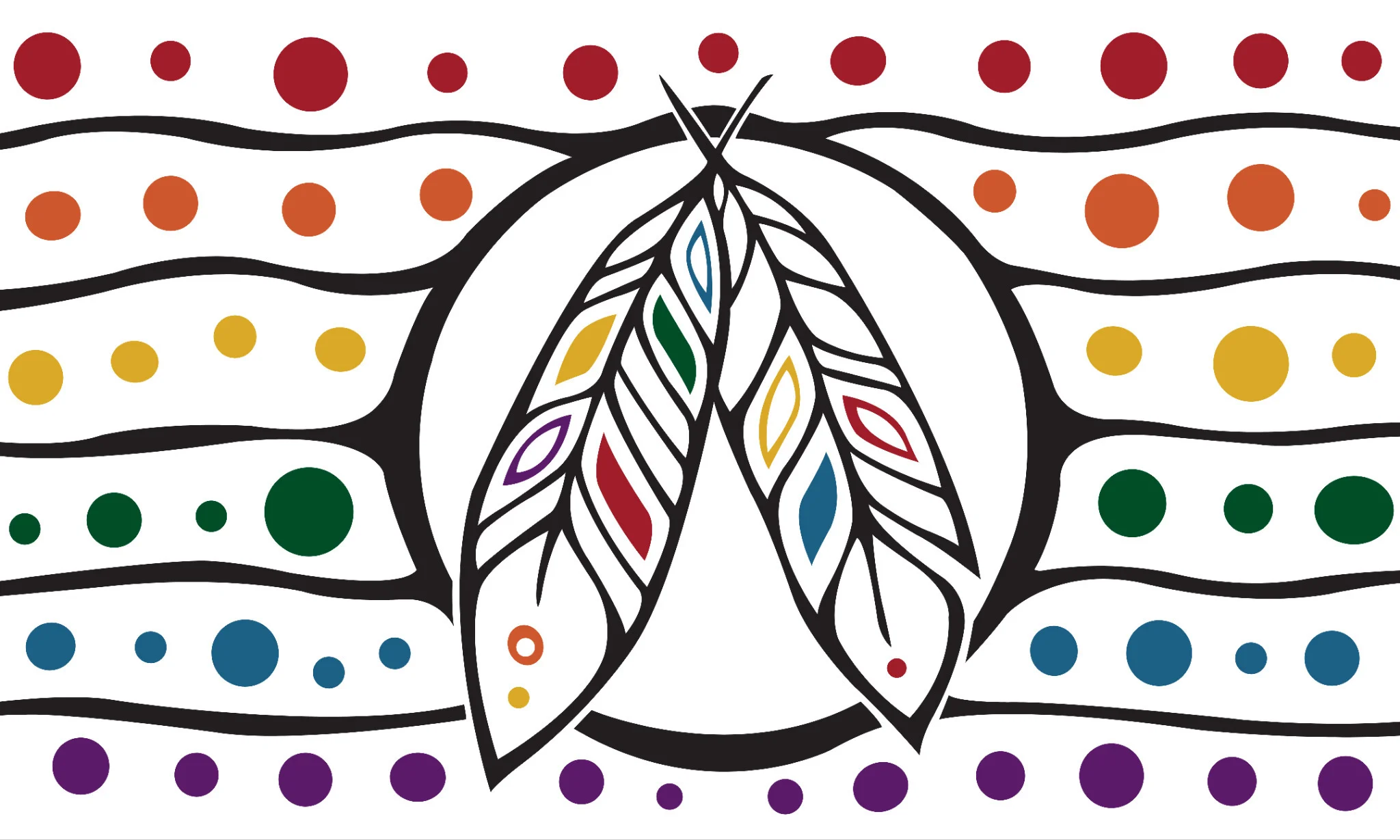
A Two-Spirit pride flag by Patrick Hunter, a Two-Spirit Ojibwe artist from Red Lake, Ontario, commissioned by the International Day of Pink and unveiled 19 November 2024 at the Canadian Museum for Human Rights in Winnipeg for the 35th anniversary of the term 'Two-Spirit.' [1][2] Built from Woodland art vocabulary rather than stripes: two eagle feathers resting on giizis, the sun, amid six bands of pictograph-inspired rainbow dots. [3] The Day of Pink calls it 'the first Two-Spirit Pride Flag'; it is the earliest known to be created on commission, though the 2005 Zoccole and 2016 2Sanon designs precede it. [3]
Key facts
- Designer
- Patrick Hunter
- Created
- First documented public use
- Documented
- 2024–present
- Aspect Ratio
- 3:5 · standard
- Origin
- Winnipeg, Manitoba, Canada
- Represented Identity
- Two-Spirit
Also known as
- Two-Spirit Pride Flag (2024)
- Day of Pink Two-Spirit Flag
- Patrick Hunter Two-Spirit Flag
Archive categories Indigenous Pride Flags
Overview
To mark the 35th anniversary of the term 'Two-Spirit' with an officially commissioned flag designed by an Indigenous artist, rooted in Indigenous artistic traditions rather than Western pride flag visual language. [1][3]
The International Day of Pink commissioned Anishinaabe artist Patrick Hunter to design a Two-Spirit pride flag for the 35th anniversary of the term 'Two-Spirit.' The flag was unveiled at a ceremony at the Canadian Museum for Human Rights in Winnipeg on November 19, 2024. The event included a panel of Two-Spirit community members (Feather Talia, Wesley Flett, Vida Lamour, Elder Charlotte Nolin, Brielle Beardy-Linklater, and Patrick Hunter) and the premiere of the short documentary Re-Emergence, featuring Two-Spirit activists, community members, and Elders. [1]
Identity & Context
- Represented Identity
- Two-Spirit
- Subcommunity
- Indigenous North American LGBTQ people who hold culturally specific gender/social roles
- Movement
- Two-Spirit visibility, Indigenous Queer pride, Day of Pink anti-bullying awareness
- Diaspora Context
- North American Indigenous communities, both within and across national borders
- Language Context
- Elder Myra Laramee (Fisher River Cree) first proposed the English term 'Two-Spirit' in 1990 at the Third Annual Inter-tribal Native American, First Nations, Gay and Lesbian American Conference. [4] Accounts place the gathering differently: some at Winnipeg, others at a site near Beausejour, Manitoba, about fifty kilometres away. The First Nations Health Authority names the conference without giving a location. It comes from the Anishinaabemowin term 'niizh manidoowag,' describing a person with both masculine and feminine characteristics. [5] The sun element in Hunter's flag is named by its Anishinaabemowin word 'giizis.' [1][3]
- Religious Context
- Two-Spirit identity is rooted in specific Indigenous spiritual and ceremonial traditions. The eagle feathers in the flag carry spiritual significance in many Indigenous Nations.
- Racial / Ethnic Context
- Exclusively Indigenous North American identity. The flag was unveiled alongside Two-Spirit Elders, activists, and community members including Elder Charlotte Nolin and Brielle Beardy-Linklater (Nisichawayasihk Cree Nation). [1]
- National Context
- Pan-Indigenous identity. The unveiling event featured panelists from multiple Nations and backgrounds.
The flag was deliberately unveiled in Winnipeg, the birthplace of the term 'Two-Spirit.' Elder Charlotte Nolin shared her personal story of the term's adoption: 'When the term was coined here in Manitoba, I was sitting in the sweat lodge at the University of B.C. That's when I was told who I was.' [1]
Creators
The Creator
Patrick Hunter
Designer
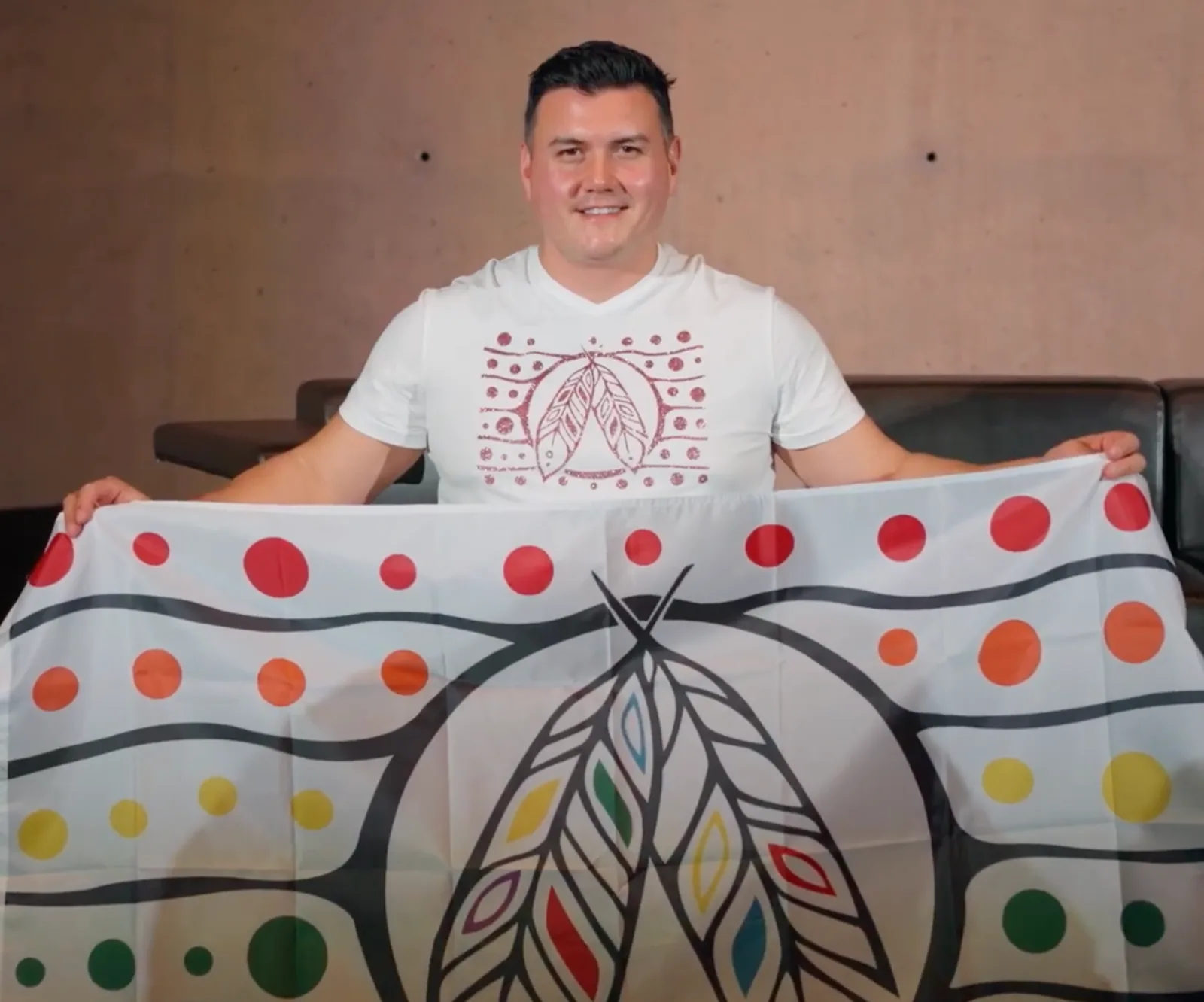
Hunter describes himself as 'a two-spirit, Ojibwe painter, graphic designer and award winning entrepreneur from Red Lake, Ontario.' He grew up surrounded by the Woodland paintings of Norval Morrisseau in his community, studied graphic design at Sault College in Sault Ste. Marie, and launched Patrick Hunter Art & Design in Toronto in 2014; he divides his time between Toronto, Sault Ste. Marie, and Red Lake. [2] Woodland art, the tradition he works in, was popularized in the late 1960s by Morrisseau and 'sees beyond the exterior of the subjects and depicts the spirit through an internal view.' [6] His commissions and collaborations include the Olympics, the Chicago Blackhawks, Holt Renfrew, and an Artist-in-Residence term with the Prince's Trust Canada. [6][2]
The sun, he kind of provides us with everything else that we need in this life. [1]
The earliest artwork that we see out on pictographs, out in the world are dots and circles, and I just thought what a throwback to seven generations ago. [1]
We walk Turtle Island with these two perspectives at all times, and if they are in harmony, we can achieve anything. [3]
Science tells us that we're all made from star stuff, as old as the universe. [3]
We're here to add our own verse to the cosmic poem. [3]
Representation really does matter. The Pride flag itself is so beautiful, and I knew I wanted to incorporate those colours in an Indigenized view. [7]
Motivations
- To create a flag that connects Two-Spirit identity to ancient Indigenous artistic traditions and cosmology [1][3]
- To honor the 35th anniversary of the term 'Two-Spirit' with a design rooted in Anishinaabe visual language [1]
Stated inspirations
- Ancient Indigenous pictograph art, dots and circles found on rock faces across Turtle Island[1]
- The sun (giizis) as provider of life and illumination[1][3]
- The concept of walking with two perspectives (masculine and feminine) in harmony[3]
Broader influences
- Woodland art tradition and its stylized organic forms[1]
Attribution
- Commissioned By
- International Day of Pink
Attribution notes
Patrick Hunter, himself Two-Spirit and Ojibwe, from Red Lake, Ontario [2], was commissioned by the International Day of Pink non-profit to design the flag for the 35th anniversary of the term 'Two-Spirit.' Hunter has spoken publicly about the design's symbolism, citing pictograph art, the sun (giizis), and the interconnectedness of all beings as core inspirations. [1][3]
Origin
- Country
- Canada
- Region / state
- Manitoba
- City
- Winnipeg
- Specific Place
- Canadian Museum for Human Rights
- Place Type
- museum
Created in Winnipeg, Manitoba, on Treaty 1 territory, the traditional homeland of the Anishinaabe, Ininew (Cree), and Dakota peoples, and within the National Homeland of the Red River Metis. [8][9]
Indigenous land context
Anishinaabe (Ojibwe) — Treaty 1 territory, traditional homeland. Winnipeg is located within Treaty 1 Territory, signed August 3, 1871 at Lower Fort Garry. The Anishinaabe are among the primary Indigenous peoples of this territory. [8][9]
Ininew (Cree) — Treaty 1 territory, traditional homeland. The Swampy Cree (Ininew) were co-signatories to Treaty 1. The name "Winnipeg" derives from the Cree words for muddy water, referring to Lake Winnipeg. [8][9]
Dakota — traditional homeland [8]
Colonial / settler context
This flag was unveiled at the Canadian Museum for Human Rights, a state institution on Treaty 1 territory. Two-Spirit visual culture exists in structural tension with the settler-colonial institutions that frame and archive it. [8][9]
- Land status
- Treaty territory (Treaty 1, 1871; first of the Numbered Treaties)
- Indigenous engagement
- Indigenous-authored
- Continuing presence
- Anishinaabe, Ininew (Cree), and Dakota communities present; National Homeland of the Red River Metis
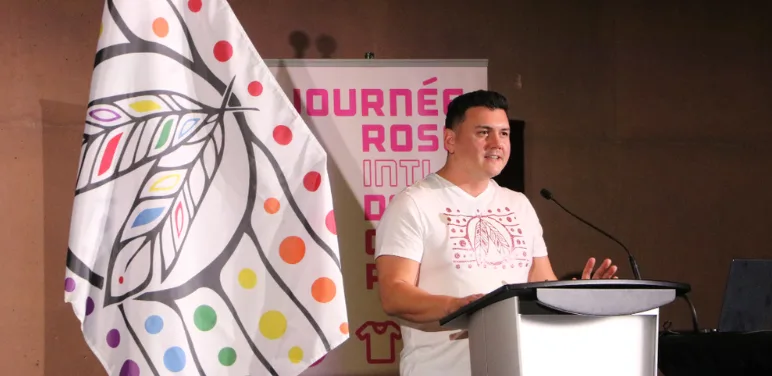
Unveiled at a Two-Spirit celebration hosted by the International Day of Pink at the Canadian Museum for Human Rights in Winnipeg, on November 19, 2024. The organizers chose Winnipeg for its association with Elder Myra Laramee first proposing the term 'Two-Spirit' in 1990, at the Third Annual Inter-tribal Native American, First Nations, Gay and Lesbian American Conference. [1][4]
Indigenous Identity Context
- Nation
- Anishinaabe
- Related Nations
- Anishinaabe
- Territory
- Turtle Island
- Language Group
- Anishinaabemowin
- Geographic Scope
- pan-Indigenous
- Colonial State
- Canada
- Traditional Knowledge Notice
- Yes
- Affiliation Type
- identity_framework
- Pan-Indigenous
- Yes
This flag was created by Anishinaabe artist Patrick Hunter and unveiled on November 19, 2024, at the Canadian Museum for Human Rights in Winnipeg, the city its organizers identify with Elder Myra Laramee first proposing the term 'Two-Spirit' in 1990, at the Third Annual Inter-tribal Native American, First Nations, Gay and Lesbian American Conference. [1][4] The flag was commissioned by the International Day of Pink to mark the 35th anniversary of the term. Hunter's design draws on Woodland art traditions and Indigenous pictograph imagery, embedding Two-Spirit identity within an artistic lineage that reaches back generations. The unveiling included Two-Spirit Elders, activists, and community members, and was accompanied by the premiere of the documentary Re-Emergence and the launch of a Two-Spirit curriculum guide for educators.
Two-Spirit is an exclusively Indigenous North American identity framework, pan-Indigenous in scope. The flag's designer is Two-Spirit and Ojibwe (Anishinaabe) [2], and its visual vocabulary is Anishinaabe (Woodland art forms, giizis); the identity it represents spans Nations. [2][1]
Human Interest
Coming home to Winnipeg
The flag was unveiled at the Canadian Museum for Human Rights in Winnipeg, the city its organizers associate with Elder Myra Laramee first proposing the term 'Two-Spirit' in 1990, at the Third Annual Inter-tribal Native American, First Nations, Gay and Lesbian American Conference, as an alternative to the colonial term 'berdache.' [4] Thirty-four years later, at the 2024 unveiling, Elder Charlotte Nolin recalled the moment the term reached her: 'When the term was coined here in Manitoba, I was sitting in the sweat lodge at the University of B.C. That's when I was told who I was.' The unveiling's location was chosen to mark the city's role in that naming. [1]
Dates & Chronology
- Year Created
- Exact date
- First public use
- Documented
- 2024–present
The flag was launched alongside a Two-Spirit curriculum guide with free learning materials and lesson plans for educators and students, produced by the Day of Pink organization. The annual International Day of Pink is held on April 9th. As of early 2025, the flag's adoption beyond the Day of Pink organization is still emerging. [1]
This is the earliest known Two-Spirit pride flag created on commission. The Day of Pink and later coverage present it as 'the first Two-Spirit Pride Flag' [3][10], a framing that overlooks the earlier grassroots designs: Art Zoccole's 2005 flag, 2Sanon's 2016 Tumblr submission, and sirieko's 2021 design. What distinguishes Hunter's flag is its origin in a formal commission from a national organization, unveiled at a dedicated ceremony. [1]
Lineage
- Indirect influences
- Two-Spirit Pride Flag (2005, Zoccole)
Part of the Two-Spirit flag family but departs from all prior designs in visual approach. Where Zoccole (2005) and 2Sanon (2016) placed Indigenous symbols on a rainbow base, and sirieko (2021) used an independent color palette alongside rainbow-adjacent colors, Hunter's design is built from Woodland art traditions with no rainbow or Western pride-flag elements. It is the first commissioned Two-Spirit flag and the first by a named, publicly identified Indigenous artist. Its relationship to the earlier flags is thematic (shared Two-Spirit visibility) rather than visual. [1][3]
Colors & Symbolism
The flag connects Two-Spirit identity to Anishinaabe cosmology and artistic tradition. Hunter built the design from Anishinaabe visual vocabulary (eagle feathers, the sun, and pictograph-inspired dots) rather than from rainbow-stripe or Western pride-flag elements. [1][3]
| Colour | Hex | Note |
|---|---|---|
| White (field) | #FFFFFF | Flag image |
| Black (formlines and linework) | #000000 | Flag image |
| Red (dot band, top) | #BE1E2D | Flag image, approximate |
| Orange (dot band) | #F47920 | Flag image, approximate |
| Yellow/Gold (dot band) | #F0B828 | Flag image, approximate |
| Green (dot band) | #00734A | Flag image, approximate |
| Blue/Teal (dot band) | #0077A8 | Flag image, approximate |
| Purple (dot band, bottom) | #5B2C86 | Flag image, approximate |
This flag has no official digital palette. Color values shown are approximate.
- Two stylized eagle feathers
- Represent the balance and harmony of masculine and feminine energies within Two-Spirit individuals. Hunter stated: 'We walk Turtle Island with these two perspectives at all times, and if they are in harmony, we can achieve anything.' [1][3]
- Giizis (the sun)
- The sun on which the feathers rest represents the boundless nature of spirit and the provider of life. Hunter said: 'The sun, he kind of provides us with everything else that we need in this life.' [1][3]
- Rainbow of dots
- Circles reflecting the spectrum of visible light and celebrating ancient Indigenous pictograph traditions. Hunter described them as 'a throwback to seven generations ago,' connecting the flag to the oldest known Indigenous art forms. The dots also add 'movement and magic' to the design. [1][3]
Hunter's stated symbolism connects Two-Spirit identity to stars, the sun, and longer timescales than contemporary identity-category vocabulary. His statement 'Science tells us that we're all made from star stuff, as old as the universe' and 'We're here to add our own verse to the cosmic poem' position Two-Spirit identity within that wider frame. [3]
Colors extracted from the flag image. The six dot bands follow a rainbow progression from red (top) to purple (bottom). The same rainbow hues appear as eye-shaped accents within the feather vanes. Exact hex values are approximations, no official palette has been published by the artist or Day of Pink.
Design
- Aspect Ratio
- 3:5 · standard
- Orientation
- horizontal
- Layout
- symbolic composition
- Center Symbol
- Two stylized eagle feathers inside a circle (giizis/sun), rendered in Woodland art style with black linework
- Additional Symbols
- Six horizontal bands of rainbow-colored dots (red, orange, yellow, green, blue, purple) separated by flowing black formlines, Eye-shaped color accents within the feathers in rainbow hues
The design uses a white field with bold black Woodland-style formlines throughout. The composition is horizontally oriented with the central feather-and-sun motif flanked by six horizontal bands of dots in rainbow progression (red at top, purple at bottom). The flowing black lines separating the dot bands have an organic, wave-like quality characteristic of Woodland art. The dots vary in size within each band.
The flag was created by Patrick Hunter as a finished Woodland art composition. The central circle (giizis) contains two large eagle feathers rendered with detailed vane structure in black linework. Each feather contains eye-shaped color accents in rainbow hues (blue, green, yellow, red, purple, gold). A small circle appears at the base of the feathers between the two quills. [1]
A white field with bold black Woodland-style linework. At center, two large stylized eagle feathers hang inside a circle representing giizis (the sun). The feathers are rendered with detailed vane patterns and contain eye-shaped accents in rainbow colors. Flanking the central motif, six horizontal bands of dots progress through the rainbow spectrum (red at top, orange, yellow, green, blue, and purple at bottom), separated by flowing black formlines. The dots vary in size, with larger dots toward the edges and smaller ones near center, evoking ancient Indigenous pictograph art. The overall effect is a pride flag built entirely from Anishinaabe Woodland art vocabulary rather than the stripe-based format of Western pride flags.
Usage & Adoption
- First Users
- International Day of Pink (commissioned the flag) [1]
- Organizations
- International Day of Pink [1]
- Geographic Usage
- Canada
- Online Usage
- Day of Pink website (dayofpink.org/twospiritflag) [3]
- Event Usage
- Unveiling ceremony at the Canadian Museum for Human Rights, Winnipeg, November 19, 2024 [1], International Day of Pink 2025 (April 9, 2025), flag launched ahead of this annual event [1]
- Current Status
- active
The flag was launched with a Two-Spirit curriculum guide for educators and the documentary Re-Emergence. [1][10] Pride-month coverage in June 2025 presented it as a milestone for Indigenous visibility within Pride's visual vocabulary. [7] Documented use otherwise centres on the Day of Pink's own materials; adoption by Two-Spirit organizations or institutions beyond the commissioning organization has not been documented. Unlike 2Sanon's 2016 design, which spread organically through social media and commercial reproduction, Hunter's flag was introduced through an institutional channel with educational materials.
Image Archive
Public unveiling of the 2024 Hunter Two-Spirit flag
Discourse & Debates
Common misidentifications
- May be confused with the 2Sanon (2016) Two-Spirit flag, which remains the most widely circulated version
- The Day of Pink's page and later coverage call this 'the first Two-Spirit Pride Flag' [3][10][7]; Art Zoccole created the earliest known Two-Spirit flag in 2005, and the 2Sanon design dates to 2016
Footnotes & Citations
Sources and footnotes 10 sources
- 1. News Two-Spirit pride flag unveiled in Winnipeg to mark anniversary. Cierra Bettens. APTN News (2024-11-19). Accessed 2026-03-18
- 2. Designer page About Patrick. Patrick Hunter. Patrick Hunter Art and Design. Accessed 2026-08-15
- 3. Organizations Two-Spirit Pride Flag. Day of Pink. Accessed 2026-08-15
- 4. Organizations 2S/LGBTQQIA+. First Nations Health Authority. First Nations Health Authority. Accessed 2026-08-15 · Archived version
- 5. Reference Two-Spirit People — Gender and Sexual Diversity. RRC Polytech Library and Academic Services. Accessed 2026-08-15
- 6. Designer page Patrick Hunter Art and Design. Patrick Hunter. Patrick Hunter Art and Design. Accessed 2026-08-15
- 7. News A New Flag, A New Chapter: Honouring Two-Spirit Identity in Pride Month. GTA Chronicle (2025-06-13). Accessed 2026-08-15
- 8. Government Land Acknowledgement. Manitoba Legislature. Accessed 2026-03-30
- 9. Government Treaties No. 1 and No. 2. Crown-Indigenous Relations and Northern Affairs Canada. Accessed 2026-03-30
- 10. News New Two-Spirit pride flag, documentary and curriculum marks major milestone in Two-Spirit visibility and celebration. Ryan Funk. Frequency (CHEB-FM Winnipeg) (2024-11-22). Accessed 2026-08-15
Image Sources
- Rendering
- two-spirit-2024-hunter
- Patrick Hunter, a Two-Spirit Ojibwe artist from Red Lake, Ontario, unveils his Two-Spirit pride flag design on the International Day of Pink, 2024. [2] · Credit: Patrick Hunter / Day of Pink · Day of Pink unveiling event, 2024