Transgender Pride Flag
Identity Pride Flag ·
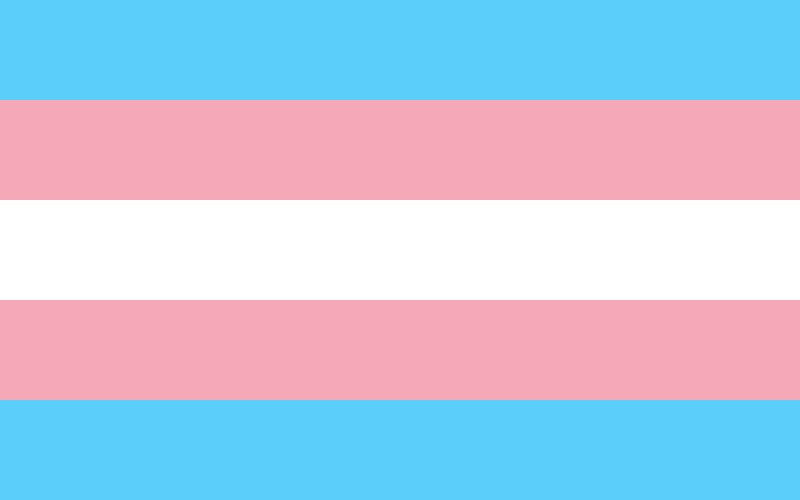
Five stripes of light blue, pink and white, made by Monica Helms on 19 August 1999, a date she now calls Transgender Flag Day, and first flown at Phoenix Pride in 2000. The original she donated to the Smithsonian in 2014 measures 57 by 46 inches, a proportion near 5:4 that matches neither the 3:5 nor the 2:1 in circulation, and no color specification by Helms has been located: the values everyone reproduces come from Wikimedia Commons edits in 2006, 2012 and 2018.
Key facts
- Designer
- Monica Helms
- Created
- First documented public use
- Phoenix Pride, 2000
- In use
- 1999–present
- Aspect Ratio
- 3:5
- Ratio Notes
- Production ratio 3:5, the archive standard, which is also what circulates. The original object: the flag Helms donated to the Smithsonian, accession 2014.0236.01, measures 57 by 46 inches, 144.78 by 116.84 centimeters, a proportion of about 1.24 to 1, close to 5:4 and matching neither 3:5 nor the 2:1 the Commons file carried from 2006. [1] Helms has specified no ratio in any source read; the 3:5 in circulation was set on the Commons file by the editor Keymap9 on 6 April 2018, in two edits noted "Better proportions" and "3:5 ratio," and has been reverted and restored twice since; the file had been 2:1 from its creation in 2006. [2] The museum dates the object's manufacture to 1999, its Related Dates reading "1999 (date made)." [1]
- Stripes
- 5
- Origin
- Phoenix, Arizona, United States
- Represented Identity
- Transgender community
Also known as
- Trans Pride Flag
- Trans Flag
- Transgender Flag
Status Canonical
Archive categories Gender Identity Pride Flags · Historical and Early Pride Flags
Overview
After Michael Page suggested the trans community could use a flag of its own, Helms made a single flag for herself, choosing a symmetrical design that reads correctly however it is hung. Wider community use followed. [3][4]
In 1999, over dinner at a bisexual conference in Phoenix, Michael Page, who had designed the bisexual pride flag, told Helms that the trans community could use a flag of its own and advised her to keep it simple. About two weeks later the five-stripe mirrored design came to her as she woke one morning. She has been specific that it was not a dream: "When you wake up and you're still sort of groggy... your mind is starting to fill with images, that's when it came to me," calling it, with a laugh, "divine intervention." [5] She drew it on paper and, through the Florida company that had made the bisexual flag, had a physical flag within a week. Helms has said the flag was at first only for herself: "This was for me, and if nobody had embraced it, it still would have been OK for me." [5][4] The flag was first noticed in print by Phoenix's Echo magazine, now OUTVoices. [6] She first carried it in the color guard at the 2000 Phoenix Pride parade, where onlookers kept asking "What is that?" [7][4]
Identity & Context
- Represented Identity
- Transgender community
- Subcommunity
- Trans and gender-nonconforming people
- Movement
- Transgender rights movement, trans visibility
- National Context
- United States
Functions as a community umbrella flag rather than a city- or event-specific political symbol. Its visual elements later fed into the Progress Pride Flag chevron.
Creators
The Creator
Monica Helms
Designer
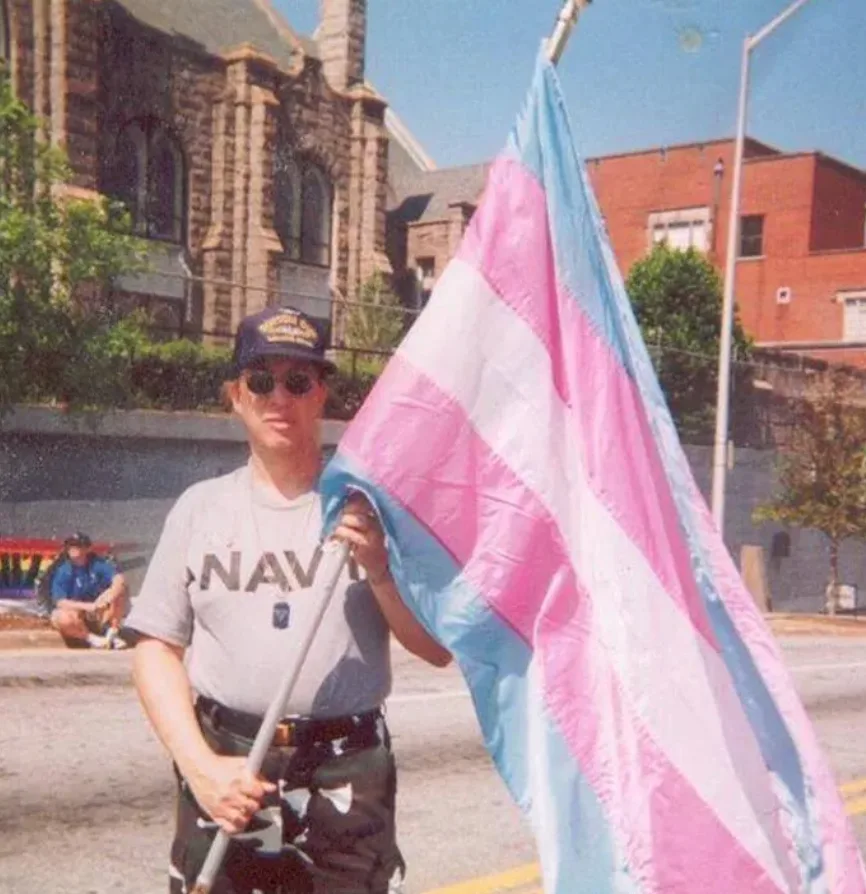
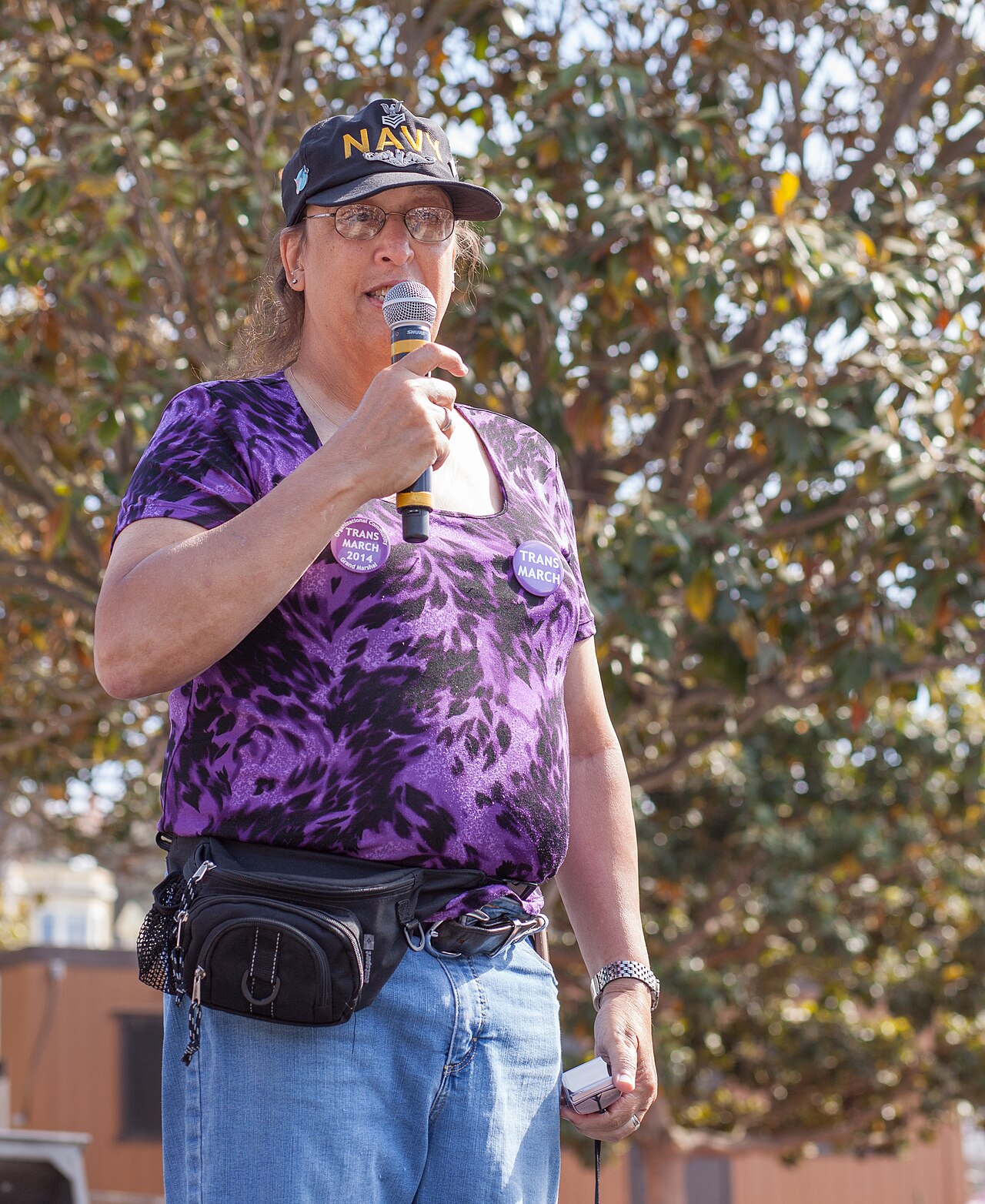

Monica Helms (born March 8, 1951, in Sumter, South Carolina) is an American trans activist, author, and Navy veteran who designed the transgender pride flag in 1999. She grew up in Arizona, where at five, in 1956, she prayed to be turned into a girl and later described the answer as delayed: "It wasn't an overnight or same-day delivery because it took 41 years." She served in the U.S. Navy from 1970 to 1978 as a nuclear-trained machinist's mate aboard the submarines USS Francis Scott Key, from 1972 to 1976, and USS Flasher, from 1976 to 1978. [8] She had a low draft number and chose both the Navy and submarines deliberately, wanting nuclear power training "because NASA was contemplating nuclear-powered space flight at the time and I am a big space and sci-fi fan," and because "they were not shooting submarines down over Vietnam." [6] She began dressing as a woman while stationed in Charleston, South Carolina, and later called it her "deepest, darkest secret"; a 1987 visit to San Francisco, where a friend described her own transition, proved decisive. She was nearly discovered aboard the USS Flasher at Vallejo, California, feigning sleep as the executive officer and chief of the boat looked into her room: "I was beyond scared." [6] In 1980 she and five others had founded Arizona's first Tri-Ess chapter, Alpha Zeta, as heterosexual crossdressers; "all six of those women who started Trias in Arizona all transitioned eventually." She began taking hormones in 1992, began living as a woman in 1997, and her marriage ended in 1998. Through those years she worked at Sprint, joining in 1990 and retiring in 2015 after twenty-five years; she attempted to establish a union at its Arizona facility, transitioned there, and described the response as "subtle bigotry": "Nasty notes were put on my locker and at my terminal." She co-founded It's Time Arizona with Amanda Schrader, and after moving to Georgia became executive director of TransAction, which sought to open homeless shelters to trans people. [6] After transitioning, Helms reapplied in 1998 to her local chapter of United States Submarine Veterans, Inc. under the name Monica and became the first trans woman admitted. The Transgender American Veterans Association began in 2002 on a Yahoo group, after Alex Fox described being refused care at the Washington VA and treated well sixty miles north in Baltimore; Helms and Angela Brightfeather founded it in January 2003, and she was its president until 2013. The Department of Veterans Affairs directive on treating transgender veterans followed in June 2011, covering hormones and therapy but not surgery; Helms has given the interval as "nearly nine years" in one interview and "eight years later" in another, and neither matches the ten years between the founding and the 2013 date one of those articles gives. [6] and in 2004 about fifty of its members made the first Transgender Veterans March to the Wall and laid a wreath at the Tomb of the Unknown Soldier. When Trump announced a transgender military ban in 2017, Helms responded: "Trans people have proven to serve well and without any issues." Her memoir, More Than Just a Flag, appeared in 2019, the year Queerty named her to its Pride50. [8][9] She met her wife Darlene Wagner at a gender-neutral contra dance in Atlanta while Wagner was beginning to transition and finishing a doctorate in bioinformatics at Georgia Tech; Wagner moved in in February 2010 and they married in November 2016, expecting same-sex marriage to be taken away. They lived in Marietta, in Cobb County. In 2023, aged 71, Helms welcomed a 14-year-old trans daughter into her life, and she sits on the boards of the Georgia ACLU and the Gilbert Baker Foundation. [6] In August 2025, citing anti-trans legislation in Georgia, Helms and her wife Darlene Wagner, who had been laid off from the CDC, moved to Costa Rica: "We are worried there's a possibility something could happen where we end up getting arrested just for being who we are." They returned to the Atlanta area after about six months, and Wagner was rehired by the CDC. [10][4]
The stripes at the top and bottom are light blue, the traditional color for baby boys. The stripes next to them are pink, the traditional color for baby girls. The stripe in the middle is white, for those who are transitioning or consider themselves having a neutral or undefined gender.
There are like 92 different flags now in our community. And I hope to think that I was the one that got it started. [9]
Motivations
- To provide the transgender community with a dedicated pride symbol
- To create a flag with inherent symmetry so it always appears correct regardless of how it is hung
Origin
- Country
- United States
- Region / state
- Arizona
- City
- Phoenix
Created in Phoenix, Arizona, on the ancestral homeland of the Akimel O'odham (River People) and Xalychidom Piipaash (Upriver People), whose descendants continue to live in the Salt River Pima-Maricopa Indian Community within the Phoenix metropolitan area. [11][12]
Indigenous land context
Akimel O'odham (River People) — ancestral homeland. The Akimel O'odham, also known as Pima, refer to themselves as O'odham ("The People"). They are specifically Akimel O'odham, meaning "River People," because of their relationship to the Gila and Salt Rivers. Their ancestors are known archaeologically as Hohokam. The Salt River Pima-Maricopa Indian Community (SRPMIC) was established by Executive Order in 1879 and lies in the heart of the Phoenix metropolitan area. [11][12][13]
Xalychidom Piipaash (Upriver People) — allied homeland. The Piipaash, also known as Maricopa, refer to themselves as Piipaash ("The People") and are part of a broader Yuman culture. They have been allied with the Akimel O'odham for many generations, sharing the Salt River community. Maricopa County itself takes its name from this people. [11]
Colonial / settler context
This flag debuted at Phoenix Pride on the ancestral homeland of the Akimel O'odham and Piipaash, whose descendants govern the Salt River Pima-Maricopa Indian Community within the same metropolitan area. The O'odham were dispossessed through Spanish colonization and the diversion of the Gila and Salt Rivers by American settlers. [11][12]
- Land status
- Colonized (Spanish mission system, U.S. settlement, river diversion)
- Indigenous engagement
- None documented
- Continuing presence
- Active governance: Salt River Pima-Maricopa Indian Community in metro Phoenix; Gila River Indian Community; Arizona is home to 22 tribal nations.
The Smithsonian, Military.com, the NVMM, GPB, and The Daily Beast all place the flag's debut at Phoenix Pride in 2000. Helms herself has consistently named Phoenix in interviews. A single Horniman Museum article instead states Atlanta (2000); with every other source confirming Phoenix, the Atlanta claim appears to be an error. [14][15]
Dates & Chronology
- Year Created
- Exact date
- First public use
- Phoenix Pride, 2000
- Period in Use
- 1999–present
The flag spread from its Phoenix debut into international use. In 2012 it was flown from the public flagpole in San Francisco's Castro District for the first time. In June 2015 Philadelphia raised it at City Hall during the Philadelphia Trans Health Conference. [15] Helms approached the museum herself, saying that after seeing in 2013 that the flag had spread internationally, "I decided to start at the top, so I called the Smithsonian and it just so happened they had begun collecting items for a new LGBTQ wing." [6] On August 19, 2014, fifteen years to the day after she made it, Helms donated the original flag to the Smithsonian's National Museum of American History, together with buttons and memorabilia from her Navy career. The museum accessioned the original as object 2014.0236.01 and a miniature as 2014.0236.02, within an accession of twelve objects. [1][16][17] Curator Katherine Ott said the moment was right "to more aggressively, directly, and openly collect LGBT materials." Helms said: "I feel honored, but I want to share that honor with the trans community. I'm also proud that they accepted my military memorabilia because trans people are still denied the right to serve." [15] The flag was displayed at the White House during Pride Month in 2016.
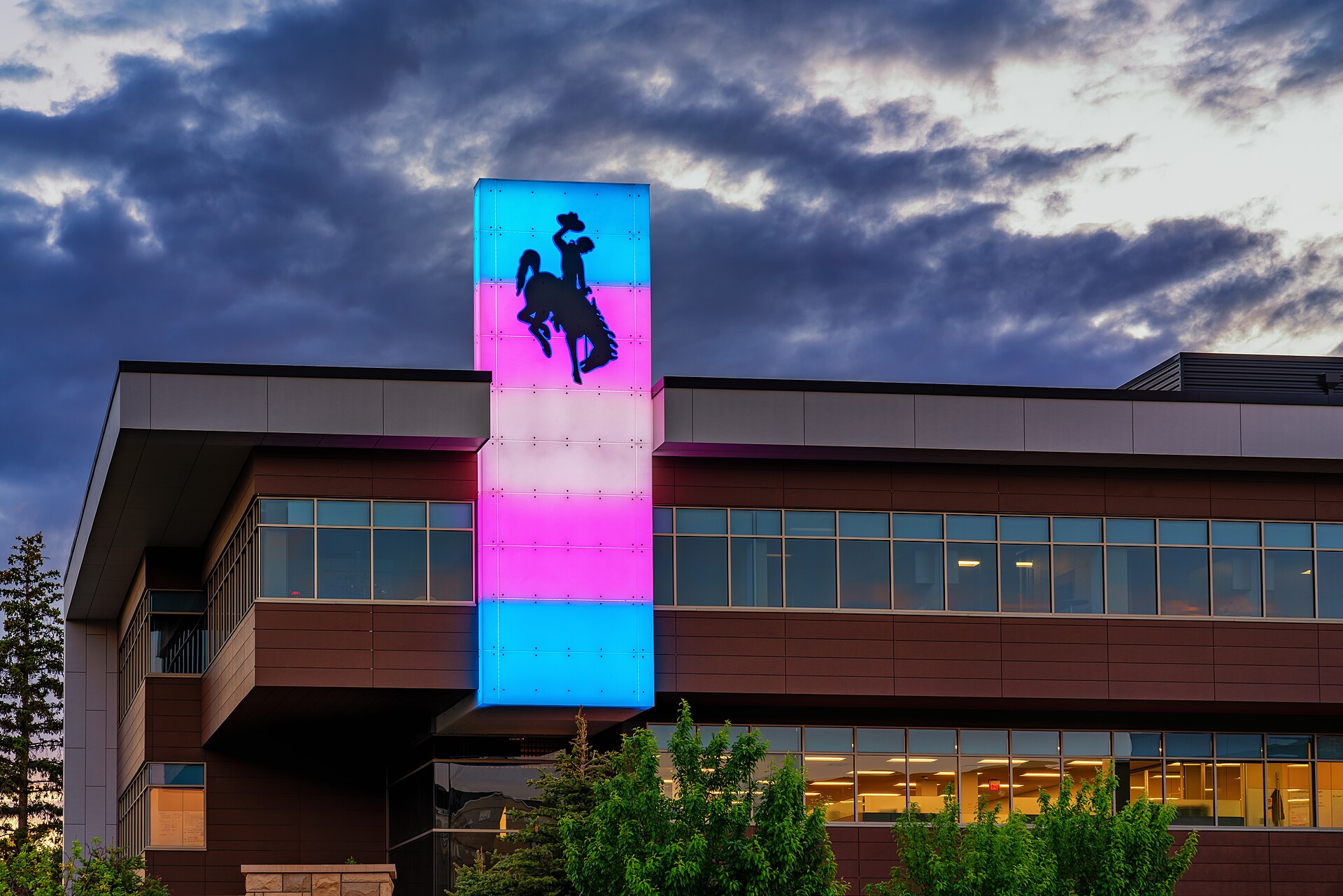

The Transgender Day of Remembrance was founded the same year as the flag, in 1999, by Gwendolyn Ann Smith, to memorialize Rita Hester and Chanelle Pickett, Black trans women killed in Massachusetts in 1998. From a single San Francisco vigil it has grown to observances worldwide, where the trans flag is commonly displayed, lowered to half-staff or projected onto public buildings. Helms organized Atlanta's first Day of Remembrance in 2000. [18][19] Helms calls August 19 "Transgender Flag Day," marking both the day she created the flag in 1999 and the day she donated it to the Smithsonian fifteen years later. [20][6]
Lineage
- Indirect influences
- Bisexual Pride Flag
- Direct children
- Anarcha-Queer Flag (transgender variant), Chicago Trans Pride Flag, Cisgender Ally Flag, "Fuck Around and Find Out" Trans Pride Flag, Nonbinary Trans Flag (2026, cirrus42), Progress Pride Flag, Sego Visibility Flag, Trans Ally Flag, Transgender Pride Flag with Transgender Symbol, Transneutral Pride Flag, Two-Spirit Transgender Pride Flag
Daniel Quasar's 2018 Progress Pride Flag incorporates the trans flag's light blue, pink, and white stripes into its chevron; Helms has said its makers never contacted her about using her colors. [4] Several later flags rework the same palette and mirrored structure: the nonbinary trans flag, the Chicago trans flag, and the FADFO trans flag all draw on the Helms flag's light-blue, pink, and white sequence, a formal relationship visible in the designs though no creator statement documenting the influence has been located. An earlier Transgender Nation flag was made in about October 1991, eight years before this one, by Dawn Holland and Anne Ogborn within Queer Nation; it is related chronologically rather than by influence, since Helms has said she believed only the rainbow and bisexual flags existed when she designed hers. [7] Marilyn Roxie adapted the design in 2010 for the genderqueer and non-binary communities. [6]
Lineage tree
Every record reachable from this one through documented parent and child relationships: 23 records across 4 generations.
- This record
- Transgender Pride Flag
- Children
- Progress Pride Flag, Transneutral Pride Flag, Chicago Trans Pride Flag, Cisgender Ally Flag, Sego Visibility Flag, Nonbinary Trans Flag (2026, cirrus42), "Fuck Around and Find Out" Trans Pride Flag, Anarcha-Queer Flag (transgender variant), Trans Ally Flag, Transgender Pride Flag with Transgender Symbol, Two-Spirit Transgender Pride Flag
Colors & Symbolism
Five horizontal stripes in light blue, pink, and white, mirrored around the central white stripe. The light blue and pink stripes are described in source documentation as the traditional baby colors for boys and girls; the central white stripe represents transitioning, neutral, or undefined gender. Helms has stated that the symmetrical layout was deliberate so that the flag could not be flown upside-down or backward. [21][14][22]
| Colour | Hex | Meaning |
|---|---|---|
| Light Blue | #5BCEFA | Traditional color for baby boys |
| Pink | #F5A9B8 | Traditional color for baby girls |
| White | #FFFFFF | Transitioning, neutral, or undefined gender (Smithsonian also broadens this to include intersex) |
| Pink | #F5A9B8 | Traditional color for baby girls |
| Light Blue | #5BCEFA | Traditional color for baby boys |
This flag has no official digital palette. Color values shown are approximate.


Helms has said the white stripe was inclusive from the start: "there needs to be a stripe for people that are not in the binary section." [4] Her wording for it has ranged from "transitioning or... a neutral or undefined gender" to "anyone who does not feel they are a part of a binary system," and she has herself included intersex people. [6][23] The Smithsonian describes it as covering "people who are intersex, transitioning, or who don't have a defined gender." [14] The meaning has broadened across accounts rather than through any redesign.
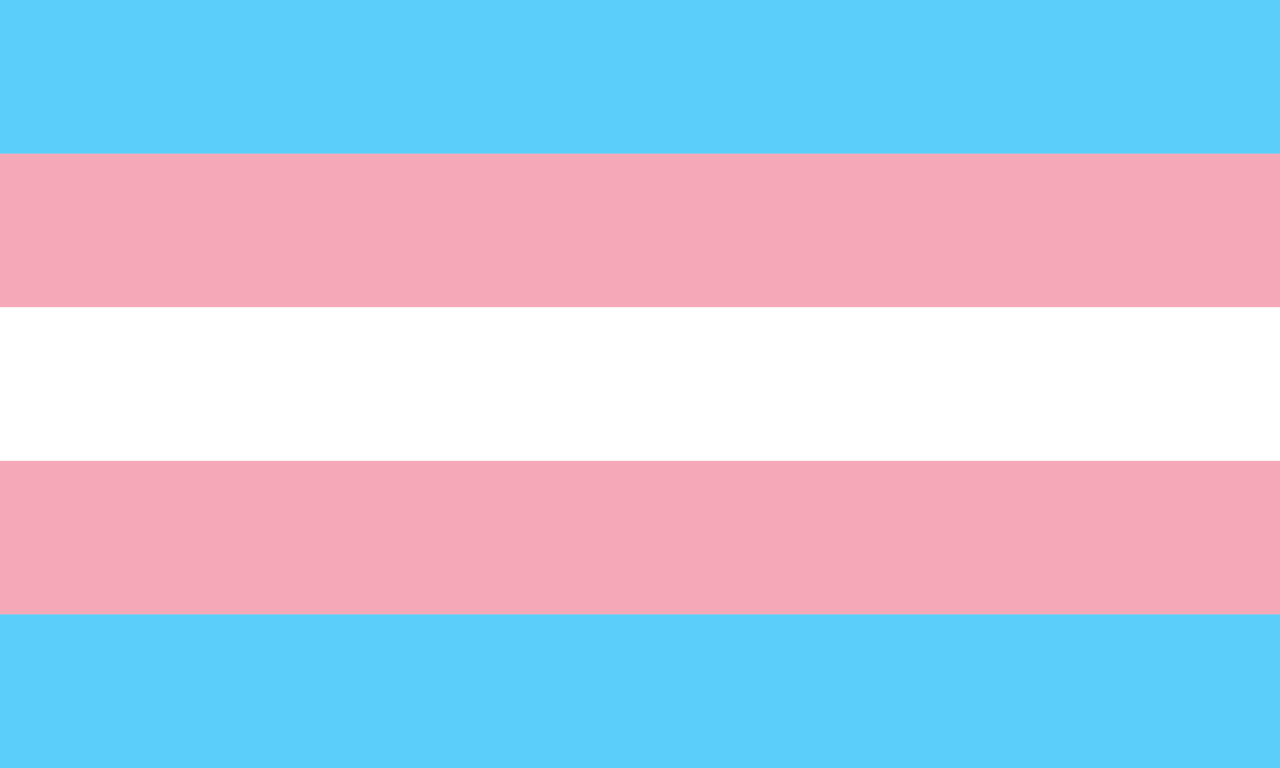

No color specification by Monica Helms has been located. The values in universal circulation come from the Wikimedia Commons file: the blue and white date from Dlloyd's original SVG of January 23, 2006, and the pink was changed on November 22, 2012 by the editor AnonMoos, whose note reads "making pink more pink, based on verbal description and HuffingtonPost photo." They are recorded here because reproductions follow them, not because the designer issued them. [2][21]
Design
- Aspect Ratio
- 3:5
- Ratio Notes
- Production ratio 3:5, the archive standard, which is also what circulates. The original object: the flag Helms donated to the Smithsonian, accession 2014.0236.01, measures 57 by 46 inches, 144.78 by 116.84 centimeters, a proportion of about 1.24 to 1, close to 5:4 and matching neither 3:5 nor the 2:1 the Commons file carried from 2006. [1] Helms has specified no ratio in any source read; the 3:5 in circulation was set on the Commons file by the editor Keymap9 on 6 April 2018, in two edits noted "Better proportions" and "3:5 ratio," and has been reverted and restored twice since; the file had been 2:1 from its creation in 2006. [2] The museum dates the object's manufacture to 1999, its Related Dates reading "1999 (date made)." [1]
- Orientation
- horizontal stripes
- Stripe Count
- 5
- Layout
- horizontal stripes
- Stripes (Top → Bottom)
- Light Blue, Pink, White, Pink, Light Blue
Five horizontal stripes of equal width, mirrored around the central white stripe: light blue, pink, white, pink, light blue. The symmetry means the flag reads correctly whichever way it is hung. [21]
No emblems, symbols, or additional markings. Helms drew the design on paper and had the first physical flag made by Freedom Flag and Banner of Florida, the company that had produced the bisexual pride flag; she chose from swatches it sent and received the flag within a week. [4][7]
A horizontal field divided into five equal stripes mirrored around a central white stripe: light blue (top), pink, white, pink, light blue (bottom). No charges, emblems, or additional markings. [21][14]
Digital Renderings
- Character
- 🏳️⚧️
- Unicode name
- Transgender Flag
- Unicode version
- Unicode 13.0
- Year added
- Type
- ZWJ sequence
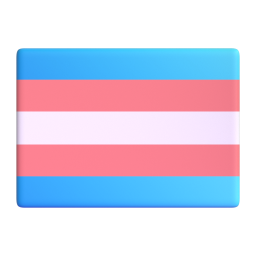
🏳️⚧️ is a ZWJ sequence, a waving white flag joined to the transgender symbol, so a font without the join shows two glyphs. Tea Uglow first proposed a transgender flag emoji in 2016 and was refused under a moratorium on new flag emoji; a 2017 request by Bianca Rey, Monica Helms, Chadwick Cipiti, and Dr. Ted Eytan was also denied. In 2018 the activist Charlie Craggs ran #ClawsOutForTrans, urging trans people to use the lobster emoji after Unicode had approved a lobster but no trans flag. Unicode approved the flag in Emoji 13.0, announced on January 29, 2020. [24]
Platform renderings



Usage & Adoption
- First Users
- Monica Helms at a Phoenix Pride event
- Geographic Usage
- United States, International
- Online Usage
- Extensive
- Event Usage
- Pride events, Transgender rights demonstrations, Transgender Day of Visibility, Transgender Day of Remembrance
- Current Status
- active and widely recognized
Widely used internationally at Pride events, transgender commemorations, and rights demonstrations, and at government and institutional displays. The original flag is in the Smithsonian's National Museum of American History; the flag was shown at the White House during Pride Month in 2016, and a transgender flag emoji was added to Unicode in 2020. The flag was displayed at the White House during Pride Month 2016, and has been flown on special occasions by San Francisco and by Santa Clara County, California. Helms says she has now seen it on all seven continents, including at Antarctica's highest peak in 2022, where a traveller carried only two flags, the rainbow flag and hers; a trans mountaineer has carried a poster of it up four of the seven summits, and Helms sent her a small flag for Everest. [6]
Image Archive
The Flag in Use
.jpg)


.jpg)


.jpg)
.jpg)
.jpg)



Design and Reconstruction
The Designer
Documented Use




Institutional Recognition


Crosswalks
The flag in use
.jpg)
Photograph by the Tumblr user feral-critter. No licence is stated and none has been sought; published at the site owner's direction with the rights status recorded as undetermined.
Discourse & Debates
- Differences in how the white stripe meaning is phrased across sources, Helms's own language, the Smithsonian's broadened wording, and Library.LGBT's distinct phrasing each present subtly different meanings without acknowledging the variation
Common misidentifications
- Sometimes conflated with other transgender flags or with Progress Pride variants that incorporate trans stripes
- The 1999 design date versus the 2000 public debut.
- The debut location: the Horniman Museum gives Atlanta, but Helms and every other source name Phoenix (2000).
Criticisms
- The flag has become a target in disputes over transgender rights. In February 2021, on the day the House voted on the Equality Act, Rep. Marie Newman, who has a transgender daughter, hung the trans flag outside her office across the hall from Rep. Marjorie Taylor Greene; Greene answered with a sign reading "There are TWO genders." A trans flag outside United Parish church in Brookline, Massachusetts was burned twice in 2022 and 2023, and trans flags were torn down and damaged at the Stonewall National Monument in June 2023, both investigated as hate crimes. Utah's Flag Display Amendments, effective May 7, 2025, bar government entities from displaying flags outside a fixed list of exemptions, reaching Pride flags by leaving them off it. [27]
- Some critics argue that the flag's binary color coding (baby blue for boys, pink for girls) reinscribes the gender binary it ostensibly challenges. Helms has responded that the white center stripe represents those outside or between genders, and that the design's simplicity was essential to its adoption.
Transgender Pride Flag is the standard title. The flag is commonly displayed at the Transgender Day of Visibility (March 31, founded 2009 by Rachel Crandall-Crocker) and the Transgender Day of Remembrance (November 20). Helms, a Navy veteran, was a vocal opponent of the 2017 ban on transgender military service, and the flag has been carried at protests of that policy, placing a symbol designed by a veteran against a rule that barred trans people from the armed forces. [28]
Footnotes & Citations
Sources and footnotes 53 sources
- 1. Museums & Exhibitions Transgender Pride Flag (object record 2014.0236.01). Smithsonian National Museum of American History. Accessed 2026-07-30 · Archived version
The museum’s own object record, accession 2014.0236.01.
- 2. Image file page File:Transgender Pride flag.svg. SVG by Dlloyd, based on Monica Helms’s design; later revisions by Mnmazur, AnonMoos, Keymap9, Plasamas, IndysNotHere and CalendulaAsteraceae. Wikimedia Commons (2006-01-23). Accessed 2026-07-30
The Wikimedia Commons file the circulating proportions come from. Its ratio has been changed by editors three times since 2018; it is not a specification by the designer.
- 3. Oral history Monica Helms (oral history interview). Interviewed by Jack MacCarthy; director of photography Astra Price. The OUTWORDS Archive (2021-11-05). Accessed 2026-07-30
- 4. Articles & Reports "I was made trans for a reason": The creator of the trans Pride flag on the emblem's enduring power. Faefyx Collington. LGBTQ Nation (2026-06-30). Accessed 2026-07-30
- 5. Interview 'Divine Intervention' Helped Monica Helms Create The Transgender Pride Flag. Samantha Allen. The Daily Beast (2017-07-01). Accessed 2026-03-11
- 6. Articles & Reports Meet the Navy veteran who created the trans Pride flag. Thomas Wheatley. Atlanta Magazine (2020-10-09). Accessed 2026-07-30
- 7. Reference Transgender flags. Flags of the World contributors, edited by Randy Young. Flags of the World (FOTW) (2023-11-04). Accessed 2026-07-30
- 8. Museums & Exhibitions The Woman Behind the Flag: Honoring Monica Helms. Justun Dorsey, Education and Outreach Coordinator. National Veterans Memorial and Museum (2025-06-11). Accessed 2026-03-11
- 9. Interview A Conversation with Living Legend Monica Helms, Creator of the Transgender Flag. FOLX Health (2025-10-07). Accessed 2026-03-11
- 10. Articles & Reports U.S. Navy veteran, creator of transgender flag, plans to leave country over anti-LGBTQ legislation. Rebecca Barnabi. Augusta Free Press (2025-09-05). Accessed 2026-03-18
- 11. Government The Peoples. Salt River Pima-Maricopa Indian Community. Accessed 2026-03-19
- 12. Academic Indigenous Land Acknowledgement. Arizona State University, Sandra Day O'Connor College of Law. Accessed 2026-03-19
- 13. Government History. Gila River Indian Community. Accessed 2026-03-19
- 14. Museums & Exhibitions Who designed the transgender flag?. Smithsonian Institution (2022-03-29). Accessed 2026-03-09
- 15. Press release National Museum of American History Collects History Related to Lesbian, Gay, Bisexual and Transgender History. National Museum of American History (media contacts Valeska Hilbig and Laura Duff). National Museum of American History (Smithsonian) (2014-08-19). Accessed 2026-03-09
- 16. Museums & Exhibitions Miniature Transgender Pride flag (object record 2014.0236.02). Smithsonian National Museum of American History. Accessed 2026-07-30
- 17. Museums & Exhibitions Collections search results for accession 2014.0236. National Museum of American History, Smithsonian Institution. National Museum of American History. Accessed 2026-07-31
- 18. Remembering Our Dead. TDoRInfo. tdor.translivesmatter.info. Accessed 2026-07-31
- 19. Academic Retelling racialized violence, remaking white innocence: The politics of interlocking oppressions in transgender day of remembrance. Sarah Lamble. Sexuality Research & Social Policy, vol. 5, no. 1, pp. 24–42 (2008-03). Accessed 2026-07-31
- 20. Interview The story behind the Transgender flag with creator Monica Helms (Translucent). Lee Wade. WYSO (2025-08-15). Accessed 2026-07-30
- 21. Databases Transgender. Library.LGBT (2021-06-11). Accessed 2026-03-09 · Archived version
An archived capture; the site went offline in July 2026. Published by Albany Pride, Western Australia; it names no author and cites no sources, and its date for the first public display disagrees with every other account.
- 22. Interview Meet The Creator Of The Transgender Flag: Monica Helms Of Marietta. Leah Fleming and Taylor Gantt. Georgia Public Broadcasting (2019-01-17). Accessed 2026-03-11
- 23. Articles & Reports Monica Helms discusses trans flag creation, new book, activism. Carrie Maxwell. Windy City Times (2019-04-24). Accessed 2026-03-11
- 24. Articles & Reports The Long Road to a Trans Flag Emoji, and Why It Matters. Mary Emily O'Hara. Adweek (2020-02-04). Accessed 2026-03-15
- 25. Interview Hear the story of how a Navy veteran created the transgender pride flag. Lee Wade. WYSO (2024-09-08). Accessed 2026-03-09
- 26. Image file page File:Prime Minister Trudeau delivers remarks at the Flag Raising Ceremony for Pride Month.webm. Justin Trudeau – Prime Minister of Canada. Wikimedia Commons (imported from YouTube) (2018-06-20). Accessed 2026-07-26
- 27. Legislation or court H.B. 77, Flag Display Amendments (Enrolled). Utah State Legislature; Chief Sponsor Rep. Trevor Lee, Floor Sponsor Sen. Daniel McCay. Utah State Legislature, 2025 General Session (2025). Accessed 2026-07-31
- 28. Government Executive Order 14004 of January 25, 2021, Enabling All Qualified Americans To Serve Their Country in Uniform. Executive Office of the President. Federal Register, 86 FR 7471 (2021-01-28). Accessed 2026-07-31
- 29. Articles & Reports Can Somebody Really Claim Ownership of the Bisexual Pride Flag?. Matt Tracy. Gay City News (2020-04-30). Accessed 2026-03-09
- Museums & Exhibitions A Horniman Transgender Flag. Connie Churcher. Horniman Museum and Gardens (2022-02-23). Accessed 2026-03-09
- Articles & Reports How Navy Veteran Monica Helms Created the Transgender Pride Flag. Blake Stilwell. Military.com (2022-03-30). Accessed 2026-03-11
- Organizations Transgender FAQ. GLAAD. Accessed 2026-03-15
- Articles & Reports How the transgender pride flag was created. NPR (2022-03-31). Accessed 2026-03-15
- Transgender flag. Wikipedia contributors. Wikipedia (2026-07-03). Accessed 2026-07-24
- File:Spbpride2014 - 2.jpg. Alek Naza. Wikimedia Commons (2014-07-26). Accessed 2026-07-30
- File:Capital Pride Parade DC 2016 (27827420056).jpg. S Pakhrin. Wikimedia Commons (2016-06-11). Accessed 2026-07-30
- Museums & Exhibitions Necklace (object record 2014.0236.09). Smithsonian National Museum of American History. Accessed 2026-07-30 · Archived version
- Community 11 – The Transgender Pride Flag is Created in Phoenix (dialog on Pride). dialog (Phoenix). Accessed 2026-07-30
- Encyclopedias & Reference Monica Helms. Wikipedia contributors. Wikipedia. Accessed 2026-07-30
- Interview Monica Helms – Creator of the Trans Pride Flag & Co-Founder of TAVA (Out Down South). Hosted by Rachel Garbus and Sam Landis; Atlanta LGBTQ+ History Project. WUSSY Mag. Accessed 2026-07-30
- Report Gender Identity Disparities in Criminal Victimization: National Crime Victimization Survey, 2017–2018. Andrew R. Flores, Ilan H. Meyer, Lynn Langton and Jody L. Herman. The Williams Institute, UCLA School of Law (2021-03). Accessed 2026-07-31
- Databases 2024 anti-trans bills tracker. Trans Legislation Tracker. translegislation.com. Accessed 2026-07-31
- Government Executive Order 14183 of January 27, 2025, Prioritizing Military Excellence and Readiness. Executive Office of the President. Federal Register, 90 FR 8757 (2025-02-03). Accessed 2026-07-31
- Legislation or court United States, et al. v. Commander Emily Shilling, et al., No. 24A1030, docket. Supreme Court of the United States. Supreme Court of the United States (2025-05-06). Accessed 2026-07-31
- Press release Palm Center Statement on Lloyd Austin’s Remarks on Transgender Ban During Defense Secretary Confirmation Hearing. Palm Center; statement by Aaron Belkin. Palm Center (2021-01-19). Accessed 2026-08-01
- News Police probe burning of Boston-area church’s transgender flag as a hate crime. Zachary Schermele. NBC News, NBC Out (2022-09-06). Accessed 2026-08-01
- News Colorado man charged in NYC with damaging Pride flags at Stonewall National Monument. Jay Valle. NBC News, NBC Out (2023-08-29). Accessed 2026-08-01
- News U.S. Reps. Marie Newman and Marjorie Taylor Greene feud over LGBTQ rights. Chicago Tribune. Chicago Tribune (2021-02-25). Accessed 2026-08-01
- Image file page Category:Monica Helms. Wikimedia Commons. Wikimedia Commons. Accessed 2026-08-01
- Trans Murder Monitoring. Transgender Europe (TGEU). TGEU. Accessed 2026-08-01
- Legislation or court Shilling v. United States, case page. Lambda Legal. Lambda Legal (2025-02-06). Accessed 2026-08-01
- Legislative testimony Testimony on HF 4657, Minnesota House Public Safety Finance and Policy Committee. Amber Muhm, HIV Outreach & Prevention Specialist and Trans Community Specialist, The Aliveness Project. Minnesota House of Representatives (2024-03-20). Accessed 2026-08-01 [no stable URL]
- Legislation or court Filings in United States v. Shilling, No. 24A1030: application for a stay, response in opposition, amicus brief, and reply. Office of the Solicitor General; Lambda Legal for the respondents; amici. Supreme Court of the United States (2025-05). Accessed 2026-08-01
Image Sources
- Rendering
- trans-1999
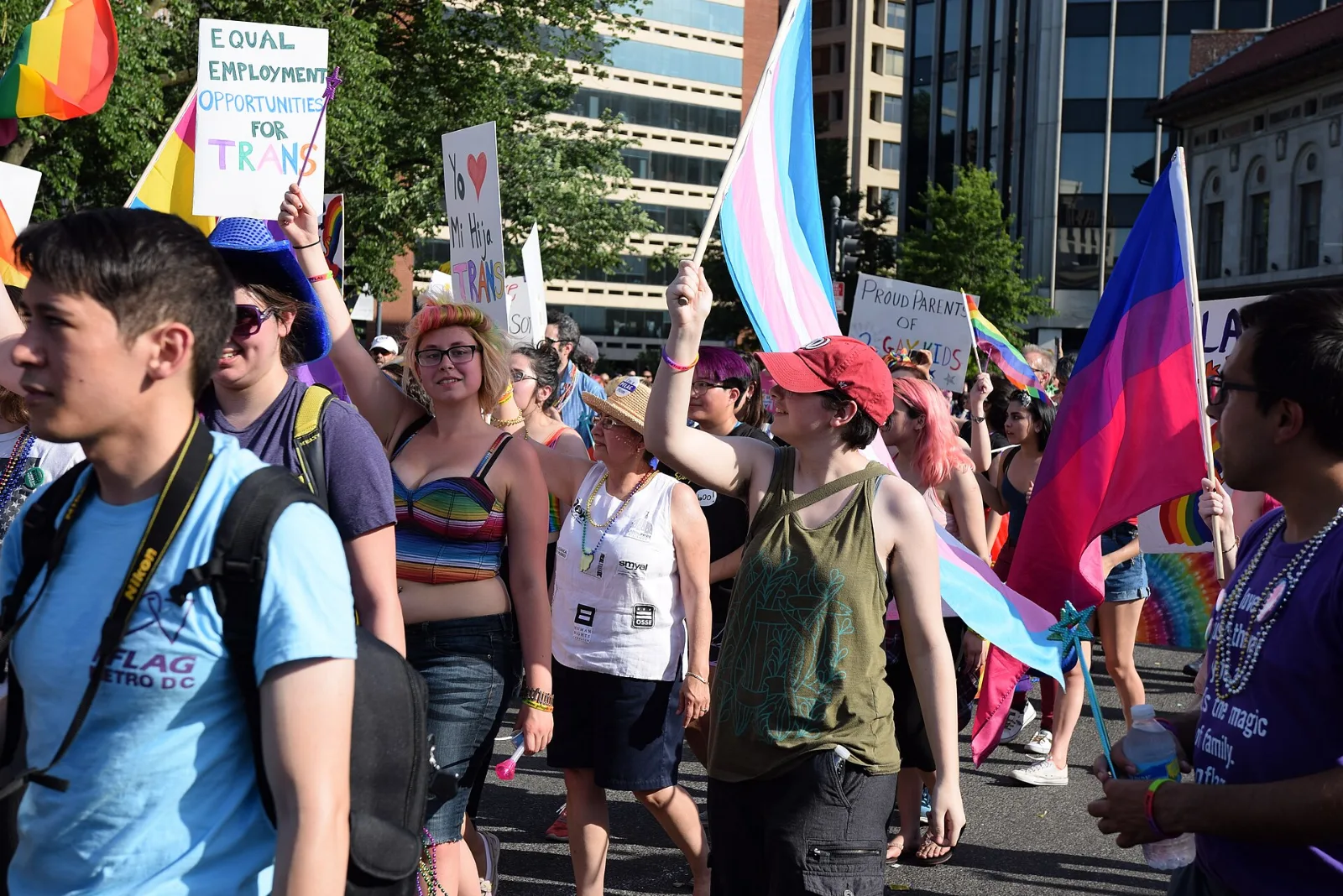
- The transgender flag at the Capital Pride Parade, Washington, D.C., 11 June 2016, beside hand-lettered placards reading "EQUAL EMPLOYMENT OPPORTUNITIES FOR TRANS" and "Yo love Mi Hija TRANS." · Credit: S Pakhrin, CC BY 2.0 · Wikimedia Commons
- A widely reused Wikimedia Commons rendering. Dlloyd made it on 23 January 2006 at 800 by 400; AnonMoos changed the pink on 22 November 2012 "based on verbal description and HuffingtonPost photo"; Keymap9 set the 3:5 ratio on 6 April 2018. Neither the palette nor the ratio comes from Helms. [2] · Credit: Dlloyd~commonswiki and later editors, after Monica Helms's design. Tagged public domain on Commons as ineligible for copyright · Wikimedia Commons
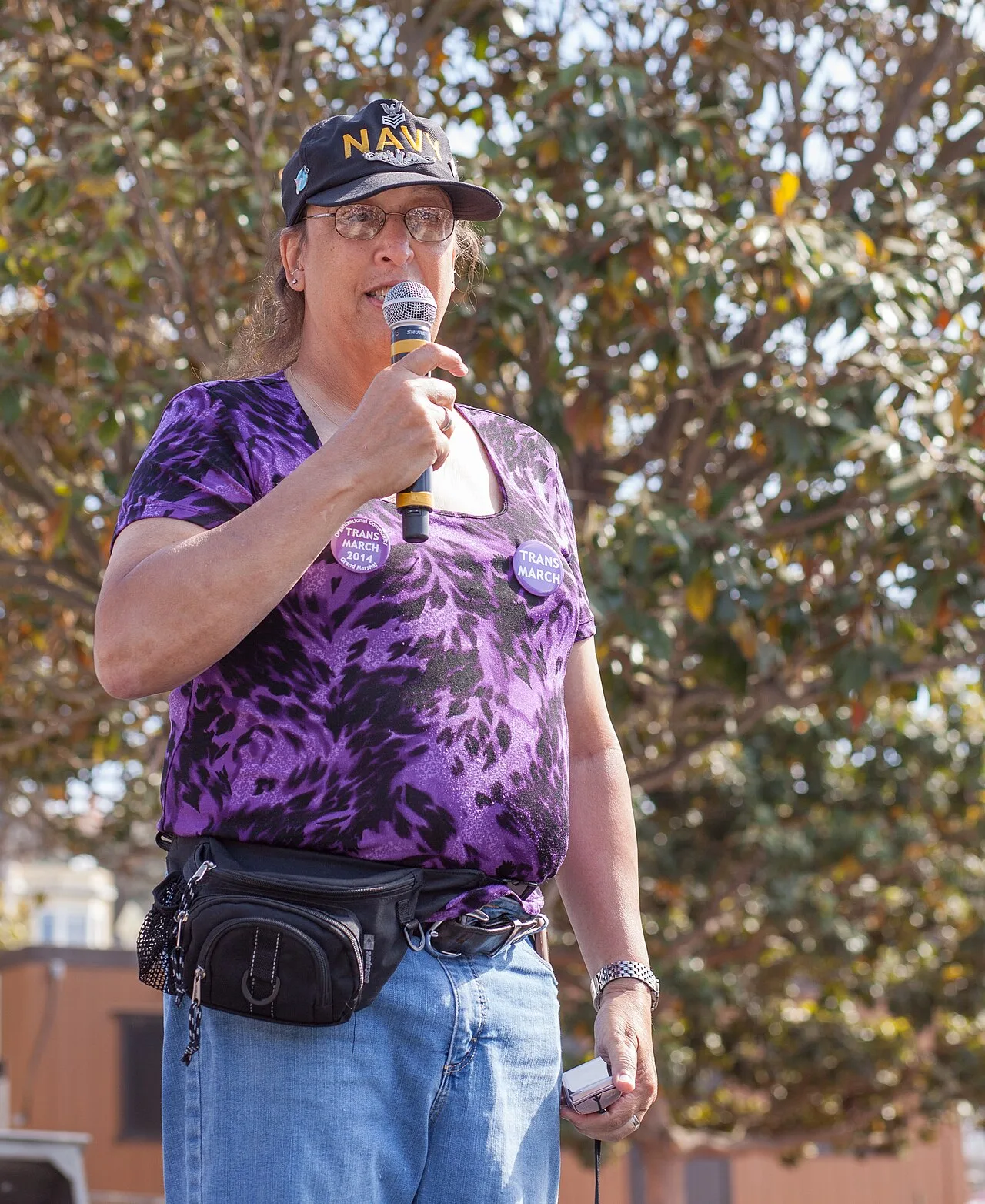
- Monica Helms speaking at the Trans March in San Francisco, 26 June 2015, in a Navy cap and two Trans March buttons, one of them reading "Trans March 2014 Grand Marshal." No flag is in the frame. [25] · Credit: Pax Ahimsa Gethen, CC BY-SA 4.0, via Wikimedia Commons · Wikimedia Commons
- Elisa Rae Shupe flying the flag on 22 June 2016, the month a court declared them non-binary. · Credit: Sandra E. Shupe, CC BY-SA 4.0 or GFDL, via Wikimedia Commons · Wikimedia Commons
- A TurnOut NC event in Charlotte, North Carolina, 20 October 2016, three weeks before the presidential election. The photographer captioned it "Attempting to stop Armageddon." · Credit: Kyle Taylor, CC BY 2.0, via Wikimedia Commons · Wikimedia Commons
- WorldPride, Madrid, 1 July 2017, with the Asociación WADO LGTBI+ Castilla-La Mancha. The Transgender flag is carried here among bisexual, transgender and pansexual flags. Photographed by Barcex. · Credit: Barcex, CC BY-SA 3.0 · Wikimedia Commons
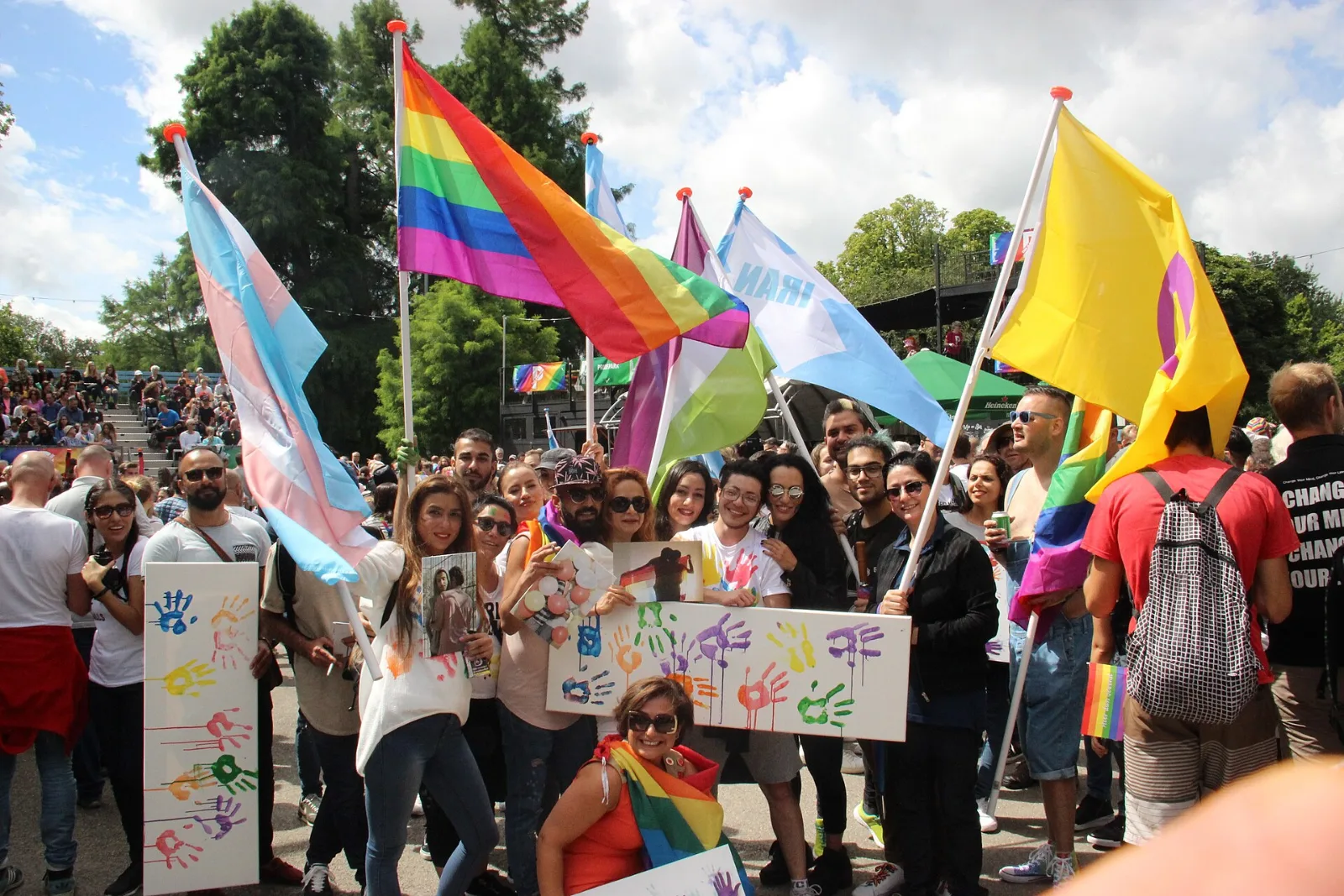
- Amsterdam Pride Walk, 29 July 2017, as IranPride entered the Vondelpark. The Transgender flag is carried here among transgender and intersex flags. Photographed by JoopeA. · Credit: JoopeA, CC BY-SA 4.0 · Wikimedia Commons
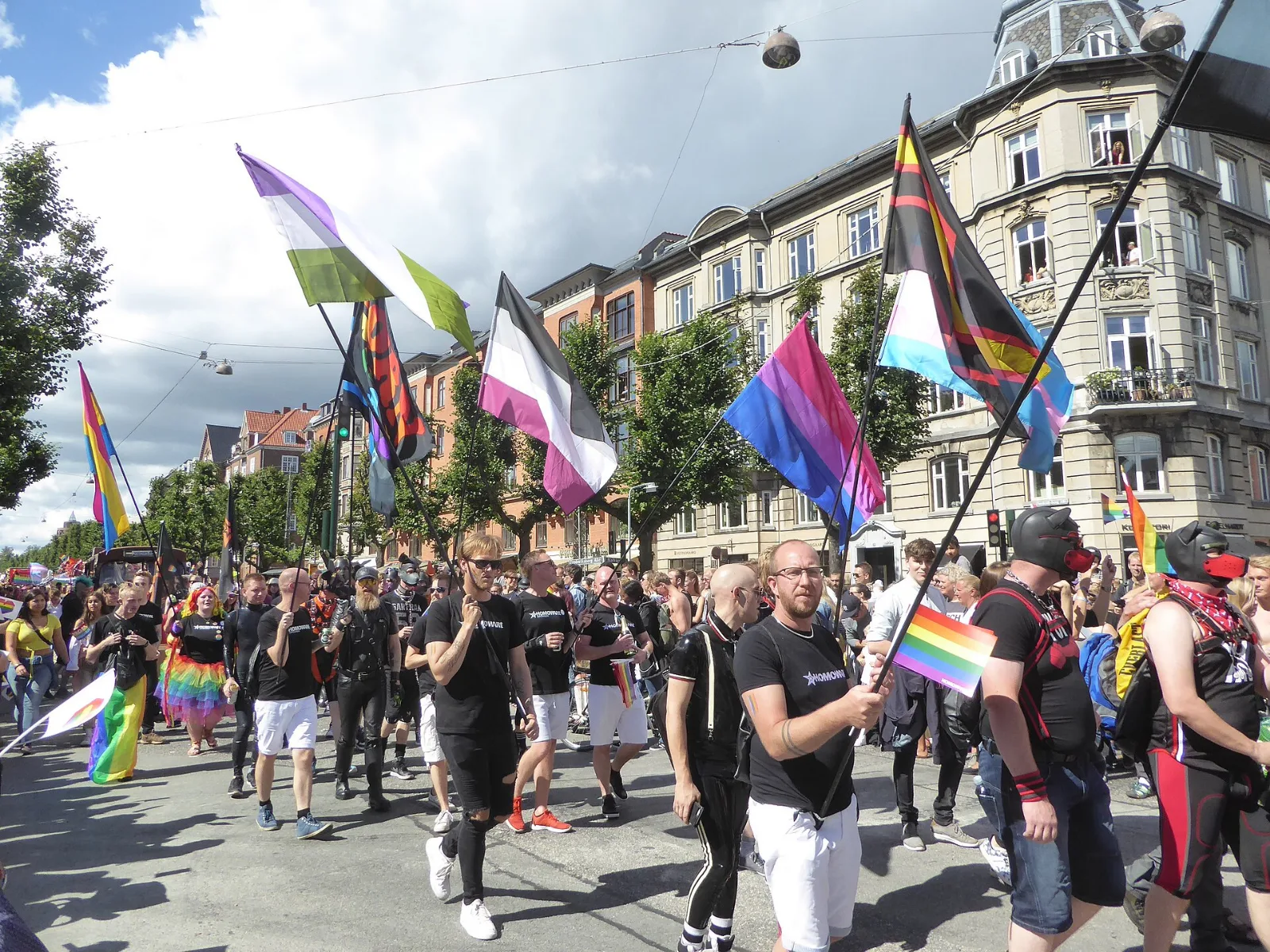
- Copenhagen Pride, Frederiksberg Allé, 19 August 2017. The Transgender flag is carried here among bisexual, transgender, bear, rubber, asexual and pansexual flags. Photographed by Leif Jørgensen. · Credit: Leif Jørgensen, CC BY-SA 4.0 · Wikimedia Commons
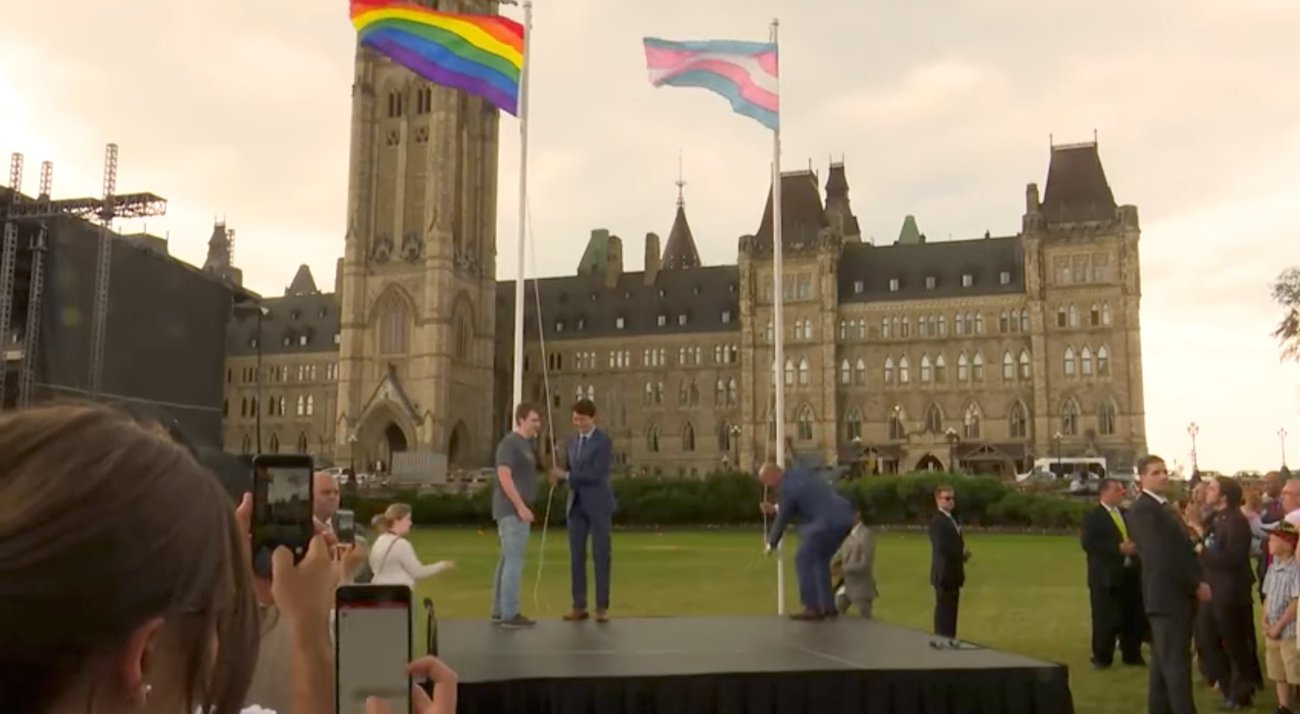
- The transgender flag and the rainbow flag raised together on Parliament Hill, Ottawa, 20 June 2018, with Prime Minister Justin Trudeau at one of the masts. Still frame from the ceremony video. [26] · Credit: Justin Trudeau – Prime Minister of Canada, CC BY 3.0, via Wikimedia Commons. Still frame extracted from the source video · Wikimedia Commons
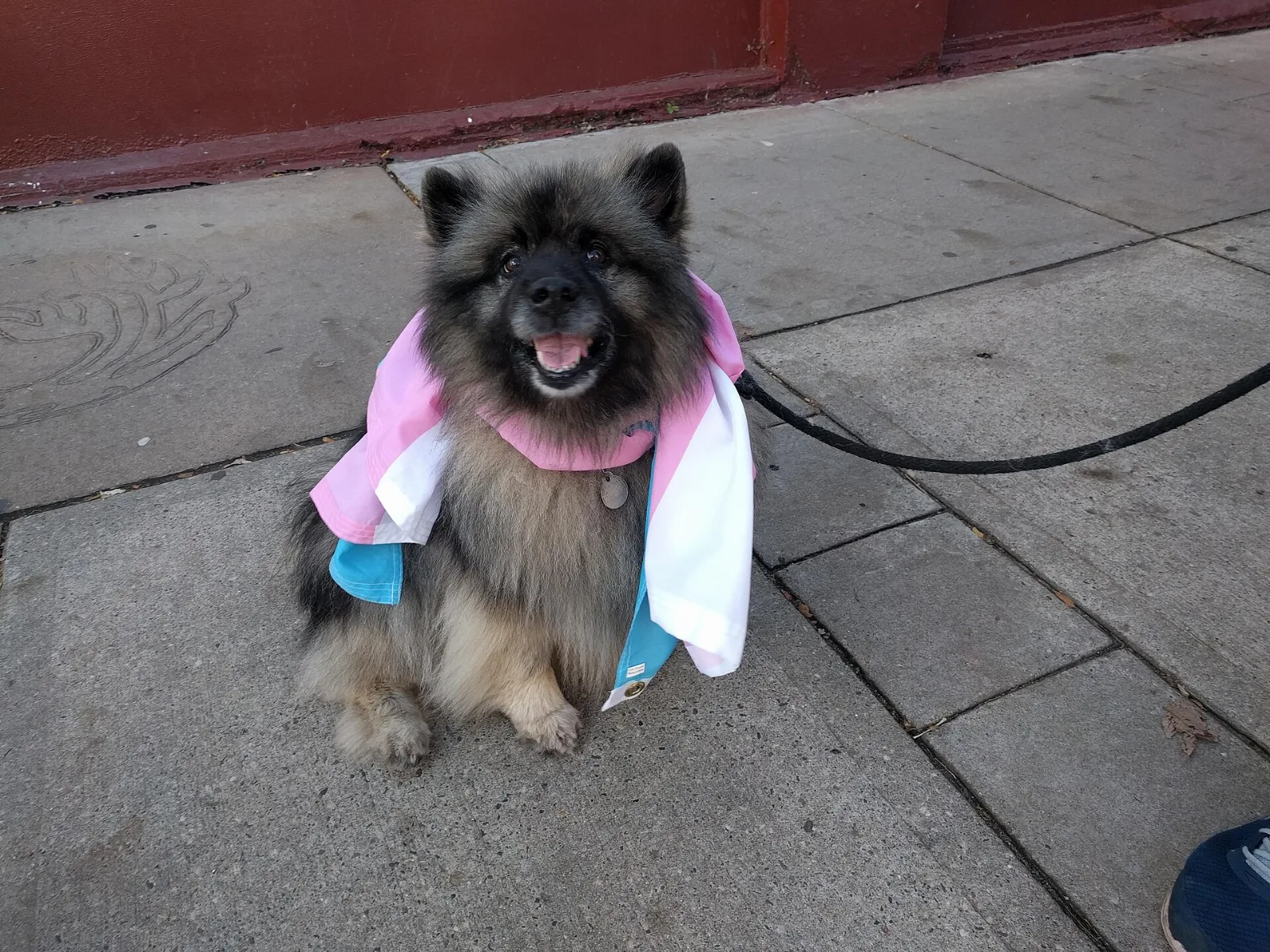
- A dog in a transgender flag scarf at the #WeWontBeErasedMN demonstration in Minnesota, 28 October 2018. · Credit: Paul2520, CC BY-SA 4.0, via Wikimedia Commons · Wikimedia Commons
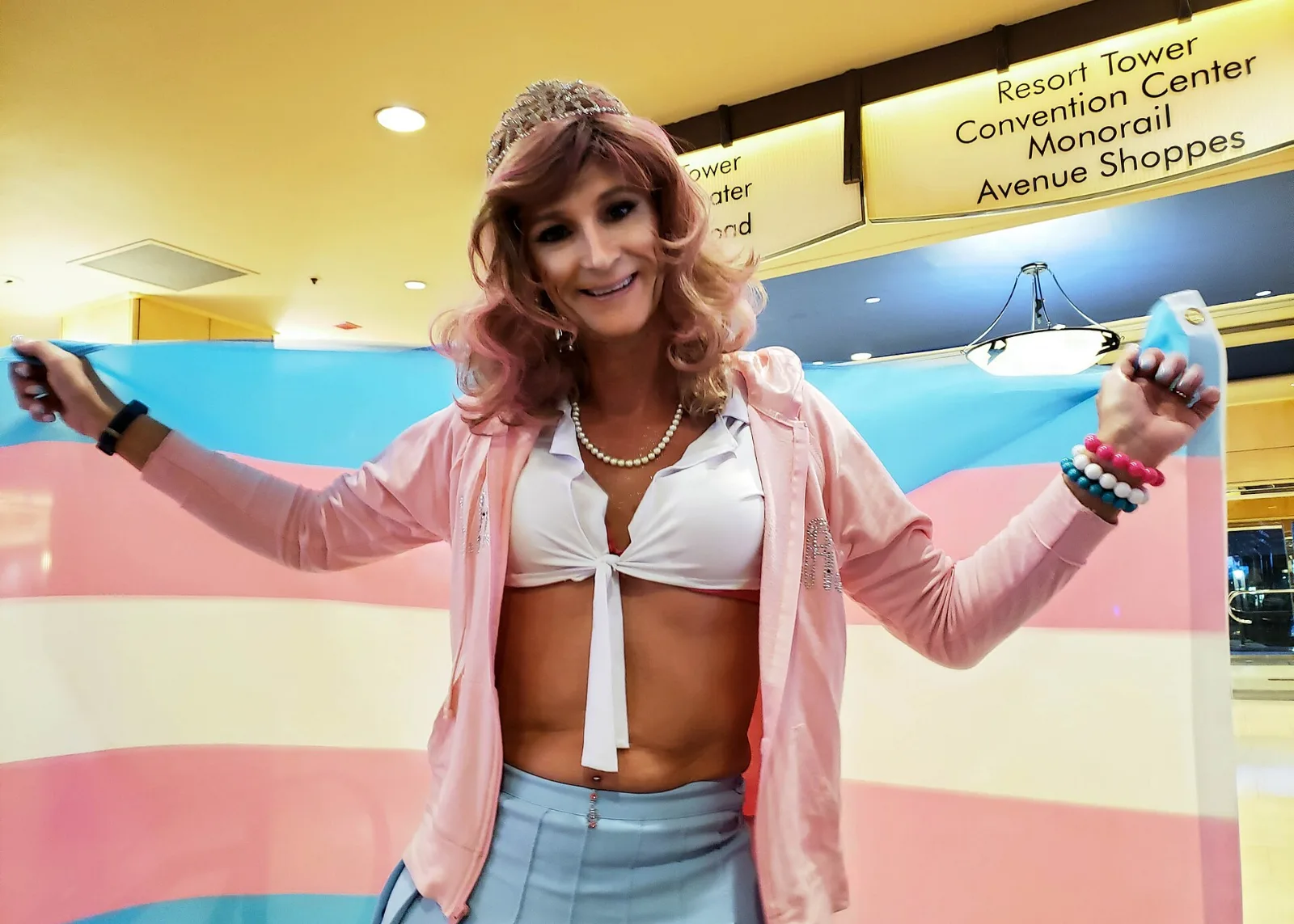
- The flag held at Bally's in Las Vegas during Viva Wildside, 14 May 2019. The photographer captioned it "Showing TG Pride colors in Las Vegas while attending our 13th annual Wildside." · Credit: Kimrydick, CC BY-SA 4.0, via Wikimedia Commons · Wikimedia Commons
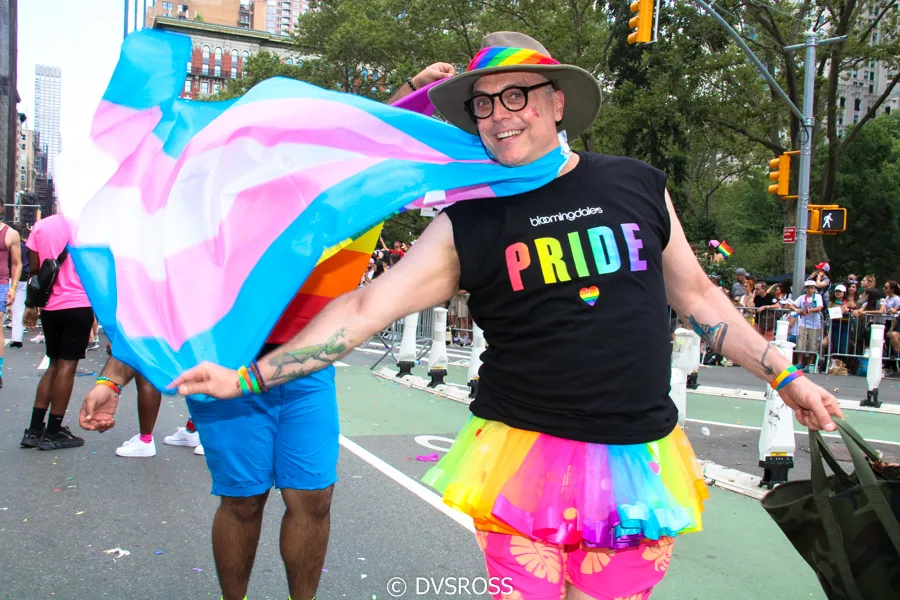
- The flag at New York Pride, 30 June 2019, the fiftieth anniversary of Stonewall and WorldPride. · Credit: DVSROSS, CC BY 2.0, via Wikimedia Commons · Wikimedia Commons
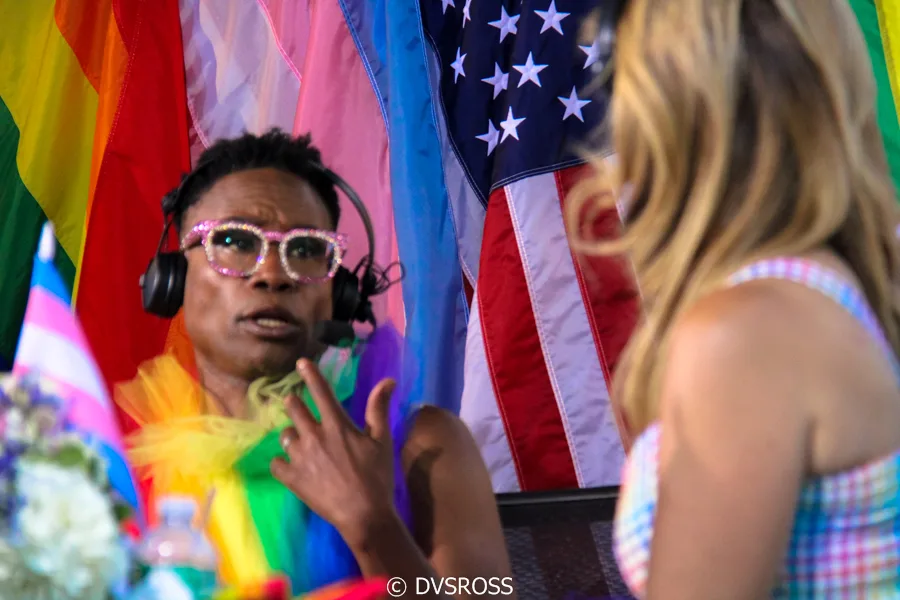
- New York Pride, 30 June 2019, with Billy Porter. Commons categorizes the frame under Billy Porter and under photographs of transgender flags in New York State. · Credit: DVSROSS, CC BY 2.0, via Wikimedia Commons · Wikimedia Commons
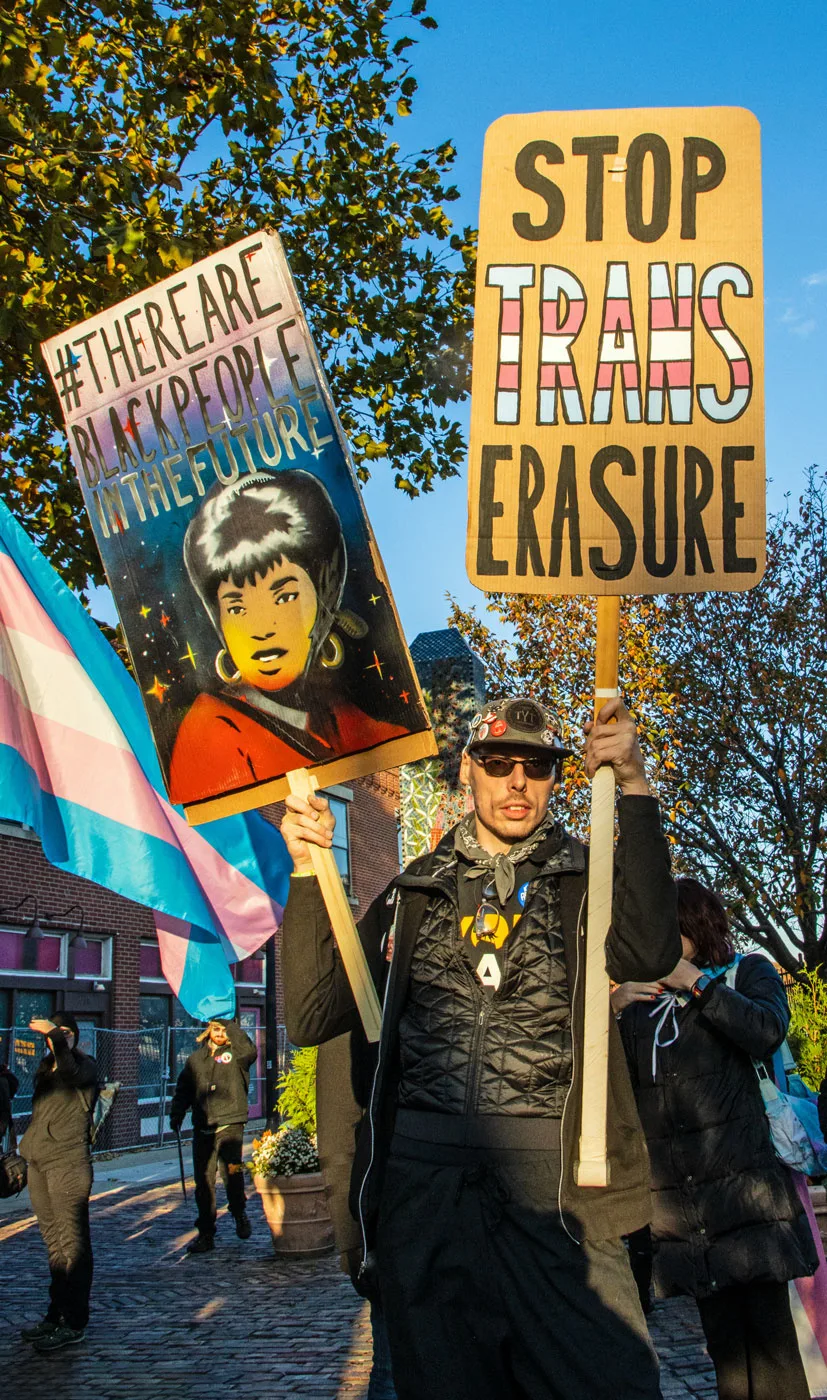
- The March for Black Trans Women in Columbus, Ohio, 3 November 2019. · Credit: Paul Becker (Becker1999), CC BY 2.0, via Wikimedia Commons · Wikimedia Commons
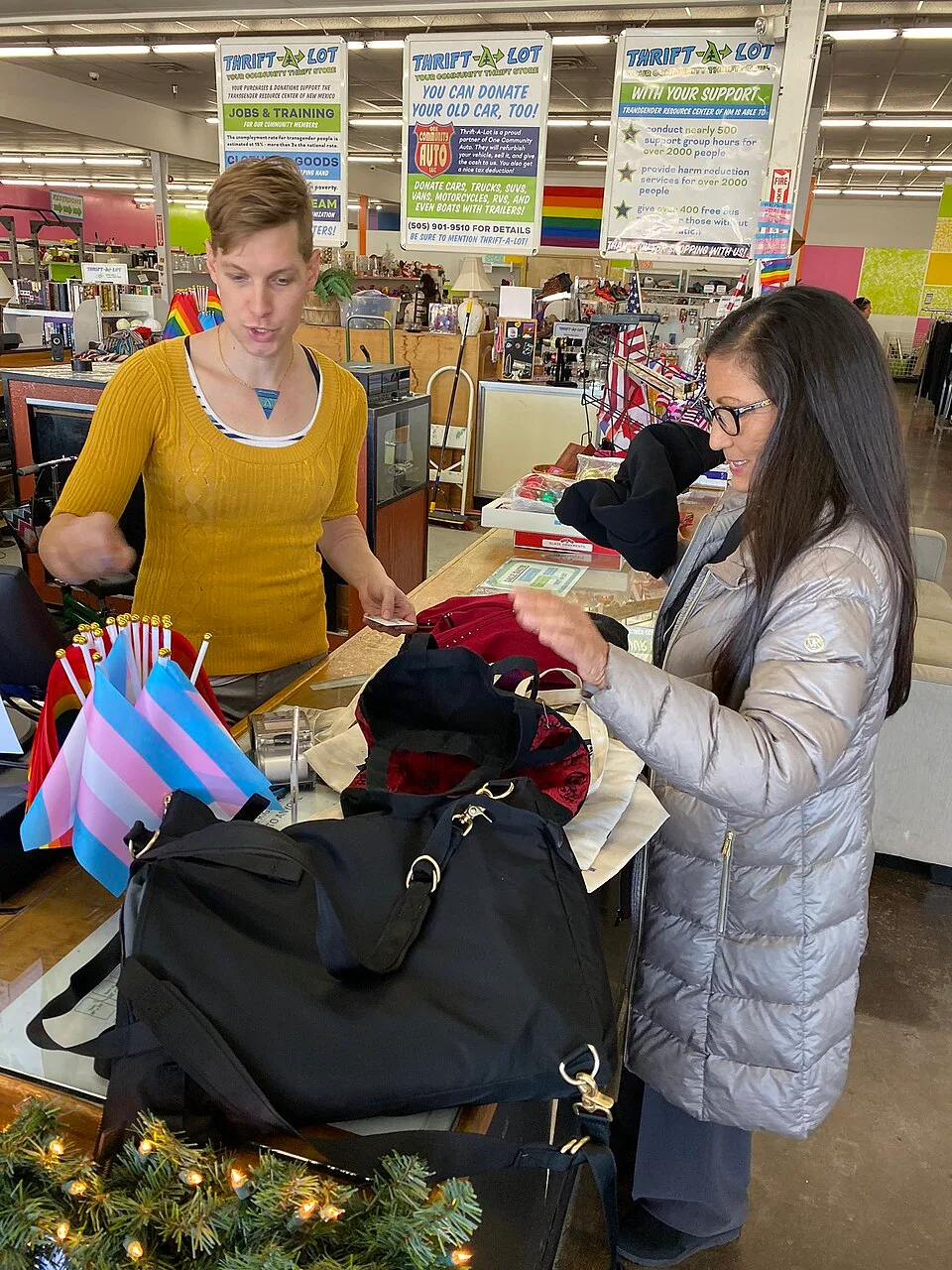
- Deb Haaland outside Thrift-A-Lot in Albuquerque, 30 November 2019, holding the flag. Her caption reads "Thrift-A-Lot supports the Transgender Resource Center." · Credit: Deb Haaland, public domain as a work posted on the official website of a member of the United States Congress · Wikimedia Commons
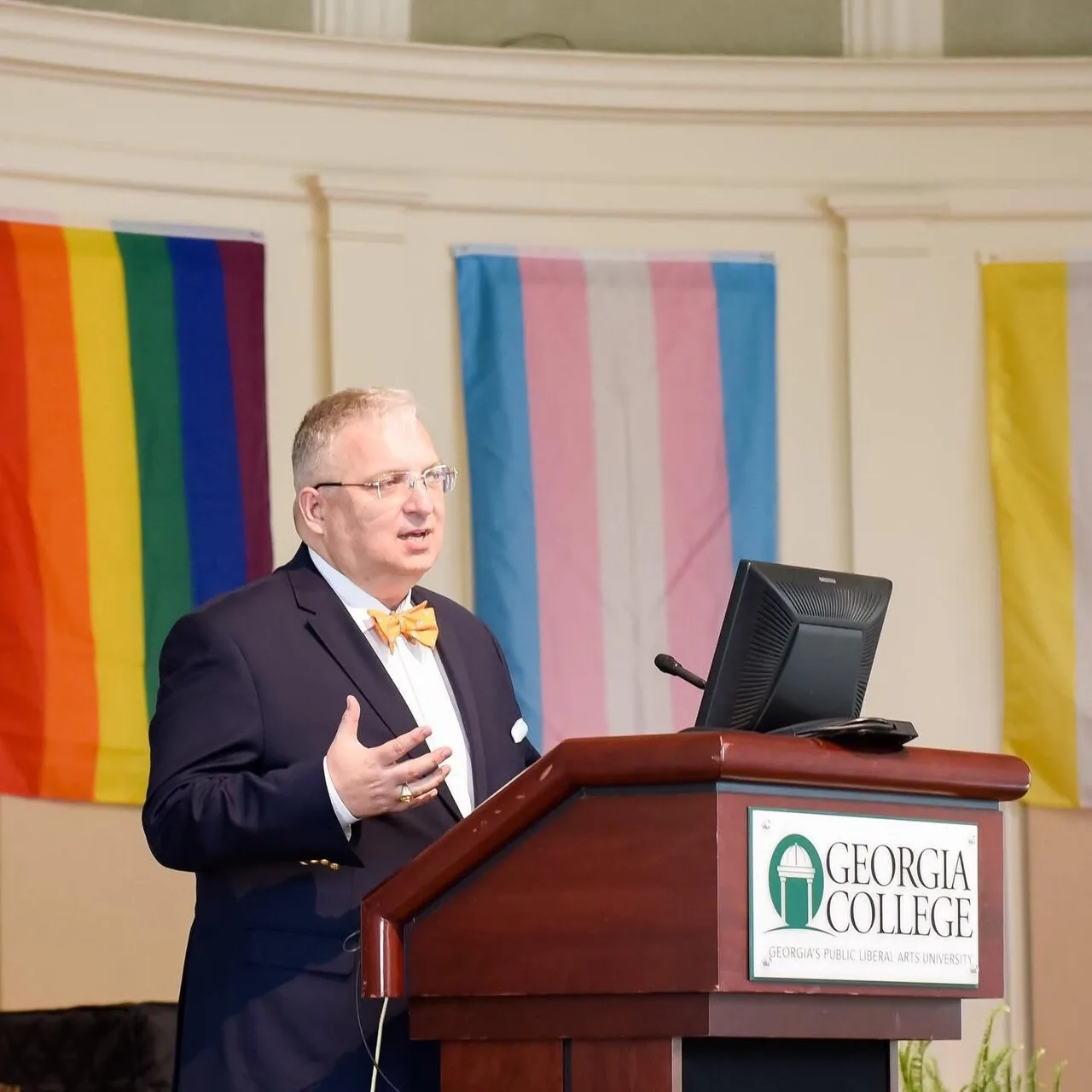
- William Perry speaking for the LGBTQ+ Alumni Affinity Group at Georgia College's Lavender Graduation, Magnolia Ballroom, May 2021, with the transgender and nonbinary flags behind him. · Credit: WPPERRY, CC0, via Wikimedia Commons · Wikimedia Commons
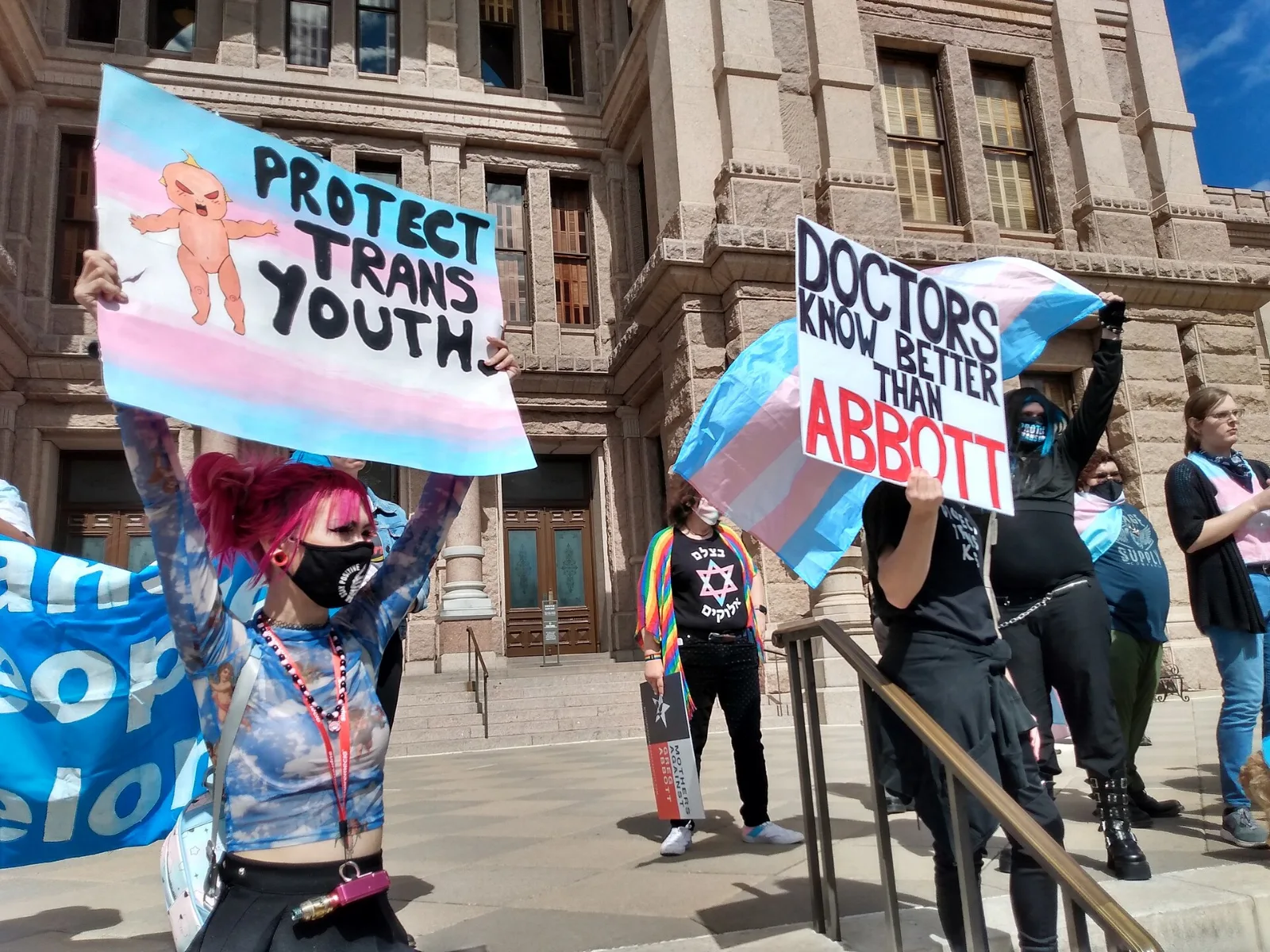
- The March for Trans Youth in Austin, Texas, 1 March 2022. · Credit: Brainy J, CC0, via Wikimedia Commons · Wikimedia Commons
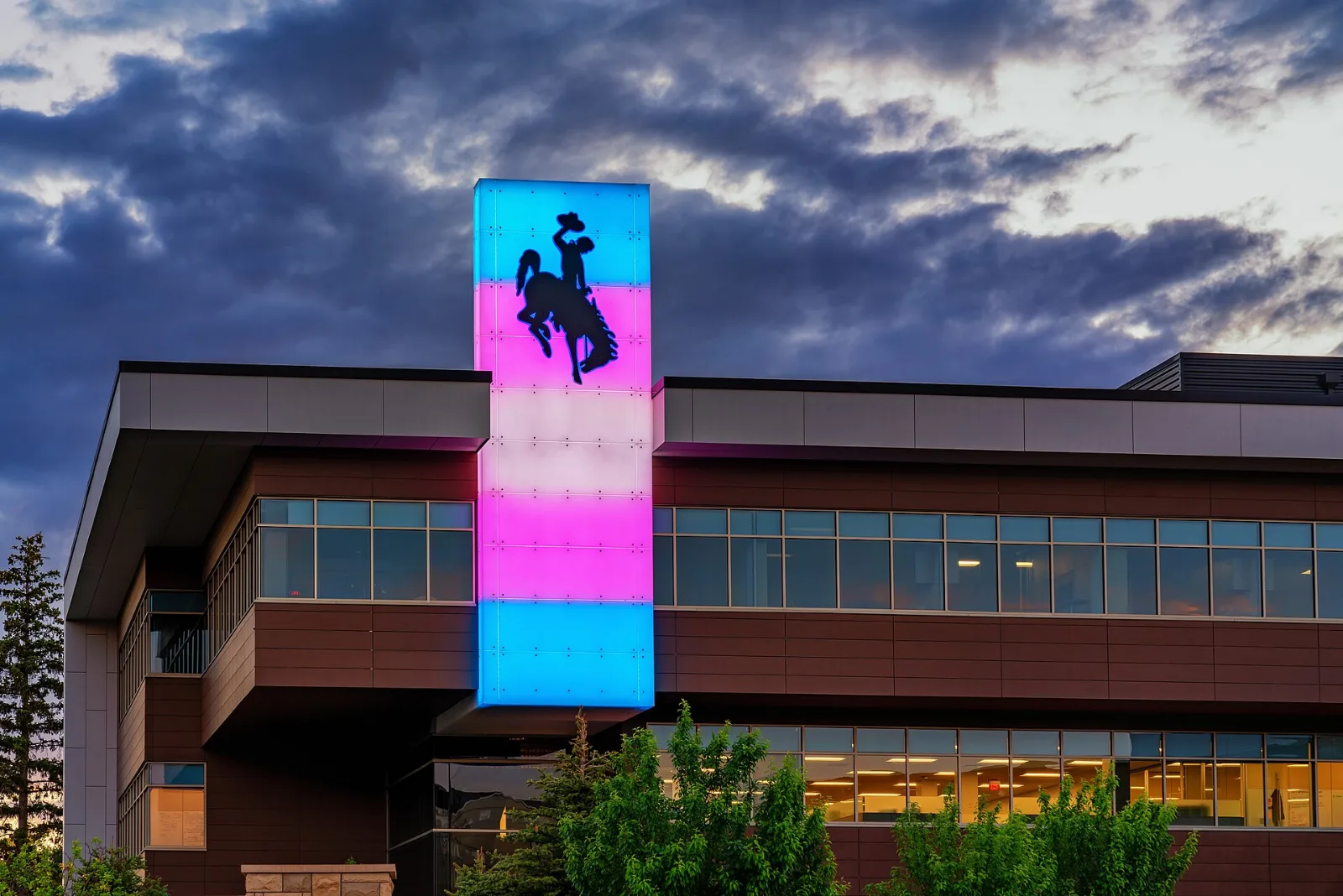
- The Marian H. Rochelle Gateway Center at the University of Wyoming in Laramie, lit in the flag's colors on 24 June 2022. The flag rendered in architectural lighting rather than cloth. · Credit: Tony Webster, CC BY 2.0, via Wikimedia Commons · Wikimedia Commons
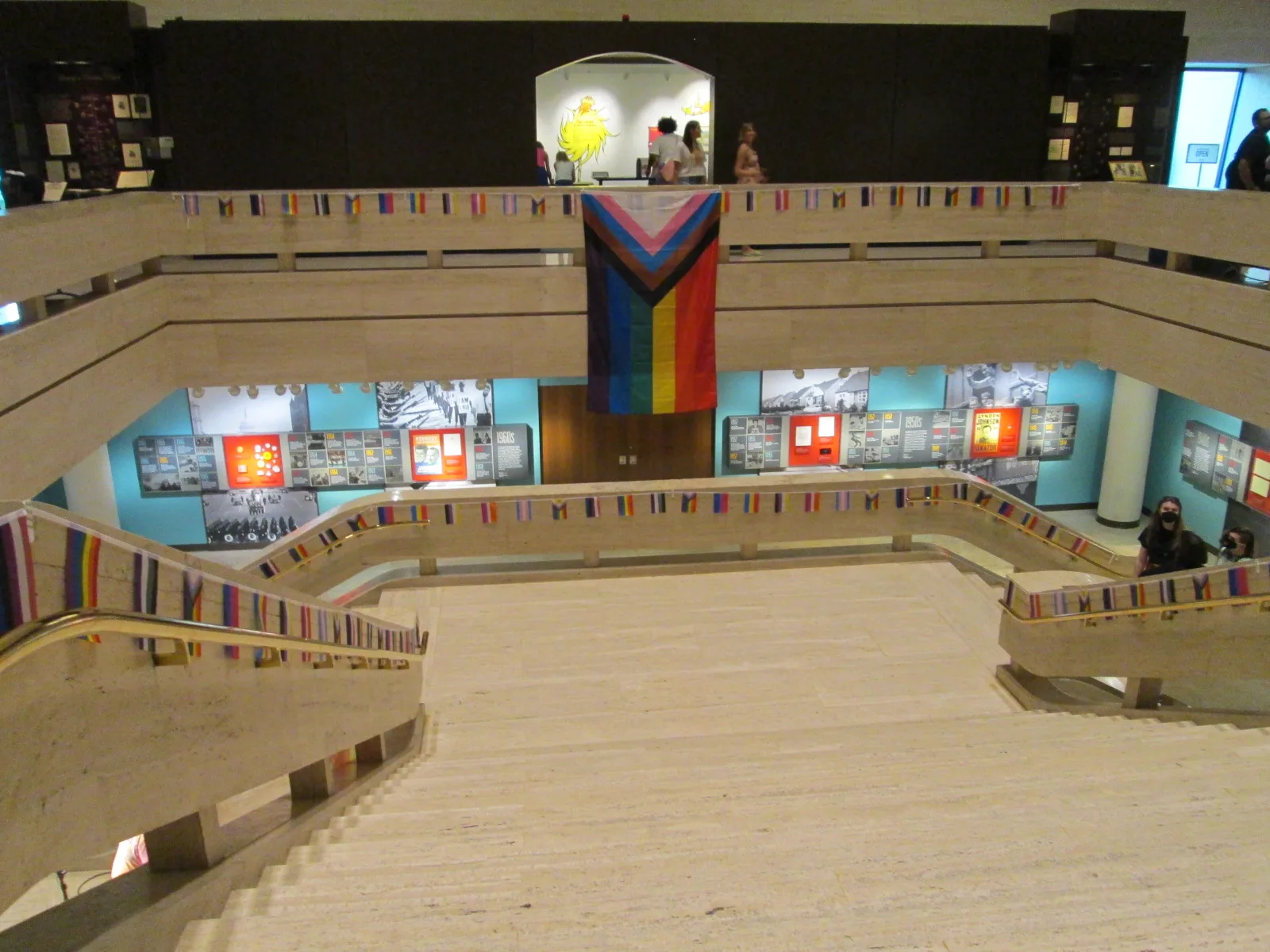
- Pride flags hung at the LBJ Presidential Library and Museum in Austin for "Y'all Means All" on 1 June 2023. Commons identifies the Progress Pride, sunset lesbian, transgender, nonbinary, genderfluid, asexual, bisexual and pansexual flags in the group. · Credit: Brainy J, CC0, via Wikimedia Commons · Wikimedia Commons
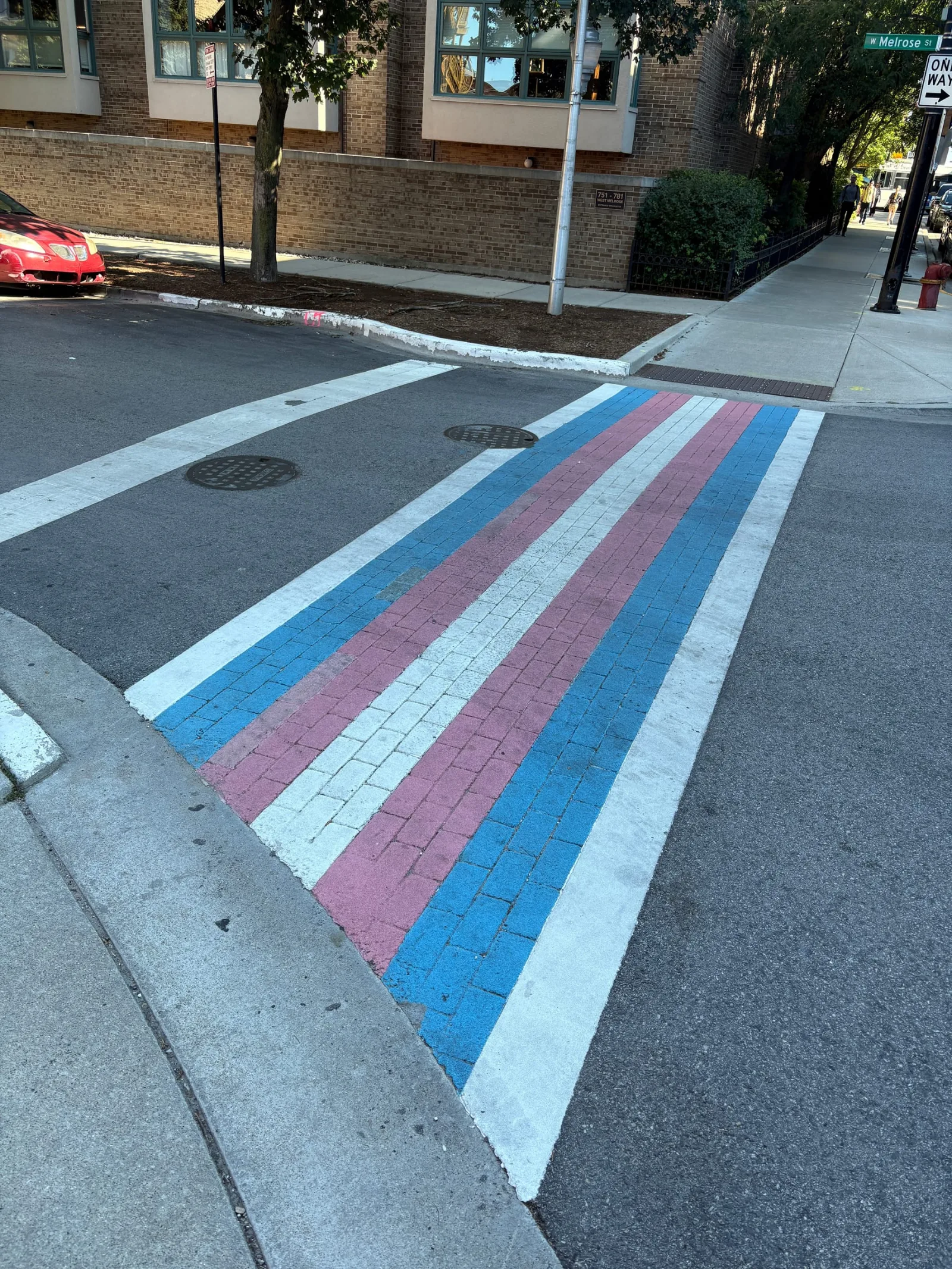
- Transgender pride crosswalk at North Halsted and West Melrose Streets in Northalsted, Chicago, July 29, 2026. The five stripes of the flag are laid into the crosswalk's brick paving and repeat symmetrically across it. · Credit: Will Montgomery · Photograph by Will Montgomery
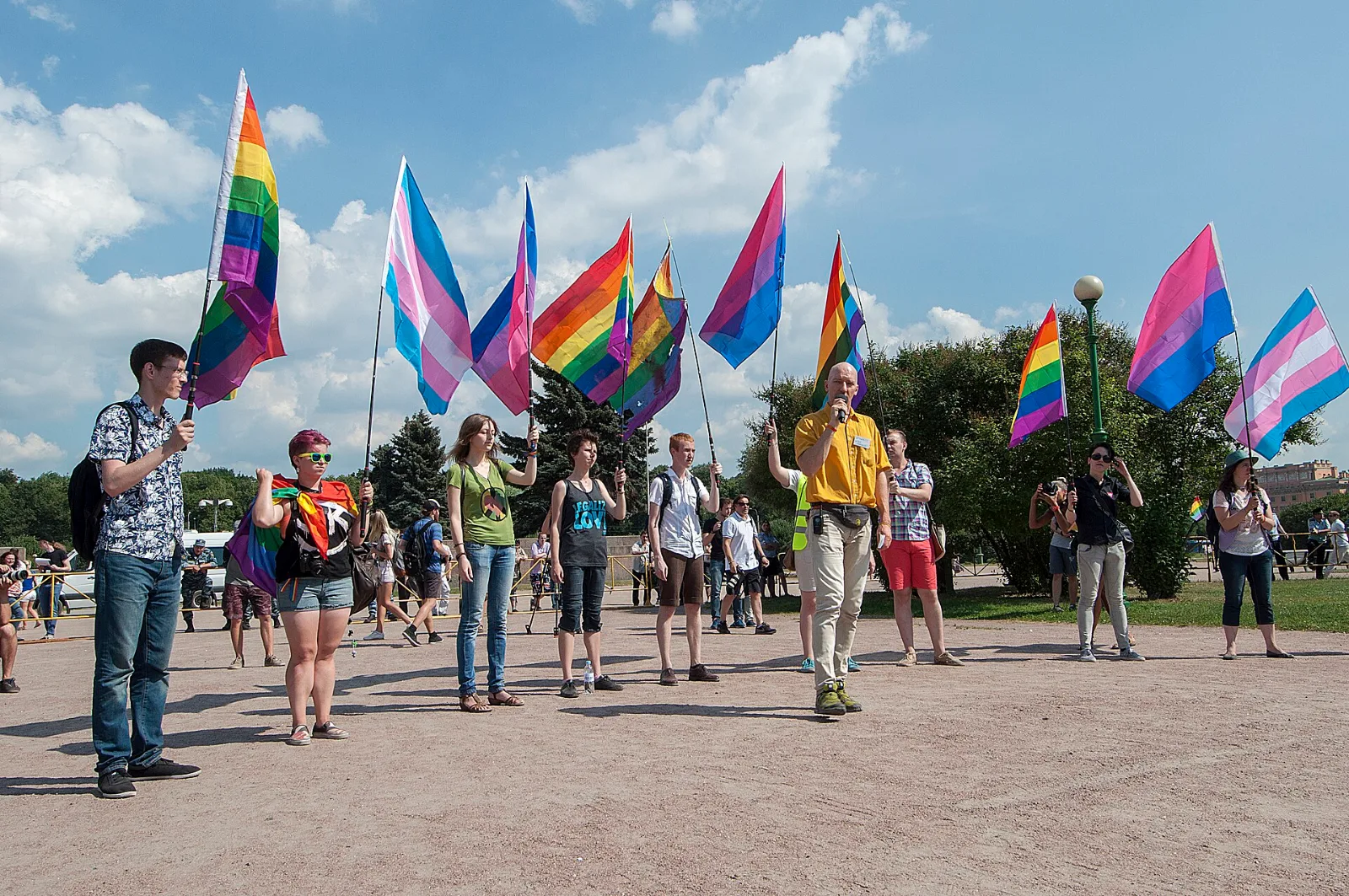
- Transgender flags flown alongside bisexual and rainbow flags at a public action during the Fifth Saint Petersburg Pride, at the Field of Mars, 26 July 2014. At least three are visible in the line. · Credit: Alek Naza, CC BY-SA 4.0 · Wikimedia Commons
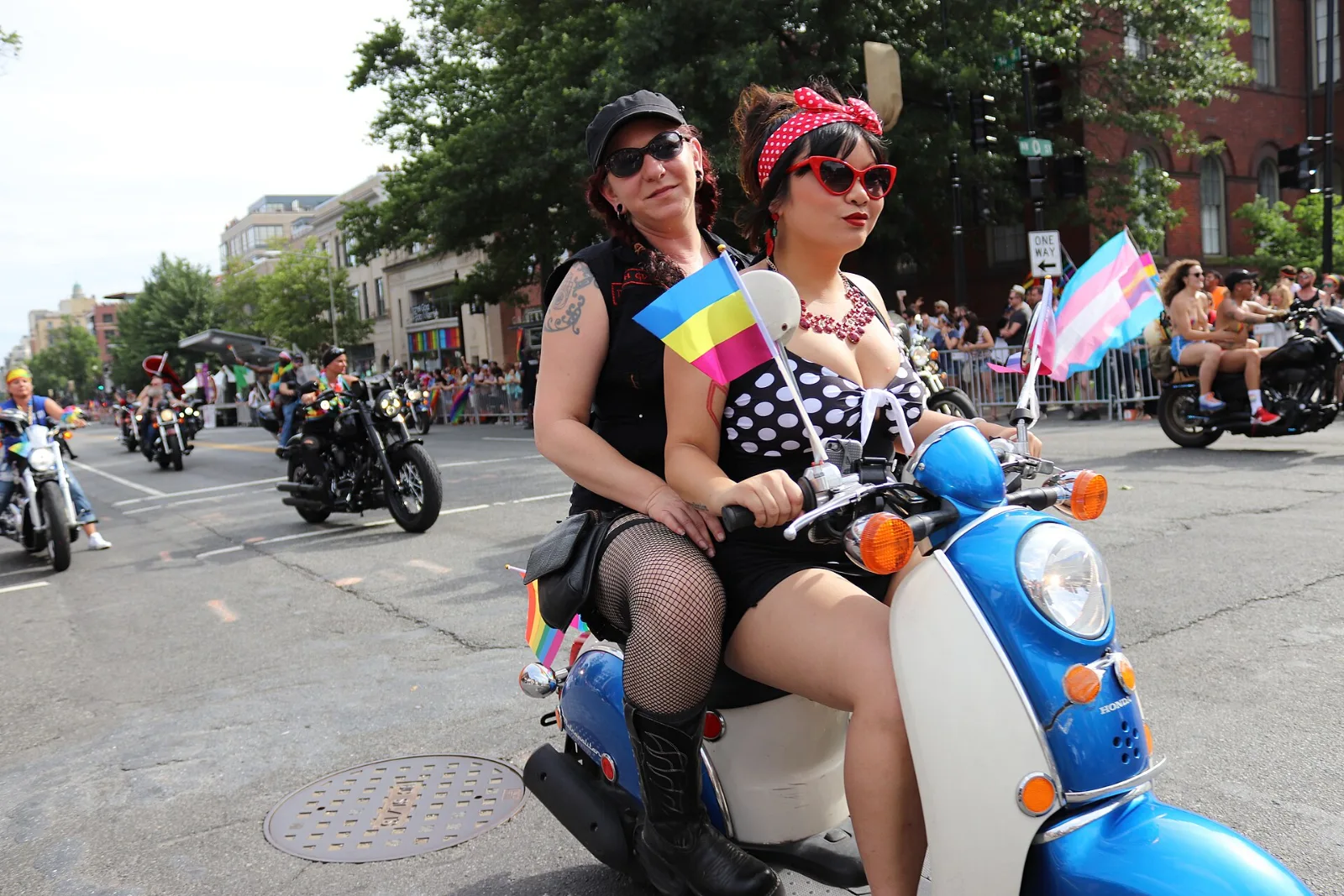
- Capital Pride Parade, Washington, D.C., 8 June 2019. A transgender flag carried by the OUT Riders Women’s Motorcycle Club, beside a pansexual flag flown in reversed order. · Credit: Elvert Barnes, CC BY-SA 2.0 · Wikimedia Commons
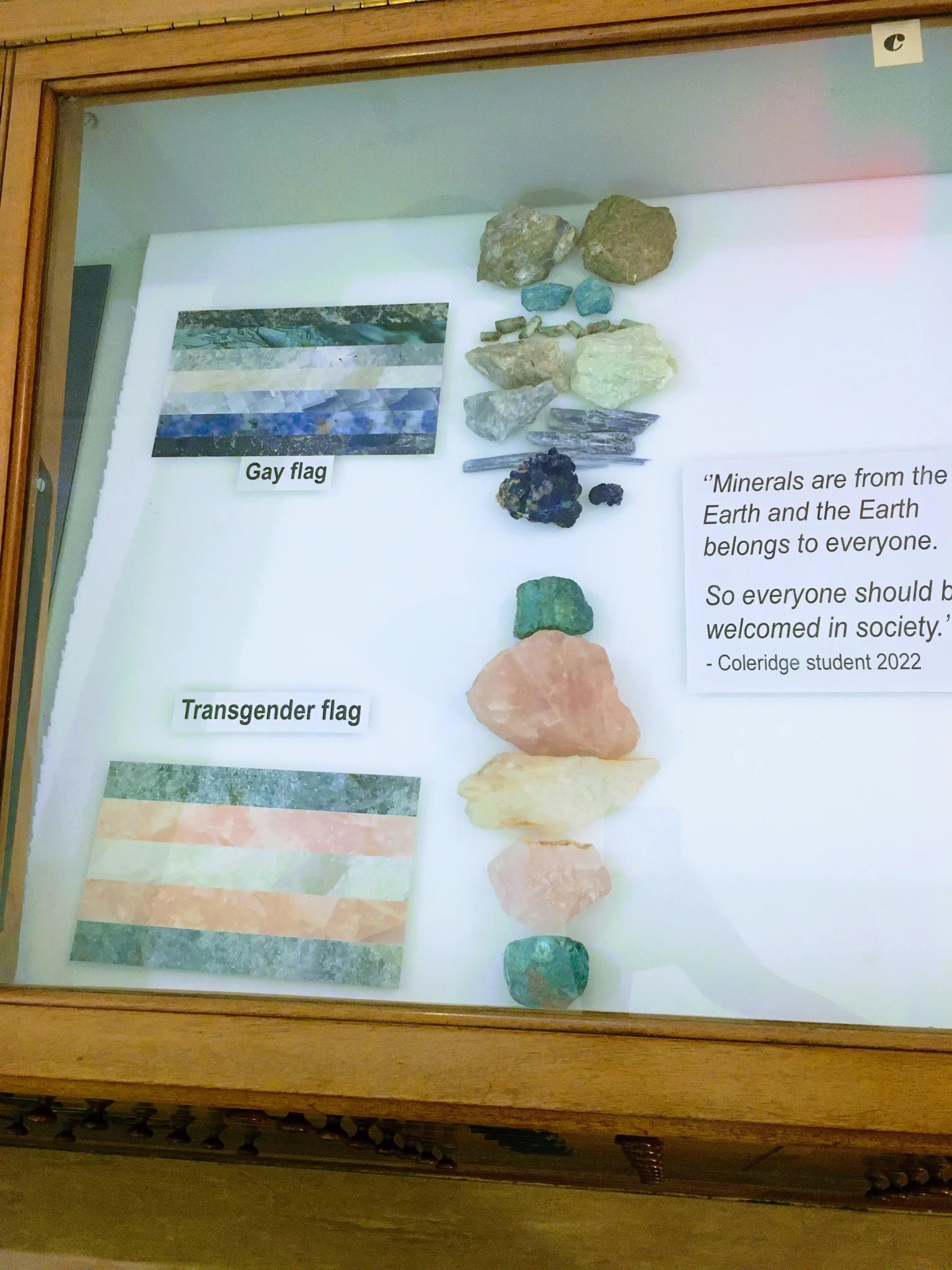
- Pride flags rendered in rock and mineral specimens in a museum display case, each flag laid out beside the stones its colours were taken from. This case shows a flag labelled "Gay flag" and the transgender flag. The case is most likely in the Cambridge geology museum: the quotation card in it is credited to a Coleridge student in 2022, and Coleridge Community College is a Cambridge school. The museum has not confirmed it. If you can add its formal name or the dates the display ran, contribute. · Credit: feral-critter, via Tumblr · feral-critter on Tumblr