Two-Spirit Pride Flag (2021, sirieko)
Indigenous Pride Flag ·
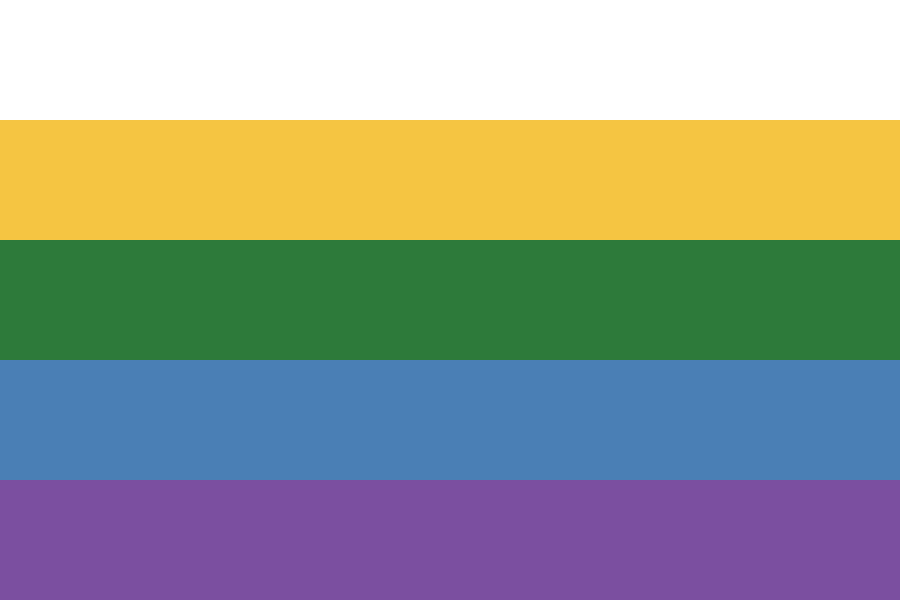
Five horizontal stripes, white, yellow, green, blue and purple, posted by the Twitter user sirieko on 4 July 2021. It is the only Two-Spirit flag in the archive that uses neither the rainbow nor Indigenous iconography, carrying its meanings in the stripe colours alone: LGBTQ+ community membership, ancestral connection, connection to Mother Earth and tribe, the blessing of being Two-Spirit, and spiritual capabilities. The LGBTQIA+ Wiki, which lists it as the fourth of four designs and opens by saying there is no widely recognized Two-Spirit flag, is the only source specific to it; the MOGAI Wiki copy declares itself content taken from that page. sirieko's nation and Indigenous identity are not stated in the record. [1] [2]
Key facts
- Designer
- sirieko
- Created
- First documented public use
- In use
- 2021–present
- Aspect Ratio
- 3:5 · standard
- Stripes
- 5
- Represented Identity
- Two-Spirit
Also known as
- Sirieko Two-Spirit Flag
- Five-Stripe Two-Spirit Flag
Status Variant Proposed
Archive categories Indigenous Pride Flags
Overview
To provide a Two-Spirit pride flag with its own distinct color language, centering Indigenous spiritual and cultural meanings rather than building on the rainbow pride tradition. [1]
Twitter user sirieko posted the design on 4 July 2021. It departs from the rainbow base that the earlier Two-Spirit flags use, replacing it with five stripes whose meanings are given individually rather than inherited from the Pride flag tradition. The LGBTQIA+ Wiki, which records the design, opens its flag section with the statement that "There is no widely recognized two spirit flag, however there are a few designs", and lists sirieko's as the fourth, after Miigwan's sun-and-moon design of 30 April 2019, 2Sanon's feather-and-circle design submitted to ask-pride-color-schemes on 17 December 2016, and a proposal by snozzzz of lgbtqa-pride-icons. [1]
Identity & Context
- Represented Identity
- Two-Spirit
- Subcommunity
- Indigenous North American LGBTQ people who hold culturally specific gender/social roles
- Movement
- Two-Spirit visibility, Indigenous Queer pride
- Diaspora Context
- North American Indigenous communities
- Religious Context
- The flag's symbolism explicitly references spiritual dimensions of Two-Spirit identity, 'spiritual capabilities' and 'connection to ancestors'
- Racial / Ethnic Context
- Exclusively Indigenous North American identity
Creators
The Creator
sirieko
Designer
Identified only as the Twitter user sirieko, who posted this five-stripe Two-Spirit design on 4 July 2021. No nation, community affiliation or further detail appears in the record, and the original post has not been located. [1]
Attribution notes
sirieko is named by the LGBTQIA+ Wiki only as a Twitter user. The wiki gives no nation, community, pronouns or biographical detail, and no post by the account has been located. Whether sirieko is Indigenous is not stated anywhere in the record. [1]
Origin
- Place Type
- Twitter post
- Digital Origin
- Yes
Digital origin; no verified physical location.
Posted on Twitter on July 4, 2021 by user sirieko. The original tweet may no longer be accessible. [1]
Indigenous Identity Context
- Territory
- Turtle Island
- Language Group
- Ojibwe (the source of niizh manidoowag, from which the English term is translated); the flag itself carries no language attribution
- Geographic Scope
- pan-Indigenous
- Colonial State
- Canada, United States
- Traditional Knowledge Notice
- Yes
- Affiliation Type
- identity_framework
- Pan-Indigenous
- Yes
This flag departs entirely from the rainbow base. Its five horizontal stripes carry meanings rooted in Two-Spirit experience: LGBTQ+ community membership, ancestral connection, connection to Mother Earth and tribe, the blessing of being Two-Spirit, and spiritual capabilities. It uses no rainbow and no Indigenous iconography. Two-Spirit is an exclusively Indigenous North American identity; the record names sirieko only as a Twitter user and does not state their nation or whether they are Indigenous. [1]
Pan-Indigenous in scope. The designer's nation and Indigenous identity are not stated in the record. [1] [1]
Dates & Chronology
- Year Created
- Exact date
- First public use
- Period in Use
- 2021–present
The design circulates through wiki documentation. The LGBTQIA+ Wiki records it, and the MOGAI Wiki reproduces that record verbatim. [1] [2]
The wiki's count of four designs omits others the archive holds, among them a feather-and-circle flag of unknown provenance uploaded to Wikimedia Commons in 2011, Harlan Pruden and Alex Wilson's 2005 design associated with Albert McLeod's organizing, and later flags. The count is the wiki's, not a census. [1]
Lineage
Part of the Two-Spirit flag family but departs from the rainbow-base tradition established by the Zoccole (2005) and 2Sanon (2016) designs. Where those earlier designs placed Indigenous symbols onto or alongside the rainbow, sirieko's flag uses an independent color language with no rainbow element. [1]
Colors & Symbolism
Each stripe carries one dimension of Two-Spirit experience: community membership, ancestral connection, connection to Mother Earth and tribe, the blessing of the identity itself, and spiritual capacity. The order runs from white at the top through earth tones to purple. [1]
| Colour | Hex | Meaning | Note |
|---|---|---|---|
| White | #FFFFFF | Two-Spirit individuals who are also members of the LGBTQ+ community [1] | Approximation, no official palette published |
| Yellow | #F5C542 | Native's connection to their ancestors, joyous spirit, and the sunlight that brings warmth [1] | Approximation, no official palette published |
| Green | #2D7A3A | Native's connection to their Mother Earth and their tribes [1] | Approximation, described as 'dark green' in sources |
| Blue | #4A7FB5 | The blessing that being Two-Spirit is, the wisdom they have access to, and the perspective they're able to share [1] | Approximation, no official palette published |
| Purple | #7B4FA0 | Their spiritual capabilities and relationship with the universe [1] | Approximation, no official palette published |
This flag has no official digital palette. Color values shown are approximate.
These meanings are given in a single paragraph on the LGBTQIA+ Wiki, whose wording is unchanged between captures of July 2022 and September 2024. The MOGAI Wiki carries the same paragraph word for word and labels its own page as content copied from the LGBTQIA+ Wiki, so it repeats the description rather than confirming it. No statement by the designer has been located, so whether the wiki's wording is sirieko's own is not established. [1] [2]
No official hex values have been published. The original tweet may no longer be accessible. Colors are approximations based on descriptive sources. The SVG uses these provisional values pending verification against the original image.
Design
- Aspect Ratio
- 3:5 · standard
- Orientation
- horizontal
- Stripe Count
- 5
- Layout
- horizontal_stripes
- Stripes (Top → Bottom)
- White, Yellow, Green, Blue, Purple
Five equal horizontal stripes.
Five equal horizontal stripes from top to bottom: white, yellow, dark green, blue, purple. No symbols or additional elements.
Five equal horizontal stripes. From top to bottom: white, golden yellow, dark green, medium blue, and purple.
Usage & Adoption
- Online Usage
- Documented on LGBTQIA+ Wiki, MOGAI Wiki, Taimi Wiki, and other pride flag guides
- Current Status
- active
Circulates primarily as one variant among several in wiki-style pride flag guides. Has not achieved the widespread commercial adoption or institutional recognition of the 2Sanon design. [1][2]
Image Archive
Flag design
Discourse & Debates
- Whether a Two-Spirit flag should build on the rainbow at all. The three designs the LGBTQIA+ Wiki lists before this one either sit on the Pride flag or borrow its structure; 2Sanon's is described there as "typically put over the gay flag". sirieko's uses no rainbow element and no Indigenous iconography, carrying its meanings in the stripe colours alone. [1]
Common misidentifications
- Reference pages titled "Two-Spirit Pride Flag" often describe the 2Sanon feather-and-circle design on a rainbow field rather than this one; Mid-South Pride's page of that title describes a flag with feathers and circles and does not mention sirieko. [3]
The English term two-spirit was proposed by Elder Myra Laramee in 1990, at the third annual inter-tribal Native American and Indigenous gay and lesbian conference in Winnipeg, as a translation of the Ojibwe niizh manidoowag. It was coined to displace the anthropological term berdache, and has been criticised by communities that already have their own terms and by people who read a binary into it. [1]
Footnotes & Citations
Sources and footnotes 6 sources
- 1. Community Two Spirit, LGBTQIA+ Wiki. LGBTQIA+ Wiki. Accessed 2026-08-16 · Archived version
- 2. Community Two Spirit, MOGAI Wiki. MOGAI Wiki (Miraheze). Accessed 2026-08-16 · Archived version
- 3. Community Two-Spirit Pride Flag. Mid-South Pride. Accessed 2026-08-16
- Two-Spirit Pride Flag. Good Good Good. Accessed 2026-03-18
- Social media snozzzz Two-Spirit flag proposal. snozzzz. lgbtqa-pride-icons (Tumblr) (2019-09-01). Accessed 2026-03-18
- Two-spirit Pride. VexiWiki (Fandom). Accessed 2026-03-31
Image Sources
- Rendering
- two-spirit-2021-sirieko
- The 2021 Two-Spirit Pride Flag by sirieko. Five horizontal stripes representing aspects of Two-Spirit identity. This entry is a work in progress, observing OCAP and CARE principles, and seeking Indigenous community review. · SVG reconstruction (approximate hex)