Queer Pride Flag
Identity Pride Flag ·
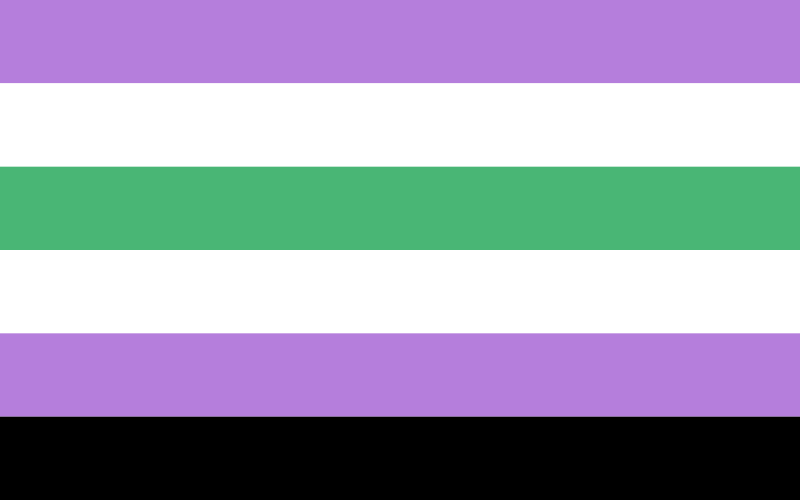
A nine-stripe flag for the reclaimed term Queer, designed by Pastelmemer and published on the Pride-Flags DeviantArt archive on 17 August 2015, which gives the source as the designer's own profile. [1] The pinks and blues beside each other stand for same-gender attraction, orange and green for nonbinary people, and black and white for the ace, aro and agender spectrum. [1][2] An earlier version set the same colours as vertical stripes behind a black capital Q; the horizontal version was made around the same time and is the one that spread. [3][2]
Key facts
- Designer
- Pastelmemer
- Created
- First dated publication
- In use
- 2015-present
- Aspect Ratio
- 3:5 · standard
- Stripes
- 9
- Represented Identity
- Queer
Also known as
- Queer Flag
Status Proposed
Archive categories Inclusive and Progress Pride Flags
Overview
To provide a visual symbol for people who identify with the reclaimed term "Queer" broadly, rather than with a more specific sexual orientation or gender identity label.
The flag was made in 2015, while Queer was being reclaimed as a broad umbrella term. Its own publication is careful about that reclamation, describing Queer as "a term that has been embraced and reclaimed by some of the MOGAI community as a symbol of pride, representing individuals who fall out of the gender and sexuality “norms”", and adding: "Not every MOGAI person likes or uses the term queer and you should never refer to someone as queer unless they specifically tell you that's what they want." [1][2] Two arrangements exist. The version documented as the first set the colours as nine vertical stripes with a black capital Q centred over them; a horizontal version without the Q was made around the same time, and that is the one that spread. [3][2]
Identity & Context
- Represented Identity
- Queer
"Queer" is used here as a broad reclaimed identity term encompassing people who do not fit neatly into other specific identity categories. The flag attempts to represent this expansive, umbrella usage.
Creators
The Creator
Pastelmemer
designer
Pastelmemer, later PastelRoswell, designed the nine-stripe Queer Pride Flag; the 2015 DeviantArt publication links their profile as the flag's source. [1] They also designed the omnisexual flag. By March 2020 they were selling Queer Pride merchandise through Redbubble, using the lavender revision of their own design rather than the original. [3][4]
Attribution notes
The Pride-Flags DeviantArt archive published the flag on 17 August 2015 and credits it plainly: "Flag source: pastelmemer.deviantart.com". [1] pride-color-schemes credits "@pastelmemer" in July 2016, and a 2020 account of the flag's origin calls it the work of "deviantart user pastelmemer (pastelroswell on tumblr)". [2][3] Pastelmemer also designed the omnisexual flag. The lavender revision is someone else's work: the Tumblr account ask-pride-color-schemes replaced one blue and one pink stripe with the genderqueer flag's lavender after criticism that pink and blue for same-gender attraction excluded multisexual and non-same-gender-attracted Queer people. Pastelmemer went on to sell merchandise using that revised version rather than the original. [3]
Origin
- Digital Origin
- Yes
Digital origin; no verified physical location.
Digital origin. The earliest dated publication is the Pride-Flags DeviantArt archive on 17 August 2015, which names the designer's own DeviantArt profile as the flag's source. [1] A 2020 account gives the earliest known online appearance as 2015 without a month. [3]
Dates & Chronology
- Year Created
- First dated publication
- Period in Use
- 2015-present
The flag's adoption has been limited but growing. Its earliest known photograph dates from July 5, 2019, in Kalamazoo, Michigan. In July 2021, it was part of the art installation 'Symbols' by Guillaume Vandame at Leadenhall Market, London, which was exhibited again in July 2022. That same month, balloons colored in the flag pattern were used at London Pride, and the flag was spotted at Bristol Pride on July 9, 2022.
In August 2022, several copies of the flag were seen at Amsterdam Pride. [5]
Major revisions
A lavender revision by the Tumblr account ask-pride-color-schemes replaced one blue and one pink stripe with the genderqueer flag's lavender, answering criticism that pink and blue for same-gender attraction excluded multisexual and non-same-gender-attracted Queer people. It was in circulation by March 2020, when the designer was selling merchandise using it. The year here is the date of the account documenting it, not of the revision, which is undated.
"Queer" has been used both as a slur and as a reclaimed identity term. Its reclamation accelerated in the late 1980s and 1990s through activist groups like Queer Nation and academic fields like Queer theory. The existence of a specific Queer pride flag is relatively recent and remains loosely documented compared to flags for more specific identities. The flag's provenance was written down in March 2020 for a specific reason: a false claim had begun circulating that the nine-stripe design was a "MAP pride flag". The post refuting it set out the flag's origin, its designer and its stripe meanings, and is the fullest account of the design that exists. [3]
Lineage
- Indirect influences
- Rainbow Pride Flag
The rainbow flag has historically served as the primary symbol for the broader Queer community. This flag represents an attempt at a distinct Queer identity flag, separate from the rainbow flag's role as a general LGBTQ symbol.
Colors & Symbolism
The meanings are published as colour pairs rather than stripe by stripe: "The pinks and blues next to each other represent same-gender attraction, the orange and green are for nb, and black and white for ace/aro/agender spectrum people as well!" [1][2]
| Colour | Hex | Meaning |
|---|---|---|
| Pink | #FFAEC9 | Same-gender attraction. The two blues sit together above the centre and the two pinks together below it. [1][2][3] |
| Orange | #FFC90E | Nonbinary people. [1][2][3] |
| Black and white (stripes 1, 5 and 9) | — | The asexual, aromantic and agender spectrum. [1][2][3] |
| Black (upper) | #000000 | — |
| Light Blue | #99D9EA | — |
| Blue | #00A2E8 | — |
| Green | #B5E61D | — |
| White | #FFFFFF | — |
| Red | #FD6666 | — |
| Black (lower) | #000000 | — |
Sampled from the original 5000x3000 file published on DeviantArt, 17 August 2015. [1]
This flag has no official digital palette. Color values shown are approximate.
The meanings come from the flag's own 2015 publication and are repeated verbatim in the 2016 documentation. [1][2] They are stated as colour pairs, which is why they do not map one-to-one onto the nine stripes. The Human Rights Campaign's flag page carries the same associations but gives no stripe count or order. [6] The lavender revision changes the reading of the pink and blue pairs, replacing one of each so the flag no longer reads as two same-gender pairs. [3]
No creator-issued values have been published. The values above are sampled from the original file behind the 2015 publication, whose byte size matches the size stated on that page, confirming it is the original rather than a re-encode. [1] Each stripe occupies exactly one ninth of the height.
Design
- Aspect Ratio
- 3:5 · standard
- Orientation
- horizontal
- Stripe Count
- 9
- Layout
- horizontal_stripes
- Stripes (Top → Bottom)
- Black, Light Blue, Blue, Green, White, Orange, Red, Pink, Black
Nine equal horizontal stripes, each one ninth of the height, from top to bottom: black, light blue, blue, green, white, orange, red, pink, black. The original file measures 5000 by 3000 pixels. [1] The 2016 accessibility description records the same sequence and calls the seventh stripe red. [2] The earlier vertical version carries the same nine colours running left to right in the reverse order, with a black capital Q centred over them. [2][3]
A horizontal flag of nine equal stripes: black, light blue, blue, green, white, orange, red, pink, black. An earlier version set the same colours as vertical stripes with a black capital Q over the centre. [1][2]
Usage & Adoption
- Online Usage
- Listed on the HRC pride flags resource page [6], Pastelmemer sells Queer Pride merchandise on Redbubble [4]
- Event Usage
- Kalamazoo, Michigan, July 5, 2019 (earliest known photograph) [5], London, UK, 'Symbols' art installation by Guillaume Vandame, Leadenhall Market, July 2021 and July 2022 [5], London Pride, July 2, 2022 (balloons in flag pattern) [5], Bristol Pride, July 9, 2022 [5], Amsterdam Pride, August 1, 2022 [5]
- Current Status
- limited
Not widely adopted as a canonical symbol. The rainbow flag and its variants remain the primary visual symbols for the broader Queer community.
Image Archive
Flag design
Discourse & Debates
- The term "Queer" itself remains contested. Some community members embrace it as a reclaimed umbrella term, while others (particularly older generations who experienced it primarily as a slur) reject its use. A flag specifically for Queer identity inherits this tension.
Common misidentifications
- This flag is sometimes confused with the rainbow flag, which serves as a general LGBTQ symbol rather than a flag for Queer identity specifically.
- A false claim that the nine-stripe design is a "MAP pride flag" circulated by early 2020 and was publicly refuted. The refutation set out the flag's origin, designer and stripe meanings, and attributed the claim's spread to rising queerphobia and exclusionism, describing it as a recycling of the older narrative casting Queer people as predators. That reading of who spread the claim and why is the refuting blog's. [3]
The flag's own publication carries a caution with it: "Not every MOGAI person likes or uses the term queer and you should never refer to someone as queer unless they specifically tell you that's what they want." [1][2]
Footnotes & Citations
Sources and footnotes 6 sources
Designer page
- 1. Queer (2). Pride-Flags, reposting a design credited to Pastelmemer. DeviantArt (2015-08-17). Accessed 2026-08-16
- 2. Queer. pride-color-schemes. Tumblr (2016-07-06). Accessed 2026-08-16
Social media
- 3. On the origin of the nine-stripe queer pride flag. genderqueerpositivity. Tumblr (2020-03-29). Accessed 2026-08-16
Retail listing
- 4. The Meaning Behind the Queer Pride Flag. Pinprick Shop. Accessed 2026-03-31
Reference
- 5. Queer Pride flag. Flags of the World (CRW Flags). Accessed 2026-03-31
Organizations
- 6. LGBTQ+ Pride Flags. Human Rights Campaign. Accessed 2026-03-30
Image Sources
- Rendering
- nine-stripe horizontal version
- The Queer Pride Flag. Colours follow the original file published on DeviantArt in August 2015; every stripe of this rendering was checked against it. [1] · Credit: SVG reconstruction; design by Pastelmemer · SVG reconstruction