Pink Jack
Regional Pride Flag ·
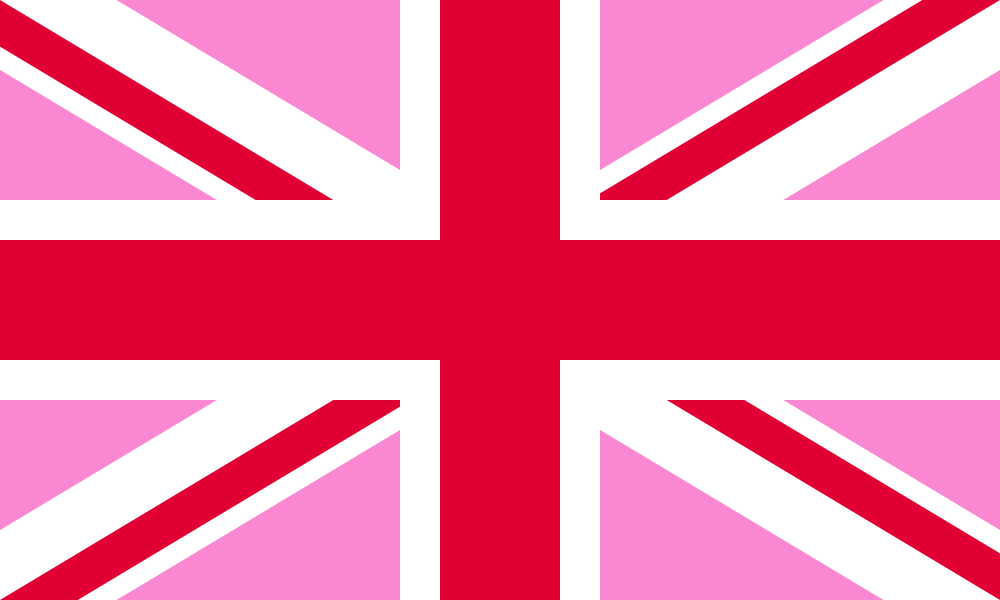
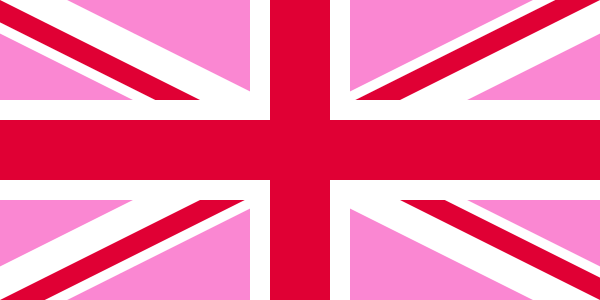
British artist David Gwinnutt developed the Pink Jack around 2000 as an expression of pride in being gay and British. The design replaces the Union Jack's blue fields with pink, referencing the reclaimed pink triangle while retaining the national flag's crosses and white fimbriation. [1][2] Gwinnutt's accounts differ on whether he first carried it at Pride London in 2004 or 2005, [3] but contemporary reporting documents the flag in national circulation by July 2006, printed on T-shirts, mouse mats and mugs in time for WorldPride. [4]

Key facts
- Designer
- David Gwinnutt
- Created
- Earliest located dated photograph
- Documented use
- Mid-2000s to the present
- Aspect Ratio
- 3:5 · standard
- Ratio Notes
- Gwinnutt prescribed no ratio. Flags of the World gives 3:5 as the usual proportion of the photographed physical flags and records 1:2 as an alternate also seen in use. [5] The hero here is 3:5. Fry1989's 1:2 vector is kept separately in the Image Archive, and its proportion belongs to that file.
- Origin
- London, England, United Kingdom
- Represented Identity
- Gay and British
Also known as
- Gay Pride Flag of the United Kingdom
- Gay Pride Flag of the UK
- Pink Union Jack
- LGBT Union Jack
Status Variant
Archive categories Regional and Language-Specific Pride Flags
Overview
To express pride in being gay and British. Gwinnutt made the design for a proposed gallery exhibition about being gay and sexuality, and framed it positively: he told PinkNews he wanted it to be a positive thing and a celebration of friendship. [4]
David Gwinnutt developed the Pink Jack while working out how his art could express his experience as a gay British man. He made it for a gallery show he was putting together about being gay and sexuality, and told PinkNews in July 2006: “I wanted to create something that was about being gay and being British. The Pink Jack seemed like a good thing.” [4] His design keeps the Union Jack's structure and replaces its blue fields with pink. Gwinnutt connects those fields to the pink triangle historically forced on homosexual men by the Nazis and later reclaimed, and describes the substitution as turning a negative symbol into a positive one. [1]
The Pink Jack followed an earlier pink St George's Cross that Gwinnutt had made and flew at Pride London in about 1998. Turtle & Pearce manufactured the Union Jack design. [1] He remembers the first flag as heavy cotton from an old school East London flag maker, in a “vibrant blancmange pink”, and says he still had it in 2015. [3] He first carried it at Pride London, though his published recollections differ between 2004 and 2005, and he expanded the project for EuroPride London in 2006. [3][1][2]
Identity & Context
- Represented Identity
- Gay and British
- National Context
- United Kingdom
Gwinnutt made the flag about a specific pairing, being gay and being British, and told PinkNews he wanted it to be a positive thing and “a celebration of friendship”. [4] The design has since circulated more broadly as an LGBT and LGBTQ British pride flag.
Creators
The Creator
David Gwinnutt
Artist, photographer, designer and gay activist

David Gwinnutt, born in 1961, is a British artist, photographer, designer and gay activist who came to prominence in the 1980s photographing London's art world and Queer scene. He lives and works in London, and the National Portrait Gallery gave him a solo show in 2017. [2] He created the Pink Jack as an expression of pride in being gay and British, developing it from an earlier pink St George's Cross and launching it widely at EuroPride London in 2006. [1][2] He ran the Pink Jack as a brand from the mid-2000s, selling flags, bunting, clothing, badges and homeware, and the site recorded its support for Crusaid, the HIV and AIDS charity. [6] In 2013 he was voted sixteenth on the Independent's list of the hundred most influential gay people in Britain for creating it. [7]
I wanted to create something that was about being gay and being British. The Pink Jack seemed like a good thing.
To PinkNews, July 2006.
I created the Pink Jack as an expression of my pride in being gay and British and in recognition of the acceptance I found in Britain, starting as a school kid in Matlock, Derbyshire. It made me think that Britain is actually cool about gay people and I wanted to celebrate that
Quoted by DACS.
The first flag I made was from company in East London, a proper old school flag maker. I still have it, it's made of a very heavy cotton and has toggles on it where it would be tied to a mast. The pink is vibrant blancmange pink.
From his 2015 guest account of the flag’s first decade.
It has to have a life of its own, nothing to do with me and it feels as if it does.
Same account, on seeing the flag carried by strangers.
Attribution notes
David Gwinnutt designed the Pink Jack and named it. He described it to PinkNews in July 2006 as art before it was a flag: “Honestly, I made it as art. In fact I made it specifically for a gallery show I was creating about being gay and sexuality.” [4] DACS, which represents him for copyright licensing, dates the design to 2000 and records the launch at EuroPride 2006. [2]
Two Wikimedia Commons contributors are authors of files rather than of the design, and neither is its originator: Fobos92, whose 500 by 300 pixel rendering of 13 January 2012 states that it was adapted from the Commons file of the flag of the United Kingdom, and Fry1989, whose vector version of 20 April 2013 supersedes it. [8][9] Manufacture and redrawing are not authorship.
Origin
- Country
- United Kingdom
- Region / state
- England
- City
- London
- Origin Type
- design development and first presentation
- Physical Origin Status
- London at city level. No studio or address is documented.
Developed and first presented in London; no exact place of making is documented.
Gwinnutt lives and works in London, and the design's documented life begins there: an East London flag maker produced the first flag, and he first carried it at Pride London. [2][3][1] The exact studio or address where the design was made is not documented and is not recorded here.
Dates & Chronology
- Year Created
- Earliest located dated photograph
- Documented use
- Mid-2000s to the present
- Creation Bounds
- Circa 2000, and approximate. DACS dates the design to 2000. [2] Gwinnutt's own biography places it in the 1990s and then says the flag became relevant in 2006, “about six years after I created it”, which points to the same year. [7] No exact day of creation has been established. His accounts of the first Pride London outing differ: his 2015 guest piece says “The first day I ‘flew’ the flag it was at the Pride London march, 2004”, while the post that carries it is written as a tenth-birthday piece dating the appearance to Pride London on 2 July 2005. [3] His own site of 2008 gives a third reading, that he “made his first PinkJack in 2005 and carried it at a Pride festival that year”, which reads as first manufacture rather than first design and sits beside DACS's 2000 rather than replacing it. [6] No dated photograph located resolves the discrepancy.
About 1998: Gwinnutt made a pink St George's Cross, manufactured by Turtle & Pearce, and flew it at Pride London. He describes it as the precursor to the Pink Jack. [1]
Circa 2000: the Pink Jack itself. DACS dates it to 2000; Gwinnutt's biography puts its creation about six years before it took off in 2006. [2][7]
2004 or 2005: the first Pride London outing. Gwinnutt's 2015 account says 2004 and remembers carrying the flag on the tube wrapped around a bamboo cane, unfurling it at the start of the march and working his way to the front. The post that carries his account dates the appearance to Pride London on 2 July 2005. [3]
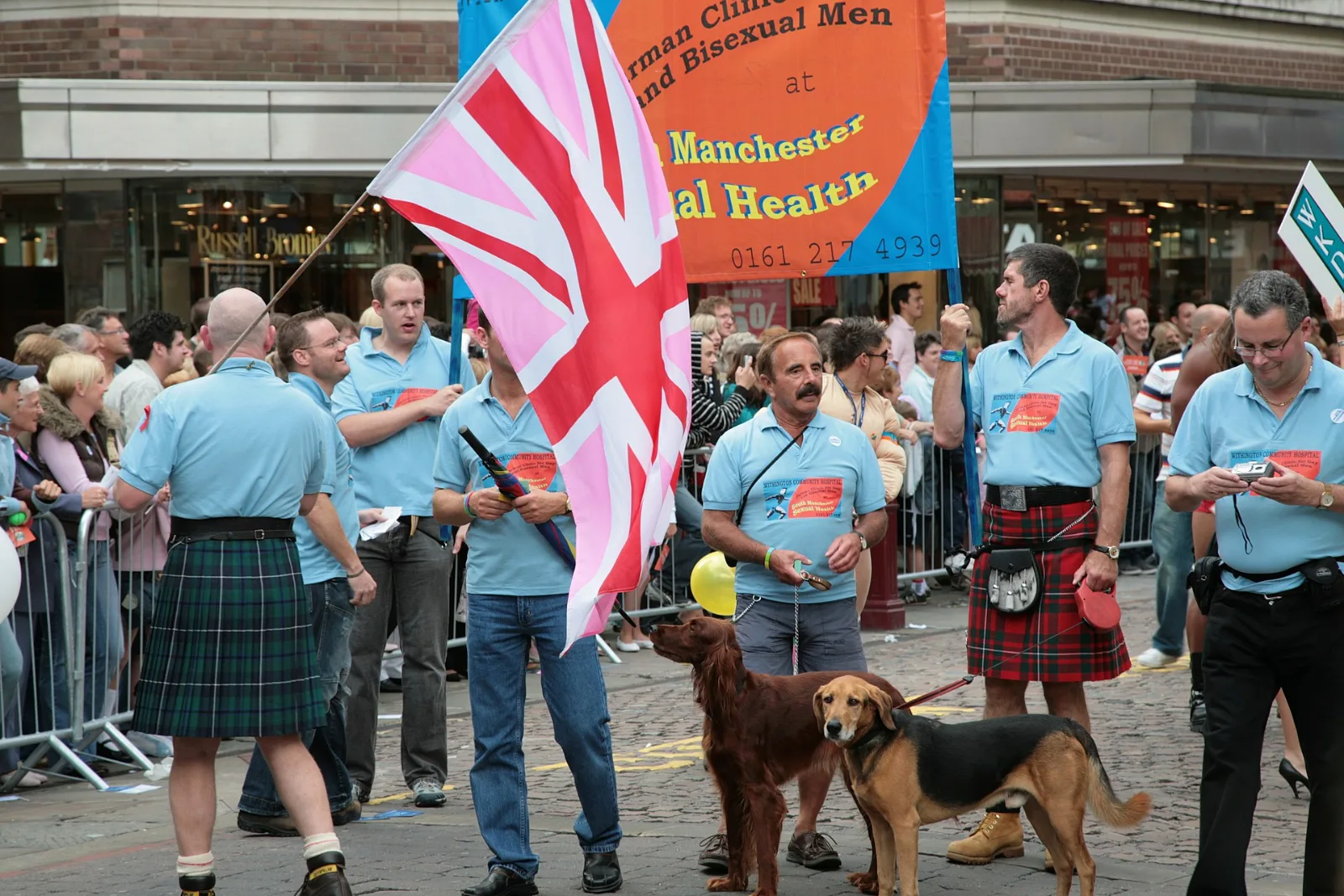
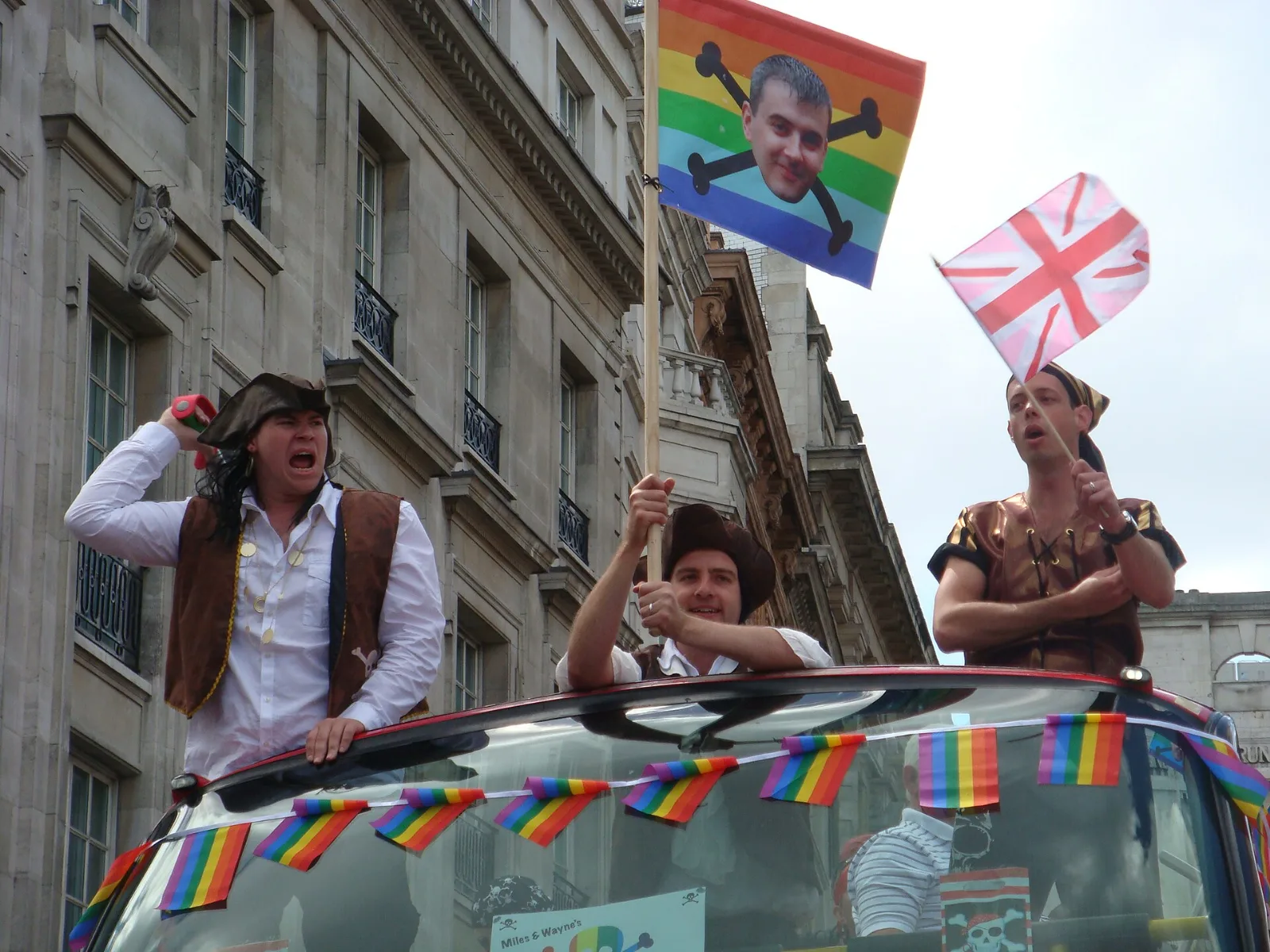
2006: the wider launch, at EuroPride in London, where Gwinnutt ran a stall and photographed the day. His own account of that year is that the flags, T-shirts and badges sold out immediately, and that several people had already copied the idea and sold out too. [10][6][2][1] The earliest located dated photograph is from London on 1 July 2006. [11][5] On 21 July 2006 PinkNews reported the flag being printed on T-shirts, mouse mats and mugs in time for WorldPride, after appearing at the paper's launch event. [4] On 26 August 2006 a large Pink Jack was carried at Pride in Manchester. [12]
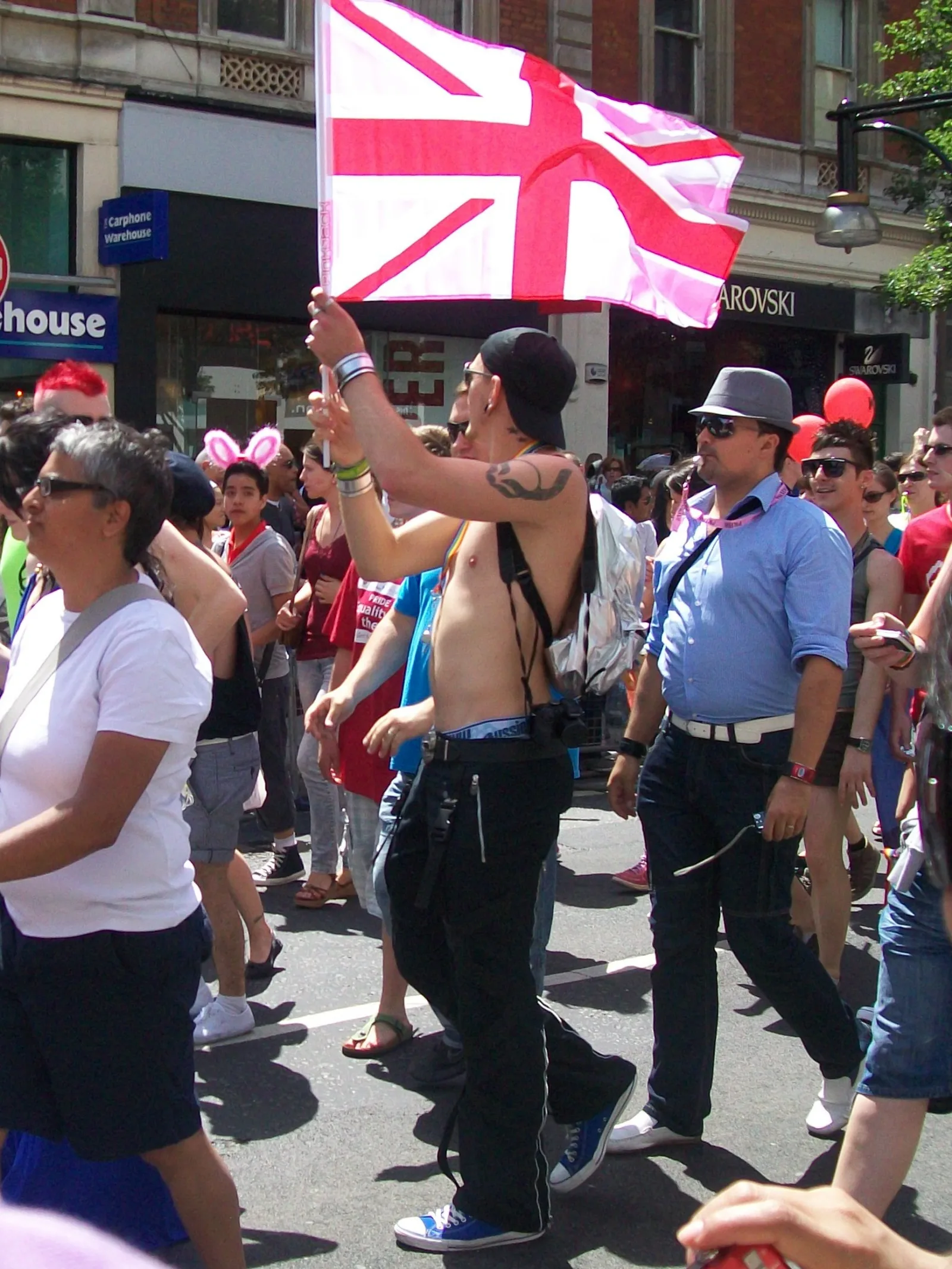
2007 to 2010: Flags of the World records the design photographed in Brighton in 2006 and 2007 and in Leeds in 2007. [5] Hand flags appear at Pride London on 5 July 2008 and 3 July 2010. [13][14]
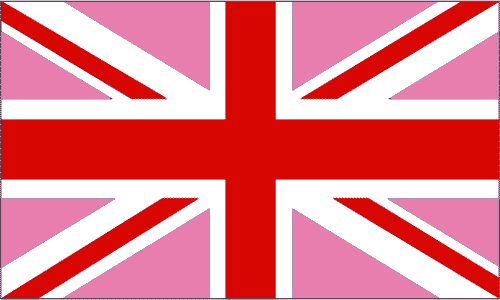
2012 onward: the design is drawn for the web. Fobos92 uploaded a 500 by 300 pixel rendering at 23:17 UTC on 13 January 2012, which the Commons page dates to 14 January; Fry1989 drew the vector version now in circulation on 20 April 2013, and Commons marks the earlier file superseded by it. [8][9]
Gwinnutt's own list of the flag's appearances includes a British Ambassador flying it at the embassy in Budapest, flags at the front of the Last Night of the Proms, and two men waving one in Red Square. He records those as his recollections rather than as documented events. [3]
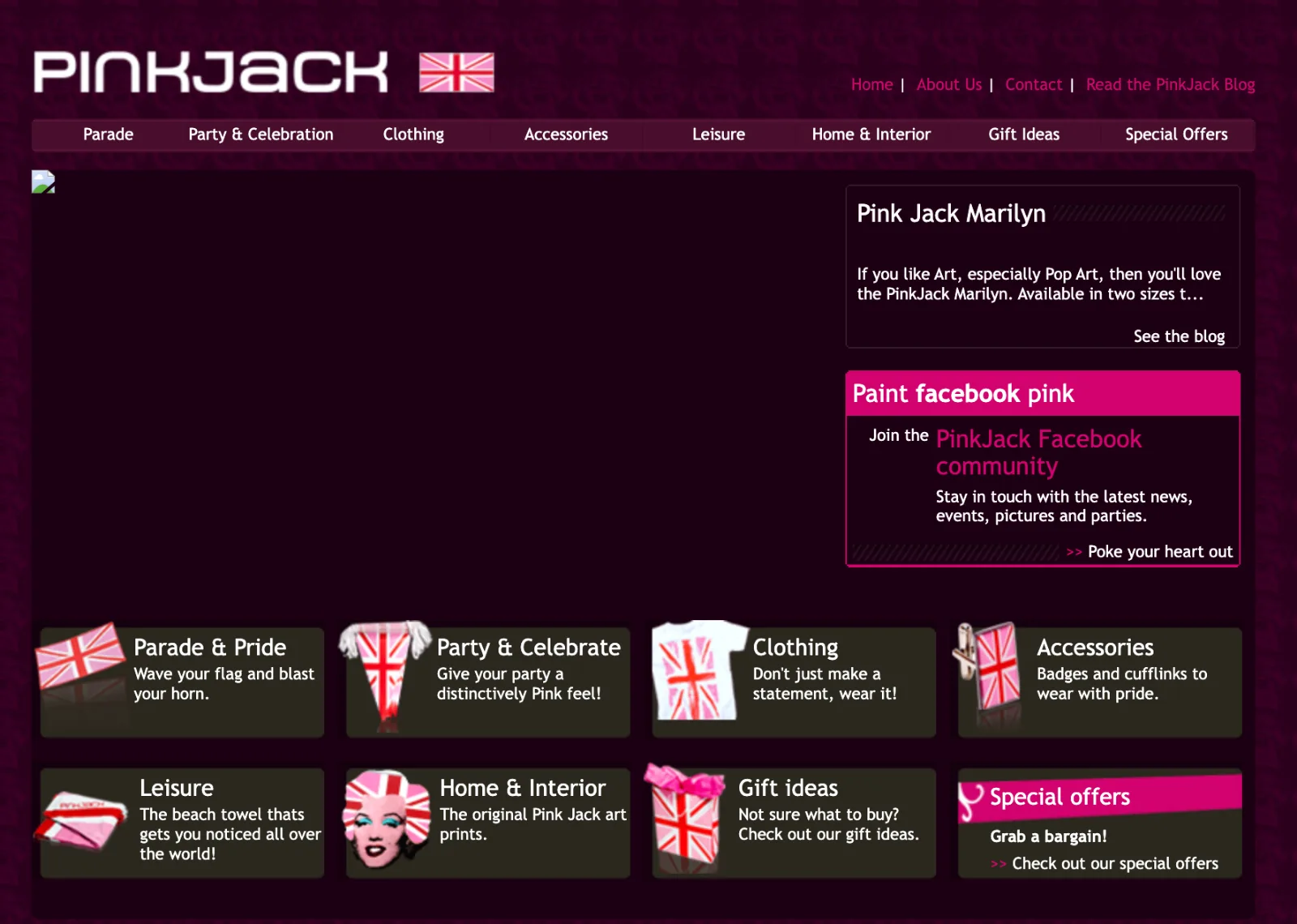
By 2008 the Pink Jack was a brand with its own shop, selling flags, bunting, clothing, badges, beach towels, homeware and prints, and stating its support for Crusaid, the HIV and AIDS charity. [6]
Flags of the World treats Pink Union Jack as a name covering several different designs, not one. In the first, the one Gwinnutt made, the blue field becomes pink while the red and white elements remain. A second keeps the blue and turns the red areas pink; Flags of the World dates its earliest known use to Brighton Pride in 2007 and records it sold by British flag shops in 3:5 only. Others replace both reds and blues with distinct pinks. [5] Rainbow-filled Union Jacks are a separate design family and are not this flag. Gwinnutt's own 2008 account of the copies is the earliest located explanation of why the name covers more than one design: after the 2006 sell-out, “There were already several people who'd copied the idea and they sold out too”. [6]
Lineage
The direct visual parent is the Union Jack. The Pink Jack preserves its cross, saltire, white fimbriation and counterchange, and replaces the blue fields with pink. [1][9] Neither the Union Jack nor Gwinnutt's earlier pink St George's Cross has a record of its own here, so both are named in prose rather than drawn as graph nodes.
Gwinnutt's earlier pink St George's Cross of about 1998 is the design's own precursor, by the same hand and the same substitution applied to a different national flag. [1] The pink of the fields is a symbolic reference to the reclaimed pink triangle rather than a borrowing from another flag. [1]
The Rainbow Pride Flag is a contextual contrast, not an ancestor. Gwinnutt's account has the rainbow flag as the symbol already in existence that did not express his particular experience, which is why he made this one. [7] The design carries no element of it.
Colors & Symbolism
Gwinnutt's accounts of what the pink carries do not agree, and both are his own. His current Pink Jack history connects the pink triangular fields to the pink triangle historically used to persecute homosexual men and later reclaimed, and describes the substitution as turning a negative symbol into a positive one. [1] The shop-era history of 2008 puts it the other way: that in his twenties he was “disenchanted by the symbols being used by the gay community: the Pink Triangle and the Rainbow Flag”, feeling that “they didn't represent him or his experiences as a British gay bloke”, and wanted something that celebrated British gay culture and was legible to straight people too. [6]
What both accounts share is the purpose. To PinkNews in 2006 he said he wanted it to be a positive thing and called it a celebration of friendship. [4] To DACS he put it as “an expression of my pride in being gay and British and in recognition of the acceptance I found in Britain”. [2] The 2008 site states it flatly: the flag “represents a place where gay and straight stand side by side, free from prejudice”. [6]
| Colour | Read from Fry1989's 2013 vector | Note |
|---|---|---|
| Light Pink | #FA87D2 | The field, in place of the Union Jack's blue. Declared in Fry1989's vector source. [9] |
| Deep Red-Pink | #E00034 | The cross and saltire. Declared in Fry1989's vector source. [9] |
| White | #FFFFFF | The fimbriation. Declared in Fry1989's vector source. [9] |
The meanings above are the creator's own, from his Pink Jack history, the 2008 shop-era history, the 2006 PinkNews interview and DACS. They attach to the design, not to the hex values of any later rendering.
Gwinnutt did not publish a digital palette. These are exact values from Fry1989's 2013 SVG and describe that rendering, not every manufactured Pink Jack. [9] The creator's own account of the first flag calls its pink a “vibrant blancmange pink”, which is a description rather than a specification, and the shades of the flags in the photographs cannot be measured from them. [3]
Design
- Aspect Ratio
- 3:5 · standard
- Ratio Notes
- Gwinnutt prescribed no ratio. Flags of the World gives 3:5 as the usual proportion of the photographed physical flags and records 1:2 as an alternate also seen in use. [5] The hero here is 3:5. Fry1989's 1:2 vector is kept separately in the Image Archive, and its proportion belongs to that file.
- Orientation
- horizontal
- Layout
- cross and saltire (Union Jack pattern)
The Union Jack pattern with pink in place of blue: a deep pink-red St George's cross fimbriated white over a deep pink-red saltire, also fimbriated white, on a light pink field, with the saltire's arms counterchanged as on the national flag. Gwinnutt's documented concept is the colour substitution; he did not publish a construction sheet. [1]
The archive's rendering follows the stroke proportions of Fry1989's 2013 vector, measured in fractions of the hoist: white cross one third, deep pink-red cross one fifth, white saltire one fifth, deep pink-red saltire two fifteenths, with the counterchange clipped as on the Union Jack. Those proportions are Fry1989's, not Gwinnutt's. [9]
No construction sheet or specification by the creator has been located. Flags of the World records the design usually made at 3:5, and 1:2 flags also seen in use. [5] Fobos92's raster is 500 by 300, or 5:3; Fry1989's vector is 1:2 on a 600 by 300 viewBox. [8][9] The rendering on this page is reconstructed at the archive's 3:5 standard, 1000 by 600, rather than stretched from either file.
The Union Jack with its blue fields replaced by pink: a deep pink-red cross and saltire with white fimbriation on a light pink field.
Usage & Adoption
- Geographic Usage
- London, England, Manchester, England, Brighton, England, Leeds, England
- Online Usage
- Rendered for Wikimedia Commons from 2012 and in circulation since
- Event Usage
- Pride London, first outing recalled by the creator as 2004 or 2005 [3], EuroPride London 2006, the wider launch [2][1], London, 1 July 2006, the earliest located dated photograph [11][5], Pride in Manchester, 26 August 2006 [12], Brighton, 5 August 2006 and 4 August 2007; Leeds, 5 August 2007 [5], Pride London, 5 July 2008 [13], Pride London, 3 July 2010 [14]
- Current Status
- Historical and continuing circulation
The Pink Jack circulated at British Pride events by the mid-2000s and received contemporary press coverage during EuroPride 2006, by which point it was being printed on T-shirts, mouse mats and mugs. [4] Photographs document flags in London, Manchester, Brighton and Leeds between 2006 and 2010. [11][12][5][13][14] The 2006 Manchester photograph shows the flag carried within a Withington Community Hospital contingent alongside a banner promoting sexual-health services for gay and bisexual men; it documents contingent use and not formal institutional adoption. [12] No organizational adoption has been established.
Image Archive
EuroPride London 2006
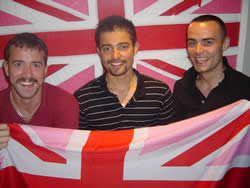
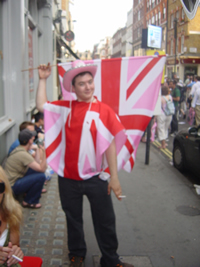
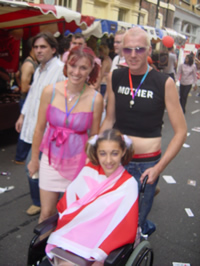
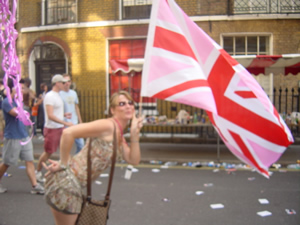
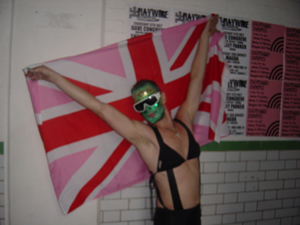
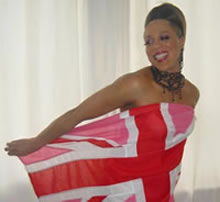
Photographed use
.jpg)

.jpg)
Later digital renderings

Discourse & Debates
Common misidentifications
- Pink Union Jack is a name for several different designs. This entry is David Gwinnutt's Pink Jack, in which the blue fields become pink and the red and white elements remain. Flags of the World also records a version keeping the blue and turning the red areas pink, sold by British flag shops and first photographed at Brighton Pride in 2007, and others replacing both reds and blues with distinct pinks. [5]
- Distinct from the rainbow Union Jack, which sets rainbow stripes into the national flag's pattern. That is a separate design family and is not this flag.
- The design contains no rainbow. Gwinnutt discussed the Rainbow Flag as the symbol already in existence that did not express his particular experience, not as visual source material. [7]
Pink Jack is the creator's own name for the design and the one used throughout. [4][1] Gay Pride Flag of the United Kingdom is the cataloguing title this record was created under and the name the Wikimedia file carries. [9] LGBT Union Jack is a later descriptive name.
Footnotes & Citations
Sources and footnotes 14 sources
- 1. Official About Us: the Pink Jack. David Gwinnutt. pinkjack.com. Accessed 2026-08-14
The creator's own history of the design: how it grew from an earlier pink St George's Cross, what the pink fields refer to, who manufactured the flag, and how it reached EuroPride. The site returned a server error when checked on 14 August 2026 and the account is carried here from the owner's reading of it.
- 2. Organizations David Gwinnutt. DACS. Accessed 2026-08-14
The artists' rights body's profile. It dates the Pink Jack to 2000, describes the launch at EuroPride 2006, gives Gwinnutt's birth year and his own statement of what the flag expresses, and records that DACS represents him for copyright licensing.
- 3. Primary statement Happy Tenth Birthday, Pink Jack!. David Gwinnutt, guest post on The Queerstory Files (Tony Scupham-Bilton). The Queerstory Files (2015-07-02). Accessed 2026-08-14
Gwinnutt's first-person account of the flag's first decade: the East London flag maker, the heavy cotton original in a vibrant blancmange pink, and carrying it to the front of the march. He gives 2004 as the first Pride London outing while the post that carries him is written as a tenth-birthday piece dated to Pride London on 2 July 2005. It also mentions a Patent Office letter asking him to renew the trademark.
- 4. News God save the queers. Katherine Knowles. PinkNews (2006-07-21). Accessed 2026-08-14
Contemporary reporting, published while the design was entering wide circulation. It names Gwinnutt as the artist, gives the title Pink Jack, records that he made it for a gallery show about being gay and sexuality, and describes it being printed on T-shirts, mouse mats and mugs in time for WorldPride.
- 5. Reference United Kingdom: Gay Pride Union Jack flags. Tomislav Todorović; ed. Rob Raeside. Flags of the World (2009-12-14). Accessed 2026-08-14
The variant and sighting record. It treats Pink Union Jack as a name covering several designs, gives 3:5 as the usual proportion of this one with 1:2 also seen, and lists dated photographs from London, Brighton and Leeds between 2006 and 2008. Page last modified 14 February 2026.
- 6. Official About PinkJack / PinkJack History. PinkJack (David Gwinnutt). pinkjack.com (2008). Accessed 2026-08-14 · Archived version
The shop-era history, copyright 2008, read from a Wayback capture of 25 September 2011. It states that PinkJack was conceived and founded by David Gwinnutt, that he was disenchanted in his twenties by the Pink Triangle and the Rainbow Flag as symbols that did not represent his experience, that he made his first PinkJack in 2005 and carried it at a Pride festival that year, and that the following year the flags, T-shirts and badges sold out, as did several copies others had already made.
- 7. Designer page About. David Gwinnutt. davidgwinnutt.com. Accessed 2026-08-14
The creator's own biography. It places the design in the 1990s and then dates its rise to 2006, “about six years after I created it”, and records his being voted sixteenth on the Independent's 2013 list of the most influential gay people in Britain for creating it. Cited for the biography only.
- 8. Image file page File:Bandera Gay Reino Unido.png. Fobos92. Wikimedia Commons (2012-01-13). Accessed 2026-08-14
The earlier rendering, 500 by 300, uploaded at 23:17 UTC on 13 January 2012 and dated 14 January on the Commons page, the difference being page dating against the UTC upload log. Attributes itself to the Commons file of the flag of the United Kingdom, and is marked superseded by Fry1989's vector.
- 9. Image file page File:Gay Pride flag of the United Kingdom.svg. Fry1989. Wikimedia Commons (2013-04-20). Accessed 2026-08-14
The vector rendering in wide circulation, uploaded at 640 by 320 and now nominally 512 by 256 on a 600 by 300 viewBox. Its declared fills are the three values in the colour table, and its stroke proportions are the basis of the archive's reconstruction. It renders the design; it is not its origin.
- 10. Official EuroPride 2006. David Gwinnutt. pinkjack.com (2006). Accessed 2026-08-14
The creator's own page of photographs from the EuroPride 2006 stall, with his captions and a set of quoted reactions. It links back to a 2005 page as where it all began the year before. Supplied by the site owner with the photographs.
- 11. Image file page Pride London 2006 photograph. Aurelien Guichard. Flickr (2006-07-01). Accessed 2026-08-14
The earliest located dated photograph of the design, taken in London on 1 July 2006 and published the following day. Cited by Flags of the World as an example of the 3:5 proportion. Not reproduced here: its current licence has not been verified.
- 12. Image file page File:Kilts for health! (226241128).jpg. Jeremy Atkinson. Wikimedia Commons (2006-08-26). Accessed 2026-08-14
Pride in Manchester, 26 August 2006, 4368 by 2912. It shows the flag carried within a Withington Community Hospital contingent behind a banner for a sexual-health service for gay and bisexual men. CC BY 2.0.
- 13. Image file page File:Pride London 2008 063.JPG. Fæ. Wikimedia Commons (2008-07-05). Accessed 2026-08-14
Pride London, 5 July 2008. Published under CC BY-SA 3.0.
- 14. Image file page File:Flying the flag (4759990599).jpg. AnemoneProjectors. Wikimedia Commons (2010-07-03). Accessed 2026-08-14
Pride London, 3 July 2010. Published under CC BY-SA 2.0.
Image Sources
- Rendering
- Archive reconstruction at 3:5, palette from Fry1989's 2013 vector
- Archive reconstruction at the 3:5 standard, 1000 by 600. Union Jack geometry drawn on the archive field; stroke proportions and palette follow Fry1989's 2013 vector. [9] · Credit: Design by David Gwinnutt; technical source Fry1989, via Wikimedia Commons · Archive reconstruction · Derivative of a CC BY-SA 3.0 file; share-alike and attribution apply to this rendering. No new claim is made over Gwinnutt's design.
- EuroPride London, 2006. Creator's own photograph. [10] · Credit: David Gwinnutt · pinkjack.com · Supplied by the creator for use in this archive; no general reuse licence
- EuroPride London, 2006. Creator's own photograph. [10] · Credit: David Gwinnutt · pinkjack.com · Supplied by the creator for use in this archive; no general reuse licence
- EuroPride London, 2006. Creator's own photograph. [10] · Credit: David Gwinnutt · pinkjack.com · Supplied by the creator for use in this archive; no general reuse licence
- EuroPride London, 2006. Creator's own photograph. [10] · Credit: David Gwinnutt · pinkjack.com · Supplied by the creator for use in this archive; no general reuse licence
- EuroPride London, 2006. Creator's own photograph. [10] · Credit: David Gwinnutt · pinkjack.com · Supplied by the creator for use in this archive; no general reuse licence
- Portrait from the creator's EuroPride 2006 page. [10] · Credit: David Gwinnutt · pinkjack.com · Supplied by the creator for use in this archive; no general reuse licence
- Manchester, 26 August 2006. 4368 by 2912. [12] · Credit: Jeremy Atkinson · Wikimedia Commons · CC BY 2.0 · CC BY 2.0
- Pride London, 5 July 2008. 2592 by 1944. [13] · Credit: Fæ · Wikimedia Commons · CC BY-SA 3.0 · CC BY-SA 3.0
- Pride London, 3 July 2010. 1736 by 2313. [14] · Credit: AnemoneProjectors · Wikimedia Commons · CC BY-SA 2.0 · CC BY-SA 2.0
- pinkjack.com, Wayback capture of 25 September 2011. [6] · Credit: PinkJack (David Gwinnutt); site by Hugo & Cat · Internet Archive · Screenshot of an archived web page, reproduced for documentation
- Earlier digital rendering, 500 by 300. [8] · Credit: Fobos92 · Wikimedia Commons · CC BY-SA 3.0 · CC BY-SA 3.0
- Later vector rendering, 1:2. [9] · Credit: Fry1989 · Wikimedia Commons · CC BY-SA 3.0 · CC BY-SA 3.0