Pansexual Pride Flag
Identity Pride Flag ·
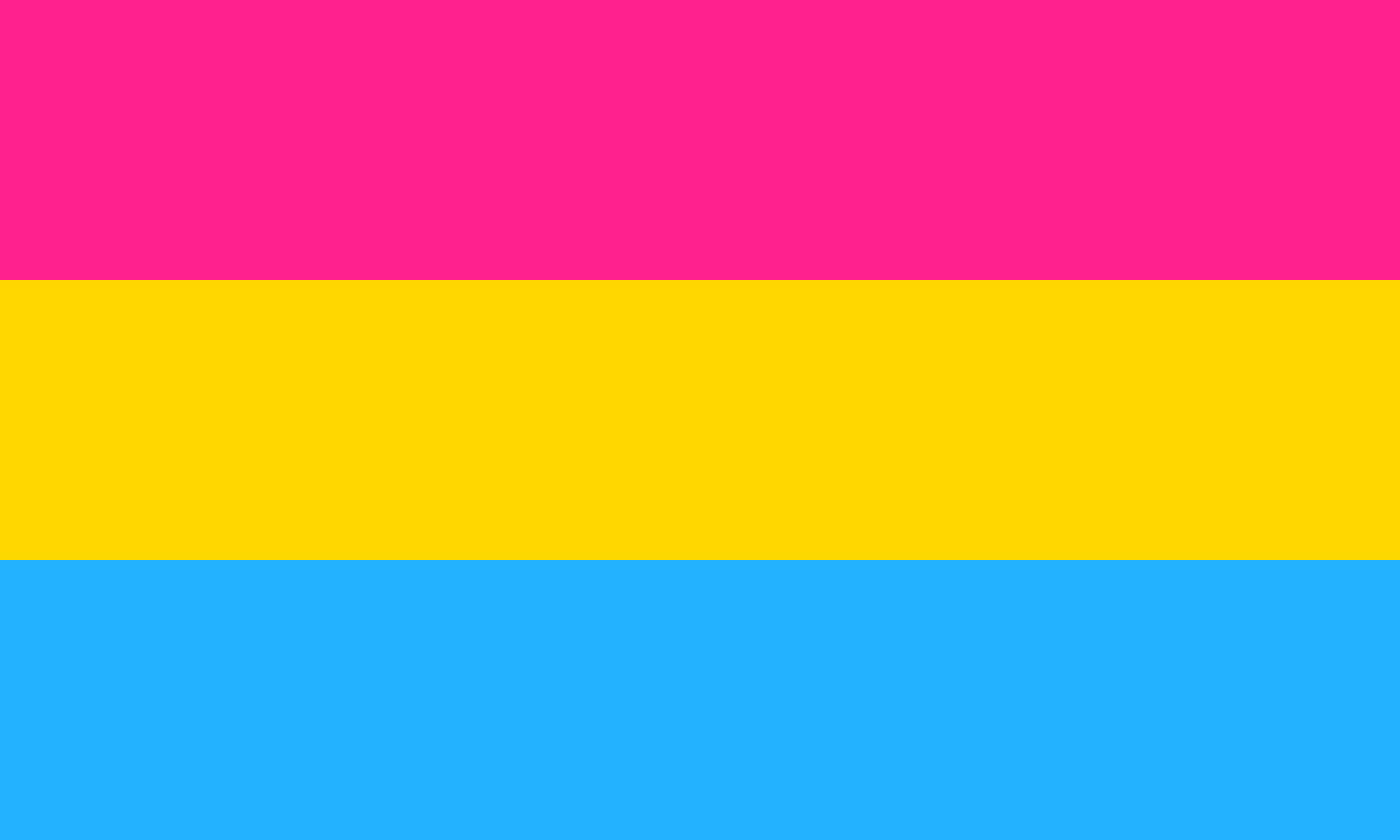
Three horizontal stripes in pink, yellow and light blue, designed by Jasper in 2010 and circulated anonymously through a Tumblr blog kept apart from his main account. A post on that blog dated 11 August 2010 set out the colour associations, pink and blue for their established gender associations and yellow for attraction outside the binary. [1] Jasper identified himself as the designer in February 2013, by which time the design had become the dominant pansexual emblem. [2]
Key facts
- Designer
- Jasper
- Created
- First documented public use
- By August 2010, on the PansexualFlag Tumblr blog
- In use
- 2010 to the present
- Aspect Ratio
- 3:5 · standard
- Ratio Notes
- No creator-prescribed ratio has been located. The PNG uploaded to Wikimedia Commons in November 2010 is 500 by 375 pixels, or 4:3, and the Commons SVG kept that proportion until Keymap9 normalised it to 3:5 on 6 April 2018. Writing for Flags of the World in February 2020, Tomislav Todorović found that the ratio "generally varies between 2:3 and 3:5, but the latter seems to clearly prevail." [3][4][5]
- Stripes
- 3
- Represented Identity
- pansexual
Also known as
- Pansexual Flag
- Pan Pride Flag
- Pan Flag
Status Canonical
Archive categories Sexual & Romantic Orientation Pride Flags
Overview
Jasper designed the Pansexual Pride Flag in 2010, aged 20, and published it anonymously through a dedicated Tumblr blog, pansexualflag.tumblr.com, kept separate from LGBTLaughs, the popular blog he already ran. The blog carried the explanation as well as the design: a post headed "Colour Symbolism," 11 August 2010, and a page of hex codes, posted 8 October 2010, whose own title told readers they "don't have to use these exact" values. [1][6] Its sidebar set out why the flag was made: "For a long time we've shared a flag with bisexual pride, but I believe as more people are choosing to identity (though we don't choose what we are) themselves as pansexual rather than bisexual. Both are legitimate orientations, neither is 'better' than the other, but they both deserve to be represented individually." Spelling as posted. [1] The same day as the symbolism post he uploaded a small stamp to DeviantArt under the handle Just-Jasper, captioned "Stamped based on proposed colours for a pansexual pride flag." He claimed the design publicly on 13 February 2013 and set out a full account in a Twitter thread on 13 August 2019. [2][7][8]
His account of the design's origin is unpretentious. "There was no popular pan flag, and the offerings were frankly... ugly. To me. Various shades of purple, P letters, P symbols incorporating gender symbols, infinity symbols. They didn't feel consistent with the other pride flags." So, "on a whim, I decided to design one. I designed it to be pretty, honestly. That was a primary function of it, to have s/t I liked to represent my identity. No point pretending I was trying to be super innovative and deep: I wanted something pretty to plaster on my blog." The stamp's wording matches: proposed colours, not a settled emblem. [7][8]
Identity & Context
- Represented Identity
- pansexual
- Subcommunity
- multisexual umbrella / bi+ spectrum (community framing)
Creators
The Creator
Jasper
Designer
Jasper designed the Pansexual Pride Flag in 2010, aged 20, and said so publicly for the first time on 13 February 2013, in a post on his Tumblr blog headed "confession time": "you know the pink/yellow/blue pansexual flag design? ... i came up with that." His Tumblr bio gives his pronouns as he/him. In the 2018 interview he described himself as "a queer nonbinary person" living in England and used they/them pronouns, adding of the terms he uses: "My identity and the terms I use for it change depending on context and mood, and various terms have been useful - queer, sapphic, pansexual, bisexual, gay." [9][2]
He published the flag anonymously and deliberately. The design went out through a separate blog, pansexualflag.tumblr.com, kept apart from the LGBTQ humour blog lgbtlaughs he already ran, "because I already ran lgbtlaughs and i didn't want to feel like i was monopolising LGBTQ blog space on tumblr, i guess. i wasnt super covert, but i tried to be subtle." That decision, not a lost record, is why the design circulated for years without a name attached. [9][2]
His reason for coming forward was not credit. "As I've got older I've realised a lot of people would be interested in knowing this part of modern queer history, and more about modern flag creation in general, and that it's worth documenting. Not for credit so much as for posterity." [7]
His account of what prompted the design is specific. In 2010 the word pansexual was gaining ground in online LGBTQ spaces, especially Tumblr, and attraction to multiple genders was otherwise covered by bisexual. "Bisexuality is at it's best inclusive of trans and non-binary people, but at the time, and in the scenes and communities I had access too, the working definition often did exclude transgender people from bisexuality's attraction parametres or draw special distinction between cis and trans people, and it made bisexuality feel like a term that didn't work for me personally anymore." He had identified as bisexual from the age of 13. [9][7]
His 2019 account of the same period revises that one and is more generous to those bisexual communities. The debates he had witnessed were "convos at the time I didn't really recognise for what they were: bi people working hard to define bisexuality on their terms, tackling intra-community transphobia, and developing within a social space where more expansive gender experiences and identities were becomes more well known and understood." Spelling as posted. He adds that the switch "was about finding something that felt truly *right* for me, but it would be dishonest to pretend the decision wasn't impacted by the politics and 'discourse' I was involved in at the time." [7]
He also records the flag's early rejection firsthand: "I remember early after the flag's creation someone attempted to add it to the pansexuality page on Wikipedia, and it was removed multiple times." He calls the experience of having made it "overwhelmingly positive," describes the first Pride at which he saw the flag flown as making him "very emotional," and notes that only a limited number of his offline friends know he designed it. [9][7]
i'm not interested in staking a copyright ownership to the design, it's just something i wanted to say. i'm proud of what happened with this. [2]
on a whim, I decided to design one. I designed it to be pretty, honestly. That was a primary function of it, to have s/t I liked to represent my identity. [7]
Be aware that you can't force people to adopt your flag design - you might face anything from lukewarm reception to outright rejection for various reasons. Create something that feels both representative, and that you think looks good - if your hope is to have other people adopt it, it has to be something you don't want to change a year down the line. [9]
The first time I saw a pansexual flag in real life at my city's Pride parade I may have had a little cry. [7]
Motivations
- To make something aesthetically pleasing, the existing pansexuality symbols being variants on the letter P combined with gender symbols, which "didn't feel like a flag does" [9]
- Because the working definition of bisexuality in the communities he had access to in 2010 often excluded transgender people, making the term stop working for him personally [9]
Stated inspirations
- The bisexual flag's palette, named in the 2010 "Colour Symbolism" post as what yellow was chosen to "stand out from," with pink and blue used in a different shade to acknowledge "the similarity of having attraction fall into the binary"[1]
Broader influences
- The rainbow flag, as the precedent for a community having a flag at all. Asked about pride flags in 2018, Jasper said: "The rainbow flag is such a significant part of LGBTQ history that I think it's completely understandable that communities and identities would want to see their own." He did not name it as a source for this design[9]
Attribution notes
Jasper gives a first name only. Asked in 2018 to supply a name for the history books, "or part of it," he answered "My name is Jasper." This entry uses no surname. The design was published anonymously in 2010 and Jasper identified himself as its author in February 2013; two DeviantArt uploads of 11 August 2010, made under his named account and linking out to the anonymous blog, support the attribution contemporaneously rather than through the later recollection alone. [9][2][8][10]
Origin
- Digital Origin
- Yes
- Origin Type
- first_circulation
- Physical Origin Status
- unknown
The flag was published on Tumblr, at pansexualflag.tumblr.com, and circulated digitally from the start. Where Jasper was when he designed it in 2010 is not documented. He told an interviewer in 2018 that he lived in England, which is a statement about 2018 rather than about the place of design. [9][1]
Dates & Chronology
- Year Created
- First public use
- By August 2010, on the PansexualFlag Tumblr blog
- Period in Use
- 2010 to the present
- Creation Bounds
- Four points are separable. The design was published anonymously on pansexualflag.tumblr.com during 2010; the LGBTQIA+ Wiki places the first post before 6 August, citing a 24 August 2011 capture of the blog's own posts tagged "flags," and that post has not been recovered with a secure date of its own. [11] The blog's "Colour Symbolism" post carries 11 August 2010 at 11:56pm and Jasper's DeviantArt stamp the same day, the earliest securely dated material. [1][8] Anna Grant uploaded a 500 by 375 pixel PNG to Wikimedia Commons at 01:21 on 4 November 2010, sourced to the blog with the author field filled in as "Unknows," which puts the design in independent circulation inside the year; AnonMoos recompressed it eleven hours later, and the author now reads Jasper. The file has since been renamed from Pan flag.png to Pansexuality flag.png. [3] Jasper identified himself as its designer on 13 February 2013. [2]
The flag spread through Tumblr reblogs and was taken up by pride-flag reference sites and community glossaries; by the mid-2010s it was the standard pansexual emblem. Biscuit's history of bi+ symbols describes it moving quickly from Tumblr to Twitter and out into the wider web. [12] The Human Rights Campaign and Outright International both include it in their flag guides, and it appears in university and municipal diversity guides alongside the bisexual and transgender flags, which documents reference circulation rather than adoption by those bodies. [13][14]
Adoption was neither immediate nor uncontested. Jasper recalls that "early after the flag's creation someone attempted to add it to the pansexuality page on Wikipedia, and it was removed multiple times," and did not expect it to travel beyond Tumblr. Writing in 2013 he was still cautious about its standing: "it's hard to call it an 'official' flag when pansexuality is still not really understood in the mainstream and oftentimes in LG(BTQ) spaces, but it's taken off." [9][2]
Major revisions
Several replacement designs circulated during an online controversy over the original creator's alleged views. One of them, a six-stripe flag credited to Jesse Gunslinger, has its own entry. None displaced the 2010 design. [15][16]
The attribution does not rest only on Jasper's later word. On 11 August 2010 he posted two small works to DeviantArt under the handle Just-Jasper: a Pansexual Pride Stamp captioned "Stamped based on proposed colours for a pansexual pride flag," and an Asexual Panromantic Pride Flag captioned "Asexual panromantic flag design based on:" followed by an outgoing link to pansexualflag.tumblr.com. His 2013 post links back to the same two deviations, and the note thread on the blog's own "Colour Symbolism" post, timed 11:56pm that night, records justjasper among the accounts that liked it. [2][8][10][1]
The flag belongs to a cluster of multisexual-spectrum flags that emerged in the early 2010s, among them Samlin's polysexual flag of 2012 and the omnisexual flag. They share a visual grammar of horizontal stripes in gender-coded hues while framing multi-gender attraction differently from one another. [12][17]
Lineage
- Indirect influences
- Bisexual Pride Flag, Rainbow Pride Flag
The 2010 "Colour Symbolism" post is the documented link to the bisexual flag, and the blog's sidebar states the relationship plainly: "For a long time we've shared a flag with bisexual pride." Yellow was chosen to make the design "stand out from the bisexual colours," while pink and blue were used in a different shade to acknowledge what the two orientations share. That is a creator-stated design relationship rather than descent, and it is recorded as an influence, not a parent. [1] Samlin described the 2012 polysexual flag as deliberately similar to the bisexual and pansexual flags because all three belong to the multisexual umbrella. [12]
Lineage tree
Every record reachable from this one through documented parent and child relationships: 8 records across 3 generations.
- This record
- Pansexual Pride Flag
- Children
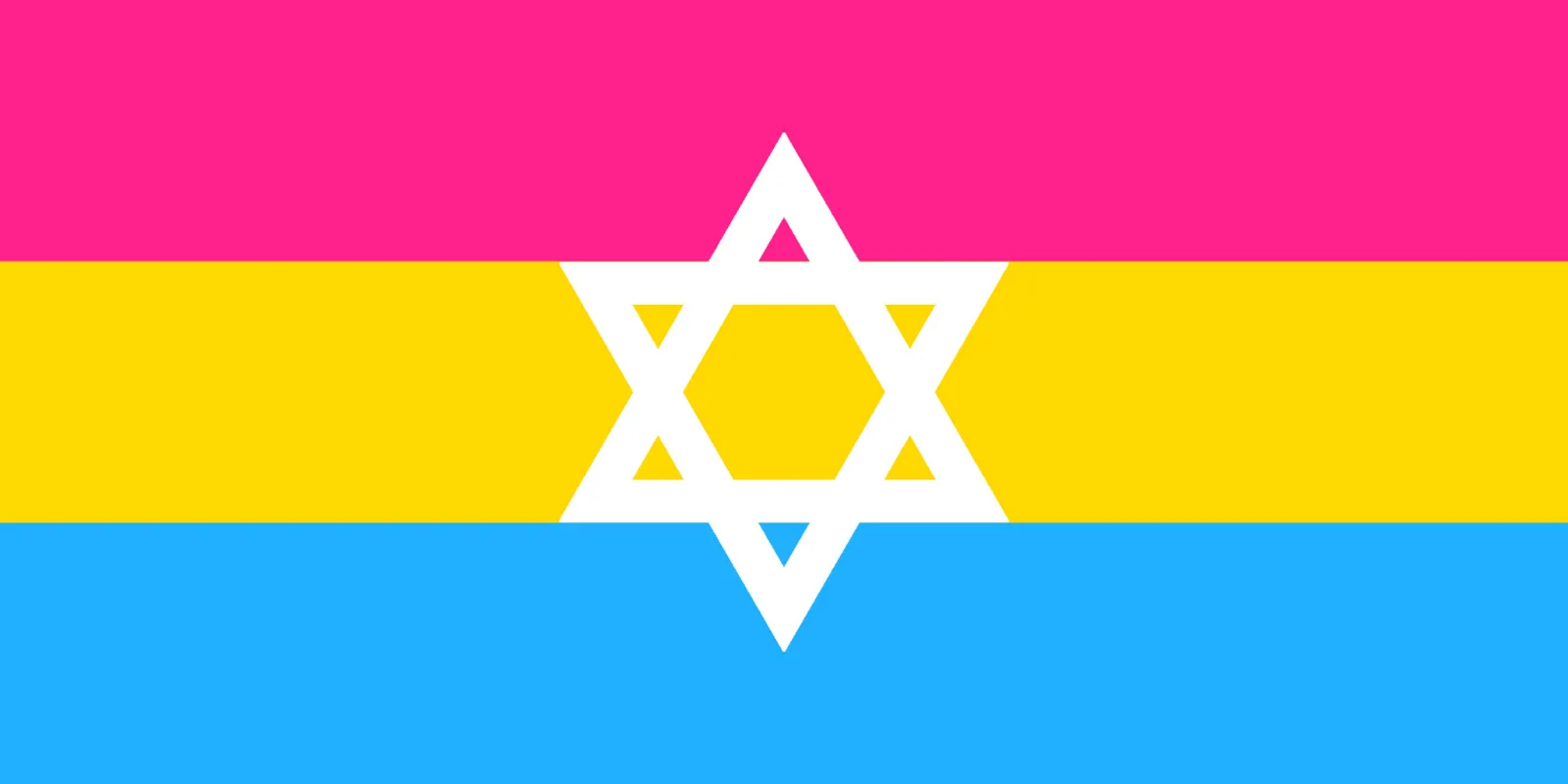
- Polysexual Pride Flag, Demipansexual Pride Flag (2016, Pride-Flags), Panromantic Pride Flag, Chicago Pansexual Pride, Pansexual Pride Flag Redesign (Jesse Gunslinger), Jewish Pansexuality Pride Flag
- Generation 3
- Polyromantic Alternative Pride Flag (2020)
Colors & Symbolism
The colour reasoning was published with the design, in the first person. A post headed "Colour Symbolism," dated 11 August 2010 on the flag's own blog, opens "I chose pink, yellow and blue as pan colours because pink and blue have come to be accepted to represent binary gender (pink for the female spectrum, blue for the male spectrum), while yellow is a bright colour, that symbolises life and happiness in many cultures, and is neglected by most queer-representing flags." Yellow does two jobs: it "makes it stand out from the bisexual colours, representing non-binary attraction." Pink and blue are deliberately not the bisexual flag's own pink and blue, and the difference is the point: "the similar use of pink/blue (in a different shade) acknowledges the similarity of having attraction fall into the binary." [1]
Jasper's later accounts are shorter and consistent with it. In 2018 he said "Most of my motivation for the flag was making something aesthetically pleasing," the pansexuality symbols then in use being variants on the letter P. [9] In 2019 he glossed the colours as "Pink and blue, because of their gendered traditions, and yellow, a generally non-gendered colour, to represent nonbinary folks etc." [7] Answering threads in 2021 that criticised the flag's gender associations, he wrote: "Reminder, I made it in 2010, and the flag has been only loosely defined since." [7]
| Colour | Hex | Meaning |
|---|---|---|
| Pink | #FF218C | Chosen because pink and blue "have come to be accepted to represent binary gender," pink for the female spectrum. Set in a different shade from the bisexual flag's pink, which the 2010 post says acknowledges "the similarity of having attraction fall into the binary." Commonly simplified to attraction to women. |
| Yellow | #FFD800 | "A bright colour, that symbolises life and happiness in many cultures, and is neglected by most queer-representing flags." It "makes it stand out from the bisexual colours, representing non-binary attraction." Commonly simplified to attraction to nonbinary people. |
| Light blue | #21B1FF | Chosen for blue's accepted association with the male spectrum of the gender binary, and likewise in a different shade from the bisexual flag's blue. Commonly simplified to attraction to men. |
pansexualflag.tumblr.com, the flag's own blog, 2010 [6]
Two things are documented and neither cancels the other. Jasper published the colour reasoning with the design in 2010, and he has also said the design began as an attempt at something that looked good, the existing pansexuality symbols being letters and gender signs that "didn't feel like a flag does." [1][9] He has resisted readings built too firmly on the gloss, noting in 2021 that the flag "has been only loosely defined since" 2010. The blog said as much at the time, telling readers "You are not obligated to use these colours." [7][1]
Readings supplied by the community
- Later reading: attraction
- Pink for attraction to women, yellow for attraction to nonbinary people, blue for attraction to men. The formulation in widest circulation, catalogued by the LGBTQIA+ Wiki as one of two re-interpretations and traced there to pride-flag guides from 2013 on. [11] [18]
- Later reading: gender identity
- Pink for femininity, yellow for nonbinary identity, blue for masculinity. This one names the genders of pansexual people rather than attraction to them. Both circulate, and neither is the 2010 post's wording, which describes what the colours have "come to be accepted to represent" before it describes attraction. [11] [17]
- Wikimedia Commons file description
- The description on the 2010 Commons PNG gives the gender-identity reading at length: blue for "those who identify as male (regardless of biological sex)," pink for those who identify as female, and yellow for "those who identify as both genders, neither gender, or a third gender; such as genderqueer and agender," adding that yellow "also represents non-binary attraction." It is not the 2010 post's wording, and it sits on the most widely reproduced early file. [3]
The values are the flag's own blog's. pansexualflag.tumblr.com published a post of hex codes, preserved in a capture of 3 November 2011 and used by KiwiNeko14 in 2013 to bring the Wikimedia Commons file "in conformity with the original scheme." That file is the one in worldwide circulation, and it renders #FF218C, #FFD800 and #21B1FF. The post's own title tells readers they "don't have to use these exact" codes. [6][4]
Jasper gave slightly different values from memory in 2019: "A strong magenta, a strong gold yellow, and a light cerulean. The pink not too purple, the yellow not too bright, the blue not too cyan. Hex FF1B8D, FFD900, 1BB2FF." All three differ from the blog's. The canonical rendering here follows the contemporaneous 2010 codes; the 2019 figures are the designer's restatement nine years later rather than a revised specification. [7]
Design
- Aspect Ratio
- 3:5 · standard
- Ratio Notes
- No creator-prescribed ratio has been located. The PNG uploaded to Wikimedia Commons in November 2010 is 500 by 375 pixels, or 4:3, and the Commons SVG kept that proportion until Keymap9 normalised it to 3:5 on 6 April 2018. Writing for Flags of the World in February 2020, Tomislav Todorović found that the ratio "generally varies between 2:3 and 3:5, but the latter seems to clearly prevail." [3][4][5]
- Orientation
- horizontal
- Stripe Count
- 3
- Layout
- horizontal_stripes
- Stripes (Top → Bottom)
- Pink, Yellow, Light blue
Three equal horizontal stripes. Flags of the World records the ratio as varying between 2:3 and 3:5 with 3:5 clearly prevailing, and the Wikimedia Commons file was set to 3:5 in April 2018; no source gives a ratio from the designer. [5][4]
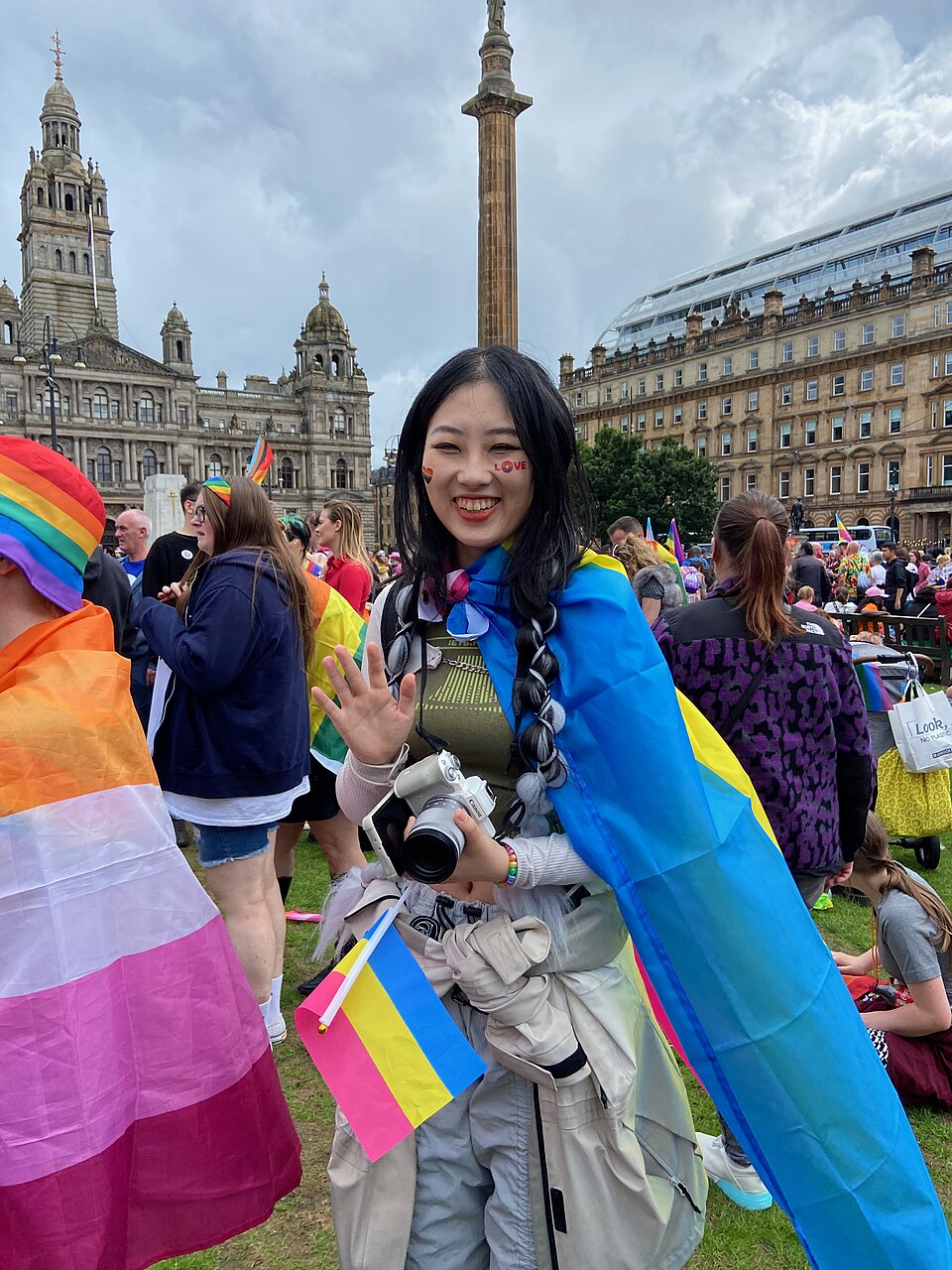

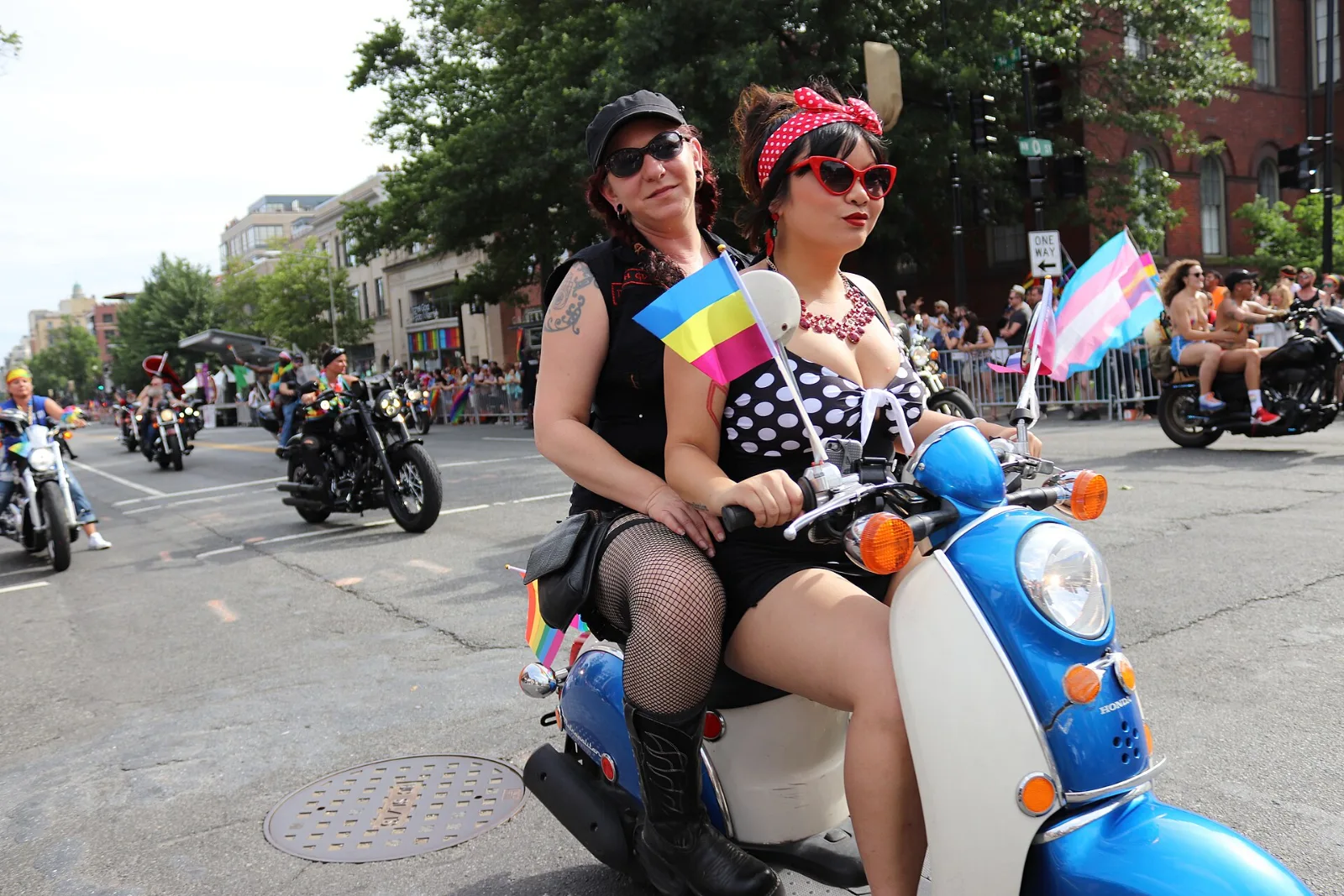
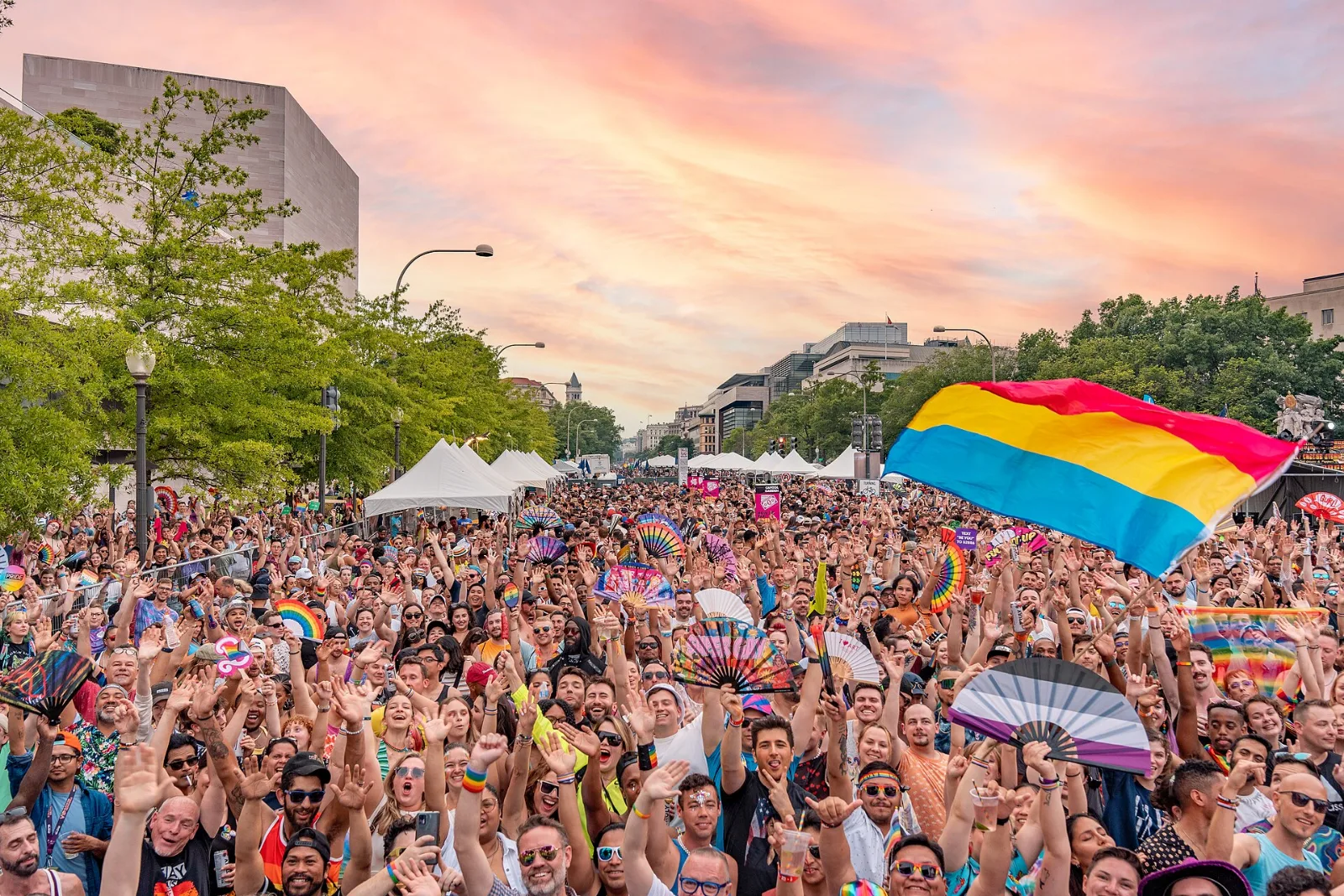
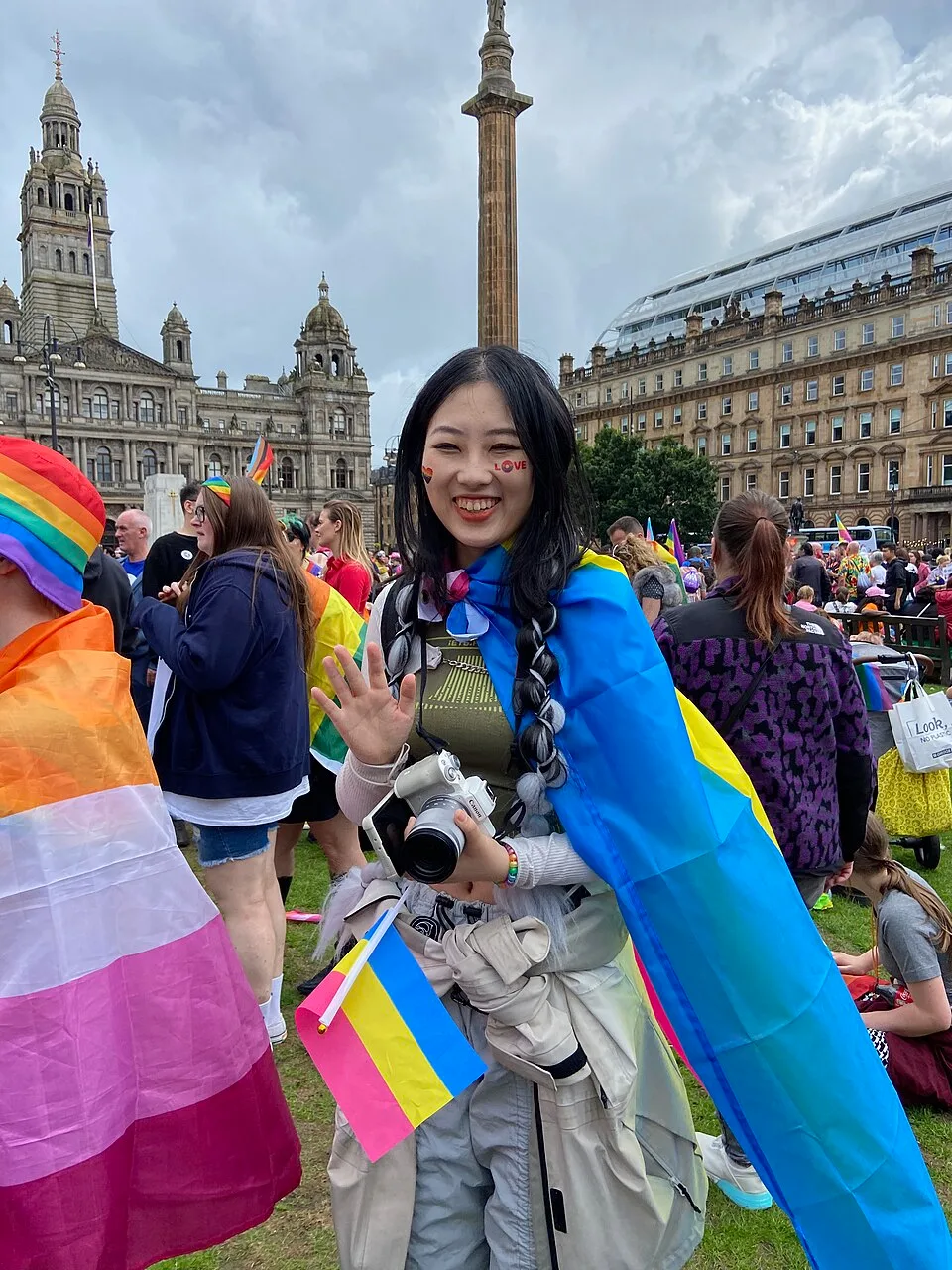
The flag is flown both ways up. Pink at the top is the original and remains the preferred hoisting, but blue at the top is documented at Chicago Pride in 2016, 2018 and 2019, at a Denver rally before the Colorado State Capitol on 13 February 2019 supporting a ban on conversion therapy for minors, at Capital Pride in Washington DC and at Brighton, Rouen and Columbus in 2019, and at Glasgow in 2023. Both orientations were flown together at Capital Pride DC in 2019. Todorović concludes it "has become another 'no right side up' flag, but with pink at the top still being preferred hoisting." [5][19]
Three equal horizontal stripes: pink at top, yellow in the middle, light blue at bottom. No emblem or additional symbols. The flag is flown both ways up, and the vexillological record on that point changed. Writing for Flags of the World in February 2020, Tomislav Todorović listed reversed-order sightings at Denver, Capital Pride in Washington DC and Brighton, all in 2019, but judged them "too few to allow for the flag to be described already as having 'no right side up.'" By June 2022, having added Chicago in 2016, 2018 and 2019, Rouen and Columbus in 2019, and both orientations flown together at Capital Pride in 2019, he concluded that it "has become another no right side up flag, but with pink at the top still being preferred hoisting." [5]
Usage & Adoption
- Geographic Usage
- International circulation
- Online Usage
- Widely used as the primary pansexual pride emblem
- Event Usage
- Capital Pride, Washington DC, 2016, 2018, 2019 and 2023 [5][20], Erie Pride, Pennsylvania, 2017 [5], Milano Pride 2017 [5], Paris Pride 2017 [5], Bourne Free, Bournemouth, 2017 [5], London Pride 2017 [5], Atlanta Gay Pride 2017 [5], EuroPride, Stockholm, 2018 [5], Christopher Street Day, Berlin, 2018 and 2019 [5], New York Pride 2019 [5], Christopher Street Day, Cologne, 2019 [5], Taiwan Pride 2019 [5], Equality March, Katowice, 2019 [21], Parada da Diversidade, Curitiba, 2022 [22], Glasgow MardiGla 2023 [19]
- Current Status
- active
Not immediately adopted. Flags of the World dates the design's presence online to the early 2010s but its real-world use to the later part of the decade, and its first documented sighting is Capital Pride in Washington DC in 2016, six years after publication. [5] From 2017 the sightings are continuous and international. Jasper did not expect it to leave Tumblr, and recalls it being added to Wikipedia's pansexuality article and removed repeatedly for years. [7]
It is now the standard pansexual emblem. The Human Rights Campaign and Outright International carry it in their flag guides, and the Commons illustration is in use on twenty Commons pages and across a very large number of Wikipedias. [13][14][4]
Image Archive
The flag in use
.jpg)





.jpg)
Documented Use
.jpg)
.jpg)


Documented use
.jpg)
_KatowicePride-Parade.jpg)

.jpg)
Derivations

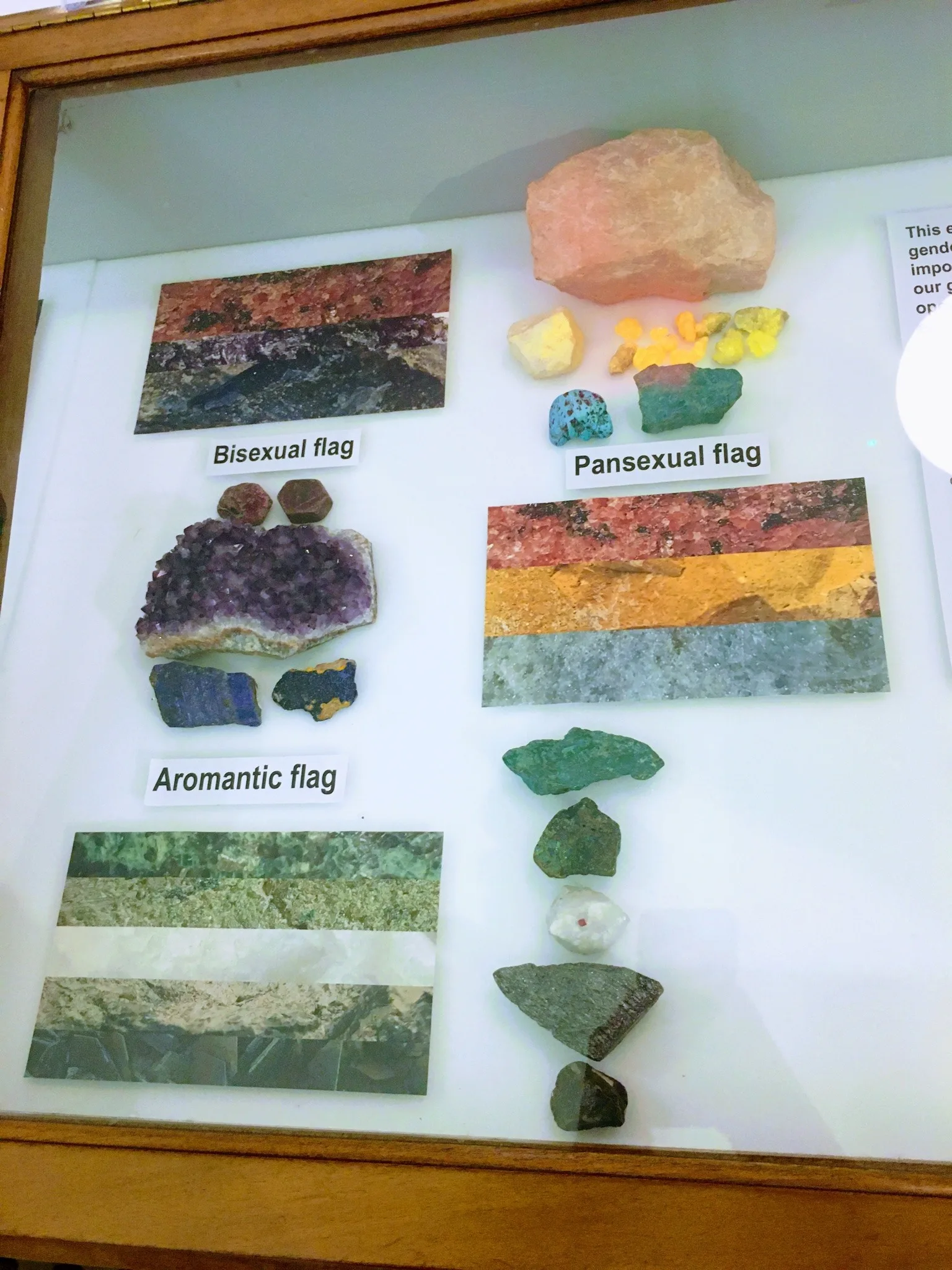
Photograph by the Tumblr user feral-critter. No licence is stated and none has been sought; published at the site owner's direction with the rights status recorded as undetermined.
Discourse & Debates
- The relationship between pansexuality and bisexuality is one of the most persistent definitional debates in multisexual discourse. Some treat them as near-synonyms with different emphasis; others maintain they describe genuinely different orientations. The flag's existence as a separate symbol is itself part of that debate. [13]
- Whether pansexual, bisexual, omnisexual and polysexual should be grouped under a shared 'bi+' or 'multisexual' umbrella remains contested. [14]
- In June 2020 several replacement designs for the pansexual flag circulated online. The fullest community account, posted by posi-pan on 25 June, describes a mostly non-pan group encountering a JPEG that assigned transphobic meanings to the stripes, taking those meanings for Jasper's, and building a six-stripe flag from the same three colours doubled; shown Jasper's own account of the design they went on promoting the replacement, and later acknowledged they had been wrong about the meanings and about Jasper while keeping it in circulation. By that account Jasper was "harassed, misgendered, labeled a transphobe and a terf, accused of being lesbophobic and pan/biphobic. for a fucking month straight." [15] The same day @PansexualityOrg posted that the replacement "was created and promoted in bad faith by non-pan people," adding that "pan flags created by pans for personal use, fun, aesthetics, or to incorporate other identities are supported here" while those made "to replace the original due to lies and exclusionist rhetoric" were not. [16] A second wave followed after Jasper posted support for bi lesbians; the LGBTQIA+ Wiki attributes its most-circulated replacement to a since-suspended Twitter account. [18] None of the replacements displaced the 2010 design, and pan lesbians took up the six-stripe version as a pan lesbian flag. [15]
Common misidentifications
- The pansexual flag is occasionally confused with the omnisexual flag, which uses a similar pink-to-blue gradient but with five stripes including a dark center.
- Pansexual and omnisexual flags are sometimes treated as near-synonyms, though many community members distinguish them: pansexuality is often framed as attraction regardless of gender, while omnisexuality is framed as attraction to all genders with gender as a factor. [17] The 2010 blog did not draw that line. Its own definition ended "Alternative: omnisexuality," and it tagged the symbolism post for omnisexuality as well as pansexuality. [1]
- Pansexuality is sometimes conflated with bisexuality in casual usage. [13]
Criticisms
- That a separate pansexual flag implies bisexuality excludes nonbinary people is a long-standing objection in bi+ discourse. The flag's own blog addressed it in 2010, before the flag circulated: "Both are legitimate orientations, neither is 'better' than the other, but they both deserve to be represented individually." [1] Jasper returned to it in 2019, describing the debates he had witnessed in 2010 as "bi people working hard to define bisexuality on their terms, tackling intra-community transphobia," and saying his own switch "was about finding something that felt truly *right* for me, but it would be dishonest to pretend the decision wasn't impacted by the politics and 'discourse' I was involved in at the time." [7]
The distinction between pansexuality and bisexuality is not universally agreed upon. The most common framing holds that pansexuality emphasizes attraction 'regardless of gender' while bisexuality emphasizes attraction 'to more than one gender,' but both communities contain individuals who would accept either definition. The existence of separate flags has not resolved the definitional debate. [13][14]
Footnotes & Citations
Sources and footnotes 25 sources
- 1. Primary statement Colour Symbolism. PansexualFlag (Jasper, published anonymously). Tumblr (2010-08-11). Accessed 2026-08-08 · Archived version
- 2. Primary statement confession time. Jasper (justjasper). Tumblr (2013-02-13). Accessed 2026-08-08 · Archived version
- 3. Image file page File:Pansexuality flag.png. Uploaded by Anna Grant with the author field filled in as "Unknows"; now credited to Jasper. Wikimedia Commons (2010-11-04). Accessed 2026-08-08
- 4. Image file page File:Pansexuality Pride Flag.svg. KiwiNeko14, after the PansexualFlag Tumblr blog; later revisions by AnonMoos, Keymap9 and Sarang. Wikimedia Commons (2013-07-14). Accessed 2026-08-08 · Archived version
- 5. Reference Pansexuality Flag. Tomislav Todorović and others; ed. Randy Young. Flags of the World (2022-11-26). Accessed 2026-08-08
- 6. Primary statement Hex Color Codes (you don't have to use these exact). PansexualFlag (Jasper, published anonymously). Tumblr (2010-10-08). Accessed 2026-08-08 · Archived version
- 7. Social media "I created the #pansexual flag, a thread". Jasper (@shrikeabyssals). Twitter/X (2019-08-13). Accessed 2026-08-08
- 8. Designer page Pansexual Pride Stamp. Just-Jasper. DeviantArt (2010-08-11). Accessed 2026-08-08
- 9. Interview Interview: Creator of the Pan Flag. majesticmesses. Majestic Mess Designs (2018-12-01). Accessed 2026-08-08
- 10. Designer page Asexual Panromantic Pride Flag. Just-Jasper. DeviantArt (2010-08-11). Accessed 2026-08-08 · Archived version
- 11. Encyclopedias & Reference Pansexual. LGBTQIA+ Wiki (Fandom) contributors. Fandom. Accessed 2026-08-08
- 12. Articles & Reports Bi symbols throughout history. Biscuit. Accessed 2026-08-08
- 13. Pride Flags. Human Rights Campaign. Accessed 2026-03-09
- 14. Pride Flags and What They Mean. Outright International. Accessed 2026-03-09
- 15. Community Response to an anonymous ask about the “new pan flag”. posi-pan. Tumblr (2020-06-25). Accessed 2026-08-08 · Archived version
- 16. Social media Statement rejecting the six-stripe replacement flag. @PansexualityOrg. Twitter/X (2020-06-25). Accessed 2026-08-08
- 17. Pride Flag Guide: Pansexual. Library.LGBT (Albany Pride initiative). Library.LGBT Pride Flag Guide. Accessed 2026-03-09
- 18. Encyclopedias & Reference Pansexual. LGBTQIA+ Wiki contributors. LGBTQIA+ Wiki. Accessed 2026-08-08
- 19. Image file page File:Glasgow's Pride MardiGla 2023 32.jpg. LornaMCampbell. Wikimedia Commons (2023-07-15). Accessed 2026-08-08
- 20. Image file page File:2023.06.11 Capital Pride Festival and Concert 162 454347-Edit (52970063519).jpg. Ted Eytan. Wikimedia Commons (2023-06-11). Accessed 2026-08-08
- 21. Image file page File:02019 0295 (2) KatowicePride-Parade.jpg. Silar. Wikimedia Commons (2019-09-07). Accessed 2026-08-08
- 22. Image file page File:Bandeiras na Parada da Diversidade em Curitiba.jpg. Transhet. Wikimedia Commons (2022-11-15). Accessed 2026-08-08
- 23. Image file page File:Couple kissing in front of pansexual flag (42328506944).jpg. Catherine Coden / ong somos. Wikimedia Commons (2018-06-16). Accessed 2026-08-08
- 24. Image file page File:Jewish Pansexuality Pride Flag.jpg. Jewish-sideblog. Wikimedia Commons (2024-06-18). Accessed 2026-08-08
- Rainbow flag (LGBTQ). Wikipedia contributors. Wikipedia (2026-06-25). Accessed 2026-07-24


Image Sources
- Rendering
- three-stripe standard
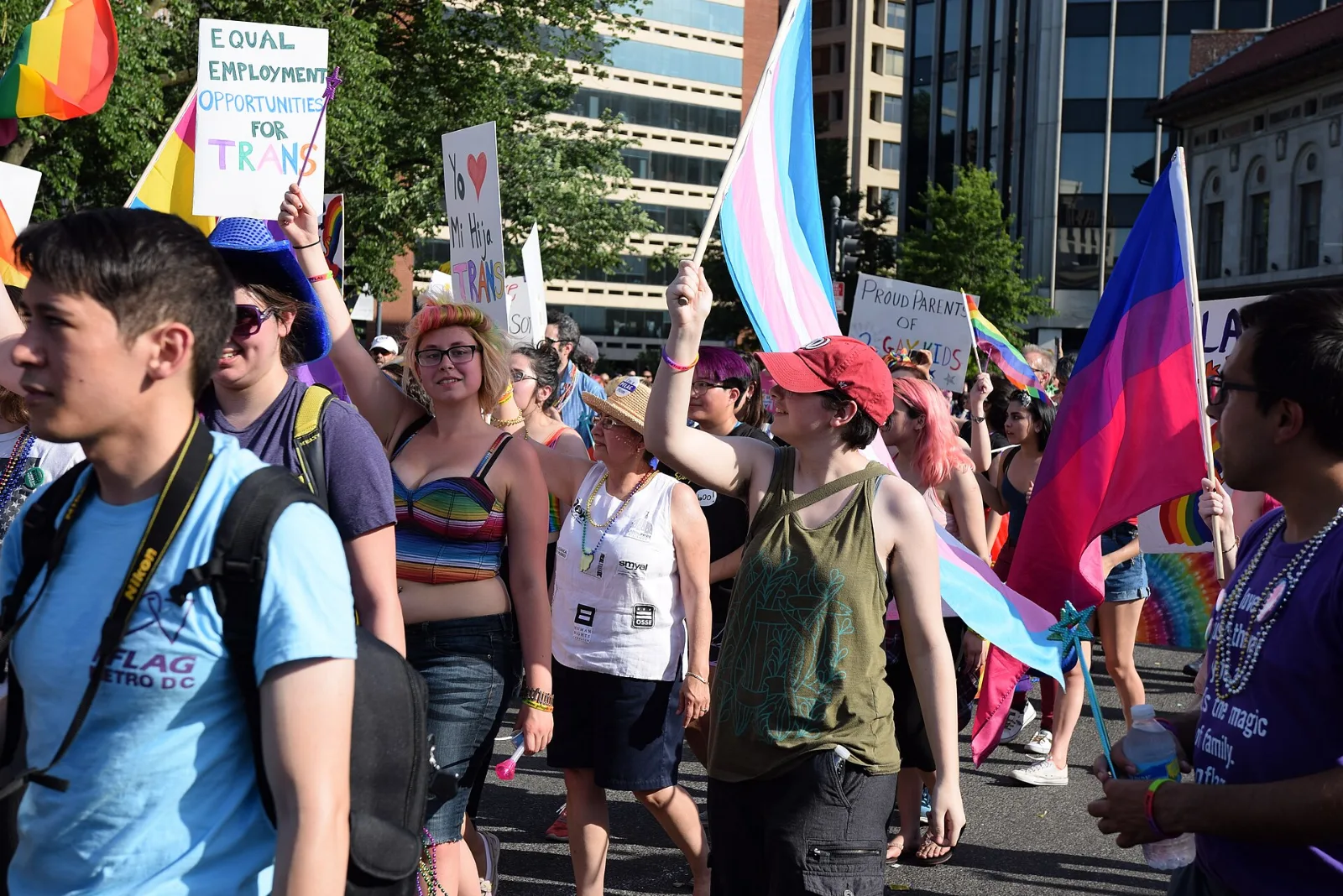
- Capital Pride Parade, Washington, D.C., 11 June 2016. The pansexual flag at upper left, behind the placard reading "EQUAL EMPLOYMENT OPPORTUNITIES FOR TRANS." Flags of the World gives Capital Pride 2016 as the earliest documented real-world use of the design. [5] · Credit: S Pakhrin, CC BY 2.0 · Wikimedia Commons
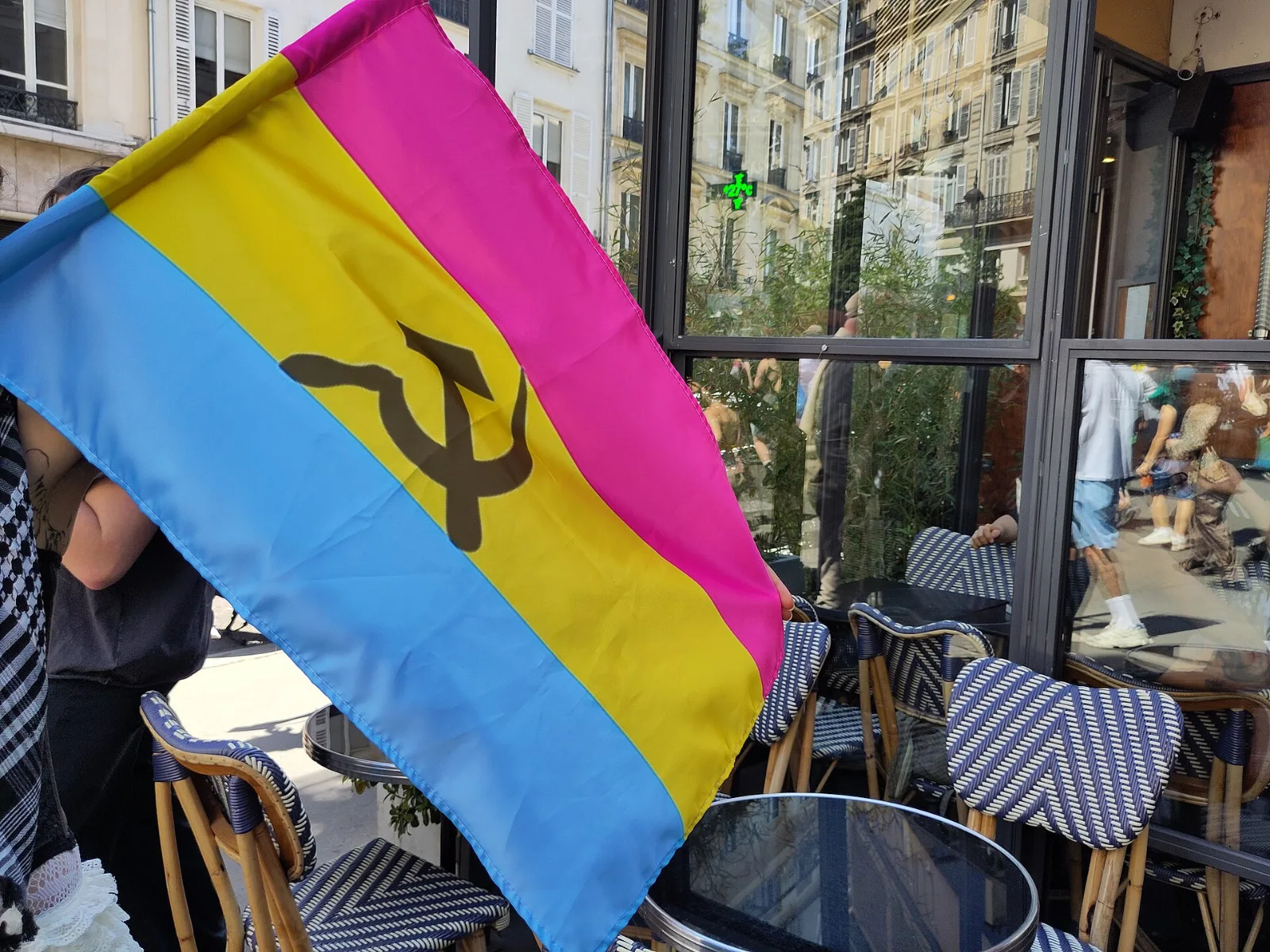
- Pride radicale de Paris, 14 June 2026. A pansexual flag charged with a hammer and sickle. A marked flag carried at a specific march, not an alternative design. · Credit: Silanoc, CC BY-SA 4.0 · Wikimedia Commons
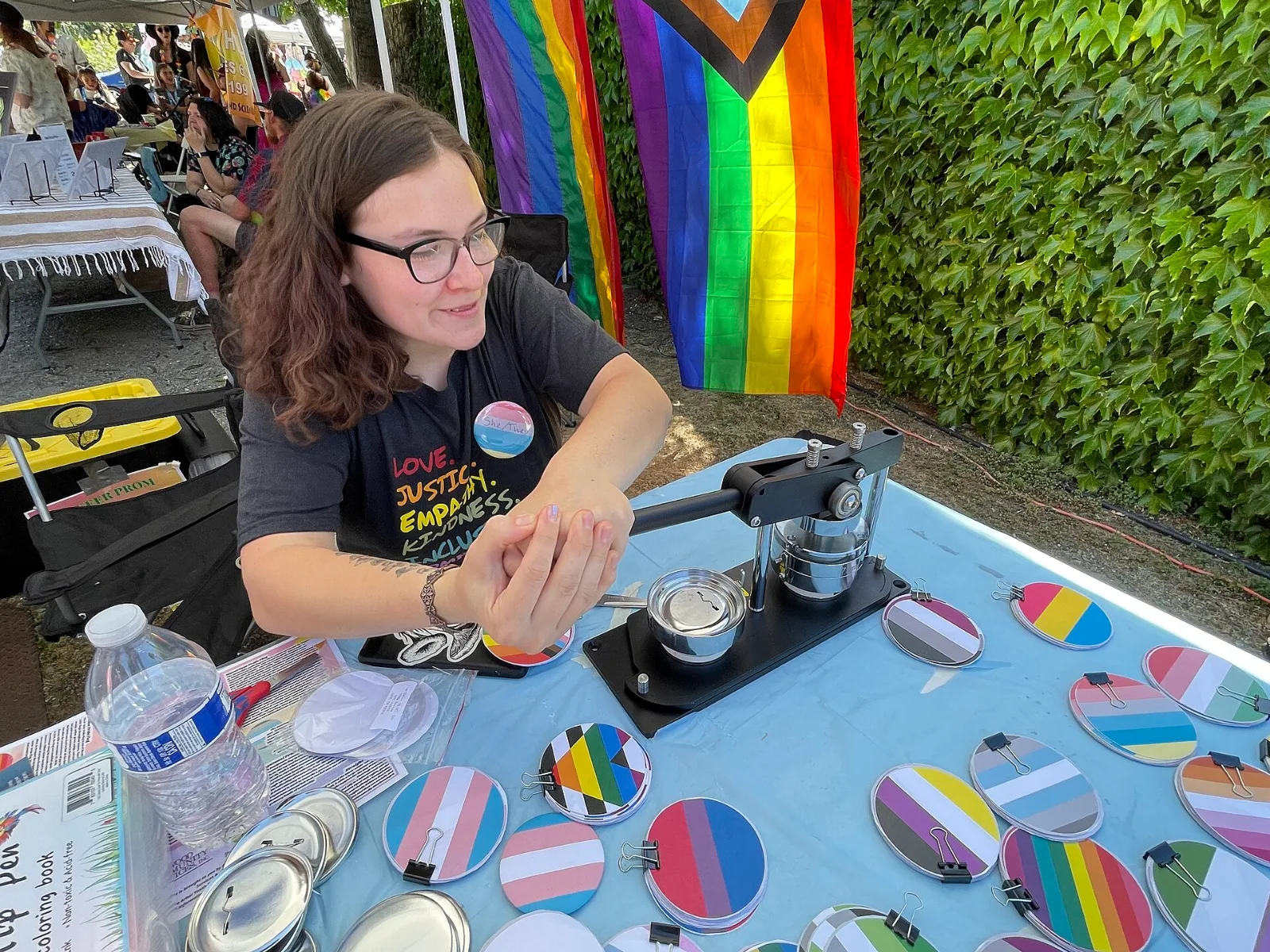
- Button making at Mendocino Pride, Hopland, California, 20 May 2023. A pansexual button among the blanks at upper right. Commons files the photograph under pansexuality pride colors. · Credit: Sarah Stierch, CC BY 4.0 · Wikimedia Commons
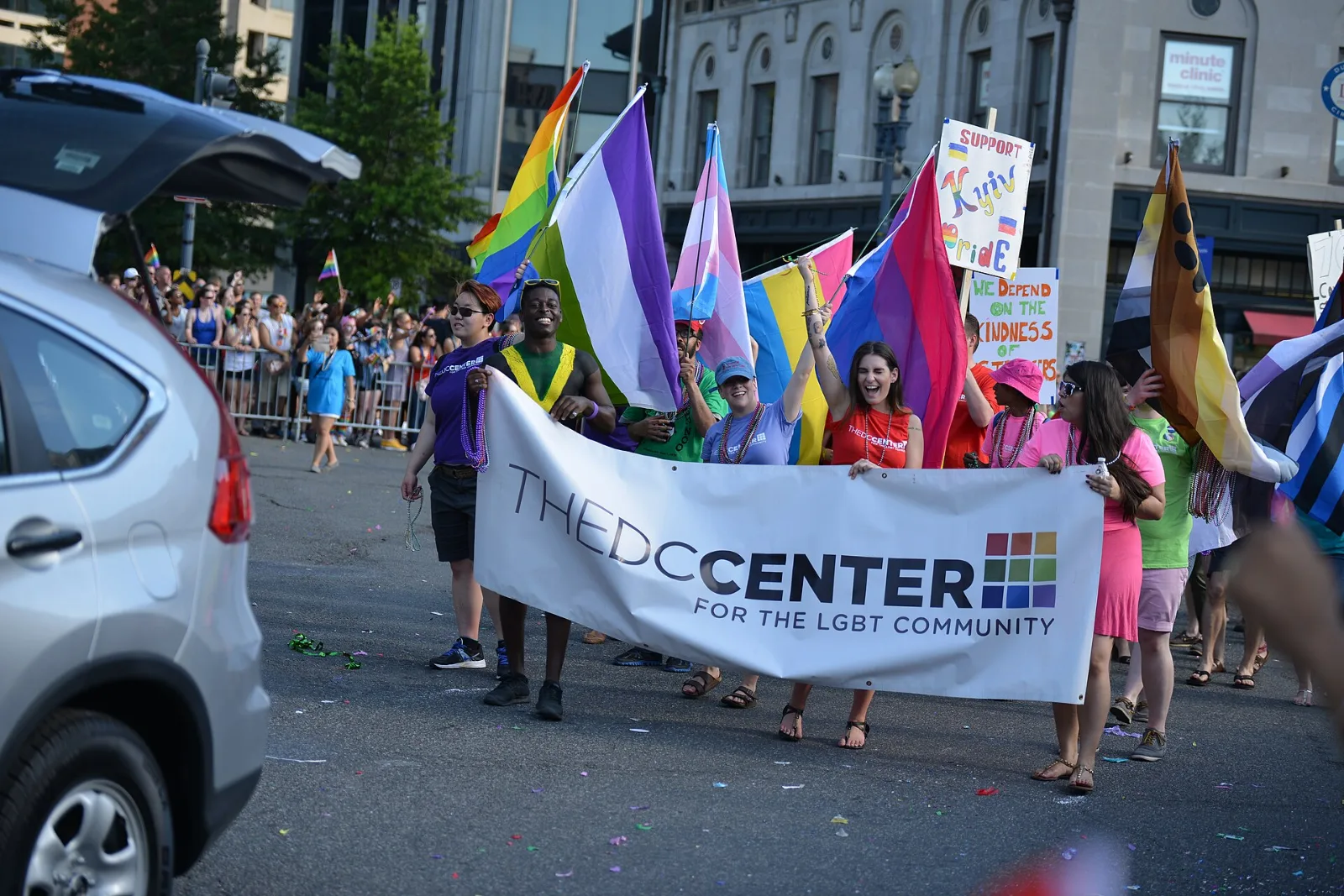
- Capital Pride Parade, Washington DC, 11 June 2016. The Pansexual flag is carried here among bisexual, pansexual, bear and nonbinary flags. Photographed by S Pakhrin. · Credit: S Pakhrin, CC BY 2.0 · Wikimedia Commons
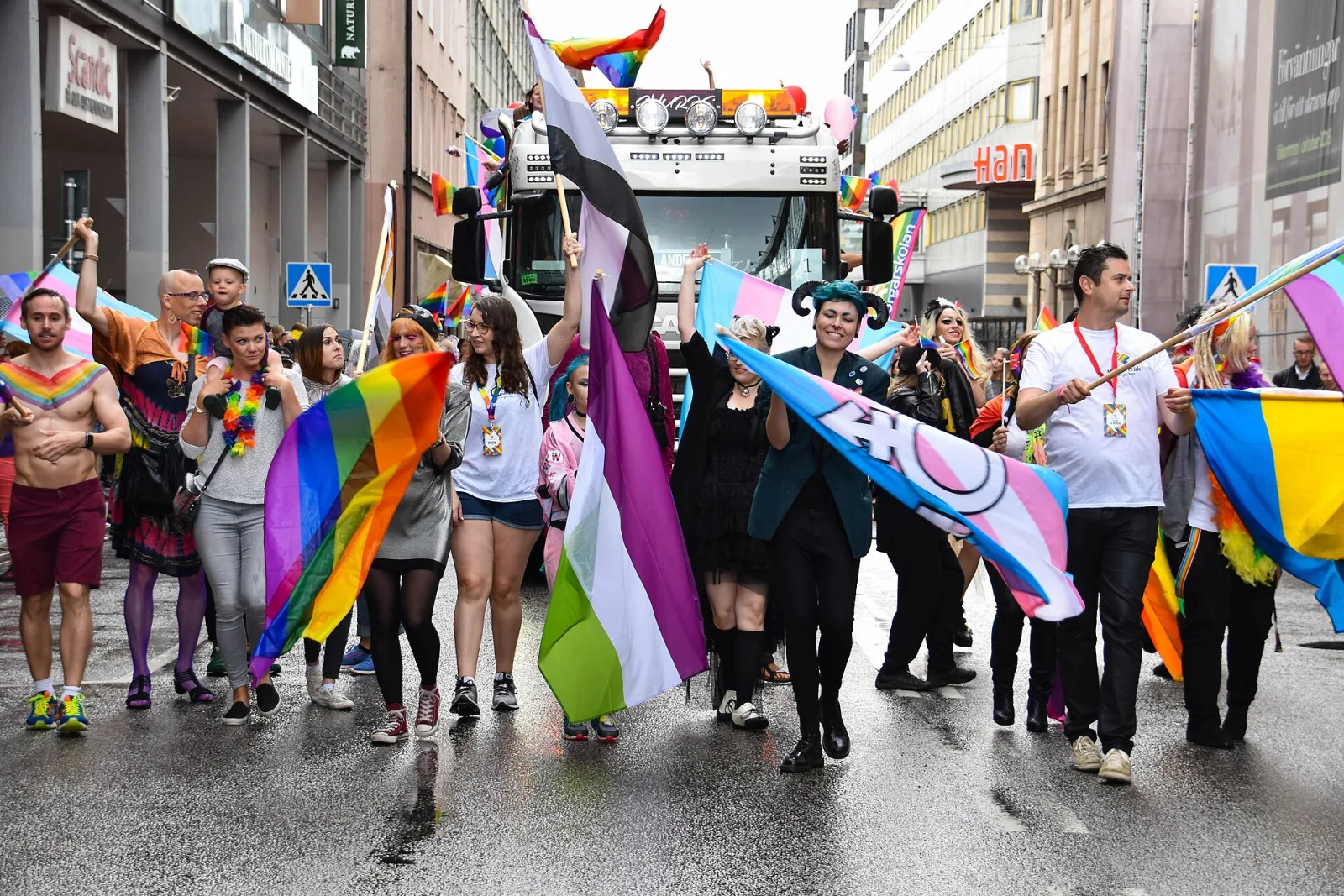
- Malmö Pride, 6 August 2016, among transgender, Genderqueer and asexual flags. Photographed by Maria Eklind. · Credit: Maria Eklind, CC BY-SA 2.0 · Wikimedia Commons
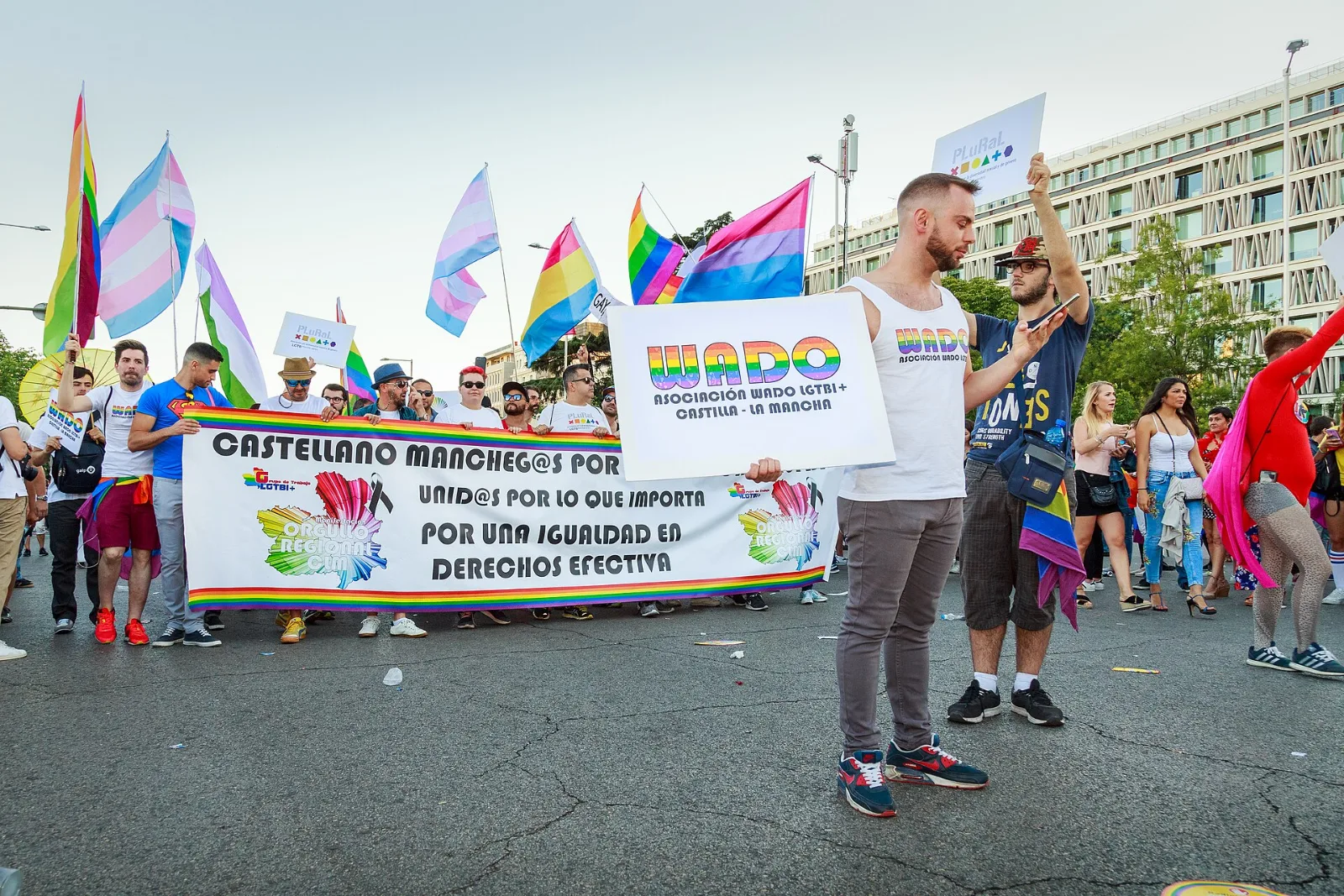
- WorldPride, Madrid, 1 July 2017, with the Asociación WADO LGTBI+ Castilla-La Mancha. The Pansexual flag is carried here among bisexual, transgender and pansexual flags. Photographed by Barcex. · Credit: Barcex, CC BY-SA 3.0 · Wikimedia Commons
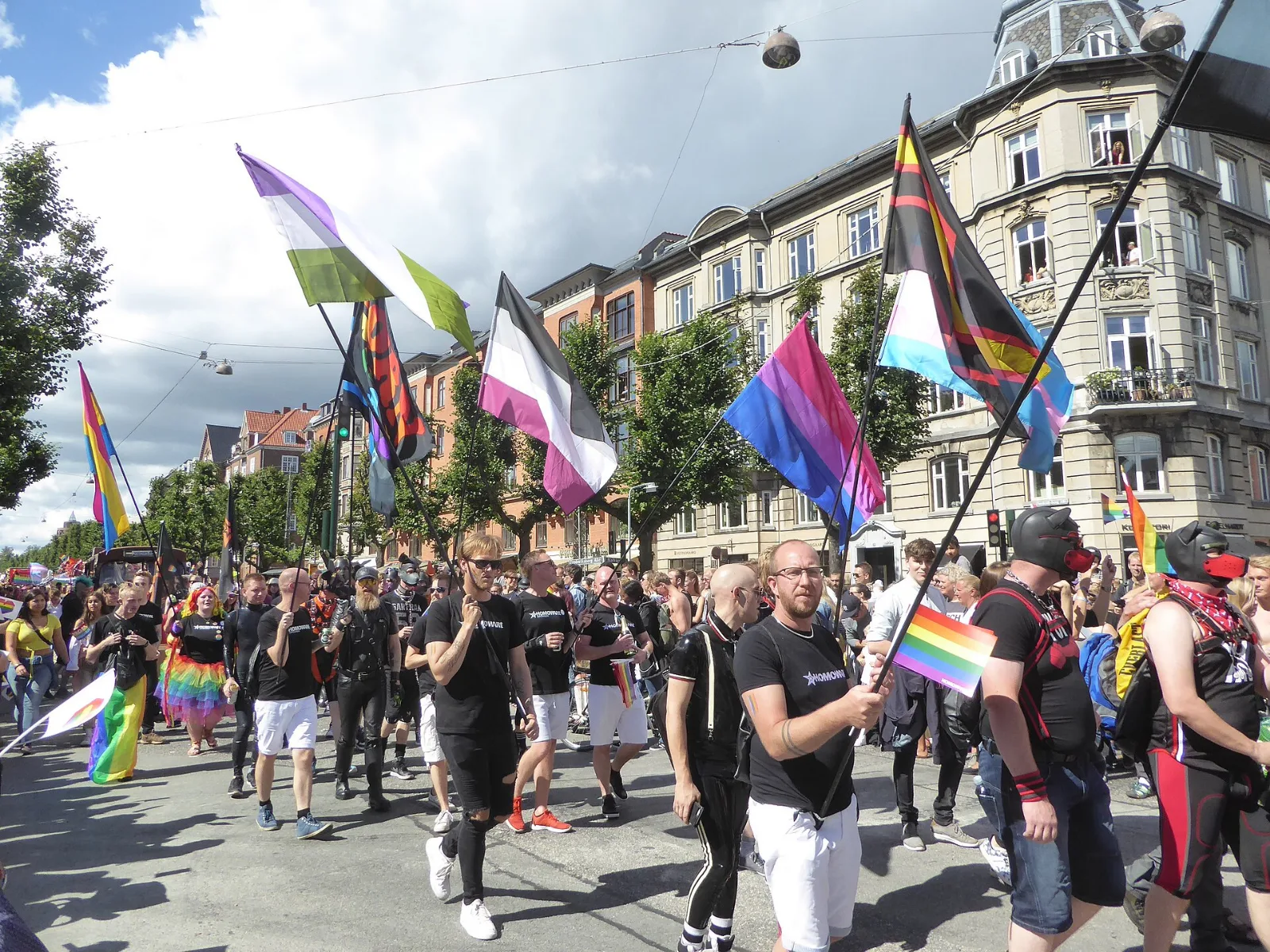
- Copenhagen Pride, Frederiksberg Allé, 19 August 2017. The Pansexual flag is carried here among bisexual, transgender, bear, rubber, asexual and pansexual flags. Photographed by Leif Jørgensen. · Credit: Leif Jørgensen, CC BY-SA 4.0 · Wikimedia Commons
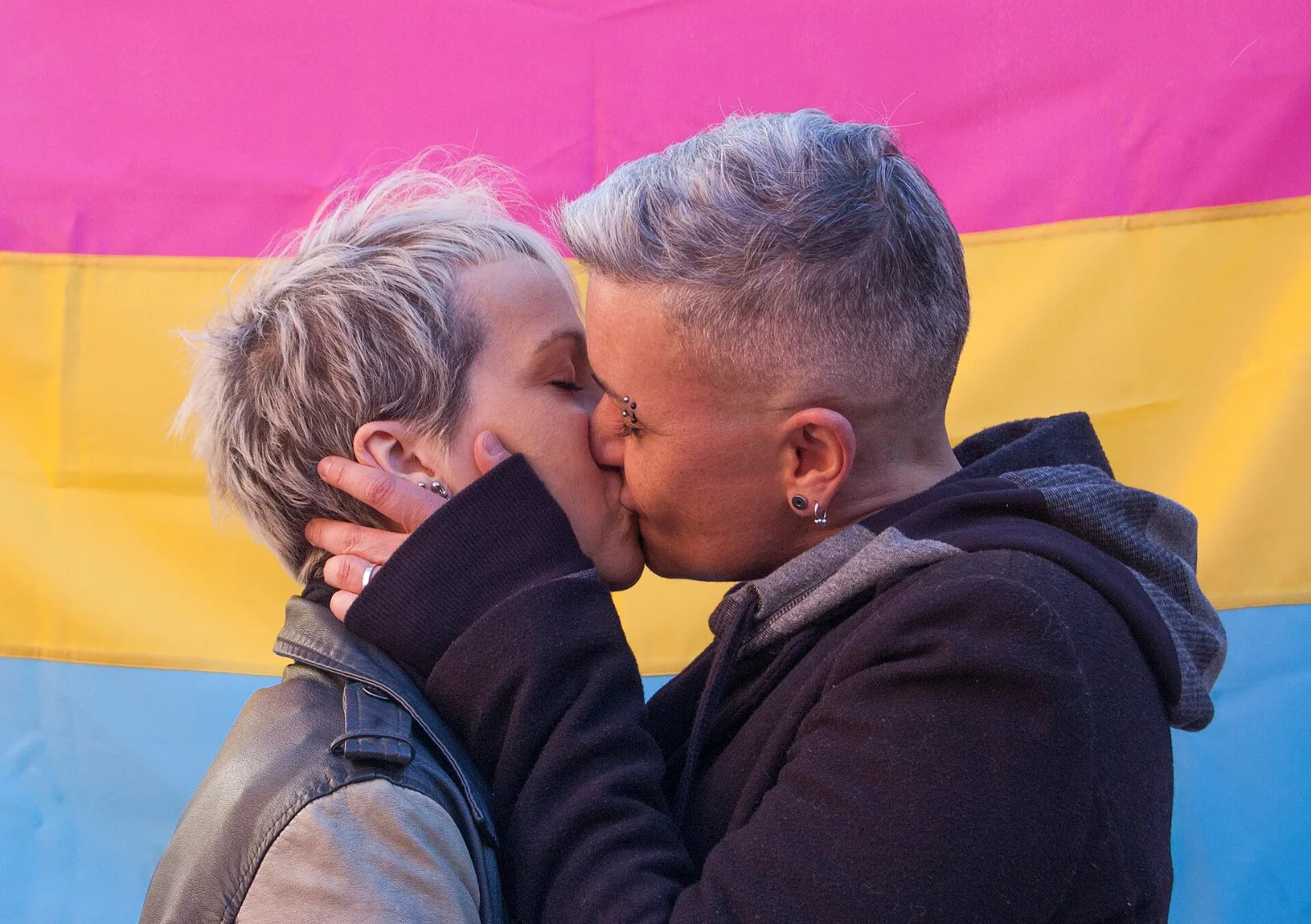
- Two people kissing in front of the flag, photographed by Catherine Coden for the Brazilian organisation SOMOS on 16 June 2018. This is the most widely deployed photograph of the flag on Wikimedia: it illustrates the Pansexuality article on thirteen language Wikipedias and is a Commons Valued Image candidate. [23] · Credit: Catherine Coden / ong somos · Wikimedia Commons, from Flickr · CC BY-SA 2.0
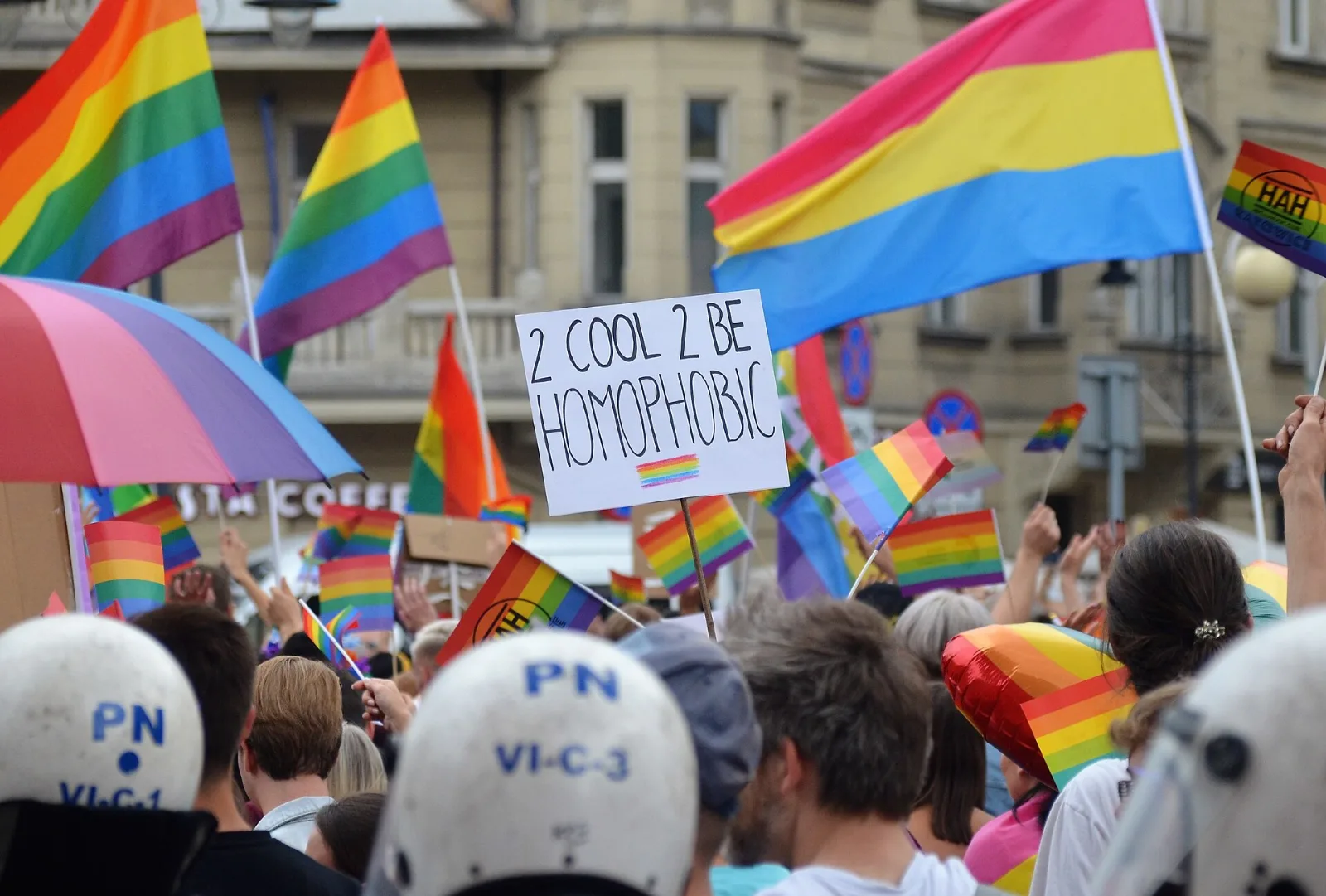
- The Equality March in Katowice, 7 September 2019, photographed by Silar. A full-size pansexual flag flies at the right; helmeted police stand in the foreground, Commons filing the image under Homophobia in Poland alongside its flag categories. [21] · Credit: Silar · Wikimedia Commons · CC BY-SA 4.0
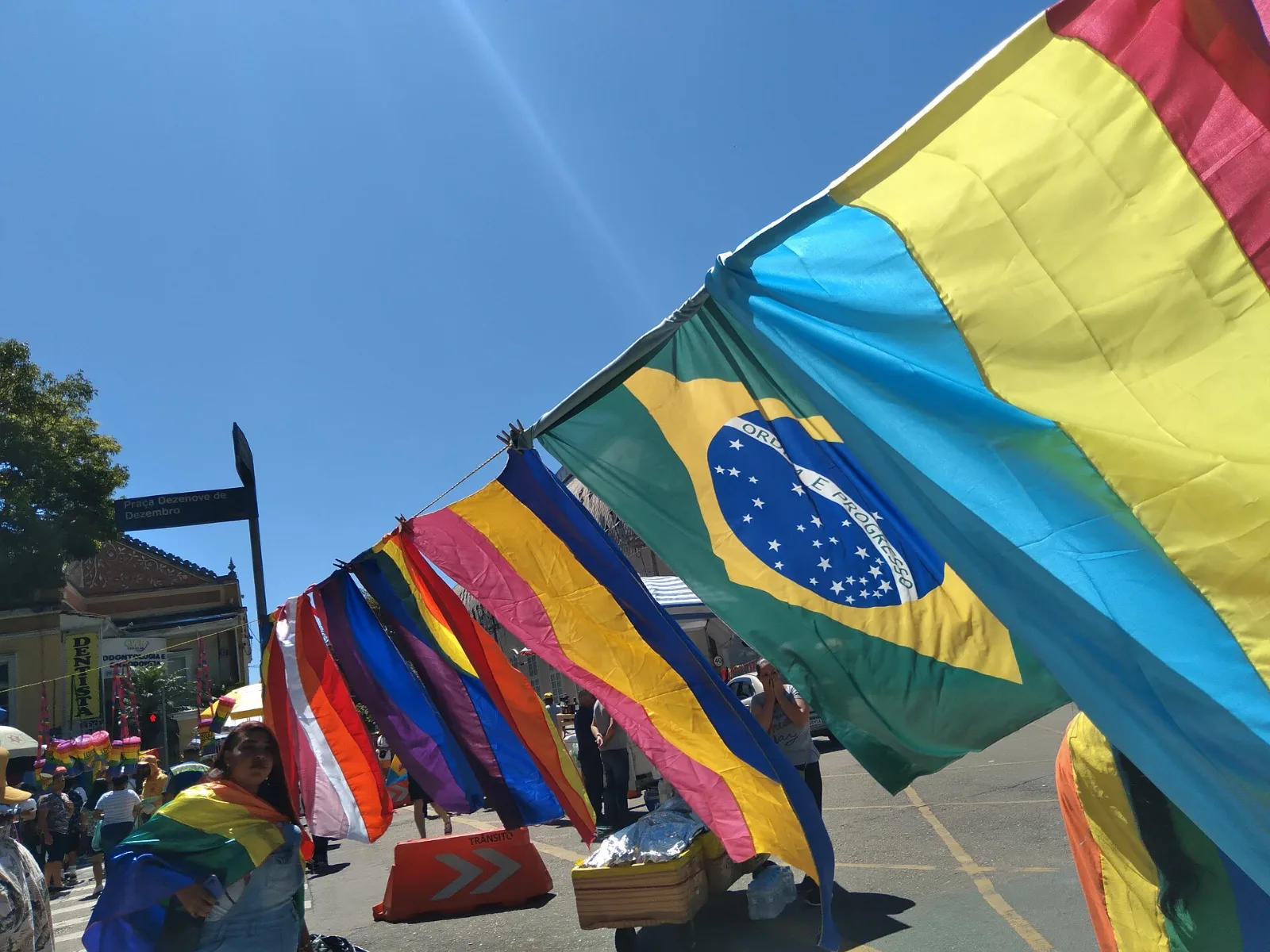
- Flags strung across Praça 19 de Dezembro at the Parada da Diversidade in Curitiba, 15 November 2022. The pansexual flag is nearest the camera, beside the Brazilian national flag; rainbow and transgender flags run down the line. Commons also identifies bisexual and five-stripe sunset lesbian flags in the row. [22] · Credit: Transhet · Wikimedia Commons · CC BY-SA 4.0
- Capital Pride Festival, Washington DC, 11 June 2023, photographed by Ted Eytan. A large pansexual flag flies over the crowd; the black, grey, white and purple fan at lower right carries the asexual palette. [20] · Credit: Ted Eytan · Wikimedia Commons, from Flickr · CC BY-SA 2.0
- Glasgow's MardiGla parade, George Square, 15 July 2023, uploaded for Wiki Loves Pride. The handheld flag is flown blue at the top, pink at the bottom, the reversed order Flags of the World records as increasingly common. A five-stripe sunset lesbian flag is at the left of frame. [19][5] · Credit: LornaMCampbell · Wikimedia Commons · CC BY-SA 4.0
- A Jewish variation on the flag, adding a Star of David, made by the Commons user Jewish-sideblog and dated 18 June 2024. One of several derivations that take the palette rather than the design. [24] · Credit: Jewish-sideblog · Wikimedia Commons · CC0 1.0
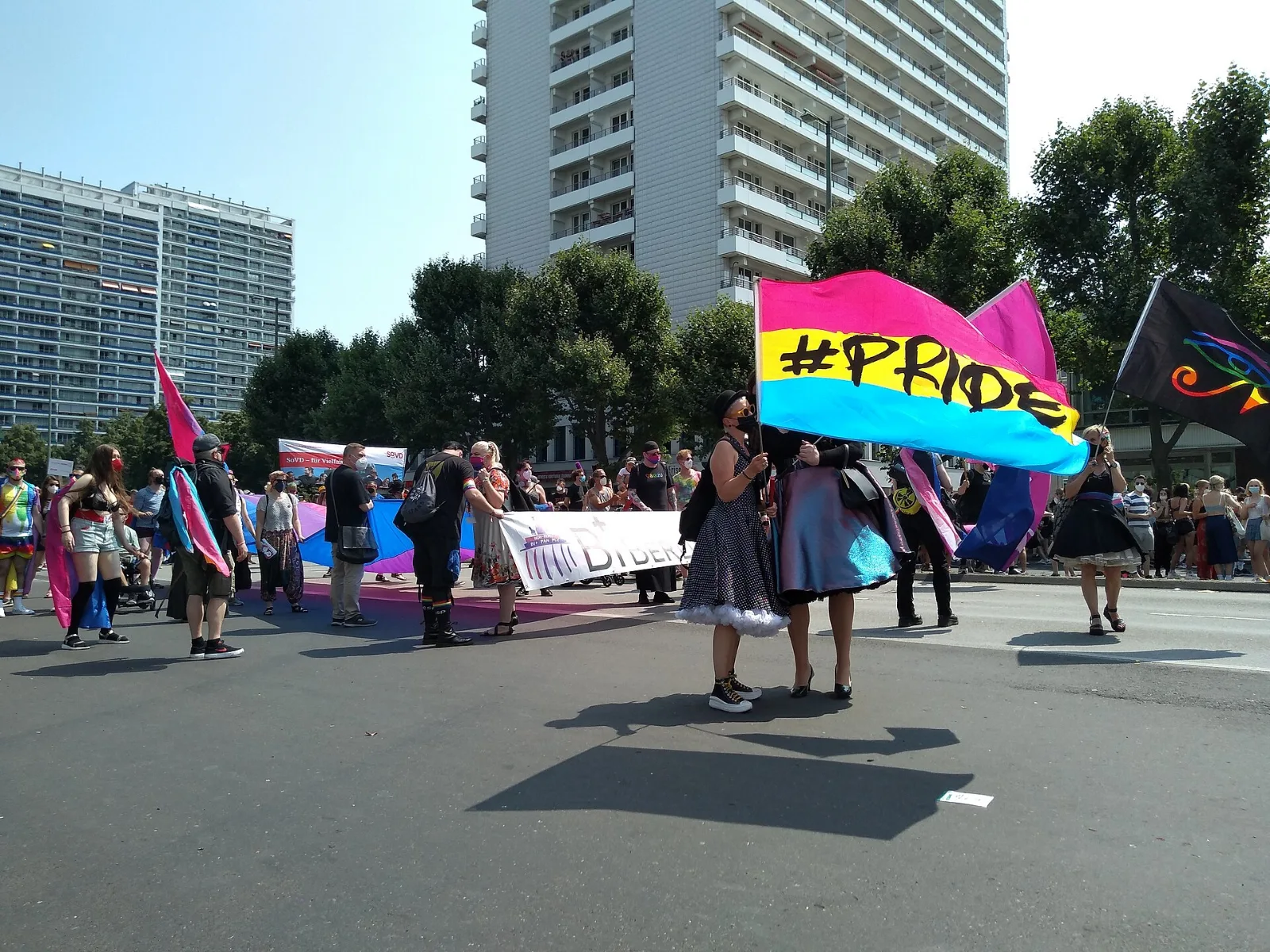
- Christopher Street Day, Berlin, 24 July 2021. A pansexual flag hand-lettered “#PRIDE,” carried alongside bisexual flags and the BIBER banner of Bi Berlin. · Credit: Lucas Werkmeister, CC BY 4.0 · Wikimedia Commons
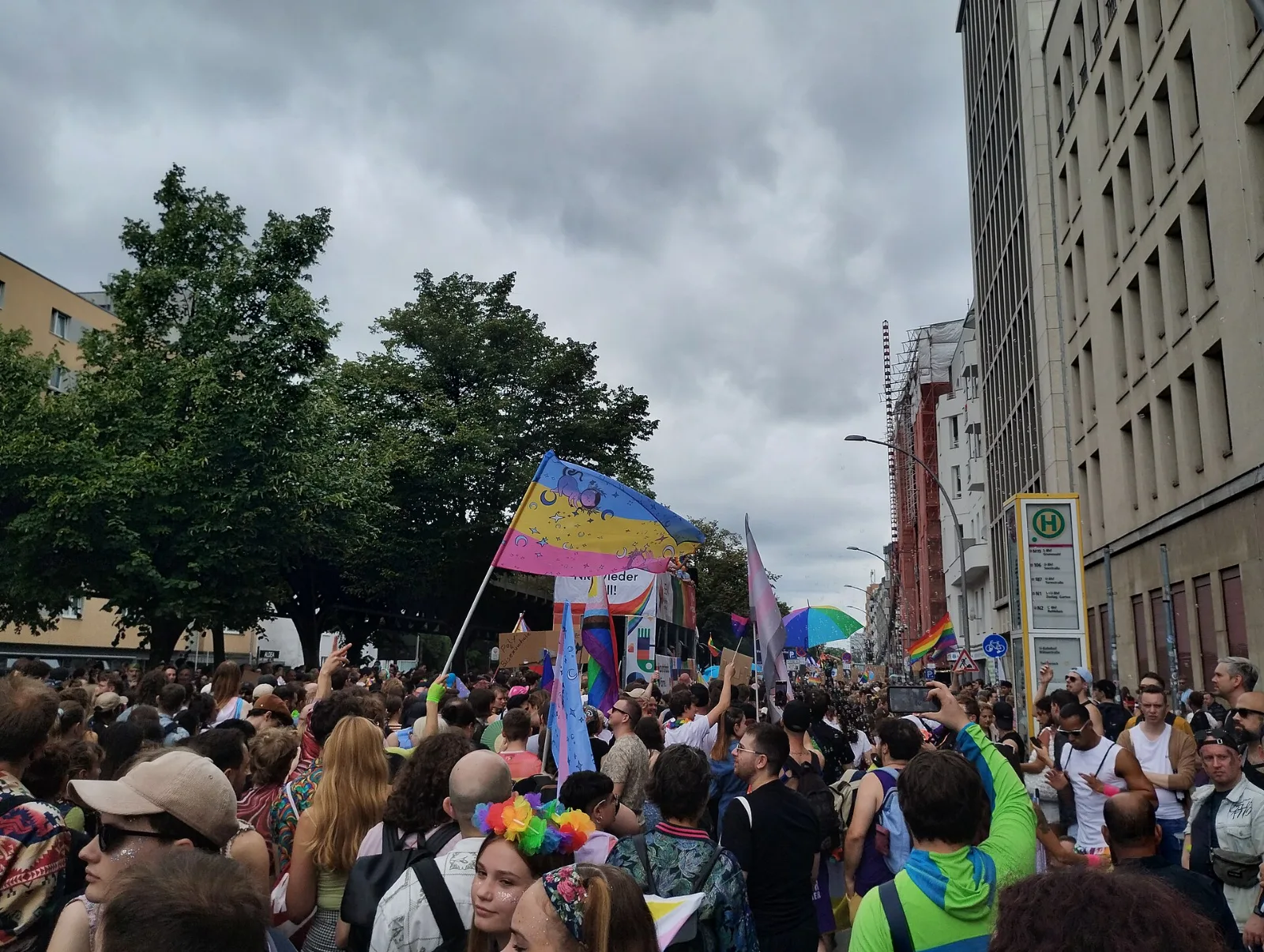
- Christopher Street Day, Berlin, 26 July 2025. Flown in reversed order and hand-painted with moons, stars and figures. · Credit: Lucas Werkmeister, CC BY 4.0 · Wikimedia Commons
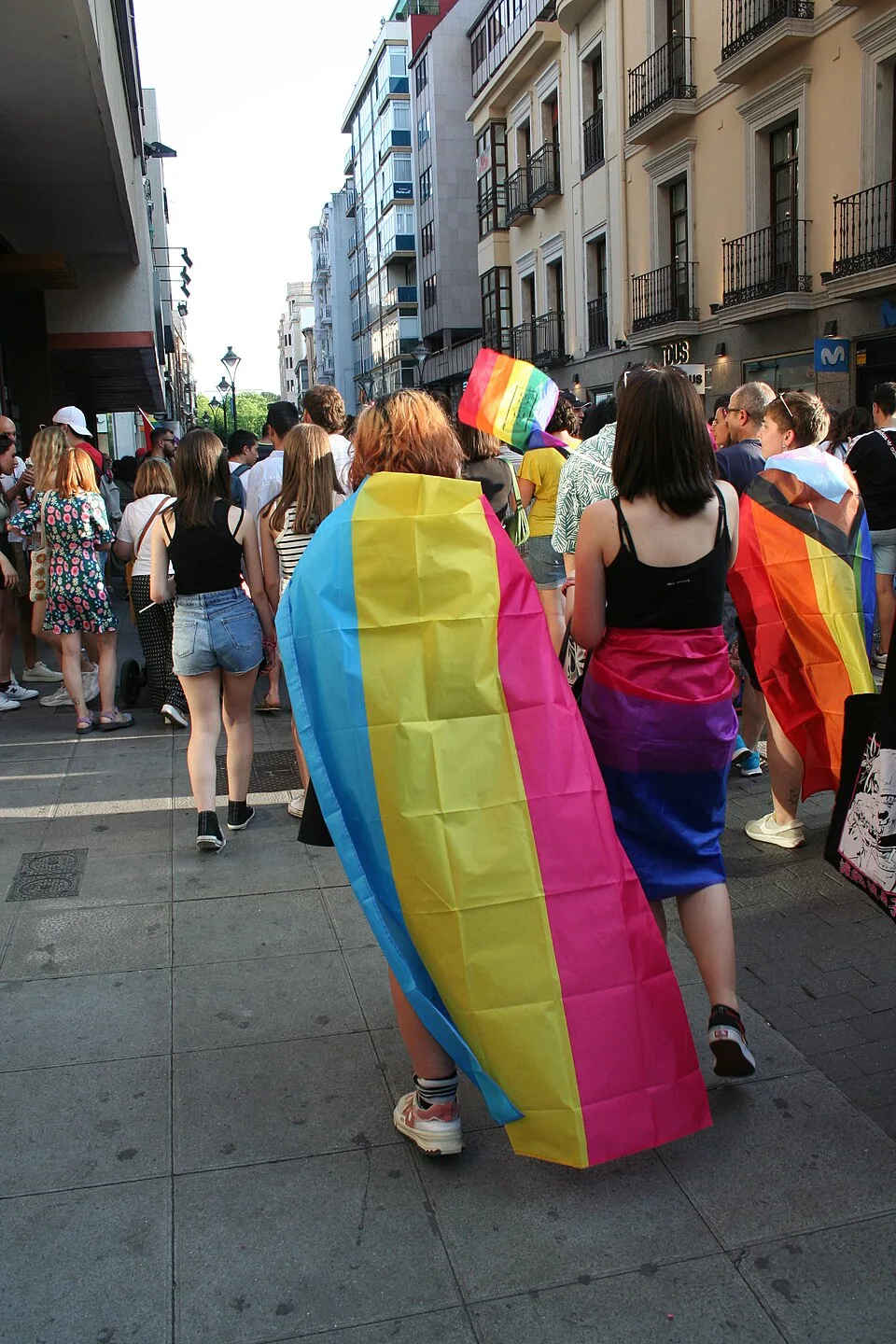
- Marcha del Orgullo LGBT+, Valladolid, 28 June 2023. The flag worn as a cape. Commons files the photograph under LGBT pride flags worn as capes. · Credit: MiguelAlanCS, CC BY-SA 4.0 · Wikimedia Commons
- Capital Pride Parade, Washington, D.C., 8 June 2019. The OUT Riders Women’s Motorcycle Club, with the pansexual flag flown in reversed order. Flags of the World cites this parade for reversed hoisting and for both orientations flying together. [5] · Credit: Elvert Barnes, CC BY-SA 2.0 · Wikimedia Commons
- Pride flags rendered in rock and mineral specimens in a museum display case, each flag laid out beside the stones its colours were taken from. This case shows the bisexual, pansexual and aromantic flags. The case is most likely in the Cambridge geology museum: the quotation card in it is credited to a Coleridge student in 2022, and Coleridge Community College is a Cambridge school. The museum has not confirmed it. If you can add its formal name or the dates the display ran, contribute. · Credit: feral-critter, via Tumblr · feral-critter on Tumblr