Androgynous Pride Flag
Identity Pride Flag ·
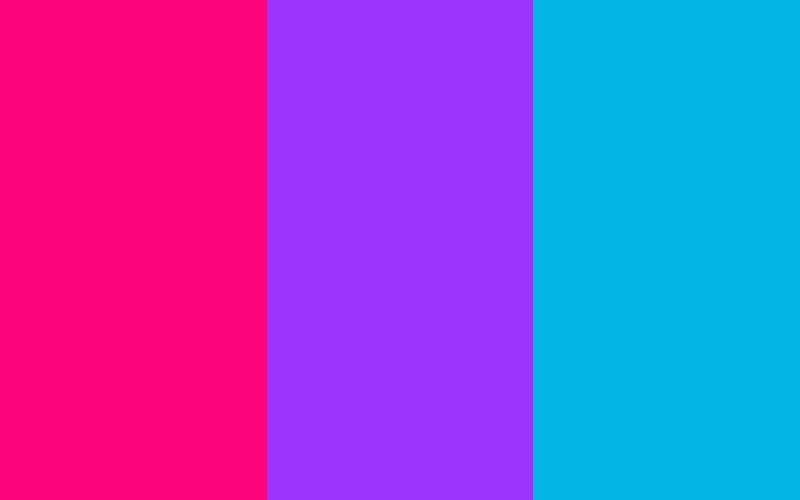
Tumblr user saveferris posted this pink, purple and blue vertical tricolour on 29 March 2011 with the caption "Voilà. Androgynous flag." The post supplied no stripe meanings. The familiar interpretation of pink as femininity, purple as a combination of femininity and masculinity, and blue as masculinity appeared in a pridearchive reblog on 24 July 2014, where it was introduced as what the colours "supposedly" meant. [1][2]
Key facts
- Designer
- saveferris
- Created
- First documented public use
- In use
- 2011 to the present
- Aspect Ratio
- 3:5
- Stripes
- 3
- Represented Identity
- androgyne
Also known as
- Androgyne Pride Flag
- Androgyne Flag
Status Canonical
Archive categories Gender Identity Pride Flags
Overview
Made by the Tumblr user saveferris and posted on 29 March 2011. The post is three words long. Its title and its entire body read "Voilà. Androgynous flag.", tagged androgyny and xs, and it carries no statement of what the three stripes mean. [1] The account has also gone by saveferris-blog, lanky and lankyledlights, and the blog now carries a retirement notice. [3][4][1]
Identity & Context
- Represented Identity
- androgyne
- Subcommunity
- nonbinary umbrella
Androgyne is a gender identity, distinct from androgynous gender expression: not everyone who presents androgynously is androgyne, and not every androgyne person presents androgynously. [3][5][6] The word combines the Greek andro, man, and gyne, woman.
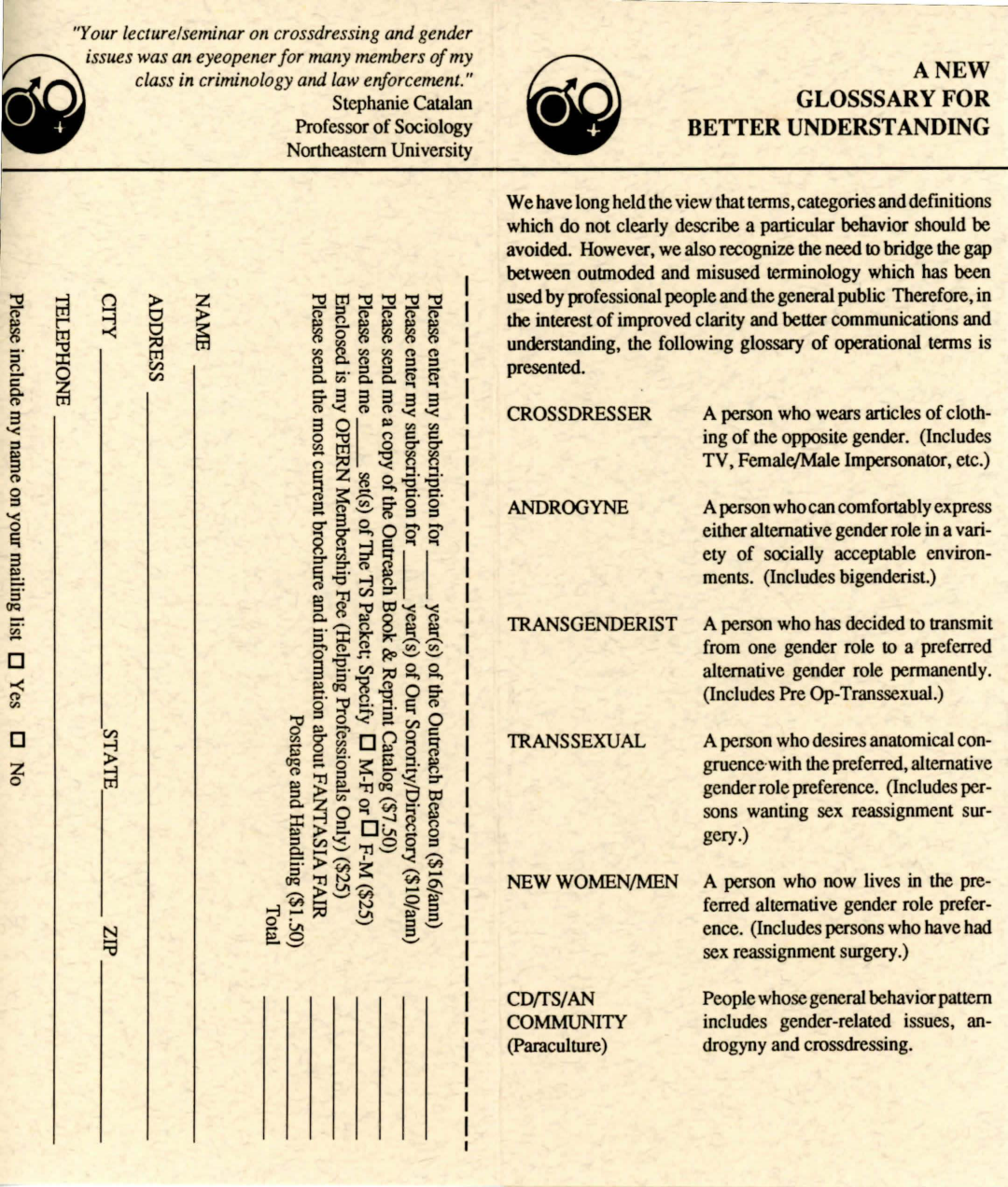
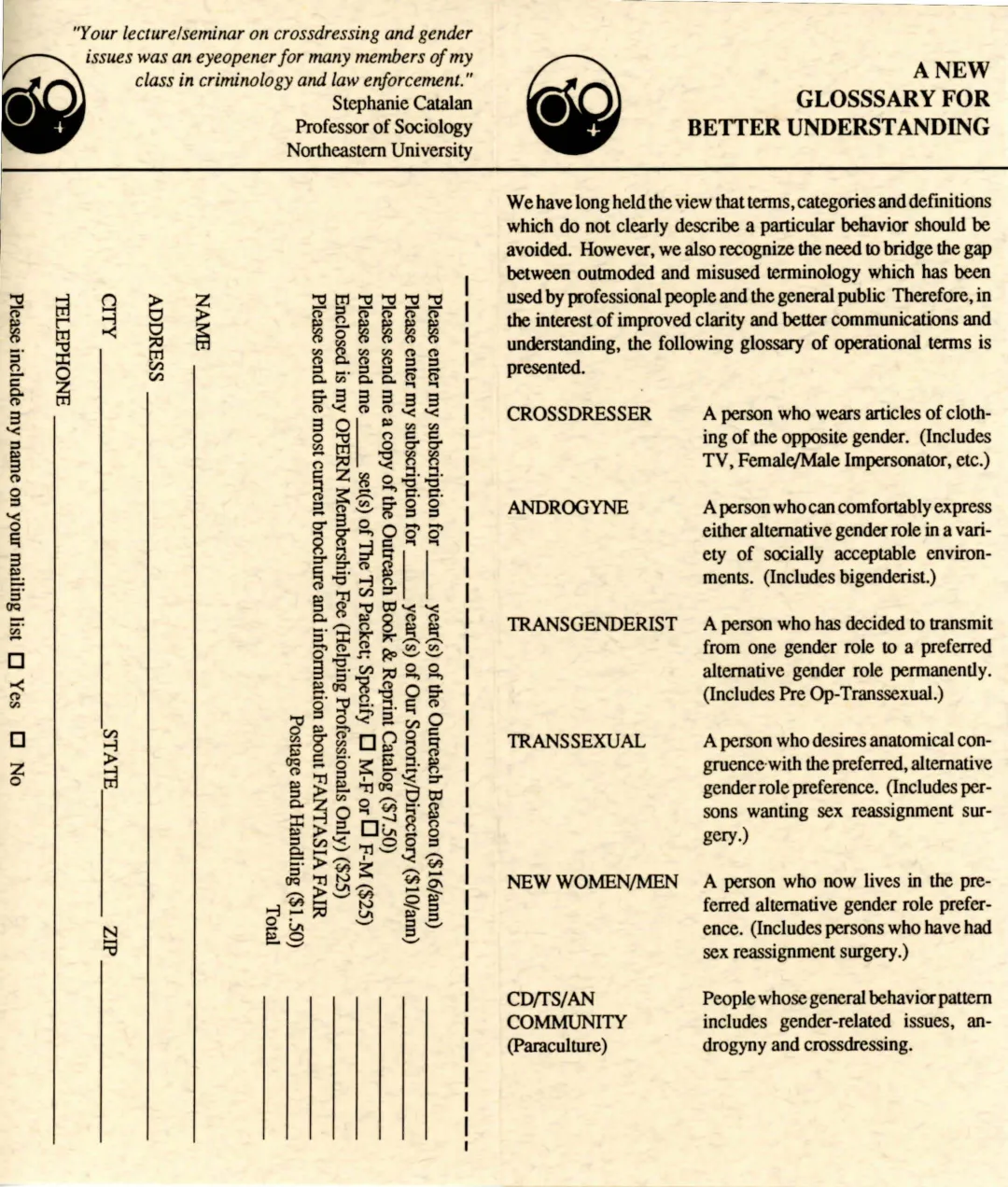
The term is a century older than the flag. Jennie June published Autobiography of an Androgyne in 1918, which Scott Herring's introduction to the 2008 reissue calls "a centerpiece for queer, trans, and gender studies of twentieth-century America"; June had founded the Cercle Hermaphroditos in New York in 1895, in her words "to unite for defense against the world's bitter persecution." [8][6] In a brochure the Digital Transgender Archive dates to circa 1987, the Human Outreach and Achievement Institute, a trans-focused organisation, defined an androgyne in a brochure glossary as "A person who can comfortably express either alternative gender role in a variety of socially acceptable environments. (Includes bigenderist.)" The final clause is dropped by the guides that quote the definition. The glossary places the term between crossdresser and transgenderist. [7] A LiveJournal community for androgynes followed in 2003, taking the Necker cube as its icon, and Facebook included both androgyne and androgynous among the 56 gender options it opened in 2014. [6]
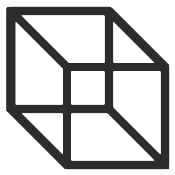
Two symbols for androgyne identity predate the flag and are not part of it. The Necker cube, an optical illusion published by the Swiss crystallographer Louis Albert Necker in 1832, was proposed for androgyny by Raphael Carter in The Angel's Dictionary in 1996, "because it is either concave or convex depending on how you look at it," in preference to a Mars-plus-Venus sign that "depends upon a juxtaposition of stereotpyes." Practical Androgyny uses a variant with a smaller square at the centre. [9][6] The combined Mars-Venus symbol, ⚨, is older and its creator unrecorded; it is also used for intersex people and can be drawn pointing in several directions. [4][10] Both are in the Image Archive under Symbols.
Historically androgyne was used interchangeably with intersex; that use has largely fallen away, and the Nonbinary Wiki records the concern that naming two binary genders in the word makes it a poorer umbrella term than nonbinary. [3][4][6]
Creators
The Creator
saveferris
Designer
A Tumblr user who posted the flag on 29 March 2011 under the title "Voilà. Androgynous flag." [1] Later community wikis report the account under the names saveferris-blog, lanky and lankyledlights, and report xe/he/it pronouns; no primary confirmation of either has been located. [3][4] No meanings for the stripes and no account of the design were published, and nothing further about the person is documented.
Attribution notes
Made by the Tumblr user saveferris. [1] Later community wikis report the same account under the names saveferris-blog, lanky and lankyledlights, and the MOGAI Wiki reports that lanky uses xe/he/it pronouns; neither is confirmed by a primary source, and both are recorded here as what those wikis report. [3][4] Nothing else about the person is documented in any source located, and no statement about the flag beyond the original post has been found. The Wikimedia Commons file of the design names SaveFerris as its author. [11]
Origin
- Specific Place
- Tumblr (saveferris)
- Place Type
- blog
- Digital Origin
- Yes
Digital origin; no verified physical location.
Published on Tumblr by saveferris on 29 March 2011. No country, city or physical location is documented; the flag's whole recorded origin is the post. [1]
Dates & Chronology
- Year Created
- Exact date
- First public use
- Period in Use
- 2011 to the present
- Creation Bounds
- Dated to 29 March 2011, the date the original post carries on its face. [1] The 2014 date that circulates alongside it is the date of a reblog. The LGBTA Wiki states that saveferris created the flag "on or before July 24, 2014" and cites one source for it: pridearchive's reupload, which is a reblog of the 2011 post with colour meanings added. [10][2] Dating the flag from that post dates the reupload. The LGBTQIA+ Wiki carries both figures on one page, 24 July 2014 in its summary and 29 March 2011 in its Flags and Symbols section, the latter with two archive citations. [3] Later guides reproduce 2014 without citing anything. [12][13][14] The LGBTA Wiki page carrying the 2014 date also carries a banner of its own: "some of the information on this page could not be verified by our staff team. Therefore, this article may include false information." [10]
The original post travelled by reblog: saveferris to fyandrogyny, an androgyny blog, to genderqueeries, and on 24 July 2014 to pridearchive, which added the colour meanings and a set of graphics. [1][2] Readers in the chain remarked on the orientation as much as the colours: one wrote "I've been wondering if there was going to be any flags with vertical stripes instead of horizontal stripes." [2]
pridearchive also produced derivative graphics from the design, a pride button, a scarf and a banner, crediting the flag to saveferris and the three graphics to itself. [2] The design has since been carried into reference contexts: the Wikimedia Commons file is used by the Simple English and Slovene Wikipedias, and Pride organisations and campus groups publish it in their own flag guides. [11][15]
The MOGAI Wiki records the same absence, that "the stripe meanings were not specified in xyr posts." [4] Three of the guides checked here, Queer in the World, Good Good Good and one of the two MOGAI Wikis, reproduce the meanings without pridearchive's hedge. [12][13][14]
The resemblance to the bisexual flag was remarked on in the post's own notes. Reblogging it through fyandrogyny, a commenter posting as maeinmaryjanes wrote: "This looks identical to the bi-pride flag. Also pink, purple and blue." The notes carry no date for the comment, and it is not among the earliest: it reached the post through a reblog chain, after the reupload of July 2014. [1] The two designs share the three colours and differ in orientation and proportion; no source documents either as derived from the other.
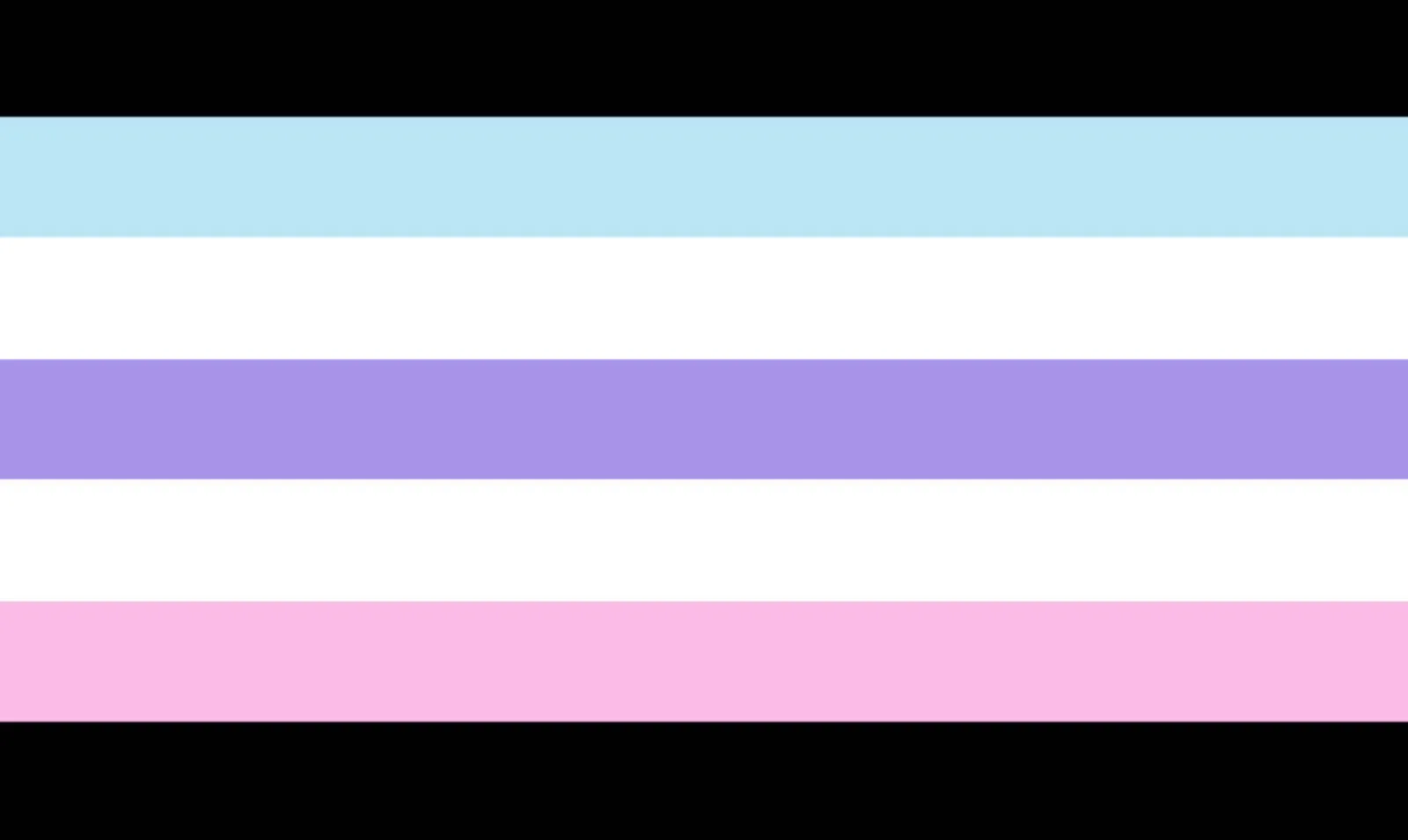
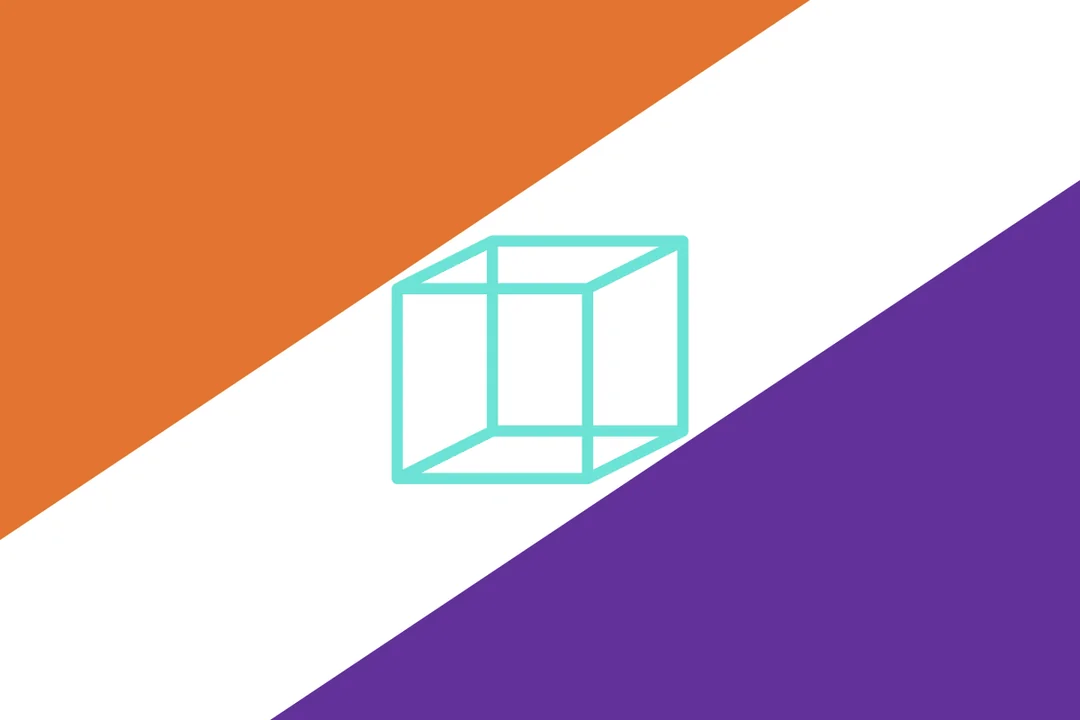
At least seven further androgyne flags have been proposed since. A seven-stripe design adding black and white was published through the Pride-Flags DeviantArt account on 24 August 2015; [16] Milith Rusignuolo posted a five-colour proposal on 2 July 2015 keyed to androgyne microlabels; [17] a Reddit user posting as wrennnnnnnnn published one on r/QueerVexillology on 19 June 2020 that carries a Necker cube and abandons the pink and blue; [18] a five-stripe design was posted to r/lgbt on 10 October 2020 by an account since deleted; [19] and further designs followed in January 2021, August 2021 and November 2021. [3][4][10] Each design's own account of its colours is given with its image in the Image Archive. A community index lists these alongside microlabel flags for mascandrogyne, femandrogyne, neutandrogyne, transandrogynous, demiandrogyne and versandrogyne. [20]
One design may be older than any of them, and it is the only one with no name attached. The androgyne alternate flag sets a blue and a pink bar on grey so that they form an equal sign, for what Library.LGBT calls the "equal" experience of masculinity and femininity, with grey for gender neutrality; a variant runs the two bars the full width. Library.LGBT states that its origin and designer are unknown but that it "almost certainly predates the currently most-used androgyne flag," on the grounds that it appears on early internet infographics about Pride flags. [21] The MOGAI Wiki goes further and reports a rumour that it dates to 2003; no evidence for that year has been located, and Library.LGBT does not give one. [4]
The resemblance to the bisexual flag became a reason to redesign. Milith Rusignuolo, explaining a proposal posted on 2 July 2015, wrote: "I was displeased with the current androgyne flags (the gray-blue-pink and pink-purple-blue ones), especially since the second one looked so similar to the bisexual flag." [17] The same objection appears in the original post's own notes. [1]
Lineage
No parent is documented. The pink-purple-blue palette uses the standard gender colour vocabulary, pink for femininity and blue for masculinity, with purple for the blend. The bisexual flag uses the same three colours, and a reader said so in the post's notes, reblogging it through fyandrogyny: the design "looks identical to the bi-pride flag. Also pink, purple and blue." The notes carry no date for the comment. It is a documented visual comparison and not evidence of derivation, and the two designs differ in orientation and proportion. [1]
An undated equal-sign design on grey may precede this flag rather than descend from it. Library.LGBT says its designer and origin are unknown and that it almost certainly predates this one, and Milith Rusignuolo, writing in 2015, names both flags together as "the current androgyne flags," which puts the grey-blue-pink design in circulation by July 2015. [21][17] Nothing establishes a design relationship in either direction, so it is recorded here as an earlier androgyne flag and not as a parent.
The bigender, genderqueer and nonbinary flags are listed as related on identity grounds. No source documents a design relationship with any of them.
Colors & Symbolism
saveferris did not publish meanings for the stripes. The interpretations below first appeared in pridearchive's 24 July 2014 reblog, which introduced them as what the colours "supposedly" meant. [1][2]
| Colour | Hex | Meaning |
|---|---|---|
| Pink | #FF007F | Femininity |
| Purple | #9832FF | A combination of femininity and masculinity |
| Blue | #00B7E7 | Masculinity |
Hex values are approximate, sampled from the surviving 2011 Tumblr JPEG; saveferris published no digital palette. [1]
Design
- Aspect Ratio
- 3:5
- Orientation
- vertical
- Stripe Count
- 3
- Layout
- vertical_stripes
- Stripes (Left → Right)
- Pink, Purple, Blue
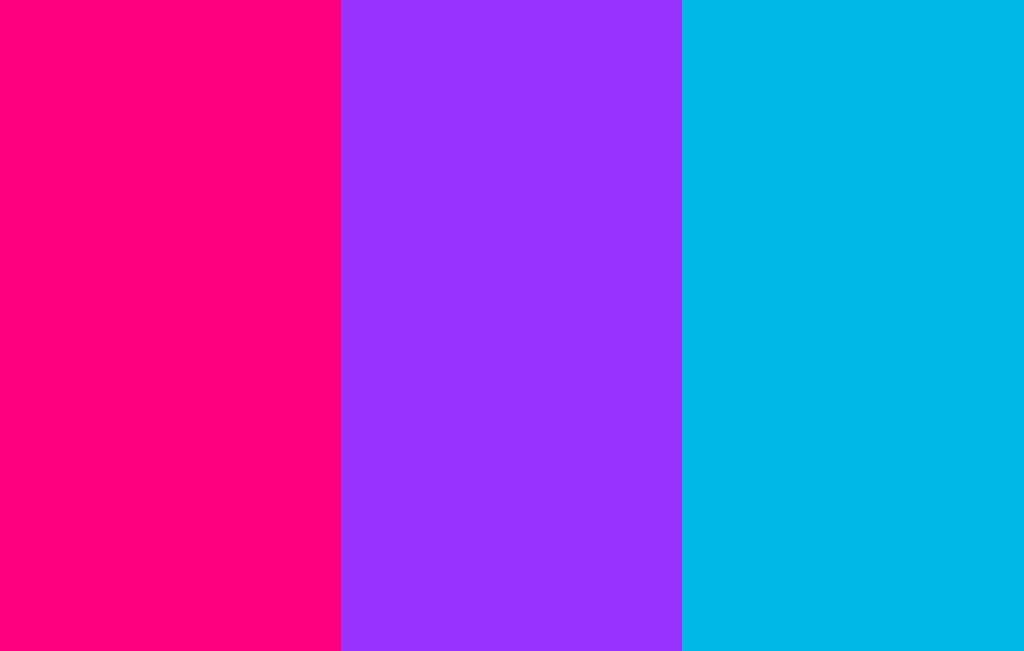
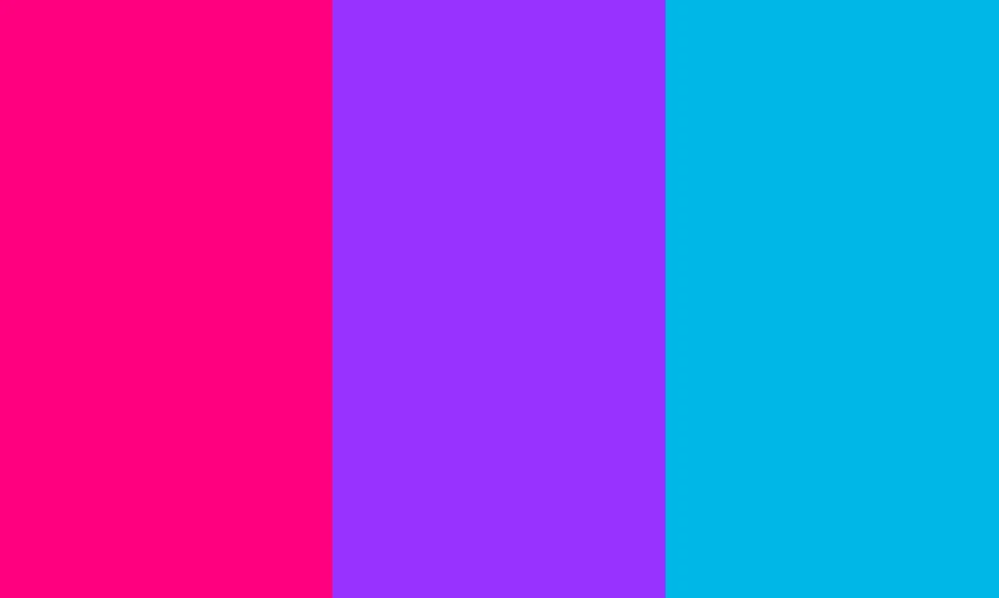
Three equal vertical stripes at 3:5. VexiWiki publishes that ratio, and the Wikimedia Commons file measures 999 by 598 pixels, which is 3:5 to within a pixel. [22][11] The image attached to the original post is 1024 by 651. [1] saveferris gave no reason for the vertical orientation, but a reader in the post's reblog chain remarked on it: "I've been wondering if there was going to be any flags with vertical stripes instead of horizontal stripes." [2]
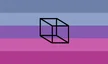
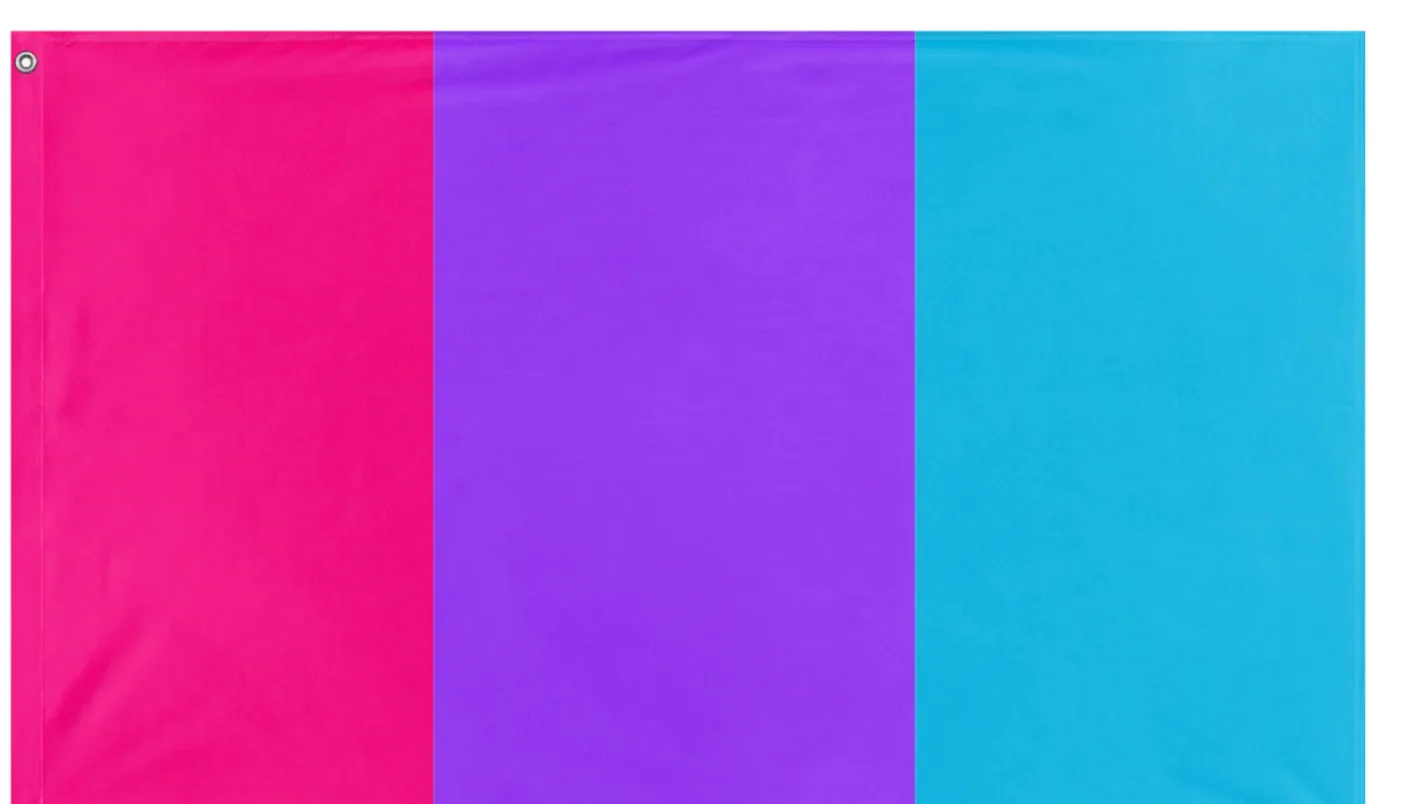
Three equally sized vertical stripes ordered left to right: pink, purple, blue. No emblem or additional symbols. [3]
Three equal vertical stripes. From left to right: pink (#FF007F), purple (#9832FF), blue (#00B7E7).
Usage & Adoption
- Online Usage
- Tumblr, from saveferris's post of 29 March 2011 through fyandrogyny and genderqueeries to pridearchive's reupload of 24 July 2014. [1][2], Wikimedia Commons, where the file illustrates the androgyne articles on the Simple English and Slovene Wikipedias. [11]
- Current Status
- active
Of the androgyne designs in circulation this is the one in general use. A community index of androgyne flags calls it "the poster flag of the community. Most people use this as their flag." [20] Its circulation is online: identity wikis, flag reference guides and small-run retail listings. Derivative graphics were made from it as early as 2014, when pridearchive published a matching button, scarf and banner. [2] It is commercially manufactured: Flagmaker & Print offers it printed to order in sizes from a six-inch table flag to three by five feet, single or double sided, with a choice of grommets or pole sleeve. [23] No photograph of the flag in physical use has been located.
Image Archive
The design

Later proposals
Before the flag
Symbols

Commercial circulation
Discourse & Debates
- Two creation dates circulate, 29 March 2011 and 24 July 2014, both appearing on the same LGBTQIA+ Wiki page in different sections. Only the 2011 date is tied to a cited post. [3][4][5]
- Which androgyne flag is the earliest. Library.LGBT holds that the undated equal-sign design almost certainly predates saveferris's, from its appearance on early Pride-flag infographics; the MOGAI Wiki repeats a rumour of 2003 that no source substantiates. [21][4]
Common misidentifications
- Androgyne is a gender identity (blending masculine and feminine), not the same as androgynous gender expression (which anyone can have regardless of identity)
- With the bisexual flag, which uses the same three colours. A commenter in the post's notes, reblogging it through fyandrogyny, wrote that it "looks identical to the bi-pride flag. Also pink, purple and blue." The notes carry no date for the comment. [1]
Criticisms
- That it is too close to the bisexual flag. Raised in the original post's notes, given in 2015 by Milith Rusignuolo as a reason for designing a replacement, and set out at length in 2020 by a redesigner on r/lgbt: "The bisexual flag is an important symbol to the bisexual community. Unfortunately, the most commonly accepted androgyne flag contains the same amount of stripes, and similar colours, to the bisexual flag. This leads to confusion between the two flags." [1][17][19]
- That the colours are hard on the eyes. The 2020 redesigner argued that "the bright colours unfortunately can cause eyestrain when shown on a digital screen," and treated that as an accessibility problem rather than a matter of taste; a community index describes that flag as "initially designed to be less eye straining to view on screens than the most common androgyne flag." [19][20]
- That its pink-and-blue vocabulary is the problem rather than its arrangement. Designing a replacement in 2020, wrennnnnnnnn chose orange and purple precisely to avoid "the whole Pink Vs. Blue aesthetic" of what they called "the currently accepted Androgyne flag." [18]
- That no replacement has displaced it. The 2020 redesigner noted the difficulty plainly: "Unfortunately, no attempts at redesign have been widely accepted." [19]
Footnotes & Citations
Sources and footnotes 28 sources
- 1. Social media "Voilà. Androgynous flag.". saveferris. Tumblr (saveferris-blog, since retired) (2011-03-29). Accessed 2026-08-10 · Archived version
- 2. Social media Androgyne Pride (reblog of saveferris via fyandrogyny and genderqueeries). pridearchive. Tumblr (2014-07-24). Accessed 2026-08-10 · Archived version
- 3. Androgyne. LGBTQIA+ Wiki. Accessed 2026-03-19
- 4. Reference Androgyne. MOGAI Wiki contributors. MOGAI Wiki (Fandom). Accessed 2026-08-10
- 5. Reference Androgyne. LGBTQIA+ Wiki contributors. LGBTQIA+ Wiki (Fandom). Accessed 2026-08-10
- 6. Reference Androgyne. Nonbinary Wiki contributors. Nonbinary Wiki (2026-05-11). Accessed 2026-08-10
- 7. Archived Sources Brochure for the Human Outreach and Achievement Institute. Human Outreach and Achievement Institute. Digital Transgender Archive (circa 1987). Accessed 2026-08-10 · Archived version
The Digital Transgender Archive record gives circa 1987 and the 1980s. The 1980 date the entry previously carried is not in the record.
- 8. Books Autobiography of an Androgyne. Jennie June. 1918; reissued by Rutgers University Press 2008, edited by Scott Herring (1918). Accessed 2026-08-10
- 9. Blogs & Personal Sources The Necker Cube: Symbol For Androgyny. Nat Titman. Practical Androgyny (2011-06-25). Accessed 2026-08-10 · Archived version
- 10. Reference Androgyne. LGBTA Wiki contributors. LGBTA Wiki (Fandom). Accessed 2026-08-10 · Archived version
- 11. Image file page File:Androgyne flag.png. Uploaded by Jmia5211; author given as SaveFerris. Wikimedia Commons (2021-11-09). Accessed 2026-08-10
- 12. Androgyne Pride Flag. Queer in the World. Accessed 2026-03-19
- 13. What Is the Androgyne Pride Flag?. Good Good Good. Accessed 2026-03-30
- 14. Androgyne. MOGAI Wiki (Fandom). Accessed 2026-04-07
- 15. Androgyne. Library.LGBT Pride Flag Guide. Accessed 2026-03-30
- 16. Designer page Androgyne (2). Pride-Flags (Auri). DeviantArt (2015-08-24). Accessed 2026-08-10
- 17. Primary statement Flags I've created. Milith Rusignuolo. avia-viridis.neocities.org. Accessed 2026-08-10 · Archived version
- 18. Social media An Androgyne flag I made because I dislike the current ones. wrennnnnnnnn. Reddit, r/QueerVexillology (2020-06-19). Accessed 2026-08-10
- 19. Social media After much research and design, here is my redesigned androgyne flag. Reddit user, account since deleted. Reddit, r/lgbt (2020-10-10). Accessed 2026-08-10
- 20. Community Flags And Symbols. androgynes.carrd.co. Carrd. Accessed 2026-08-10
- 21. Reference Androgyne (Alternate). Library.LGBT (Albany Pride, Albany, Western Australia). Library.LGBT Flag Library (2021-06-11). Accessed 2026-08-10
- 22. Reference Androgyne Pride. VexiWiki contributors. VexiWiki (Fandom). Accessed 2026-08-10
- 23. Retail listing Androgyne Flag (Pride Movement). Flagmaker & Print. Flagmaker & Print. Accessed 2026-08-10
- Androgyne Flag Color Palette. SchemeColor.com. Accessed 2026-03-19
- Androgyne Flag Color Codes. flagcolorcodes.com. Accessed 2026-03-30
- Rainbow flag (LGBTQ). Wikipedia contributors. Wikipedia (2026-06-25). Accessed 2026-07-24
- Reference The Angel’s Dictionary / Androgyny RAQ. Cameron Reed. chaparraltree.com (1996-07-14). Accessed 2026-08-10 · Archived version
- Image file page File:Androgyne symbol.svg. Kwamikagami. Wikimedia Commons (2021-12-09). Accessed 2026-08-10

Image Sources
- Rendering
- standardized reconstruction at 3:5
- Credit: saveferris · Tumblr, 29 March 20111024 by 651. Its three bands sample #FE007F, #9832FF and #00B8E7.Rights No licence or reuse terms accompanied the post.
- Credit: Encycloflaggia, after saveferris · Original post: saveferris, 29 March 2011Drawn at the archive's 3:5 production ratio, which is not the proportion of the original image.Rights Archive rendering. The underlying design is saveferris's and unlicensed.
- The image attached to saveferris's post of 29 March 2011, the artefact the flag circulates from. It is 1024 by 651 pixels, and its three bands sample #FE007F, #9832FF and #00B8E7, within one unit of the values this entry publishes. [1] · Credit: saveferris · Tumblr, 29 March 2011
- The seven-stripe alternative, submitted to Pride-Flags-For-Us and published through the Pride-Flags DeviantArt account on 24 August 2015. Its designer explains the black and white as representing how androgyne, "while non-binary, is somewhat a more binary identity than others. It weaves between male and female comfortably." Blue and pink stand for masculine and feminine traits and for people at either end of the identity; purple for "a comfortable blending" and for androgyne being non-binary. [16] · Credit: Submitted via Pride-Flags-For-Us; published by Pride-Flags (Auri) · DeviantArt
- wrennnnnnnnn's proposal, posted to r/QueerVexillology on 19 June 2020 under the title "An Androgyne flag I made because I dislike the current ones." It abandons the pink and blue deliberately: orange is "a lesser known masculine color, one that doesn't play off of the whole Pink Vs. Blue aesthetic," purple "a low key feminine color," the white "an absence of gender, same as on the Genderqueer and Nonbinary flags," and the teal "a mixture of two colors, both gendered on opposite sides of the binary." The cube is Raphael Carter's 1996 Necker cube symbol. The designer built it on a twelve by eight grid. [18] · Credit: wrennnnnnnnn · Reddit, r/QueerVexillology
- The five-stripe redesign posted to r/lgbt on 10 October 2020 by an account since deleted. Dark blue is masculinity, light blue community, purple androgyne identity, light pink love and dark pink femininity. Its author gave three reasons for redesigning: the resemblance to the bisexual flag, that "the bright colours unfortunately can cause eyestrain when shown on a digital screen," and that no earlier redesign had caught on. [19] · Credit: Reddit user, account since deleted · Reddit, r/lgbt
- The same 2020 design charged with the Mars-Venus androgyne symbol, ⚨, posted alongside the plain version. [19] · Credit: Reddit user, account since deleted · Reddit, r/lgbt
- The third version of the 2020 design, charged with the Necker cube, which its author captioned "the necker cube, a symbol of androgyny." Two of the later androgyne flag proposals carry the cube. [19] · Credit: Reddit user, account since deleted · Reddit, r/lgbt
- The design as it circulates on Wikimedia Commons, uploaded on 9 November 2021 by Jmia5211, whose file page gives the author as SaveFerris and the original design as 2011. At 999 by 598 pixels it is 3:5. It is a later reupload and recreation, not the file attached to the original post. The Simple English and Slovene Wikipedias illustrate their androgyne articles with this file. [11] · Credit: SaveFerris (design); file uploaded by Jmia5211 · Wikimedia Commons · Public domain
- The glossary page of the Human Outreach and Achievement Institute's brochure, held by the Digital Transgender Archive. The Institute, a Boston non-profit founded in 1975, published the definition that later circulates through androgyne flag guides: "A person who can comfortably express either alternative gender role in a variety of socially acceptable environments." The brochure adds a clause the guides drop: "(Includes bigenderist.)" It sits in a list running from crossdresser to transgenderist to transsexual, offered "in the interest of improved clarity and better communications" against what the page calls misused terminology. [7] · Credit: Human Outreach and Achievement Institute · Digital Transgender Archive
- The Necker cube, published by the Swiss crystallographer Louis Albert Necker in 1832 and proposed as a symbol for androgyny in 1996 by Raphael Carter, "because it is either concave or convex depending on how you look at it." Carter preferred it to the Mars-Venus sign, which "depends upon a juxtaposition of stereotpyes" and "combines the signs for the two most irritating gods in the Roman pantheon." It is not on this flag; it became the icon of a LiveJournal androgyne community in 2003 and appears on wrennnnnnnnn's 2020 proposal. [9][6] · Practical Androgyny
- The flag as a manufactured object, photographed for Flagmaker & Print's catalogue: three by five feet, double-sided, two grommets at the hoist. It documents manufacture rather than community use; no photograph of the flag in community use has been located. [23] · Credit: Flagmaker & Print · Flagmaker & Print
- Practical Androgyny's variant of the cube, with a smaller square at the centre. Nat Titman explains the change: focusing on that square "may allow the brain to break out of its cycle between two 'equally possible interchangeable stable states' and see the image for what it is; a two dimensional drawing which is neither of the interpreted cubes." [9] · Credit: Practical Androgyny · Practical Androgyny