Nonbinary Pride Flag
Identity Pride Flag ·
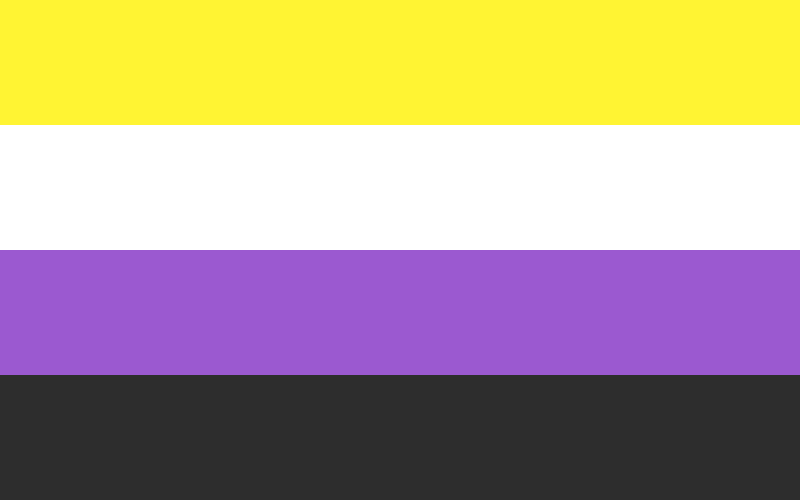
Kye Rowan announced this four-stripe Nonbinary Pride Flag on 17 February 2014, after posting three finalist arrangements on Tumblr that morning and asking readers which they preferred [1][2]. Rowan made it for nonbinary people who did not feel represented by the Genderqueer flag, and described the two designs as meant to stand together rather than replace one another [3]. Rowan explained the yellow, white, purple and black bands through gender and the presence or absence of light, and published the flag's colour values on the blog the next day [2][4].
Key facts
- Designer
- Kye Rowan
- Created
- First publication
- In use
- 2014–present
- Aspect Ratio
- Approx. 3:2 · source image
- Ratio Notes
- Measured from the designer's own image on the 17 February 2014 announcement: 600 × 401 pixels, a ratio of about 1.496. No creator-specified universal proportion has been located. [2]
- Stripes
- 4
- Represented Identity
- nonbinary
Also known as
- Non-binary Flag
- Non-binary Pride Flag
Status Canonical
Archive categories Gender Identity Pride Flags
Overview
To give nonbinary people who did not feel represented by the Genderqueer flag a flag of their own, alongside rather than in place of it. [1][3]
A call was put out on Tumblr in early 2014 for a nonbinary flag separate from Marilyn Roxie's 2011 Genderqueer Pride Flag. Rowan had already answered it once: "A call was put out for a nonbinary flag that is separate from the genderqueer flag, and I proposed a fairly well received option. After some discussion on a few different people's concerns, I have narrowed it down to these three variations with the following explanation for the colors." [1]
The three finalists went up at 05:56 UTC on 17 February 2014, using the same four colours in different orders, with the colour key and a request for responses: "So these are my final proposals. If you have a favorite, please let me know! This is a work in progress and nothing is set in stone, so your input is valued." [1] At 23:35 UTC the same day, seventeen hours and thirty-nine minutes later, Rowan announced the result: "After counting up all the 'votes' for each variation of my nonbinary flag (to be separate from the genderqueer flag), it seems this is the most loved! Yay!" The winning arrangement was the second of the three posted that morning. Rowan closed the post by crediting the discussion rather than the count: "After all the discussion I've had with others on the best colors, arrangements, and descriptions possible, this is the final product. Hope you all like!" [1][2]
Rowan did not offer the flag as a replacement for the Genderqueer flag. Asked the next day why nonbinary should be considered separate from genderqueer, Rowan wrote that many people "do not want a slur like 'queer' in, on, or around their identity", that genderqueer is "a political identity that is assumed by many nonbinary people" rather than an umbrella term, and that the myth of it as an umbrella "is so widespread that the flag that was supposed to represent us ends up forcing a group of people under an identity that they do not want". Rowan added an edit to the same post: "Genderqueer and queer are not a political identity for everyone who uses them! They really are often used simply because they are the identity a person feels fits them." [3]
Identity & Context
- Represented Identity
- nonbinary
- Movement
- Nonbinary visibility within the broader trans and gender-diverse umbrella
Creators
The Creator
Kye Rowan
Designer
Kye Rowan designed the Nonbinary Pride Flag through the Tumblr account thejasmineelf-blog in February 2014, in answer to a call for a flag separate from the Genderqueer flag. [1] Rowan posted three finalist arrangements on 17 February, invited readers to choose between them, and announced the yellow, white, purple and black ordering that evening. [1][2] Over the following days Rowan answered questions about the design on the same account: publishing the flag's hex and RGB values "for public record" [4], explaining at length why a nonbinary flag was wanted separately from the Genderqueer flag [3], and expanding on the yellow band when a reader asked what it meant. [5] Rowan wrote of that band's explanation, "this is hard to explain to people who do not experience gender this way. I myself don't always experience it this way, hence that conversation I had last night trying to make a more inclusive explanation for the colors." [5] The account's last post dates to May 2014, and no portrait of Rowan has been located.
This is a work in progress and nothing is set in stone, so your input is valued.
Posting the three finalist arrangements, 17 February 2014
Genderqueer is not an umbrella term, it is a political identity that is assumed by many nonbinary people. The myth that genderqueer is an umbrella term is so widespread that the flag that was supposed to represent us ends up forcing a group of people under an identity that they do not want.
Answering a reader who asked why nonbinary is considered separate from genderqueer, 18 February 2014
Motivations
- To give nonbinary people who did not feel represented by the Genderqueer flag a flag of their own
- To settle the arrangement by asking readers rather than by deciding alone
Stated inspirations
- A call put out on Tumblr for a nonbinary flag separate from the Genderqueer flag, to which Rowan had already offered an earlier proposal[1]
- The presence and absence of light, used to ground the white and black bands[1]
Attribution notes
The February 2014 posts were published through the Tumblr account thejasmineelf-blog, which titled itself genderweird and signed the posts with no name. [1][2] A page kept on the same account, Flag Stuff, is cited by later file records as the design's own description page and is credited there to Kye Rowan. [6][7] The name itself reaches general reference works through writing published in 2021, 2022 and 2023. [8] Later sources also give conflicting ages for Rowan at the time of the design, seventeen on the Wikimedia Commons file record and fourteen in the Library.LGBT guide; no primary source establishing either figure has been located. [6][9]
Origin
- Place Type
- online community / social media platform
- Digital Origin
- Yes
Digital origin; no verified physical location.
The call, the proposals, the selection and the colour values were all published on Tumblr. [1][2][4] No place of residence, physical launch or country of design is documented in the primary material, so the flag carries no geographic origin.
Dates & Chronology
- Year Created
- Exact date
- First publication
- Period in Use
- 2014–present
The two posts travelled very differently. As recorded on 14 August 2026, the proposals carried 134 notes and the announcement 3,320. [1][2]
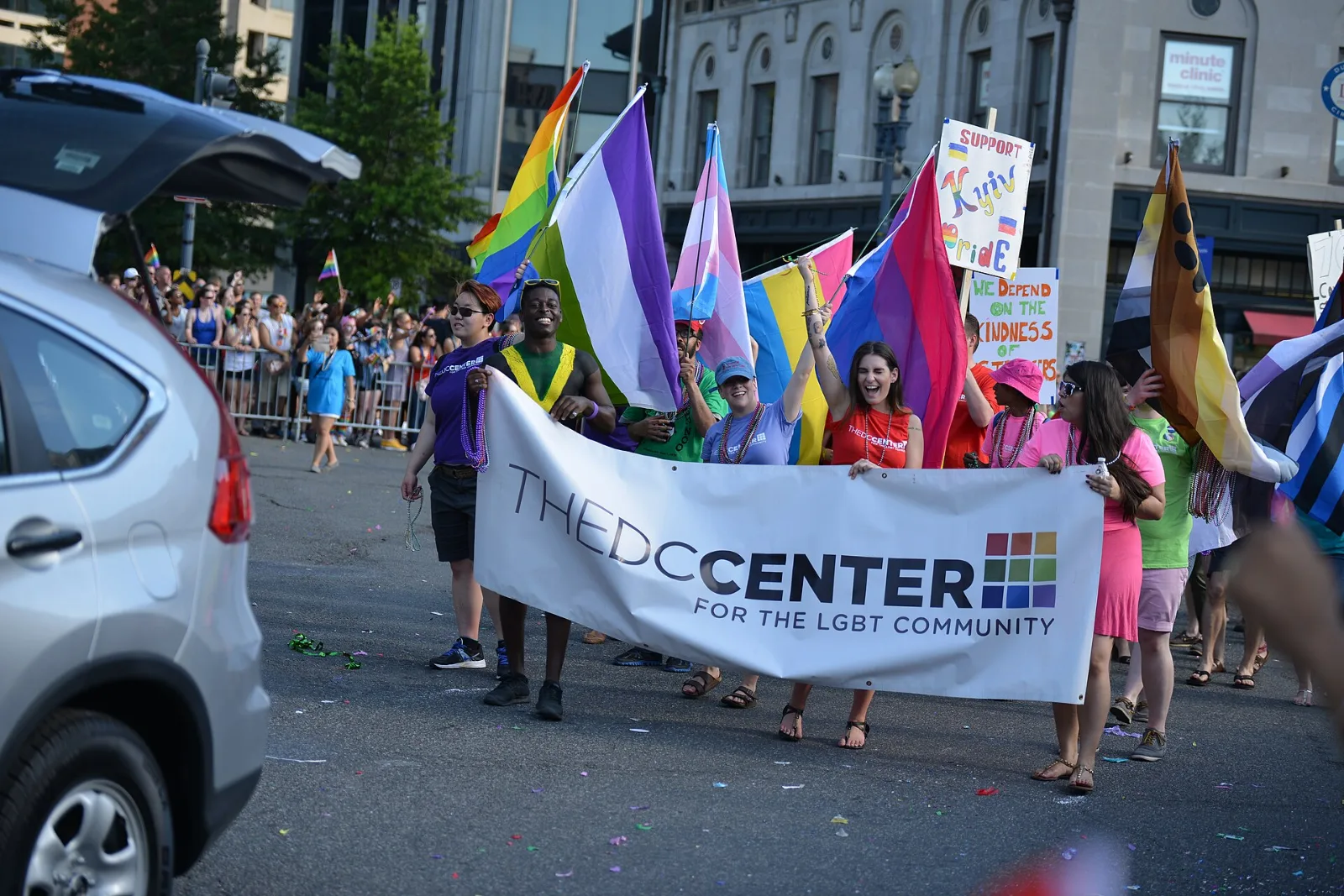
The flag spread through Tumblr first and reached print and physical use quickly. It was carried in the Capital Pride parade in Washington, D.C., on 11 June 2016, among the rainbow, genderqueer, transgender, bisexual, pansexual and bear flags. Institutional glossaries list it as the standard nonbinary emblem. [9][10]
At the 2024 Eurovision Song Contest in Malmö, the Swiss winner Nemo displayed the flag onstage. A reporter told Nemo that several fans had had their nonbinary flags confiscated at the venue entrance; Nemo answered, "That is unbelievable. I had to smuggle my flag in because Eurovision said no. I did it anyways," and called it a "double standard". Eurovision's organisers pointed to a longstanding policy of allowing only the flags of participating countries and rainbow flags, and said that "due to heightened geopolitical tensions, the flag policy was more rigorously enforced by security at this year's event". [11]
Rowan kept answering questions on the same account for several days after the announcement. On 18 February a reader asked for the hex codes, and Rowan gave them "for public record" in a stripe, hex and RGB table. [4] Another reader asked what the yellow band meant, and Rowan expanded the one-line key into a concrete explanation: "Yellow is used to point out that something is its own. For example: taxis, notebook dividers, sticky notes, store sale markers. The things we mark as yellow are things that are not related to other things: personal cars, the opposite section of the note book, the papers around the post-it, things that aren't on sale." [5] A third reader wrote to say the flag's description had shown them that "genderless" was an option; Rowan replied that "regardless of whether or not you've had a word for it, how you feel is, was, and always will be valid". [12]
The 17 February post also points readers elsewhere, noting that another user, plantextract, was setting up a blog for submissions "not only for a nonbinary flag, but for agender and bigender flags as well". [1] That account no longer resolves.
Lineage
- Indirect influences
- Genderqueer Pride Flag
- Direct children
- Nonbinary Trans Flag (2026, cirrus42), Two-Spirit Nonbinary Pride Flag (2016 Tumblr documentation)
- Related flags
- Agender Pride Flag, Androgynous Pride Flag, Aporagender Pride Flag, Bigender Pride Flag, Ceteroromantic Pride Flag (Four-Stripe Heart, 2016), Deminonbinary Pride Flag
+ 14 more
Diamoric Pride Flag, Enbian Pride Flag (2016, enbians), Gender Neutral Pride Flag, Gender Questioning Pride Flag, Genderflux Pride Flag, Graygender Pride Flag, Intergender Pride Flag, Maverique Pride Flag, Neutrois Pride Flag, Pangender Pride Flag, Toric Pride Flag (2017, diamoricmlm-and-nblm), Transgender Pride Flag, Trigender Pride Flag, Trixic Pride Flag (2017, Non-aligned-sapphic)
Rowan made the Nonbinary flag in answer to a need described in relation to the Genderqueer flag, and meant the two to be used alongside each other rather than one in place of the other. [1][3] The Genderqueer flag is therefore a contextual predecessor, not a design this flag modifies or replaces: it supplies neither the palette nor the arrangement.
Two later designs take this flag directly, and both creators say so. 2Sanon presented the Two-Spirit device over three grounds in one 2016 submission and preferred it away from the rainbow: "personally I think I'd prefer it with the trans or nonbinary flag background, as seen in my submission above." [13] cirrus42's Nonbinary Trans Flag carries these four colours, in this order, as a hoist chevron over a transgender-flag ground, which cirrus42 describes as "the enby flag chevron entering from the left side (disrupting the perfect symmetry of the trans flag)". [14] Other flags for nonbinary and multigender identities share this flag's subject rather than its design, and are listed as related rather than descended.
Lineage tree
Every record reachable from this one through documented parent and child relationships: 3 records across 2 generations.
- This record
- Nonbinary Pride Flag
Colors & Symbolism
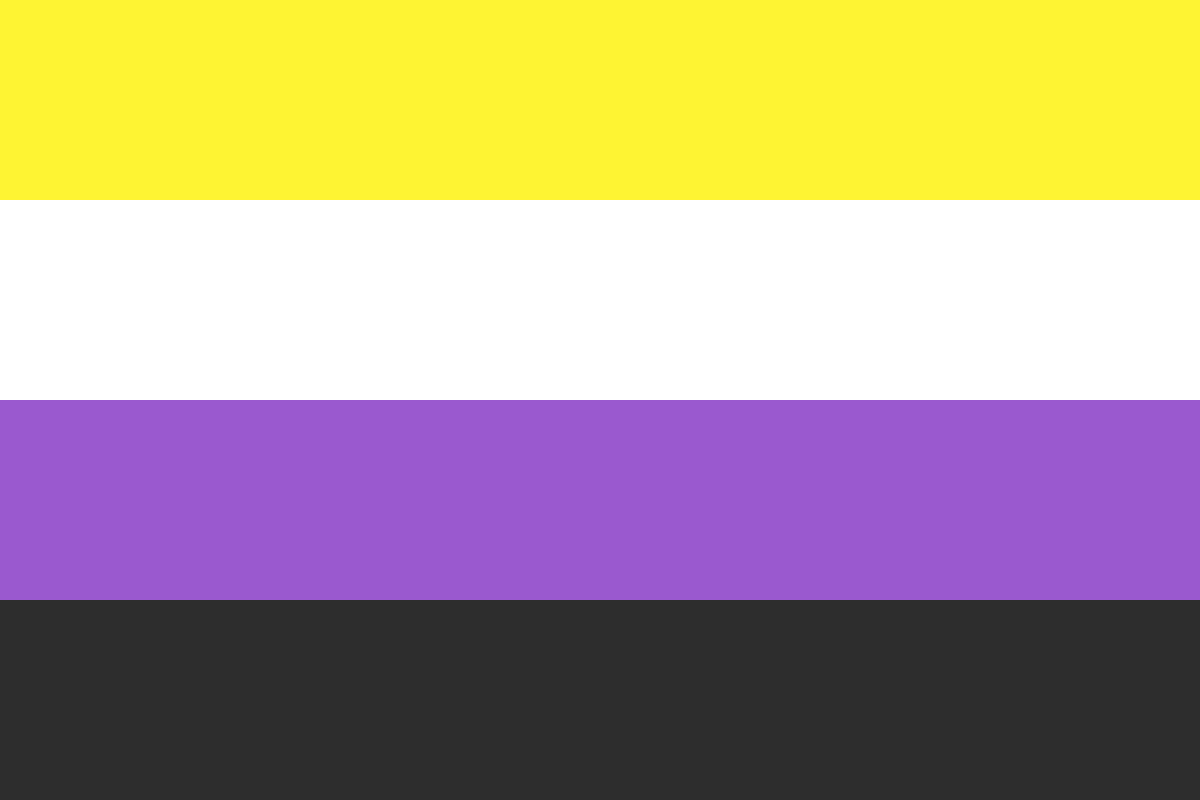
Rowan explained the palette through gender and through the presence or absence of light. [1][2]
| Colour | Hex | Meaning | Note |
|---|---|---|---|
| Yellow | #FFF433 | "Representative of being outside the binary, as it is a color often used to distinguish something as its own." | Published by Kye Rowan, 18 February 2014 |
| White | #FFFFFF | "The photological presence of all color/light. This is to represent people who are many or all genders." | Sampled from Rowan's 17 February 2014 announcement image; see the palette notes on the later cosmic latte value |
| Purple | #9B59D0 | "The fluidity and multiplicity of many gender experiences, the uniqueness and flexibility of nonbinary people, as well as representing those whose gender experiences include being of or between female and male." | Published by Kye Rowan, 18 February 2014 |
| Black | #2D2D2D | "The photological absence of color/light. This is to represent agender or genderlessness." | Published by Kye Rowan, 18 February 2014 |
The four meanings are Rowan's own, given in both February 2014 posts and unchanged between them. [1][2] Rowan later expanded the yellow band's explanation for a reader who found it hard to follow, giving taxis, notebook dividers, sticky notes and sale markers as things marked yellow to show they stand apart from what surrounds them. [5]
Later summaries commonly shorten the purple to a mixture of male and female. Rowan's wording is wider than that, and puts fluidity, multiplicity, uniqueness and flexibility before the female-and-male clause. [1][2] Explanations that read the purple through lavender's place in LGBTQ history appear in writing about the flag from 2022 onward and are not what Rowan wrote. [8]
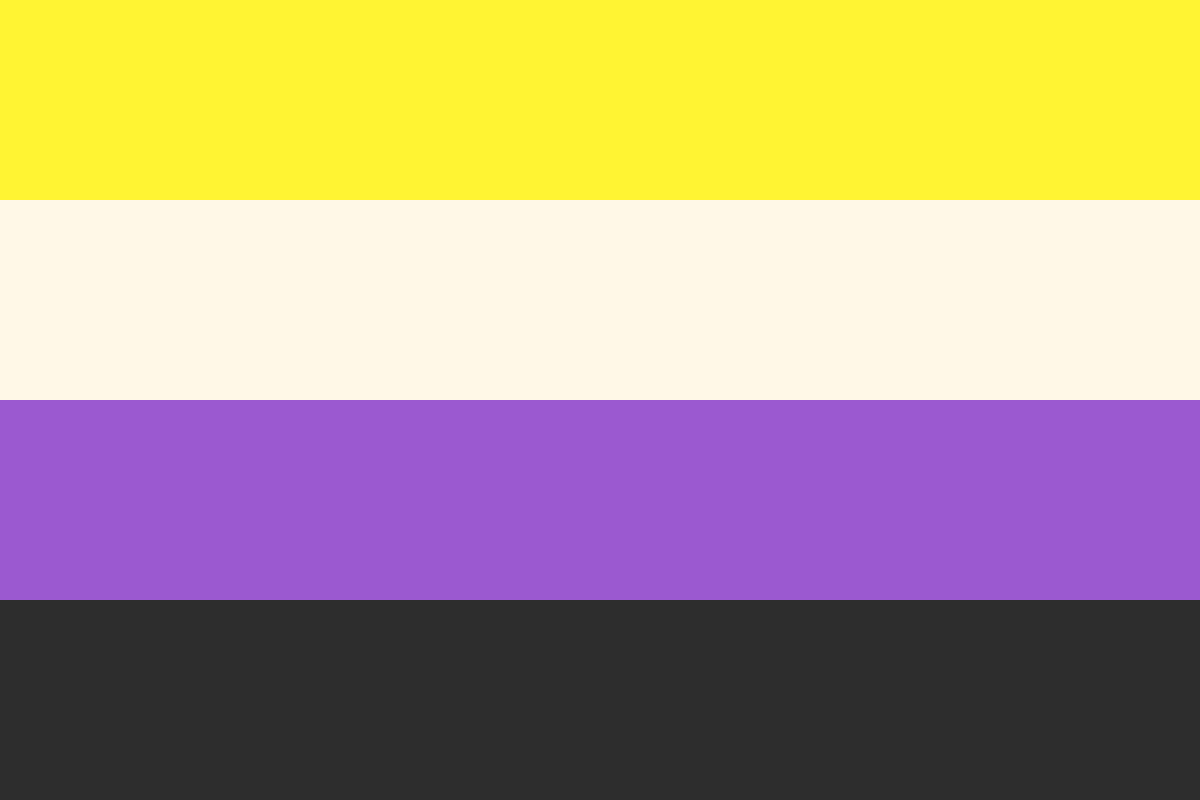
Rowan published the palette on 18 February 2014, the day after the announcement, in answer to a reader who asked for the hex codes. The reply is headed "For public record" and gives a stripe, hex and RGB table: yellow FFF433 and 255,244,51; purple 9B59D0 and 155,89,208; black 2D2D2D and 45,45,45; white FFFE87 and 255, 248, 231. [4] The first three rows agree between their hex and their RGB. The white row does not: the RGB triple 255, 248, 231 is #FFF8E7, the shade called cosmic latte, while the hex written beside it, FFFE87, converts to 255, 254, 135. The band in Rowan's own announcement image is unmodified white. [2]
The values above are the three Rowan published unchanged, with white given as it appears in the 2014 artwork. The cosmic latte value is shown in the image archive as the second documented state of the white band rather than as a fan variant. The band Rowan calls black is dark grey, not #000000, in the announcement image and in the published table alike. The Wikimedia Commons vector uses the same four values. [7]
Design
- Aspect Ratio
- Approx. 3:2 · source image
- Ratio Notes
- Measured from the designer's own image on the 17 February 2014 announcement: 600 × 401 pixels, a ratio of about 1.496. No creator-specified universal proportion has been located. [2]
- Orientation
- horizontal
- Stripe Count
- 4
- Layout
- horizontal_stripes
- Stripes (Top → Bottom)
- Yellow, White, Purple, Black
Four equal horizontal stripes: yellow at the top, then white, then purple, then dark grey at the bottom, which Rowan names as black. No emblem.
Rowan published no proportion. The image attached to the 17 February announcement measures 600 by 401 pixels, about 3:2, and its bands run 99, 100, 100 and 102 pixels deep, which is four equal quarters of a height that does not divide by four. [2] The archive's own artwork is drawn at a clean 3:2 with four exactly equal bands. The Wikimedia Commons vector derived from the design is 300 by 200, also 3:2. [7]
Usage & Adoption
- First Users
- Readers of the Tumblr account thejasmineelf-blog, who were asked to choose between the three finalist arrangements
- Geographic Usage
- International
- Online Usage
- Widely used online as a nonbinary identifier; listed in institutional glossaries
- Event Usage
- Capital Pride parade, Washington, D.C., 11 June 2016, Eurovision Song Contest, Malmö, May 2024, displayed onstage by the winner Nemo
- Current Status
- active
Adoption ran through online circulation rather than institutional endorsement. No body adopted or standardised the flag, and its authority rests on use. [1][2]
Image Archive
The Design
Documented Use
.jpg)
Discourse & Debates
- The relationship between "nonbinary" and "genderqueer" as terms was the reason the flag was made, and Rowan set out the argument at length the day after the announcement: that genderqueer is "more of a political identity" rather than an umbrella term, that many people do not want the word queer near their identity, and that treating genderqueer as an umbrella "ends up forcing a group of people under an identity that they do not want". Rowan added an edit noting that genderqueer and queer are not political identities for everyone who uses them. [3] Rowan's own position was not that the two exclude each other: the flag was made to fly alongside the Genderqueer flag. [1][3]
- At Eurovision 2024 the flag became a point of dispute about what audiences may carry. Nemo displayed it onstage and said venue rules had stopped fans bringing their own in. The contest's organisers said their policy allowed the flags of participating countries and rainbow flags, and that it had been enforced more strictly that year. [11]
Common misidentifications
- Sometimes treated as interchangeable with the Genderqueer Pride Flag, although it was made to be a separate flag used beside it
- The bottom band is often reproduced as pure black. Rowan calls it black, but the published value is #2D2D2D and the 2014 artwork is dark grey
- The Wikimedia Commons raster is sometimes described as the creator's own upload. It was uploaded by a third party in 2016 and replaced twice by other editors; Rowan is credited on it as the artwork's author, not as its uploader
- The purple band is often explained by reference to lavender's place in LGBTQ history. That reading appears in later writing about the flag rather than in Rowan's own account [8]
- Conflicting secondary claims about the designer's age at the time, fourteen or seventeen, neither supported by a primary source [9][6]
Institutional sources vary on hyphenation, "nonbinary" against "non-binary", and some guides misspell the designer's first name. [9][10] Rowan's own posts use "nonbinary". [1] "Enby" is common as a community term and a search word, but has not been documented as a name for the flag itself.
Footnotes & Citations
Sources and footnotes 15 sources
- 1. Social media Nonbinary flag proposals and colour explanations. Kye Rowan. Tumblr (thejasmineelf-blog) (2014-02-17). Accessed 2026-08-14
The three finalist arrangements, posted at 05:56 UTC, with the colour key and a request for responses.
- 2. Social media Final nonbinary flag after the vote, with colour key. Kye Rowan. Tumblr (thejasmineelf-blog) (2014-02-17). Accessed 2026-08-14
The selected arrangement, posted at 23:35 UTC the same day. The attached image measures 600 × 401 pixels.
- 3. Social media Answer on why nonbinary is considered separate from genderqueer. Kye Rowan. Tumblr (thejasmineelf-blog) (2014-02-18). Accessed 2026-08-14
Rowan's longest statement of the flag's purpose, carrying a later edit qualifying the argument.
- 4. Social media Answer giving the flag's hex and RGB values "for public record". Kye Rowan. Tumblr (thejasmineelf-blog) (2014-02-18). Accessed 2026-08-14
Posted at 02:36 UTC in answer to a reader's question. The white row's hex and RGB do not agree with each other.
- 5. Social media Answer clarifying the yellow stripe. Kye Rowan. Tumblr (thejasmineelf-blog) (2014-02-18). Accessed 2026-08-14
Expands the one-line key into examples of things marked yellow to show they stand apart.
- 6. Image file page File:Non-binary Pride Flag.png. Wikimedia Commons (2016-04-09). Accessed 2026-08-14
Uploaded by Betkaludmova in April 2016 and replaced by two later editors. Credits Kye Rowan as author, links Rowan's Tumblr as the design's description page, gives Rowan's age as seventeen, and carries a CC0 tag chosen by the uploader.
- 7. Image file page File:Nonbinary flag.svg. Wikimedia Commons. Accessed 2026-08-14
A vector derived from the Commons raster, 300 × 200, using #FFF433, #FFFFFF, #9B59D0 and #2D2D2D. Eight revisions by seven editors since 2017; the licence tag is a Commons rationale, not a creator statement.
- 8. Reference Kye Rowan. Nonbinary Wiki. Accessed 2026-08-14
Imported from Wikipedia, last edited 17 October 2023. Cites only writing from 2021, 2022 and 2023; nothing contemporaneous with the flag.
- 9. Reference Nonbinary - Pride Flag Guide. Library.LGBT (Albany Pride initiative). Library.LGBT Pride Flag Guide (2021-06-11). Accessed 2026-03-09
Cites no author and no sources. Consulted in March 2026; the site went offline in July 2026 and its text can no longer be re-checked.
- 10. Reference Pride Flags Glossary. Resource Center for Sexual & Gender Diversity. University of California, Santa Barbara. Accessed 2026-03-09
- 11. News Eurovision winner Nemo urges Switzerland to recognise third gender. Ashifa Kassam. The Guardian (2024-05-16). Accessed 2026-08-14
Carries Nemo's remarks after the win, the report of confiscated flags at the venue, and the organisers' statement on the flag policy.
- 12. Social media Answer to a reader who found the word "genderless" through the flag. Kye Rowan. Tumblr (thejasmineelf-blog) (2014-02-18). Accessed 2026-08-14
Reception on the day after the announcement, in the reader's words and Rowan's reply.
- 13. Social media Two-Spirit flag submission. 2Sanon. ask-pride-color-schemes (Tumblr) (2016-12-17). Accessed 2026-08-14
Shows the Two-Spirit device over three grounds, the rainbow, transgender and nonbinary flags, and states the submitter's preference for the last two.
- 14. Primary statement Creator's explanation comment on the Nonbinary Trans Flag post. u/cirrus42. Reddit, r/NonBinary (2026-02-12). Accessed 2026-08-14
Names the design's two components, the transgender flag ground and the nonbinary flag chevron, 33 seconds after the upload.
- Encyclopedias & Reference Non-binary flag. Wikipedia. Accessed 2026-03-09


Image Sources
- Rendering
- four-stripe standard
- Credit: Encycloflaggia archive rendering after Kye Rowan's 2014 design · Kye Rowan, final arrangement announced 17 February 2014 · reconstruction
- Archive reconstruction of Kye Rowan's selected 2014 Nonbinary Pride Flag arrangement, using the colours shown in Rowan's own final image: #FFF433, #FFFFFF, #9B59D0 and #2D2D2D. [2] · Credit: Encycloflaggia archive rendering after Kye Rowan's 2014 design · Kye Rowan, final arrangement announced 17 February 2014 · reconstruction
- The same arrangement with the white band at cosmic latte, #FFF8E7. Rowan gave that value as the white stripe's RGB when publishing the palette on 18 February 2014, one day after the announcement, although the hex written beside it in the same table reads FFFE87. [4] · Credit: Encycloflaggia archive rendering after Kye Rowan's published values · Kye Rowan, palette published 18 February 2014 · reconstruction
- Capital Pride parade, Washington, D.C., 11 June 2016. The Nonbinary flag flies at the right of the group, behind the Bear Brotherhood flag, among rainbow, genderqueer, transgender, bisexual and pansexual flags carried behind the banner of The DC Center for the LGBT Community. Photographed by S Pakhrin. · Credit: S Pakhrin · Wikimedia Commons · archival · CC BY 2.0