Bigender Pride Flag
Multigender Pride Flag ·
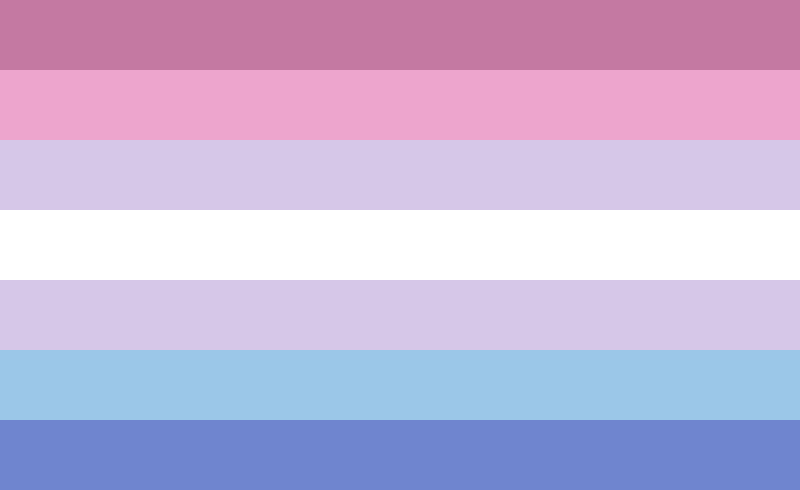
A seven-stripe horizontal flag using pink, lavender, white, and blue tones, posted in two versions by Tumblr user no-bucks-for-this-doe in July 2014: one with a plain white center stripe and one with a white-to-gray gradient center. [1] A 2019 community investigation traced the attribution to a Pride Archive post, since deleted, whose month is inferred from its post identifier rather than stated by any source while airing allegations against the designer, who is reported to have answered in 2022 that they were "more or less true" and that "flags belong to the community as a whole, not the creator". Neither quotation has been traced to a post that could be read; both reach this entry through a wiki. [2] The design remains widely recognized, though alternative bigender flags circulate, one of them recommended on the ground that this design references only male and female. [3]
Key facts
- Designer
- no-bucks-for-this-doe
- Created
- First documented public use
- In use
- 2014–present
- Aspect Ratio
- 3:5 · standard
- Ratio Notes
- No proportion is published for this design. The archive supplies its standard production ratio. The file held here is an archive rendering, not the designer's artwork. [4]
- Stripes
- 7
- Represented Identity
- bigender
Also known as
- Bigender Flag
- Bigender Pride Flag (2014 design)
- Bigender Pride Flag (no-bucks-for-this-doe design)
Status Historical Contested
Archive categories Gender Identity Pride Flags
Overview
To provide a specific visual symbol for bigender identity. [4]
Designed in 2014 during a period of active multigender and nonbinary flag creation on Tumblr. [4] [1] Two versions were posted in July 2014: one with a plain white center stripe and one with a white-to-gray gradient center stripe. [1] Both shared the same overall seven-stripe pink-lavender-blue structure.
Identity & Context
- Represented Identity
- bigender
- Subcommunity
- multigender umbrella
Creators
The Creator
no-bucks-for-this-doe
Designer
Tumblr user no-bucks-for-this-doe (Sunny) posted two bigender flag designs in July 2014, documented through Pride Archive circulation; a 2019 investigation named an August 2014 Pride Archive post as the proof of the attribution. [4][1][3] Two versions were posted: one with a plain white center stripe and one with a white-to-gray gradient center stripe. [1] Allegations against the designer became a subject of community discussion in 2019 and prompted some community members to propose alternative designs. The designer answered them in April 2022, writing that they were "more or less true" and giving up any claim over the flag. [2][3] The designer's original posts are no longer directly accessible; attribution relies on contemporary reposts and later secondary documentation.
flags belong to the community as a whole, not the creator
Posted in April 2022, in the same statement in which the designer wrote that allegations made against them were 'more or less true.' [2] Reported by a wiki; the originating post has not been located or read.
Motivations
- To provide a specific visual symbol for bigender identity
Origin
- Digital Origin
- Tumblr (Pride Archive / Pridearchive circulation)
Digital origin; no verified physical location.
Two bigender flag designs were posted by no-bucks-for-this-doe in July 2014 and documented through Pride Archive reposts. [1] One used a plain white center stripe; the other used a white-to-gray gradient center stripe. [1] The exact post dates within July 2014 are uncertain.
Dates & Chronology
- Year Created
- First public use
- Period in Use
- 2014–present
The white-center version became the more widely circulated of the two early designs. [4] [1] It spread through Tumblr reposts and later appeared in pride-flag reference guides. Masculine-leaning and feminine-leaning variants based on the same design family also circulated in secondary documentation. [1] Following controversy around the original designer, alternative bigender flag designs have appeared. [1] The 2014 design remains widely recognized and historically documented, though it is not universally preferred.
Major revisions
The historically common version is the 2014 design with a plain white center stripe. The gradient-center version and later redesigns are distinct and may warrant separate records. [1] The widely circulated SVG files on Wikimedia Commons and similar repositories are later reconstructions, not original creator-uploaded files. [1]
Bigender is part of the multigender umbrella, alongside polygender, trigender, and pangender. The bigender flag shares the multigender flag family's use of pink and blue (for femininity and masculinity), adding purple for the combination and white for shifting between. The flag was created during the 2014 wave of Tumblr-origin pride flags, the same period that produced the nonbinary, agender, demiboy, and demigirl flags. [4][1][2]
Lineage
- Indirect influences
- Rainbow Pride Flag
A multigender-family flag adjacent to the demigender cluster. [4] [1] Not a direct ancestor of the demigender designs, but part of the broader mid-2010s gender-identity flag tradition. The placement of pink at the top and blue at the bottom was described by sources as representing the separation yet coexistence of femininity and masculinity. [4]
Colors & Symbolism
The palette maps bigender experience as two gendered poles held together by a shared center, with intermediate tones acknowledging the nonbinary and agender dimensions that can accompany a bigender identity. The mirrored pink-blue arrangement presents both gendered experiences as simultaneously present rather than alternating. [4][1]
| Colour | Hex | Meaning |
|---|---|---|
| Dark Pink | #C479A2 | Femininity. |
| Light Pink | #EDA5CD | Femininity. |
| Lavender | #D6C7E8 | Mixture of femininity and masculinity, or nonbinary identity, depending on source phrasing. |
| White | #FFFFFF | Agender, neutral, or nonbinary identity, depending on source phrasing. |
| Lavender | #D6C7E8 | Mixture of femininity and masculinity, or nonbinary identity, depending on source phrasing. |
| Light Blue | #9BC7E8 | Masculinity. |
| Dark Blue | #6F85CF | Masculinity. |
Circulating community values from reference sites
This flag has no official digital palette. Color values shown are approximate.
Sources differ on whether the lavender stripes indicate androgyny, mixture, or nonbinary identity specifically, and whether white indicates agender identity or broader neutrality. [4] [1] The gradient-center variant used a white-to-gray transition in the center stripe, which some sources interpreted as emphasizing a spectrum between agender and partial gender rather than a single neutral point. [1] The placement of pink at the top and blue at the bottom has been described as representing the separation yet coexistence of femininity and masculinity. [4]
No official creator-published hex values have been found. The values given are drawn from widely circulating community reference sites and later SVG reconstructions. [4] The commonly used Wikimedia Commons SVG is a later reconstruction, not an original creator-uploaded file; its hex values may not match the original design exactly. [1]
Design
- Aspect Ratio
- 3:5 · standard
- Ratio Notes
- No proportion is published for this design. The archive supplies its standard production ratio. The file held here is an archive rendering, not the designer's artwork. [4]
- Orientation
- horizontal
- Stripe Count
- 7
- Layout
- horizontal_stripes
- Stripes (Top → Bottom)
- Dark Pink, Light Pink, Lavender, White, Lavender, Light Blue, Dark Blue
Seven equal horizontal stripes: dark pink, light pink, lavender, white, lavender, light blue, and dark blue, from top to bottom. No emblem or additional symbols. [4] This describes the plain white center version, which is the more widely circulated of the two early 2014 designs; a gradient-center variant also dates to the same July 2014 origin. [1] Both versions share the same outer stripe structure.
Usage & Adoption
- Geographic Usage
- Internet circulation, Later broader guide-site and institutional circulation
- Online Usage
- Circulated through Tumblr, Pride Archive reposts, and later pride-flag reference guides
- Current Status
- active
The 2014 white-center version became the historically common bigender flag, appearing in guide sites and reference compilations. [4] Alternative bigender designs have circulated since the mid-2010s, particularly following controversy around the original designer. [1] No single bigender flag design holds universal or institutional endorsement. [4] [1]
Discourse & Debates
- Multiple alternative bigender flag designs have been proposed since the mid-2010s. The 2014 design remains widely recognized and historically documented, but it is not uncontested or universally preferred.
- Two early 2014 versions existed (white center and gradient center); the white-center version became dominant in circulation, but the gradient-center version is also documented.
- Masculine-leaning and feminine-leaning variants based on the same design family have circulated in secondary documentation.
Common misidentifications
- The widely used Wikimedia Commons SVG is a later reconstruction, not the original creator upload. It should not be cited as the original design file.
- The existence of multiple bigender flag designs can cause confusion about which is 'the' bigender flag. No single design holds that status universally.
Criticisms
- Allegations against the flag's designer became a subject of community discussion in 2019. Answering an anonymous ask about "rumors going around," Tumblr user tubbs-is-my-friend investigated on 30 June 2019, linking an August 2014 Pride Archive post as "proof of who created the pink/purple/blue bigender flag" together with a callout post about the designer, and concluding "Well, maybe not them IDing as a T3RF/gender cr1t specifically, but y'know." A participant in the reblog thread put the verdict more bluntly: "The creator may not be a TERF, but they're a transphobe and an abuser." [3] The designer addressed the allegations in April 2022, writing that they were "more or less true" and that "flags belong to the community as a whole, not the creator." [2] Nonbinary Wiki records the controversy and the redesign activity that followed it. [1] The allegations were made and answered within the community; no adjudication of them has been located, and they are set out here as claims and a response rather than as findings. Some community members adopted or preferred alternative bigender flag designs as a result. [1][2]
- The design has been criticized as exorsexist, on the ground that it references only male and female and leaves out bigender people whose genders are otherwise. The blog bigendering, tagged into the 2019 thread, made this argument the deciding one: while doubting the creator-based case, it wrote "I do think we should move away from it anyway because of the exorsexist connotations of the flag itself," and recommended the pink, yellow, white, purple and blue alternative, quoting its meanings from a 2014 proposal on pride-flags-for-us. [3]
Footnotes & Citations
Sources and footnotes 6 sources
- 1. Bigender. Nonbinary Wiki. Accessed 2026-03-10
- 2. Bigender. LGBTQIA+ Wiki. Accessed 2026-03-18
- 3. Social media bigender flag creator thread (root by tubbs-is-my-friend, 30 June 2019, with replies). tubbs-is-my-friend, with dinofucker9000, denizenhardwick, forthebigenders and bigendering. Tumblr (2019-06-30). Accessed 2026-08-14
The root post answers an anonymous ask, links an August 2014 Pride Archive post as proof of the attribution, and links a callout post; replies carry the verdict quoted here and bigendering's argument for moving away from the flag.
- 4. Bigender. Library.LGBT Pride Flag Guide. Accessed 2026-03-10
- 5. Bigender (1). Pride-Flags. DeviantArt (2015-07-04). Accessed 2026-03-18
- Category:Bigender pride flags. Nonbinary Wiki. Accessed 2026-03-10
Image Sources
- Rendering
- 2014 white-center version (most common)
- The seven-stripe design as documented, drawn for this entry. [5] · Credit: Archive rendering after the design attributed to no-bucks-for-this-doe · Encycloflaggia renderingRights The rendering held here is drawn by this archive from the documented colours and stripe order. It is not the designer's file, and no designer file has been located.