Graygender Pride Flag
Identity Pride Flag ·
Tumblr user pride-flags proposed this five-stripe Graygender Pride Flag on 30 March 2015, retaining the color meanings of invernom's earlier, unlocated designs. [1] invernom, who coined graygender in 2014, endorsed the proposed blue alternatives the following day. [1][2] The deep-blue version was later published by the Pride-Flags DeviantArt archive in August 2015. [3]

Key facts
- Designer
- pride-flags-for-us (contributor not named)
- Created
- First documented publication
- In use
- Documented online from 2015
- Aspect Ratio
- 3:5
- Stripes
- 5
- Represented Identity
- Graygender people
Also known as
- Greygender Pride Flag
- Greygender Flag
- Gray Agender Flag
- Grey Agender Flag
Archive categories Gender Identity Pride Flags
Overview
The proposer was dissatisfied with the existing flag and put the change to the community directly: "I don't really like the graygender flag. So I made new one. And I wonder if you are up for a change?" The redesign deliberately kept the earlier flags' color meanings. [1]

invernom coined graygender on 20 March 2014 and offered the word outward: "If it feels like it hits home for you, feel free to use the word for yourself!" [2] They also made earlier graygender flags, known only from their own later statement; those designs have not been located. [1] On 30 March 2015 at 22:56:09 UTC the Tumblr account pride-flags proposed a replacement, keeping the earlier flags' color assignments and offering two candidate blues. invernom reblogged and endorsed the concepts the next day at 21:45:27 UTC. [1][4]
Identity & Context
- Represented Identity
- Graygender people
- Subcommunity
- nonbinary umbrella; gray-spectrum vocabulary
Graygender is a nonbinary gender identity coined by invernom for an experience of gender that may feel weak, indeterminate, infrequent, or held with substantial ambivalence. invernom modeled the name on graysexuality and grayromanticism after finding terms such as agender, neutrois, and gender neutral close but insufficient for their experience, writing that the word "could have that same relationship to 'agender'" that graysexuality has to asexuality. [2]
Creators
The Creator
pride-flags-for-us
Blog on which the March 2015 concepts were proposed; the contributor is not named
pride-flags-for-us was a Tumblr flag blog that took submissions and answered requests, run by a rotating group of moderators. It later posted under the name pride-flags, which is how the graygender proposal is addressed in invernom's reblog; the two names index the same posts. [5] The blog is the origin point for several flags documented in this archive, including genderflux and demifluid. Its account is now deactivated, and the individual who wrote the graygender proposal is not named in any surviving copy. [5][6]
I used the colour coding of original flag (which I really agree with, btw), just couldn't decide between two blues. One is deep ocean blue, second grayish ocean blue. [1]
Motivations
- Dissatisfaction with the existing graygender flag, keeping the earlier color coding while changing the execution. [1]
invernom
Coiner of graygender; designer of earlier unlocated graygender flags; endorser of the 2015 proposals
invernom coined graygender on 20 March 2014, modeling the word on graysexuality and grayromanticism after finding agender, neutrois, and gender neutral close but insufficient for their experience. [2] In their March 2015 reblog they stated that they had made the original graygender flags and welcomed the new concepts, observing that either proposed blue worked better with the grays than their earlier choice. The earlier flags have not been located. [1]
These are all excellent greygender flag concepts!! I may have made the original graygender flags but I'm def open to new & better ideas for them, and I think either of the blues you chose fit better with the greys of the flag than my original choice of blue. [1]
Motivations
- Wanting "something a bit clearer and more specific to my experience of gender, that feels truly right to use" than the existing nonbinary vocabulary. [2]
Broader influences
Attribution notes
On 30 March 2015, the Tumblr account pride-flags proposed replacing an existing graygender flag while retaining its color meanings. The post presented alternative blues described as "deep ocean blue" and "grayish ocean blue". [1][5] The account has since been deactivated, and no inspected primary source establishes the designer's offline identity; the contemporary reference entry on pride-color-schemes records the credit as "Designed by: [Deactivated]". [6] That account is the flag blog pride-flags-for-us under its later name: Wayback indexes for pride-flags-for-us.tumblr.com and pride-flags.tumblr.com share post identifiers, and Tumblr numbers posts per blog. [5] It is the same blog behind the genderflux, demifluid, boyflux and girlflux origin posts, and it ran both submissions and a rotating group of moderators, so the first-person "I made new one" is one unnamed contributor there rather than a single proprietor. [5] The Pride-Flags account on DeviantArt published the deep-blue rendering on 23 August 2015; it is recorded here as the later publisher of that file, not as the original proposer. [3]
Origin
- Digital Origin
- Yes
Digital origin; physical location not documented.
Digital origin; physical location not documented. The design was proposed on Tumblr on 30 March 2015 and endorsed there the next day; the proposal post is no longer live, and its text and images survive through invernom's reblog. [1][5]
Dates & Chronology
- Year Created
- Exact date
- First documented publication
- Period in Use
- Documented online from 2015
The Pride-Flags DeviantArt archive published the deep-blue five-stripe rendering on 23 August 2015, with a description explaining the colors. [3] On 31 July 2016 the pride-color-schemes reference entry reproduced the flag and its meanings, crediting the term to invernom and the design to "[Deactivated]". [6] The design circulated through Tumblr and DeviantArt and was reproduced by later LGBTQIA+ reference sites and identity guides, including the LGBTQIA+ Wiki, the MOGAI Wiki, and The LGBT Sentinel's 2019 flag guide. [7][8][9] The located sources document online reference use beginning in 2015; they do not establish a continuous measure of adoption or a specific physical debut. The term circulated further through Ash Hardell's December 2016 video "What is Greygender?". [10]
Later alternative. Pride-Flags published a seven-stripe Graygender or Gray Agender alternative on 7 January 2018. It uses dark gray, light gray, white, and a muted blue, mirrored around a blue center stripe, and is licensed CC BY 3.0. [11] The identity's published definitions shifted over time: the 2015 DeviantArt description compresses invernom's definition to "a nonbinary gender that is weak and/or indeterminate or that the individual themself is not that invested in their gender", and a revised wording introduced on pride-color-schemes in 2016 is the version most identity references now carry. [3][6][8]
Lineage
The documented predecessor is invernom's earlier graygender flags, the source of the color meanings the 2015 proposal deliberately retained; those designs are known only from invernom's statement and have not been located. [1] The deep-blue and grayish-blue options presented in the same March 2015 post are contemporary sister proposals, and the 2018 seven-stripe design is a later alternative. [1][11] Graysexuality and grayromanticism are naming context for the identity rather than design ancestors, and the related flags listed here are navigational neighbours, not documented visual sources. [2]
Colors & Symbolism
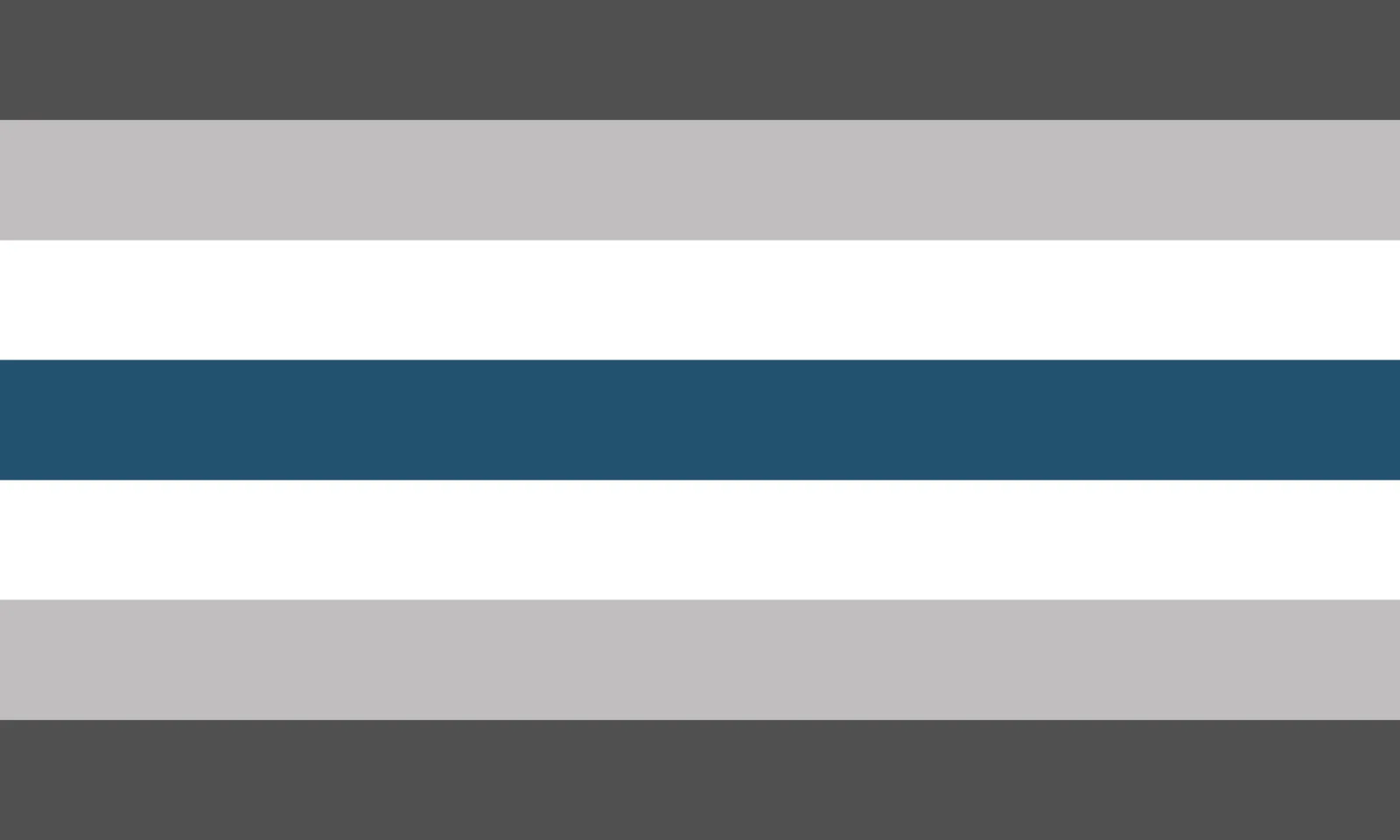
Two grays for the range of graygender experience, a deep blue for graygender as an identity and experience, and narrow white stripes for the validity of graygender people and their experiences, in the archived explanation published with the design. [3]
| Colour | Hex | Meaning | Note |
|---|---|---|---|
| Light Gray | #BFBEBE | Range of graygender experience: with the dark gray, the differences in how strongly gender is felt. [3] | Measured from the 5000 by 3000 source PNG. No creator-published hex values have been located. [12] |
| White | #FFFFFF | Validity of graygender people and their experiences. [3] | Measured from the 5000 by 3000 source PNG. [12] |
| Deep Blue | #082384 | Graygender as an identity and experience, compared in the archived explanation to deep ocean water: calm, subtly variable, difficult to read below the surface, and still rich. [3] | Measured from the 5000 by 3000 source PNG. The proposal called this option "deep ocean blue". [12][1] |
| White | #FFFFFF | Validity of graygender people and their experiences, as in the upper white stripe. [3] | Measured from the 5000 by 3000 source PNG. [12] |
| Dark Gray | #515151 | Range of graygender experience, paired with the light gray. [3] | Measured from the 5000 by 3000 source PNG. [12] |
This flag has no official digital palette. Color values shown are approximate.
These meanings are the explanation published with the design on DeviantArt in 2015 and repeated on pride-color-schemes in 2016. [3][6] The 2015 proposal states that the color assignments carry over from invernom's earlier flags, but invernom's own meanings text has not been located. [1] The LGBT Sentinel's 2019 guide gives a variant reading, with white as "the acknowledgment of the notion of gender and lack of investment in it"; that article states its definitions were informed by gender.wikia.org. [9]
Values are measured from the lossless 5000 by 3000 PNG behind the 2015 DeviantArt publication, held in this archive's gallery. [12] The compressed 1154 by 692 JPEG preview served by the DeviantArt page renders the same fields at #BFBFBF, #FFFFFF, #092384 and #515151, with artifacts along the stripe boundaries; those are properties of the preview, not creator specifications. [3] The 2018 alternative uses dark gray #505050, light gray #C1BEBF, white, and a muted blue #225270. [11]
Design
- Aspect Ratio
- 3:5
- Orientation
- horizontal
- Stripe Count
- 5
- Layout
- horizontal stripes, varied widths
- Stripes (Top → Bottom)
- light gray, white, deep blue, white, dark gray
Measured from the 5000 by 3000 pixel PNG behind the 2015 DeviantArt publication: the three wide stripes occupy 856, 859 and 856 rows and the two narrow whites 215 and 214 rows, consistent with intended proportions of two sevenths and one fourteenth. The narrow whites act as separators between the dominant gray and blue bands. [12][3]
Five horizontal stripes of unequal width. The archive's SVG is a reconstruction drawn at 800 by 480 with stripe heights of 137, 34, 138, 34 and 137, reproducing the proportions and colors measured in the source PNG. [12]
Five horizontal stripes, from top to bottom: light gray, narrow white, deep blue, narrow white, and dark gray. The white stripes are about one quarter the height of the others, leaving the grays and blue visually dominant. [12]
Usage & Adoption
- Online Usage
- Tumblr, where the design was proposed and endorsed in March 2015 [1], DeviantArt, where the Pride-Flags archive published it in August 2015 [3], LGBTQIA+ reference sites and identity guides [7][8][9]
- Current Status
- active
The design circulated through Tumblr and DeviantArt and was reproduced by later LGBTQIA+ reference sites and identity guides. The located sources document online reference use beginning in 2015; they do not establish a continuous measure of adoption or a specific physical debut. [3][7][8][9]
Image Archive
Later Publication


Later Alternatives
Archive Reconstruction
Discourse & Debates
Common misidentifications
- Graygender is distinct from agender: agender is typically defined as having no gender, while graygender describes a gender that is present but weak, indeterminate, or held with ambivalence. invernom anticipated the distinction in the coining post, noting that agender "can very easily be taken" to mean no gender at all, "which is why it doesn't quite work for me". [2] The titles Gray Agender and Grey Agender come from later archive and reference pages and do not make the two identities interchangeable. [3][6]
- Graygender is a gender identity, not an orientation; graysexual and grayromantic, which share the prefix, describe weak or rare sexual and romantic attraction. [2]
Both spellings date from the start: the coining post is titled "Identifying As “Graygender”/“Greygender”". [2] Gray agender and grey agender appear as alternate titles on the DeviantArt publications and later reference pages. [3][6][7]
Footnotes & Citations
Sources and footnotes 12 sources
- 1. Social media invernom's reblog of the graygender flag redesign proposal. invernom (reblogging pride-flags). Tumblr (2015-03-31). Accessed 2026-08-16
- 2. Primary statement Identifying As “Graygender”/“Greygender”. invernom. Tumblr (2014-03-20). Accessed 2026-08-16 · Archived version
- 3. Designer page Graygender / Gray Agender. Pride-Flags. DeviantArt (2015-08-23). Accessed 2026-08-16 · Archived version
- 4. Social media Tumblr embed of the reblog, preserving the reblog trail and post timestamps. invernom (reblogging pride-flags). Tumblr (2015-03-31). Accessed 2026-08-16
- 5. Social media Graygender flag redesign proposal (original post, offline; text and images preserved in invernom's reblog). pride-flags-for-us (posting as pride-flags). Tumblr (2015-03-30). Accessed 2026-08-16
- 6. Designer page Graygender, Gray Agender (reference entry crediting the designer as [Deactivated]). pride-color-schemes. Tumblr (2016-07-31). Accessed 2026-08-16
- 7. Encyclopedias & Reference Graygender. LGBTQIA+ Wiki (Fandom). Accessed 2026-08-16
- 8. Encyclopedias & Reference Greygender. MOGAI Wiki (Miraheze) (2021-11-13). Accessed 2026-08-16
- 9. Articles & Reports The Gender Identification Flags You Should Know About For Pride Season!. The LGBT Sentinel (2019-05-24). Accessed 2026-08-16 · Archived version
- 10. Video & Media What is Greygender?. Ash Hardell. YouTube (2016-12-17). Accessed 2026-08-16 · Archived version
- 11. Designer page Graygender / Gray Agender (2). Pride-Flags. DeviantArt (2018-01-07). Accessed 2026-08-16
- 12. Image file page Source PNG behind the 2015 DeviantArt publication, 5000 by 3000 pixels. Published by Pride-Flags. DeviantArt (2015-08-23). Accessed 2026-08-16 · Archived version
Image Sources
- Rendering
- March 2015 five-stripe design
- Archive reconstruction of the five-stripe design proposed in March 2015 and later published by Pride-Flags on DeviantArt · Credit: Design attributed to the deactivated Tumblr account pride-flags; reconstruction by Encycloflaggia · Encycloflaggia · reconstruction
- The 5000 by 3000 PNG behind the 23 August 2015 DeviantArt publication · Credit: Published by Pride-Flags (DeviantArt) · DeviantArt · verified
- The seven-stripe alternative published 7 January 2018, CC BY 3.0 · Credit: Published by Pride-Flags (DeviantArt) · DeviantArt · verifiedRights CC BY 3.0
- The 5000 by 3000 pixel PNG behind the 23 August 2015 DeviantArt publication, the earliest located file of the design. Measured stripe heights 856, 215, 859, 214 and 856. [12][3] · Credit: Published by Pride-Flags (DeviantArt); design attributed to the deactivated Tumblr account pride-flags · DeviantArt · Standard copyright notice; no separate reusable license located
- The compressed 1154 by 692 JPEG preview served by the DeviantArt page, kept for comparison with the source PNG. Its stripe boundaries carry compression artifacts. [3] · Credit: Published by Pride-Flags (DeviantArt) · DeviantArt · Standard copyright notice; no separate reusable license located
- "Graygender / Gray Agender (2)", published 7 January 2018: seven stripes in dark gray, light gray, white and a muted blue, mirrored around the blue centre. 5000 by 3000 pixels, CC BY 3.0. [11] · Credit: Published by Pride-Flags (DeviantArt) · DeviantArt · CC BY 3.0
- Archive reconstruction of the five-stripe design proposed in March 2015 and later published by Pride-Flags on DeviantArt. Drawn from measurements of the 2015 source PNG. [12] · Credit: Design attributed to the deactivated Tumblr account pride-flags; reconstruction by Encycloflaggia · Encycloflaggia reconstruction · Reconstruction subject to the rights status of the underlying design