Neutrois Pride Flag
Identity Pride Flag · documented by 2015
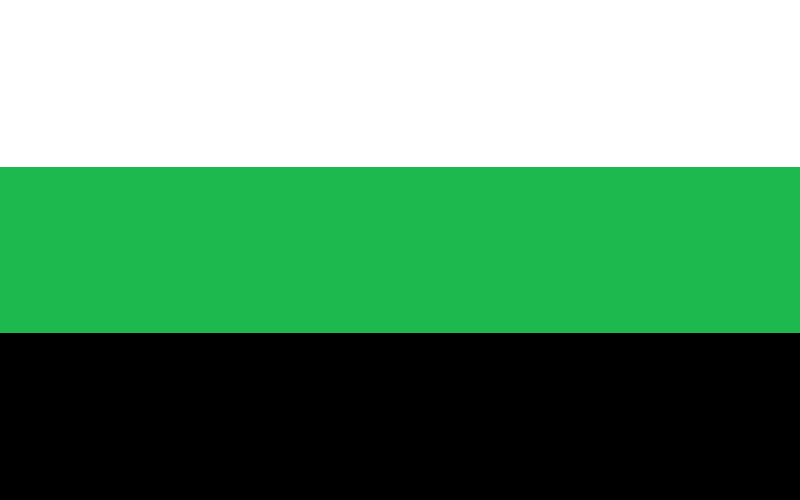
A white, green, and black horizontal tricolor used for neutrois identity. H. A. Burnham coined the term in 1995 [1], but the flag's designer, creation date, and original platform remain unknown. The earliest dated appearance located for this entry is a 4 July 2015 archive post [2], followed by a documented Wikimedia Commons vector in 2016 [3].

Key facts
- Earliest located appearance
- Circulation
- documented by 2015
- Aspect Ratio
- 3:5 · standard
- Ratio Notes
- No creator-specified ratio has been located. The archive renders the flag at the standard 3:5 production proportion, with three equal stripes.
- Stripes
- 3
- Represented Identity
- neutrois
Status Canonical
Archive categories Gender Identity Pride Flags
Overview
The Neutrois Pride Flag is a horizontal tricolor of white, green, and black used for neutrois identity. Community sources describe neutrois as a neutral gender, an absence of gender, or an experience that overlaps with agender without being identical to it. [4][5] H. A. Burnham coined the term in 1995, and archived Neutrois Outpost pages document its early online development by 2000 and 2001. [1][6]
The flag's designer, creation date, and original publication platform remain unknown. The earliest dated appearance located for this entry is a 4 July 2015 post by the Pride-Flags archive on DeviantArt, which should not be treated as proof of authorship or the design's first use. [2] A 2016 Wikimedia Commons vector documents the now-common white, green, and black form. [3] The stripe meanings are widely repeated in community sources, but no creator statement has been located. [7][4]
Identity & Context
- Represented Identity
- neutrois
- Subcommunity
- nonbinary umbrella
- Language Context
- The term neutrois was coined in 1995 by H. A. Burnham, who used ze/hir pronouns. Neutrois Outpost's own FAQ, in a 2001 archived capture, records it first-hand: "Neutrois means non-gendered class. It was originally coined by H.A. Burnham, in 1995. Ze formed it to give a name to hirself, and other people with feelings of gender absence and resulting misalignment." [1] Later readings of the word's second element differ and are interpretations rather than documented intent: the group-denoting French suffix -ois, as in Québécois, or trois, three, as in third gender [4][5]. Documented pronunciations include new-TWA, new-TROY and new-TROSS among others [5].
Community sources describe neutrois as a neutral gender, an absence of gender, or an experience that overlaps with agender without being identical to it [4][5].
Creators
Creator unknown
No identification located
The original designer is unknown. No reliable source located for this entry identifies a creator, creation date, original platform, or place of origin. [4][5] The Pride-Flags DeviantArt account is a later archive and publisher, not the designer [2]; Jynto created the documented 2016 Wikimedia Commons SVG, which is vectorization and file provenance rather than authorship of the underlying design [3].
Contribute information about who designed this flag.
Origin
The original platform and place of origin are unknown.
The original platform and place of origin are unknown. No reliable source located for this entry identifies the flag's original publication platform, and the earliest dated appearance located, a 4 July 2015 Pride-Flags archive post on DeviantArt, is an archive republication rather than evidence of where the design first appeared. [2][4][5]
Dates & Chronology
- Earliest located appearance
- Circulation
- documented by 2015
- Creation Bounds
- The designer and creation date are unknown. The earliest dated appearance located for this entry is the Pride-Flags archive's DeviantArt post of 4 July 2015, which documents circulation rather than authorship or first use. [2]
Identity chronology. 1995: H. A. Burnham coins neutrois. [1] January 1997: a self-described FtN person discusses transition in the soc.support.transgendered newsgroup. [5] By November 2000: Neutrois Outpost is online, carrying the transition-centred definition. [6] March 2001: archived captures of the Outpost's FAQ and definition document early usage. [1][6] February 2014: Facebook includes neutrois among its expanded custom gender terms. [8]
Flag chronology. 4 July 2015: the earliest dated online appearance located for this entry, posted by the Pride-Flags archive on DeviantArt. [2] 10 June 2016: Jynto uploads a white, green and black SVG to Wikimedia Commons, later optimized by other editors. [3] 28 October 2017: FOTW identifies a Neutrois flag in Tom Hsieh's Taiwan Pride Parade photograph. [9][10]
The flag circulates principally through online identity references, community wikis, flag archives and digital graphics. [7][4][5]
The identity is older than any located appearance of the flag. H. A. Burnham coined neutrois in 1995, forming it, in the Outpost's words, "to give a name to hirself, and other people with feelings of gender absence and resulting misalignment" [1]; a self-described FtN (female-to-neutrois) person discussed gender dysphoria and physical transition plans in the soc.support.transgendered newsgroup in January 1997; and the site Neutrois Outpost was online by November 2000 [5]. The Outpost's own definition was transition-centred: "A Neutrois is someone who identifies as being non-gendered and seeks to lose the major physical signifiers that indicate gender to others... Neutrois are trying to lose gender traits, not gain new ones." [6] Micah, whose blog documented nonbinary transition through the 2010s, framed it the same way: "Transition is a process of subtraction: a neutrois wishes to get rid of any and all gendered characteristics so as to achieve as neutral a body as possible." [11][5] Broader current use does not necessarily imply dysphoria or transition. In print, neutrois appears in Just Add Hormones (2005) and Richards and Barker's Sexuality and Gender for Mental Health Professionals (2013) [5]. None of this documents the flag, which is not attested in any source located here before 2015.
Lineage
No direct parent is documented. Community explanations compare the Neutrois flag's green stripe with the Genderqueer Pride Flag's use of green outside the conventional pink-and-blue gender binary. No source located for this entry confirms that the unknown Neutrois designer directly derived the design from it. [7][4] The Wikimedia Commons statement that its 2016 SVG file was based on File:Genderqueer_Flag.svg describes the technical construction of that later vector file, not the original design's lineage. [3]
Colors & Symbolism
The three stripes are reported to stand for gender neutrality, a gender outside male and female, and genderlessness. These meanings are repeated in community references and in the description accompanying the 2016 Wikimedia Commons vector. No statement from a confirmed original designer has been located, so they should not be described as creator-confirmed meanings. [7][4][3]
| Colour | Hex | Meaning | Note |
|---|---|---|---|
| White | #FFFFFF | Community-reported as neutral, unidentified, or questioning gender. [7][4][3] | Consistent across the sources located, including the 2016 Wikimedia Commons vector [7][3] |
| Dark Chartreuse Green | #1F9F00 | Community-reported as a gender outside male, female, or a mixture of the two; the reading describes the shade as the inverse of lavender, the mix of pink and blue. [7][4][3] | The value drawn by the 2016 Wikimedia Commons vector and listed by Flag Color Codes [3][7] |
| Black | #000000 | Community-reported as agender or genderless. [7][4][3] | Consistent across the sources located, including the 2016 Wikimedia Commons vector [7][3] |
This flag has no official digital palette. Color values shown are approximate.
The meanings are repeated in community references and in the description accompanying the 2016 Wikimedia Commons vector, which attributes them to nonbinary.org. No statement from a confirmed original designer has been located. [4][3]
No creator has published values. The archive asset follows the palette of the 2016 Wikimedia Commons vector, which draws the green at #1F9F00 [3]. The value #1DB84E circulates as a later reproduction variant. [7]
Design
- Aspect Ratio
- 3:5 · standard
- Ratio Notes
- No creator-specified ratio has been located. The archive renders the flag at the standard 3:5 production proportion, with three equal stripes.
- Orientation
- horizontal
- Stripe Count
- 3
- Layout
- horizontal_stripes
- Stripes (Top → Bottom)
- White, Dark Chartreuse Green, Black
Three equal horizontal stripes ordered from top to bottom: white, green, and black. The design contains no emblem.
Usage & Adoption
- Online Usage
- Online identity references, community wikis, flag archives and digital graphics [7][4][5]
- Event Usage
- Taiwan Pride Parade, Taipei, 28 October 2017: FOTW identifies a Neutrois flag in Tom Hsieh's photograph [9][10]
- Current Status
- active
The flag circulates principally through online identity references, community wikis, flag archives and digital graphics. FOTW identifies a Neutrois flag in Tom Hsieh's photograph from the Taiwan Pride Parade in Taipei on 28 October 2017. [7][4][5][9][10]
Image Archive
The archive's reference rendering.
Discourse & Debates
- Whether neutrois names a neutral gender or the absence of gender; definitions vary across sources and individuals [4][11]
- Which symbol stands for neutrois. Neutrois Outpost's own pages used a null symbol nested in a triangle, the triangle representing "pride in the knowledge of who we are" [1]. The Nonbinary Wiki documents four symbols in circulation: the prong-less circle-and-line (U+26B2), the Outpost's circle-and-triangle, the null or empty-set sign, and the plain circle; the LGBTQIA+ Wiki adds that the circle-and-line appears to have been designed by a group of non-binary Brazilians in 2014, and that agender symbols are sometimes used interchangeably. [4][5]
Common misidentifications
- Sometimes conflated with agender. Community sources generally describe neutrois as a neutral gender and agender as the absence of gender, while noting that usage varies and some people identify as both, or use the terms interchangeably. [4][5]
- Distinct from androgyne: neutrois is described as the absence of male and female rather than a mix of both. [4]
- The Neutrois Outpost definition historically emphasized physical transition and gender dysphoria; broader contemporary use does not necessarily imply either. [6][11]
Coined by H. A. Burnham in 1995 and discussed in newsgroups for transgender people; the earliest cited newsgroup use of the FtN framing is from January 1997 [4][5]. Alternate Neutrois flag designs by Jules/James Gray and by AriMations, the latter based on the agender flag, are documented as separate designs rather than versions by the unknown designer of this flag [4]. The identity utrois is documented as neutrois's opposite [4].
Footnotes & Citations
Sources and footnotes 12 sources
- 1. Archived Sources Frequently Asked Questions. Neutrois Outpost, via the Internet Archive (capture of 7 March 2001) (2000-11-23). Accessed 2026-08-12
Carries the coinage: Burnham, 1995, ze/hir pronouns, and the word's purpose, in the community site's own words.
- 2. Image file page Neutrois. Pride-Flags. DeviantArt (2015-07-04). Accessed 2026-08-14
The earliest dated appearance located for this entry, posted 4 July 2015 by the Pride-Flags archive account, which publishes and catalogues flags rather than claiming their design.
- 3. Image file page File:Neutrois Flag.svg. Wikimedia Commons (2016-06-10). Accessed 2026-08-14
Jynto's SVG, uploaded 10 June 2016 at 1272 × 786 and later optimized by other editors. Its markup draws the green at #1F9F00, its description gives the stripe meanings and attributes them to nonbinary.org, and the file page states the file is based on File:Genderqueer_Flag.svg with colours from File:Neutrois_flag.jpg. Marked public domain as simple geometry.
- 4. Encyclopedias & Reference Neutrois. LGBTQIA+ Wiki. Accessed 2026-08-12
Carries the stripe meanings, the coinage citation to a 2001 capture of neutrois.com, both readings of the word's second element, and two named alternate flags. Lists no hex values and no flag creator.
- 5. Encyclopedias & Reference Neutrois. Nonbinary Wiki. Accessed 2026-08-12
Documents the identity's history: the Outpost's 2000 definition, the 1997 newsgroup use, the Facebook milestone, and four symbols in circulation.
- 6. Archived Sources What are Neutrois?. Neutrois Outpost, via the Internet Archive (capture of 2 March 2001) (2000-11-11). Accessed 2026-08-12
The Outpost's founding definition, transition-centred, in the site's own words.
- 7. Databases Neutrois Pride Flag. Flag Color Codes. Accessed 2026-08-12
Lists the three hex values and the stripe meanings in circulation. Names no author and cites no source for them.
- 8. Blogs & Personal Sources Facebook gender options. Dennis Baron. The Web of Language, University of Illinois. Accessed 2026-08-14
Documents neutrois among the custom gender terms Facebook added in 2014.
- 9. Databases Neutrois flag. Tomislav Todorović. Flags of the World (FOTW) (2022-04-23). Accessed 2026-08-14
FOTW's page on the flag, describing the white-green-black tricolor and its reported symbolism, and identifying a Neutrois flag in a photograph from the Taiwan Pride Parade of 28 October 2017.
- 10. Image file page Taiwan Pride Parade 2017. Tom Hsieh. Flickr (2017-10-28). Accessed 2026-08-14
The photograph FOTW identifies, taken 28 October 2017 and uploaded the following day. Marked All Rights Reserved; linked rather than reproduced.
- 11. Blogs & Personal Sources Genderqueer.me (formerly Neutrois Nonsense). Micah. Neutrois Nonsense (blog). Accessed 2026-08-12
Micah's blog, the source of the subtraction definition; earlier addressed as neutrois.me.
- Community Neutrois Outpost. Neutrois Outpost. Accessed 2026-08-12
The community's own site: definitions and the identity's range.
Image Sources
- Rendering
- three-stripe standard
- Credit: Designer unknown. Archive rendering by Encycloflaggia at the standard 3:5 proportion, with the palette of the 2016 Wikimedia Commons vector by Jynto · Wikimedia Commons
- Archive rendering at the standard 3:5 proportion, following the palette of the 2016 Wikimedia Commons vector. The stripe meanings reported in community sources are white for neutral, unidentified or questioning gender, green for a gender outside male and female, and black for agender or genderless; no statement from a confirmed original designer has been located. [3][4] · Credit: Designer unknown; archive rendering by Encycloflaggia · EncycloflaggiaRights The original design's rights status is unknown; the rendering is provided for reference display.