Polygender Pride Flag
Multigender Pride Flag ·
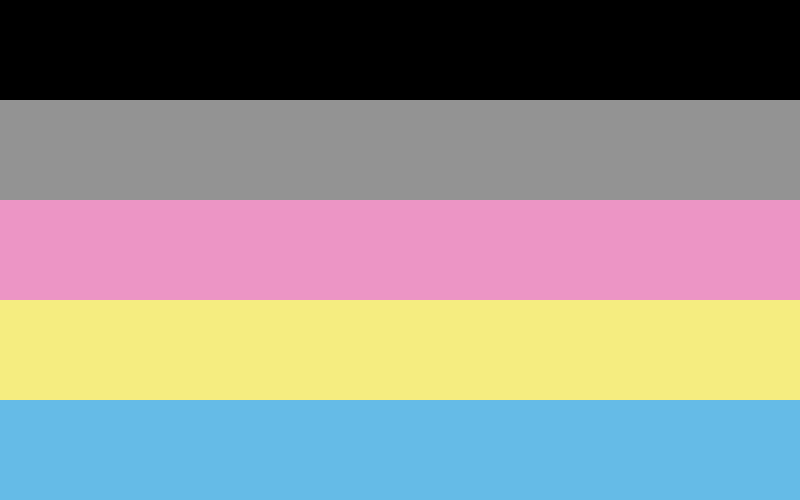
A five-stripe Polygender Pride Flag by an unidentified, now-deactivated Tumblr user, documented in an April 7, 2014 submission to Pride-Flags-for-Us. [1] Its black, gray, pink, yellow and blue stripes represent partial agender experience, changing or fluctuating genders, femininity, genders outside the binary, and masculinity; the sources that preserve those meanings disagree about which of pink and blue carries which, and the designer is recorded only as a deactivated account. [1][2][3]
Key facts
- Designer
- Unidentified former Tumblr user
- Created
- Earliest located publication
- In use
- 2014 to present
- Aspect Ratio
- 3:5 · standard
- Stripes
- 5
- Represented Identity
- people who experience more than one gender
Also known as
- Polygender Flag
Archive categories Gender Identity Pride Flags
Overview
No creator statement has been located. Orientando describes the submission as a pride flag for anyone with more than one gender, which is the only stated purpose on record. [1]
The design existed on or before 7 April 2014, when it was submitted to the Pride-Flags-for-Us Tumblr blog as a pride flag for anyone with more than one gender. Orientando records that date and links the submission, which now returns 404. [1][4] Nothing about the designer survives beyond the account status: later documentation records only that the account had been deactivated. [2]
Identity & Context
- Represented Identity
- people who experience more than one gender
- Subcommunity
- multigender umbrella
Polygender describes experiencing more than one gender. Those genders may be held simultaneously, at different times, or with changing intensity, and Orientando notes the last of these is also described as polygender-flux. [1] Boston University's Living Language Guide gives it as "a term for anyone who experiences more than one gender identity", usable "as a gender identity in its own right" or "as an umbrella term for other identities which fit this description", and adds that polygender people "may or may not identify as multigender, nonbinary, or transgender specifically". [5] Polygender is not a synonym for polysexuality, polyamory or polygamy; the shared prefix means many, and the identities are unrelated.
Creators
Associated Figures
Pride-Flags-for-Us
Tumblr blog that hosted the earliest located submission
Pride-Flags-for-Us was a Tumblr blog that published flags submitted by readers. Orientando records the polygender flag as submitted there on 7 April 2014 and links the post directly; the post now returns 404 and the blog no longer carries it. Hosting a submission is not authorship. [1][4]
Pride-Flags
Later archival uploader on DeviantArt
Pride-Flags uploaded a 5000 by 3000 copy of the design to DeviantArt as "Polygender (1)", timestamped 2015-07-04T04:58:09Z and displayed by the site as 3 July 2015 in Pacific time. The page carries a definition of the term, the stripe meanings, and the line "Flag by Unknown"; it asserts no Creative Commons licence. A second Pride-Flags upload, "Polygender (3)" of 9 July 2016, is a different design described as "by Anonymous" and "created to be more accessible for people with eye-strain and other sensory issues". [3][6]
Attribution notes
The designer's name and former Tumblr handle have not been recovered. Orientando records that the flag was submitted to the Pride Flags For Us blog on 7 April 2014 and links that post, which no longer resolves. [1] Pride-Flags' 2015 DeviantArt upload ends "Flag by Unknown", and pride-color-schemes' 2016 documentation gives "Designed by: [Deactivated]": the account existed and had already been abandoned. [3][2] Pride-Flags-for-Us hosted the earliest located submission; Pride-Flags later uploaded a high-resolution copy to DeviantArt. Neither is the designer.
Origin
- Digital Origin
- Yes
Digital origin; no geographic origin is documented.
Digital origin, on Tumblr. No geographic origin is documented. The earliest located publication is a submission to the Pride-Flags-for-Us blog on 7 April 2014, recorded and linked by Orientando; the design therefore existed on or before that date. [1] The 2015 DeviantArt upload is a later copy, not the original publication. [3]
Dates & Chronology
- Year Created
- Earliest located publication
- Period in Use
- 2014 to present
The flag circulates through Tumblr, DeviantArt, identity wikis, pride reference sites and commercial reproductions. [1][3][7] No organization or community body is documented as having adopted it, and multiple alternative polygender designs exist, so it is a widely reproduced polygender flag rather than an official or universally accepted standard. [2][6]
Two later designs are documented for the same identity and neither displaced this one. pride-color-schemes published a five-stripe alternative by @nova-pride-flags in dark red, pink, light blue, green and dark blue, issued without any statement of meaning. [2] Pride-Flags uploaded a separate design as "Polygender (3)" on 9 July 2016, describing it as "by Anonymous" and "created to be more accessible for people with eye-strain and other sensory issues". [6]
Lineage
No parent, child, sibling, influence or homage is recorded, because no source documents a visual derivation for this design. The multigender, bigender, trigender, pangender, genderflux and demifluid entries are contextual identity neighbours for navigation: shared identity territory is not flag genealogy. Multigender is the closest of these and the relationship is the hardest to state cleanly, because multigender functions as an umbrella term over polygender while a distinct multigender flag also circulates; the two records are kept separate rather than merged. The alternative polygender design by @nova-pride-flags and Pride-Flags' 2016 "Polygender (3)" are later alternatives for the same identity, not descendants of this one. [2][6]
Colors & Symbolism
Later community documentation preserves the stripe meanings below. The designer's own post is no longer accessible, so none of this is a surviving direct creator statement. [1][2][3]
| Colour | Hex | Meaning |
|---|---|---|
| Black | #000000 | Partial agender experience: "for those who feel partially agender". [3][2][1] |
| Gray | #939393 | Changing or fluctuating genders: "for those whose gender(s) change or fluctuate". [3][2][1] |
| Pink | #ED94C5 | Femininity and partial identification with feminine genders. The two Pride-Flags-lineage sources assign this stripe the other way round; see the note below. [1][7][3][2] |
| Yellow | #F5ED81 | Nonbinary genders: "the yellow is for genders outside the binary". [3][2][1] |
| Blue | #64BBE6 | Masculinity and partial identification with masculine genders. As with pink, the two Pride-Flags-lineage sources assign this stripe the other way round. [1][7][3][2] |
Measured from the 5000 by 3000 Pride-Flags archival PNG preserved by Orientando (SHA-256 991e54ce…5a6e7c, 74,378 bytes). Not a creator-issued specification. [8]
Sources disagree about two stripes. Pride-Flags' 2015 DeviantArt description and pride-color-schemes' 2016 post both read "The pink and blue stripes are for masculinity and femininity respectively, and those who feel partially male/female", assigning pink to masculinity and blue to femininity. [3][2] Orientando, which links the 2014 submission directly, gives pink for genders evoking femininity and blue for genders evoking masculinity, and every flag guide since agrees with it. [1][7] This entry's table follows Orientando and the later guides, which is also the near-universal colour convention, but the disagreement is real and unresolved, and the two texts that reverse the stripes share one lineage rather than being independent of each other.
No creator-issued values exist. The values above are measured from the Pride-Flags archival PNG, which contains exactly five flat colours. [8] Library.LGBT publishes a later reference palette of #000000, #939393, #EC95C5, #F5ED80 and #65BBE7, differing from the measured artifact by one unit in three channels. The two are not mixed here, and neither is a creator specification. [7] The alternative five-stripe design published by @nova-pride-flags in the same 2016 post samples at #A42A3B, #C63673, #87BDB0, #4D9453 and #30637D. [2]
Design
- Aspect Ratio
- 3:5 · standard
- Orientation
- horizontal
- Stripe Count
- 5
- Layout
- horizontal_stripes
- Stripes (Top → Bottom)
- Black, Gray, Pink, Yellow, Blue
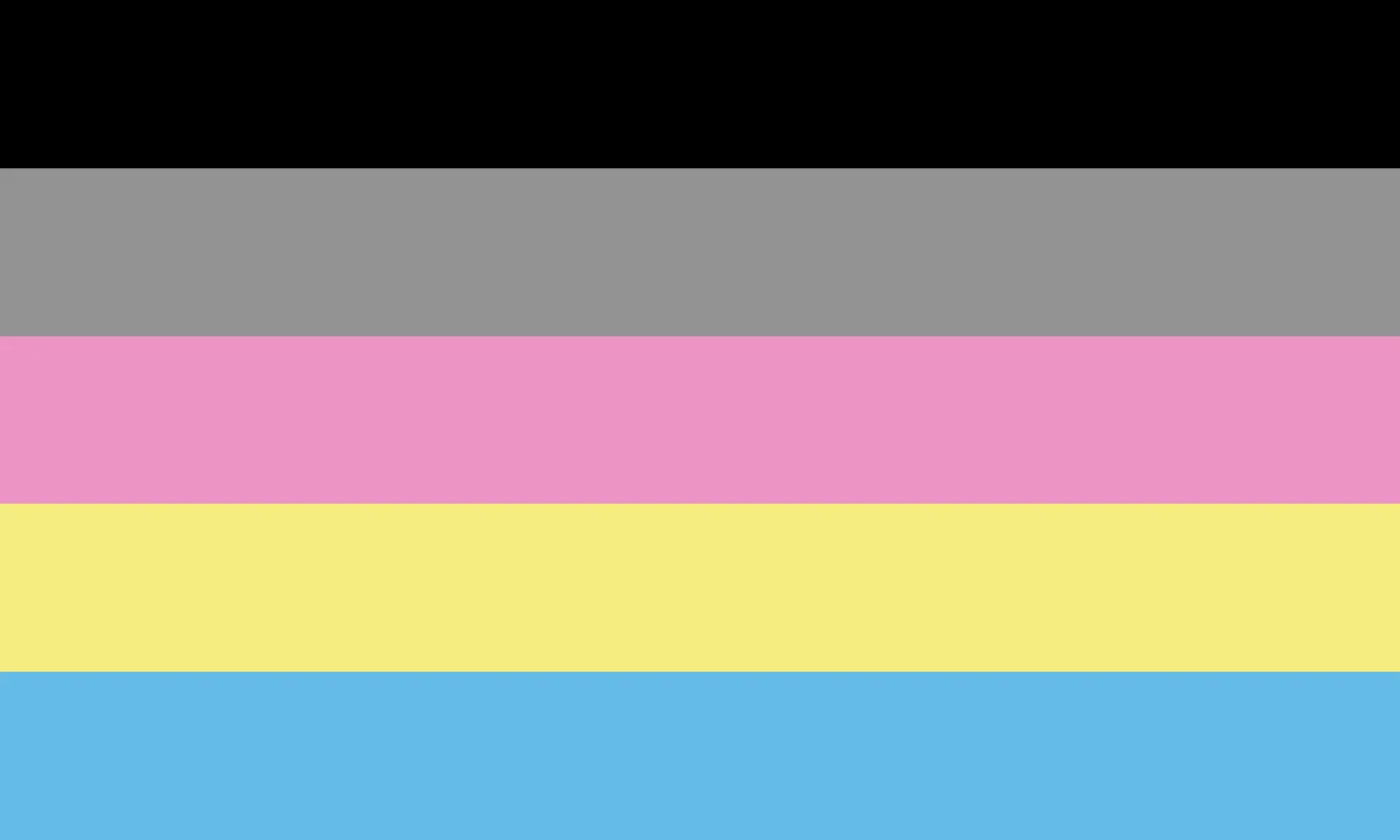
Five equal horizontal stripes and no emblem or charge. The Pride-Flags archival PNG measures 5000 by 3000 pixels, matching the database's standard 3:5 production ratio. Its stripe boundaries fall at heights of 601, 600, 598, 600 and 601 pixels, which is raster rounding rather than an intended unequal-stripe specification. The archive's reconstruction is drawn at 800 by 480 with five 96-pixel bands. [8]
Five equally sized horizontal stripes ordered top to bottom: black, gray, pink, yellow, blue. No emblem or additional symbols. [8][3]
Five equal horizontal stripes: black, gray, pink, pale yellow and light blue. No charge. [8]
Usage & Adoption
- Online Usage
- Tumblr, where the earliest located publication was a submission to Pride-Flags-for-Us [1][4], DeviantArt, through the later Pride-Flags uploads [3][6], Identity wikis and pride flag reference sites [1][7], Commercial reproductions from small pride flag vendors
- Current Status
- active, community-circulated, not formally canonical
The flag circulates online and in commercial reproductions. No formal organization or community body is documented as having adopted it, no physical or event use is documented, and multiple alternative polygender designs exist. It is a recognizable and widely reproduced polygender flag, not an official or universally accepted standard. [1][2][6]
Image Archive
Later Archival Copy
Archive Reconstruction
Discourse & Debates
- How many genders polygender requires. Pride-Flags' 2015 description records both readings side by side: "Some define polygender as anyone having more than one gender: they may have two (bigender), three (trigender), or more. Others define polygender as strictly people who have more than three genders." Orientando gives the second threshold as four or more. [3][1]
- Whether polygender is distinct from genderfluid. The 2015 description says that where polygender means changing "from one gender to the next at different times", the word "is used interchangeably with genderfluid"; Orientando separates the two by treating change of intensity over time as polygender-flux. [3][1]
Common misidentifications
- Polygender is confused with polysexuality, polyamory and polygamy on the strength of the shared prefix. They describe different things and none of them is a gender identity.
- Polygender and multigender are used interchangeably. Multigender functions as an umbrella term, but a distinct multigender flag also circulates, and Pride-Flags' 2016 description warns against confusing polygender with "Multigender, an otherkin-specific term". The two records are kept separate here. [6]
The adjectival form "polygendered" is documented in Gary Bowen's evolving A Dictionary of Words for Masculine Women, whose surviving 5 November 1996 capture defines "POLYGENDERED, PANGENDERED" as "exhibiting characteristics of multiple genders, deliberately refuting the concept of only two genders". That capture carries a 1995 copyright line and the note "posted on FTM-intl.org 95 may 15". [9] The same definition, adapted, appears in Boston University's Living Language Guide. [5] Orientando notes that polygender appears among nonbinary identities from the 2000s onward without certainty that those uses carry the present meaning. [1] Term history is not flag history: the flag is documented from 2014.
Footnotes & Citations
Sources and footnotes 9 sources
- 1. Reference Poligênero. Orientando. Orientando. Accessed 2026-08-16
Records the 7 April 2014 submission to Pride Flags For Us, links the original post, preserves the five stripe meanings, and hosts the full-size Pride-Flags PNG.
- 2. Social media Polygender. pride-color-schemes. Tumblr (2016-08-01). Accessed 2026-08-16
Documents the design, its stripe meanings, the designer status "Designed by: [Deactivated]", and a separate alternative by @nova-pride-flags.
- 3. Image file page Polygender (1). Pride-Flags. DeviantArt (2015-07-04). Accessed 2026-08-16
A later high-resolution upload, timestamped 2015-07-04T04:58:09Z and displayed as 3 July 2015 in Pacific time. Carries the stripe meanings and the line "Flag by Unknown"; asserts no Creative Commons licence.
- 4. Social media this is an flag for anyone whose identity includes…. Submitted by an unidentified user; hosted by Pride-Flags-for-Us. Tumblr (2014-04-07). Accessed 2026-08-16
The earliest located publication. The post now returns 404 and is retained as publication evidence; its date and content are known through Orientando, which links it.
- 5. Academic Living Language Guide: Gender and Sexuality. Boston University, Community Center for Inclusion, Equity and Belonging. Boston University. Accessed 2026-08-16
Current institutional definition of polygender, credited to The Trans Language Primer, with a second definition adapted from an LGBTQIA Resource Center.
- 6. Image file page Polygender (3). Pride-Flags. DeviantArt (2016-07-09). Accessed 2026-08-16
A different, later design, described as "by Anonymous" and made "to be more accessible for people with eye-strain and other sensory issues". Cited for that design and for its warning against confusing polygender with multigender.
- 7. Reference Pride Flag Guide: Polygender. Library.LGBT (Albany Pride initiative). Library.LGBT Pride Flag Guide. Accessed 2026-03-30
A tertiary flag guide: it names no author and cites no sources. The site went dark in July 2026 and could not be re-read; its values and readings are carried forward from the March 2026 reading and are never sole support here.
- 8. Image file page Pride-Flags archival PNG, 5000 by 3000 pixels. Uploaded by Pride-Flags; preserved by Orientando. Orientando. Accessed 2026-08-16 · Archived version
The measured artifact: PNG, 5000 by 3000, 74,378 bytes, SHA-256 991e54ceb932eb4c2e320b66152a95c526150767457c5133975928ef1b5a6e7c. Its byte size matches the 72.63 KB the deviation page states for its own file.
- 9. Archived Sources A Dictionary of Words for Masculine Women. Gary Bowen. FTM International (1995-05-15). Accessed 2026-08-16 · Archived version
Cited from the 5 November 1996 capture, which carries the headword POLYGENDERED, PANGENDERED, a 1995 copyright line, and the note "posted on FTM-intl.org 95 may 15". The present-day mirror was not reachable.
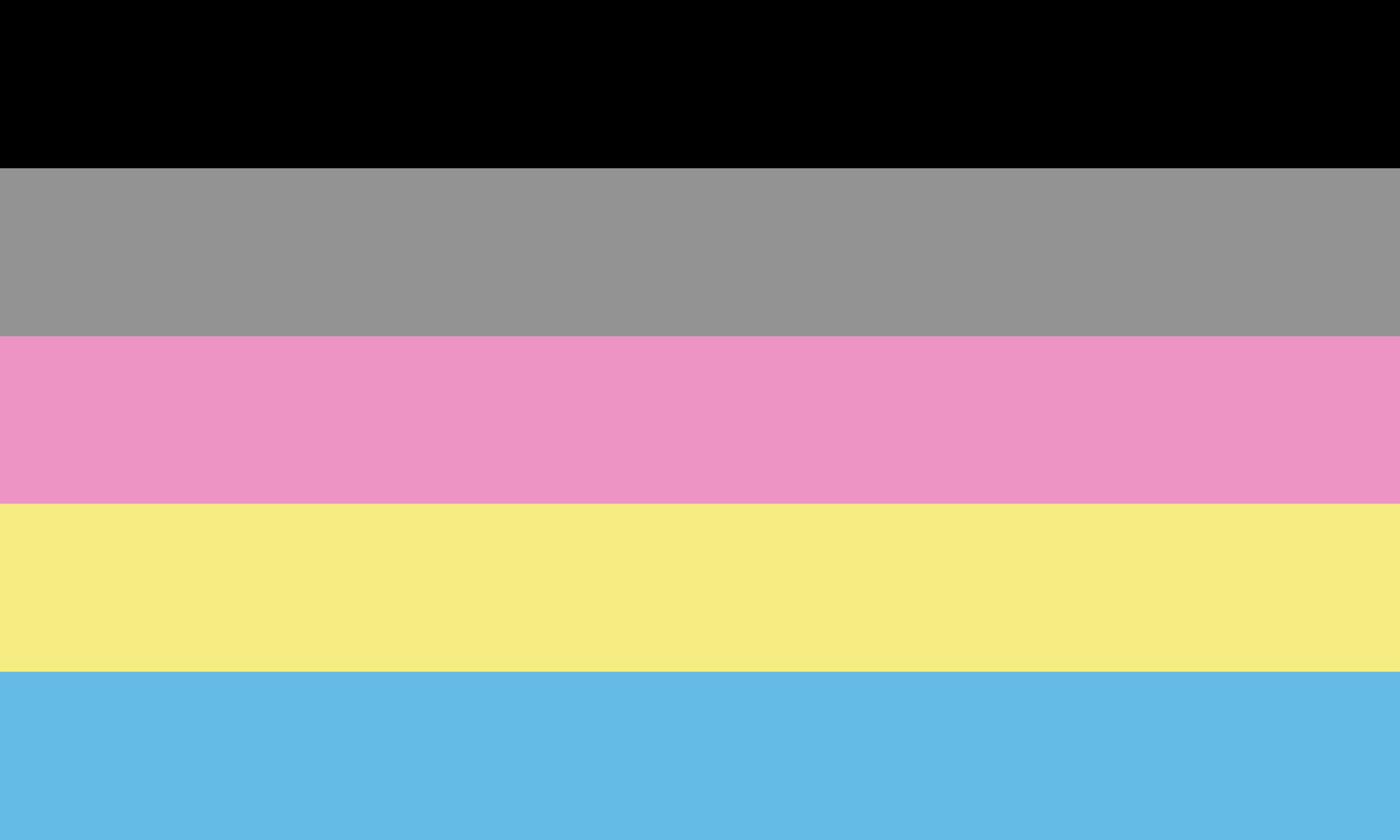
Image Sources
- Rendering
- five-stripe design submitted by 7 April 2014
- Encycloflaggia reconstruction of the five-stripe polygender flag · Credit: Designer unidentified; reconstruction by Encycloflaggia · Encycloflaggia · reconstructionRights Archive-produced reconstruction; colours measured from the Pride-Flags archival PNG
- The 5000 by 3000 PNG uploaded by Pride-Flags to DeviantArt and preserved by Orientando · Credit: Uploaded by Pride-Flags; designer unidentified · Orientando (file); DeviantArt (page) · verifiedRights No licence asserted on the deviation page; rights unknown
- Later high-resolution copy of the polygender flag, uploaded by Pride-Flags to DeviantArt as "Polygender (1)" and preserved at full size by Orientando. Not the April 2014 Tumblr image: no pixel-level or archival evidence identifies it with the submitted file. [3][8] · Credit: Uploaded by Pride-Flags; designer unidentified · DeviantArt, preserved by Orientando · No licence asserted on the deviation page; rights unknown
- The archive's reconstruction, drawn at 800 by 480 with five equal bands using the palette measured from the Pride-Flags archival PNG. [8] · Credit: Designer unidentified; reconstruction by Encycloflaggia · Encycloflaggia reconstruction · Archive-produced reconstruction, subject to the rights status of the underlying design