Genderqueer Pride Flag
Identity Pride Flag ·
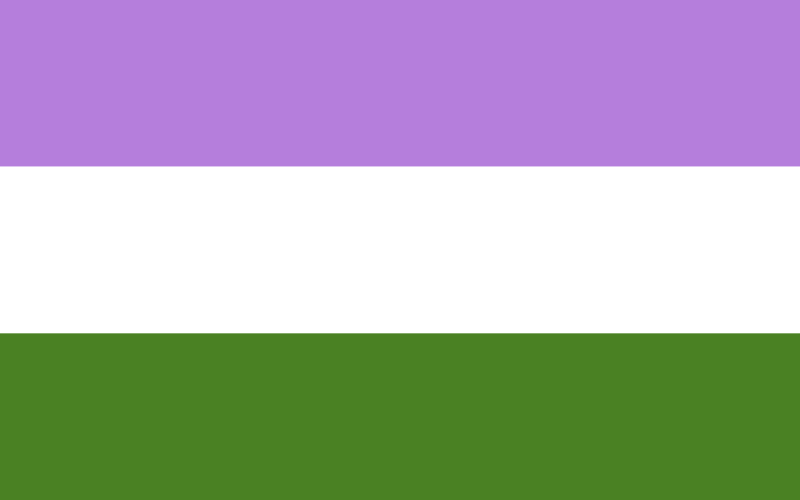
Marilyn Roxie finalised this lavender, white and dark chartreuse green tricolour in June 2011 after two earlier versions, then corrected the green to the exact inverse of the lavender in June 2012. [1] Designed in San Francisco as a personal art project and released for unrestricted use, it became an internationally circulated symbol of genderqueer identity. [2][3] In Britain, its accidental resemblance to suffragette colours has complicated how the flag is read. [4]
Key facts
- Designer
- Marilyn Roxie
- Created
- First documented public use
- In use
- 2011–present
- Aspect Ratio
- 3:5 · standard
- Stripes
- 3
- Origin
- San Francisco, California, United States
- Represented Identity
- Genderqueer
Also known as
- Genderqueer Flag
- Genderqueer and Non-Binary Pride Flag
Status Canonical Contested
Archive categories Gender Identity Pride Flags
Overview
To give genderqueer identity a visible banner at a point when none existed. Roxie wrote so at the time: "As no standard GQ flag appeared to exist (though there are gay/lesbian pride, bisexual, and transgender flags), I decided to create one!" [5] Looking back in 2019: "I noticed that there wasn't a genderqueer flag, and started with lavender as a springboard, due to lavender being a mix of blue and pink (present in the transgender flag) and the color's significance in queer culture." [2]
Marilyn Roxie designed the flag in San Francisco, beginning around the time they started college in autumn 2010, at the age of 20. [2]
Roxie names the rainbow, transgender and bisexual flags as the ones they had seen, "so I was thinking horizontal stripes would be the way forward." Their relationship to the transgender flag was specific rather than oppositional: "I didn't feel 'excluded' by the transgender flag per se, and am aware that the white stripe in the transgender flag can represent GQ and non-binary people, but I'm not a big fan of the blue and pink associations with gender personally and figured a lot of genderqueer people probably wouldn't be either." [2]
Identity & Context
- Represented Identity
- Genderqueer
- Movement
- Genderqueer visibility
In 2010 and 2011 "genderqueer" was the dominant umbrella term for people whose gender fell outside the male-female binary, and "nonbinary" was not yet in wide use. Roxie has said as much of their own vocabulary at the time: "'Genderqueer' was the word I encountered in 2009/2010, and I'm not sure I even remember reading non-binary much or at all." [2] The term was coined in the 1990s, first appearing in a 1995 newsletter of the Transexual Menace and credited to Riki Anne Wilchins, who described it as meant "to describe those of us who were not only Queer, but were so because we were the kind of gendertrash society rejected." [4]
Creators
The Creator
Marilyn Roxie
Designer
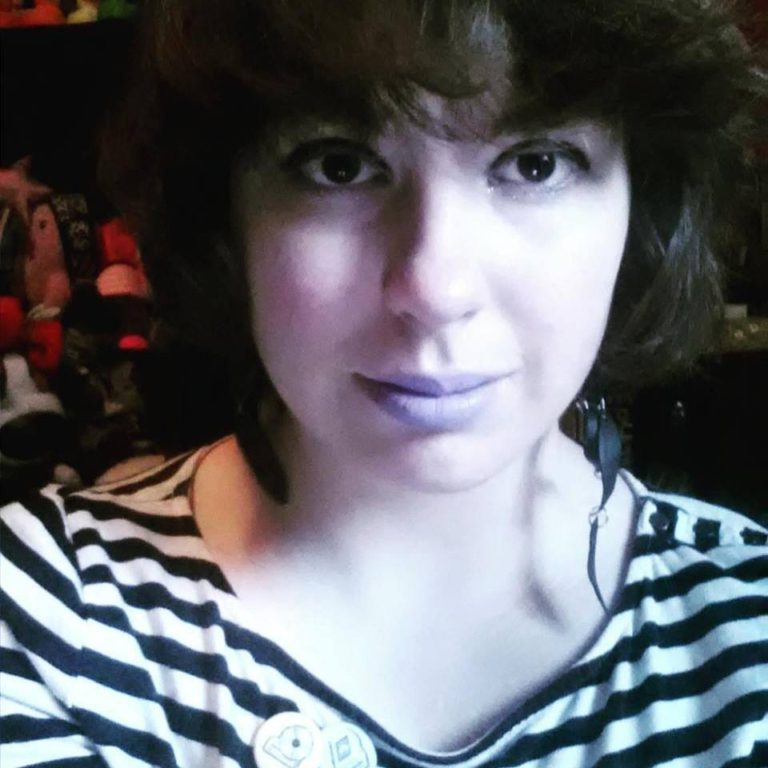
Marilyn Roxie (they/them) is a video artist and experimental photographer whose work explores "androgyny, male submission, queer subculture, and the relationship of found image and creative authorship," and the founder of Vulpiano Records, a netlabel they launched in November 2009 and run from San Francisco. [2][7] They were 20 when they designed the flag, and created genderqueerid.com on Tumblr while attending San Francisco City College. [2][6]
Roxie describes starting that site as "a place to hold my flag designs and other symbols of gender identity I was finding," which grew as readers wrote in with questions about identity terms and coming out, and as they worked on a paper on genderqueer history for a college class: "I just noticed a lot of gaps in tracing how identity terms and concepts had been used over time and wanted to bring everything I found in one place." [8]
On being known for the flag, Roxie is direct: "at this time in my life, the majority of what I do doesn't have anything to do with the genderqueer flag, and my gender and sexuality are not the most interesting things about me. I really do value being also asked questions about my interests and activities that I have going on these days, now that so many years since the flag's creation have passed." [2]
I noticed that there wasn't a genderqueer flag, and started with lavender as a springboard, due to lavender being a mix of blue and pink (present in the transgender flag) and the color's significance in queer culture.
Motivations
- To create a distinctive, visible symbol for the genderqueer community
- To increase visibility for genderqueer and related identities
Stated inspirations
- Lavender, for its long association with Queerness and because it mixes the blue and pink of the transgender flag[1][2]
- The absence of any genderqueer flag[2]
- The rainbow, transgender and bisexual flags, the only ones Roxie had seen at the time, which suggested horizontal stripes[2]
Attribution notes
Marilyn Roxie designed the flag alone, posting the first version under the account name neonsigh. [5] Library.LGBT records that the final version followed "consultation with online genderqueer communities," and Roxie says "It was primarily online interaction that shaped the creation of the flag," but no other person is credited with the design and Roxie claims none. The submissions invited on the flag's own page are for other people's designs: the licence there "applies only to designs that I have made, not the submissions of visitors to this page." [9][2][1]
Origin
- Country
- United States
- Region / state
- California
- City
- San Francisco
- Digital Origin
- Yes
Created in San Francisco, California, on the unceded ancestral homeland of the Ramaytush Ohlone people. [10][11]
Indigenous land context
Ramaytush Ohlone — unceded ancestral homeland (Indigenous name: Ramaytush). The Ramaytush Ohlone are the original peoples of Yelamu, the San Francisco Peninsula. [12] [13] The area now comprising the City and County of San Francisco was inhabited by the Yelamu, an independent tribe of the Ramaytush Ohlone peoples. [14] The land was never ceded, and in the words adopted by San Francisco's own commissions, the Ramaytush Ohlone 'have never ceded, lost, nor forgotten their responsibilities as the caretakers of this place.' [15] [14] The Commission on the Environment states that the Ramaytush Ohlone 'are not a mythical population of the past, but an integral and active community in the present San Francisco Bay Area region.' [14] [10][11][12][15][14][13]
Colonial / settler context
This flag was designed in San Francisco on unceded Ramaytush Ohlone land. No treaty of cession exists for the San Francisco Peninsula. [11][12][15][14][13]
- Land status
- Unceded (no treaty of cession exists)
- Indigenous engagement
- None documented
- Continuing presence
- The Ramaytush Tribe and the Association of Ramaytush Ohlone are active in the region today: the Farming is Medicine initiative in San Gregorio, a National Park Service curriculum, youth and stewardship partnerships, land-return advocacy, and the campaign to rename half of Mission Dolores Park to Chutchui. The Tribe's own website went online in 2026, with membership applications opening that April. [12] [13]
Creator identifies as "from San Francisco" and describes early development during the start of college; dissemination was primarily online. [2]
Dates & Chronology
- Year Created
- Exact date
- First public use
- Period in Use
- 2011–present
- Creation Bounds
- The final version was published in June 2011. The earliest documented physical use is later: opposition protests in Moscow on 4 February 2012, where the flag was carried with the rainbow flag. [1][3] The date of the first version is unresolved. Roxie's flag page gives June 2010; in 2019 they said "the first version was created in September 2010," adding that sites dating the flag to 2011 have taken the year of finalisation for the year of creation: "2011 is simply when the design was finalized." Both are the designer's own statements. The June 2010 date has the earlier support: writing on 4 September 2010, Roxie described that day's design as "modified from an initial attempt I had made in June 2010." [16] The conflict is with their own 2019 recollection and is left standing. [1][2]
The earliest documented physical use is the opposition protests in Moscow on 4 February 2012, where the flag was carried with the rainbow flag; Roxie's own site posted the sighting and Flags of the World cites it alongside a report in Ridus. [3][1] It was carried again at the pride parade in Madurai, India, on 30 September 2012. [3] Roxie's own summary of its circulation runs "from Reddit's genderqueer subreddit to handmade bracelets and beanies, from a political rally in Moscow to the book spine of Sam Rosenthal's Rye," and records the design referenced in Transgender: A Reference Handbook and in Nonbinary Gender Identities: History, Culture, Resources. [1]
.jpg)
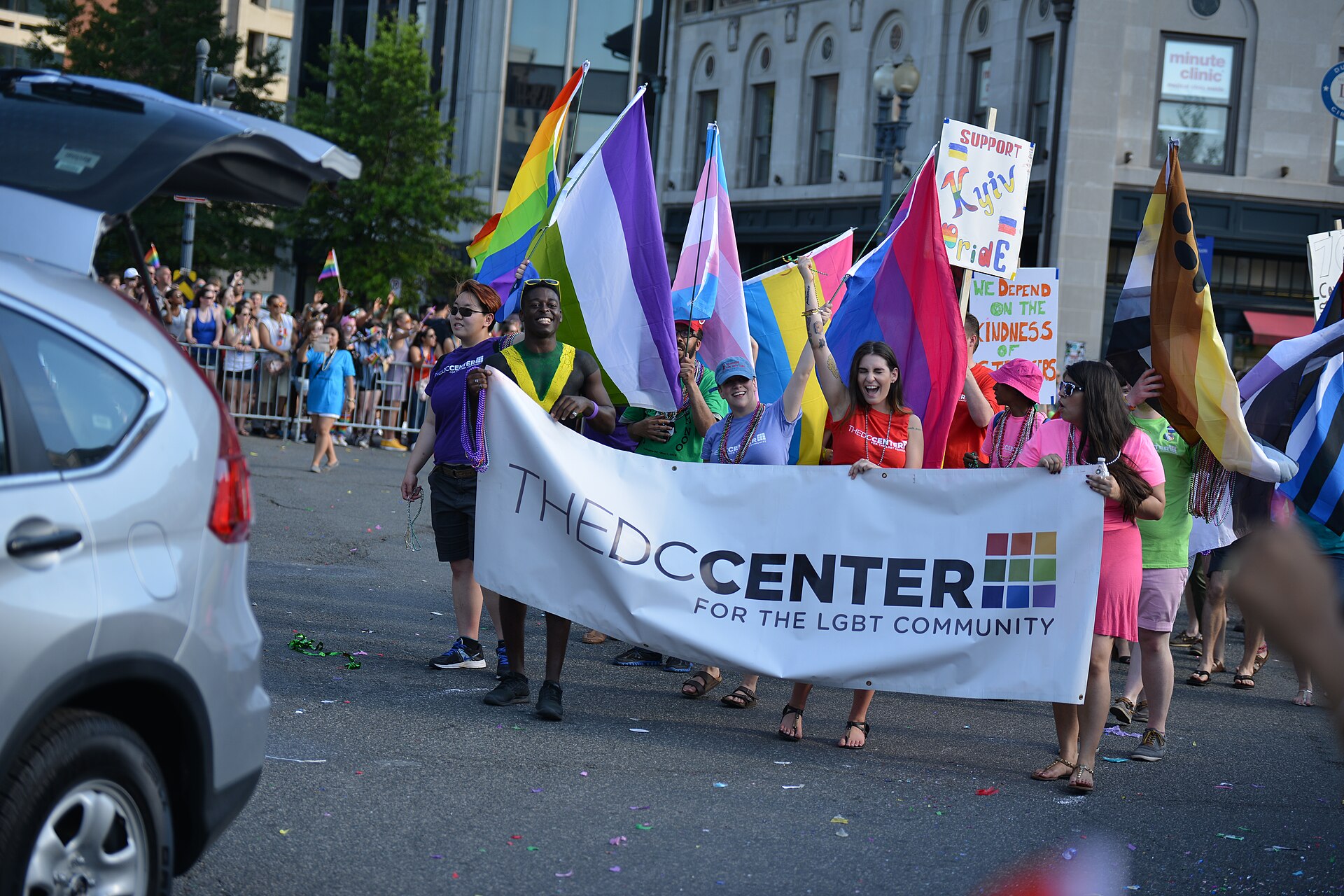
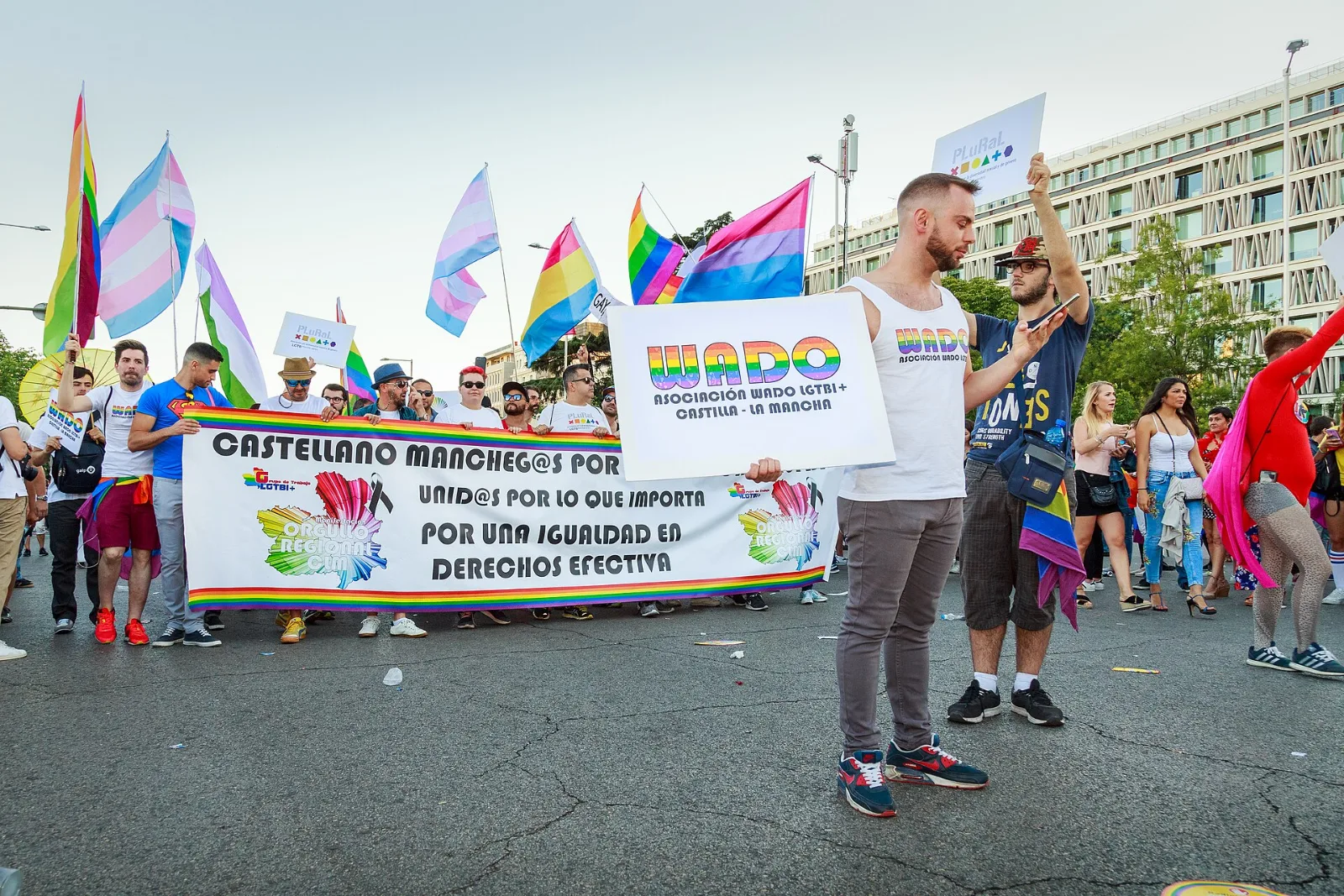
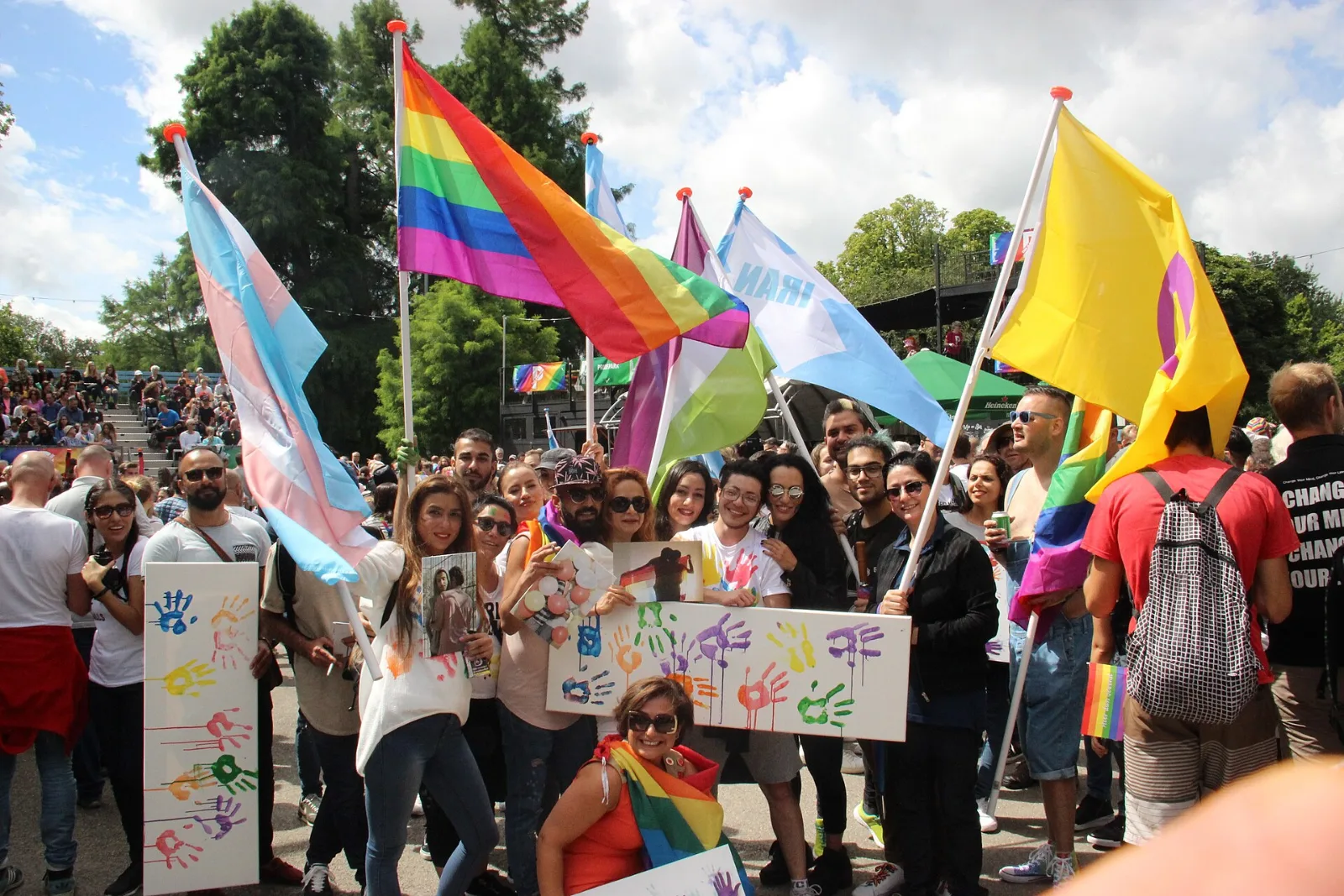
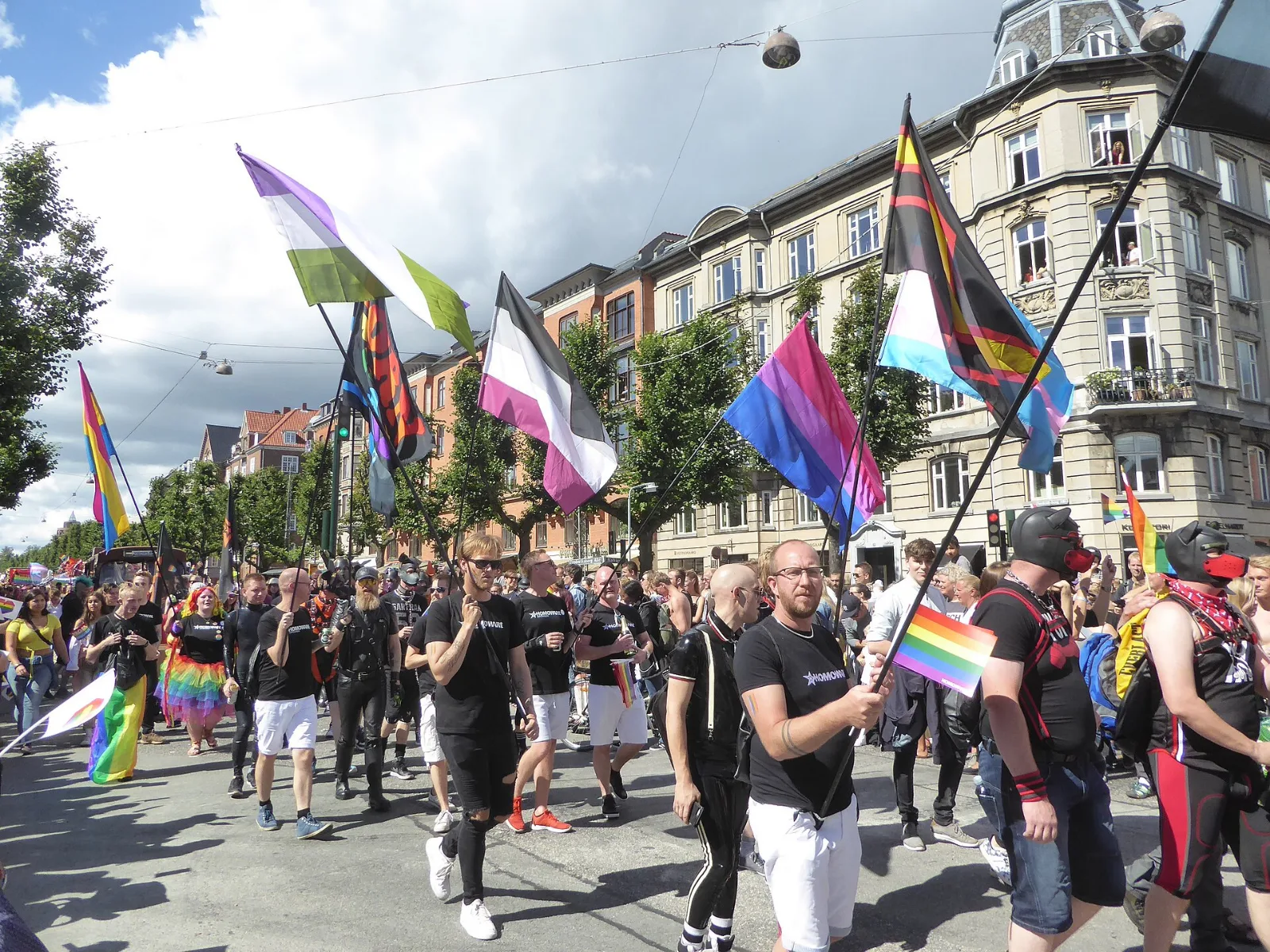
Todorović dates wider use to the late 2010s and lists fourteen photographed appearances: Capital Pride in Washington DC on 11 June 2016 and again on 9 June 2018; Malmö Pride on 6 August 2016; Erie Pride, Pennsylvania, on 24 June 2017, in three photographs; WorldPride in Madrid on 1 July 2017; Amsterdam Pride on 29 July 2017; Copenhagen Pride on 19 August 2017; Twin Cities Pride in Minneapolis on 23 June 2019, in three photographs; Brighton Pride on 3 August 2019; and Manchester Pride on 24 August 2019. He notes the colour shades vary between photographs, and suspects lighting rather than the flags. [3] The flag is also included in institutional Pride flag guides at British Columbia and Santa Barbara. [17][18]
Roxie expected none of it: "When I created the flag, I honestly didn't expect much of anything apart from maybe some people embedding it on their pages or making little items with the flag on it at best. It felt more like a personal art project - throwing it out there and making it clear that anyone could use it if they wanted to. It was nice to see people putting the image of the flag on their websites or having pins and physical flags made, but I had no idea it would endure for so many years since, and be used in so many ways or be utilized internationally and in parades or on people's walls." [2]
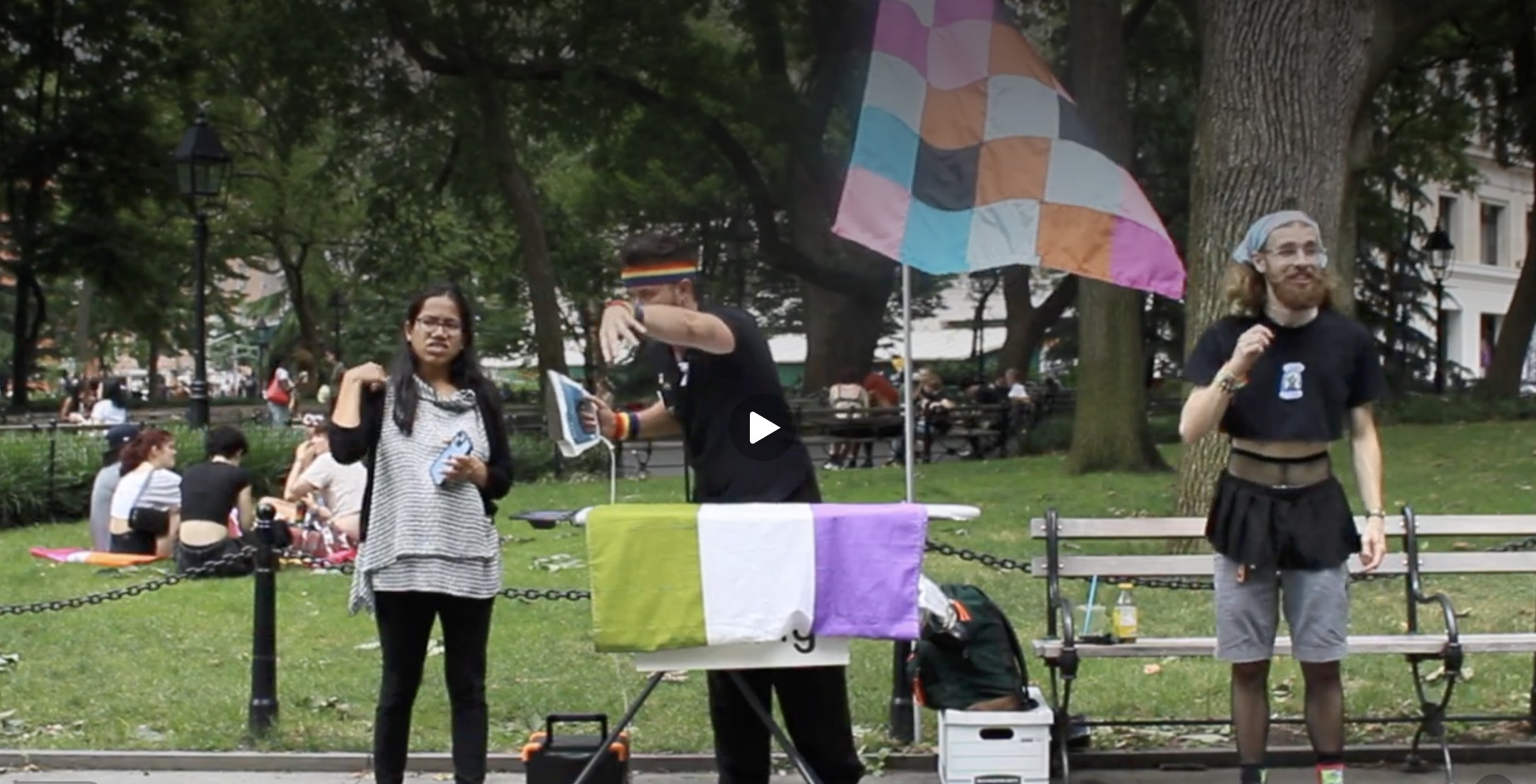
The flag was ironed in public at Washington Square Park in Greenwich Village, New York, on 30 June 2024, in Will Montgomery's Free Flag Ironing, alongside six-stripe rainbow, Progress, lesbian, intersex-inclusive Progress, pansexual, panromantic and nonbinary flags. [19]
Major revisions
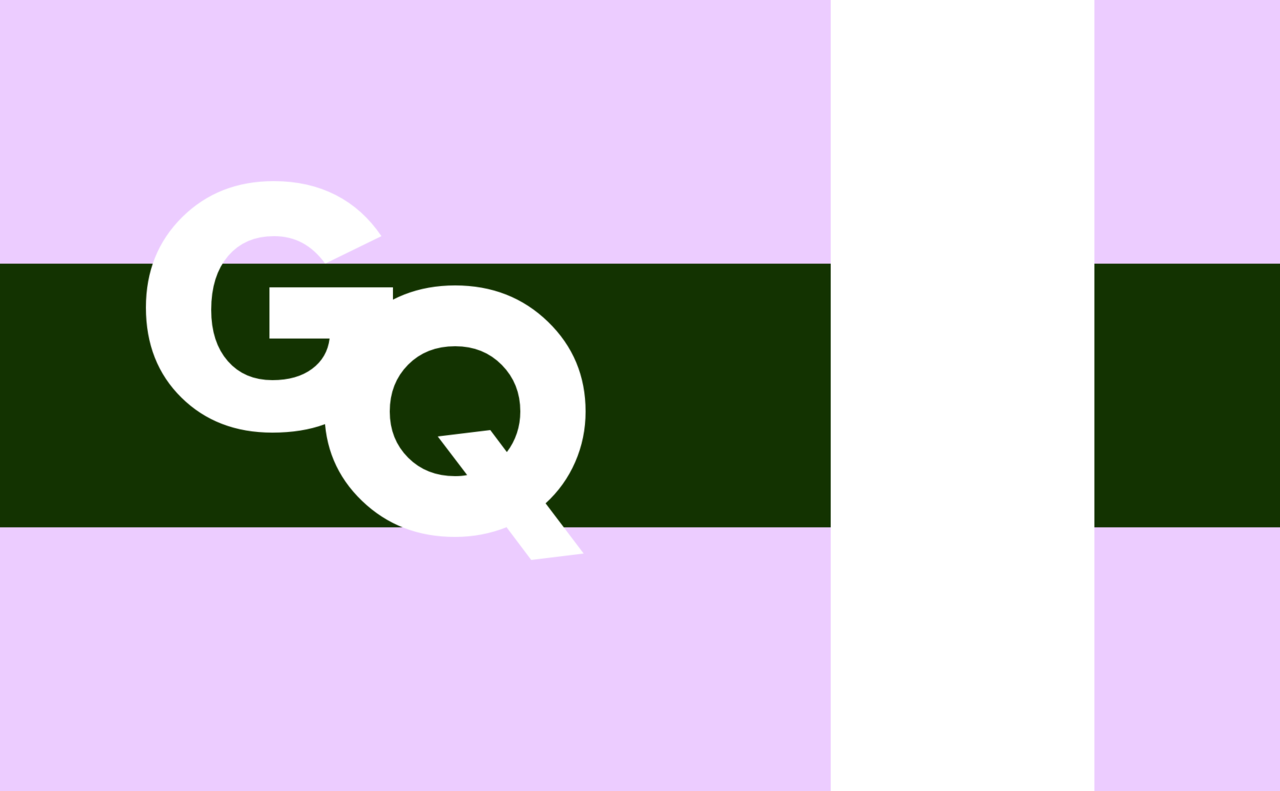
Version 1.0. A pale lavender field with a dark green horizontal band, a white vertical band in the fly half, and the letters "GQ" across the green. Roxie gives the lettering as a symbol they made in Futura Bk Bold "so the letters intersect," and describes the white band as something that might later let people "insert gender and orientation symbols." The colour meanings differ from the final flag's: lavender for the combination of blue and pink, green as its inverse for "those who go beyond gender binary identities," and white for "androgynous, as well as neutrality" rather than for agender identity.
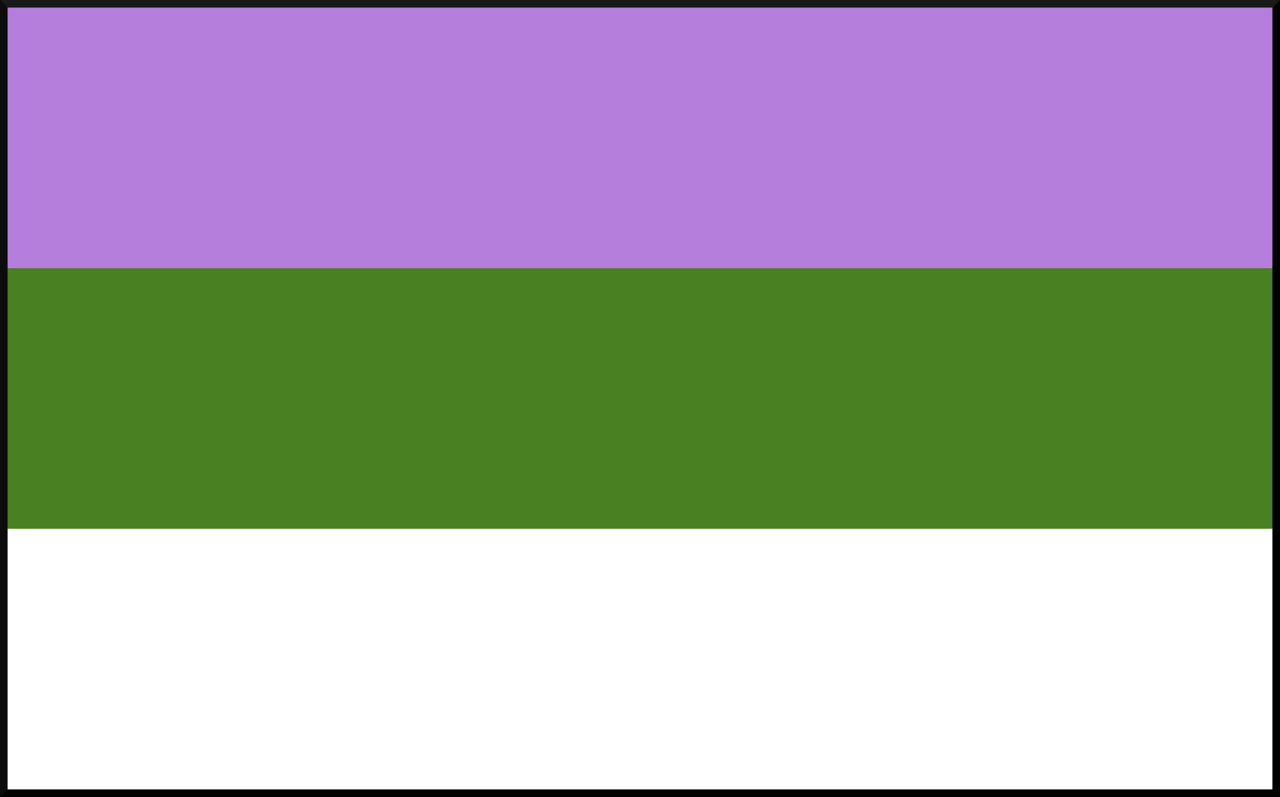
Version 2.0, posted 4 September 2010: three horizontal stripes, lavender over dark chartreuse green over white, within a black border. Roxie describes it as "modified from an initial attempt I had made in June 2010" and as "aesthetically similar to the gay and lesbian, bisexual, transgender, asexual, and pansexual flags." The colour meanings at this stage differ from the final ones: lavender for those "who feel they are both male and female in identity, as well as 'queerness'"; green, as the inverse of the lavender, for those "who feel they are neither male nor female in identity"; and white for those "falling completely outside of the gender binary."
Version 3.0, final. The green and white stripes exchange places, giving the lavender, white, green order in use since. Library.LGBT records that the final version followed consultation with online genderqueer communities.
True-colour update. The green changes from #498022 to #4A8123, the true inverse of the lavender.
Roxie added a note to the flag page in April 2013 stating that the design is not related to any UK suffragette colours, flags or other symbols, and linking a post explaining it. [1] That post, of 24 April 2013, answers two messages telling Roxie "this is not a creation, but an appropriation" and "Ya nicked it!" Roxie describes the effect plainly: "I just started shaking and trying to hold back tears." They had learned of the WSPU colours only the previous year, from a comment left on their own site. [20]
Roxie has described what the flag was for them at the time. "When I created the flag, I was in a very dark time in my life. I really wanted to die because I thought it was impossible to by happy with my body, the way other people saw me, and how I saw myself. I created this flag in part after more clearly realizing my identity and needing to have something in my life that could serve as a symbol of pride for myself, and for others who might identify like me. There are so many myths about genderqueerness and general lack of knowledge that I thought that making a symbol of awareness would be beneficial for anyone who wanted to use it, as a signpost that would say: 'yes! I am not alone.'" [20]
Lineage
- Indirect influences
- Bisexual Pride Flag, Rainbow Pride Flag, Transgender Pride Flag
Roxie names the rainbow, transgender and bisexual flags as what they had seen when designing, and took horizontal stripes from them. The white stripe is explicitly congruent with the white of the transgender flag. [1][2] Writing in September 2010, Roxie named a wider set the design was meant to sit among: "the gay and lesbian, bisexual, transgender, asexual, and pansexual flags," all "a series of horizontal colored bars, each with special meaning." [16]
Kye Rowan created the nonbinary flag in February 2014, at the age of 17, after a call went out for a flag for nonbinary people who did not feel the genderqueer flag represented them. It was made to be flown alongside this one rather than to replace it. [21][22]
Lineage tree
Every record reachable from this one through documented parent and child relationships: 3 records across 2 generations.
- This record
- Genderqueer Pride Flag
Colors & Symbolism
Lavender for androgyny and for the "queer" in genderqueer, white for agender identity, and dark chartreuse green, the inverse of lavender, for identities defined outside of and without reference to the binary. Roxie describes lavender as a mixture of blue and pink, the two colours of the transgender flag, and the white stripe as congruent with the transgender flag's own. [1][2]
| Colour | Hex | Meaning |
|---|---|---|
| Lavender | #B57EDC | Androgyny and the "queer" in genderqueer |
| White | #FFFFFF | Agender identity |
| Dark Chartreuse Green | #4A8123 | Identities defined outside and without reference to the binary |
Designer's flag page [1]
Roxie chose lavender as the flag's starting point for its long association with Queerness and because it mixes blue and pink. [1][2] That association runs from purple blooms, garlands and crowns in the surviving fragments of the 7th-century Lesbian poet Sappho, through "The Lavender Song" performed in the lesbian and trans social clubs of 1920s Berlin, to the "purple column" of protesters in lavender ribbons at a gay power demonstration after Stonewall, and to the lesbians who took back Betty Friedan's "lavender menace" by wearing it on handprinted shirts and storming the stage of a major event. [23]
The three colours are not an opposition system. In the designer's words, they "are all interrelated as well as key concepts in their own right, and there are more concepts and variation of gender and sexuality present that tie into genderqueer identities than can be listed here." [1]
The stripe meanings changed with the stripes. In September 2010 Roxie gave green, as the inverse of the lavender, for genderqueer people "who feel they are neither male nor female in identity," and white for those "falling completely outside of the gender binary." [16] The final flag page assigns white to agender identity and green to identities defined outside of and without reference to the binary. [1] Accounts giving the September 2010 reading, among them Queer Art History, are reporting the earlier assignment rather than misreading the later one. [6]
Roxie chose #b57edc because it is floral lavender as a web colour, "so there would not be any confusion with purple, magenta, and so on." [20] In June 2012 they changed the green from #498022 to #4A8123 so that it would be the exact inverse of the lavender. [1]
Design
- Aspect Ratio
- 3:5 · standard
- Orientation
- horizontal
- Stripe Count
- 3
- Layout
- horizontal_stripes
- Stripes (Top → Bottom)
- Lavender, White, Dark Chartreuse Green
Three equal horizontal bands, lavender over white over dark chartreuse green, with no emblem or overlay. [1][3]
The two earlier versions differed in layout as well as colour. Version 1 carried a white vertical band in the fly half and the letters "GQ"; version 2 was a horizontal tricolour of lavender, green and white within a black border. The final version exchanged the green and white stripes and dropped the border. Roxie gives the reason: moving the white into the middle kept it "from disappearing on websites with white backgrounds." [20] The June 2012 true-colour update adjusted the green from #498022 to #4A8123 so that it is the exact inverse of the lavender. [1][24][16]
Three equal horizontal stripes: lavender, white and dark chartreuse green.
Usage & Adoption
- First Users
- Opposition protesters in Moscow, 4 February 2012, carrying it with the rainbow flag [3][1]
- Geographic Usage
- Russia, India, United States, Sweden, Spain, Netherlands, Denmark, United Kingdom, Mexico
- Online Usage
- Reddit's genderqueer subreddit [1], Handmade goods sold online, including bracelets and beanies [1]
- Event Usage
- Opposition protests, Moscow, 4 February 2012 [3][1], Pride parade, Madurai, India, 30 September 2012 [3], Capital Pride Parade, Washington DC, 11 June 2016 [3], Malmö Pride, 6 August 2016 [3], Erie Pride, Erie, Pennsylvania, 24 June 2017 [3], WorldPride, Madrid, 1 July 2017 [3], Amsterdam Pride, 29 July 2017 [3], Copenhagen Pride, 19 August 2017 [3], Mexico City Pride, 2017, where the superseded 2010 design was flown upside-down on a float [3], Capital Pride Parade, Washington DC, 9 June 2018 [3], Twin Cities Pride, Minneapolis, 23 June 2019 [3], Brighton Pride, 3 August 2019 [3], Manchester Pride, 24 August 2019 [3], Free Flag Ironing, Washington Square Park, New York, 30 June 2024 [19]
- Current Status
- active
Reports and photographs document the flag at protests and Pride events in Russia, India, the United States and several European countries from 2012 onward. A superseded 2010 version was photographed at Mexico City Pride in 2017. [3] No institutional body has adopted the flag. It also appears on the spine of Sam Rosenthal's book Rye and is referenced in Transgender: A Reference Handbook and in Nonbinary Gender Identities: History, Culture, Resources. [1]
Image Archive
Design Development
Documented Use
.jpg)



Discourse & Debates
- The relationship between "genderqueer" and "nonbinary" is unsettled, and shifted under the flag. Roxie, who encountered "genderqueer" in 2009 and 2010 and barely remembers reading "non-binary" then, now says: "despite being 'known' as the GQ flag creator - I'm more likely to use just the word non-binary specifically these days because more people immediately can understand what it means." [2] Kye Rowan's nonbinary flag followed in 2014. [18] Roxie's own site was titled Genderqueer and Non-Binary Identities, and the flag is described on it as the genderqueer and non-binary pride flag. [1]
- In the United Kingdom the flag's colours now collide with gender-critical use of the suffragette purple, white and green. Writing in Brig in June 2024, Ali Rees, who is genderqueer, described taking the sticker off their phone and the hearts out of their Twitter bio: "I don't want to change the flag. The colours were carefully considered, they carry meaning for myself and others. I don't think genderqueer people should be bullied and silenced and have our flag taken from us. But if I flew these colours at a pride march in 2024, I know without a doubt that it would create more fear than solidarity." Rees notes the problem has not travelled: "The siege on the genderqueer flag hasn't made it as an export." [4]
Common misidentifications
- Read as derived from the UK suffragette colours. The Women's Social and Political Union chose purple, green and white for loyalty, purity and hope in the early 1900s. [4] Roxie, who is American, had not seen them: "I had not to my knowledge ever seen it before creating the genderqueer flag (the earliest genderqueer flag design looks especially dissimilar)... when I later moved to England for a while for grad school, I saw it all over place, such as at the People's History Museum in Manchester. The history is important to know about, and I may have designed the flag differently if I had seen it at 20, but it is what it is. I know I would have used lavender as the jumping-off point, still, at any rate." [2] Roxie added a note to the flag page in April 2013 stating the design is unrelated to any UK suffragette symbols; Todorović records the similarity as "entirely unintentional." [1][3]
- Dated to 2011 as the year of creation. That is the year the design was finalised. [2]
- Treated as interchangeable with the nonbinary flag, which is a separate 2014 design by Kye Rowan. [18]
Criticisms
- Roxie has received objections from within Queer communities. "I once received a very angry, sad email from someone who said that my genderqueer flag 'diluted' the meaning of the rainbow flag. I don't see how that is any more true than the notion that state flags 'dilute' the meaning of a country flag; they don't. Pride flags are signposts to promote visibility, curiosity, and connection." [2]
- Questions about the suffragette resemblance have reached the designer directly, "some out of curiosity, and some with anger or bewilderment." [2]
The site Roxie built around the flag was titled Genderqueer and Non-Binary Identities, and the design is named on it as the genderqueer and non-binary pride flag, so both terms were attached to it from the start. [1] As "nonbinary" gained currency the flag came to be read more narrowly as the genderqueer one. Distinct records are kept here for each.
Footnotes & Citations
Sources and footnotes 25 sources
- 1. Designer page Genderqueer Flag. Marilyn Roxie. marilynroxie.com. Accessed 2026-08-10 · Archived version
The designer's own page for the flag, carrying the version history, the hex values, the colour meanings, the rights statement and the April 2013 suffragette note.
- 2. Interview Interview: Creator of the Genderqueer Flag. Majestic Mess, with additional questions by Erin Bradshaw; interview with Marilyn Roxie. Majestic Mess Designs (2019-07-14). Accessed 2026-08-10
Interview conducted 11 July 2019, and the source of most of the designer's firsthand wording here.
- 3. Databases Genderqueer Pride Flag. randy young (editor); flag documentation by Tomislav Todorović. Flags of the World (FOTW) (2025-03-22). Accessed 2026-08-10
A signed contributor page at Flags of the World, cited for its dated sightings and design descriptions. Inference by the contributor is attributed to him by name and date.
- 4. News Shades of Gay: The Misappropriation of the Genderqueer Flag. Ali Rees. Brig Newspaper (2024-06-13). Accessed 2026-08-10
A student newspaper essay by a genderqueer writer, cited for its firsthand account of the flag in the United Kingdom, for the WSPU colours, and for the passage it quotes from the designer's own site.
- 5. Social media The Genderqueer flag is a new design created by Marilyn Roxie (neonsigh). Marilyn Roxie. Tumblr (marilynroxie.com) (2010-06). Accessed 2026-08-11 · Archived version
Roxie's post announcing the first version, with their reasons for each colour, the typeface of the "GQ" lettering, and the intended use of the white vertical band.
- 6. Reference Marilyn Roxie: Non-Binary Pride Flag (2011). Casey Hoke. Queer Art History (2017-08-24). Accessed 2026-08-10
Casey Hoke's profile of Roxie, published 24 August 2017. Cited for biography and for the portrait. Its account of the colour meanings differs from the designer's own and is recorded under misidentifications rather than followed.
- 7. Organizations About. Vulpiano Records. Vulpiano Records. Accessed 2026-08-10
The netlabel's own about page, cited for its founding date, base and licensing.
- 8. Interview Marilyn Roxie: Genderqueer Flag Designer, Founder of Vulpiano Records. Casey Robertson (The Sonic City), with Marilyn Roxie. The Buzz Mag (2015-02). Accessed 2026-08-10
- 9. Reference Genderqueer - Pride Flag Guide. Library.LGBT (Albany Pride initiative). Library.LGBT Pride Flag Guide (2021-06-11). Accessed 2026-08-10 · Archived version
Published 11 June 2021, last modified 29 January 2022. Cited for its descriptions of the two superseded versions and for the consultation with online genderqueer communities.
- 10. Academic UCSF Land Acknowledgment. University of California, San Francisco. Accessed 2026-03-30
- 11. Academic Ohlone Land. University of California, Berkeley, Centers for Educational Justice and Community Engagement. Accessed 2026-03-30
- 12. Tribal nation The Ramaytush Ohlone — Original Peoples of the San Francisco Peninsula. Association of Ramaytush Ohlone. Association of Ramaytush Ohlone. Accessed 2026-07-26
- 13. Organizations Ramaytush Ohlone Land Acknowledgment. American Indian Cultural District (with AICD board member Gregg Castro, Ramaytush Ohlone). American Indian Cultural District, San Francisco. Accessed 2026-07-26
- 14. Government Resolution on Ramaytush Ohlone Land Acknowledgement. San Francisco Commission on the Environment. San Francisco Environment Department (2021-02-01). Accessed 2026-07-26
- 15. Government Ramaytush Ohlone Land Acknowledgment (Resolution 2021-01). San Francisco Public Library Commission. San Francisco Public Library (2021-04-15). Accessed 2026-07-26
- 16. Social media The September 2010 genderqueer flag is a design.... Marilyn Roxie. Tumblr (genderqueerid.com) (2010-09-04). Accessed 2026-08-11 · Archived version
Roxie's post proposing the second version, dated 4 September 2010. It gives the colour meanings as they stood then, dates the first attempt to June 2010, and names the flags the design was made to sit alongside.
- 17. Reference Guide to pride flags. UBC Equity & Inclusion Office. University of British Columbia (2025-03-17). Accessed 2026-08-10
- 18. Reference Pride Flags Glossary. Resource Center for Sexual & Gender Diversity. University of California, Santa Barbara. Accessed 2026-08-10
- 19. Video & Media Free Flag Ironing. Will Montgomery. willmontgomery.art. Accessed 2026-08-10
The artist's own project page, listing each performance with its date, location and the flags ironed.
- 20. Social media On the Genderqueer and Non-Binary Flag and Suffragette Colours in the UK. Marilyn Roxie. Tumblr (2013-04-24). Accessed 2026-08-11 · Archived version
Roxie's own post answering the accusation that the flag took the suffragette colours. It sets out the colour reasoning, the three versions with their dates, the reason the white stripe moved to the middle, and Roxie's account of what the flag was for them at the time. Read from the genderqueerpositivity reblog, which preserves it in full.
- 21. File:Non-binary Pride Flag.png. Wikimedia Commons file record. Wikimedia Commons (2014-02-17). Accessed 2026-08-11
The file record for Kye Rowan's nonbinary flag, giving the date, the author and the circumstances of its creation, and preserving the two Tumblr posts it came from.
- 22. Kye Rowan. Nonbinary Wiki. nonbinary.wiki (2023-10-17). Accessed 2026-08-11
Cited for the statement that the nonbinary flag was made to be flown alongside the genderqueer flag rather than to replace it.
- 23. Museums & Exhibitions Violet Delights: A Queer History of Purple. V&A Dundee (Victoria and Albert Museum). Accessed 2026-08-10
A history of purple and lavender in Queer culture. It says nothing about this flag.
- 24. Social media The genderqueer flag is a new design created by.... Marilyn Roxie. Tumblr (marilynroxie.com) (2010-06). Accessed 2026-08-11 · Archived version
The designer's post carrying the first version of the flag. The image it published is reproduced in the Image Archive.
- 25. Designer page About the Flag. Marilyn Roxie. genderqueerid.com. Accessed 2026-08-10 · Archived version
The designer's companion page on genderqueerid.com, cited from the capture of 7 May 2023.

Image Sources
- Rendering
- v3 final (true-color update)
- Final three-stripe design with Roxie's June 2012 true-colour update. · Credit: Marilyn Roxie · Designer's flag page
- Marilyn Roxie. The photograph appears with Casey Hoke's profile of Roxie on Queer Art History, published 24 August 2017. The date of the photograph itself is not recorded. · Credit: Marilyn Roxie, self-portrait · Queer Art HistoryRights No licence is stated on the source page. Rights undetermined.
- Version 1, posted by Roxie in June 2010. A pale lavender field crossed by a dark green horizontal band, with a white vertical band set into the fly half and the letters "GQ" in white across the green, set in Futura Bk Bold so that they intersect. [5] Neither the pale lavender nor the dark green is the palette the final flag uses. [24][1] · Credit: Marilyn Roxie · Tumblr, marilynroxie.com
- Version 2, September 2010. Three equal horizontal stripes, lavender over green over white, within a black border. This version already carries the lavender #B57EDC and the green #498022 that the final design would use until the June 2012 update. [16][1] · Credit: Marilyn Roxie · Tumblr, genderqueerid.com
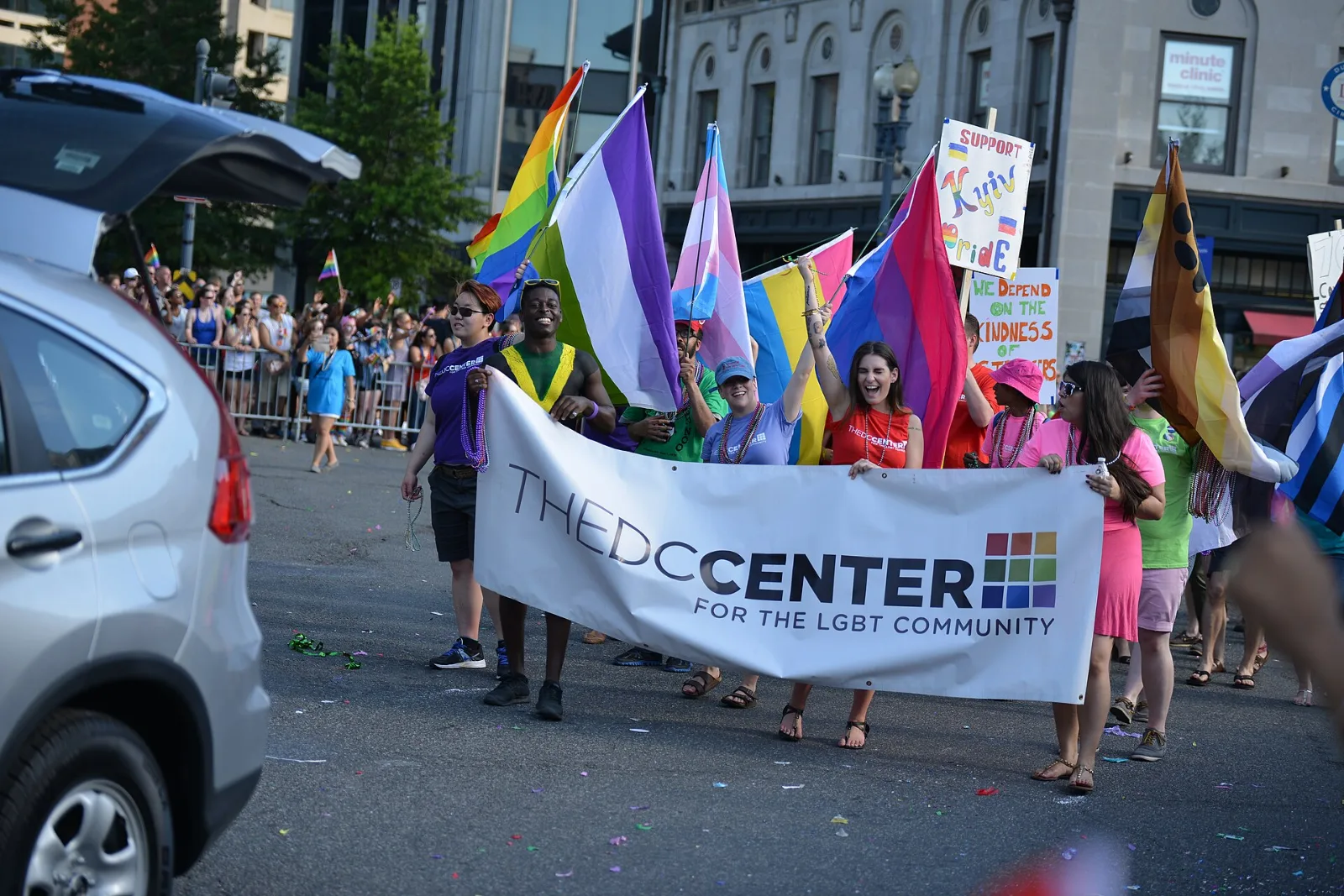
- Capital Pride Parade, Washington DC, 11 June 2016. The Genderqueer flag is carried among bisexual, pansexual, bear and nonbinary flags. Photographed by S Pakhrin. [3] · Credit: S Pakhrin, CC BY 2.0 · Wikimedia Commons
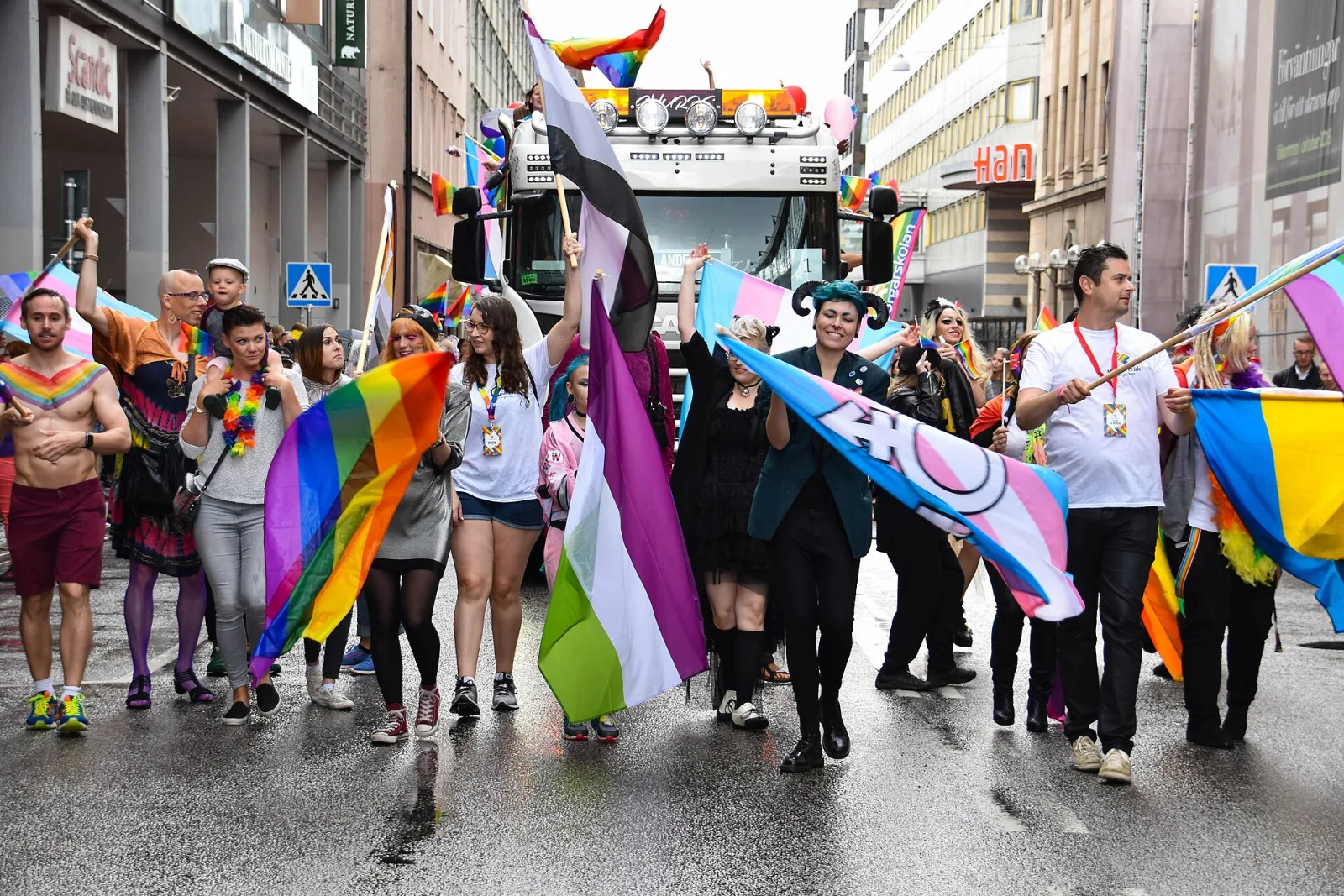
- Malmö Pride, 6 August 2016. The Genderqueer flag is carried at the centre of the frame, among transgender, asexual and pansexual flags. Photographed by Maria Eklind. [3] · Credit: Maria Eklind, CC BY-SA 2.0 · Wikimedia Commons
- WorldPride, Madrid, 1 July 2017, with the Asociación WADO LGTBI+ Castilla-La Mancha. The Genderqueer flag is carried among bisexual, transgender and pansexual flags. Photographed by Barcex. [3] · Credit: Barcex, CC BY-SA 3.0 · Wikimedia Commons
- Amsterdam Pride Walk, 29 July 2017, as IranPride entered the Vondelpark. The Genderqueer flag is carried among transgender and intersex flags. Photographed by JoopeA. [3] · Credit: JoopeA, CC BY-SA 4.0 · Wikimedia Commons
- Copenhagen Pride, Frederiksberg Allé, 19 August 2017. The Genderqueer flag is carried among bisexual, transgender, bear, rubber, asexual and pansexual flags. Photographed by Leif Jørgensen. [3] · Credit: Leif Jørgensen, CC BY-SA 4.0 · Wikimedia Commons