Diamoric Pride Flag
Identity Pride Flag ·
Created on June 26, 2016 by Milith Rusignuolo, later credited by Pride-Flags as Auriga La Fresne or Auri, the Diamoric Pride Flag represents nonbinary-centered attraction and relationships. [1][2] Its mint-white-mint field follows the Sapphic and Achillean flag convention and carries a purple-and-yellow myrtle emblem separately credited by Pride-Flags to snoodspirit. [2][3]

Key facts
- Designer
- Milith Rusignuolo
- Created
- Creation date given by the creator's own page
- In use
- 2016 to present
- Aspect Ratio
- 3:5 · standard
- Stripes
- 3
- Represented Identity
- diamoric
Also known as
- Diamoric Flag
- Dionysian (original term, pre-July 2016)
Archive categories Sexual & Romantic Orientation Pride Flags
Overview
To give the nonbinary equivalent of Sapphic and Achillean a flag, following the discussion that produced the term. [1]
The flag was made on 26 June 2016, after a discussion about what to call the nonbinary equivalent to Sapphic and Achillean. The creator's archived page records both the date and the process: "We debated over the shade of green until we decided on the minty shade." [1] Pride-Flags published an archival rendition on 11 September 2016. [2]
Identity & Context
- Represented Identity
- diamoric
- Subcommunity
- nonbinary attraction and relationships
Pride-Flags gives the etymology and definition: from the Greek prefix "dia-", meaning "passing through", "going apart", and "thoroughly/completely", and the Latin "amor" for love. Diamoric is "an intentionally flexible, loose term that describes a personal identity or a relationship (sexual, romantic, platonic etc.) that is neither 'straight' nor 'gay' due to the presence of one or more non-binary people". [2]
Creators
The Creators
Milith Rusignuolo
Designer of the flag
Self-identified creator of the Diamoric Pride Flag on their own archived flags page, which is headed as a list of flags created and proposed by them and dates this flag to 26 June 2016. Pride-Flags credits the same page under the name Auriga La Fresne, and pride-color-schemes shortens that to Auri. [1][2][4]
snoodspirit
Designer of the myrtle emblem
Credited by Pride-Flags on the separate Diamoric Myrtle Flower deviation: "Designed by: snoodspirit", linking to their Tumblr post proposing a cypric or adonic flag. The credit covers the emblem, not the whole flag. [3]
Marlowe Lune
Term development and coordination
Developed the concept and definition, coordinated the discussion that replaced Dionysian, ran the Appellic versus Diamoric poll, and announced the result. Not recorded as a designer of the flag. [5][6][7]
Jae
Proposed the original Dionysian wording
Then posting as jesse-mcree, proposed the word Dionysian in a reply to Marlowe Lune's 13 June 2016 discussion. Not recorded as a designer of the flag. [5]
Attribution notes
The surviving first-person source is an archived personal page headed as a list of flags "created and proposed by me, Milith Rusignuolo", whose Diamoric section states: "This flag was created on June 26, 2016, after the debate about what to call the non-binary equivalent to Sapphic and Achillean. We debated over the shade of green until we decided on the minty shade." [1] Pride-Flags credits the flag to "Auriga La Fresne" and links that credit to the same personal page; a later Tumblr archive shortens it to "Auri". [2][4] The evidence suggests a name change or alternate name rather than two designers, but the archive cannot verify the identity relationship beyond the shared source URL. The myrtle emblem is credited separately by Pride-Flags to snoodspirit. [3]
Origin
- Digital Origin
- Yes
Digital origin; no verified physical location.
Digital origin, on Tumblr and a personal site. No physical origin is documented and none is recorded. [1]
Dates & Chronology
- Year Created
- Exact date
- Creation date given by the creator's own page
- Period in Use
- 2016 to present
Documented across community reference resources and commercial reproductions. The creator's page records that the mint version was selected after discussion, which supports calling it the principal documented version; no institutional adoption has been located. [1][2][4]
Terminology and flag have separate chronologies. On 13 June 2016 the Tumblr user jesse-mcree, now Jae, proposed the word Dionysian in a reply to Marlowe Lune's discussion of a nonbinary counterpart to Sapphic and Achillean. [5] Marlowe Lune developed the concept and definition, coordinated the replacement process and ran a poll between Appellic and Diamoric. [6] Diamoric was announced as the selected term on 14 July 2016. [7] The flag itself dates from 26 June 2016, between the proposal and the poll. [1] Pride-Flags published its archival rendition and the standalone myrtle one second apart on 11 September 2016. [2][3]
Lineage
- Related flags
- Achillean Flag (Original, 2016), Nonbinary Pride Flag, Sapphic Flag
The white band is a documented design influence: Pride-Flags publishes the white stripe as "following the pattern of the Sapphic and Achillean flags", and the creator's own page describes the flag as the nonbinary equivalent to Sapphic and Achillean. [2][1] That is a stated convention rather than descent from either flag, and the three are not recorded as siblings merely because they are discussed as a trio.
Colors & Symbolism
Pride-Flags publishes the flag's meanings: "Green: non-binary. White: following the pattern of the Sapphic and Achillean flags. Myrtle: the flower sacred to Aphrodit(e/us) and Adonis, whose relationship may be said to be diamoric." [2]
| Colour | Hex | Meaning |
|---|---|---|
| Mint | #91F291 | Nonbinary, in the meanings published with the flag. [2] |
| White | #FFFFFF | Following the pattern of the Sapphic and Achillean flags. [2] |
| Mint | #91F291 | Nonbinary, in the meanings published with the flag. [2] |
| Wine purple | #66023C | — |
| Yellow | #FFFF00 | — |
These hexadecimal values are exact measurements from the cited 5000 by 3000 source PNG. They document that artifact rather than a creator-issued color specification. [8]
These meanings are published on the Pride-Flags deviation rather than inferred. The creator's own page adds that the shade of green was settled by discussion: "We debated over the shade of green until we decided on the minty shade." [1]
Four values. Sampling the 5000 by 3000 source PNG across a grid finds mint, white, the myrtle's wine purple and the star's yellow, and nothing else beyond anti-aliasing. [8]
Design
- Aspect Ratio
- 3:5 · standard
- Orientation
- horizontal
- Stripe Count
- 3
- Layout
- horizontal_stripes
- Stripes (Top → Bottom)
- Mint, White, Mint
- Center Symbol
- Stylized myrtle
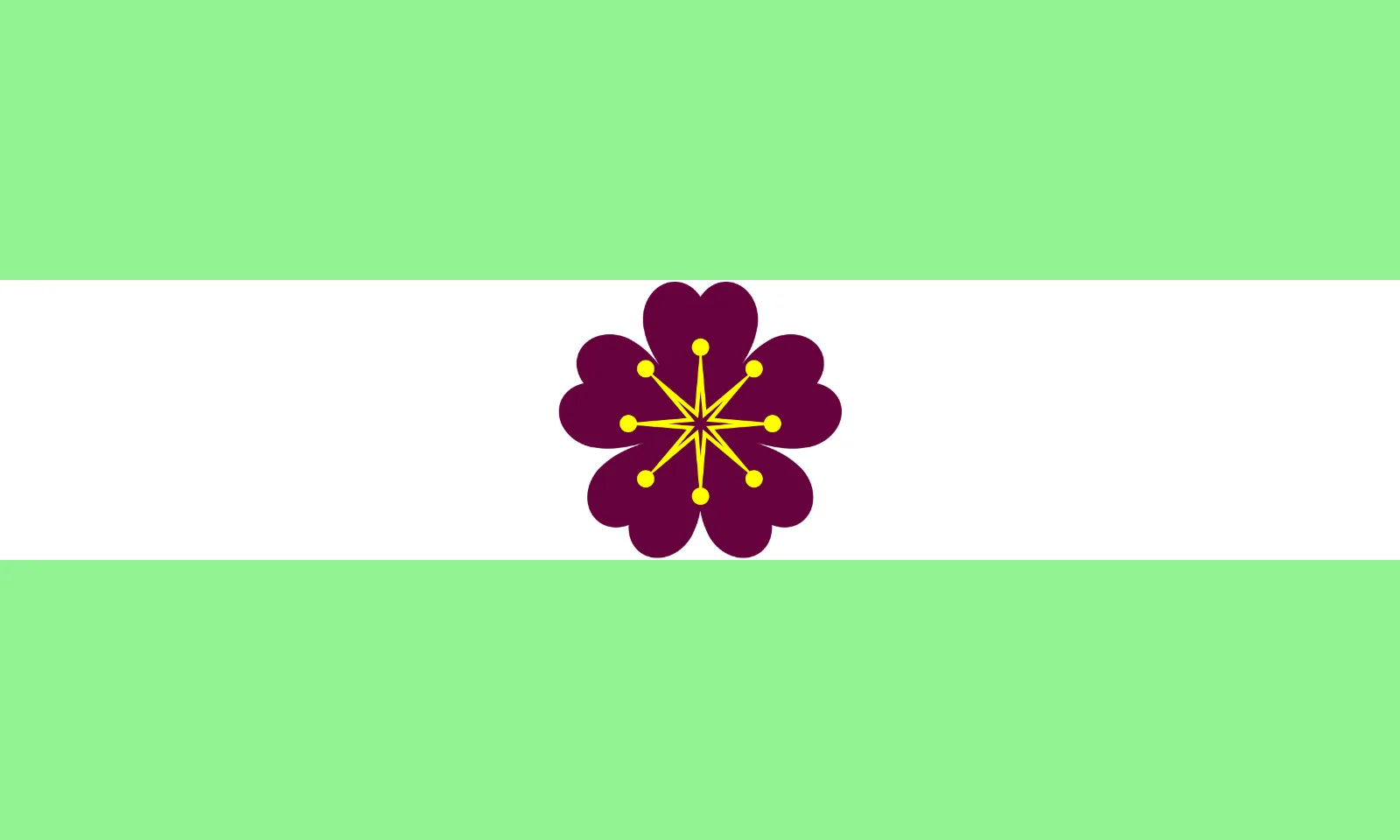
Three equal horizontal bands of 1000 rows each in the 5000 by 3000 source file. The myrtle occupies x 1995 to 3006 and y 1008 to 1992, centred on the white band and overlapping both mint bands. The display reconstruction is normalised to 3:5 at 800 by 480 with both emblem colours traced from the source raster. [8]
Three equal bands with a centred stylized myrtle in wine purple, over which sits a yellow eight-pointed star outline with terminal circles. [8]
Three equal horizontal bands of mint, white and mint, with a centred stylized myrtle in wine purple carrying a yellow eight-pointed star and terminal circles. [8]
Usage & Adoption
- Online Usage
- Tumblr, where the term and flag were discussed and announced [5][7], DeviantArt, through the 2016 Pride-Flags archival publication [2], Community reference resources and commercial reproductions
- Current Status
- principal documented version
Documented across community reference resources and commercial reproductions. No institutional adoption has been located. [2][4]
Image Archive
Historical Rendition
Separately Published Emblem


Archive Reconstruction
Discourse & Debates
Common misidentifications
- Pride-Flags credits the flag to Auriga La Fresne while the linked personal page is written in the first person by Milith Rusignuolo, and a later Tumblr archive shortens the credit to Auri. These are one creator page under more than one name rather than competing designers. [2][1][4]
- The standalone myrtle deviation is not simply the flag's emblem extracted: it inverts the composition, showing the flower as negative space in a wine panel. [3][8]
Dionysian was the wording used before July 2016 and is kept as the original term. Appellic was the competing proposal in the poll rather than an established name. Adonian, Adonic, Cypric and Philenbic appear in the surrounding discussion as proposed alternatives; no source located here documents them in actual use as names for this identity or flag, so they are recorded as proposals rather than aliases. [5][6][7][3]
Footnotes & Citations
Sources and footnotes 8 sources
- 1. Archived Sources Flags I've created. Milith Rusignuolo. avia-viridis.neocities.org, via the Internet Archive. Accessed 2026-08-16
The surviving first-person source. Headed as flags created and proposed by Milith Rusignuolo; its Diamoric section gives the creation date as 26 June 2016 and records the debate over the shade of green.
- 2. Image file page Diamoric. Published by Pride-Flags. DeviantArt (2016-09-11). Accessed 2026-08-16 · Archived version
The archival rendition, 5000 by 3000, timestamped 02:32:48 UTC. Publishes the etymology, definition and colour meanings, credits "Designed by: Auriga La Fresne" with a link to the creator's personal flags page, and displays Creative Commons Attribution 3.0.
- 3. Image file page Diamoric Myrtle Flower. Published by Pride-Flags; emblem designed by snoodspirit. DeviantArt (2016-09-11). Accessed 2026-08-16 · Archived version
The standalone emblem, 1012 by 988, timestamped 02:32:47 UTC. Credits "Designed by: snoodspirit" with a link to their Tumblr post, and displays no Creative Commons licence.
- 4. Social media Diamoric. pride-color-schemes. Tumblr. Accessed 2026-08-16
A later archive post that shortens the designer credit to Auri.
- 5. Archived Sources Original Dionysian discussion post. Marlowe Lune, with a reply from jesse-mcree. Tumblr, via the Internet Archive (2016-06-13). Accessed 2026-08-16
The 13 June 2016 exchange in which the Dionysian wording is proposed in reply to Marlowe Lune's discussion.
- 6. Archived Sources Non-binary Love: An Update and a Poll. Marlowe Lune. Tumblr, via the Internet Archive. Accessed 2026-08-16
The poll that put Appellic against Diamoric.
- 7. Archived Sources Diamoric Love. Marlowe Lune. Tumblr, via the Internet Archive (2016-07-14). Accessed 2026-08-16
The poll result and the definition of the selected term.
- 8. Image file page Source PNG behind the 2016 archival rendition, 5000 by 3000. Published by Pride-Flags. DeviantArt (2016-09-11). Accessed 2026-08-16 · Archived version
The downloaded file, measured for this entry: 180,684 bytes, three bands of 1000 rows, four flat colours, and the myrtle occupying x 1995-3006 and y 1008-1992. Both emblem outlines in the reconstruction are traced from it.
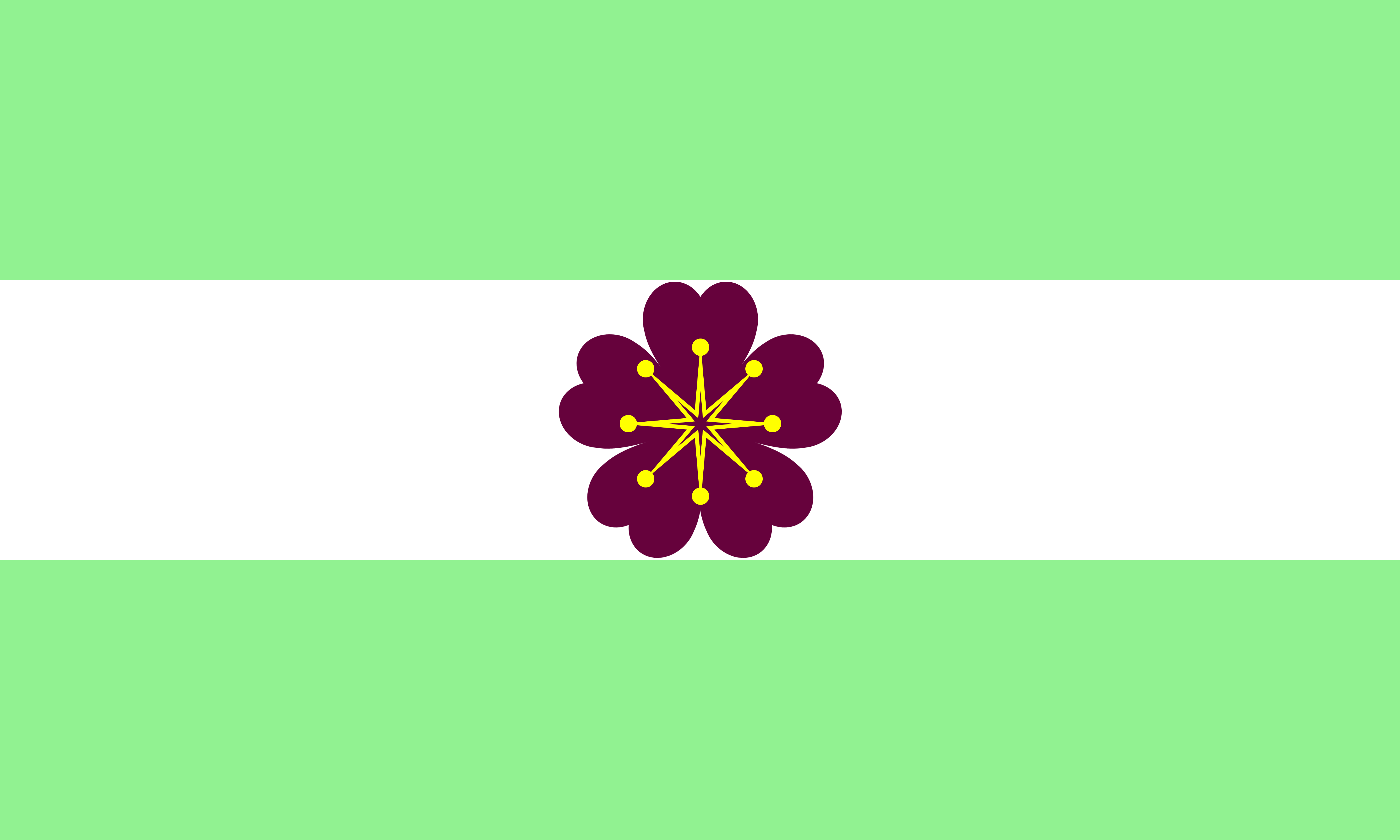
Image Sources
- Rendering
- the mint version selected after discussion, created 26 June 2016
- Encycloflaggia reconstruction of the complete Diamoric Pride Flag · Credit: Flag by Milith Rusignuolo; myrtle by snoodspirit; reconstruction by Encycloflaggia · Encycloflaggia · reconstructionRights Archive-produced reconstruction; bands and emblem traced from the 2016 source PNG
- The 5000 by 3000 file published by Pride-Flags on 11 September 2016 · Credit: Published by Pride-Flags; flag by Milith Rusignuolo, credited there as Auriga La Fresne · DeviantArt · verifiedRights Creative Commons Attribution 3.0, as displayed on the deviation
- The complete historical rendition: 5000 by 3000 pixels, published by Pride-Flags on 11 September 2016, crediting the flag to Auriga La Fresne with a link to the creator's personal flags page. [2][8] · Credit: Published by Pride-Flags; flag by Milith Rusignuolo, credited there as Auriga La Fresne · DeviantArt · Creative Commons Attribution 3.0, as displayed on the deviation
- "Diamoric Myrtle Flower", the standalone emblem deviation published the same minute, 1012 by 988 pixels and credited to snoodspirit. It is composed differently from the flag: the myrtle reads as negative space in a wine panel rather than a wine flower on white. It displays no Creative Commons licence. [3] · Credit: Published by Pride-Flags; emblem designed by snoodspirit · DeviantArt · No Creative Commons licence displayed
- The archive's existing copy of the standalone emblem, retained as a separate artifact. [3] · Credit: Published by Pride-Flags; emblem designed by snoodspirit · DeviantArt · No Creative Commons licence displayed
- The archive's reconstruction, normalised to 3:5, with the myrtle and star outlines traced from the source raster rather than approximated. [8] · Credit: Flag by Milith Rusignuolo; myrtle by snoodspirit; reconstruction by Encycloflaggia · Encycloflaggia reconstruction · Archive-produced reconstruction, subject to the rights status of the underlying design