Trigender Pride Flag
Multigender Pride Flag ·
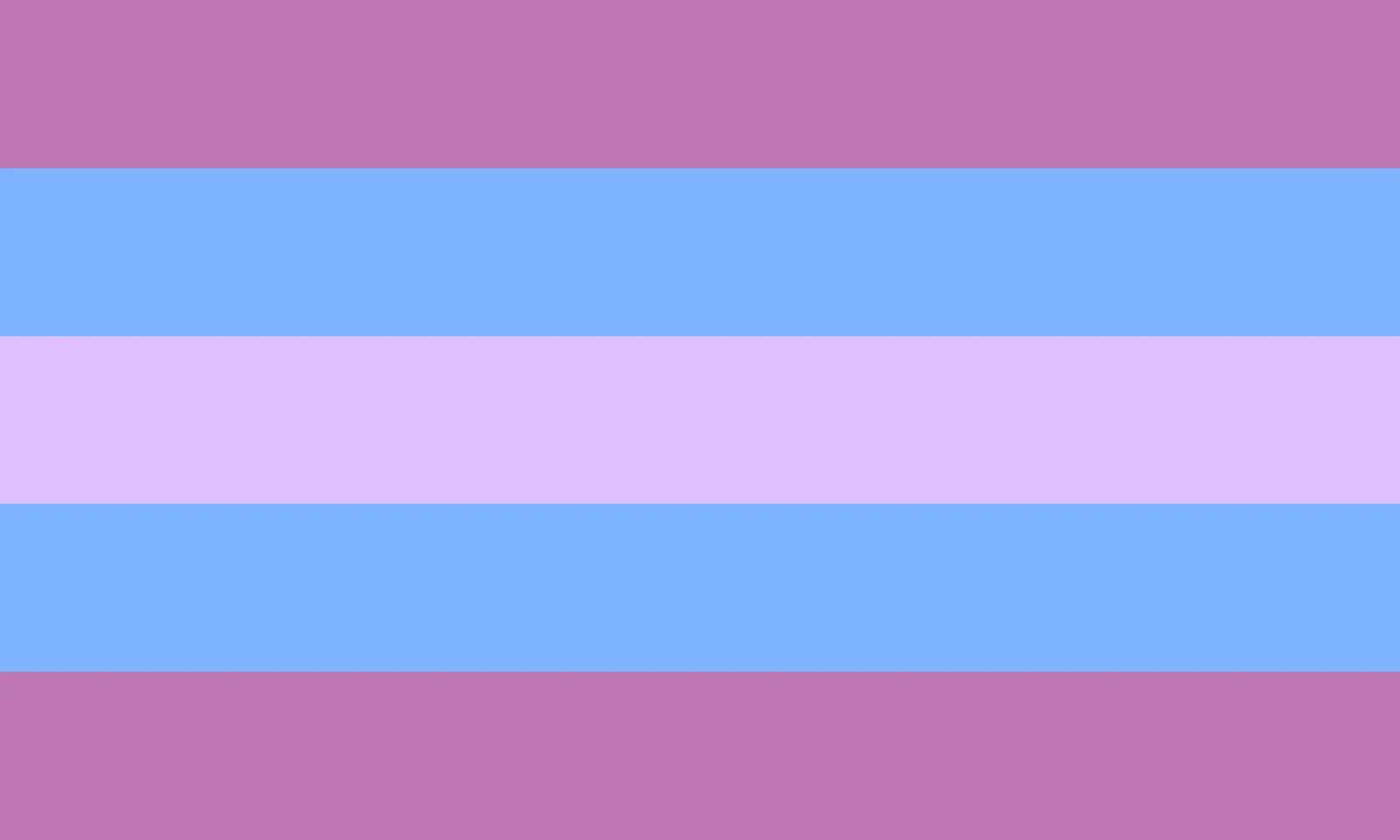
A five-band mirrored flag for a person who experiences three gender identities. At least three materially different designs circulate under the name, and this entry leads with the earliest that can be inspected: the Pride-Flags rendering of 23 August 2015, five mirrored bands of muted purple, light blue and pale lavender, with no green in it. [1] Its source credit points to a pride-flags-for-us post titled "another trigender flag i made", which has not been recovered, so the designer is attributed rather than established. [1] The widely reproduced green-centred version is a later community rendering, and Pride-Flags replaced its own file again in 2021 with a seven-band design. [2][3]
Key facts
- Designer
- pride-flags-for-us (Tumblr blog), attributed
- Created
- First documented public use
- In use
- 2014–present
- Aspect Ratio
- 3:5 · standard
- Ratio Notes
- The 2015 source file is 5000 by 3000, which reduces to exactly 5:3, so the production ratio shown here matches the artifact rather than merely defaulting to it. [1]
- Stripes
- 5
- Represented Identity
- trigender
Also known as
- Trigender Flag
Archive categories Gender Identity Pride Flags
Overview
To represent trigender identity with a dedicated flag at a time when the broader multigender community (including bigender and pangender identities) was producing its own flag designs on Tumblr and DeviantArt. [2][4]
The earliest documented appearance is an 11 October 2014 post by the Tumblr blog pride-flags-for-us, described as a softer-coloured revision of an earlier trigender flag, which implies a prior version by the same blog. [4] Pride-Flags republished a trigender flag on DeviantArt on 23 August 2015, crediting a pride-flags-for-us post titled "another trigender flag i made" as its source. [1] The term itself long predates the flag: it was in use by at least 1998 to 1999, initially in reference to Two-Spirit, the traditional third-gender concept in some Native American cultures, before taking on its current meaning. [5] It received academic recognition in the 2013 text Sexuality and Gender for Mental Health Professionals: A Practical Guide. [5]
Identity & Context
- Represented Identity
- trigender
- Subcommunity
- multigender umbrella
Creators
The Creator
pride-flags-for-us
Designer, attributed through the source credit on the earliest located republication
pride-flags-for-us was a Tumblr blog that made and collected pride flag designs during 2014 and 2015, and is the source Pride-Flags credits for the trigender flag. [1] It is the same blog credited elsewhere in this archive for the demifluid submission of February 2015. The blog still exists under the same handle but no longer carries its flag posts. Nothing about the person or people behind it is documented.
Attribution notes
Pride-Flags, a DeviantArt account that republishes community designs and credits their makers, gives the flag's source as a post by the Tumblr blog pride-flags-for-us titled "another trigender flag i made". [1] The title states authorship and the word "another" places it after an earlier trigender flag by the same blog. The post is no longer readable: the blog survives but now runs as a fan blog and the post returns nothing, so the body text, any stated meanings and the original image have not been recovered. [1] Earlier versions of this entry recorded the designer as unknown.
Origin
- Digital Origin
- Tumblr (pride-flags-for-us, earliest documented posting)
Digital origin; no verified physical location.
The earliest documented appearance is an 11 October 2014 Tumblr post by pride-flags-for-us, described as a softer-coloured version of a prior trigender flag. [4] Pride-Flags credits the same blog as the source of the flag it republished in August 2015. [1]
Dates & Chronology
- Year Created
- First public use
- Period in Use
- 2014–present
The flag circulated through Tumblr, DeviantArt, and eventually pride-flag reference sites and community wikis. [2][4] It remains the most commonly referenced trigender flag design, though its institutional adoption has been limited compared to more widely recognized identity flags. Several alternative trigender flag designs have been proposed: Tumblr user aroaesflags posted an alternate on May 26, 2020 based on a submission from a user who found the standard flag unsatisfying; Trigenderiscool created a version on March 19, 2021; and Tumblr user pride-color-schemes proposed a redesign using pink, blue, and purple stripes specifically because the existing flag's color scheme was seen as reducing trigender identity to a simple 'male + female + other' triad. [4][5] The 2021 Pride-Flags description also names an "Alternative trigender flag by Lovenderr". [3]
Major revisions
The flag follows the same five-stripe mirrored structure (A-B-C-B-A) as the transgender pride flag designed by Monica Helms in 1999: both are palindromic designs that read the same regardless of orientation. [2][4] Whether this structural similarity reflects conscious borrowing or convergent design convention is not documented. The trigender flag sits within a cluster of multigender flags that emerged on Tumblr between 2014 and 2015, including the bigender flag (2014) and the pangender flag (January 2015). These flags share a common context of online community self-representation but have separate designers and independent design histories. Trigender falls under the multigender umbrella, which includes bigender (two genders), trigender (three), quadgender (four), polygender (many but not all), and pangender (all genders). In the 2015 U.S. Transgender Survey, approximately 4% of non-cisgender respondents identified as multigender. [5]
The year recorded here is the year of the earliest documented appearance, 11 October 2014, not a date of design. The post carrying it describes the flag as a softer-coloured revision of an earlier trigender flag, so a prior version existed and has not been located. [4]
Lineage
- Indirect influences
- Rainbow Pride Flag, Transgender Pride Flag
Part of the broader multigender cluster alongside bigender and pangender flags. The five-stripe mirrored structure echoes the transgender pride flag, though no direct authorship or derivation relationship has been documented. [2] [4] The shared palindromic layout may reflect a common design convention rather than direct influence.
Colors & Symbolism
No maker-authored meanings have been recovered for the bands of the 2015 rendering shown here. [1] The mirrored structure means the flag reads the same from either direction, which is a property of the design rather than a documented statement of intent. The pink, blue-violet and green readings that circulate belong to the later Library.LGBT rendering and are described below as that rendering’s meaning system. [2]
| Colour | Hex |
|---|---|
| Muted purple | #BF77B3 |
| Light blue | #7EB3FF |
| Pale lavender | #E0C0FF |
| Light blue | #7EB3FF |
| Muted purple | #BF77B3 |
Measured from the Pride-Flags rendering of 23 August 2015, 5000 by 3000, the earliest inspectable file tied to a credited source post. [1]
This flag has no official digital palette. Color values shown are approximate.
The meanings usually quoted for this flag are attached to a different rendering from the one shown. Library.LGBT publishes a five-band version with a green centre, roughly #FF95C4, #9581FE and #67D965, and a meaning system reading the bands as femininity, masculinity and a third or other gender; the green centre is described variously as androgyny, nonbinary identity or a third gender category. [2][4] No source read for this entry traces any of those readings to the maker of the 2015 file, which has no green in it at all. They are recorded here as a later community meaning system rather than as the design’s stated symbolism. [1][2]
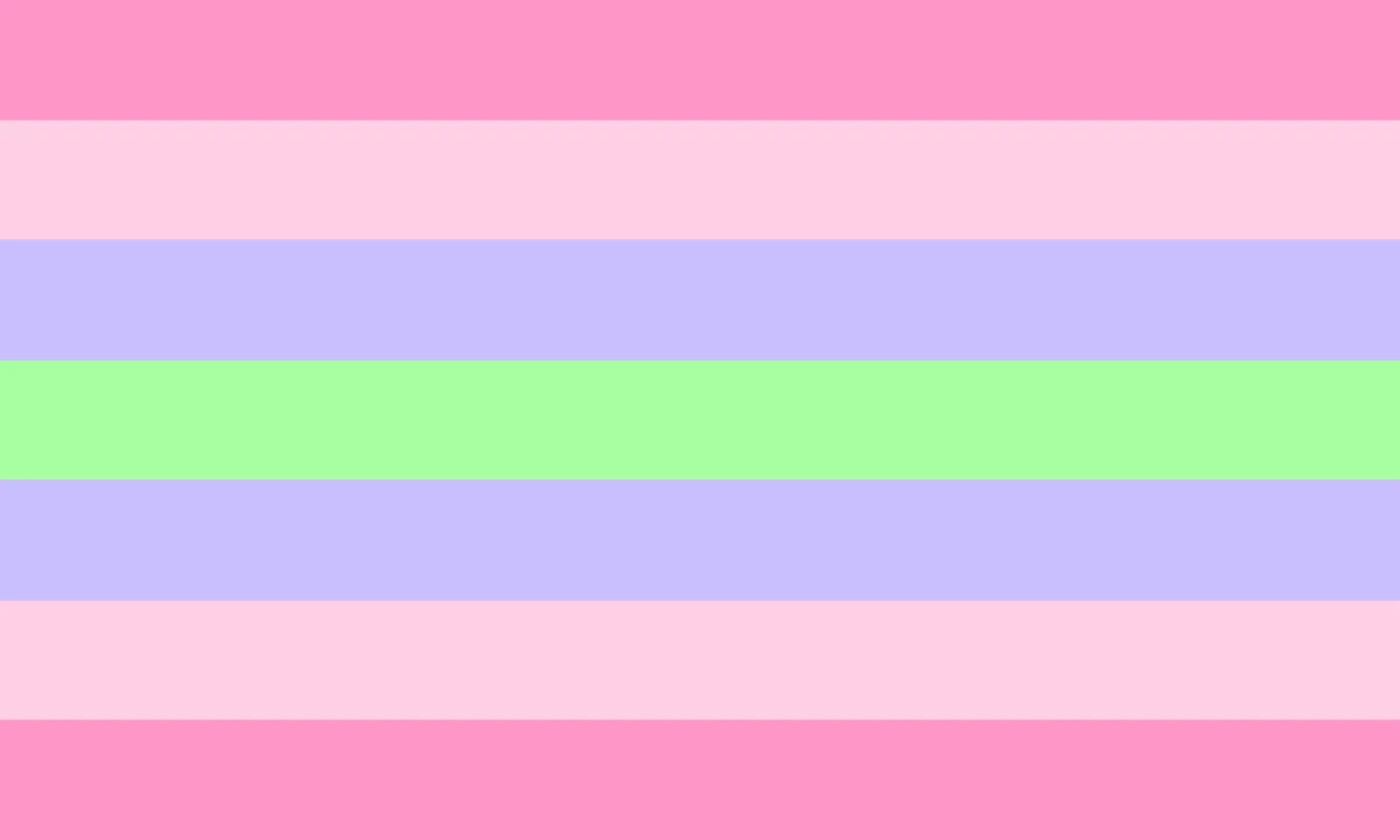
At least three materially different flags circulate under this name and this entry leads with the earliest that can be inspected. The values here are measured from the Pride-Flags rendering of 23 August 2015: five mirrored bands, muted purple and light blue around a pale lavender centre, with no green anywhere in it. [1] A later community rendering published by Library.LGBT uses roughly #FF95C4, #9581FE and #67D965 and puts a green band at the centre; earlier versions of this entry published those values as though they were the original. [2] Pride-Flags then replaced its own file on 22 March 2021 with a seven-band design in #FF96C6, #FFD0E5, #CABFFF and #A7FFA1. [3] The three are archived separately and none of them carries maker-authored colour meanings.
Design
- Aspect Ratio
- 3:5 · standard
- Ratio Notes
- The 2015 source file is 5000 by 3000, which reduces to exactly 5:3, so the production ratio shown here matches the artifact rather than merely defaulting to it. [1]
- Orientation
- horizontal
- Stripe Count
- 5
- Layout
- horizontal_stripes
- Stripes (Top → Bottom)
- Muted purple, Light blue, Pale lavender, Light blue, Muted purple
Five mirrored horizontal bands of equal depth, measured at about 600 rows each in the 3000-row source file. [1]
Five equal horizontal bands in a mirrored pattern: muted purple, light blue, pale lavender, light blue, muted purple, top to bottom. No emblem or additional symbols. The flag reads the same regardless of orientation. [1]
Five horizontal bands of equal depth, mirrored about the centre: muted purple, light blue, pale lavender, light blue, muted purple. Three colours across five bands, measured from the 5000 by 3000 source file. [1] Two other designs circulate under this name: a five-band version with a green centre published by Library.LGBT, and a seven-band version published by Pride-Flags in 2021. [2][3]
Usage & Adoption
- First Users
- Online multigender and gender-diverse communities
- Geographic Usage
- Internet circulation
- Online Usage
- Circulated through Tumblr, DeviantArt, and pride-flag reference guides, Pride flag reference databases, LGBTQIA+ identity wikis
- Current Status
- documented online circulation; multiple competing renderings
Image Archive
Earliest inspectable sourced reproduction
Later variant
Discourse & Debates
- Several alternate trigender flag designs have been proposed, including versions by Tumblr users aroaesflags and Trigenderiscool, among others. The absence of a known original creator contributes to the proliferation of alternatives.
Criticisms
- The flag has been criticized for implying a narrow interpretation of trigender identity as simply 'boy, girl, and other,' with the color symbolism seen as reductive.
Trigender is distinct from bigender (two genders) and pangender (all genders). The three genders experienced by trigender people are not necessarily male, female, and a third; they may include any combination of gender identities. The flag's pink-violet-green color scheme implies a male-female-other triad, which some community members have noted may not reflect all trigender experiences. [4]
Footnotes & Citations
Sources and footnotes 6 sources
- 1. Designer page Trigender (3). Pride-Flags. DeviantArt (2015-08-23). Accessed 2026-08-16
Republication crediting its source as a pride-flags-for-us post titled "another trigender flag i made". Its 5000 by 3000 file has five mirrored bands measuring #BF77B3, #7EB3FF and #E0C0FF, with no green.
- 2. Trigender. Library.LGBT Pride Flag Guide. Accessed 2026-03-10
- 3. Designer page Trigender (3), 2021 replacement. Pride-Flags. DeviantArt (2021-03-22). Accessed 2026-08-16
The same account's later trigender rendering: seven mirrored bands measuring #FF96C6, #FFD0E5, #CABFFF and #A7FFA1. Its description names an alternative trigender flag by Lovenderr.
- 4. Trigender. LGBTQIA+ Wiki. Accessed 2026-03-10
- 5. Trigender. Nonbinary Wiki. Accessed 2026-03-12
- Trigender Pride Flag. SexualDiversity.org. Accessed 2026-03-30
Image Sources
- Rendering
- Pride-Flags rendering of 23 August 2015, the earliest inspectable sourced reproduction
- The five-stripe design as documented, drawn for this entry. The original designer has not been identified. [2] · Credit: Rendering by Pride-Flags (DeviantArt), 23 August 2015; the designer of the underlying flag is attributed to pride-flags-for-us through that page’s source credit and is not otherwise identified. · Encycloflaggia renderingRights The rendering held here is drawn by this archive from the documented colours and stripe order. It is not the designer's file, and no designer file has been located.
- The earliest inspectable file tied to a credited source post, published by Pride-Flags on 23 August 2015 at 5000 by 3000. Its source credit points to a pride-flags-for-us Tumblr post titled "another trigender flag i made"; that post’s body and image have not been recovered. Five mirrored bands, no green. [1] · Credit: Rendering by Pride-Flags (DeviantArt); design attributed to pride-flags-for-us through the credited source title. · DeviantArtRights The deviation states no licence. Rights in the underlying design are unresolved and separate from rights in this file.
- A materially different seven-band design published by Pride-Flags on 22 March 2021 as a replacement for its own 2015 file, at 5000 by 3000. It adds a pale green centre and two extra bands, and is a later variant rather than a redraw of the 2015 flag. [3] · Credit: Rendering by Pride-Flags (DeviantArt). · DeviantArtRights The deviation carries a Creative Commons Attribution licence for this file. That covers the file, not the underlying design.