Agender Pride Flag
Identity Pride Flag ·
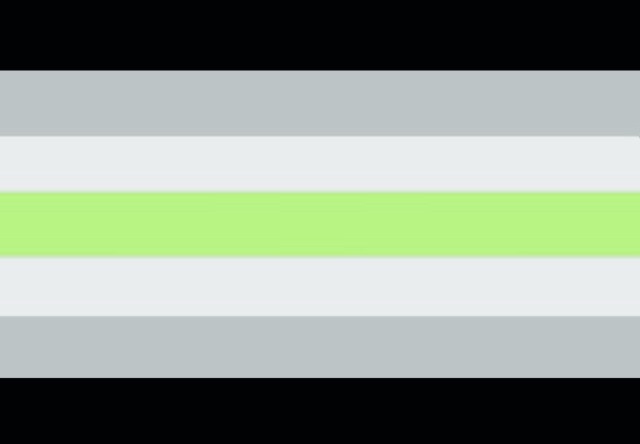
Seven symmetrical stripes, black through grey and near-white to a green centre, made by Salem to give genderless people a flag. Salem posted a darker proposal on 18 February 2014, marked it out of date, and published the confirmed pastel version the next day. [1][2] They named the transgender flag as the primary influence, "a similar stripe pattern and symmetry", and explained the green as an inversion of the purple on the genderqueer and nonbinary flags: agender, in their account, does not fall between male and female at all. [3] Their surviving statement gives permission plainly: "please use the flag how you see fit". [4]
Key facts
- Designer
- Salem
- Created
- Final version published
- In circulation
- 2014 to present
- Aspect Ratio
- 160:111 in the final source image
- Stripes
- 7
- Represented Identity
- agender people
Also known as
- Agender Flag
- Agender/Genderless Flag
- Genderless Flag
Status Canonical
Archive categories Gender Identity Pride Flags
Overview
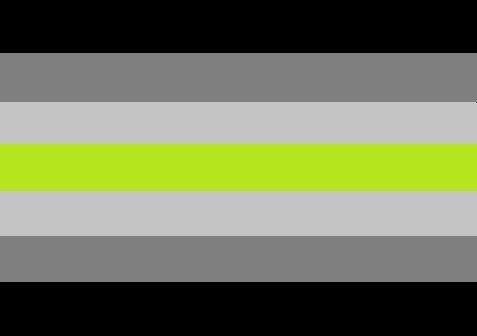
Salem made the flag in February 2014, during what they described as a "huge influx of identities, pronouns, and other means of personalizing one’s identity" on Tumblr, as an effort to give genderless people visibility. [3] A darker proposal came first, on 18 February; Salem marked it out of date and published the confirmed pastel version on 19 February. [2][1]
Identity & Context
- Represented Identity
- agender people
Agender describes people who do not identify with or experience a gender. Some agender people also use terms such as genderless, while individual relationships to nonbinary and transgender umbrellas vary. The University of British Columbia’s guide puts it that agender people "can exist outside of the gender binary, be gender non-conforming, and/or identify as trans". [5]
Creators
The Creator
Salem
Designer
Salem is an artist from Staten Island, New York, who made the agender flag in February 2014, in the same period as their demiboy and demigirl designs, posting as transrants. Tumblr in 2014, they said, "was seeing a huge influx of identities, pronouns, and other means of personalizing one’s identity... I figured if there was a time to come up with a flag for genderless people, this was it!" [3]
They created the flag at what they describe as the lowest point in their life, living far from home in an abusive relationship, and have framed it as reclamation: "My identity as a survivor is inextricably attached to the creation of this flag, and it is a product of an attempt to reclaim myself and my identity. I’m so glad it has been a source of strength and pride for so many people." [3]
The flag’s spread was at first "a little overwhelming", they said, because it circulated without attribution; they came to expect that, and later wondered whether they would choose the same colours again. [3] In January 2019 they emptied the blog and left one statement, affirming authorship, noting that their thinking had changed since leaving Tumblr, and describing agender, in their later personal view, as "a sort of gender atheism, or lack of belief in gender". That is Salem’s own later reflection, not a general definition. The statement ends with permission: "please use the flag how you see fit". [4]
Attribution notes
Salem, who posted under the handle transrants and has also been known as Ska and Salem X, is the documented creator, in a 2018 interview and in the statement that opens "my name is salem and i created the agender flag." [3][4] The 2018 interview records they/she pronouns as of that interview. [3] The Commons vector credits a fuller name; this record follows the name Salem uses in their own current statement. [6][4]
Origin
- Digital Origin
- Yes
Digital. Both stages were posted to Salem’s Tumblr. [1][2] The physical place of design is unknown: Salem is from Staten Island, New York, and has lived across the city’s boroughs, but they have said that when the flag was created they were living very far from home, and no source says where. [3] New York belongs to the creator’s biography, not to the flag’s origin. Later displays in Tel Aviv, Sydney and Iowa City are usage, not origin.
Dates & Chronology
- Year Created
- Exact date
- Final version published
- In circulation
- 2014 to present
- Creation Bounds
- The design went through two stages a day apart. Salem posted an Agender/Genderless proposal on 18 February 2014, the date the 2018 interviewer gives for the flag’s creation, and then marked that post out of date. [3][2] The confirmed pastel version, the flag as it circulates, was published on 19 February 2014; Salem’s post calls it "a more pastel version" and identifies it as final. [1] That 19 February date is carried independently by the Wikimedia Commons derivative that cites the post. [7] 18 February is the reported creation and proposal stage, not the publication date of the final artwork.
.jpg)
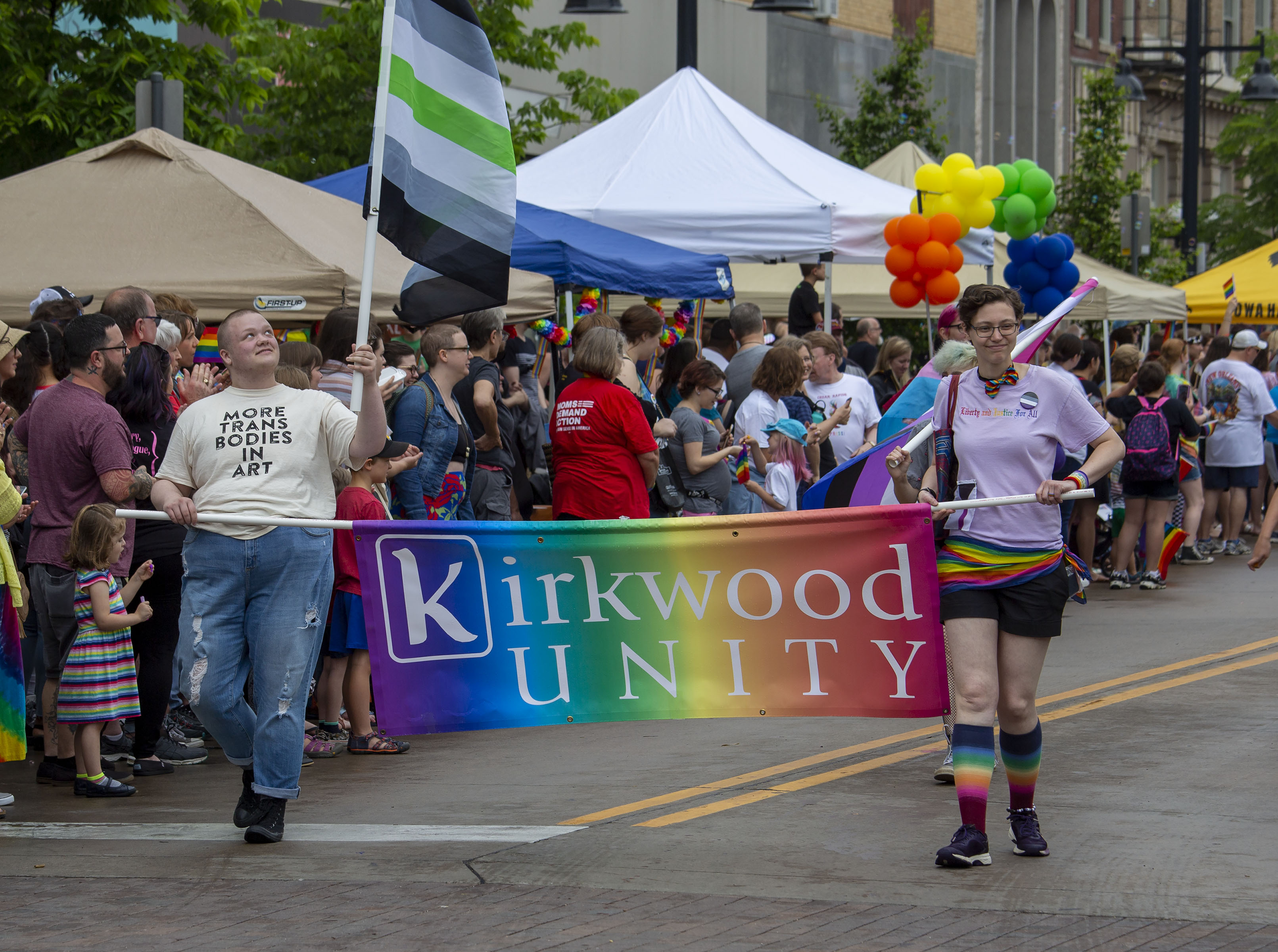
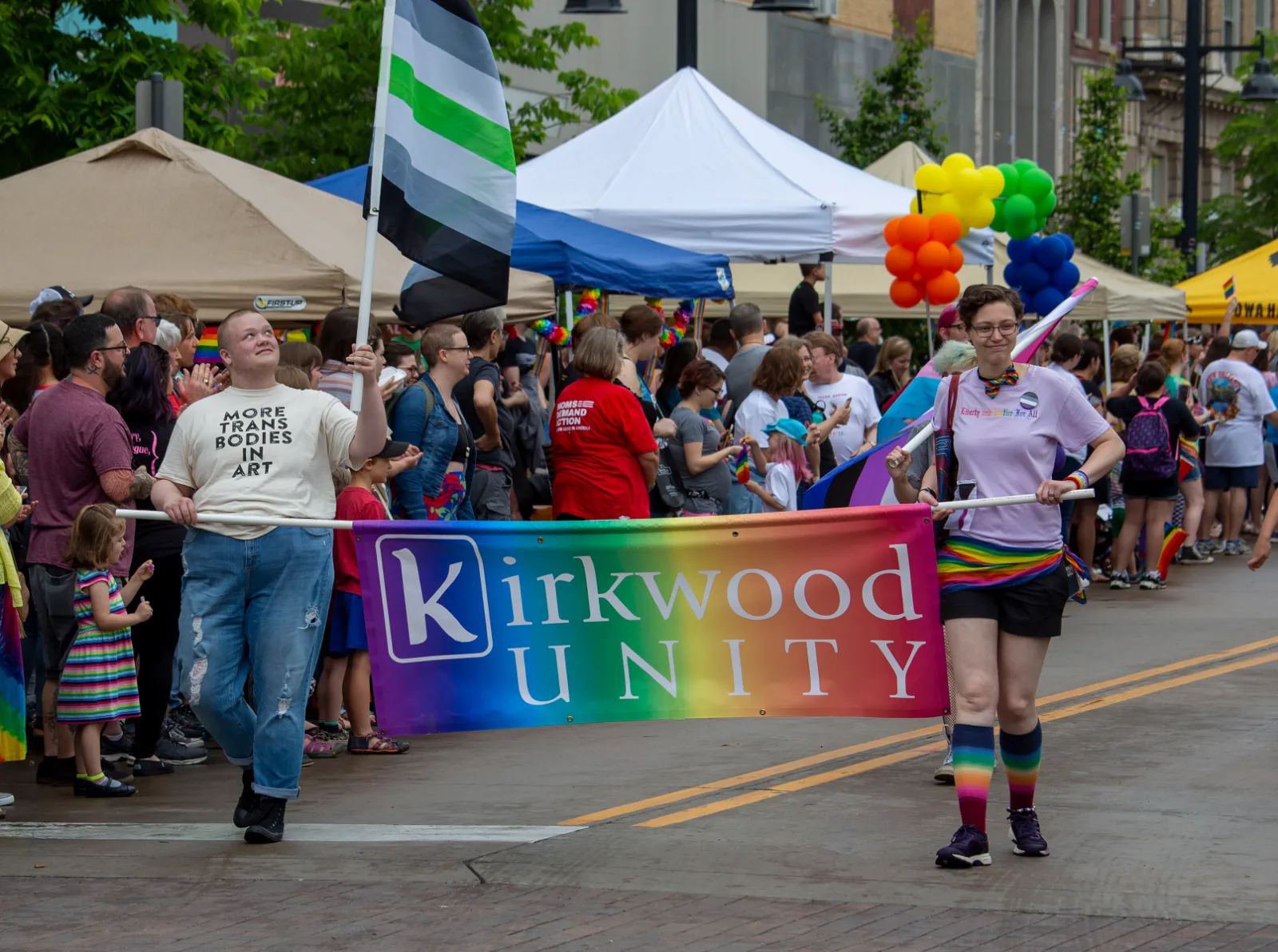
The flag spread first through Tumblr and then well beyond it. Salem reported that by June 2018 it had appeared in Snapchat’s Bitmoji offerings. [3] Photographs document physical display: among a collection of pride flags on Rothschild Boulevard in Tel Aviv in June 2018, at the Sydney Gay and Lesbian Mardi Gras season in 2019, and carried at the head of a marching group at Iowa City Pride on 15 June 2019. [9][10][8] Institutional guides including Library.LGBT and the University of British Columbia’s equity office carry it. [11][5] No single organization formally adopted it on behalf of agender people; its standing rests on breadth of use.
Major revisions
The darker proposal of 18 February, black, medium grey, light grey and a bright yellow-green, was superseded by the pastel version Salem identified as final. [2][1]
The two Tumblr posts sit a day apart and their order is documented three ways: Salem marked the proposal out of date on an archived tag page, the post identifiers run in sequence, and the Commons derivative citing the final post carries its 19 February date. [2][1][7]
Asked in 2018 whether the agender flag had influenced the aromantic flag, released that November with a similar palette, Salem answered carefully: "My flag may have been influential in their color choices." Nothing establishes the influence beyond that hedged answer. [3]
May 19 is now widely listed as Agender Pride Day. Later sources trace the observance to 2017, although its original organizer and founding documentation remain unclear, and nothing connects it to Salem or to this flag’s creation.
Lineage
- Indirect influences
- Genderqueer Pride Flag, Transgender Pride Flag
- Direct children
- Pangender Pride Flag
The transgender flag is the documented primary influence: "The trans flag was the primary influence, I wanted it to have a similar stripe pattern and symmetry." [3]
The genderqueer flag is a documented palette reference rather than a parent: the 2014 post explains the green through its relationship to genderqueer purple, and in 2018 Salem named the purple "on the nonbinary & genderqueer flags" together. [1][3] The nonbinary flag, released in the same month of February 2014, enters the record only through that later comparison; neither design is documented as drawing on the other. [3]
On the aromantic flag, released that November with a similar palette, Salem said only: "My flag may have been influential in their color choices." The relationship is recorded as possible, not established. [3]
The demiboy and demigirl flags are Salem’s own related designs from the same 2014 period, and the deminonbinary flag derives from those designs. [3]
Lineage tree
Every record reachable from this one through documented parent and child relationships: 2 records across 2 generations.
- This record
- Agender Pride Flag
- Children
- Pangender Pride Flag
Colors & Symbolism
Salem’s 2014 statement, quoted back to them in the 2018 interview: "The black and white stripes represent an absence of gender, the gray represents semi-genderlessness, and the central green stripe represents nonbinary genders." [3][1]
| Swatch | Hex | 18 Feb proposal swatch | 18 Feb proposal | Colour | Meaning | Note |
|---|---|---|---|---|---|---|
#010204 | #000000 | Near-black | With white, complete absence of gender | Measured from the final 640 by 444 JPEG; the alternate value from the superseded proposal. [1][2] | ||
#BCC4C6 | #7F7F7F | Grey | Semi-genderlessness. [3][1] | Measured from the final JPEG; the proposal used a darker medium grey. [1][2] | ||
#E9EDEE | #C3C3C3 | Near-white | With black, complete absence of gender | Measured from the final JPEG; the proposal’s counterpart band was a light grey. [1][2] | ||
#B8F483 | #B5E51D | Pastel green | Nonbinary genders, as the inverse of genderqueer purple | Measured from the final JPEG; the proposal used a brighter yellow-green. [1][2] |
In 2018 Salem expanded the reading: the monochrome run "represents a spectrum of internal identities, from people who experience a strong feeling of gender, to those who experience no gender whatsoever", and the green marks where agender falls relative to male, blue, and female, pink: "it doesn’t fall between that spectrum at all, in my experience". [3] Library.LGBT later published a different stripe-by-stripe reading in which white stands for mixed or all genders. That is the guide’s 2021 interpretation, not Salem’s: Salem assigned black and white jointly to absence of gender. [11]
Salem supplied colour names and meanings, not digital specifications, so no palette is official. The first column is measured from the interior of the final 640 by 444 JPEG of 19 February 2014; the second from the superseded proposal of 18 February. [1][2] Library.LGBT’s later normalized palette gives the grey as #B9B9B9 and the white as #FFFFFF, with the same green, #B8F483; those are the guide’s values, not measurements of Salem’s file. [11]
Design
- Aspect Ratio
- 160:111 in the final source image
- Orientation
- horizontal
- Stripe Count
- 7
- Layout
- horizontal stripes
- Stripes (Top → Bottom)
- near-black, grey, near-white, pastel green, near-white, grey, near-black
Seven horizontal stripes in a mirrored sequence with green at the centre, so the flag reads the same either way up, a symmetry Salem borrowed from the transgender flag. [3] Salem’s final posted image is 640 by 444 pixels, 160:111 as a width-to-height ratio; 444 does not divide evenly by seven, so its compressed stripe boundaries are not seven mathematically identical bands. That is the artifact’s own proportion, not a standard flag ratio. [1] Later manufactured and vector versions normalize the geometry to conventional proportions; those are later renderings, not corrections of the source.
The superseded 18 February proposal is 477 by 336 pixels with seven equal 48-pixel stripes: black, medium grey, light grey, a bright yellow-green, then mirrored. [2] The final version lightens every interior band to a pastel register. Measured from the two files: the proposal’s interior colours are #000000, #7F7F7F, #C3C3C3 and #B5E51D; the final’s are #010204, #BCC4C6, #E9EDEE and #B8F483. These are measured artifact values from lossy JPEGs, not creator-issued specifications. [2][1]
Seven horizontal stripes, near-black, grey, near-white, pastel green, near-white, grey, near-black, with no emblem.
Usage & Adoption
- Online Usage
- Wide online circulation from 2014, including Snapchat Bitmoji offerings by June 2018 and the pride-flag guides of Library.LGBT and the University of British Columbia. [3][11][5]
- Event Usage
- Displayed among a collection of pride flags on Rothschild Boulevard, Tel Aviv, June 2018. [9], Photographed in use during the 2019 Sydney Gay and Lesbian Mardi Gras season. [10], Carried at the head of a marching group at Iowa City Pride, 15 June 2019. [8]
- Current Status
- In wide use
The design is the principal, widely recognized agender flag, carried by institutional guides and documented in physical use on three continents. No single organization formally adopted it for all agender people; its standing is customary. [10][11][5]
Image Archive
Flag Designs
Documented Use
Discourse & Debates
Common misidentifications
- The 18 February proposal, darker and with a brighter yellow-green, is a superseded first stage, not a variant in circulation. Salem marked it out of date the next day. [2][1]
- Flags of the World dates the Sydney Mardi Gras photograph to an event of 30 March 2019; the 2019 parade took place on 2 March. The 30 March date is not reproduced here as the event date. [10]
Salem’s current statement describes agender, in their later personal view, as "a sort of gender atheism, or lack of belief in gender". That is one creator’s reflection, offered years after the design, not a general definition. [4]
Footnotes & Citations
Sources and footnotes 12 sources
- 1. Image file page A more pastel version of my agender/genderless flag (final post). Salem, posting as transrants at batty.co.vu. Tumblr (2014-02-19). Accessed 2026-08-14 · Archived version
The post that published the confirmed pastel version, with the colour meanings. The blog is gone; the post survives in an archived capture, its image on the Tumblr CDN, and its permalink and 19 February 2014 date are carried independently by the Wikimedia Commons file record that cites it.
- 2. Image file page Agender/Genderless flag (superseded first proposal). Salem, posting as transrants at batty.co.vu. Tumblr (2014-02-18). Accessed 2026-08-14 · Archived version
The earlier darker proposal, preserved through an archived tag page on which Salem marked it out of date and pointed readers to the confirmed version.
- 3. Interview Interview: Creator of the Agender Flag. Majestic Mess Designs, with Salem. Majestic Mess Designs (2018-12-16). Accessed 2026-08-14
An email interview conducted 3 to 12 December 2018 and published that month; some answers were revised for privacy on 2 October 2019. The interviewer, not Salem, supplies the 18 February 2014 date.
- 4. Primary statement my name is salem and i created the agender flag.. Salem. Tumblr (2019-01-04). Accessed 2026-08-14
The statement Salem left after emptying the blog: it affirms authorship, explains the removal, notes their views have changed, offers a later personal reading of agender, and gives permission to use the flag.
- 5. Reference Guide to pride flags. University of British Columbia, Equity and Inclusion Office. Accessed 2026-08-14
An institutional guide carrying the flag, Salem’s creator credit with they/she pronouns, and the 2014 colour meanings.
- 6. Image file page File:Agender pride flag.svg. Current version credited to Salem Fontana; uploaded by QuickQuokka. Wikimedia Commons (2015-02-06). Accessed 2026-08-14
The normalized vector most guides reproduce, first uploaded in 2015 and modified since. A later derivative, not Salem’s file.
- 7. Image file page File:Agender flag.png. Uploaded by Cyparse. Wikimedia Commons (2017-10-04). Accessed 2026-08-14
A 2017 derivative whose file record independently carries the final post’s permalink and its 19 February 2014 date.
- 8. Image file page File:Iowa City Pride 2019 (48076720736).jpg. IowaPipe. Wikimedia Commons (2019-06-15). Accessed 2026-08-14
A photograph of the 15 June 2019 Iowa City Pride parade in which a large agender flag is carried at the front of a marching group.
- 9. Blogs & Personal Sources Gay Tel Aviv: pinkwashing or genuine?. Trip by Trip (2018-06-05). Accessed 2026-08-14
A June 2018 travel article whose photographs include an agender flag among a collection of pride flags on Rothschild Boulevard. Evidence of display at that place and time, nothing more.
- 10. Reference Agender flag. Flags of the World contributors; page by Tomislav Todorovic. Flags of the World (2021-07-31). Accessed 2026-08-14
A usage record: it quotes the 2014 colour statement and documents displays in Tel Aviv, Sydney and Iowa City.
- 11. Reference Pride Flag Guide: Agender. Library.LGBT (2021-06-11). Accessed 2026-08-14
A later institutional guide with its own normalized palette and its own stripe-by-stripe reading.
- 12. Image file page File:Agender flag.jpg. Uploaded by AnonMoos. Wikimedia Commons (2015-01-25). Accessed 2026-08-14
Preservation of the 640 by 444 final image on Commons from January 2015, credited to the transrants blog. The uploader classified it CC0; that is the uploader’s classification, not a dedication by Salem.


Image Sources
- Rendering
- Salem’s final posted file, 19 February 2014
- The confirmed pastel version, 640 by 444 pixels, byte-identical to the file Salem posted · Credit: Salem · Tumblr · verified
- The first proposal, posted 18 February 2014 and marked out of date by Salem the next day. 477 by 336 pixels; interior colours #000000, #7F7F7F, #C3C3C3, #B5E51D. [2] · Credit: Salem · Tumblr · Creator permission stated; no named license
- The confirmed pastel version, posted 19 February 2014, "a more pastel version" in Salem’s words. 640 by 444 pixels, 160:111; interior colours #010204, #BCC4C6, #E9EDEE, #B8F483. [1] · Credit: Salem · Tumblr · Creator permission stated; no named license
- The flag carried at the head of a marching group, Iowa City Pride, 15 June 2019. [8] · Credit: IowaPipe · Wikimedia Commons · CC BY-SA 2.0