International Bear Brotherhood Flag
Bear / Gay Male Subculture Flag ·
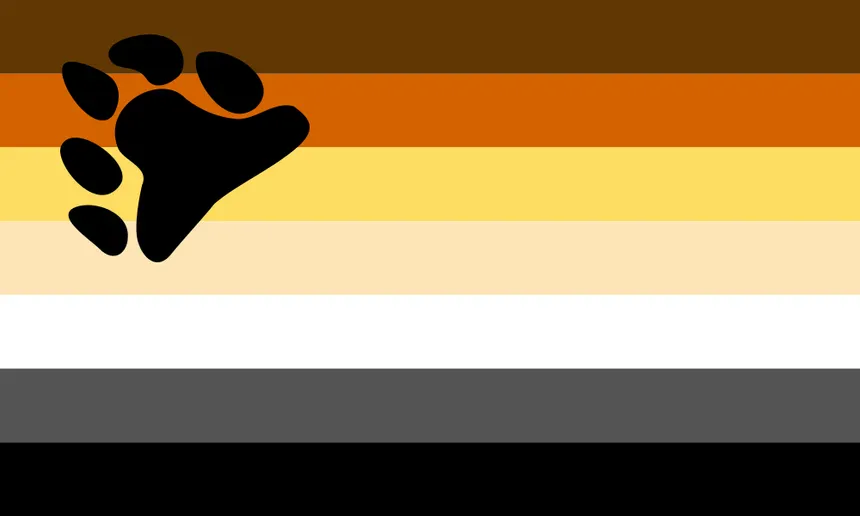
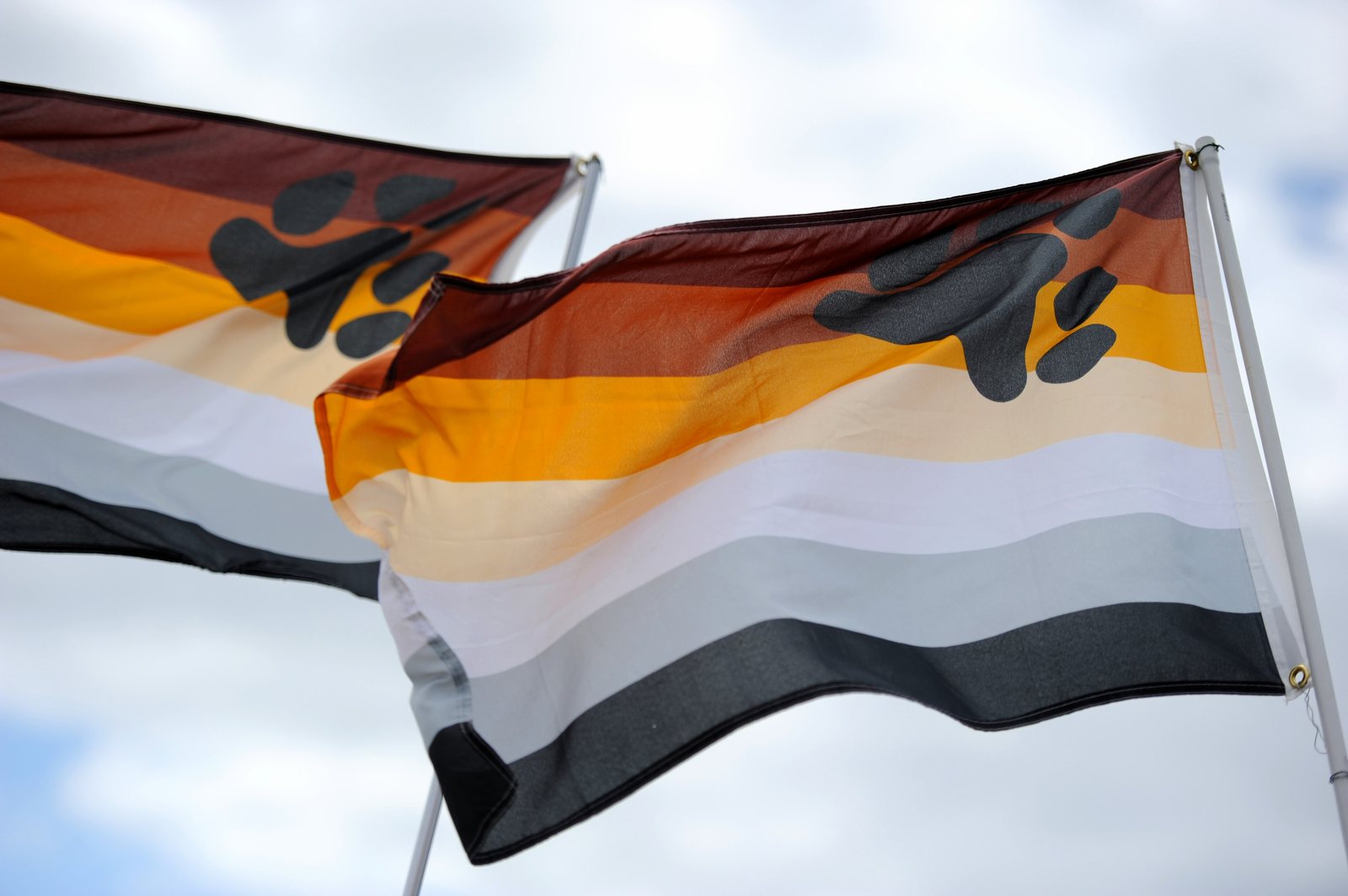
A seven-stripe horizontal flag in bear-fur tones with a black bear paw print in the canton. Craig Byrnes originated the design in 1995 for a psychology senior project on bear culture. Paul Witzkoske drew the graphics and Bob Nicholson sewed four prototypes, one of which the Washington-area Chesapeake Bay Bears chose by vote in July 1995. Authorship of the winning design has been disputed since: Byrnes registered the copyright and is generally credited, while Witzkoske maintains the executed design was his.
Key facts
- Designer
- Craig Byrnes
- Created
- First documented public use
- In use
- 1995–present
- Aspect Ratio
- 3:5
- Stripes
- 7
- Origin
- Washington, D.C., District of Columbia, United States
- Represented Identity
- bear subculture
Also known as
- Bear Pride Flag
- Bear Flag
- Bear Brotherhood Flag
Status Canonical
Archive categories Subculture Pride Flags · Historical and Early Pride Flags
Overview
To provide a visible, unifying symbol for the bear community. Byrnes conceived the design as part of his undergraduate psychology research on bear culture and wanted something that could serve the community the way the leather pride flag served leathermen. [1] [2]
The bear movement formed in the 1980s as a reaction to the exclusion of larger, hairier, and older men from mainstream gay culture, which prized youth, slenderness, and a gym-sculpted physique. Its roots lay in the leathermen of the 1960s and the Girth and Mirth social clubs of the 1970s. Bear Magazine, founded by Richard Bulger and Chris Nelson in 1987, described itself as the first periodical devoted specifically to larger, hirsute men. [3]
By the mid-1990s, roughly forty bear clubs existed across the United States, and events like International Mr. Bear (founded 1992), Lazy Bear Weekend, and International Bear Rendezvous (both 1995) were formalizing the community's identity. [3] The flag appeared during this organizing wave, as a visible symbol for a subculture that, in these accounts, valued "natural" masculinity, working-class presentation, and body acceptance in contrast to a gay mainstream that prized youth and a gym-sculpted physique. [1]
Identity & Context
- Represented Identity
- bear subculture
- Subcommunity
- bear community within LGBTQ and gay male communities
Creators
The Creators
Craig Byrnes
Concept originator and copyright claimant
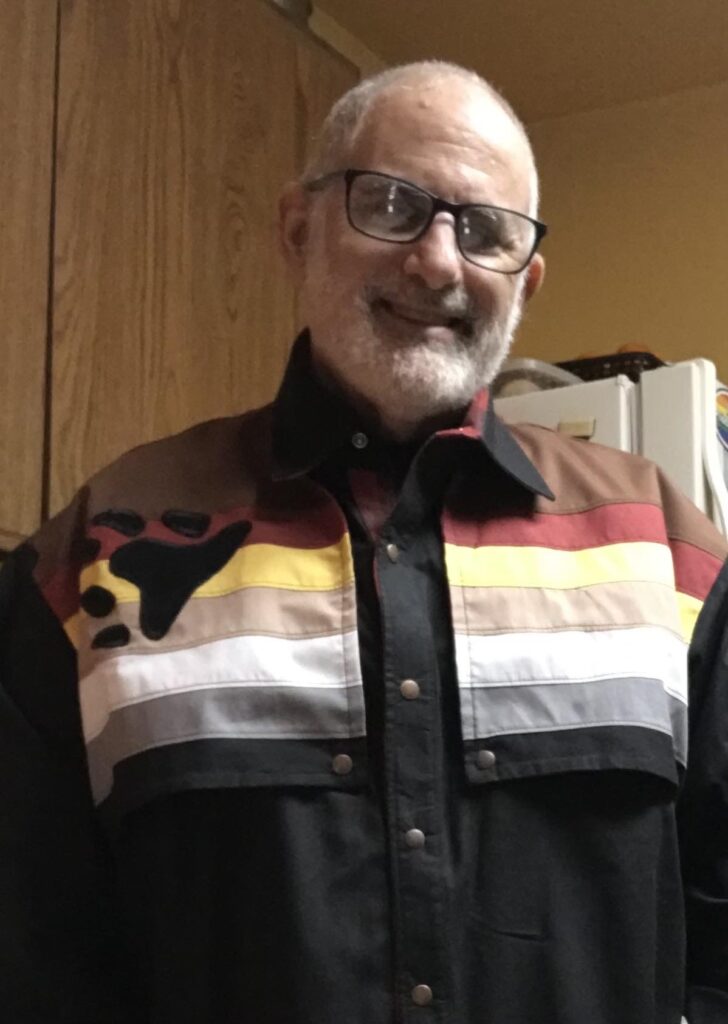
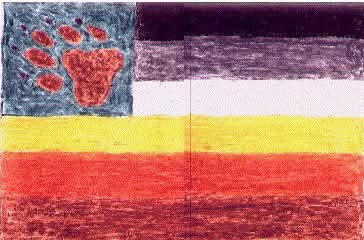
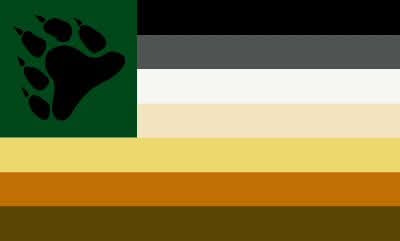
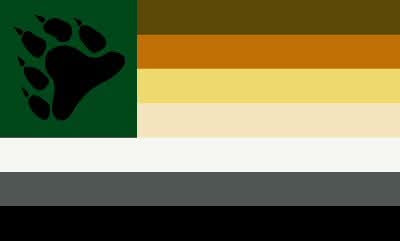
Craig Byrnes grew up in Virginia Beach and enrolled at Mary Baldwin College (now University) in 1989 to study psychology through its Adult Degree Program. [2] He found a home in the bear community forming in the Washington, D.C. area in the early 1990s, becoming a founding member of the Chesapeake Bay Bears in 1993. He held bear pageant titles including Mr. Baltimore Bear Cub (1993), Mr. Teddy Bear Leather of Virginia (1994), Mr. D.C. Bear (1998) [2], and International Mr. Bear (1999), and was featured in American Bear magazine and American Grizzly. He traveled the country using his titles to raise funds for AIDS charities. Byrnes created Bear Manufacturing to produce flag merchandise commercially, but the community was not yet large enough to sustain the business, and he donated profits back to the community. [1] While studying he worked at the Staunton McDonald's and lived on West Beverley Street, and he circulated his bear-community survey on early internet forums. He lost his job for being gay after the April 1993 March on Washington, lost his housing, and never completed the degree. [2] Byrnes conceived the flag in 1995 as part of his psychology senior project on bear culture. His gay father, Walter Byrnes, financed the project. [4] His friend Bob Nicholson bought him a box of crayons, and Byrnes colored his initial concept, six stripes with a brown paw print on a green canton, before asking Paul Witzkoske to develop graphic variations. Witzkoske produced four seven-stripe variants, and attendees at a Chesapeake Bay Bears event in July 1995 voted on the winner. Byrnes registered the copyright and is generally credited as the flag's creator; Witzkoske maintains that the winning design was his and that he was never compensated. [1][5] Byrnes has said he registered the flag rather than the graphic and never enforced the copyright. [6]
I'll never forget the copyright number - Visual Art Copyright 763-760. I've never enforced it, just held on to make sure it wasn't abused.
I'm not a graphic artist. I'm a visionary of ideas.
Motivations
- To provide a visible symbol for the bear community
Paul Witzkoske
Graphic designer
Paul Witzkoske, a professional graphic designer, produced the four candidate graphics for the 1995 contest, working in Adobe Illustrator 88. He had briefly dated Byrnes in the early 1990s, and Byrnes introduced him to the Washington-area bear community. His first design, which won the vote, took Byrnes's six-stripe crayon concept to seven stripes, in brown, rust, gold, cream, white, gray and black with black at the bottom "for balance," dropped the green canton, and set the paw at an angle directly on the stripes, a layout he wrote that he consciously took from the Leather Pride Flag. He also designed the Bear Manufacturing logo and product artwork. He maintains that the winning design was his, that Byrnes "incorrectly takes credit for the final design, for which he claimed copyright," and that he was never compensated; he did not sue, he wrote, because he lacked the money. He does not dispute that Byrnes originated the idea. [5][7][8]
I consciously chose to follow the layout of the Leather Flag placing the paw shape in the far corner at an angle and directly on the stripes.
There's no dispute that Craig originated the idea... But Craig incorrectly takes credit for the final design, for which he claimed copyright.
Bob Nicholson
Prototype fabricator
Bob Nicholson, a member of the Washington-area bear community and Byrnes's former partner, bought Byrnes the box of crayons used for the initial concept and sewed the four prototype flags, three feet by five, on a home machine from colour-guard flag material. Because the graphic's Pantone colours were unavailable in flag nylon, the first production run followed his sewn templates rather than Witzkoske's graphic, so the earliest manufactured flags carried Nicholson's paw. He has left no first-person account; every mention of him comes from Byrnes or Witzkoske. [6][7][5]
Origin
- Country
- United States
- Region / state
- District of Columbia
- City
- Washington, D.C.
- Origin Type
- design
- Physical Origin Status
- reported
Developed within the Washington, D.C. bear community, on the traditional homeland of the Nacotchtank (Anacostan) and Piscataway peoples. [9][10]
Indigenous land context
Nacotchtank (Anacostan) — traditional homeland. The Nacotchtank lived at the confluence of the Potomac and Anacostia rivers, within the boundaries of the greater Conoy/Piscataway Chiefdom. Jesuit missionaries Latinized the name to "Anacostan." Disease, colonial pressure and settler exploitation of intertribal conflict were devastating. On continuity the Park Service is explicit: "They are still here, though they don't self-identify as Nacotchtank." The Park Service names the Piscataway, Patawomeck and Rappahannock as peoples who may represent descendants. [9] [9][10]
Piscataway — traditional territory of the Piscataway Chiefdom. The Piscataway Chiefdom encompassed the D.C. area and much of present-day Maryland; the Nacotchtank lived within its boundaries as an unaffiliated group. [9] The Piscataway continue to live in the region. [9] [9][10]
Colonial / settler context
This flag was developed within the Washington, D.C. bear community, on the homeland of the Nacotchtank and Piscataway peoples. The city serves as the seat of the federal government that administered Indian removal, allotment, and termination policies. [10]
- Land status
- Colonized (English colonial project, Chesapeake region, 17th century onward)
- Indigenous engagement
- None documented. Both land sources are settler institutions: the National Park Service and the District government. No source authored by the Nacotchtank, Piscataway or Conoy has been read.
- Continuing presence
- The National Park Service records that the Nacotchtank "are still here, though they don't self-identify as Nacotchtank," and names the Piscataway, Patawomeck and Rappahannock as peoples who may represent descendants. More than 4,000 American Indians live in Washington, D.C. today. [9]
Developed within the Washington-area bear community, chiefly the Chesapeake Bay Bears, of which Byrnes was a founding member. Byrnes drew the crayon concept as part of a psychology senior project at Mary Baldwin College; Witzkoske produced the graphics, Nicholson sewed the prototypes, and the four prototypes were shown for a vote at a Chesapeake Bay Bears event in July 1995. No located source identifies a single design location. A 2022 historical marker in the Bloomingdale neighborhood commemorates Washington, D.C.'s role in the flag's development. [2][11]
Dates & Chronology
- Year Created
- First public use
- Period in Use
- 1995–present
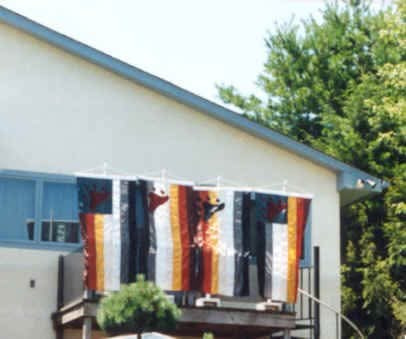
The four prototype flags, sewn by Bob Nicholson on a home machine, were shown at the Chesapeake Bay Bears "Bears of Summer" event in July 1995, the flag's first documented public display, where attendees voted on the winning design. The flag gained wider traction in 1997 when Byrnes supplied 25 flags to the Gay-Lesbian Store in Chicago during bear pride. [2] "That's what made it the de facto Bear Pride flag," Byrnes later recalled. [1]
Paul Witzkoske recorded the design's first raising in San Francisco in his own words: "I am proud that my Bear Flag design was raised for the first time on the enormous flag pole at Harvey Milk Plaza in San Francisco, coinciding with International Bear Rendezvous weekend in February." The quotation carries no year, and it reaches print through a quotation compendium rather than through Witzkoske's own posting. [12]
By the late 1990s the flag was in international circulation. In 2022, a historical marker was erected in the Bloomingdale neighborhood of Northwest Washington, D.C., commemorating the city's role in the flag's development. [2]
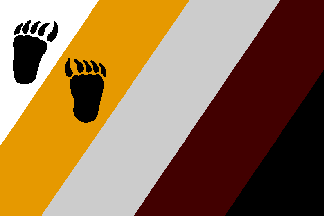
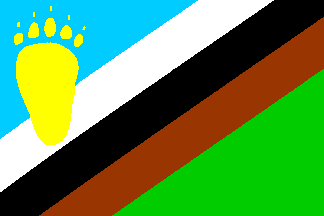
The stripe colors represent the fur of bear species throughout the world. Reference sources and the 2022 Washington, D.C. marker describe the palette as bear fur rather than human skin or hair categories; the reviewed sources do not record Byrnes stating this in his own words. The flag was deliberately copyrighted as the "International Bear Brotherhood Flag" rather than the "Bear Pride Flag" to avoid conflict with two other bear flags that existed at the time. Byrnes learned of them late: at the International Bear Rendezvous of 1996, Lurch, founding president of the San Francisco Bears and the recipient of one of the four original prototypes, told him two flags were already "vying for the right to call themselves 'The Bear Pride Flag.'" Byrnes "had no interest in competing" and registered his under the other name. [2] The earlier designs are documented: Steve Heyl and Jim Maxwell of the Front Range Bears in Denver made a diagonal-striped bear flag in 1992, and another came from Spags, a Seattle bear bar. [13] Les Wright's Bear History Project, founded the same year as the flag (1995) and now archived in Cornell University's Human Sexuality Collection, documented the community's identity formation during this period; its publication led the Library of Congress to add "bear" as a cataloging category. [3] [1]
Lineage
- Indirect influences
- Leather Pride Flag, Rainbow Pride Flag
- Direct children
- Chicago Bear Pride, Nonbinary Bear Flag, Trans Bear Flag
An adjacent gay male subculture flag, not a direct descendant of the modern gay-men-specific stripe lineage. [14][3] The bear and leather communities share overlapping subcultural histories within gay male communities. [3]
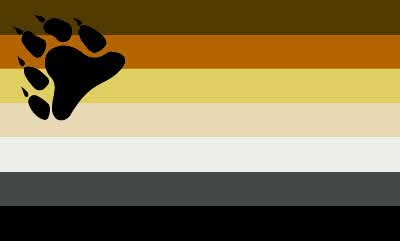
The winning graphic's layout follows the Leather Pride Flag (1989) on the explicit testimony of the man who drew it. Paul Witzkoske wrote in 2011 that he "consciously chose to follow the layout of the Leather Flag placing the paw shape in the far corner at an angle and directly on the stripes," because the bear community "was perceived as a subset of the leather community," and that he chose seven stripes partly because the leather flag, the American flag and the original rainbow flag all carry an odd number. [5] The influence is on layout, not on the palette or the meaning, and it is attributed to Witzkoske's graphic rather than to Byrnes's crayon concept, which had six stripes and a green canton. Byrnes's own account and Les K. Wright's history do not mention the leather flag. [1][6]
A second bear flag was made in 1995 by a named designer. The Twilight Guard, a Connecticut and New York fellowship of leathermen and bears founded in July that year, lists on its own flag gallery a Behr Pride Flag "created by Sean Campbell in 1995," describing its elements as "a bear's paw and five colors representing the basic hair types," and saying it "was used in many of the Twilight Guard's promotional and informational material the same year." Campbell was the club's resident artist. [15] The two designs both place a paw at the upper hoist over horizontal bands, and both use color to stand for hair, though the Behr gallery's wording is "the basic hair types" and this flag's own documented symbolism is separate. Nothing located connects Campbell and Byrnes or establishes that either design influenced the other, so the Behr Pride Flag is recorded as a related design rather than a parent, child or sibling. The same gallery page lists this flag separately and credits Byrnes, adding its own parenthetical that "there is much debate about the origin of the bear flag, as well as Mr. Byrnes' claim as the creator and copy right holder." [15]
Lineage tree
Every record reachable from this one through documented parent and child relationships: 4 records across 2 generations.
- This record
- International Bear Brotherhood Flag
Colors & Symbolism
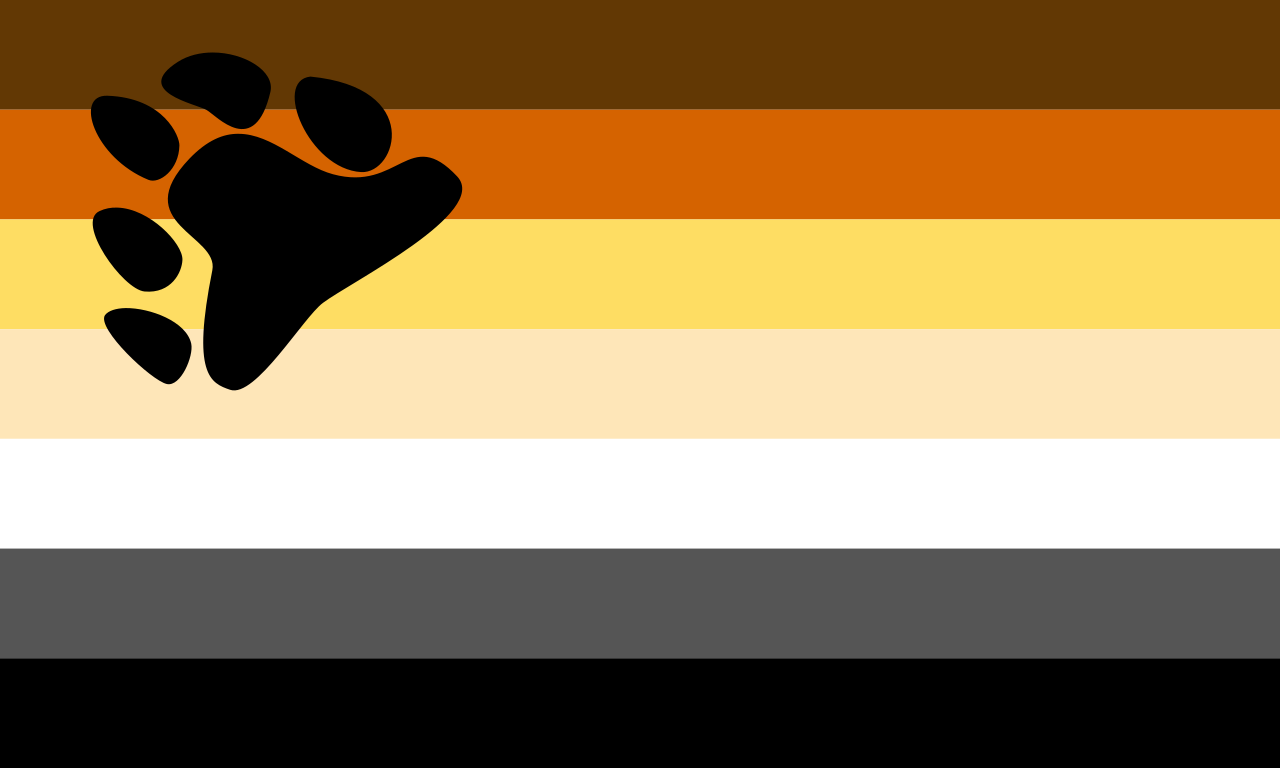
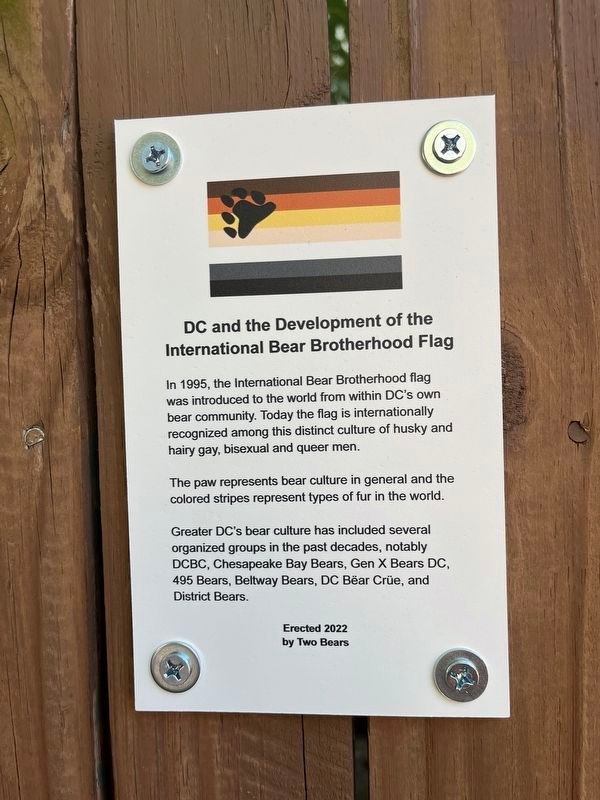
The seven earth-tone stripes collectively represent the fur of bear species throughout the world. Reference sources describe the palette as bear fur rather than human skin or hair categories: Library.LGBT states the stripes represent "the various shades of bear fur (not, as popular myth dictates, hair colour or skin colour)," and the 2022 Washington, D.C. marker reads that the stripes "represent types of fur in the world." [14][11] A 2022 D.C. historical marker describes the palette as representing "types of fur in the world." [11] The paw print sits at the hoist, placed at an angle and directly on the stripes, an arrangement taken from the Leather Pride Flag. [5]
| Colour | Hex | Meaning |
|---|---|---|
| Dark Brown | #623804 | Bear fur shade. |
| Orange-Rust | #D56300 | Bear fur shade. |
| Golden Yellow | #FEDD63 | Bear fur shade. |
| Tan | #FEE6B8 | Bear fur shade. |
| White | #FFFFFF | Bear fur shade. |
| Gray | #555555 | Bear fur shade. |
| Black | #000000 | Bear fur shade. |
Digital reference value from the 2007 Wikimedia Commons SVG (Fibonacci), the upstream of the circulating palette; the same seven appear in the archived Library.LGBT capture, each labelled "Colour of bear fur." Not a creator specification. [16][14]
This flag has no official digital palette. Color values shown are approximate.
- Bear paw print
- Bear-community identity.
No individual stripe-by-stripe symbolic meanings beyond fur color shades have been documented. The paw print is the most symbolically loaded element. [14] [3]

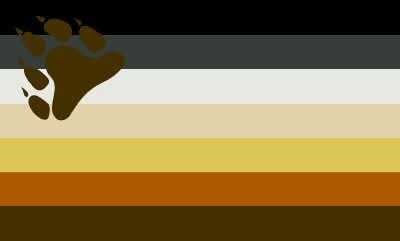
No official creator-published hex specification. The seven values in every circulating palette trace to one file: the SVG uploaded to Wikimedia Commons by the user Fibonacci on 29 April 2007, whose fills are #623804, #d56300, #fedd63, #fee6b8, #ffffff, #555555 and #000000. [16] The archived Library.LGBT capture gives the same seven, labelling each "Colour of bear fur." [14] Neither is a specification from Byrnes, and the values postdate the flag by twelve years. No Pantone specification has been located: the values once tabled were attributed to a Flags of the World page that is now dead, and the live Flags of the World entry carries none, so the Pantone column has been removed. [17][8] The original Pantone colors were not available in flag nylon, so the flag company worked from Nicholson's sewn templates rather than matching specific Pantone swatches. [1]
Design
- Aspect Ratio
- 3:5
- Orientation
- horizontal
- Stripe Count
- 7
- Layout
- horizontal_stripes_with_emblem
- Stripes (Top → Bottom)
- Dark Brown, Orange-Rust, Golden Yellow, Tan, White, Gray, Black
- Additional Symbols
- Bear paw print in upper-left canton
Seven equal horizontal stripes with a bear paw print in the canton, placed at an angle and directly on the stripes. The four 1995 prototypes were made three feet by five, the standard commercial flag size; no permanent official ratio has been documented, and the 2007 digital rendering is 5:3. [8][16] The paw originally had nails on the tips. Accounts of why they went differ in emphasis rather than substance: Witzkoske says they were "later omitted as adding too much expense to the manufacture of each flag, especially the smaller sizes" [5], while Byrnes attributes the change to the flag company's recommendation [6]. The shades have never been fixed: the fourth stripe, called cream in the original graphic, is frequently rendered as a pinkish skin tone, and gold, rust and gray all vary widely between manufacturers and reproductions. [8]
Usage & Adoption
- First Users
- Chesapeake Bay Bears ("Bears of Summer" event, July 1995 - first documented public display)
- Organizations
- Chesapeake Bay Bears, International Mr. Bear competition, Lazy Bear Weekend (Guerneville, CA), International Bear Rendezvous (San Francisco)
- Geographic Usage
- International circulation
- Event Usage
- Bear pride events and gatherings internationally
- Current Status
- active
The flag has been in continuous use as the primary bear-community symbol since 1995. [14] [3] An International Bear Pride tartan based on its colours was registered with the Scottish Register of Tartans in 2015. [3] A variant without the paw print has circulated widely in Mexico City, recorded there between 2007 and 2018. [8]
Image Archive
The Original Flags
Design Process
Predecessors
Renderings

In use

.jpg)
Variants and Descendants

Documented Use
.jpg)

Recognition
Discourse & Debates
- The design credit is disputed. Byrnes conceived the original concept and copyrighted the flag, but Paul Witzkoske (who created the graphic variations from Byrnes's crayon sketch, including the winning seven-stripe design) maintains he was the actual designer and was never compensated. Byrnes eventually announced he was releasing 'his' rights to the public domain; Witzkoske disputed this action but lacked the resources to pursue litigation. [1]
- In the late 1980s and early 1990s, Richard Bulger, a founder of Bear Magazine, was involved in a trademark dispute tied to the magazine and the commercial use of "bear," remembered in the community as a "bear war" over who could claim a shared identity. The specific mark and its scope are not established in the reviewed sources. [1]
- Parts of the bear community have historically treated otters and cubs as subcategories under the bear umbrella, and the Bear Brotherhood Flag has been used accordingly. Distinct otter flags appeared only in the late 2010s, on online Pride-flag directories and social platforms; their history belongs with those designs rather than with this flag.
Criticisms
- Bear communities remain predominantly white. Bears of color have described barriers to visibility and recognition within the larger community and have formed subgroups in response, and in June 2020 racism and lack of diversity in bear spaces became a widely discussed flashpoint. Wright's Bear World Magazine history reports these debates. Demographic scholarship on the bear community is sparse, and a named study for specific findings on racialized self-identification has not been located. [1]
- Scholars of the bear subculture argue that it both challenges dominant gay male body ideals and reproduces elements of hegemonic masculinity, valorizing a particular large, hairy, masculine body and a working-class presentation. The ethnographic literature frames this as a tension within the subculture rather than a settled judgment, and distinctions among bears, chubs and muscle bears are themselves debated within the community. [3]
The bear subculture emerged in part from leather communities but is distinct from them. The two share overlapping histories, venues, and aesthetics, but bear identity centers on body type and presentation rather than kink practice.
Footnotes & Citations
Sources and footnotes 21 sources
- 1. Articles & Reports The Bear Flag: Craig Byrnes and the International Bear Brotherhood Flag. Les K. Wright. Bear World Magazine (2024-01-02). Accessed 2026-03-15
- 2. Hidden History: How MBU Helped Invent an International Gay Pride Flag. Mary Baldwin University, Office of Integrated Communications. Mary Baldwin University (2024-06-03). Accessed 2026-03-15
- 3. Bear flag (gay culture). Wikipedia (last edited 2026-06-07). Accessed 2026-03-09
A tertiary summary. The claims drawn from it here are traced to the sources it cites: Kampf (2000), Wright (2024), and Witzkoske's own 2011 account.
- 4. Putting Out the Bears Flag. Tony Scupham-Bilton. The Queerstory Files (2012-06-05). Accessed 2026-03-30
- 5. The Bear Flag and My Part in Its Creation. Paul Witzkoske. Originally a Facebook note (note_id 10207949587133610); archived by ArchivalFlags (2011-06-14). Accessed 2026-07-28
- 6. Primary statement Craig Byrnes, comments on "Putting Out the Bears Flag". Craig Byrnes. The Queerstory Files (comments) (2015-03-12). Accessed 2026-07-27
- 7. Archived Sources Bear flag artifact, circa 1995 (Collection 2022-47). GLBT Historical Society staff. Online Archive of California (2025-07-14). Accessed 2026-07-27
- 8. Encyclopedias & Reference The International Bear Brotherhood Flag. FOTW contributors (António Martins, M. Schmöger, Steve Kramer, Tomislav Todorović); editor Randy Young. Flags of the World (2025-01-11). Accessed 2026-07-27
- 9. Government The Indigenous Capital. U.S. National Park Service. Accessed 2026-03-19
- 10. Organizations Land Acknowledgment. DC Commission on the Arts and Humanities. Accessed 2026-03-19
- 11. Archived Sources DC and the Development of the International Bear Brotherhood Flag. Erected by Two Bears; page by Devry Becker Jones. The Historical Marker Database (2022-10-22). Accessed 2026-07-27
- 12. Bear (subculture). Wikiquote contributors. Wikiquote (last edited 2022-06-06). Accessed 2026-07-28
A quotation compendium. It gives no date for the Witzkoske piece it quotes and no link to the original.
- 13. Encyclopedias & Reference Other "Bear" flags. FOTW contributors (M. Schmöger, Tomislav Todorović, Juan Morales); editor Randy Young. Flags of the World (2025-01-11). Accessed 2026-07-27
- 14. Bear. Library.LGBT Pride Flag Guide (2021-06-21). Accessed 2026-03-09 · Archived version
An archived capture. The site went offline in July 2026. Published by Albany Pride, Western Australia; it names no author and cites no sources.
- 15. Designer page Pride and Fetish Flag Gallery. The Twilight Guard. The Twilight Guard. Accessed 2026-08-03 · Archived version
- 16. File:Bear Brotherhood flag.svg. Fibonacci. Wikimedia Commons (2007-04-29). Accessed 2026-07-28
The 2007 Wikimedia Commons SVG from which the seven circulating hex values derive. Uploaded as the uploader's own work; it is not a specification issued by the designer.
- 17. Bear Brotherhood Flag (dead link). CRWFLAGS / Flags of the World (FOTW). Accessed 2026-03-30
- 18. International Bear Brotherhood flag — registration VA0000763760. United States Copyright Office. Copyright Public Records System (CPRS) (registered 1996-04-02). Accessed 2026-07-28
- Bear Pride Flag Color Codes (dead link, 404). SchemeColor. Accessed 2026-03-30
- Rainbow flag (LGBTQ). Wikipedia contributors. Wikipedia (2026-06-25). Accessed 2026-07-24
- Grin and Bear it for 17 Years. Tony Scupham-Bilton, with comments by Craig Byrnes and Steve Heyl. The Queerstory Files (2013-02-16, updated February 2017). Accessed 2026-07-28
Image Sources
- Rendering
- standard paw-in-canton version
- The surviving record of Craig Byrnes's initial crayon concept: six stripes with the darkest at the top and a paw print on a field in the upper hoist. Witzkoske added the seventh stripe, reversed the order to put black at the bottom, dropped the field and moved the paw onto the stripes. Accounts describe the field as green; it reads blue-grey in this reproduction. · Credit: Reproduced by Paul Witzkoske · The Bear Flag and My Part in Its Creation
- The four prototypes Bob Nicholson sewed, hung from a line under the eaves for the vote at the Chesapeake Bay Bears charity contest, July 1995. Attendees chose between them by dropping quarters into buckets, the proceeds going to AIDS charities. The flags hang with the hoist uppermost; the paws are visible, but at this resolution the four designs cannot be told apart. · Credit: Reproduced by Paul Witzkoske · The Bear Flag and My Part in Its Creation
- Design 2: the same arrangement as the winner with the stripe order reversed, black at the top, and a brown paw in place of the black one. · Credit: Paul Witzkoske · The Bear Flag and My Part in Its Creation
- Design 3, keeping Byrnes's green field and his stripe order with black on top. Witzkoske made it "to humor Craig's idea" and judged the field "too awkward and busy." · Credit: Paul Witzkoske · The Bear Flag and My Part in Its Creation
- Design 4: Design 3 with the stripe order reversed, brown at the top. The green field survived into two of the four candidates and lost. · Credit: Paul Witzkoske · The Bear Flag and My Part in Its Creation
- The Spags flag, named for a Seattle bear bar and the other bear flag predating Byrnes's. Flags of the World dates this rendering to 2001. The Wikimedia file description calls it the first bear community flag, but FOTW's own account places the Front Range Bears flag earlier, in 1992. · Credit: Marcus Schmoeger · Flags of the World
- The SVG uploaded to Wikimedia Commons by the user Fibonacci on 29 April 2007. Its seven fills are the values that circulate as this flag's palette across reference sites, though Byrnes never published one. Fibonacci drew the paw as a path in a text editor rather than tracing anything Byrnes issued. · Credit: Fibonacci, CC BY-SA 3.0 · Wikimedia Commons
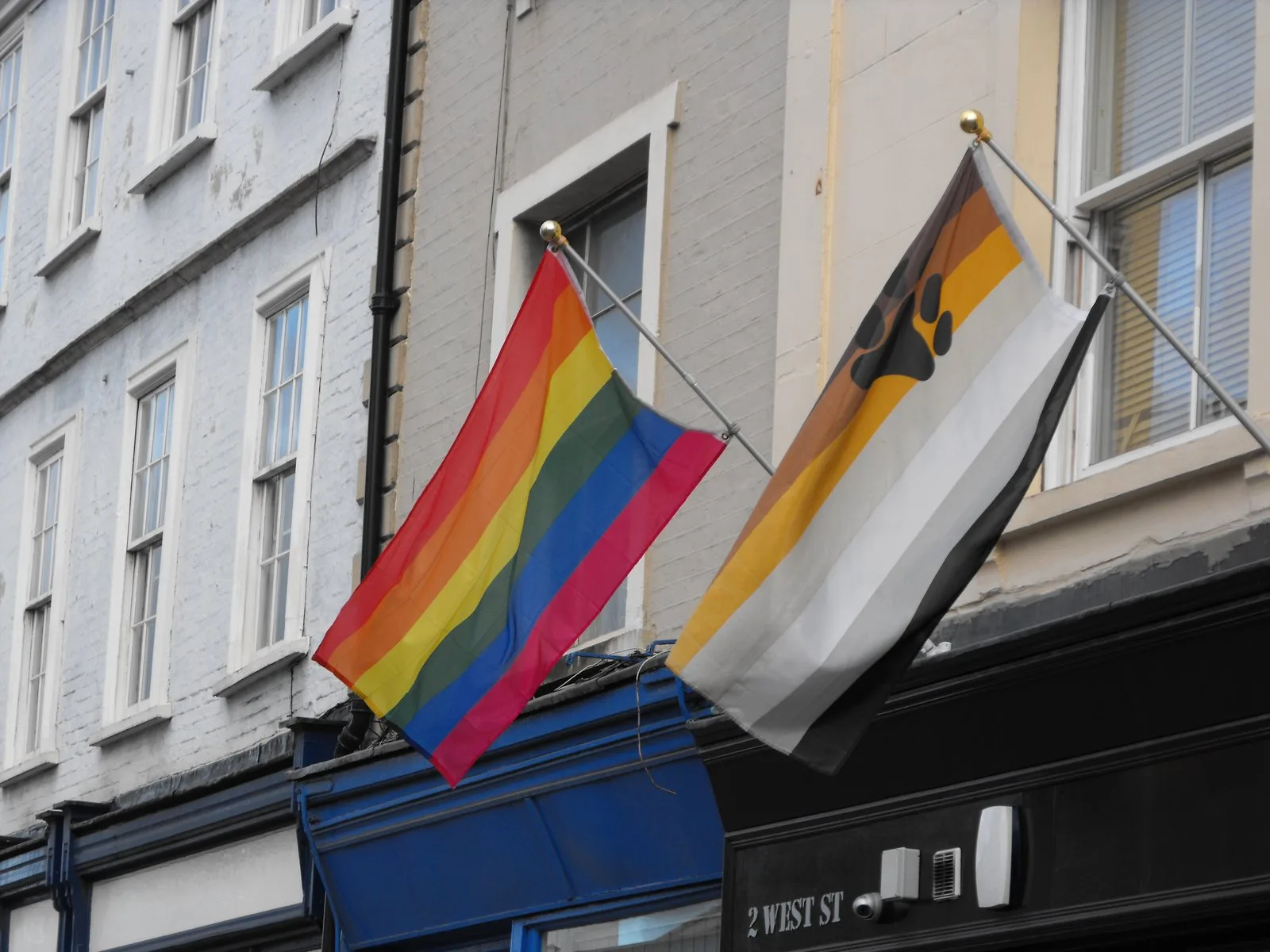
- The bear flag flying beside the rainbow flag above 2 West Street, Old Market, Bristol, 23 March 2009. The paw appears at the hoist and the stripes read dark brown through rust, gold and cream to grey and black. · Credit: Kicior99, CC BY 3.0 · Wikimedia Commons
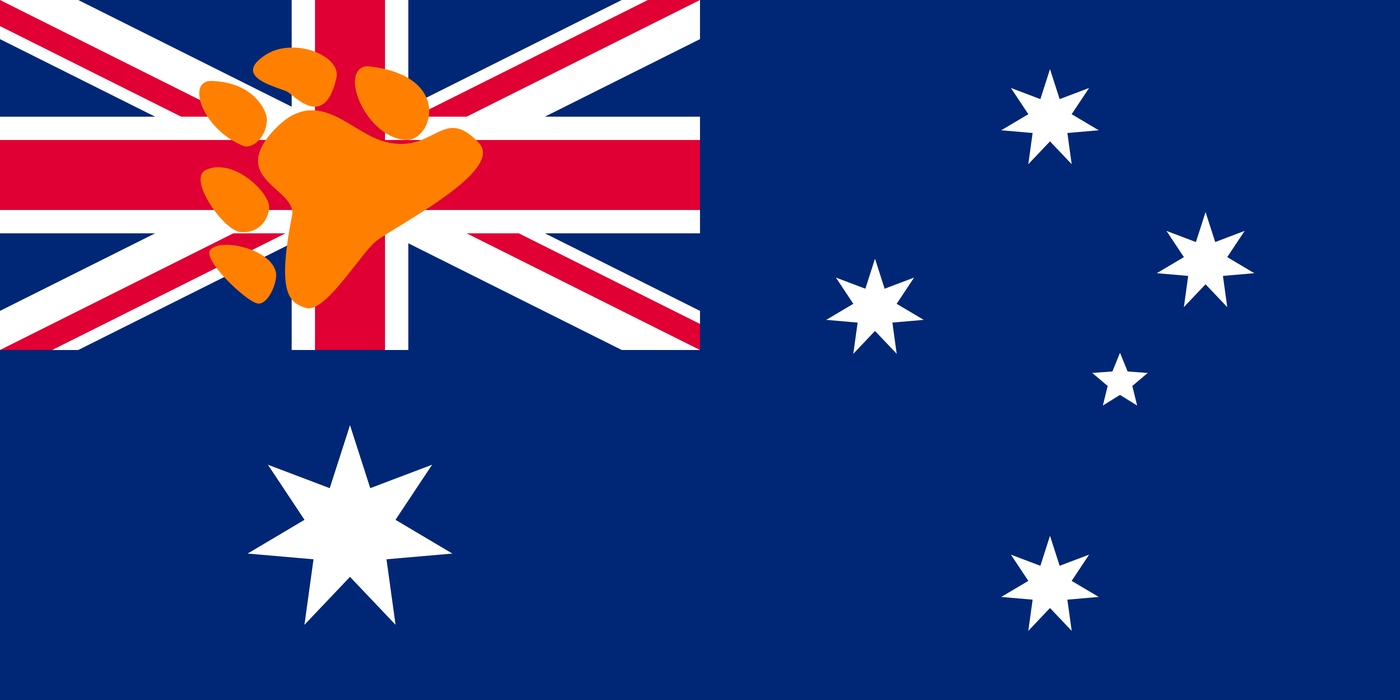
- An online derivative: the Australian national flag with the paw from the Bear Brotherhood flag laid over the Union Jack. Made on Wikimedia Commons in 2010 by the user Fry1989, combining File:Flag of Australia (converted).svg with Fibonacci's File:Bear Brotherhood flag.svg. Wikipedia's article reproduces it. No reviewed source documents the design originating with, or being used by, the Australian bear community, so it is recorded here as an online derivative rather than a community flag. · Credit: Fry1989, after Fibonacci, CC BY-SA 3.0 · Wikimedia Commons
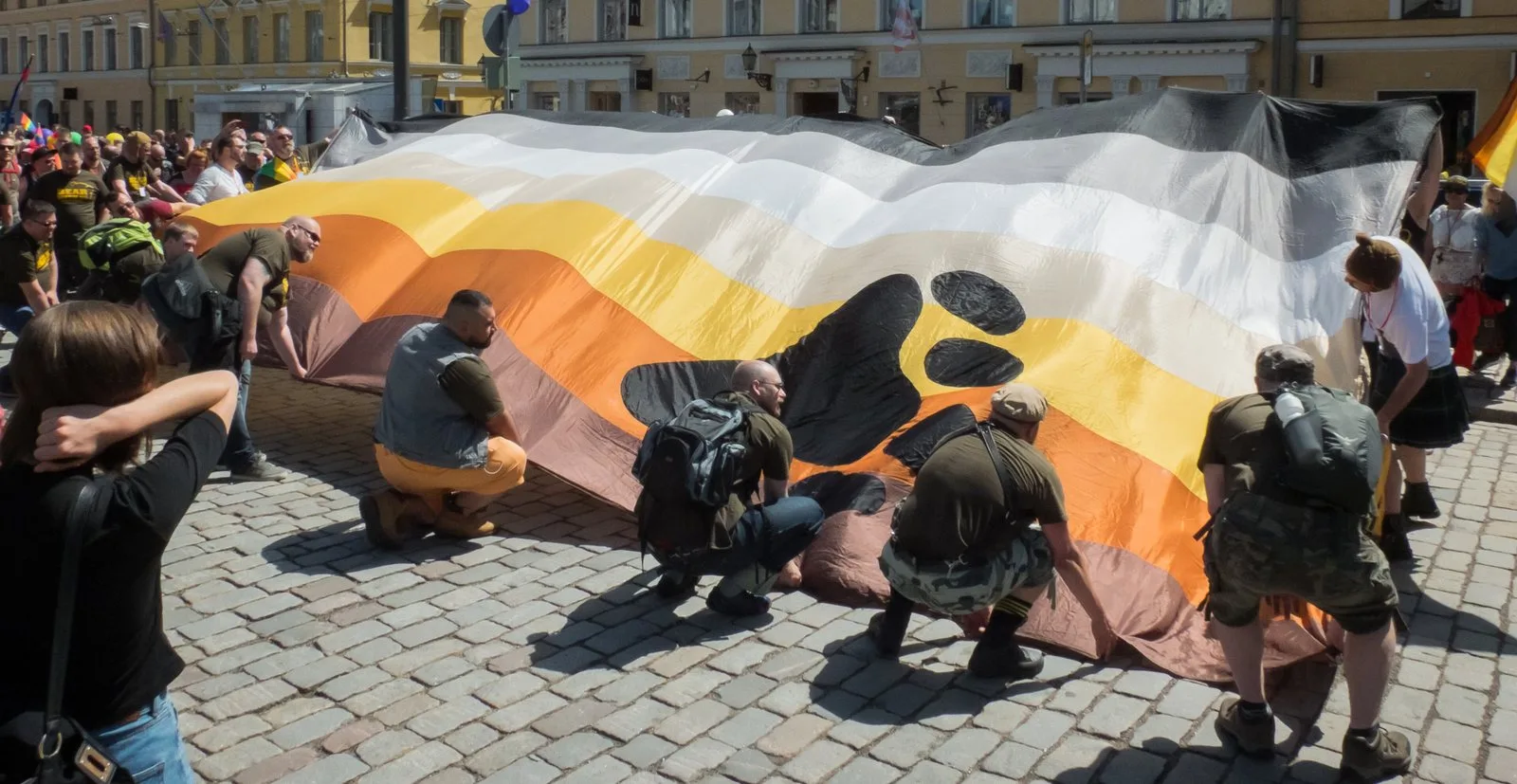
- An oversized bear flag carried at Helsinki Pride, 27 June 2015. · Credit: Heikki Siltala, CC BY 2.0 · Wikimedia Commons
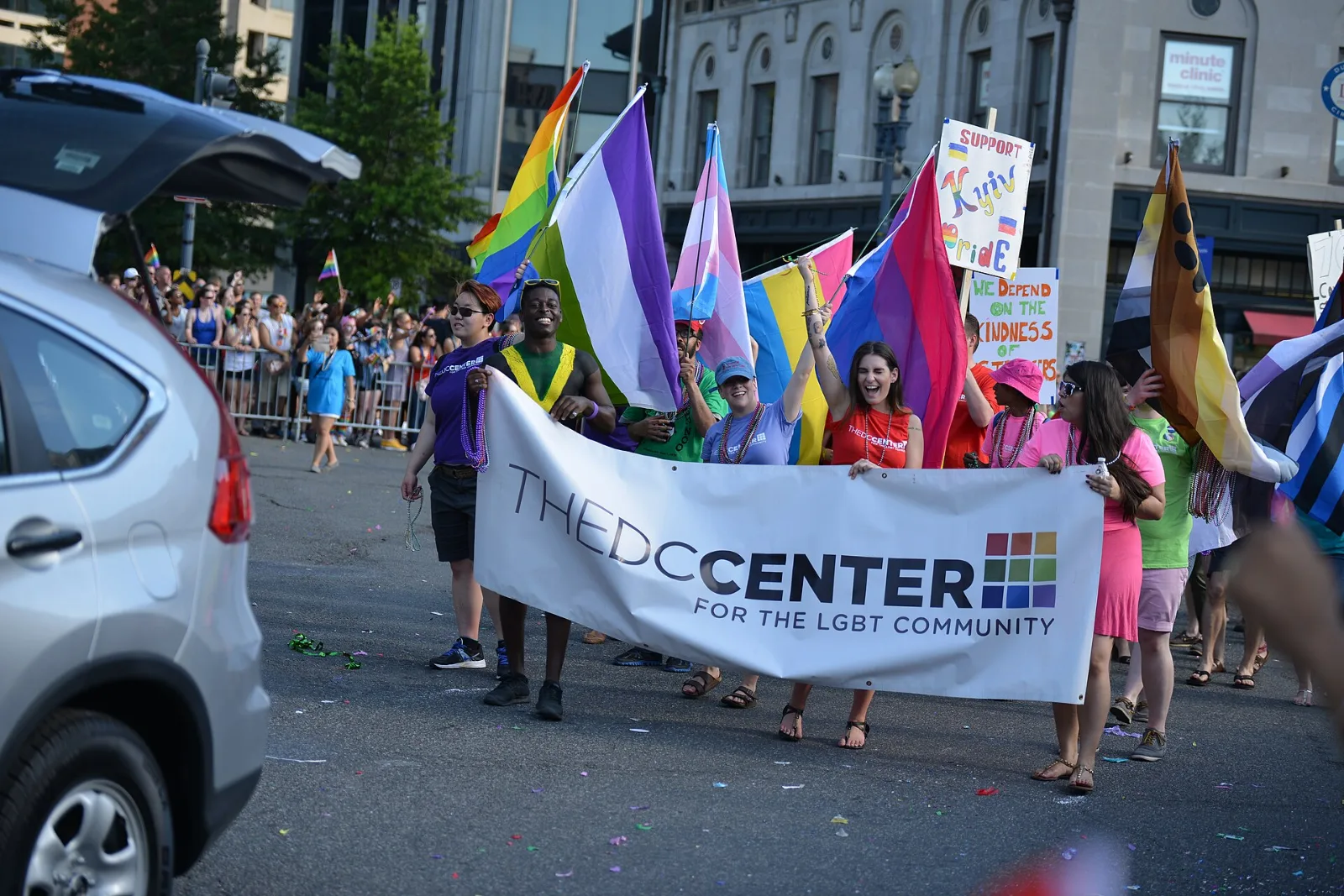
- Capital Pride Parade, Washington DC, 11 June 2016. The Bear flag is carried here among bisexual, pansexual, bear and nonbinary flags. Photographed by S Pakhrin. · Credit: S Pakhrin, CC BY 2.0 · Wikimedia Commons
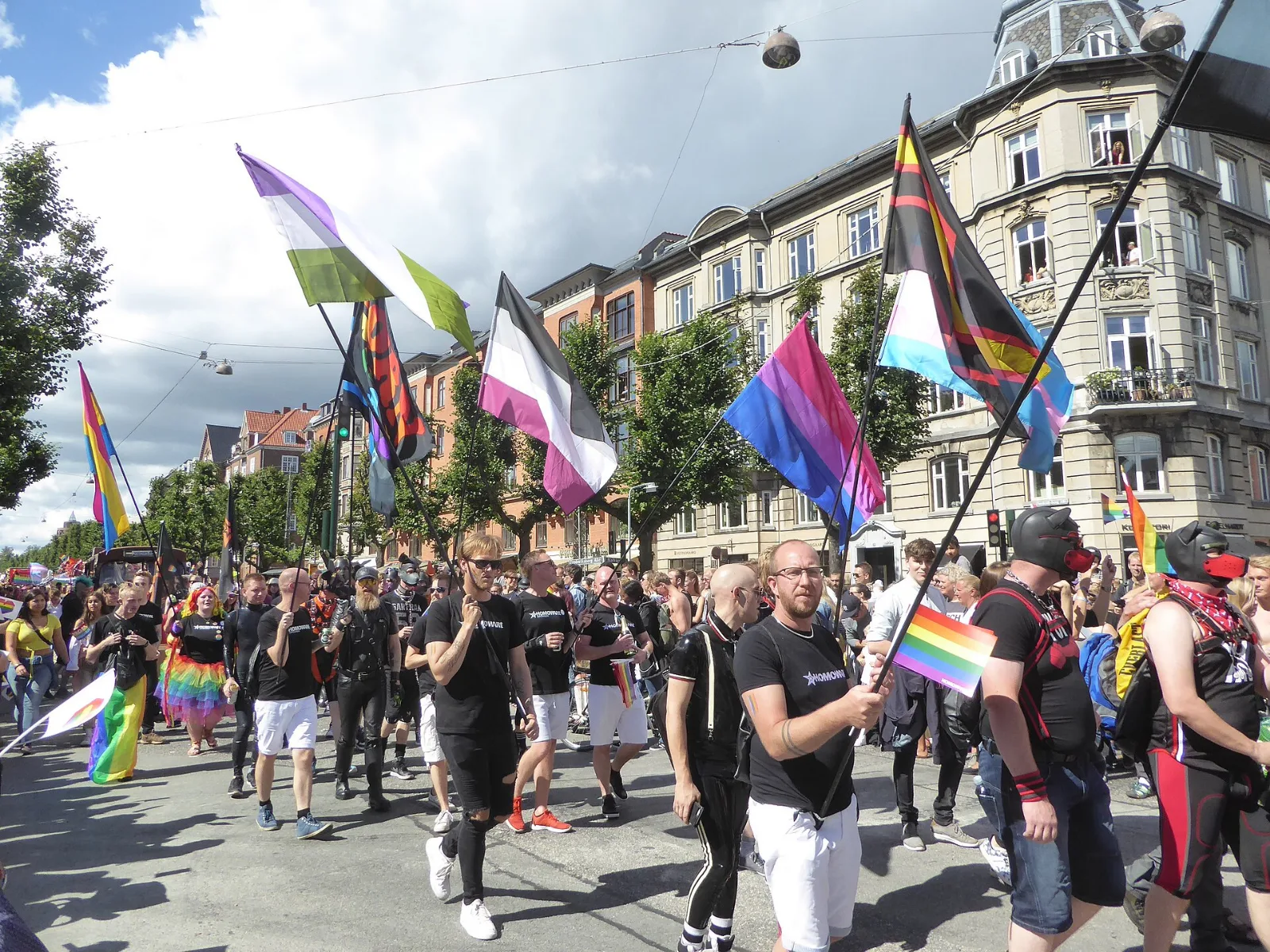
- Copenhagen Pride, Frederiksberg Allé, 19 August 2017. The Bear flag is carried here among bisexual, transgender, bear, rubber, asexual and pansexual flags. Photographed by Leif Jørgensen. · Credit: Leif Jørgensen, CC BY-SA 4.0 · Wikimedia Commons
- The marker erected in 2022 by Two Bears, on a fence in an alleyway off Thomas Street NW in Bloomingdale, Washington, D.C. Its text reads that "the colored stripes represent types of fur in the world," and it names no designer. [11] · Credit: Photograph supplied by Will Montgomery · The Historical Marker Database
- "Flag Raisers," the illustration Bear Manufacturing used on its own history page. · Credit: Dave Williams · Bear Manufacturing