Pangender Pride Flag
Multigender Pride Flag ·
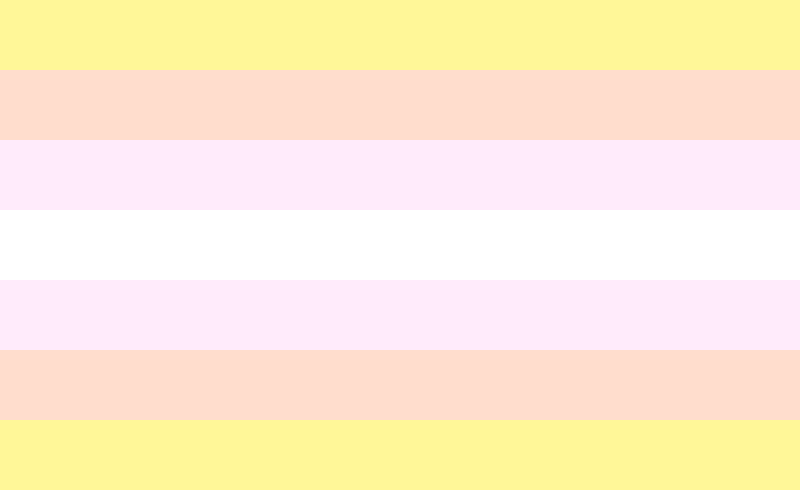
A seven-stripe mirrored flag in pale yellow, light red, light pink-violet, and white, designed by Cari Rez Lobo and posted to Tumblr on January 28, 2015. The color concept draws on a white-light metaphor: the bright pastel tones are intended to represent the full range of gender identities combining into white at the center, analogous to white light containing all visible wavelengths.
Key facts
- Designer
- Cari Rez Lobo
- Created
- First documented public use
- In use
- 2015–present
- Aspect Ratio
- 3:5 · standard
- Ratio Notes
- No proportion is published for this design. The archive supplies its standard production ratio. The file held here is an archive rendering, not the designer's artwork. [1]
- Stripes
- 7
- Origin
- Brazil
- Represented Identity
- pangender
Also known as
- Pangender Flag
- Pangender Pride Flag (Cari Rez Lobo design)
Archive categories Gender Identity Pride Flags
Overview
To represent pangender identity with a dedicated flag grounded in a coherent visual metaphor, addressing the absence of a multigender symbol that specifically named the experience of identifying with all genders.
Pangender identity describes the experience of identifying with all genders, or, more precisely, with a multiplicity of genders that may include male, female, nonbinary, and other identities, experienced simultaneously or over time. The term emerged in online Queer communities in the early 2010s as part of the broader expansion of nonbinary gender language. A critical caveat that the pangender community itself has articulated: pangender does not claim identification with culturally specific genders (such as Two-Spirit, hijra, fa'afafine, or other culturally rooted gender categories) that belong to specific cultural or Indigenous traditions. This distinction (between claiming all genders as a personal experience and claiming genders that belong to cultures one is not part of) has been a significant point of discourse and is addressed directly in the LGBTQIA+ Wiki's pangender entry.
Lobo designed the flag in January 2015, drawing structural inspiration from the agender pride flag and applying a white-light color metaphor from optics: just as all visible wavelengths of light combine into white light, all genders combine into the white center stripe. The surrounding pastel tones (yellow for non-male/non-female genders, light red for transitional genders, pink-violet for the combination of female and male) progress inward toward the unifying center. [1][2][3]
Identity & Context
- Represented Identity
- pangender
- Subcommunity
- multigender umbrella
Creators
The Creator
Cari Rez Lobo
Designer
Cari Rez Lobo (Tumblr: pangendering, also known as Rezeict) is a pangender and panflux artist and biologist from Brazil who created the pangender pride flag on January 28, 2015. [1][2] As both a visual artist and a scientist, Lobo brought an unusual design sensibility to the flag: the white-light concept, that all visible wavelengths combine into white, is drawn directly from optics and applied as a metaphor for all genders combining into a unified whole. Lobo posted two flag variants simultaneously, both using the same color logic but differing in proportion or layout. The standard version, with its seven mirrored stripes in pastel tones, became the dominant circulating form. The design also draws on the agender pride flag's structural logic. [1] Lobo's identification as both pangender and panflux (experiencing fluctuating intensity across all genders) informed the flag's design: the soft, nearly translucent pastel tones convey a sense of shimmer and variability rather than the saturated solidity of flags representing fixed identities. [3]
I've been trying to come up with pangender pride flags, so here are the ones I created:
Opening the post of 28 January 2015 that introduced the design.
They are based on the agender pride flag, which is this one:
Naming the flag's basis in the same post.
The colors are very bright so that they represent the multiplicity of genders (because the white light, in the electromagnetic spectrum, is a combination of all colors).
Answering a reader who asked how the colours were chosen.
It consists of seven stripes colored (top to bottom) yellow, light red, violet, white, violet, light red, yellow.
From the same answer.
Motivations
- To represent pangender identity with a flag whose color logic draws on the concept of white light containing all visible wavelengths
Broader influences
Attribution notes
Cari Rez Lobo posted the flag to the Tumblr blog pangendering on 28 January 2015 under the heading "Possible pangender pride flags", presenting it as a proposal rather than a finished standard: "I've been trying to come up with pangender pride flags, so here are the ones I created", closing "What do you think?" [4] More than one design was posted in that entry, offered as alternatives. The designer states the basis directly in the same post: "They are based on the agender pride flag". [4]
The palette and the meaning of each band are the designer's own, given in answer to a reader's question on the same blog. [5]
Origin
- Country
- Brazil
- Digital Origin
- Tumblr (pangendering)
Creator or earliest documentation associated with Brazil, but no specific city has been verified. Brazil is home to over 300 Indigenous peoples and over 270 Indigenous languages. Without a confirmed city-level location, specific Indigenous land attribution cannot be responsibly made.
Posted to Tumblr on January 28, 2015. [1] [2] Two flag variants were posted at the same time with the same color meanings. [1]
Dates & Chronology
- Year Created
- Exact date
- First public use
- Period in Use
- 2015–present
The flag circulated through Tumblr and later appeared in pride-flag reference guides including Library.LGBT and the LGBTQIA+ Wiki. It is the most commonly referenced pangender flag design. Its visibility remains more niche than flags for binary-adjacent identities (demiboy, demigirl) or broader umbrella categories (nonbinary, genderqueer), reflecting the relatively smaller community that uses the pangender label. [1][2]
Major revisions
The flag's symmetrical layout means it reads the same regardless of orientation. [1] The white-light concept -- that bright pastel tones combine into white -- provides the conceptual basis for the color choices. [1]
Cari Rez Lobo (Rezeict) is a pangender and panflux artist and biologist from Brazil. The Pangendering Tumblr blog has existed since September 26, 2014. The flag was proposed in January 2015 and is based on the agender pride flag's structure. [4][5]
Lineage
- Evolved from
- Agender Pride Flag
- Indirect influences
- Rainbow Pride Flag
Part of the broader multigender cluster alongside bigender and trigender flags. The designer cited the agender pride flag as a structural influence. [1] Not part of the demigender design family. [1] The derivation is the designer's own statement rather than an inference: "They are based on the agender pride flag". [4] The same post and the same colour logic also produced a panflux flag. [4][5]
Lineage tree
Every record reachable from this one through documented parent and child relationships: 2 records across 2 generations.
- Ancestor
- Agender Pride Flag
- This record
- Pangender Pride Flag
Colors & Symbolism
A white-light metaphor, stated by the designer: the bright tones stand for the multiplicity of genders "because the white light, in the electromagnetic spectrum, is a combination of all colors", and the white centre band is "the blend of all these genders". [5]
| Colour | Hex | Meaning |
|---|---|---|
| Yellow | #FFF798 | Genders not related to female or male. |
| Light Red | #FFDDCD | Transition to genders related to female and male. |
| Light Pink-Violet | #FFEBFB | Combination of female and male genders. |
| White | #FFFFFF | Blend of all genders. |
| Light Pink-Violet | #FFEBFB | Combination of female and male genders. |
| Light Red | #FFDDCD | Transition to genders related to female and male. |
| Yellow | #FFF798 | Genders not related to female or male. |
Given by the designer on their own blog, in answer to a question about how the colours were chosen. [5]
The white center represents the concept that all visible wavelengths of light combine into white -- applied here as a metaphor for all gender identities combining. [1] The surrounding pastel tones progress from non-male/non-female genders (yellow) through transitional and combinatory genders (light red, pink-violet) toward the inclusive center. [1]
The values are the designer's own, published on the pangendering blog with a meaning for each: #FFF798 for "all the genders that are not related to female and male", #FFDDCD for "the transition to the genders which are related to female and male", #FFEBFB for "the combination of female and male", and #FFFFFF for "the blend of all these genders". [5] Earlier versions of this entry carried the same four values but attributed them to a flag guide that has since gone offline; they are the designer's. A different set, #FFEA7E, #FFC3B0 and #FFD6F3, circulates in secondary sources and is not the designer's. [2]
Design
- Aspect Ratio
- 3:5 · standard
- Ratio Notes
- No proportion is published for this design. The archive supplies its standard production ratio. The file held here is an archive rendering, not the designer's artwork. [1]
- Orientation
- horizontal
- Stripe Count
- 7
- Layout
- horizontal_stripes
- Stripes (Top → Bottom)
- Yellow, Light Red, Light Pink-Violet, White, Light Pink-Violet, Light Red, Yellow
Seven equal horizontal stripes in a mirrored pattern: yellow, light red, light pink-violet, white, light pink-violet, light red, yellow, from top to bottom. No emblem or additional symbols. [1] The flag reads the same regardless of orientation. Two variants were posted simultaneously in January 2015. The standard version, with the hex values attributed to the creator's Tumblr, is the one documented.
Seven horizontal bands mirrored about a white centre, running yellow, light red, light violet, white, light violet, light red, yellow. The designer describes the arrangement in those terms: "It consists of seven stripes colored (top to bottom) yellow, light red, violet, white, violet, light red, yellow." [5] The tones are deliberately pale, following a white-light metaphor: "The colors are very bright so that they represent the multiplicity of genders (because the white light, in the electromagnetic spectrum, is a combination of all colors)." [5]
Usage & Adoption
- Geographic Usage
- Internet circulation
- Online Usage
- Circulated through Tumblr and pride-flag reference guides
- Current Status
- active
Discourse & Debates
- Whether pangender implies identification with culturally specific genders (Two-Spirit, hijra, etc.) or is limited to genders available within one's own cultural context, the community consensus is the latter [2][3]
- The relationship between pangender and omnigender, which are sometimes used interchangeably and sometimes distinguished (pangender as simultaneous, omnigender as sequential) [3]
- Whether pangender belongs under the nonbinary umbrella, the multigender umbrella, both, or neither [2]
Common misidentifications
- Sometimes confused with bigender or genderfluid, pangender specifically names identification with all genders, not two genders or fluid movement between genders
- Pangender is not the same as pansexual, the 'pan' prefix means 'all' in both cases, but one refers to gender identity and the other to sexual orientation
- The flag's very pale pastel tones are sometimes confused with the agender flag at small sizes, though the agender flag uses green and black rather than yellow and red
Criticisms
- Pangender has faced criticism for potentially implying identification with culturally specific genders (such as Two-Spirit, hijra, fa'afafine, or muxe) that belong to particular cultural or Indigenous traditions. The pangender community has generally responded by clarifying that pangender refers to all genders available within one's own cultural framework, not to the appropriation of genders from cultures one does not belong to. This boundary is explicitly stated in the LGBTQIA+ Wiki's pangender entry. [2][3]
- Some people question whether 'all genders' is a coherent experiential category or an abstract claim that cannot be meaningfully lived. Pangender individuals respond that the experience is real and internally consistent, not a theoretical position but a felt sense of identification that encompasses rather than selects. [3]
The prefix 'pan-' from Greek ('all') connects pangender linguistically to pansexual and panromantic, though the three terms address entirely different dimensions of identity. Pangender is sometimes paired with panflux, which describes fluctuating intensity across all genders, the designer Cari Rez Lobo identifies as both. [1][3]
Footnotes & Citations
Sources and footnotes 8 sources
- 1. Pangender. Library.LGBT Pride Flag Guide. Accessed 2026-03-10
Library.LGBT has been offline since July 2026. The palette it was cited for is now carried by the designer's own post.
- 2. Pangender. LGBTQIA+ Wiki. Accessed 2026-03-10
- 3. Pangender. Nonbinary Wiki. Accessed 2026-03-15
- 4. Social media Possible pangender pride flags. Cari Rez Lobo (Rezeict). Tumblr (Pangendering) (2015-01-28). Accessed 2026-03-31
The design post of 28 January 2015, presenting more than one candidate flag and naming the agender pride flag as their basis.
- 5. Social media What do the pangender pride colors represent/how.... Cari Rez Lobo. Tumblr (Pangendering). Accessed 2026-03-31
The designer's own specification: the four hex values, a meaning for each, the seven-band order, and the white-light rationale.
- Pangendering Tumblr (creator's blog). Cari Rez Lobo. pangendering (Tumblr) (2015-01-28). Accessed 2026-03-15
- Pangender. Gender Wiki. Accessed 2026-03-15
- Rainbow flag (LGBTQ). Wikipedia contributors. Wikipedia (2026-06-25). Accessed 2026-07-24
Image Sources
- Rendering
- standard creator-linked version
- The seven-stripe design as the designer published it, drawn for this entry. [4] · Credit: Archive rendering after Cari Rez Lobo's design · Encycloflaggia renderingRights The rendering held here is drawn by this archive from the documented colours and stripe order. It is not the designer's file, and no designer file has been located.