Deminonbinary Pride Flag
Demigender Pride Flag ·
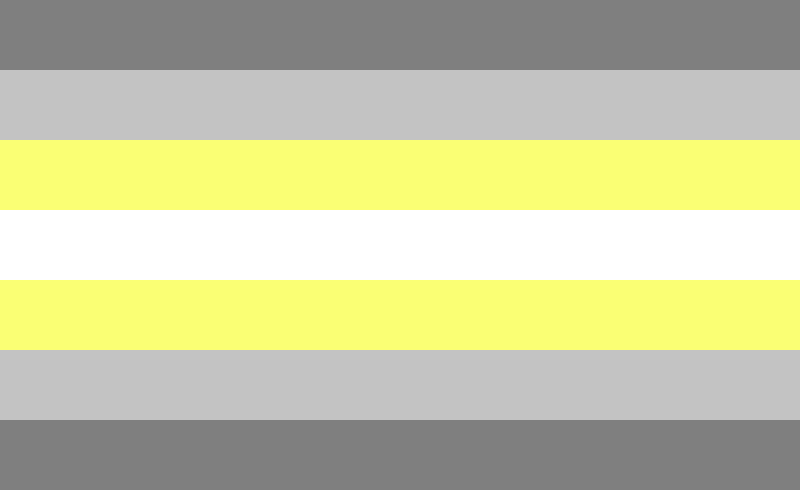
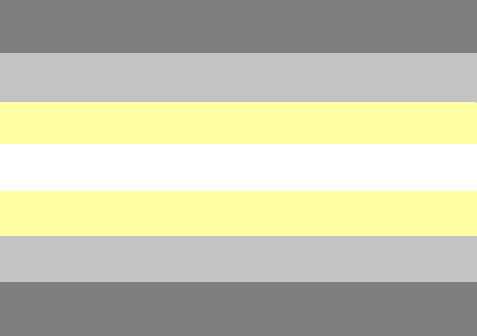
Seven mirrored stripes of unequal depth, dark grey and light grey framing pale yellow around a white centre. The Tumblr user druxydeity added the design on 5 April 2014 to a reblog of two flag proposals Transrants had posted on 18 February 2014, introducing it with the line "i really hope it's not out of my place to make/add this but". All three files are 477 by 336 pixels and share the same stripe boundaries, greys and white, which makes the deminonbinary version a recolour of the pair rather than a separate design. [1]
Key facts
- Designer
- druxydeity
- Created
- First documented publication
- In use
- 2014 to the present
- Aspect Ratio
- Variable across renderings · original 477 × 336, about 1.42:1
- Ratio Notes
- The original file is 477 by 336 pixels, about 1.42:1. No proportion was specified for the design and later renderings use their own: Nikki's Commons vector is 5:3, and the Pride-Flags DeviantArt copy is 5000 by 3000, also 5:3. [1][2][3] The archive's own 3:5 production standard is not applied to this record, because the shape of the documented artefact is part of what the record preserves.
- Stripes
- 7
- Represented Identity
- Deminonbinary, also called demienby
Also known as
- Deminonbinary Flag
- Demi-Nonbinary Flag
- Demienby Flag
Archive categories Gender Identity Pride Flags
Overview
druxydeity published the design on 5 April 2014, adding it to a reblog of Transrants's demigirl and demiguy flag proposals of 18 February 2014 with the line "i really hope it's not out of my place to make/add this but". Tumblr's record of the chain gives both posts to the second, and two separately preserved copies of it agree. [1][4]
The three images are one artefact recoloured. Each is 477 by 336 pixels. Each carries seven stripes of unequal depth beginning at rows 0, 53, 102, 144, 191, 236 and 282. Each uses #7F7F7F for the outer bands, #C3C3C3 for the second and sixth, and #FFFFFF for the centre. Only the third and fifth stripes differ: #FFAEC9 in the demigirl proposal, #99D9EA in the demiguy proposal, #FFFFA6 in druxydeity's. Transrants's two files are JPEGs and druxydeity's is a PNG. [1]
Identity & Context
- Represented Identity
- Deminonbinary, also called demienby
- Subcommunity
- demigender umbrella
Deminonbinary, also called demienby, is a demigender identity describing a partial connection to being nonbinary. The label does not prescribe what, if anything, constitutes the remainder of a person's gender.
Neither post in the chain defines the term. druxydeity supplied the image and one sentence, and Transrants titled the pair it answers "demigirl & demiguy flag proposals". [1]
Creators
The Creator
druxydeity
Designer
A pseudonymous Tumblr account. druxydeity posted the pale-yellow deminonbinary version on 5 April 2014 as an addition to Transrants's demigirl and demiguy proposals, prefacing it "i really hope it's not out of my place to make/add this but". No name, location, pronouns, or further statement about the design has been located, and the original post survives only in the reblog trail. [1]
"i really hope it's not out of my place to make/add this but" [1]
Salem
Creator of the source designs
Transrants posted the demigirl and demiguy flag proposals on 18 February 2014 that druxydeity recoloured seven weeks later. The blog is Salem X's, who kept a single statement there after deleting the rest: "my name is salem and i created the agender flag." [5] Salem made the template this design reuses, not this design. [1]
"demigirl & demiguy flag proposals" [1]
Attribution notes
druxydeity is a Tumblr pseudonym. The blog still exists, but the reblog that carried the design no longer resolves on it and survives only inside the trail of later reblogs. Nothing else about the person is documented: no name, no location, no pronouns, and no statement about the design beyond the sentence introducing it. [1]
Transrants made the two proposals druxydeity recoloured, and is Salem X, who writes on that blog, "my name is salem and i created the agender flag". [5] In December 2018 Majestic Mess asked Salem, "What led you to create the agender, demiboy, demigirl (hi, hello, it me) and deminonbinary flags?", and Salem answered about the moment rather than about any individual design: "Tumblr in 2014 (when these flags were created) was seeing a huge influx of identities, pronouns, and other means of personalizing one's identity." The grouping of four flags is the interviewer's, and the rest of the answer is about the agender flag. The year is right for all of them. [6]
Origin
- Digital Origin
- Tumblr
- Physical Origin Status
- Unknown. Neither creator's location is documented and no place of making is recorded.
Digital origin on Tumblr; no physical location documented.
Published on Tumblr, as an addition to a reblog. No earlier venue has been located. [1]
Dates & Chronology
- Year Created
- Exact date
- First documented publication
- Period in Use
- 2014 to the present
- Creation Bounds
- Tumblr's own record of the reblog chain timestamps druxydeity's post at 5 April 2014, 23:39:03 UTC, and the Transrants post it answers at 18 February 2014, 15:23:33 UTC. Two independently preserved copies of the chain carry identical values. [1][4] No source places the design before that post.
The design circulated by reblog and was copied out of Tumblr within a year. Pride-Flags published a rendering of it on DeviantArt on 4 July 2015, crediting the family to Transrants, and a purple-striped alternative titled Deminonbinary / Demiandrogyne (3) on the same day. [3][7] Nikki drew a vector version for Wikimedia Commons on 29 June 2020 and released it under CC0. [2] The preserved chain carried 889 notes when read. [1]
A DeviantArt journal by SavvyRed carries a page-level date of 21 June 2013 and describes the design as "Seven horizontal stripes. From top to bottom: dark grey, grey, yellow, white, yellow, grey, dark grey", for "Deminonbinary and sometimes Demigender", "Created by alexander—the-great". It is the source of the colour meanings later sites repeat. [8]
That page date does not date that section. The journal is a catalogue its author kept adding to, and the deminonbinary section links to a post on alexander--the-great's Tumblr whose post ID falls above the 18 February 2014 post in the chain, eight months after the journal's own date. Tumblr issues post IDs in ascending order, so the linked post cannot be from June 2013. It has since been deleted and its contents cannot be read.
The attribution to alexander--the-great is therefore later provenance of unclear scope. It may refer to a separate rendering, to a reblog, or to an error. It is not contemporaneous evidence, and nothing places this design before druxydeity's post. [8]
Lineage
- Direct predecessors
- Demiboy Pride Flag, Demigirl Pride Flag
An adaptation of Transrants's paired demigirl and demiguy proposals of 18 February 2014, made by recolouring the third and fifth stripes. The two source images and this one share dimensions, stripe boundaries, greys and white exactly, so the direction of derivation is not in doubt. [1]
Lineage tree
Every record reachable from this one through documented parent and child relationships: 3 records across 2 generations.
- Ancestor
- Demiboy Pride Flag, Demigirl Pride Flag
- This record
- Deminonbinary Pride Flag
Colors & Symbolism
No meaning is stated by the person who made the flag. druxydeity's post supplies the image and one sentence and nothing else. [1]
| Colour | Measured from the 2014 original | Note |
|---|---|---|
| Dark Grey | #7F7F7F | The outer stripes. Measured from druxydeity's 477 × 336 PNG, where it is also the outer stripe value of both Transrants proposals. [1] |
| Light Grey | #C3C3C3 | The second and sixth stripes. Measured from druxydeity's 477 × 336 PNG, and identical in both Transrants proposals. [1] |
| Pale Yellow | #FFFFA6 | The third and fifth stripes, and the only value that differs from the two source images. Measured from druxydeity's 477 × 336 PNG. [1] |
| White | #FFFFFF | The centre stripe. Measured from druxydeity's 477 × 336 PNG, and identical in both Transrants proposals. [1] |
This flag has no official digital palette. Color values shown are approximate.
The readings in circulation are later, and they do not agree with one another. Grey is given as partiality or as a partial gender connection; yellow as nonbinary identity; white variously as agender identity, as nonbinary identity, as all genders, or as gender in general.
The earliest of these is SavvyRed's journal, which glosses grey as "semi/demi-gender, as if to be a gender version of grey ace", yellow as "non-binary genders", and white as "a combination of all genders". [8] That gloss is the journal's, written beside an attribution this entry does not follow, and it is not attributable to druxydeity.
Nothing in the post connects the yellow to any other flag.
No palette was published. These are exact readings of the 2014 file, not a specification, and they are what distinguishes the design from its two source images: the greys and the white are shared, and only the third and fifth stripes were changed, from #FFAEC9 in the demigirl proposal and #99D9EA in the demiguy proposal to #FFFFA6. The two source values were measured again from the trail originals on 14 August 2026; this record previously gave them as #FEAEC9 and #9AD9EA. [1]
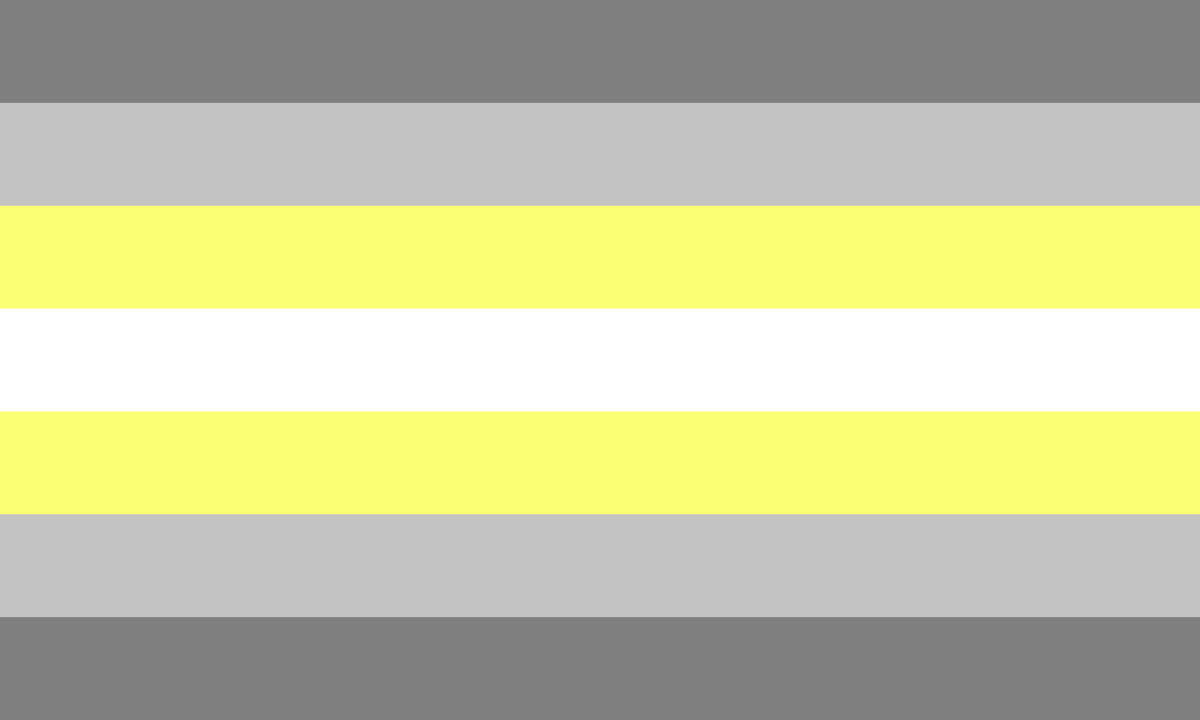
Later renderings use different values. Nikki's 2020 Commons vector uses #FBFF74 for the yellow, a more saturated colour than the original. [2]
Design
- Aspect Ratio
- Variable across renderings · original 477 × 336, about 1.42:1
- Ratio Notes
- The original file is 477 by 336 pixels, about 1.42:1. No proportion was specified for the design and later renderings use their own: Nikki's Commons vector is 5:3, and the Pride-Flags DeviantArt copy is 5000 by 3000, also 5:3. [1][2][3] The archive's own 3:5 production standard is not applied to this record, because the shape of the documented artefact is part of what the record preserves.
- Orientation
- horizontal
- Stripe Count
- 7
- Layout
- horizontal_stripes
- Stripes (Top → Bottom)
- Dark Grey, Light Grey, Pale Yellow, White, Pale Yellow, Light Grey, Dark Grey
Seven horizontal stripes in a mirrored arrangement, dark grey and light grey framing pale yellow around a white centre. The stripes are not equal. In the 477 by 336 pixel original they are 53, 49, 42, 47, 45, 46 and 54 pixels deep from top to bottom, beginning at rows 0, 53, 102, 144, 191, 236 and 282. The outer pair is the deepest and the third stripe the shallowest, and the pattern is close to but not exactly symmetrical about the centre. [1]
No construction sheet, proportion or palette was ever published for the design, so the measurements above describe the file rather than a specification.
Later renderings regularise what the original does not. Nikki's 2020 vector for Wikimedia Commons divides a 35 by 21 field into seven equal stripes of three units and uses #FBFF74 for the yellow. [2] Neither the equal stripes nor that yellow comes from druxydeity's file, and both can be compared against it in the Image Archive.
Seven mirrored horizontal stripes of unequal depth: dark grey, light grey, pale yellow, white, pale yellow, light grey, dark grey.
Usage & Adoption
- Online Usage
- Reblogged on Tumblr; the preserved chain carried 889 notes when read [1], Reuploaded to DeviantArt by Pride-Flags on 4 July 2015 [3], Vectorised for Wikimedia Commons by Nikki on 29 June 2020 [2]
- Current Status
- In circulation since 2014
Circulation is documented; adoption by any person or organisation is not. No example of the flag being flown, printed, sold, or adopted has been located, and the sources that carry it are reblogs, reuploads and redraws. [1][2][3]
Image Archive
Original Artwork
Later Renderings

Discourse & Debates
Common misidentifications
- The design is used for demigender generally as well as for deminonbinary specifically. The overlap is present in the earliest description of it, which gives it as being for "Deminonbinary and sometimes Demigender". [8]
Later sources conflict on who made this flag and when, and the conflict has a traceable shape. SavvyRed's journal names alexander--the-great under a page date of June 2013; the 2018 Majestic Mess interview groups the design with three Salem X made; the preserved reblog chain records druxydeity adding it on 5 April 2014. Only the last is contemporaneous with the design. [1][8][6]
Footnotes & Citations
Sources and footnotes 8 sources
- 1. Social media druxydeity reblog of transrants, "demigirl & demiguy flag proposals". druxydeity, reblogging transrants. Tumblr (2014-04-05). Accessed 2026-08-14
The primary source for this design, preserved in the reblog trail of a later post. It carries both original posts with their Tumblr timestamps, 18 February 2014 for the transrants proposals and 5 April 2014 for druxydeity's addition, druxydeity's one line of text, and all three 477 × 336 images. The original URLs it preserves are http://transrants.tumblr.com/post/77071883543/demigirl-demiguy-flag-proposals and http://druxydeity.tumblr.com/post/81825780580/transrants-demigirl-demiguy-flag-proposals, neither of which still resolves.
- 2. Image file page File:Deminonbinary flag.svg. Nikki. Wikimedia Commons (2020-06-29). Accessed 2026-08-14
A vector redraw released under CC0 1.0, drawn in a text editor with a 35 × 21 viewBox at 1200 × 720. It regularises the design into seven equal stripes and uses #FBFF74, neither of which is in the 2014 file.
- 3. Image file page Deminonbinary (1). Pride-Flags. DeviantArt (2015-07-04). Accessed 2026-08-14
A 5000 × 3000 reupload published 4 July 2015, one of a large batch posted that day. Its description credits the demigender family to transrants and links the demigirl and demiguy proposals, but does not record druxydeity's addition. The page displays a Creative Commons Attribution 3.0 licence. The date belongs to this rendering, not to the design.
- 4. Social media genderheaven reblog of the same chain. genderheaven. Tumblr (2020-08-26). Accessed 2026-08-14 · Archived version
A second preservation of the same trail, from a different reblogger and five years earlier. It carries the same two post identifiers and the same timestamps, which is what makes the dates independent of any one surviving copy.
- 5. Social media transrants (Salem X's blog). Salem X. Tumblr. Accessed 2026-08-14
The blog that posted the two source proposals, kept as a single statement after its owner deleted the rest. It identifies the account: "my name is salem and i created the agender flag."
- 6. Interview Interview: Creator of the Agender Flag. Majestic Mess Designs, with Salem X. Majestic Mess Designs (2018-12-16). Accessed 2026-08-14
An email interview conducted 3 to 12 December 2018. The question groups four flags together and the answer speaks about 2014 as a moment rather than about individual designs, which is how this flag came to be listed among Salem X's.
- 7. Image file page Deminonbinary / Demiandrogyne (3). Pride-Flags. DeviantArt (2015-07-04). Accessed 2026-08-14
A purple-striped alternative posted the same day as the yellow reupload. Unlike that one it states no licence.
- 8. Blogs & Personal Sources Pride Flags Colors explained (journal). SavvyRed. DeviantArt (2013-06-21). Accessed 2026-08-14
A catalogue of pride flags and colour meanings. Its page-level date is 21 June 2013, but it was added to over time and its deminonbinary section links to a Tumblr post whose identifier places it after 18 February 2014. The section is the origin of the colour glosses later sites repeat, and of the attribution to alexander--the-great.
Image Sources
- Rendering
- Archive reconstruction of the 2014 original
- Vector reconstruction at the original's 477 × 336 proportion, with its measured stripe depths and colour values. [1] · Credit: Encycloflaggia reconstruction after druxydeity · Measured from the 2014 original · 477 × 336 · Rights in the underlying design unresolvedDrawn for this entry from measurements of druxydeity's file, which is published beside it in the Image Archive at its original size and bytes.
- The design as its maker posted it, added to a reblog of transrants's demigirl and demiguy proposals. [1] · Credit: druxydeity · Tumblr · 5 April 2014 · 477 × 336 · No licence located; rights unestablishedRights druxydeity published the file on Tumblr without a licence statement, and no later statement has been located. Copyright is presumed to rest with the maker. Reproduced here at its original size and bytes as the documentary record of the design.
- A later redraw, included to show how the design was regularised in circulation. [2] · Credit: Nikki · Wikimedia Commons · 29 June 2020 · 1200 × 720 · CC0Rights Nikki released this redraw under CC0 1.0. The dedication covers Nikki's file only and says nothing about rights in druxydeity's 2014 artwork.