Enbian Pride Flag (2016, enbians)
Identity Pride Flag ·
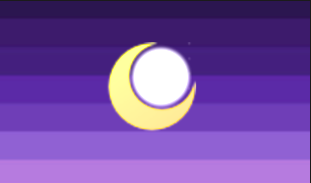
A gradient flag for enbian identity, a nonbinary person attracted to nonbinary people, or a relationship containing no binary people. Seven purple bands with softened boundaries, running near-black to mauve, charged with a yellow crescent and an off-white disc. Posted by the Tumblr user enbians on 25 August 2016 as a nomination rather than a finished flag.


Key facts
- Designer
- enbians (Tumblr handle)
- Created
- First documented public use
- In use
- 2016 to present
- Aspect Ratio
- 3:5 · standard
- Stripes
- 7
- Represented Identity
- enbian
Also known as
- NB4NB Flag
- Enby-attracted-to-enbies Flag
Status Proposed
Archive categories Sexual & Romantic Orientation Pride Flags
Overview
To provide a dedicated visual symbol for enbian identity, representing nonbinary people who experience attraction to other nonbinary people. The flag addressed a gap in the existing pride flag landscape, where orientation flags overwhelmingly assumed binary gender on at least one side of the attraction. [1]
enbians posted the flag on Tumblr on 25 August 2016, presenting it as a nomination and inviting other proposals. [2] It was the first flag in what would become the trixic/toric/enbian triad. The trixic and toric flags followed over a year later in October 2017.
Identity & Context
- Represented Identity
- enbian
- Subcommunity
- nonbinary orientation
- Language Context
- The archive gives the term both ways. As a noun: "A nonbinary person attracted (exclusively or not) to nonbinary people, or in a relationship that contains no binary individuals." As an adjective: "Describing a relationship between nonbinary people, a nonbinary person fitting the definition of enbian above, or a community of enbians." It adds that "Enbian is similar to sapphic and achillean, but can function as a noun and concerns all nonbinary genders rather than a specific gender." [3]
Creators
The Creator
enbians
Designer
enbians is a pseudonymous Tumblr handle credited as the designer of the enbian pride flag, posted on 25 August 2016 together with a statement of meaning for each element of the design and, in a follow-up reply, a further note on the disc. [2] No biographical information about the person behind the handle has been verified.
my nomination for the enbian flag
if no one else comes forward with another proposal, maybe it'll even be our official flag
Motivations
- To create a visual symbol for enbian identity, giving nonbinary people attracted to other nonbinary people a distinct flag. [1]
Attribution notes
Attributed to the Tumblr user enbians, who posted the design on 25 August 2016 and called it "my nomination for the enbian flag", adding that "if no one else comes forward with another proposal, maybe it'll even be our official flag". [2] Pride-Flags published its own version on 21 December 2016, four months later; unlike several entries of this period, the archive's upload postdates the original rather than preceding it. [3]
Origin
- Digital Origin
- Yes
No verified physical origin location. Without a confirmed location, Indigenous land context cannot be attributed.
Originated on Tumblr. No physical location of creation is documented. [1]
Dates & Chronology
- Year Created
- Exact date
- First public use
- Period in Use
- 2016 to present
The enbians 2016 design is the original, though its gradient-and-emblem composition has made it less straightforward to reproduce than simpler stripe flags, and the versions in circulation differ from it. [1][2] Several alternates have appeared: the-ross-winchester created a redesign in October 2017, nblnb offered another in June 2018, and an anonymous wiki user introduced a simplified three-stripe version in 2021 that has gained adoption due to its ease of reproduction. [1]
Enbian is part of a triad of nonbinary orientation terms alongside trixic (nonbinary attraction to women) and toric (nonbinary attraction to men). The enbian flag preceded the other two by over a year.
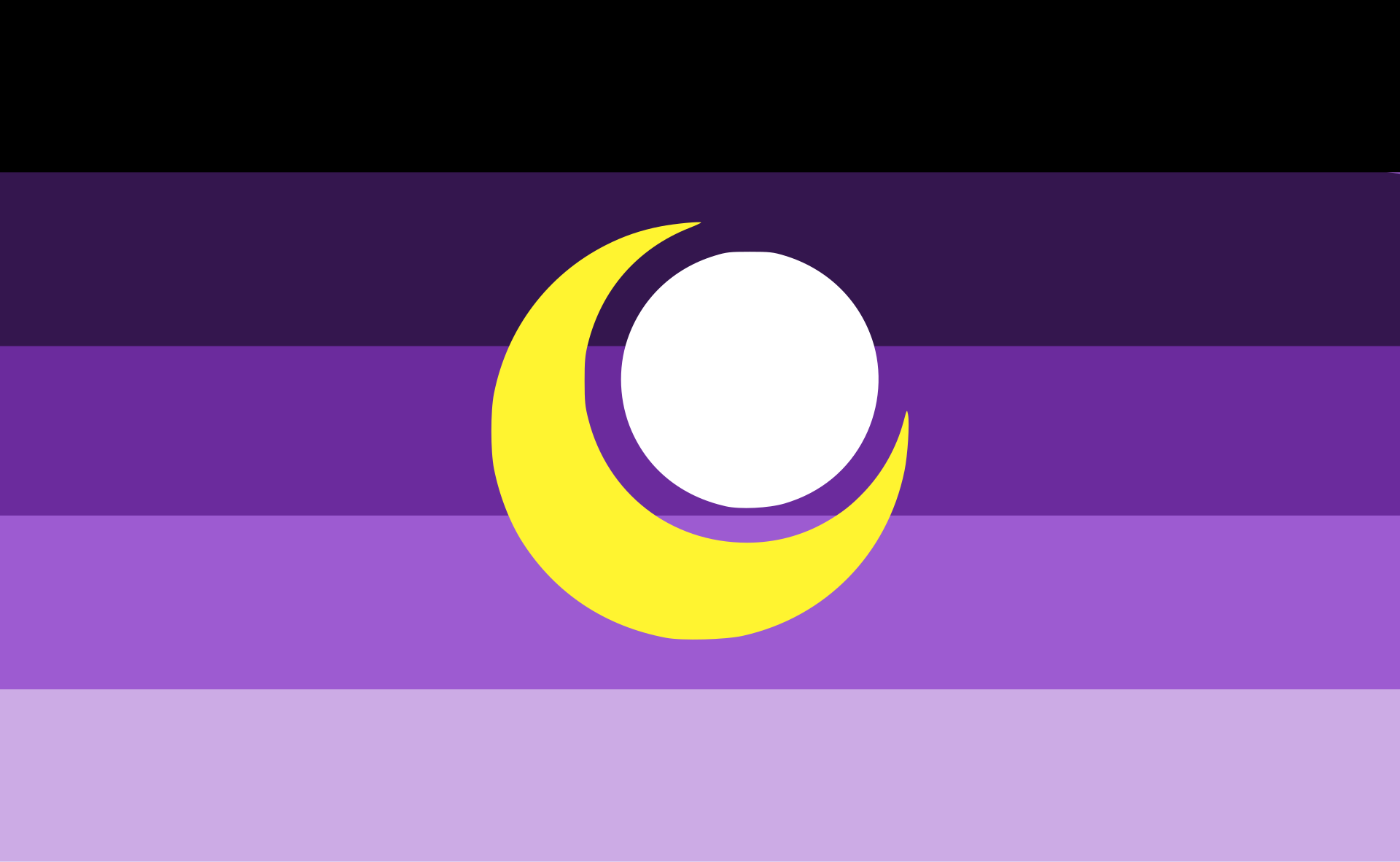
The design that circulates most widely is not the one enbians posted. The rendering on Wikimedia Commons, uploaded by Mangostaniko on 1 June 2018 and described there as "one of the proposals", replaces the gradient with five hard-edged bands running black to pale lavender, and enlarges the crescent so that it wraps most of the disc. It carried this entry's illustration until August 2026 and remains in the Image Archive as a separate proposal.
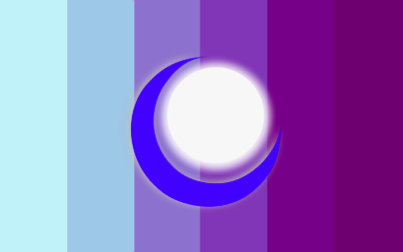
enbians posted two further variants the following day, 26 August 2016: one keeping the horizontal purple gradient at a higher saturation, and one running the stripes vertically in pale cyan through blue to dark purple, with a blue crescent in place of the yellow. [4]
Lineage
The enbian flag completes the trixic/toric/enbian triad of nonbinary orientation flags. Unlike its siblings, the original uses a gradient field with celestial symbols rather than simple horizontal stripes. The 2021 three-stripe simplification brings the enbian flag closer to the visual idiom of the trixic and toric flags. [1]
Colors & Symbolism
enbians published a meaning for each element. The purple gradient "represents how no two nonbinary genders are exactly alike, but they can all coexist under one umbrella term, as long as the differences between them are acknowledged". The yellow moon "represents how someone's feelings and self-perceptions can change over time", and "its crescent shape reminds us that some part of our identity was once hidden, and that we must now conceal that part of ourselves from anyone who would wish us harm". The colorless circle "represents how, as per the human experience, there are things we understand but cannot explain about how we know our genders. Identification transcends human language." [2]
| Colour | Hex | Meaning | Note |
|---|---|---|---|
| Purple | #4C2980 | "No two nonbinary genders are exactly alike, but they can all coexist under one umbrella term, as long as the differences between them are acknowledged." [2] | Sampled from the 310 by 182 copy of the 2016 original recovered from the Wayback Machine [2] |
| Near Black | #1B0C36 | — | Sampled from the 310 by 182 copy of the 2016 original recovered from the Wayback Machine [2] |
| Deep Violet | #28104A | — | Sampled from the 310 by 182 copy of the 2016 original recovered from the Wayback Machine [2] |
| Indigo | #2D1357 | — | Sampled from the 310 by 182 copy of the 2016 original recovered from the Wayback Machine [2] |
| Violet | #3E1B74 | — | Sampled from the 310 by 182 copy of the 2016 original recovered from the Wayback Machine [2] |
| Light Purple | #644294 | — | Sampled from the 310 by 182 copy of the 2016 original recovered from the Wayback Machine [2] |
| Mauve | #7F559D | — | Sampled from the 310 by 182 copy of the 2016 original recovered from the Wayback Machine [2] |
| Yellow (crescent) | #FEE700 | — | Median of the crescent interior on the recovered copy [2] |
| Off-White (disc) | #F7F7F7 | — | Sampled from the recovered copy; the disc is not pure white [2] |
- Yellow crescent moon
- "Represents how someone's feelings and self-perceptions can change over time... Its crescent shape reminds us that some part of our identity was once hidden, and that we must now conceal that part of ourselves from anyone who would wish us harm." [2]
- Colorless circle
- "Represents how, as per the human experience, there are things we understand but cannot explain about how we know our genders. Identification transcends human language." In a follow-up reply enbians added that the filled part of the circle is "symbolic of the unity of two (or more) individuals who are bound together in love similarly to how light is bound to the moon". [2]
The meanings are enbians' own, quoted from the 2016 post and its follow-up reply. [2] They describe the original design; the simplified 2021 three-stripe version may carry different or adapted symbolism that is not documented in available sources.
Measured on the only copy of the 2016 original located, a 310 by 182 pixel PNG recovered from a 2023 Wayback capture of the post. At that size the band boundaries are blurred and the file carries compression noise, so each value is the median of a band's interior rather than a flat read; they are close approximations of the original, not the designer's specification. [2]
The entry previously gave five values sampled from its own illustration. That illustration is Mangostaniko's separate 2018 Commons rendering, not the enbians design, and its five hard-edged bands are a different construction from the seven blended ones here. [5]
Pride-Flags' redraw of December 2016 is a third flag rather than a recolouring: seven hard steps running #261F4F, #37296B, #3C307C, #5141A5, #6551B5, #8670D1 and #AB89DD, with the crescent at #FFEFA1. All three are recorded because all three circulate. [3]
Design
- Aspect Ratio
- 3:5 · standard
- Orientation
- horizontal
- Stripe Count
- 7
- Layout
- gradient_field_with_emblem
- Stripes (Top → Bottom)
- Near Black, Deep Violet, Indigo, Violet, Purple, Light Purple, Mauve
- Center Symbol
- Off-white disc within a yellow crescent
Seven bands of equal depth on the surviving copy, each about 26 rows of 182, with the boundaries blurred over roughly four rows rather than cut cleanly. The moon sits left of centre: the yellow disc is 83 pixels across on a 310 by 182 field, centred at 49 percent of the width and 47 percent of the height, and the off-white disc, 49 pixels across, sits inside it and up and to the right, so the yellow survives as a crescent on the lower left. Pride-Flags' December redraw uses seven hard-edged bands. [2][3]
A purple field graded from near-black at the top to mauve at the bottom in seven softly blended steps, with an off-white disc set inside a slightly larger yellow disc so that the yellow reads as a crescent. Not a stripes-only design; the blending makes exact reproduction dependent on reference imagery.
Seven softly blended bands running #1B0C36, #28104A, #2D1357, #3E1B74, #4C2980, #644294, #7F559D from top to bottom, with a yellow #FEE700 disc charged with an off-white #F7F7F7 disc offset up and to the right, leaving a crescent. Pride-Flags' redraw of December 2016 runs seven hard-edged steps instead, #261F4F, #37296B, #3C307C, #5141A5, #6551B5, #8670D1, #AB89DD, with a paler #FFEFA1 crescent. The Commons rendering by Mangostaniko is a third design again: five hard bands, #000000, #34164E, #6B2B9D, #9D5BD1, #CCABE5, with a #FFF430 crescent wrapping a #FFFFFF disc. [2][3][5]
Usage & Adoption
- Online Usage
- Reproduced in nonbinary orientation flag guides including the LGBTQIA+ Wiki. [1]
- Current Status
- active
The original enbians 2016 design and the simplified 2021 three-stripe version both circulate. The visual complexity of the original may have contributed to the adoption of simpler alternatives. [1]
Image Archive
The 2016 Original

Designer Variants
Other Proposals
Archive Reconstruction
Discourse & Debates
- Whether the simplified 2021 three-stripe version should be considered a replacement for or a companion to the original 2016 gradient design. Both versions circulate, and there is no formal community consensus on which is primary.
Common misidentifications
- Enbian is sometimes confused with the broader nonbinary identity itself. Enbian specifically describes attraction between nonbinary people, not nonbinary identity in general.
- At least three distinct designs circulate under this name: the enbians original of August 2016, the Pride-Flags redraw of December 2016, and Mangostaniko’s five-band Commons rendering of June 2018. They differ in band count, palette and moon geometry, and are not versions of one another. [2][3][5]
Enbian describes a nonbinary person attracted to other nonbinary people. The term is also sometimes written as nblnb (nonbinary-loving-nonbinary). [1]
Footnotes & Citations
Sources and footnotes 6 sources
- 1. Enbian. LGBTQIA+ Wiki. Accessed 2026-04-26
- 2. Archived Sources enbians, enbian flag nomination post. enbians. Tumblr (2016-08-25). Accessed 2026-08-16 · Archived version
The original post, recovered from a 2023 Wayback capture; the live page no longer serves. Carries the flag image, a meaning for each element of the design, and the nomination language.
- 3. Image file page Enbian (1). Pride-Flags. DeviantArt (2016-12-21). Accessed 2026-08-16
The archive’s seven-step redraw, with a definition distinguishing the term’s noun and adjective uses.
- 4. Archived Sources enbians, enbian flag variants. enbians. Tumblr (2016-08-26). Accessed 2026-08-16 · Archived version
Two further designs posted the day after the nomination, one a brighter recolouring and one running its stripes vertically.
- 5. Image file page File:Enbian Pride flag.svg. Mangostaniko. Wikimedia Commons (2018-06-01). Accessed 2026-08-16
A five-band rendering described on Commons as one of the proposals, with its first proposer unrecorded. It is a different design from the enbians original.
- Blogs & Personal Sources FAQ. Mod Hermy, with Mod Tath and Mod Ez. pride-color-schemes (Tumblr). Accessed 2026-08-16
States the project’s crediting practice and its terms of reuse.
Image Sources
- Rendering
- enbians (2016), as recovered
- Encycloflaggia reconstruction of the 2016 enbians design, measured from the recovered copy · Credit: Design: enbians; reconstruction by Encycloflaggia · Encycloflaggia · reconstructionRights Archive-produced reconstruction; no terms of reuse have been located from enbians
- The 310 by 182 image carried in the enbians post, recovered from a 2023 Wayback capture · Credit: enbians, 25 August 2016 · Tumblr, via the Wayback Machine · verifiedRights No licence stated; no terms of reuse located from enbians
- Mangostaniko’s five-band SVG, described on Commons as one of the proposals · Credit: Mangostaniko, 1 June 2018 · Wikimedia Commons · verifiedRights CC0 1.0 Universal (Public Domain Dedication)
- The 2016 original as it survives: 310 by 182 pixels, the image carried in the enbians post of 25 August 2016, recovered from a 2023 Wayback capture because the live post no longer serves. This is the artifact the entry's colours and geometry are measured from, and the only located copy. [2] · Credit: enbians, 25 August 2016 · Tumblr, via the Wayback Machine · No licence stated; no terms of reuse located from enbians
- A variant enbians posted the following day, 26 August 2016, keeping the horizontal gradient and the moon but running the purples brighter. 311 by 183 pixels. [4] · Credit: enbians, 26 August 2016 · Tumblr, via the Wayback Machine · No licence stated; no terms of reuse located from enbians
- The second variant of 26 August 2016, and the most different: the stripes run vertically, the palette moves from pale cyan through blue to dark purple, and the crescent is blue rather than yellow. 403 by 252 pixels. [4] · Credit: enbians, 26 August 2016 · Tumblr, via the Wayback Machine · No licence stated; no terms of reuse located from enbians
- Mangostaniko’s rendering, uploaded to Wikimedia Commons on 1 June 2018 and described there as "one of the proposals" with its first proposer unrecorded. It is a separate design, not a rendering of the enbians flag: five hard-edged bands instead of seven blended ones, and a crescent that wraps most of the disc. It illustrated this entry until August 2026. [5] · Credit: Mangostaniko, 1 June 2018 · Wikimedia Commons · CC0 1.0 Universal (Public Domain Dedication)
- The archive's reconstruction, normalised to 3:5, built to the seven band values and the moon geometry measured on the recovered original. The reconstruction draws clean edges where the surviving copy is blurred by its own compression. [2] · Credit: Design: enbians; reconstruction by Encycloflaggia · Encycloflaggia reconstruction · Archive-produced reconstruction; no terms of reuse have been located from enbians