Genderflux Pride Flag
Identity Pride Flag ·
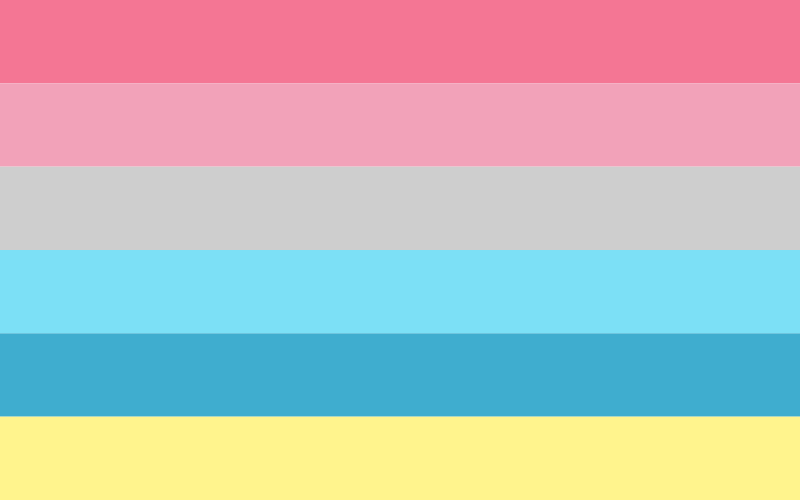
Genderflux describes gender that changes in intensity rather than necessarily from one identity to another. [1] An unnamed contributor submitted this six-stripe Genderflux Pride Flag to the Tumblr community flag blog pride-flags-for-us on 4 December 2014. [2][3] The post identifies pink and blue with female and male identities, pale pink and blue with demigirl and demiboy identities, grey with agender or gender-neutral identities, and yellow with identities outside the binary. [2]
Key facts
- Designer
- Unnamed Tumblr submitter
- Created
- First documented public use
- In use
- Documented from 2014, with later circulation through the present
- Aspect Ratio
- 3:5 · standard
- Stripes
- 6
- Represented Identity
- genderflux
Also known as
- Genderflux Flag
Archive categories Gender Identity Pride Flags
Overview
In the submitter's words, the flag was made "at my friend's suggestion". [2]
The modern genderflux definition circulated on Tumblr from mid-2014: the community catalog mogai-archive's entry for the term, credited to deergoths, carries an original date of 20 July 2014. [4] Surviving sources attribute the term to bigendeer or deergoths, names later references treat as one person. [1][5][6] Two flag proposals reached pride-flags-for-us on 4 December 2014. Tumblr user nopadsnohelmets submitted a square gradient design, based on the demigender flag, at 00:39:31 UTC; the now-standard six-stripe design followed at 03:05:52 UTC, 2 hours, 26 minutes and 21 seconds later, from a contributor the record does not name. [7][2][3] No surviving source says the six-stripe designer drew on the gradient proposal: it is an earlier same-day proposal, not a parent design. [7]
Identity & Context
- Represented Identity
- genderflux
- Subcommunity
- nonbinary umbrella
Creators
Creator unknown
No identification located
The flag was submitted anonymously to pride-flags-for-us, a community flag blog on Tumblr, on 4 December 2014, and no surviving source identifies the submitter. The post is tagged as a submission and carries the submitter's own statement: "Here's a genderflux flag I made at my friend's suggestion." [2][3] The submitter designed and submitted the flag; the friend suggested the idea and is not documented as a co-designer, and the blog's moderators are not documented as the designers. [2] An attribution to Tumblr user campcounseling around 2012 appears in one uncited institutional guide, which also describes a five-stripe design, and is contradicted by the primary record. [8] Wikimedia Commons reproductions credit deergoths as author; deergoths is the name later references attach to the term's coining, and the surviving 2014 post attributes the flag to its unnamed submitter, so the Commons author field likely conflates the attributed term coiner with the flag's designer. [9][10][2]
Contribute information about who designed this flag.
Attribution
- Primary Designer
- Unnamed Tumblr submitter
Origin
- Digital Origin
- Yes
Digital origin; no verified physical location.
The flag originated on Tumblr, submitted to pride-flags-for-us, a moderated community blog that described itself as "a safe place for those without flags (and usually without recognition) to create something to represent themselves." [2]
Dates & Chronology
- Year Created
- Exact date
- First public use
- Period in Use
- Documented from 2014, with later circulation through the present
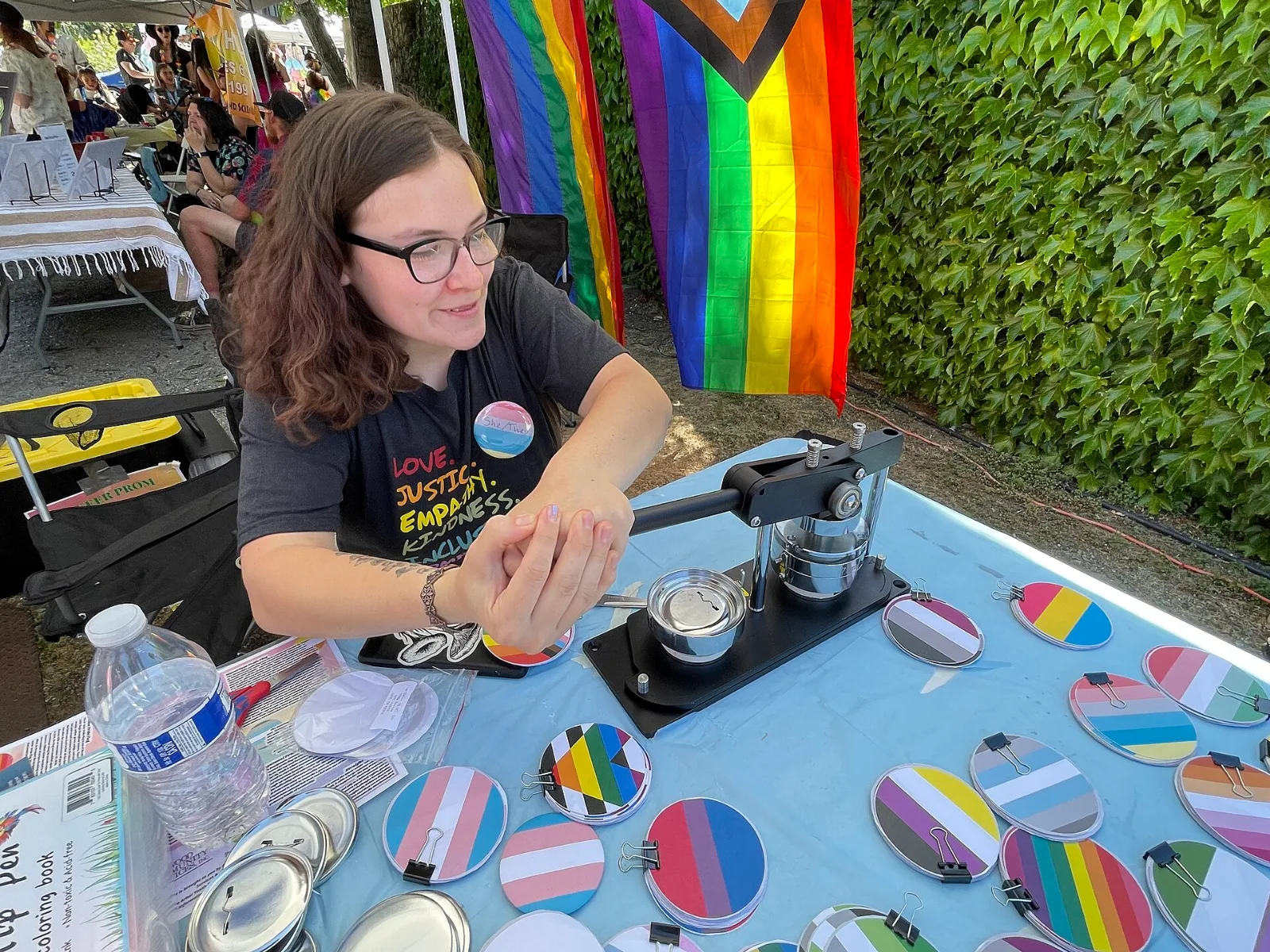
The hosting blog's moderators were quoting the origin post's meanings as the flag's meanings by August 2015. [11] On 3 July 2015 at 22:55:31 PDT, which is 4 July by UTC, the DeviantArt archive account Pride-Flags published a 5000 by 3000 pixel master of the design, crediting "pride-flags-for-us.tumblr.com/ (I think)"; ten seconds later it published a separate seven-stripe variant with yellow bands at both edges. [12][13] Reference sources that date the design to 4 July 2015 are reading the same upload in UTC. [6][12] By 2018 and afterward the standard design appeared in dictionary, community, Wikimedia and institutional reference materials: Dictionary.com illustrated its genderflux entry with the flag by October 2018, and Wikimedia Commons carries reproductions uploaded in 2020 and 2025. [14][9][10][15] On 20 May 2023 the design appeared on button-making material photographed at Mendocino Pride in Hopland, California. [16]
Genderflux describes change in the intensity or strength of gender rather than necessarily movement from one gender identity to another; genderfluid is the related concept for movement between genders. [1][6] Alternative designs circulated alongside the standard one: an unnamed submitter posted an alternative genderflux flag with its own meanings to the same blog on 19 July 2015, and by July 2016 the catalog blog pride-color-schemes documented seven genderflux designs then in circulation. [17][18]
Lineage
Genderflux is conceptually adjacent to genderfluid, which involves movement between genders rather than change in intensity; the relationship is an identity comparison, and no primary source connects the Genderfluid Pride Flag to this design. [1][6] The square gradient proposal submitted by nopadsnohelmets earlier on 4 December 2014 is an earlier same-day proposal, not a documented ancestor. [7] The later boyflux, girlflux, genderfae and genderfaun flags share the flux vocabulary; no source documents design inheritance from this flag.
Colors & Symbolism
The meanings were published with the flag: "The pink and blue are for female and male; the pale pink and blue for demigirl and demiboy; the gray for agender or genderneutral; and the yellow for identities outside the binary." [2] The arrangement runs from feminine shades through a neutral grey centre to masculine shades, with yellow set apart at the bottom.
| Colour | Hex | Meaning |
|---|---|---|
| Dark Pink | #F47694 | Female. [2] |
| Light Pink | #F2A2B9 | Demigirl. [2] |
| Grey | #CECECE | Agender or genderneutral. [2] |
| Light Blue | #7CE0F7 | Demiboy. [2] |
| Dark Blue | #3ECDF9 | Male. [2] |
| Yellow | #FFF48D | Identities outside the binary. [2] |
Measured from the lossless July 2015 Pride-Flags archival master; the same value appears in Dictionary.com's 2018 illustration and Mid-South Pride's current vector. Not creator-issued. [12][14][15]
This flag has no official digital palette. Color values shown are approximate.
Meanings as published with the flag on 4 December 2014. [2] Guides circulate a simplified set, women, demigirls, agender, demiboys, men, nonbinary, that tracks the original wording while dropping "genderneutral" and narrowing "identities outside the binary" to "nonbinary". [6][19] The reading of the grey centre stripe as the zero-intensity point of genderflux experience is a later guide interpretation, not creator language. [6]
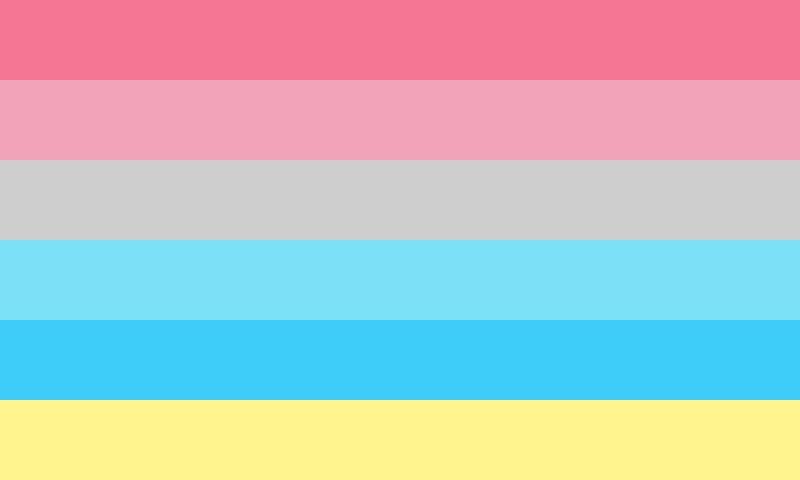
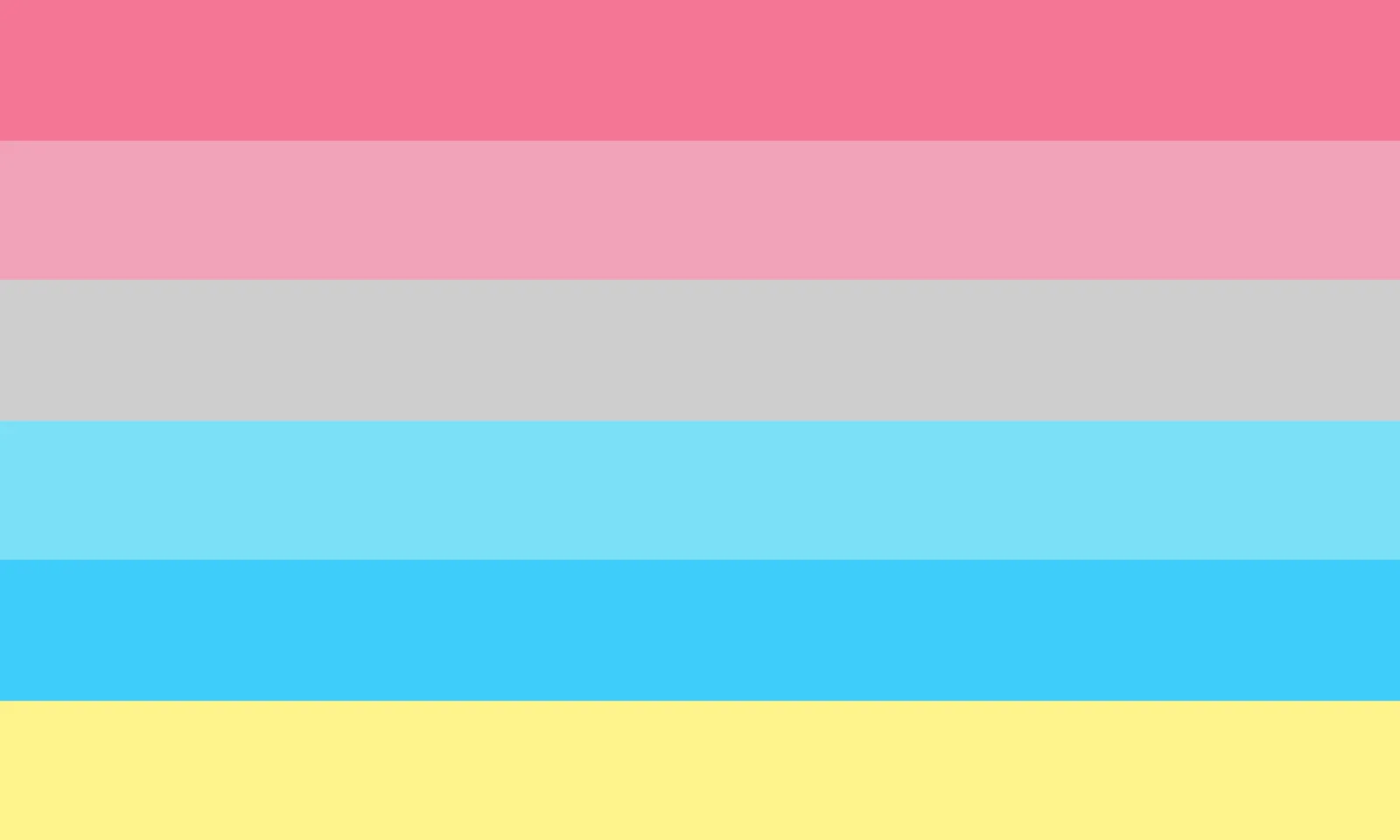
No hex values were creator-issued: the December 2014 post names its colors in words. [2] The values above are measured from the lossless 5000 by 3000 master the DeviantArt archive account Pride-Flags published in July 2015. [12] The currently accessible copy of the 2014 Tumblr source image is an 800 by 480 JPEG transcode measuring #F57694, #F2A3B9, #CECECE, #7CE0F7, #3ECDF9 and #FFF48E, small differences that are file-specific and likely introduced in transcoding; the two files are close but not literally identical. [20] Dictionary.com's 500 by 300 illustration, in circulation by October 2018, uses the six archival-master values exactly in equal 50-pixel stripes, and Mid-South Pride's current vector uses the same palette: later matches that demonstrate the archival palette's circulation, not creator-issued specifications. [14][15] The published SchemeColor and FlagColorCodes code sets each differ from these values by one to two points on several stripes, and SchemeColor's color names are its own inventions. [21][19]
Design
- Aspect Ratio
- 3:5 · standard
- Orientation
- horizontal
- Stripe Count
- 6
- Layout
- horizontal_stripes
- Stripes (Top → Bottom)
- Dark Pink, Light Pink, Grey, Light Blue, Dark Blue, Yellow
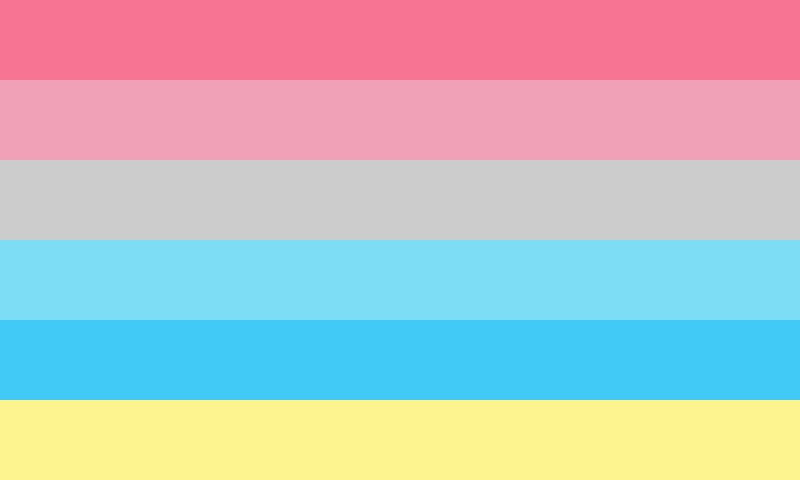
The December 2014 source image measures 800 by 480 pixels, exactly 3:5, with six equal 80-pixel stripes. [20] The July 2015 archival master measures 5000 by 3000 pixels, also exactly 3:5, but its stripes are not equal: measured heights are 502, 497, 504, 496, 504 and 497 pixels. [12] The flag image shown on this page is a reconstruction, drawn at 800 by 480 with six equal stripes and the palette measured from the lossless 2015 master; it is not an untouched primary artifact.
Six equal horizontal stripes ordered top to bottom: dark pink, light pink, grey, light blue, dark blue, yellow, as in the December 2014 source image. [20]
A six-stripe horizontal flag. The arrangement moves from feminine-associated colors (dark pink, light pink) through a neutral grey centre to masculine-associated colors (light blue, dark blue), with yellow at the bottom for identities outside the binary. [2][20]
Usage & Adoption
- Online Usage
- Circulated from Tumblr and the DeviantArt flag archives from 2014 and 2015; later carried by dictionary, wiki and institutional reference guides and by Wikimedia Commons [12][14][6][9][15]
- Event Usage
- Badge material at the Mendocino Pride button-making table, Hopland, California, 20 May 2023 [16]
- Current Status
- active
The design is active in reference use: Dictionary.com illustrates its genderflux entry with it, Wikimedia Commons and English Wikipedia's pride flag gallery carry reproductions, and organizational pride guides reproduce it. [14][9][15] Documented physical use is badge material at a 2023 community event. [16]
Image Archive
Original Artwork
Renderings
Later Reproductions


The Flag in Use

Discourse & Debates
- Whether genderflux is a distinct axis of experience or a subset of genderfluidity is handled both ways in the reference record: the LGBTQIA+ Wiki presents it as a genderfluid microlabel, while the coining-era definition kept intensity and kind apart. [6][1]
Common misidentifications
- Genderflux is frequently confused with genderfluid. Genderfluid describes shifts between different genders, while genderflux describes changes in the intensity or degree of gender experience. [6][1]
- Institutional guides carry documentation errors: Mid-South Pride displays the six-stripe design while its prose describes a five-stripe flag with a different palette, and the San Francisco Gay Men's Chorus guide describes a five-stripe design attributed to Tumblr user campcounseling in 2012, an attribution contradicted by the primary record. Neither guide is reliable for the flag's origin, creator, geometry or symbolism. [15][8]
- Wikimedia Commons' reproductions credit deergoths as the flag's author. Deergoths is the name later references attach to the term's coining, and the surviving 2014 post attributes the flag to an unnamed submitter; the Commons author field likely conflates the attributed term coiner with the flag's designer. [9][10][2]
Criticisms
- The December 2014 gradient proposal drew immediate design criticism for resembling the pansexual flag. [7]
The modern sense, variation in the intensity of a gender identity, dates to mid-2014 on Tumblr: mogai-archive's catalog entry, credited to deergoths, carries an original date of 20 July 2014, and the era's resource page crushingthebinary credited the coinage to "tumblr user bigendeer (thank you!)". [4][1] Dictionary.com credits Deergoths; later references treat deergoths and bigendeer as one person, and neither original account is archived, so the attribution rests on incomplete evidence. [5][6][22] Genderflux is also used as a noun and a verb. [1] Earlier, unrelated uses of the word predate the identity sense: Dictionary.com traces genderflux for "shifting between genders" to a 1994 Queer Pagans newsletter. [5]
Footnotes & Citations
Sources and footnotes 22 sources
- 1. Social media Genderflux Information and Resources (archived term definition). crushingthebinary (Tumblr) (by 2015-07-03). Accessed 2026-08-15 · Archived version
- 2. Social media Here's a genderflux flag I made at my friend's suggestion (origin post). Unnamed submitter. pride-flags-for-us (Tumblr) (2014-12-04). Accessed 2026-08-15 · Archived version
- 3. Social media Reblog of the origin post preserving its text, image and machine timestamp (posted 2014-12-04T03:05:52Z). prideaesthetic (Tumblr) (2016). Accessed 2026-08-15
- 4. Social media mogai-archive genderflux entry, preserved (archived term definition). lgbtqiarchive (Tumblr), preserving mogai-archive (original 2014-07-20). Accessed 2026-08-15
- 5. Reference What Does Genderflux Mean?. Dictionary.com (Gender & Sexuality Dictionary) (2018-11-06). Accessed 2026-08-15
- 6. Encyclopedias & Reference Genderflux. LGBTQIA+ Wiki (Fandom). Accessed 2026-08-15
- 7. Social media hi! so i tried to create a genderflux flag (earlier same-day gradient proposal). nopadsnohelmets. pride-flags-for-us (Tumblr) (2014-12-04). Accessed 2026-08-15 · Archived version
- 8. Organizations Pride flags guide. San Francisco Gay Men's Chorus. Accessed 2026-08-15
- 9. Image file page File:Genderflux Pride Flag.png (2020 raster). Wikimedia Commons (2020-08-02). Accessed 2026-08-15
- 10. Image file page File:Genderflux Pride Flag.svg (2025 SVG remake). Argenti Aertheri (uploader). Wikimedia Commons (2025-07-16). Accessed 2026-08-15
- 11. Social media Someone asked for the genderflux flag but I posted the wrong gender and flag!. Cyzu (mod). pride-flags-for-us (Tumblr) (2015-08-27). Accessed 2026-08-15 · Archived version
- 12. Image file page Genderflux (1) (5000 by 3000 archival master). Pride-Flags. DeviantArt (Pride-Flags) (2015-07-03). Accessed 2026-08-15 · Archived version
- 13. Image file page Genderflux (2) (seven-stripe variant). Pride-Flags. DeviantArt (Pride-Flags) (2015-07-03). Accessed 2026-08-15 · Archived version
- 14. Image file page Dictionary.com genderflux article illustration (500 by 300 pixels). Dictionary.com (2018-10). Accessed 2026-08-15
- 15. Organizations Genderflux Pride Flag. Mid-South Pride. Accessed 2026-08-15
- 16. Image file page File:Mendocino Pride 2023 - Sarah Stierch - 9.jpg. Sarah Stierch. Wikimedia Commons (2023-05-20). Accessed 2026-08-15
- 17. Social media an alternative genderflux flag. pride-flags-for-us (Tumblr) (2015-07-19). Accessed 2026-08-15 · Archived version
- 18. Social media Genderflux (catalog of seven designs). pride-color-schemes (Tumblr) (2016-07-31). Accessed 2026-08-15
- 19. Reference Genderflux Flag Color Codes. FlagColorCodes. Accessed 2026-08-15
- 20. Image file page Original genderflux flag image, 800 by 480 pixels (media ID tumblr_ng1f8sXEt61ttq5l9o1). Tumblr CDN (2014-12-04). Accessed 2026-08-15
- 21. Reference Genderflux Flag Colors Hex, RGB & CMYK Codes. SchemeColor. Accessed 2026-08-15
- 22. Encyclopedias & Reference Genderflux. Nonbinary Wiki (last edited 2023-12-12). Accessed 2026-08-15
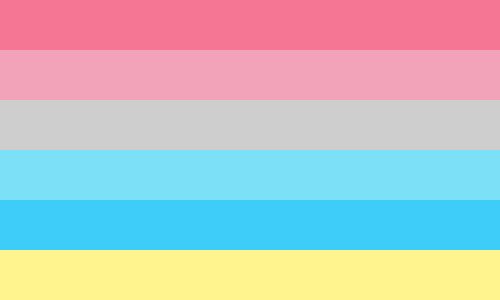
Image Sources
- Rendering
- six-stripe standard
- Button making at Mendocino Pride, 20 May 2023; genderflux disc at center right · Credit: Sarah Stierch (Commons username Missvain) · Wikimedia Commons · verified
- The flag image from the 4 December 2014 submission to pride-flags-for-us, 800 by 480 pixels with six equal stripes. This copy is served by Tumblr's media CDN as a JPEG transcode of the original upload. [20] · Credit: Unnamed submitter, via pride-flags-for-us (Tumblr) · Tumblr CDN, media ID tumblr_ng1f8sXEt61ttq5l9o1 · No explicit license in the surviving post
- Genderflux (1), the 5000 by 3000 archival master published by the DeviantArt archive account Pride-Flags on 3 July 2015 at 22:55:31 PDT, 4 July by UTC, crediting "pride-flags-for-us.tumblr.com/ (I think)". Its measured stripe heights are 502, 497, 504, 496, 504 and 497 pixels, and its palette is the one reference reproductions carry. [12] · Credit: Pride-Flags (DeviantArt archive account) · DeviantArt · Uploader states the files in its gallery are free to use for pride-related purposes
- Genderflux (2), a seven-stripe variant with yellow at both edges, published by Pride-Flags ten seconds after the six-stripe master. [13] · Credit: Pride-Flags (DeviantArt archive account) · DeviantArt · CC BY 3.0, per the DeviantArt record
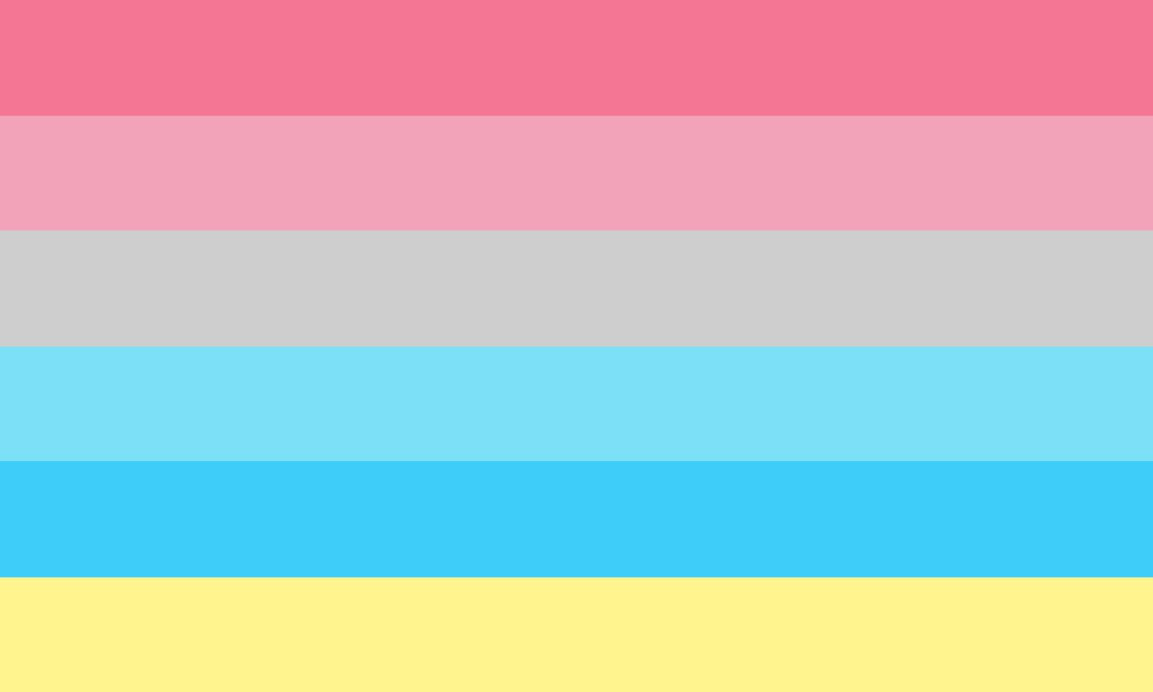
- The Wikimedia Commons raster, 1153 by 692 pixels, uploaded 2 August 2020 and used in English Wikipedia's pride flag gallery. Its author field credits deergoths, the name later references attach to the term's coining; the surviving 2014 post attributes the flag to an unnamed submitter. [9] · Credit: Uploaded by Commons user Pretty Guardian Sailor Venus, sourced from Nonbinary Wiki · Wikimedia Commons · CC BY-SA 4.0
- Button making at Mendocino Pride, Hopland, California, 20 May 2023. A genderflux disc sits at center right among the button papers. The design appears on button-making material, not as a flown flag. [16] · Credit: Sarah Stierch, CC BY 4.0, via Wikimedia Commons · Wikimedia Commons, own work · CC BY 4.0
- SVG remake uploaded to Wikimedia Commons on 16 July 2025 by Argenti Aertheri, marked public domain under a threshold-of-originality rationale. Its hex values differ slightly from the archival master's. [10] · Credit: Argenti Aertheri, via Wikimedia Commons · Wikimedia Commons · Public domain, threshold-of-originality rationale per the file page
- The reconstruction drawn for this entry: 800 by 480 with six equal stripes, combining the source image's equal-stripe geometry with the palette measured from the 2015 archival master. [20][12] · Credit: Encycloflaggia reconstruction · Encycloflaggia · No ownership is claimed over the underlying design