Aporagender Pride Flag
Identity Pride Flag ·
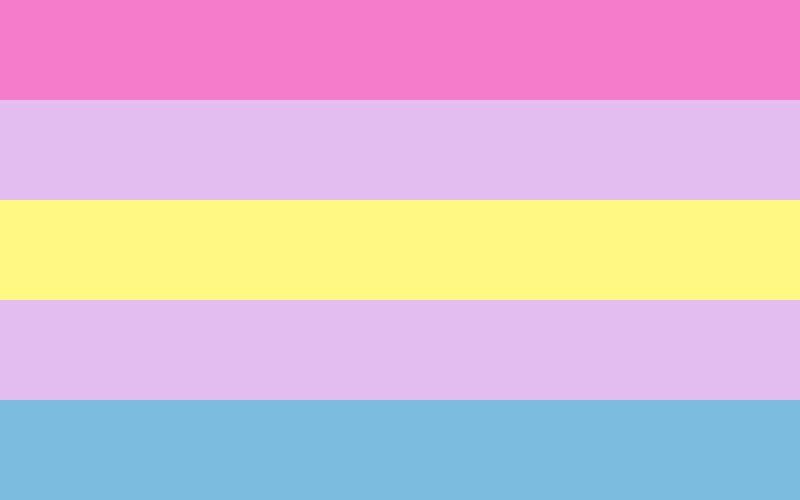
A five-stripe flag for Aporagender identity, published by the Tumblr blog Pride Flags For Us on 13 June 2014. Its pink, lavender, yellow, lavender and blue bands place a distinctly nonbinary gender at the centre, separate from male, female and in-between combinations [1]. Contemporary sources credit Hyaenahart, also identified as Mod Lex, as the designer, although Tumblr records the root post as a submission from fireprincette [1] [2]. The term itself is four days older than the flag: Lily, the Aporagender blog’s original moderator, coined it on 9 June 2014 [3].
Key facts
- Designer
- Hyaenahart (Mod Lex)
- Created
- First documented publication
- In use
- 2014 to the present
- Aspect Ratio
- 359:240 (approximately 3:2), from the surviving source file
- Stripes
- 5
- Represented Identity
- Aporagender
Also known as
- Aporagender Flag
Status Canonical
Archive categories Gender Identity Pride Flags
Overview
Lily published the term on 9 June 2014 on the Aporagender Tumblr blog. The original definition presented Aporagender as both a specific nonbinary identity and an umbrella term: “a gender separate from male, female, and anything in between while still having a very strong and specific gendered feeling”, explicitly distinguished from having no gender. Lily added that people who do not fit the definition exactly can still identify with it. [3] On 10 June Lily explained the word’s construction. [4]
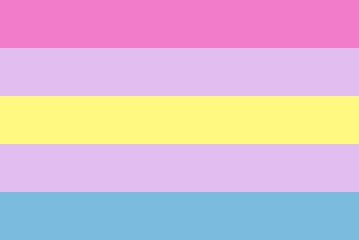
The flag followed on 13 June 2014, when Pride Flags For Us published the five-stripe proposal, recorded by Tumblr as a submission from fireprincette. The Aporagender blog circulated it the same day and subsequently called Hyaenahart the maker of its flag and pride buttons. [1] [5] [2]
Later community documentation connects the coinage to contemporary concern that the existing term aliagender might be appropriative. The surviving 9 June post does not itself state that motivation; it is later-documented context rather than wording from the coinage announcement. [6] [7]
Identity & Context
- Represented Identity
- Aporagender
- Subcommunity
- Nonbinary community
- Language Context
- Lily said that apor or apo was drawn from a Greek root meaning “separate”, and that the final a was added for pronunciation. This is the coiner’s stated construction of the term. [4]
Creators
The Creator
Hyaenahart (Mod Lex)
Primary design attribution
Credited by the contemporary Aporagender blog as “the maker of our flag and pride buttons” on 13 June 2014; the association between the names Hyaenahart and Lex comes from that blog’s contemporary tagging and reblog context, not from a later biographical profile. [2] The 2015 Pride-Flags reconstruction says “Designed by Lex”. [8] In November 2015 a later moderator of the community blog wrote that “the original mod and the person who designed the flag is no longer part of this blog”. [9] The attribution is held at medium to high confidence because the root post’s own submission metadata names a different account, fireprincette, and the relationship between the two is unresolved. [1]
“Blue and pink have been put on either end of the flag to show that you feel your gender is ‘away’ from these two colours, stereotyped as blue being masculine and pink being feminine. Purple to represent as feeling between male and female. Yellow to represent how the gender is nothing like being female, male or both, but is also placed close enough to blue, purple and pink to show that it’s still connected strongly to some sort of specific gender. Yellow also represents how it’s a non-binary identity.” [1]
Lily
Coiner of the term Aporagender
The original moderator of the Aporagender Tumblr blog. Lily coined the term and published its definition on 9 June 2014, presenting Aporagender as “a gender separate from male, female, and anything in between while still having a very strong and specific gendered feeling”, and as an umbrella as well as a specific identity. [3] On 10 June 2014 Lily explained the construction of the word: apor or apo drawn from a Greek root meaning “separate”, with the final a added for pronunciation. That is the coiner’s stated derivation, not an independently verified scholarly etymology. [4] A November 2015 community post thanks “original mod Lily” by name. [9] Lily did not design the flag.
“Aporagender is a term recently coined by me, meaning a gender separate from male, female, and anything in between while still having a very strong and specific gendered feeling.” [3]
fireprincette
Original submitter; possible design contributor
Tumblr’s automatic source note records the root flag proposal as “submitted by fireprincette” to Pride Flags For Us on 13 June 2014. [1] Whether this account drew the design, relayed it, or is another name for the credited maker is not established by any surviving source; the submission role is certain and the design role is unresolved.
Attribution notes
Three distinct roles meet in this flag, and the surviving evidence does not fully resolve them. Tumblr’s automatic source note on the root post records it as a submission from the account fireprincette. [1] The Aporagender blog, circulating the proposal the same day, called Hyaenahart “the maker of our flag and pride buttons”; its contemporary tagging and reblog context connect Hyaenahart with Lex, and the 2015 Pride-Flags reconstruction on DeviantArt likewise says “Designed by Lex”. [2] [8] Hyaenahart, or Mod Lex, is therefore the best-supported designer attribution, with fireprincette recorded as the original submission account and a possible design contributor. No source establishes whether fireprincette and Hyaenahart are the same person, and this entry does not assume they are.
The term is not the designer’s. Lily, the Aporagender blog’s original moderator, coined Aporagender on 9 June 2014, four days before the flag. [3] [9]
Origin
- Specific Place
- Tumblr (Pride Flags For Us)
- Place Type
- blog
- Digital Origin
- Yes
- Origin Type
- digital
- Physical Origin Status
- unknown
Digital origin; no verified physical location.
Published on Tumblr by the blog Pride Flags For Us on 13 June 2014, as post 88661099589. [1] The Aporagender blog reblogged it the same day. [5] No physical location is documented for any of the people involved, and none is plotted.
Dates & Chronology
- Year Created
- Exact date
- First documented publication
- Period in Use
- 2014 to the present
- Creation Bounds
- The root post on Pride Flags For Us, post 88661099589, is timestamped 13 June 2014 at 12:12:10 p.m. Eastern Daylight Time. [1] The term is older: Lily published the Aporagender definition on 9 June 2014 and the flag followed four days later. [3] Publication dates the design’s appearance; no earlier private making is documented, and no physical first display has been located.
The five-stripe design became the most widely circulated flag associated with Aporagender identity through Tumblr, DeviantArt, identity wikis, community resources and later merchandise. No formal adoption by a representative organization has been documented. [8] [6] [7]
Neither 2014 posting survives at its address: the Aporagender blog’s early posts and the Pride Flags For Us flag archive are both gone from Tumblr, and the record rests on archived captures. [1] [3]
Aporagender and maverique were coined six days apart: Aporagender on 9 June 2014, maverique on 15 June 2014 by Vesper H. The two describe nonbinary genders that are neither neutral nor absent, with different emphases. [3] [6]
On 14 August 2015 the DeviantArt account Pride-Flags published a 5000 by 3000 reconstruction credited “Designed by Lex”; that dates the rendering, not the flag. [8] In November 2015, community discussion questioned the purple stripe’s “between male and female” symbolism, and a later moderator said the original designer had left the blog and could not clarify. [9] In 2018 Mod Lune published an alternative design, explicitly as an alternative rather than a replacement. [10]
Lineage
No design source is documented for the five-stripe proposal. Kye Rowan’s Nonbinary Pride Flag, published earlier in 2014, precedes it and also uses yellow for gender outside the binary, but the proposal does not name that flag and no borrowing is documented; the connection is contextual visual history, not lineage. [1]
Aporagender sits under the nonbinary umbrella and is discussed alongside aliagender, which later community documentation records as the term’s point of departure, and maverique, coined six days later. It contrasts with agender: the original definition emphasizes a present, strongly felt gender rather than an absence. Comparisons with neutrois vary because definitions of neutrois differ between people and sources. [3] [6] [7]
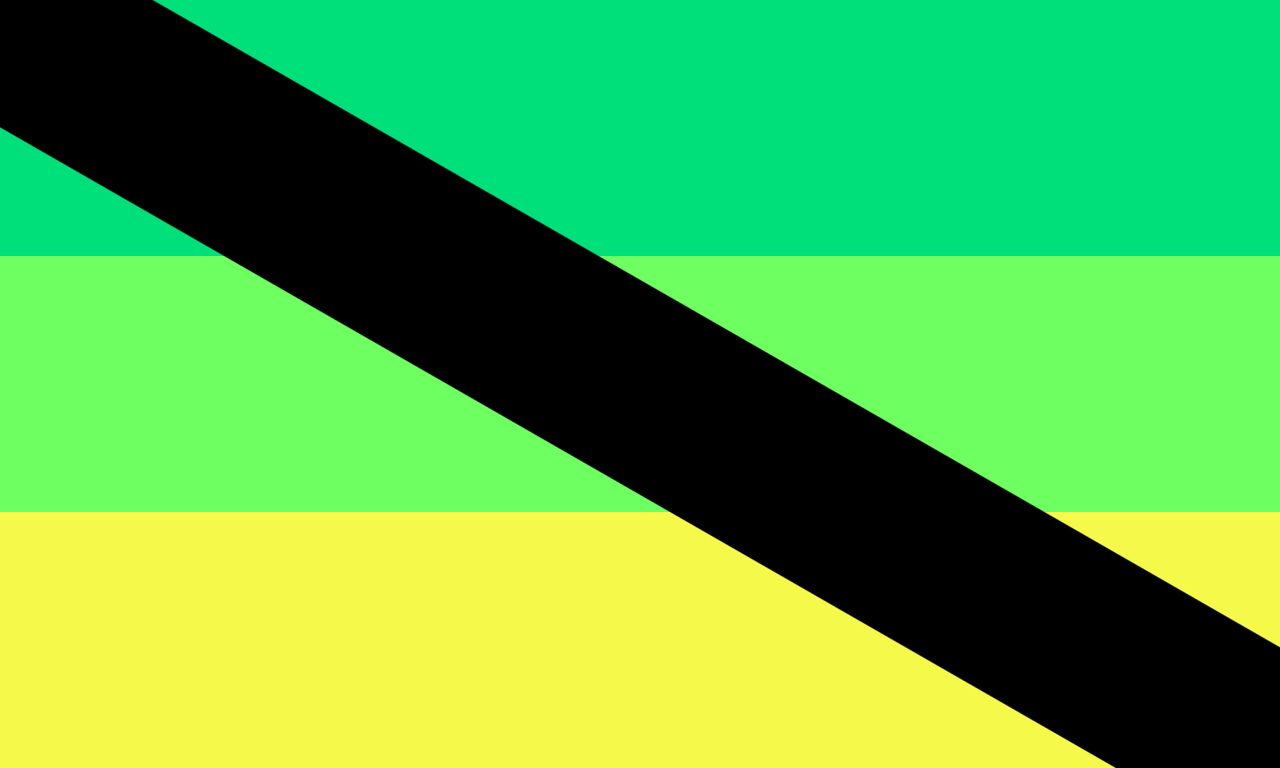
In 2018 Mod Lune of wedontcareaboutyourbinary published an alternative Aporagender flag in green, yellow, teal and black, stating it was “not meant to abolish the original”. [10] The account fireprincette also submitted a five-stripe bigender proposal to Pride Flags For Us in 2014; it is a lead about the submitter’s wider activity, not a documented parent or influence of this design.
Colors & Symbolism
The proposal explained the arrangement rather than colours alone. Pink and blue sit at opposite outer edges, associated with stereotypical femininity and masculinity, their distance from the centre expressing that the gender is “away” from both. Lavender represented a feeling between male and female in the proposal’s original scheme. Yellow represented a gender unlike female, male or both, placed near the other bands to show that Aporagender still describes a specific gendered feeling; yellow also represented nonbinary identity. [1]
| Colour | Hex | Meaning |
|---|---|---|
| Pink | #F37CCA | Stereotypical femininity, placed at the outer edge; the distance from the centre expresses being “away” from that category [1] |
| Lavender | #E1BDF0 | A feeling between male and female, in the proposal’s original symbolic scheme [1] |
| Yellow | #FFF982 | A gender unlike female, male or both, placed near the other bands to show it is still a specific gendered feeling; also nonbinary identity [1] |
| Lavender | #E1BDF0 | As stripe 2 [1] |
| Blue | #7BBBDD | Stereotypical masculinity, at the opposite outer edge [1] |
Exact pixel value of the surviving 2014 source PNG. [1]
The symbolism is the proposal’s own. Yellow’s nonbinary meaning does not name Kye Rowan’s Nonbinary Pride Flag and no borrowing from it is documented. In November 2015, community discussion questioned why lavender carried a between-male-and-female meaning on a flag for a gender defined as separate from those categories, and read the yellow centre as the design’s crucial element; the original designer had left the community blog by then and could not be asked. [9]
No designer-issued colour specification has been located. These are the exact pixels of the surviving 359 by 240 source file, which contains four unique colours; they are measurements, not declared official swatches. Flag-colour aggregator sites circulate slightly different values (#F47CCB, #E3BDF0, #FFF983, #7BBCDF), which match no pixel in the source file. [1]
Design
- Aspect Ratio
- 359:240 (approximately 3:2), from the surviving source file
- Orientation
- horizontal
- Stripe Count
- 5
- Layout
- horizontal_stripes
- Stripes (Top → Bottom)
- Pink, Lavender, Yellow, Lavender, Blue
Five equal horizontal stripes of 48 pixels each in the 359 by 240 source file, symmetric about the yellow centre: pink, lavender, yellow, lavender, blue. The file contains exactly four unique colours, the lavender appearing twice. [1]
Five equal horizontal stripes. From top to bottom: pink (#F37CCA), lavender (#E1BDF0), yellow (#FFF982), lavender (#E1BDF0), blue (#7BBBDD), the exact pixel values of the surviving 2014 source file.
Usage & Adoption
- Online Usage
- Tumblr, DeviantArt, Identity wikis and community resources
- Current Status
- De facto community standard; no formal adoption documented
The five-stripe design became the most widely circulated flag associated with Aporagender identity through Tumblr, DeviantArt, identity wikis, community resources and later merchandise. No formal adoption by a representative organization has been documented, and inclusion on community wikis is circulation, not adoption. [8] [6] [7]
Image Archive
Historical source file
Alternative designs
Symbols


Flag design
Discourse & Debates
Common misidentifications
- Sometimes conflated with maverique, coined six days after Aporagender; the two identities have different emphases.
- Aporagender is distinct from agender: its original definition emphasizes a present, strongly felt gender rather than an absence. Comparisons with neutrois vary because definitions of neutrois differ between people and sources. [3] [6]
Criticisms
- In November 2015, Aporagender community members questioned why the lavender stripes carried a “between male and female” meaning on a flag for a gender defined as separate from those categories. A later moderator answered that “the original mod and the person who designed the flag is no longer part of this blog” and could not supply the missing explanation; commentary in the same thread read the yellow centre as the crucial Aporagender element, distinct from the surrounding pink, purple and blue. [9]
- In 2018 Mod Lune of wedontcareaboutyourbinary proposed an alternative green, yellow, teal and black design, writing that the original “focuses too heavily on binary gender and ‘betweenness’”, with four of its five stripes devoted to binary reference. Lune stated the alternative was “not meant to abolish the original or anything, just to provide an alternative for those who’d like one”. [10]
Lily said the prefix apor or apo was drawn from a Greek root meaning “separate”, with the final a added for pronunciation; that is the coiner’s stated construction. [4] The wikis disagree about the identity’s symbol: one credits satusepiida, 20 July 2016, with a 2021 conversion by themogaidragon, while another credits z1msoda, 4 August 2021. A further symbol by mourningmogaicrew is dated 13 August 2021 in both. [6]
Editorial note
This entry’s status field marks the design canonical in the archive’s sense: the dominant, most widely circulated design for the identity. It does not mean formal organizational adoption, of which none is documented.
Footnotes & Citations
Sources and footnotes 10 sources
- 1. Social media A flag proposal for aporagender (root post 88661099589). Pride Flags For Us; recorded by Tumblr as submitted by fireprincette. Tumblr (Pride Flags For Us), via the Internet Archive (2014-06-13). Accessed 2026-08-14 · Archived version
The flag’s first posting, timestamped 13 June 2014 at 12:12:10 p.m. EDT, surviving as an archived capture; the blog’s flag archive is gone. The original image file survives on Tumblr’s media host.
- 2. Social media Aporagender pride buttons (maker attribution). The Aporagender blog. Tumblr (Aporagender blog), via the Internet Archive (2014-06-13). Accessed 2026-08-14 · Archived version
Calls Hyaenahart “the maker of our flag and pride buttons” and notes the button adaptation adjusted the yellow and purple bands to differ from the Pansexual flag.
- 3. Social media Aporagender is a term recently coined by me (original coinage post). Lily, original moderator of the Aporagender blog. Tumblr (Aporagender blog), via the Internet Archive (2014-06-09). Accessed 2026-08-14 · Archived version
The coinage post, surviving as an archived capture; the live blog’s early posts are gone.
- 4. Social media Could I ask the etymology of the prefix apora? (Lily’s answer). Lily, original moderator of the Aporagender blog. Tumblr (Aporagender blog), via the Internet Archive (2014-06-10). Accessed 2026-08-14 · Archived version
The coiner’s own explanation of the term’s construction, surviving as an archived capture.
- 5. Social media Aporagender blog reblog of the flag proposal. The Aporagender blog. Tumblr (Aporagender blog), via the Internet Archive (2014-06-13). Accessed 2026-08-14 · Archived version
The identity blog’s same-day circulation of the proposal.
- 6. Encyclopedias & Reference Aporagender. Nonbinary Wiki. Accessed 2026-08-14
Community synthesis of the term’s history and related identities.
- 7. Encyclopedias & Reference Aporagênero. Orientando. Accessed 2026-08-14
Research synthesis naming Lily as coiner and the Aporagender blog’s creator, recording the blog’s later change of hands, Lex’s flag posting, and the later alternative flags.
- 8. Image file page Aporagender (5000 by 3000 reconstruction). Pride-Flags. DeviantArt (2015-08-14). Accessed 2026-08-14
A later 5:3 reconstruction, published 14 August 2015, carrying the proposal’s symbolism text and the credit “Designed by Lex”. The page applies Creative Commons Attribution 3.0 to this specific upload.
- 9. Social media Flag Colours (community discussion). aporagenderme, with replies. Tumblr (2015-11-18). Accessed 2026-08-14
Questions the purple stripe’s “between male and female” meaning; a later moderator says the original designer has left the blog; thanks “original mod Lily” and current mod Kellex by name; reads the yellow centre as the design’s key element.
- 10. Social media Aporagender Flag Suggestion (Mod Lune alternative). Mod Lune, wedontcareaboutyourbinary. Tumblr (2018-07-03). Accessed 2026-08-14
The 2018 alternative design in green, yellow, teal and black, offered explicitly as an alternative rather than a replacement.
Image Sources
- Rendering
- exact_source_reconstruction
- The hero reproduces the surviving 2014 source file’s exact colours and proportions as an archive-drawn SVG; the archive is the vectorizer, not the designer. [1] · Credit: Hyaenahart (Mod Lex), per the contemporary Aporagender blog; submitted through fireprincette; published by Pride Flags For Us
- Credit: Design credited contemporaneously to Hyaenahart (Mod Lex); submitted through fireprincetteRights No explicit licence located for this file.
- Credit: Mod Lune, wedontcareaboutyourbinaryRights No licence statement located; reproduced from the designer’s own posting.
- Credit: Creator disputed: satusepiida (2016) per the MOGAI Wiki, z1msoda (2021) per the LGBTQIA+ Wiki
- Credit: mourningmogaicrew, 13 August 2021
- The surviving original file, 359 by 240 pixels with five equal 48-pixel stripes and four unique colours. Submitted to Pride Flags For Us through fireprincette and published 13 June 2014; the Aporagender blog contemporaneously credited Hyaenahart (Mod Lex) as the maker. No explicit licence has been located for this file. [1] [2] · Credit: Via Pride Flags For Us on Tumblr · Tumblr
- Mod Lune’s 2018 alternative design, published on the blog wedontcareaboutyourbinary on 3 July 2018 and offered explicitly as an alternative, “not meant to abolish the original”. Green and yellow stand for nonbinary identity apart from any pink and blue reference, teal for aporagender identities that may seem binary-adjacent but are their own genders, and the black diagonal for the presence of a specific gender feeling on a plane distinct from the binary. Measured fills: #6EFF60, #F5FA4A, #00E07A, #000000 at 1280 by 768. [10] · Credit: Mod Lune, wedontcareaboutyourbinary · Tumblr
- An alternate symbol, credited to the Tumblr user mourningmogaicrew, 13 August 2021. · Credit: mourningmogaicrew, via the community wikis. · MOGAI Wiki
- Archive-drawn SVG reconstruction at the source file’s own 359 by 240 proportions and exact colours (#F37CCA, #E1BDF0, #FFF982, #E1BDF0, #7BBBDD). The archive is the vectorizer; the design is the 2014 proposal’s. · Credit: Encycloflaggia reconstruction from the 2014 source file · Exact-source SVG
- The aporagender symbol. The wikis disagree about its maker: one credits satusepiida, 20 July 2016, with a 2021 black-and-transparent conversion by themogaidragon; another credits z1msoda, 4 August 2021. · Credit: Creator disputed between sources; see caption. · MOGAI Wiki / LGBTQIA+ Wiki