Transmasculine Pride Flag
Identity Pride Flag ·
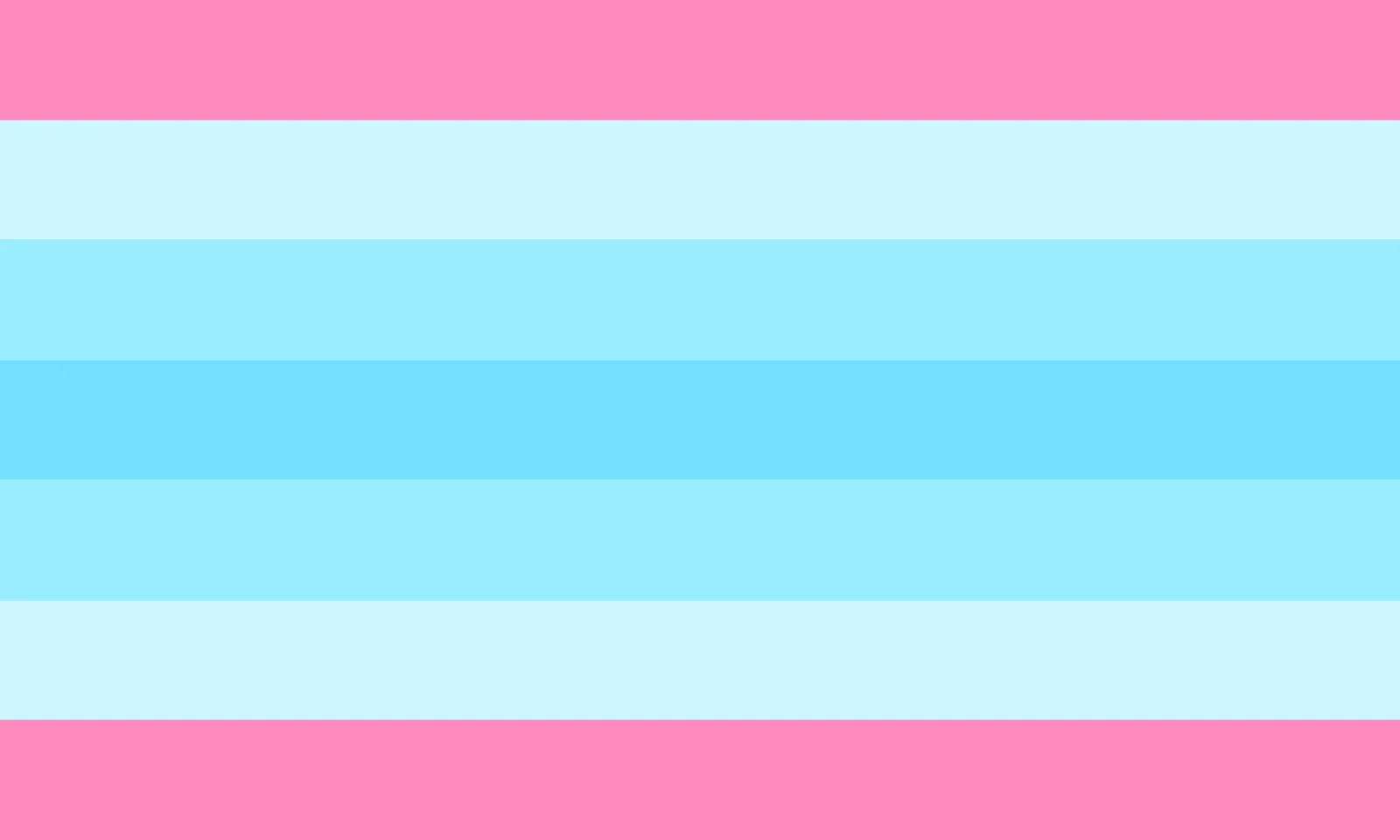
A seven-stripe flag for transmasculine identity, first published by the Pride-Flags archive on DeviantArt on July 4, 2015. [1] Its unknown designer arranged pink outer stripes around three shades of blue mirrored across a darker-blue center. [2] The design was later documented as the counterpart of the transfeminine flag. No creator-issued symbolism has been located. [3]
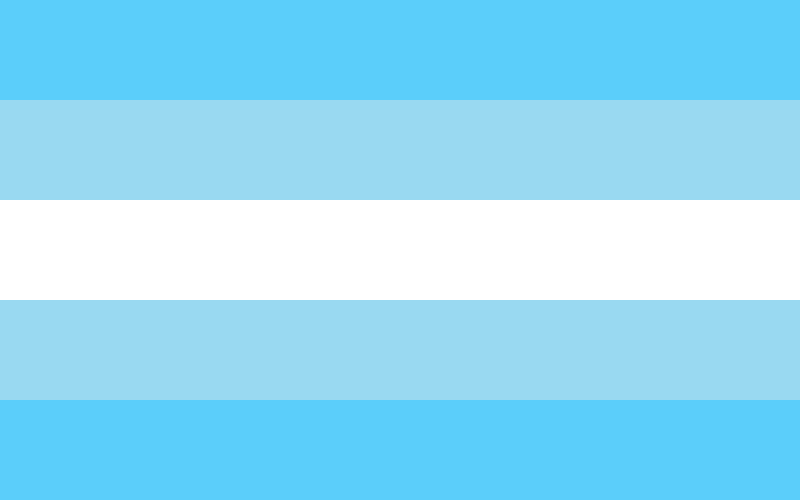
Key facts
- Designer
- Unknown
- Created
- Earliest located publication
- In use
- 2015 to present
- Aspect Ratio
- 3:5
- Stripes
- 7
- Represented Identity
- transmasculine
Also known as
- Transmasc Pride Flag
- Trans Man Pride Flag
- Trans Man / Transmasculine (1)
Archive categories Gender Identity Pride Flags
Overview
No creator statement has been located. The 2015 publication carries a definition of the identity rather than an account of why the design was made. [1]
The design existed by 4 July 2015, when the Pride-Flags archive published it on DeviantArt at 5000 by 3000 pixels. Its counterpart was published from the same account eleven seconds later. [1] The page's description defines the terms and credits no designer, and the date the design was made is unknown.
Identity & Context
- Represented Identity
- transmasculine
- Subcommunity
- transgender umbrella
Transmasculine, often shortened to transmasc, describes a person who identifies with masculinity in some way. The term includes trans men and other trans and nonbinary people with a connection to masculinity. The 2015 publication defines the pair narrowly by assignment at birth: Transmasculine is the counterpart term. The 2015 description defines transfeminine as transgender people "assigned male at birth, but identify with femininity to a greater extent than with masculinity", who "could be either trans women or nonbinary", and adds that "The 'opposite' goes for Transmasculine." [1] These are glossary definitions rather than universal rules, and individual use of the terms varies.
Creators
Associated Figures
Pride-Flags
Earliest located publisher and uploader
Pride-Flags is a DeviantArt archive of pride flag artwork. It published "Trans Man / Transmasculine (1)" on 4 July 2015 at 5000 by 3000 pixels under a Creative Commons Attribution 3.0 licence. The page carries a definition of transgender, transfeminine and transmasculine identity and names no designer. [1]
pride-color-schemes
Later paired documentarian
pride-color-schemes is a Tumblr flag-documentation blog. On 3 August 2016 it published the two canonical flags together with four alternates, recording accessibility descriptions and credits. [3] The account operated as an archive rather than a design studio and said so in a later reply about this pair. [4]
Attribution notes
The designer is unknown. The 2015 DeviantArt publication carries a definition of the terms and no designer credit. [1] The 2016 paired documentation gives "Term coined by: Unknown" and no attribution for this design. [3] Pride-Flags published and uploaded the earliest located artifact; pride-color-schemes later documented the pair. Neither is the designer. pride-flags-for-us is credited in that same 2016 post as the designer of one of the transfeminine alternates, which is a statement about that alternate and not about this design. [3]
Origin
- Digital Origin
- Yes
Digital origin; no geographic origin is documented.
Digital origin. No geographic origin is documented and no place of creation is known. The earliest located publication is the Pride-Flags DeviantArt archive on 4 July 2015, which identifies a publisher and a repository rather than where the unknown designer worked. [1]
Dates & Chronology
- Year Created
- Earliest located publication
- Period in Use
- 2015 to present
The flag has circulated online since its 2015 DeviantArt publication and was reproduced in the 2016 pride-color-schemes archive and later identity references. No formal organizational adoption has been located. [1][3]
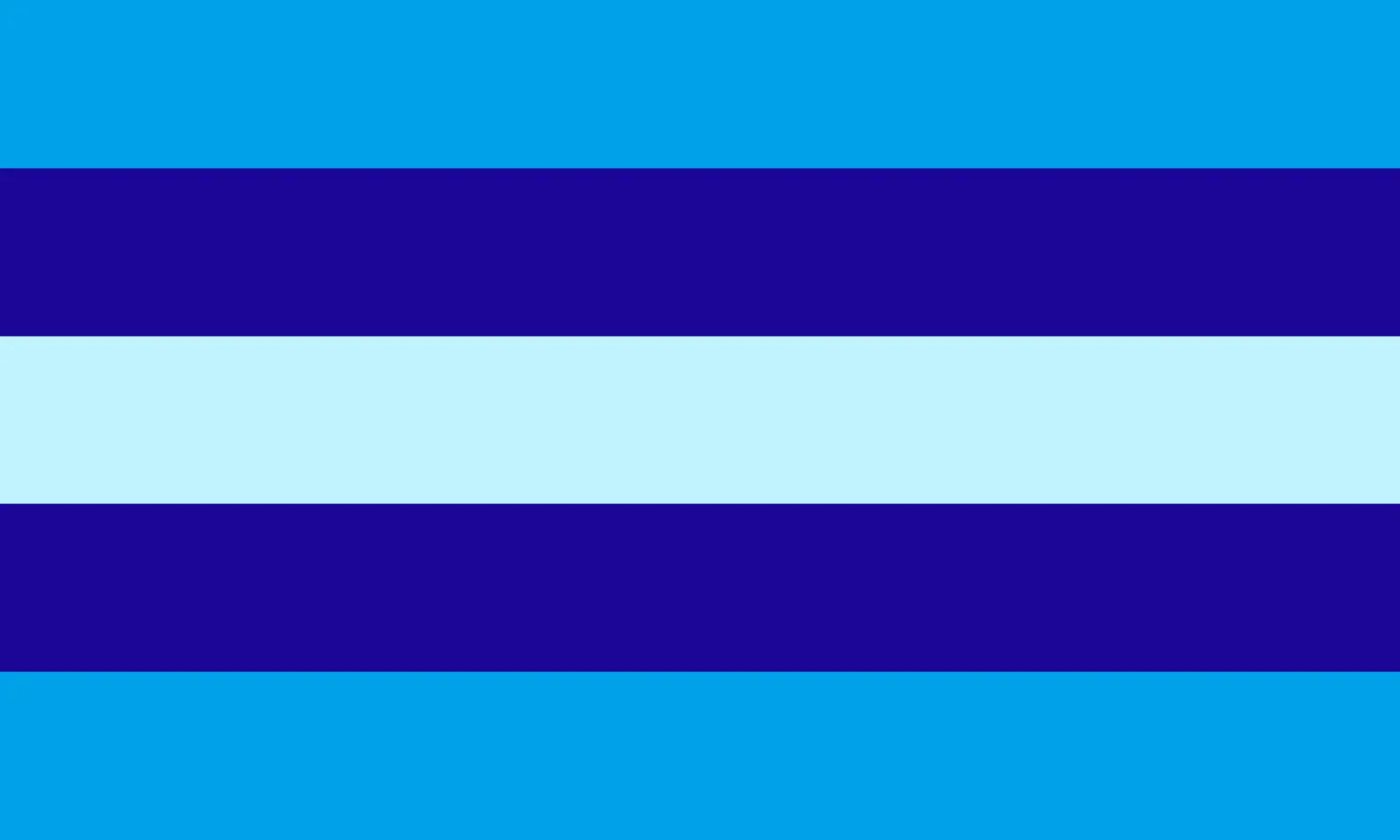
Chronology: the design existed by 4 July 2015; it was published that day on the Pride-Flags DeviantArt archive; on 3 August 2016 the two canonical flags and four alternates were documented together by pride-color-schemes; on 17 February 2023 that archive discussed the pair again and clarified that it did not create every flag it archived. [1][3][4] Two alternate transmasculine designs were published by the same archive and are described in Variants below. The Transfeminine Pride Flag's own alternates are on that entry. Variants. "Trans Man / Transmasculine (3)" was published by the same archive on 14 June 2016: five stripes in blue, indigo and powder blue, measured #00A2E8, #1C0697, #C0F4FE, #1C0697, #00A2E8. No designer credit has been located for it, and the page displays a Creative Commons Attribution 3.0 licence. [5][3] "Trans Man / Transmasculine (2)" followed on 20 April 2016: muted five-stripe design in mauve, slate and teal, measured #A1626D, #5F7992, #00879D, #5F7992, #A1626D. No designer credit has been located for it, and the page displays no licence. [6][3] The 2016 documentarian remarked that the two muted designs look reversed: "I honestly don't know why this one's the transmasc and the other one's the transfem instead of the other way around, it looks like they should be that way, but they're not." That remark is about the muted pair only, not about the 2015 seven-stripe designs. [3] Both are later alternatives, not replacements.
Lineage
- Companion flags
- Transfeminine Pride Flag
- Related flags
- Transgender Pride Flag
The strongest documented relationship is with the Transfeminine Pride Flag: the two were published from the same account eleven seconds apart on 4 July 2015, share one construction with the palettes exchanged, and were documented together in 2016 as a pair. [1][3] The pink-and-blue vocabulary resembles Monica Helms's Transgender Pride Flag and later community references connect the palettes, but no creator statement located says this design was derived from it, so that relationship is recorded as contextual rather than as descent. Shared category membership with other trans-themed flags is not genealogy and is not recorded as lineage. The Transneutral Pride Flag is documented as built on this pair: its record quotes the statement "It is based on the transmasculine and transfeminine flags." That is a documented later derivation, recorded there rather than as descent here.
Colors & Symbolism
No symbolism issued by the unknown designer has been located. The 2015 publication and the 2016 paired documentation describe the stripe sequence and define the identity, and neither assigns meanings to the stripes. [1][3]
| Colour | Hex | Meaning |
|---|---|---|
| Pink | #FF8ABE | No creator-issued meaning has been located for this stripe. [1][3] |
| Very Light Blue | #CCF5FF | No creator-issued meaning has been located for this stripe. [1][3] |
| Light Blue | #99ECFF | No creator-issued meaning has been located for this stripe. [1][3] |
| Blue | #75DFFF | No creator-issued meaning has been located for this stripe. [1][3] |
| Light Blue | #99ECFF | No creator-issued meaning has been located for this stripe. [1][3] |
| Very Light Blue | #CCF5FF | No creator-issued meaning has been located for this stripe. [1][3] |
| Pink | #FF8ABE | No creator-issued meaning has been located for this stripe. [1][3] |
These hexadecimal values are exact measurements from the cited source PNG. They document that artifact rather than a creator-issued color specification. [2]
A later community reading treats the outer stripes as the gender the wearer was assigned and the graduated inner stripes as movement toward the identity at the centre. That reading circulates in identity wikis and flag guides; it is an interpretation added after publication, and no source located here records how widely it is held. The 2015 and 2016 publications do not state it. [1][3]
Four values mirrored across seven stripes, top to bottom #FF8ABE, #CCF5FF, #99ECFF, #75DFFF, #99ECFF, #CCF5FF, #FF8ABE. These hexadecimal values are exact measurements from the cited source PNG. They document that artifact rather than a creator-issued color specification. [2] The 2016 documentation's copy of the design carries the same values. [3]
Design
- Aspect Ratio
- 3:5
- Orientation
- horizontal
- Stripe Count
- 7
- Layout
- horizontal_stripes
- Stripes (Top → Bottom)
- Pink, Very Light Blue, Light Blue, Blue, Light Blue, Very Light Blue, Pink
The flag consists of seven nominally equal horizontal stripes mirrored around a single center stripe. The source artifact measures 5000 by 3000 pixels, giving a 3:5 ratio. No creator-issued construction sheet has been located. [2]
Measured stripe heights in the source raster are 429, 426, 433, 424, 433, 426 and 429 pixels, which is raster rounding rather than an intended unequal-stripe specification. [2]
Seven nominally equal horizontal stripes, symmetrical about the centre. The 2016 accessibility description records the sequence as "pink, light blue, blue, darker blue, blue, light blue, pink". [3]
Usage & Adoption
- Online Usage
- DeviantArt, where the earliest located artifact was published in 2015 [1], Tumblr, through the August 2016 pride-color-schemes documentation [3], Later identity references and flag guides
- Current Status
- circulating online; no formal adoption located
The flag has circulated online since its 2015 DeviantArt publication and was reproduced in the 2016 pride-color-schemes archive and later identity references. No formal organizational adoption has been located. [1][3]
Image Archive
Earliest Located Publication
Documented Variants
Archive Reconstruction
Discourse & Debates
Common misidentifications
- The transfeminine flag uses the same construction with the palettes exchanged: blue on the outside where this one has pink. No source located here records how often the two are actually confused. [3]
The 2015 archive titles pair "Trans Woman" with "Transfeminine" and "Trans Man" with "Transmasculine." Current glossary usage treats transfeminine and transmasculine as broader terms that can include trans women and trans men as well as nonbinary and other trans people connected to femininity or masculinity. [1]
Footnotes & Citations
Sources and footnotes 6 sources
- 1. Archived Sources Trans Man / Transmasculine (1). Published by the Pride-Flags archive. DeviantArt (2015-07-04). Accessed 2026-08-16
The earliest located publication. The page renders its date as 4 July 2015 and labels it 05:41 UTC. 5000 by 3000 pixels, displaying a Creative Commons Attribution 3.0 licence. The description defines the identity terms and names no designer.
- 2. Image file page Source PNG behind the 2015 publication, 5000 by 3000 pixels. Published by the Pride-Flags archive. DeviantArt (2015-07-04). Accessed 2026-08-16 · Archived version
The downloaded file, measured for this entry: 74,467 bytes, SHA-256 31e19fd09d61fe76792be0eaf1dab52aae93518236ce95855b8a8a5a65f44a3c, stripe heights 429, 426, 433, 424, 433, 426 and 429 pixels, and the colour values published in Colors.
- 3. Social media Trans Woman/Transfeminine and Trans Man/Transmasculine. pride-color-schemes. Tumblr (2016-08-03). Accessed 2026-08-16
Documents the two canonical flags together with four alternates, with accessibility descriptions and credits. Gives "Term coined by: Unknown" and no designer for either canonical design.
- 4. Social media Could you please redo the Trans Man / Trans Woman flags?. ask-pride-color-schemes. Tumblr (2023-02-17). Accessed 2026-08-16
A later reply about this pair in which the archive account distinguishes what it archived from what it made.
- 5. Archived Sources Trans Man / Transmasculine (3). Published by the Pride-Flags archive. DeviantArt (2016-06-14). Accessed 2026-08-16
An alternate five-stripe design, 5000 by 3000 pixels, measured #00A2E8, #1C0697, #C0F4FE, #1C0697, #00A2E8. The page renders its date as 14 June 2016 and displays a Creative Commons Attribution 3.0 licence.
- 6. Archived Sources Trans Man / Transmasculine (2). Published by the Pride-Flags archive. DeviantArt (2016-04-20). Accessed 2026-08-16
The muted alternate, 5000 by 3000 pixels, measured #A1626D, #5F7992, #00879D, #5F7992, #A1626D. The page renders its date as 20 April 2016, displays no Creative Commons licence, and carries a plain copyright line.
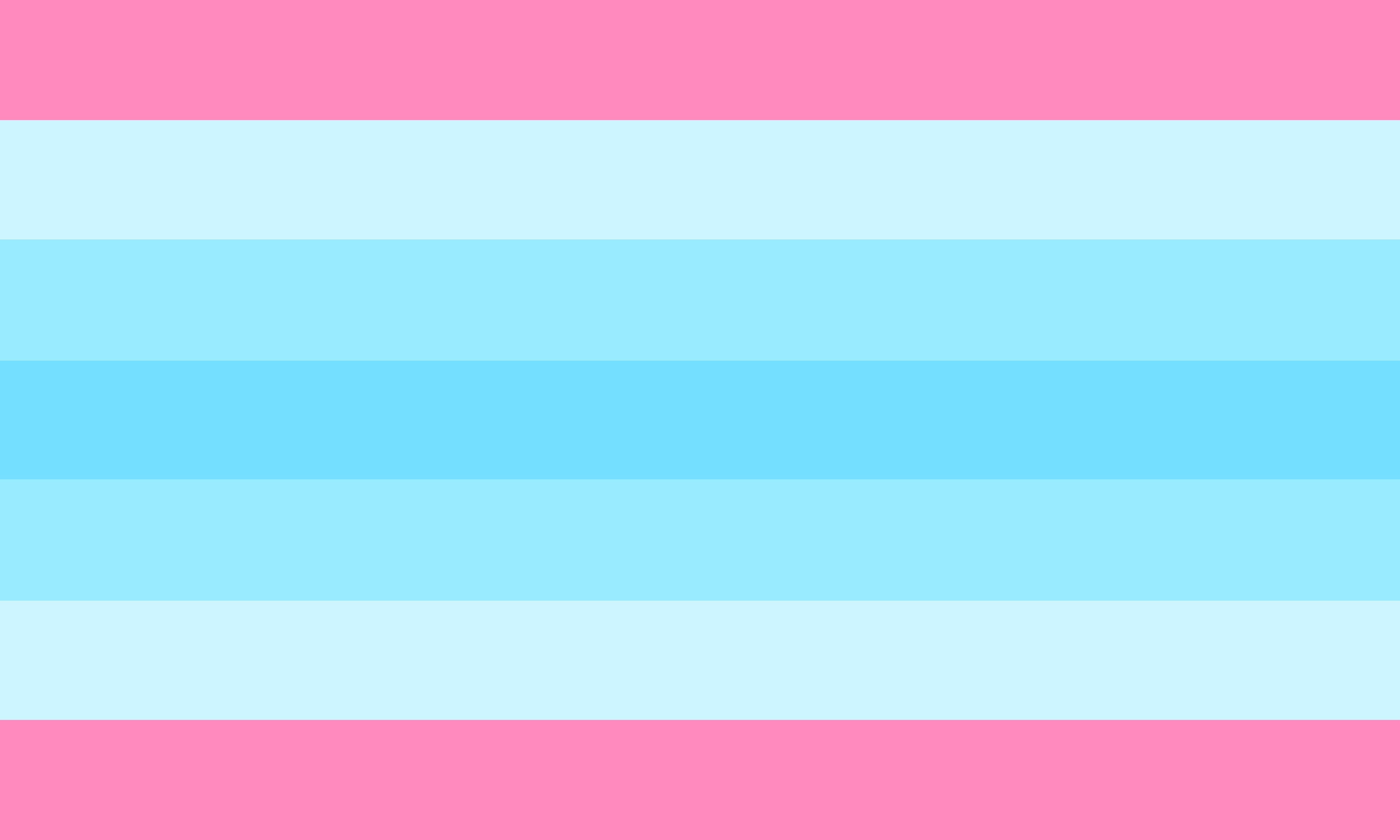
Image Sources
- Rendering
- seven-stripe design published 4 July 2015
- Encycloflaggia reconstruction of the seven-stripe transmasculine flag · Credit: Designer unknown; reconstruction by Encycloflaggia · Encycloflaggia · reconstructionRights Archive-produced reconstruction; colours measured from the 2015 source PNG
- The 5000 by 3000 source PNG published by the Pride-Flags archive on 4 July 2015 · Credit: Published and uploaded by Pride-Flags; designer unknown · DeviantArt · verifiedRights Creative Commons Attribution 3.0, as displayed by the publishing archive
- The source artifact: 5000 by 3000 pixels, 74,467 bytes, SHA-256 31e19fd0…f44a3c, published by the Pride-Flags archive on DeviantArt on 4 July 2015 as "Trans Man / Transmasculine (1)". Measured top to bottom: #FF8ABE, #CCF5FF, #99ECFF, #75DFFF, #99ECFF, #CCF5FF, #FF8ABE. [1][2] · Credit: Published and uploaded by Pride-Flags; designer unknown · DeviantArt · Creative Commons Attribution 3.0, as displayed by the publishing archive
- "Trans Man / Transmasculine (3)", an alternate five-stripe design published by the same archive on 14 June 2016, measured #00A2E8, #1C0697, #C0F4FE, #1C0697, #00A2E8. No designer credit has been located for it. A later alternative, not a replacement for the 2015 design. [5][3] · Credit: Published and uploaded by Pride-Flags; designer unknown · DeviantArt · Creative Commons Attribution 3.0, as displayed by the publishing archive
- The archive's reconstruction, drawn at 800 by 480 with seven equal bands using the colours measured from the 2015 source PNG. [2] · Credit: Designer unknown; reconstruction by Encycloflaggia · Encycloflaggia reconstruction · Archive-produced reconstruction, subject to the rights status of the underlying design