Transgender Pride Flag with Transgender Symbol
Identity Pride Flag · 2016–present
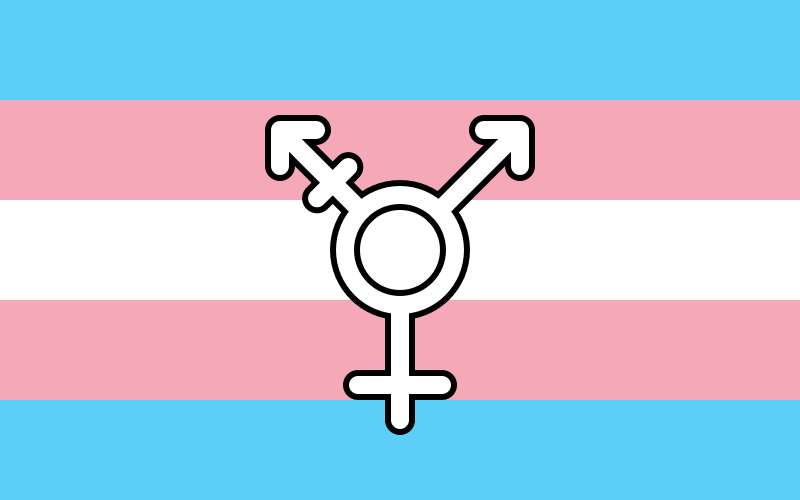
Monica Helms's 1999 transgender pride flag charged with a large transgender symbol in white, fimbriated black. Both halves have documented authors and the combination has none: Holly Boswell made the symbol, Helms the flag, and no source records who first put one on the other, or when. [1] Nancy R. Nangeroni, who made the first pin of the symbol, traces it firsthand: Boswell "drew it for Wendy Parker, who drew it for me." [2] The earliest recorded uses date to 2016, and the flag is documented in the United States, Sweden and Germany through 2019. [1]
Key facts
- Designer
- Unknown
- First documented public use
- 17 June 2016, Baltimore Pride
- In use
- 2016–present
- Aspect Ratio
- 3:5 · standard
- Ratio Notes
- No ratio is documented for the variant. The parent flag is catalogued at 3:5 and this carries the same standard production ratio; no measurement of a variant flag has been made.
- Stripes
- 5
- Represented Identity
- transgender
Status Variant
Archive categories Gender Identity Pride Flags
Overview
The variant combines two things that already existed. The transgender symbol is Holly Boswell's: a combination of the astronomical signs for Mars and Venus, standing for male and female, with the addition of a third branch, an arrow crossed by an additional stroke, for mixed gender identities. [1] Nancy R. Nangeroni, who turned it into a pin, gives the chain of transmission firsthand: "Don't blame me, I didn't invent it. Holly Boswell, in North Carolina, drew it for Wendy Parker, who drew it for me and suggested that I do something with it on my computer." [2] Monica Helms designed the five-stripe transgender pride flag in 1999. At some point before June 2016 the symbol was placed on the flag in white, fimbriated black. No source located records who did that, or when. [1]
The symbol is usually dated to 1993, a date that traces to a single unbylined summary saying Boswell "had the idea to combine the two symbols along with a hybrid symbol into a triad." [3] Nangeroni's account gives no date, so Boswell's authorship is better attested than the year. [2]
Identity & Context
- Represented Identity
- transgender
Documented in use in the United States, Sweden and Germany between 2016 and 2019. [1]
Creators
The Creators
Holly Boswell
Creator of the transgender symbol the variant carries. Not the designer of this variant.
A transgender activist in North Carolina, credited with the transgender symbol this flag carries. Nangeroni, who made the first pin of it, records that Boswell "drew it for Wendy Parker, who drew it for me." [2] The symbol is usually dated 1993, on the authority of a single unbylined summary. [3] No writing by Boswell about the symbol has been located, and nothing documents whether she knew of or approved its use on the flag.
Nancy R. Nangeroni
Made the first pin of the symbol and its widely circulated rendering. Not the designer of this variant.
Nangeroni received the symbol secondhand and executed the version that circulated: "I made it of soft shapes, to connote gentility, accommodation, permission. I placed it on a lavender triangle 'cause it's time we, the crossdressing - transsexual - transgender community, took a stand in support of the gay community. I chose bright blue for strength, and 'cause I liked the way it looked." She disclaims invention of the symbol itself and gives it freely for community use. [2]
Don't blame me, I didn't invent it. Holly Boswell, in North Carolina, drew it for Wendy Parker, who drew it for me and suggested that I do something with it on my computer.
On the symbol's origin, from her page on GenderTalk.
The symbol of a circle joining the elements of male, female, and the two combined, came from many sources, and is owned by none. Please use it.
On rights in the symbol.
Attribution notes
No source located names a designer for this variant, and none should be inferred. Two prior authorships are documented and are not the same thing as authorship of the combined flag: Holly Boswell created the transgender symbol in 1993, and Monica Helms designed the flag in 1999. Who first placed one on the other, and when, is undocumented. The variant appears in the record already in use, at Baltimore Pride in 2016. [1]
Origin
Undocumented. The earliest photograph located is from Baltimore in 2016, which records a use rather than an origin.
Dates & Chronology
- First public use
- 17 June 2016, Baltimore Pride
- Period in Use
- 2016–present (earliest documented use)
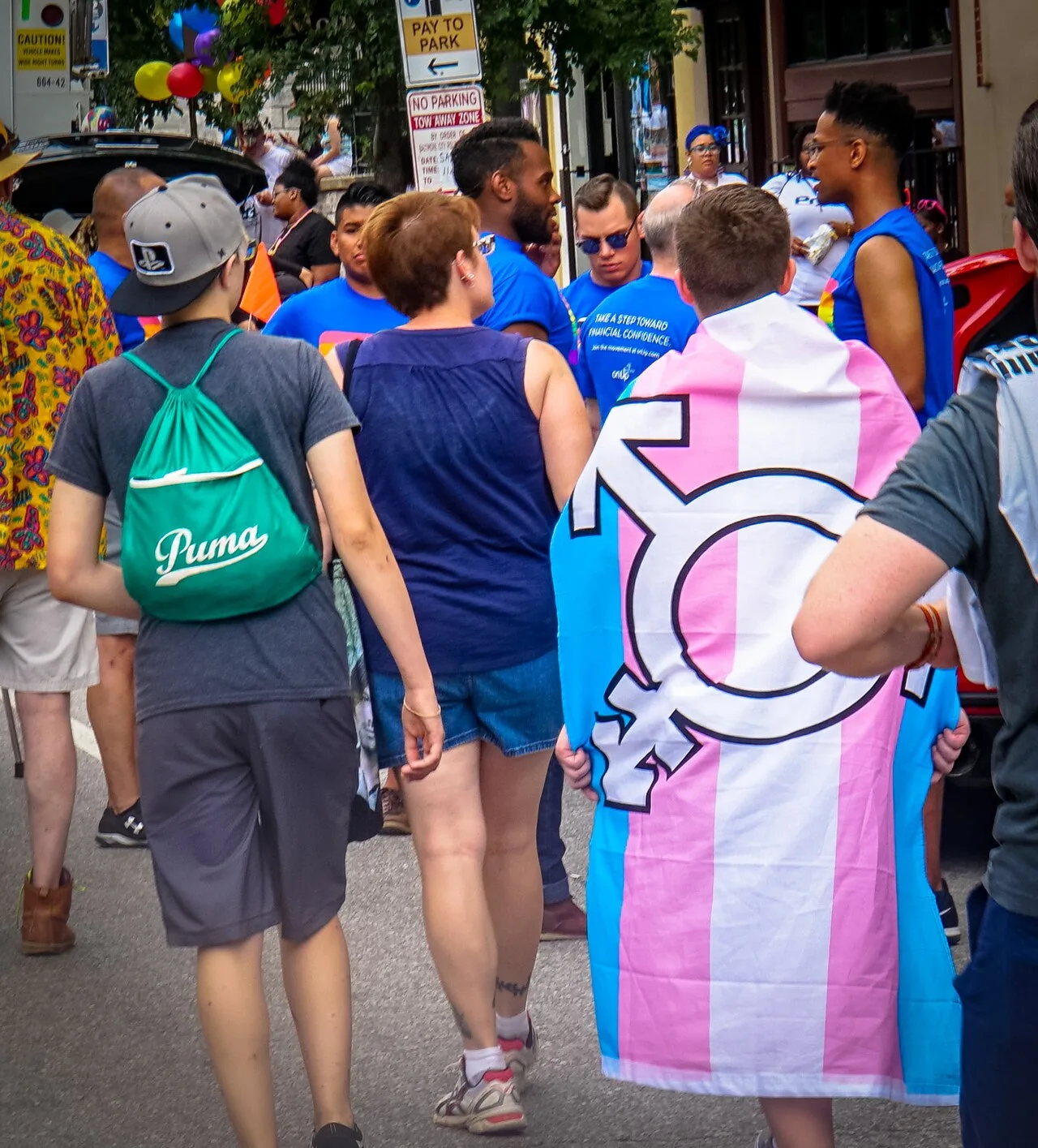
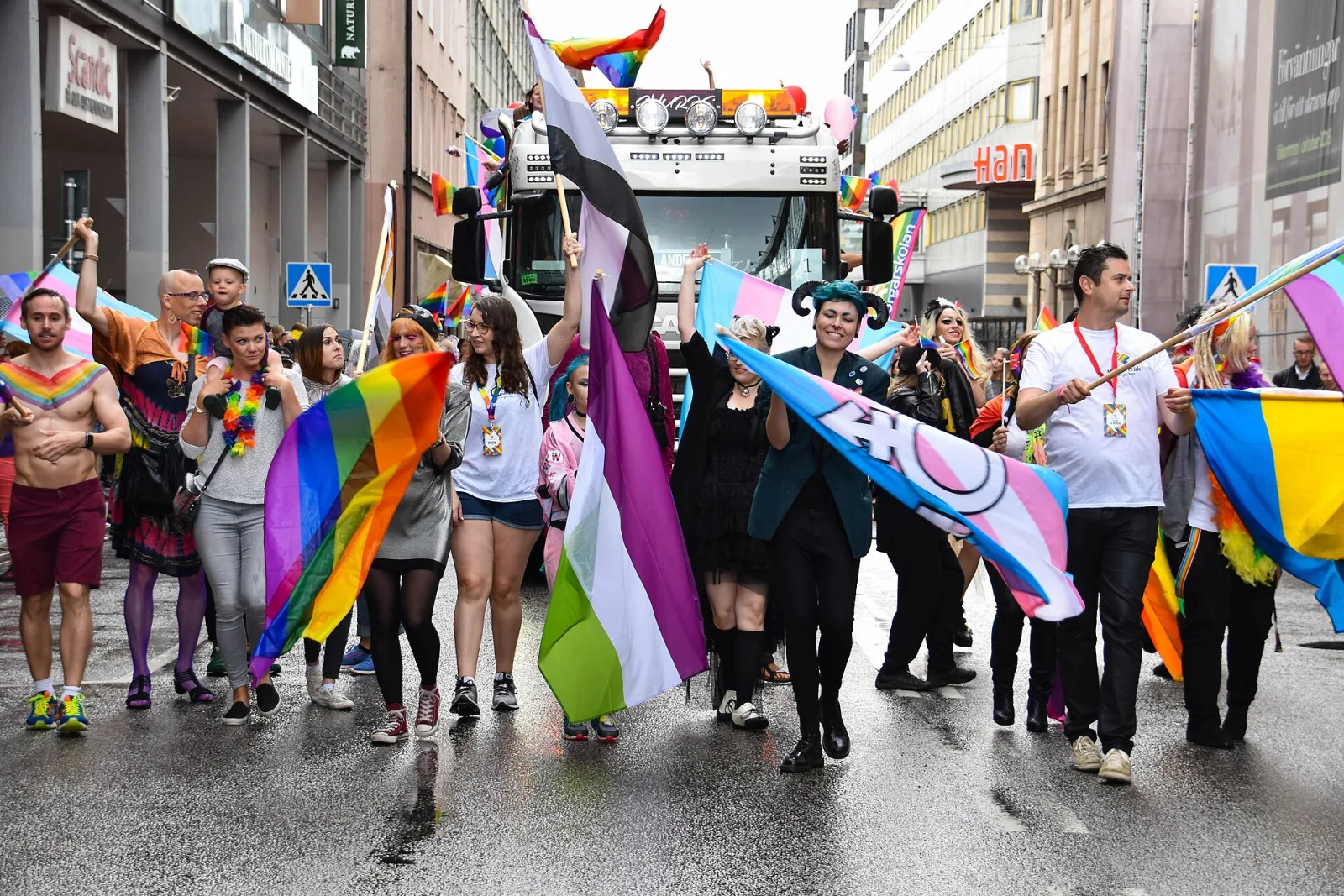
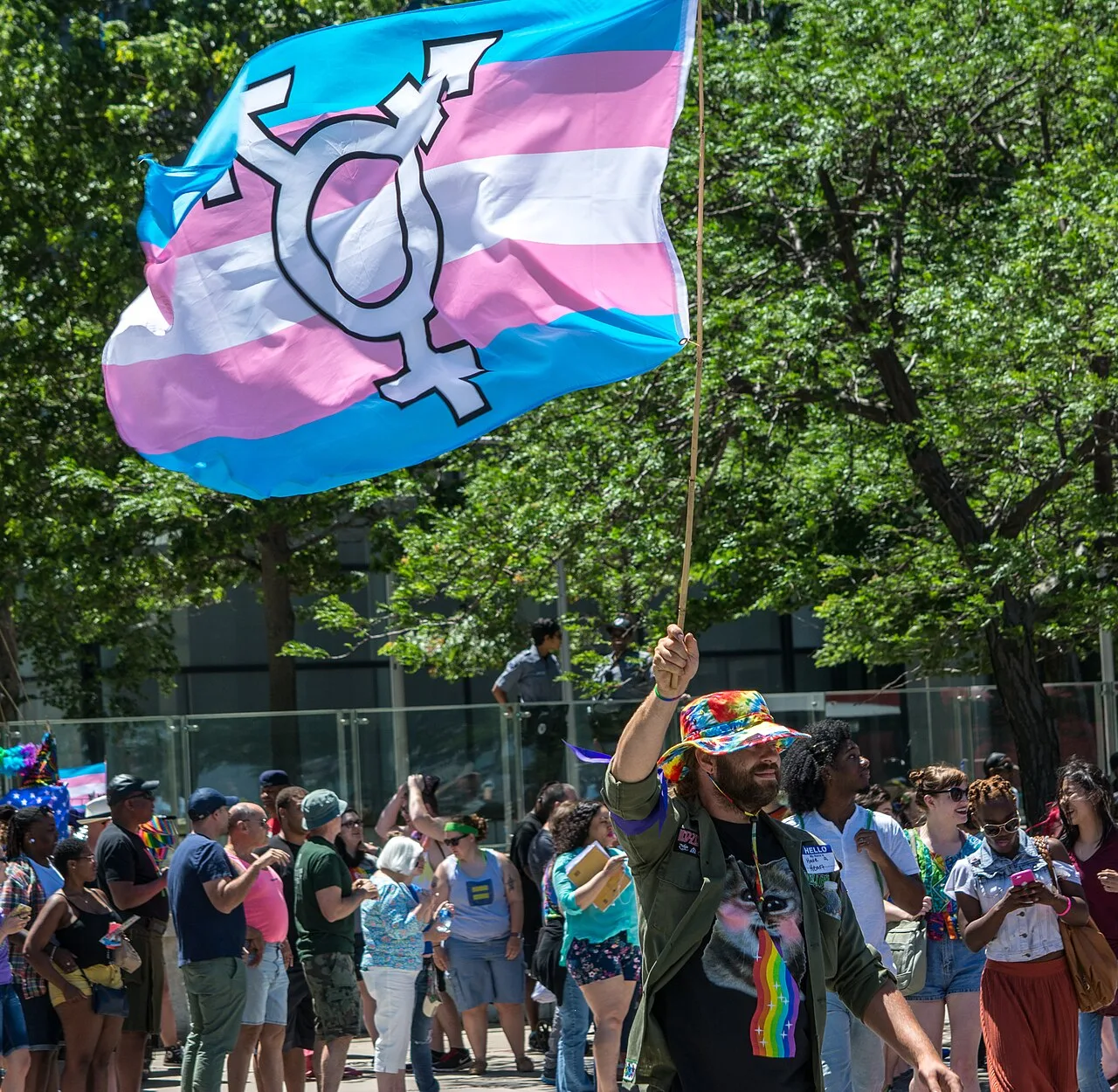
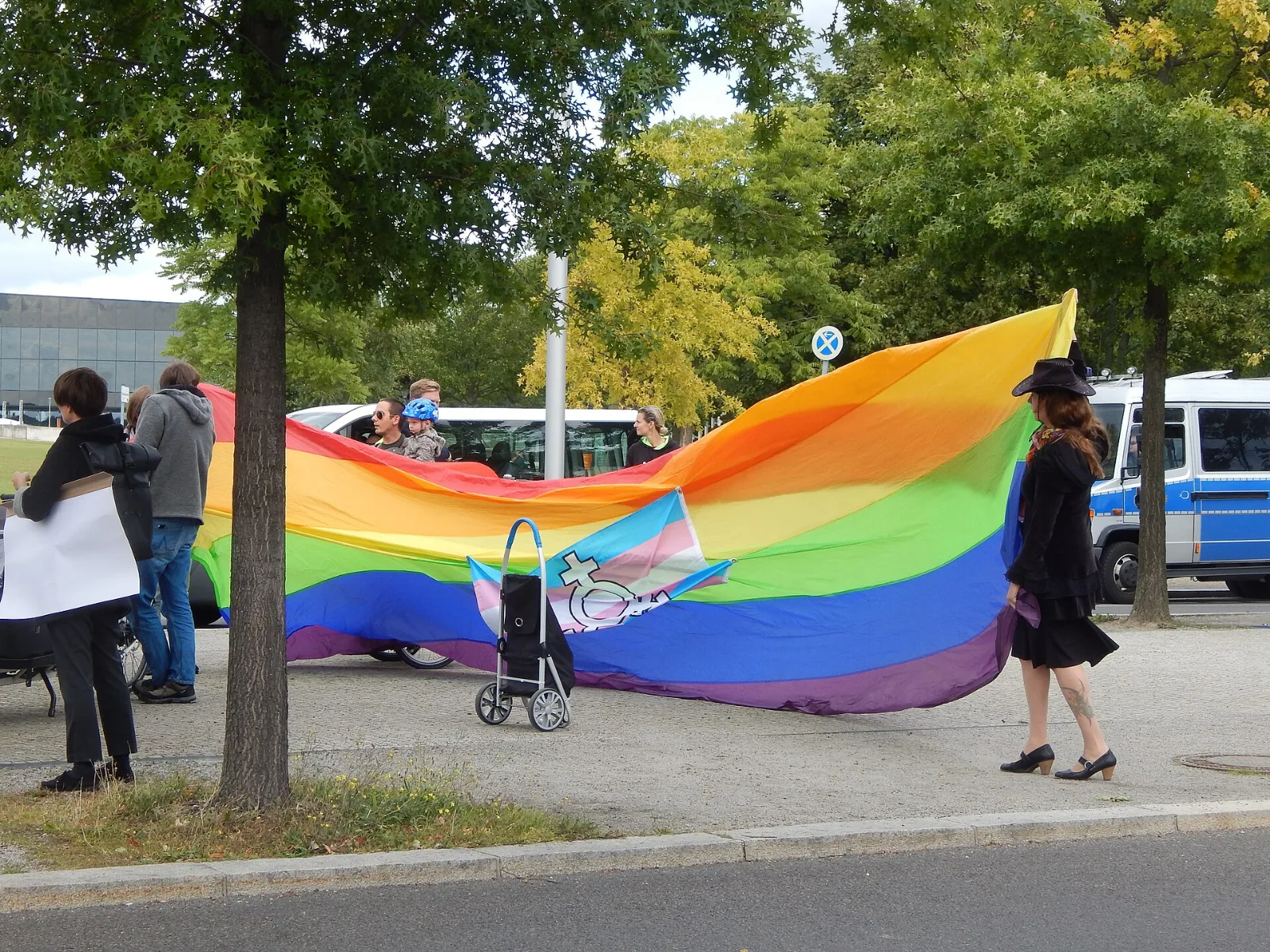
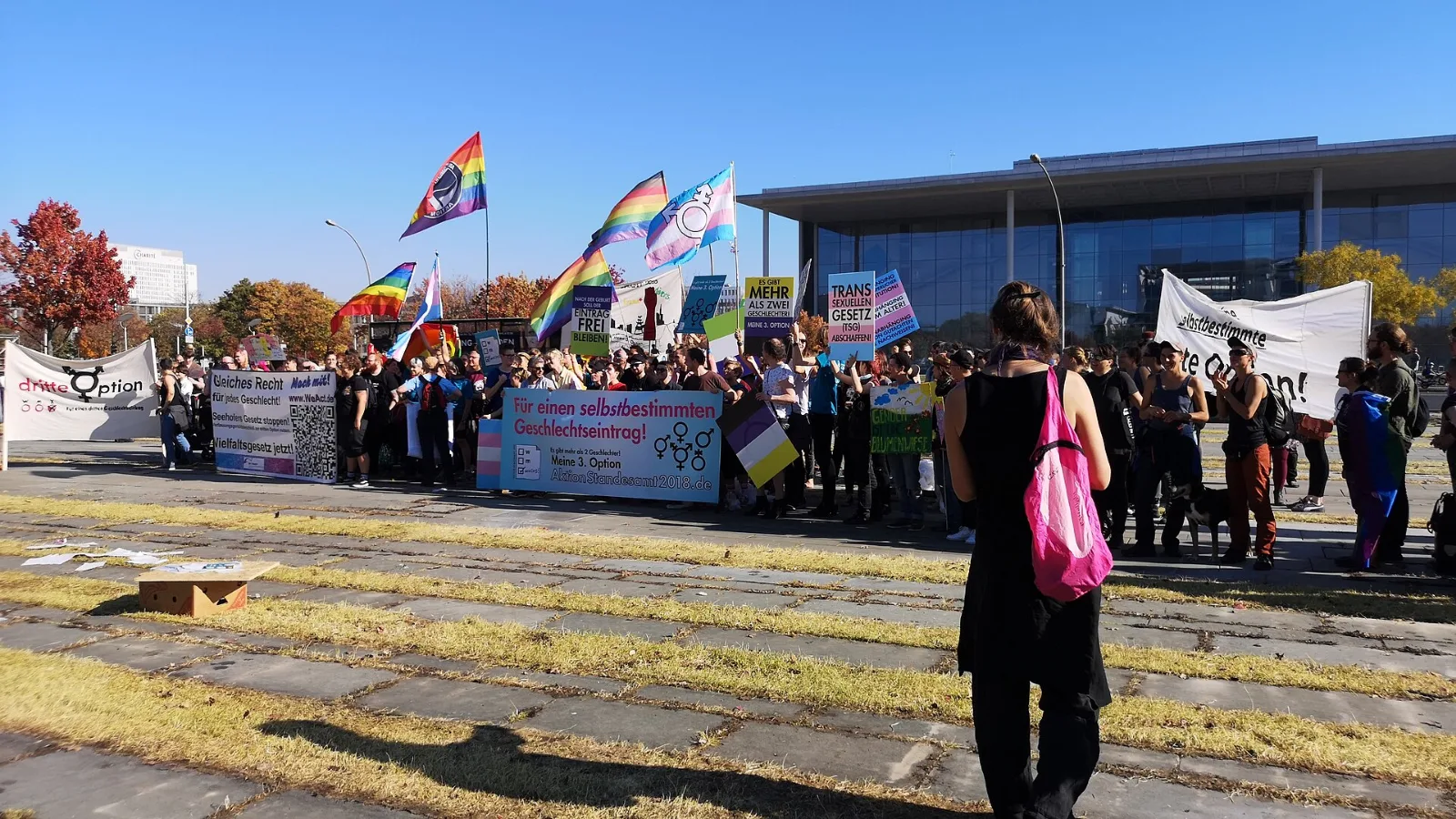
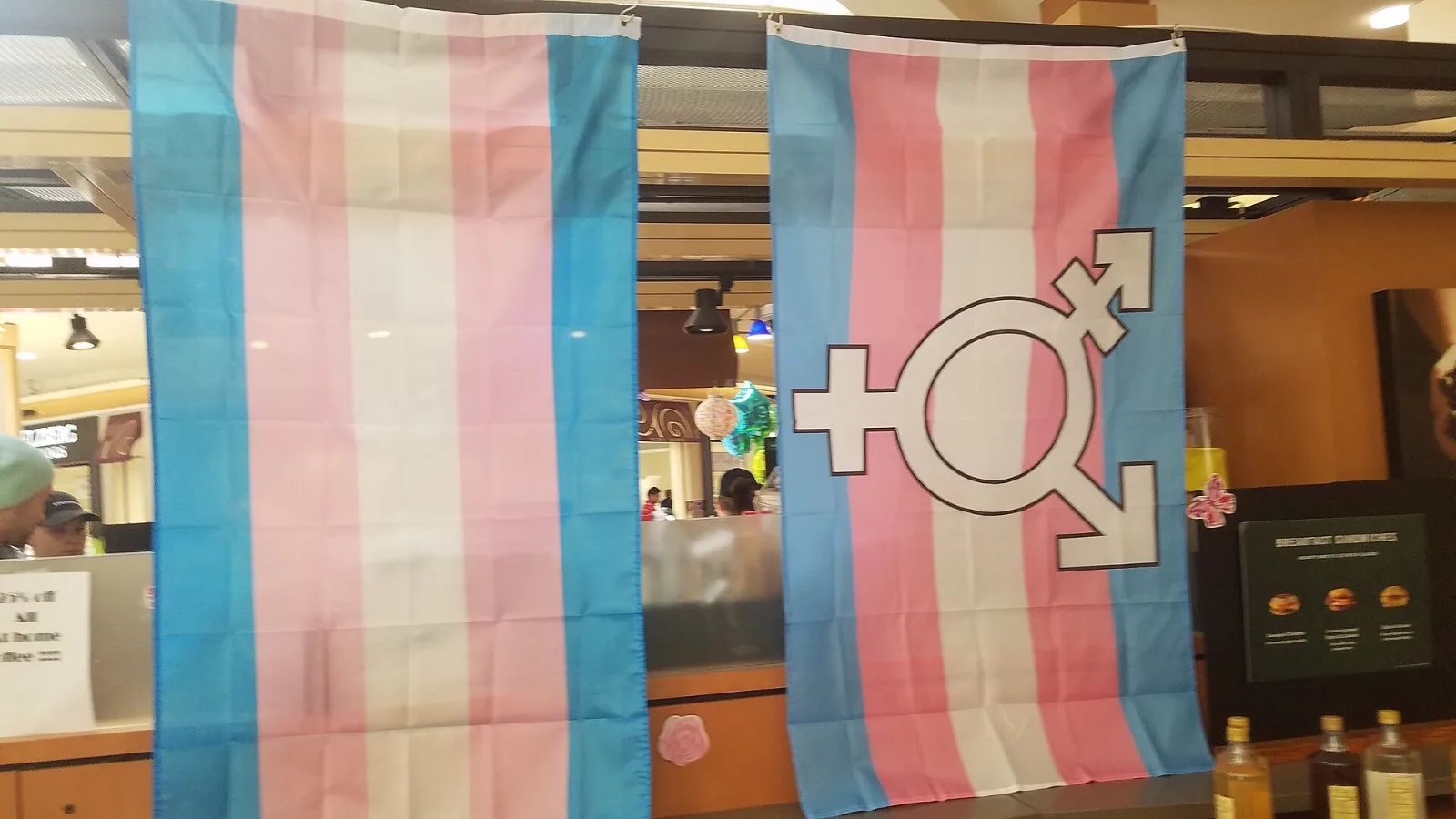
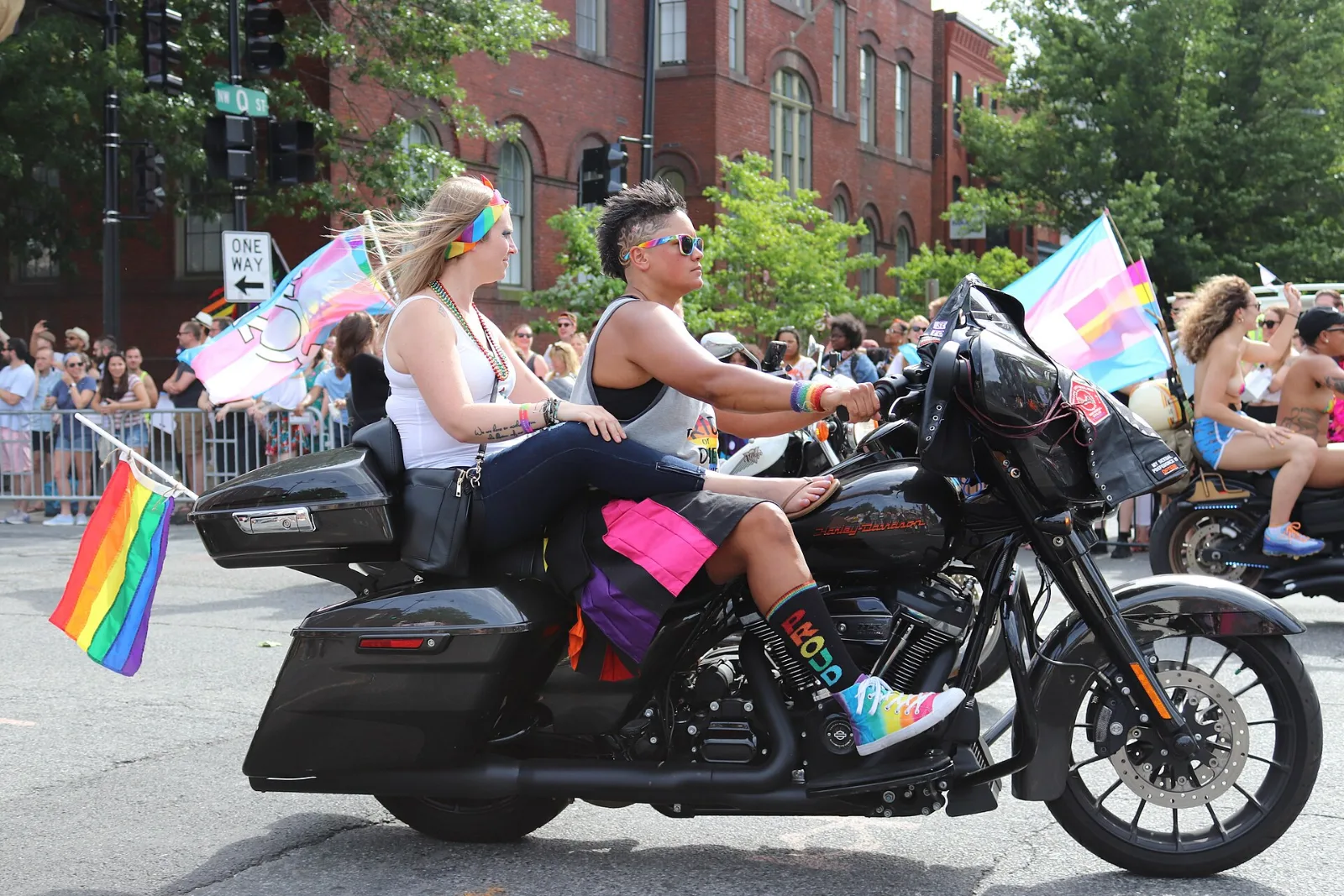
Tomislav Todorović cataloged eleven dated photographs of the variant in use between 2016 and 2019, each with a citation: Baltimore Pride in 2016; Malmö Pride in Sweden in 2016; Cleveland, Chicago and Olympia in 2017; the Berlin protests against the anti-LGBT "Demo für Alle" gathering in September 2017; Columbus and Munich in 2018; the Civil Registration Office Action in Berlin in October 2018, an event supporting a third gender option in official documentation; Transgender Day of Visibility in Winston-Salem in 2019, where it flew alongside the unmodified flag; and the Capital Pride Parade in Washington, D.C., in June 2019, where it flew alone. [1]
The symbol's encoding matters to the variant's spread. Boswell's design is encoded at U+26A7, assigned in Unicode 4.1 within the block 26A2..26B1, under the formal name MALE WITH STROKE AND MALE AND FEMALE SIGN. [4] It is the character in the transgender flag emoji, the sequence U+1F3F3 U+FE0F U+200D U+26A7 U+FE0F, added in Emoji 13.0. [5]
Lineage
- Direct predecessors
- Transgender Pride Flag
A charged variant of the 1999 flag, not an independent design. The device it adds has its own author and predates the flag by six years.
Lineage tree
Every record reachable from this one through documented parent and child relationships: 2 records across 2 generations.
- Ancestor
- Transgender Pride Flag
- This record
- Transgender Pride Flag with Transgender Symbol
Colors & Symbolism
The field carries the meanings Helms gave it. The added symbol carries Boswell's: Mars and Venus for male and female, and a third branch, an arrow crossed by an additional stroke, for mixed gender identities. [1] Nangeroni, describing the symbol she made into a pin, reads it as linking "the internationally accepted symbols for male and female together with a new entity, which is a combination of the two, and which we call transgender," and takes the enclosing circle as "a symbol of wholeness" representing "the wholeness of a society which includes the transgender." [2]
| Colour | Hex | Meaning |
|---|---|---|
| Light Blue | #5BCEFA | Boys, the traditional color for baby boys |
| Pink | #F5A9B8 | Girls, the traditional color for baby girls |
| White | #FFFFFF | Nonbinary, gender fluid, transitioning, intersex, or no gender at all, and the symbol |
| Black | #000000 | The fimbriation outlining the symbol |
Read from the vector published here. The base flag has no creator-issued palette; these are the circulating Wikimedia values.
This flag has no official digital palette. Color values shown are approximate.
No statement by Boswell about the symbol has been located, and none by anyone about why it was added to the flag. The fullest account of the symbol is Nancy R. Nangeroni's, which is firsthand but describes the symbol and the pin she made from it rather than the flag. [2]
No palette is specified for the variant. The base flag has no designer-issued palette either: its circulating values were set on Wikimedia Commons, the pink by an editor in 2012 working "based on verbal description and HuffingtonPost photo."
Design
- Aspect Ratio
- 3:5 · standard
- Ratio Notes
- No ratio is documented for the variant. The parent flag is catalogued at 3:5 and this carries the same standard production ratio; no measurement of a variant flag has been made.
- Orientation
- horizontal
- Stripe Count
- 5
- Layout
- charged horizontal stripes
- Stripes (Top → Bottom)
- light blue, pink, white, pink, light blue
- Center Symbol
- Transgender symbol in white, fimbriated black
Described only as "a large transgender symbol in white, fimbriated black, upon the field." No dimensions or placement rules are documented. [1]
The five-stripe transgender pride flag, light blue and pink on either side of a central white stripe, with a large transgender symbol placed across the center in white outlined in black. The symbol is a circle with three branches: the Mars arrow, the Venus cross, and a third arm combining the two, an arrow crossed by an additional stroke. Renderings of the symbol differ, and the widely circulated version with rounded line ends and full symmetry is Nangeroni's own execution rather than Boswell's drawing; which rendering the flag's charge descends from is not documented. [2]
Usage & Adoption
- Geographic Usage
- United States, Sweden, Germany
- Online Usage
- The symbol it carries, U+26A7, is the character used in the transgender flag emoji, the sequence U+1F3F3 U+FE0F U+200D U+26A7 U+FE0F, added in Emoji 13.0. [5]
- Event Usage
- Baltimore Pride 2016, Malmö Pride 2016, Cleveland Pride 2017, Chicago Pride 2017, Capital City Pride, Olympia 2017, Berlin protests against Demo für Alle, 2017, Columbus Pride 2018, Christopher Street Day Munich 2018, Civil Registration Office Action, Berlin 2018, Transgender Day of Visibility, Winston-Salem 2019, Capital Pride Parade, Washington 2019
- Current Status
- in use
Documented use runs from 2016 to 2019 in three countries, and appears alongside the unmodified flag as often as apart from it. [1]
Image Archive
The Variant in Use
.jpg)
.jpg)
.jpg)



.jpg)
Discourse & Debates
Common misidentifications
- Frequently reproduced as though it were the standard transgender pride flag. It is a charged variant; the plain five-stripe design is the one Helms made.
Footnotes & Citations
Sources and footnotes 12 sources
- 1. Reference Transgender flags (Monica Helms transgender flag: Variant). Tomislav Todorović, on Flags of the World, edited by Randy Young. Flags of the World (FOTW) (2021-07-18). Accessed 2026-07-31
- 2. Primary statement Transgender Symbol. Nancy R. Nangeroni. GenderTalk. Accessed 2026-08-14
A firsthand account by the person who made the first pin of the symbol. The page is undated.
- 3. Six LGBTQ symbols and their meanings. BBC Bitesize. Accessed 2026-08-14
The page Todorović cites for the Boswell attribution. Unbylined and uncited; an educational summary.
- 4. Reference Unicode Character Database: DerivedAge.txt and UnicodeData.txt. Unicode Consortium. Unicode Consortium. Accessed 2026-08-14
U+26A7 falls within the block 26A2..26B1, assigned in Unicode 4.1; its formal name is MALE WITH STROKE AND MALE AND FEMALE SIGN.
- 5. Reference emoji-zwj-sequences.txt. Unicode Consortium. Unicode Consortium. Accessed 2026-08-14
Records the transgender flag as the ZWJ sequence 1F3F3 FE0F 200D 26A7 FE0F, Emoji 13.0.
- 6. Image file page File:2016.06.17 Baltimore Pride, Baltimore, MD USA 6698 (34573762763).jpg. Ted Eytan. Wikimedia Commons. Accessed 2026-07-31
- 7. Image file page File:Malmö Pride (28826883725).jpg. Maria Eklind. Wikimedia Commons (2016-08-06). Accessed 2026-07-31
- 8. Image file page File:End of pride 02 - Cleveland Pride 2017 (38179008771).jpg. Tim Evanson. Wikimedia Commons (2017-06-24). Accessed 2026-07-31
- 9. Image file page File:Protest gegen die Demo für Alle vor dem Kanzleramt in Berlin 02.jpg. C.Suthorn. Wikimedia Commons (2017-09-15). Accessed 2026-07-31
- 10. Image file page File:Aktion Standesamt 2018 Abschlusskundgebung vor dem Kanzleramt in Berlin 43.jpg. C.Suthorn. Wikimedia Commons (2018-10-13). Accessed 2026-07-31
- 11. Image file page File:Transgender day of visibility at Starbucks.jpg. Breawycker. Wikimedia Commons (2019-03-31). Accessed 2026-07-31
- 12. Image file page File:122.GayPrideParade.WDC.8June2019 (48055274897).jpg. Elvert Barnes. Wikimedia Commons (2019-06-08). Accessed 2026-07-31
Image Sources
- Rendering
- Approximate rendering
- Drawn over the 1999 flag’s stripes and colors to the only description on record, "a large transgender symbol in white, fimbriated black, upon the field." No designer’s specification exists, and no source documents the charge’s size or placement, so those are the archive’s and carry no authority. Not a photograph, and not evidence of any particular flag. · Credit: Archive rendering, Encycloflaggia · Flags of the World, Transgender flags · approximateDrawn by the archive from the FOTW description. Todorović’s own illustration on that page is likewise a reconstruction and is not reused here.
- Baltimore Pride, the earliest documented use of the variant. Ted Eytan photographed it at 13:14; the Flickr set, filename and Commons category say 17 June 2016, while the description field and the EXIF say 17 June 2017. [1][6] · Credit: Ted Eytan, CC BY-SA 2.0, via Wikimedia Commons · Wikimedia Commons
- Malmö Pride, Sweden, 6 August 2016. The frame carries the transgender, genderqueer, asexual and pansexual flags together. [7] · Credit: Maria Eklind, CC BY-SA 2.0, via Wikimedia Commons · Wikimedia Commons
- Cleveland Pride, 24 June 2017. [8] · Credit: Tim Evanson, CC BY-SA 2.0, via Wikimedia Commons · Wikimedia Commons
- Protest against the "Demo für Alle" gathering, in front of the Chancellery in Berlin, 15 September 2017. [9] · Credit: C.Suthorn / cc-by-sa-4.0 / commons.wikimedia.org · Wikimedia Commons
- The closing rally of Aktion Standesamt 2018 in front of the Chancellery in Berlin, 13 October 2018, an action supporting a third gender option in official documentation. [10] · Credit: C.Suthorn / cc-by-sa-4.0 / commons.wikimedia.org · Wikimedia Commons
- A Starbucks in Hanes Mall, Winston-Salem, North Carolina, flying two flags for Transgender Day of Visibility, 31 March 2019. This is the instance Todorović describes as the variant "hoisted together with unmodified version." [1][11] · Credit: Breawycker, CC BY-SA 4.0, via Wikimedia Commons · Wikimedia Commons
- The Capital Pride Parade, Washington, D.C., 8 June 2019, the instance Todorović marks as the variant "used alone." [1][12] · Credit: Elvert Barnes, CC BY-SA 2.0, via Wikimedia Commons · Wikimedia Commons