Bisexual Pride Flag
Identity Pride Flag ·
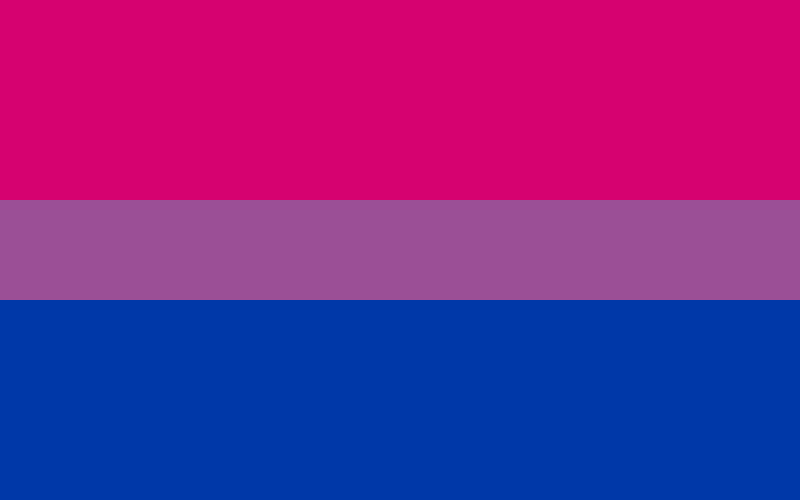
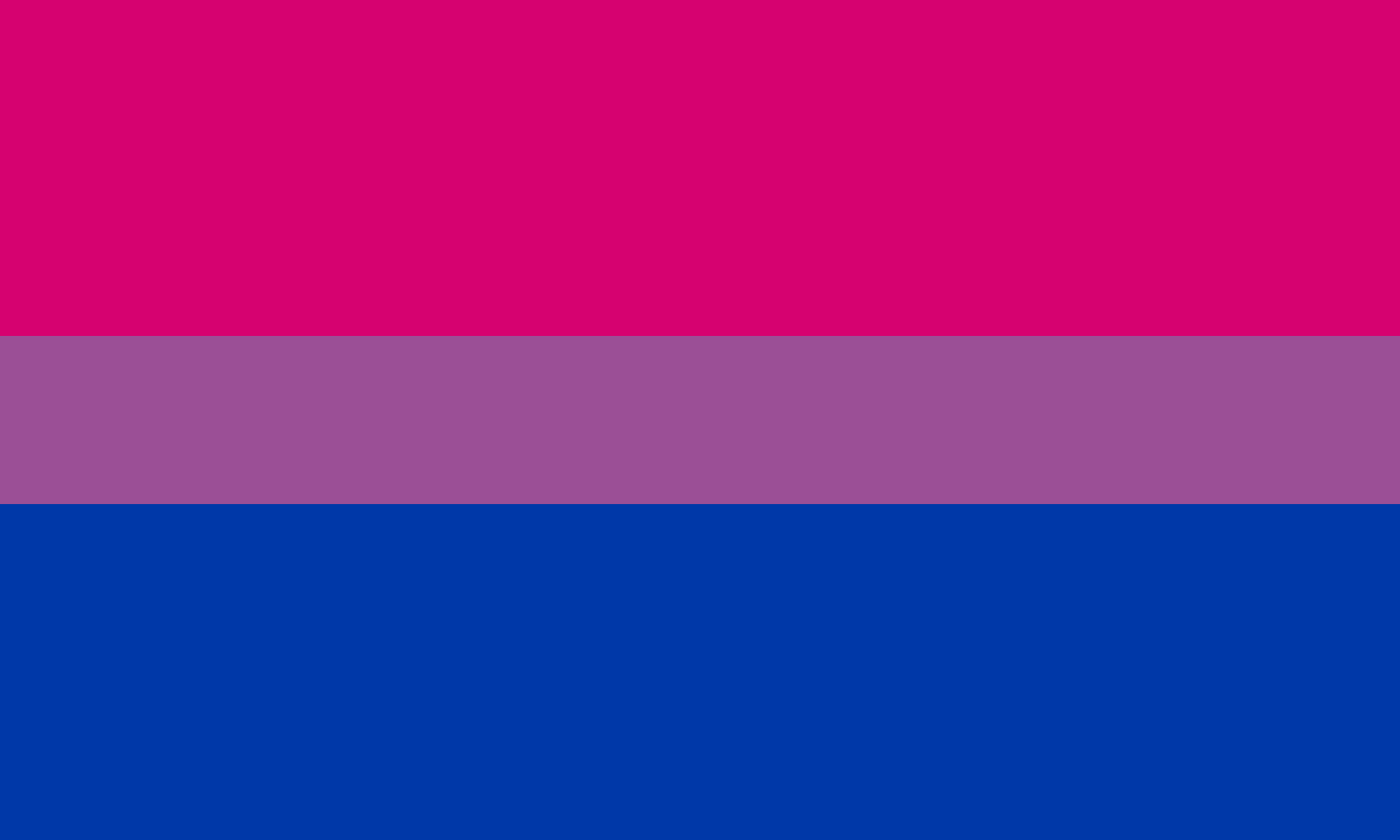
A three-stripe flag, a wide magenta band over a narrow lavender-purple band over a wide royal-blue band in 40:20:40 proportions, unveiled by Michael Page on 5 December 1998. Its palette was adapted from Liz Nania's older biangles symbol, which she dates to 1985. Page specified the flag in Pantone only, PMS 226, 258 and 286, and asked users to "use the exact PMS colors"; every hex value in circulation is a later conversion, set on Wikimedia Commons in April 2018. Ownership of the design was disputed in 2020. [1][2]
Key facts
- Designer
- Michael Page
- Created
- First documented public use
- In use
- 1998–present
- Aspect Ratio
- 2:3 or 3:5
- Stripes
- 3
- Represented Identity
- bisexual
Also known as
- Bisexual Flag
- Bi Pride Flag
- Bi Flag
Status Canonical
Archive categories Sexual & Romantic Orientation Pride Flags · Historical and Early Pride Flags
Overview
Page's own statement: "As a result of volunteer work I was doing for BiNet USA, it occurred to me that if bi people were going to be visible at home, pride events and rallies, we needed a Bi Pride Flag!" He gave the purpose as "to maximize bisexual pride and visibility." [1]
The flag emerged from bisexual community organizing in the late 1990s, in response to bisexual erasure: the denial or minimization of bisexuality as a distinct orientation. The legal scholar Kenji Yoshino has described an "epistemic contract" by which heterosexual and homosexual communities alike had an interest in a binary framework that treated bisexuality as a phase or a fence-sitting position. [3] Bisexual people also met "pick a side" pressure and exclusion from some Queer organizations and events. Page conceived the flag to make bisexuality visible where it otherwise went unseen, the purpose he stated directly: "to maximize bisexual pride and visibility." [1]
Identity & Context
- Represented Identity
- bisexual
- Subcommunity
- multisexual umbrella / bi+ spectrum (community framing)
Creators
The Creator
Michael Page
Designer
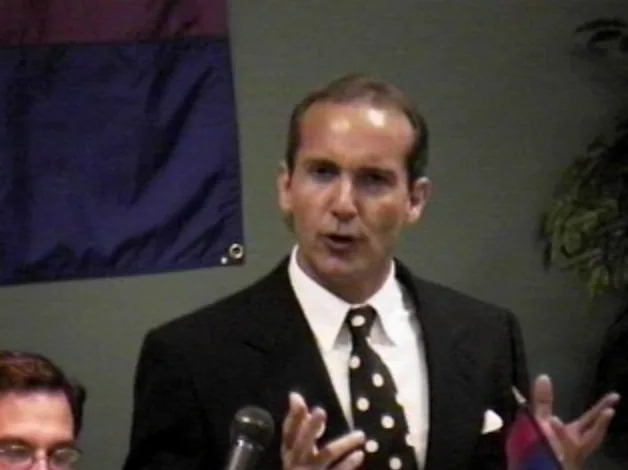
Michael Page created the bisexual pride flag and unveiled it on 5 December 1998 at the first anniversary party of BiCafe, the bisexual personals and dating site he ran from Florida. He dated the project that became BiCafe to 1996, describing it as starting "to discover I was not the only bi person on Earth," and gave his own location as Miami-Fort Lauderdale. [4][1] He gave his own reason for making it: "As a result of volunteer work I was doing for BiNet USA, it occurred to me that if bi people were going to be visible at home, pride events and rallies, we needed a Bi Pride Flag!" Its purpose, he wrote, was "to maximize bisexual pride and visibility," and it was "for free public and commercial use." [1] He took the palette from the biangles, the overlapping-triangle symbol designed by Liz Nania, and explained the purple center as the point where bisexual people "blend unnoticeably into both the gay/lesbian and straight communities." [1] He ran a network of sites under his company The Coffee Club, Inc.: BiFlag.com, BiCafe, the resource hub BiFocus.com, and BiPrideStore, which sold flags in every size alongside stickers and gifts. The design was free while the objects were for sale. [1] He worked as a jet pilot [5] and mentioned a call taken "while on layover." [6] He did not identify as queer: "I have not a thing against those who self identify as queer. I just don't work as a volunteer for a queer movement is all." [6] Fritz Klein helped him at the outset, visiting his home to discuss BiCafe and traveling with him to a bisexual conference in Australia in February 1998. He volunteered as a BiNet USA regional organizer from July 1999 and logged the flag's early appearances with photographs on his own site through at least 2007. [6] bicafe.com closed in 2012 and he left the bisexual scene soon afterwards. [7] BiNet USA announced his death circa August 2016, and no indexed obituary has been located. [8] That report is contested: Monica Helms, who met him at a BiNet conference in Phoenix and became his friend, spoke of him in November 2021 as living but deliberately unfindable, "He’s gone stealth across the board," and said he had withdrawn because others were claiming to have created the flag. [9] Whether and when he died is not established. Two photographs of him survive in his own recovered archive: his BiCafe profile portrait, and a photograph of him speaking on a panel in Fort Lauderdale on 22 January 2000. [6][4] He documented his own activity on biflag.com between 1998 and 2007, which leaves him unusually well evidenced in his own words for a flag designer of this period.
Motivations
- To create a more visible bisexual community symbol than the older biangles emblem [10]
- To give the bisexual community a flag on par with the rainbow flag's visibility [10][11]
Stated inspirations
Origin
No verified physical location; the flag was unveiled at BiCafe's first-anniversary party on 5 December 1998.
The flag was unveiled at the first anniversary party of BiCafe on 1998-12-05. [10][11][12] No specific geographic location for the design process was established in the sources reviewed.
Dates & Chronology
- Year Created
- Exact date
- First public use
- Period in Use
- 1998–present
The flag was unveiled on December 5, 1998, at the first anniversary party of BiCafe. [10][11][12] It became the primary bisexual pride emblem and spread internationally within its first four years, reaching Australia, Italy and Iceland. [6][7]
The flag's early spread was tied to bisexual community organizing in the late 1990s, including BiNet USA and the establishment of Celebrate Bisexuality Day (September 23), first marked in 1999 and co-founded by Page with Wendy Curry and Gigi Raven Wilbur. [13][7][5] Curry, then president of BiNet USA, and Wilbur helped popularize the flag in an era shaped by "Don't Ask, Don't Tell" and the growth of online bisexual community-building. Fritz Klein described it as "a most important new Bi symbol" in the BiNet USA newsletter of Winter 1998. [13][7]
Lineage
- Indirect influences
- Bisexual biangles symbol, Rainbow Pride Flag
- Direct children
- Biromantic Asexual Pride Flag (Nikki, 2022), Biromantic Pride Flag (Grey Heart, 2016), Biromantic Pride Flag (Centered Heart, 2016), Bisexual Ally Flag, Chicago Bisexual Pride, Demibisexual Pride Flag (2016, Pride-Flags), Heteroflexible Pride Flag (Crimson, 2024), Homoflexible Pride Flag (Crimson, 2024), Polysexual Pride Flag
A historically significant entry in the multisexual / bi+ group. The bisexual flag is not a direct parent of every later multiple-attraction flag. It is a historical reference point alongside pansexual, polysexual, omnisexual, and abrosexual flags; available sources support sibling and comparison relationships rather than strict parent-child derivation. Part of the broader post-rainbow striped pride-flag tradition.
Lineage tree
Every record reachable from this one through documented parent and child relationships: 11 records across 3 generations.
- This record
- Bisexual Pride Flag
- Children
- Polysexual Pride Flag, Biromantic Pride Flag (Centered Heart, 2016), Biromantic Pride Flag (Grey Heart, 2016), Demibisexual Pride Flag (2016, Pride-Flags), Chicago Bisexual Pride, Bisexual Ally Flag, Biromantic Asexual Pride Flag (Nikki, 2022), Heteroflexible Pride Flag (Crimson, 2024), Homoflexible Pride Flag (Crimson, 2024)
- Generation 3
- Polyromantic Alternative Pride Flag (2020)
Colors & Symbolism
The flag adapts the color logic of the earlier bisexual biangles symbol into a horizontal format with documented 40/20/40 proportions. [2][10][11] In Michael Page's original explanation the wide magenta and royal-blue stripes stand for attraction to the same sex and to the opposite sex, and the narrow purple center represents the overlap between them, the color that results when pink and blue combine. Page described it this way: "the purple pixels of color blend unnoticeably into both the pink and blue, just as in the 'real world' where bi people blend unnoticeably into both the gay/lesbian and straight communities." [1]
| Colour | Designer (PMS) | Community (hex) | Meaning |
|---|---|---|---|
| Magenta | 226 | #D60270 | Attraction to the same sex, in Michael Page’s original explanation. |
| Lavender-Purple | 258 | #9B4F96 | Attraction to both sexes; the purple overlap represents the blending of magenta and blue. |
| Royal Blue | 286 | #0038A8 | Attraction to the opposite sex, in Michael Page’s original explanation. |
Pantone specified by Michael Page, biflag.com [1]; hex and RGB are later conversions, not his [11]
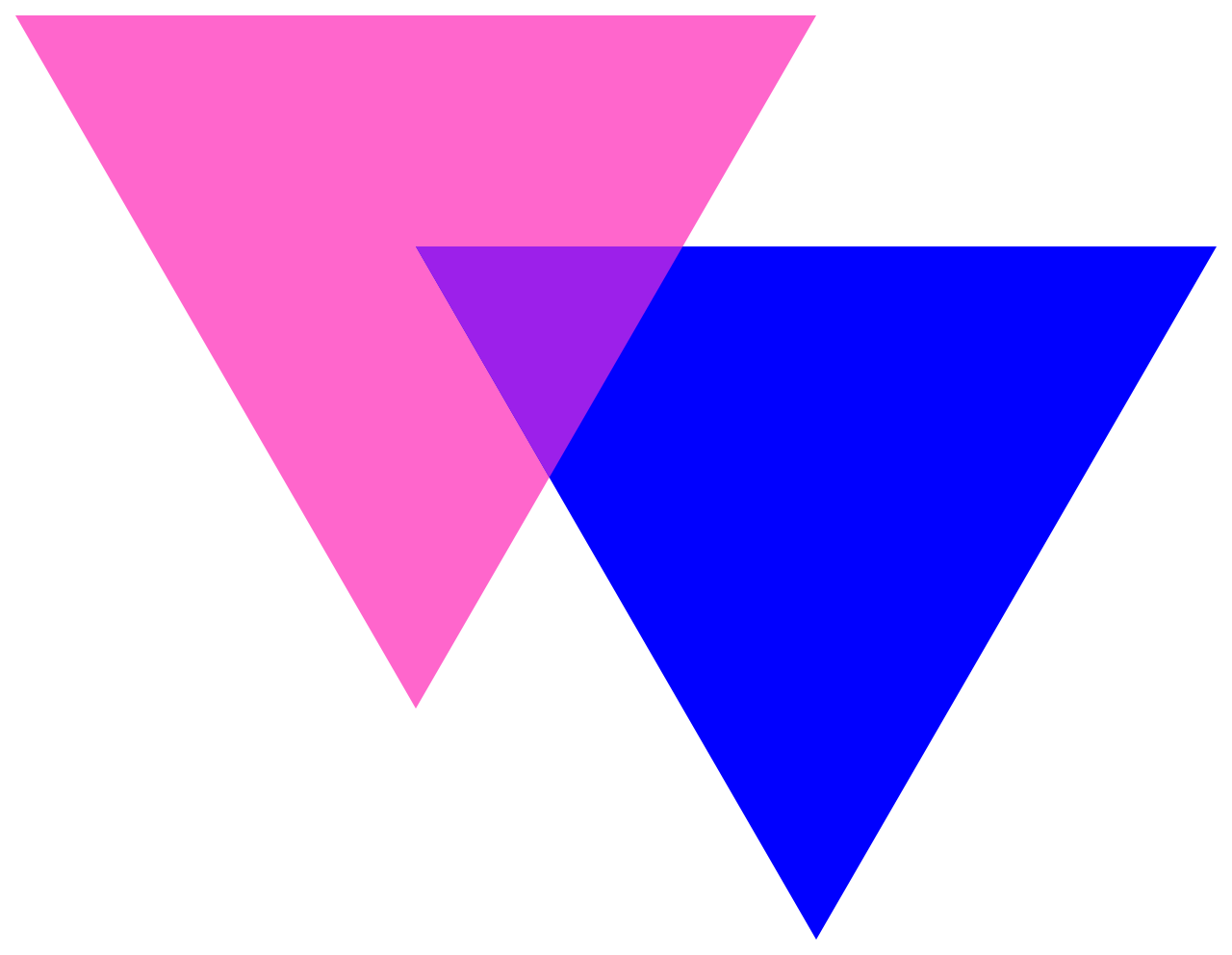

The palette comes from the biangles, the overlapping-triangle bisexual symbol designed by the artist Liz Nania. On her own portfolio she heads the work "Biangles, 1985" and describes it as two overlapping triangles in pink and blue, colors "traditionally associated with girls and boys in the US," with a lavender center for "the wholeness and queerness of bisexuality"; the triangle itself references the pink triangle that Nazi Germany used to mark gay men and that LGBTQ+ communities reclaimed in the 1980s. [2] Biscuit gives the same 1985 date independently. [7] Wikipedia instead ties the design to Nania co-organizing the bisexual contingent for the Second National March on Washington, held 11 October 1987. [11] Not everyone accepted the biangles: Vivian Wagner designed a double crescent moon as an alternative bisexual symbol because many bisexual people objected to the biangles’ use of the pink triangle, a Nazi concentration-camp badge. [7] Page took the biangles' colors and overlap pattern by his own account and translated the overlap into the flag's narrow purple middle stripe. [1] Later educational sources often broaden the center stripe to attraction to all genders, a reinterpretation rather than Page's documented wording. [10][11]
The designer specified the palette in Pantone and only in Pantone: "magenta - PMS 226 (pink), lavender - PMS 258 (purple) and royal - PMS 286 (blue)." He asked that it be reproduced exactly: "Please use the exact PMS colors listed above. If we are going to be effective with this flag, we need to be consistent with our colors." [1] The hex values in universal circulation, #D60270, #9B4F96 and #0038A8, are conversions made by others. They are recorded here because they are what reproductions follow, not because Page issued them. [11] Nor are they uniform: Library.LGBT publishes #9B4F97 and #0038A7, differing in the last digit on two of the three stripes. [10] The stripe proportions are his: 40 per cent, 20 per cent, 40 per cent.
Design
- Aspect Ratio
- 2:3 or 3:5
- Orientation
- horizontal
- Stripe Count
- 3
- Layout
- horizontal_stripes
- Stripes (Top → Bottom)
- Magenta, Lavender-Purple, Royal Blue
Three horizontal stripes in proportions 2:1:2. The overall ratio is not fixed: Flags of the World records that it follows "the commercially available proportions, either 2:3 or 3:5." [14] Wikipedia's infobox gives 3:5 alone. [11] Page's own specification sets the stripe proportions at 40, 20 and 40 per cent but does not state an overall ratio. [1]
Three horizontal stripes with unequal widths: a wider magenta stripe at top (40%), a narrower lavender-purple stripe in the middle (20%), and a wider royal-blue stripe at bottom (40%). [10] No emblem or additional symbols. Current reference sources also support 3:5 as the documented proportion. This is one of the few identity flags where stripe proportions are explicitly documented.
Usage & Adoption
- First Users
- Michael Page and BiCafe members, from the unveiling of 5 December 1998 [1]
- Geographic Usage
- International circulation
- Online Usage
- Widely used as the primary bisexual pride emblem
- Event Usage
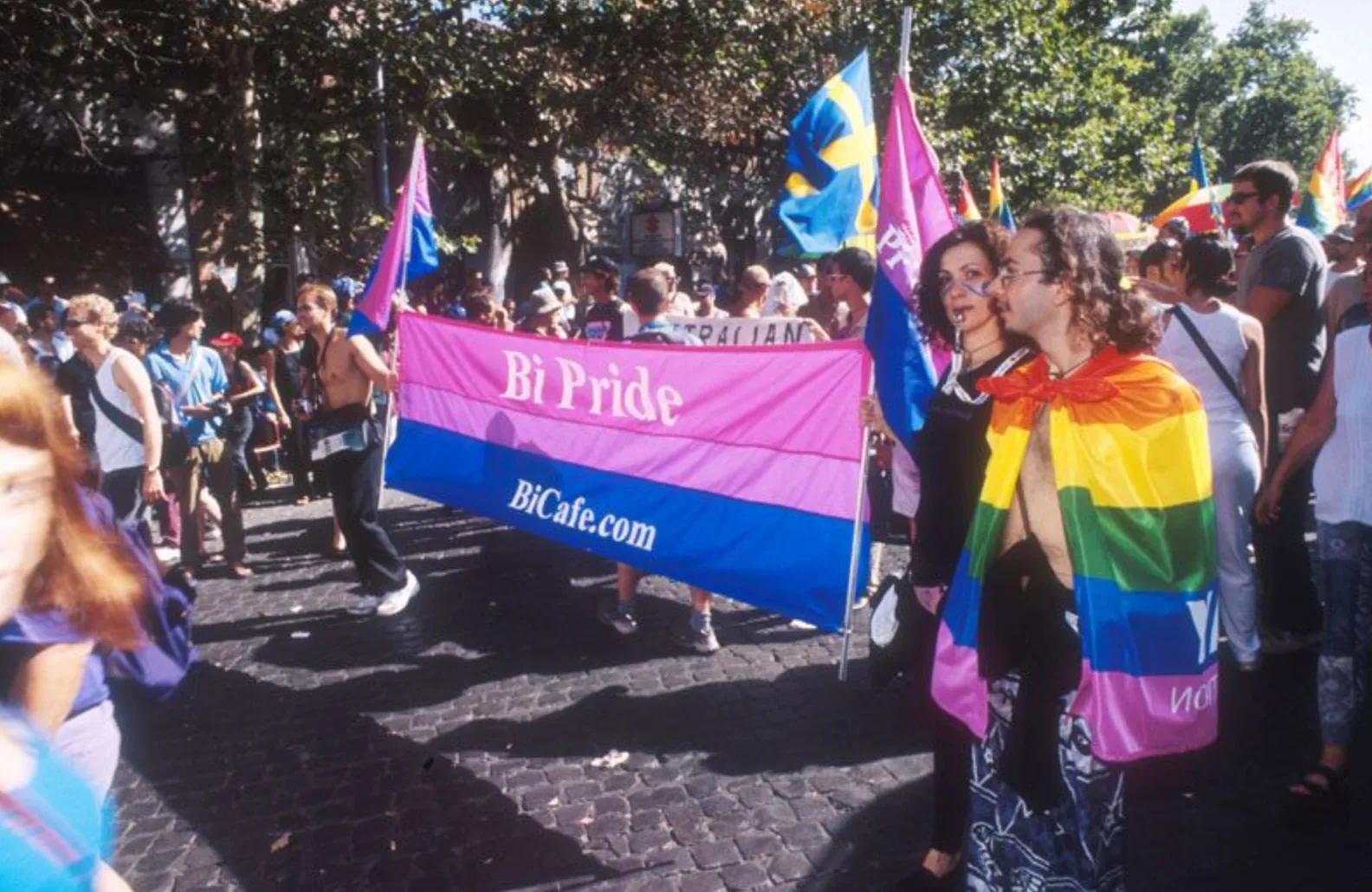
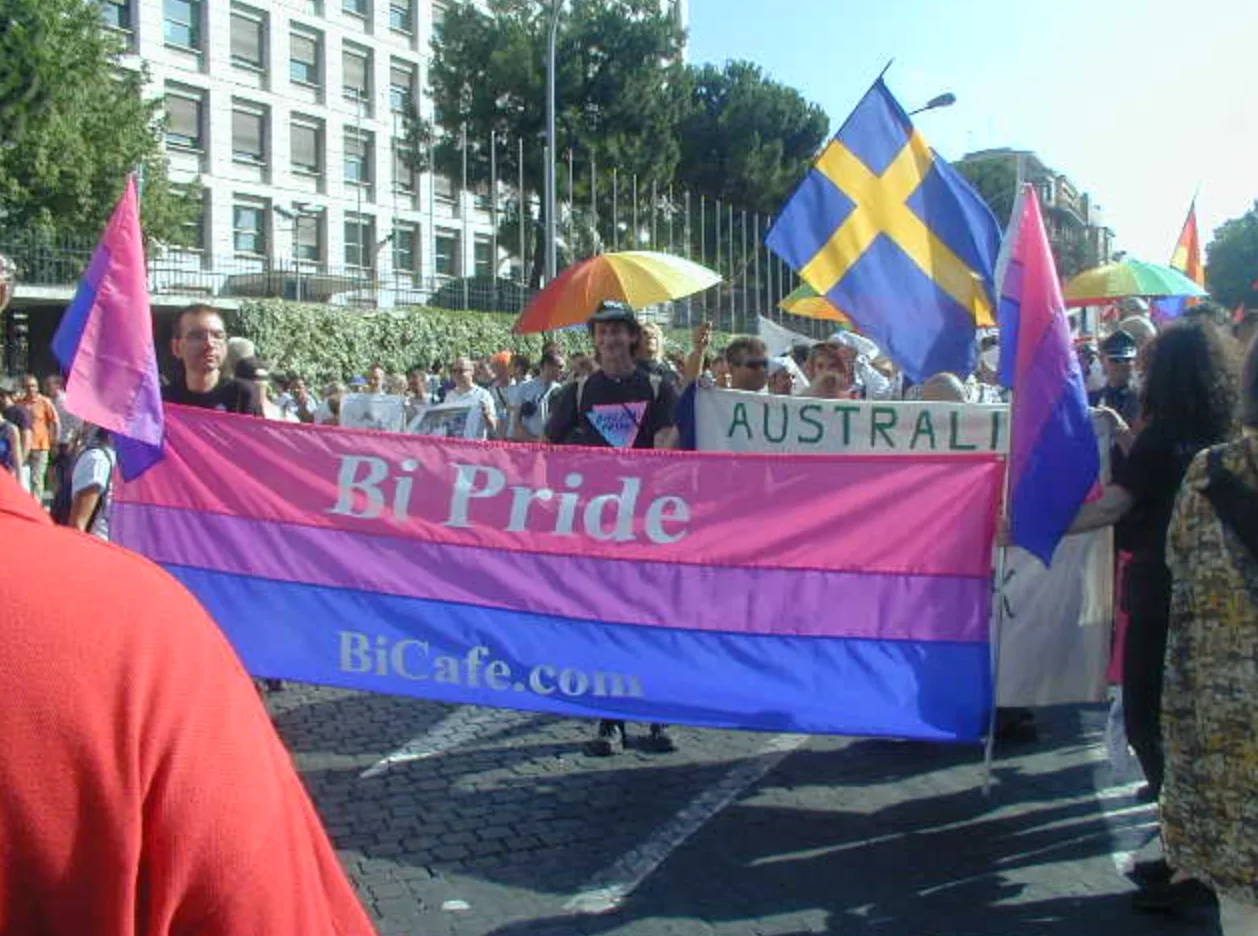
- Equality Begins at Home, Florida State Capitol, Tallahassee, 22 March 1999: the flag's first practical appearance [6], Phoenix Pride, 6 June 1999 [6], Houston Bi Conference, 22 October 1999: first display on public property, flown above the Sheraton Hotel for three days [6], Heritage of Pride, Fort Lauderdale, 22 January 2000 [6], Sydney Gay and Lesbian Mardi Gras, 4 March 2000 [6], GLBT World Pride, Rome, 9 July 2000 [6], Gay and Lesbian Community Center, Fort Lauderdale, 20 December 2000: first permanent raising alongside the rainbow flag [6], New York City LGBT Pride Parade, 30 June 2002 [6], Reykjavík Pride, 11 August 2002: first appearance in Iceland [6]
- Current Status
- active
The flag moved quickly and through people rather than institutions. Page logged its appearances himself with photographs: first at Equality Begins at Home, at the Florida State Capitol in Tallahassee, on 22 March 1999, where a Tallahassee Democrat photographer shot it and the image ran in colour on the paper’s front page the next morning; on public property for the first time above a Houston hotel that October, and permanently beside the rainbow flag at a Fort Lauderdale community center in December 2000. [6] BiNet USA bought a thousand stickers after the Tallahassee appearance and distributed them nationally. [6] It reached Australia, Italy and Iceland within four years, carried by individuals who met on the bisexual listservs: the Queensland activist Wayne Roberts took it to the Sydney Gay and Lesbian Mardi Gras in March 2000, a set carrying the bicafe.com URL reached World Pride in Rome two months later, and a BiCafe member known as Mosi took it to Reykjavík Pride in August 2002. [6] Wendy Curry, then president of BiNet USA, put the movement's size at the time this way: "I don't think there were more than 200 of us worldwide." [7]
Image Archive
The flag in use
.jpg)


.jpg)

Provenance

Documented Use
.jpg)


The designer

Early adoption
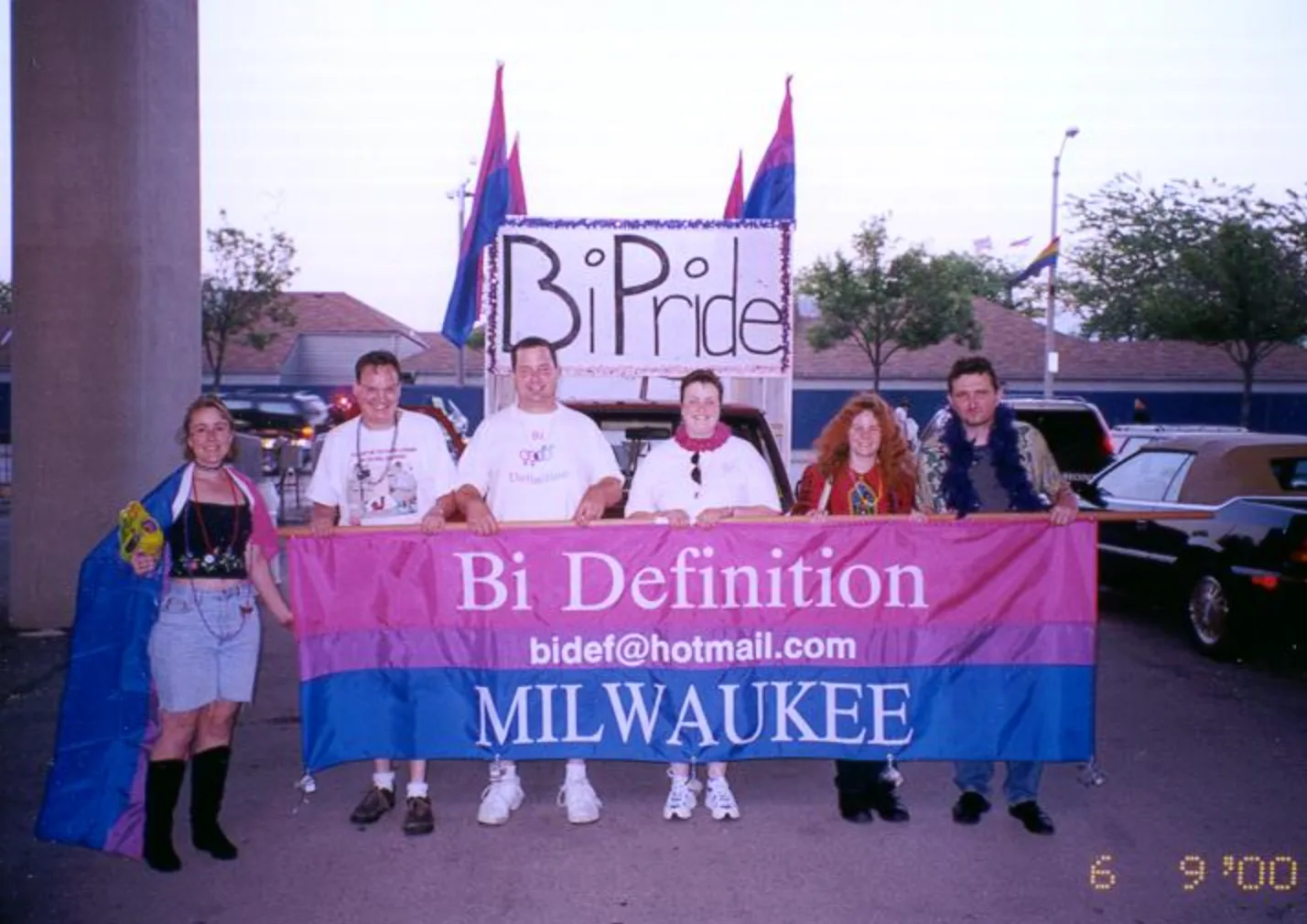
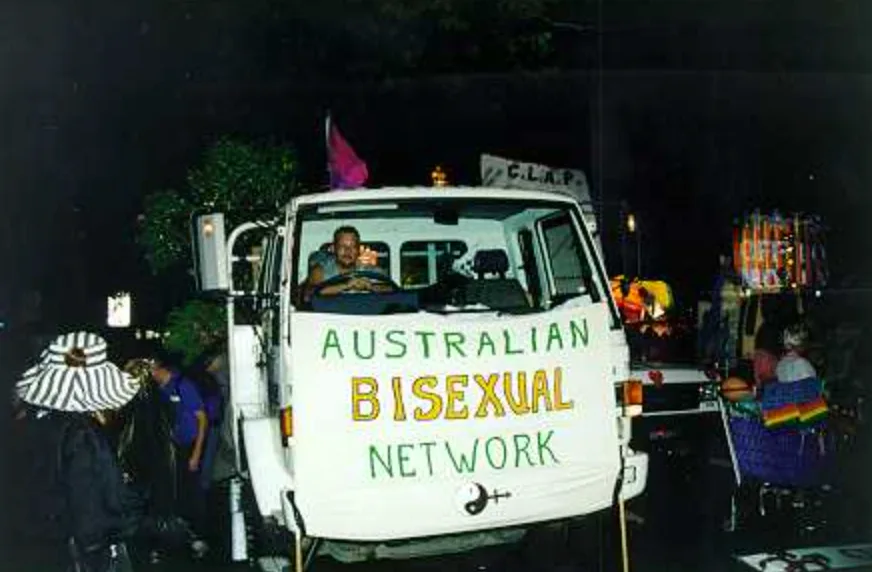
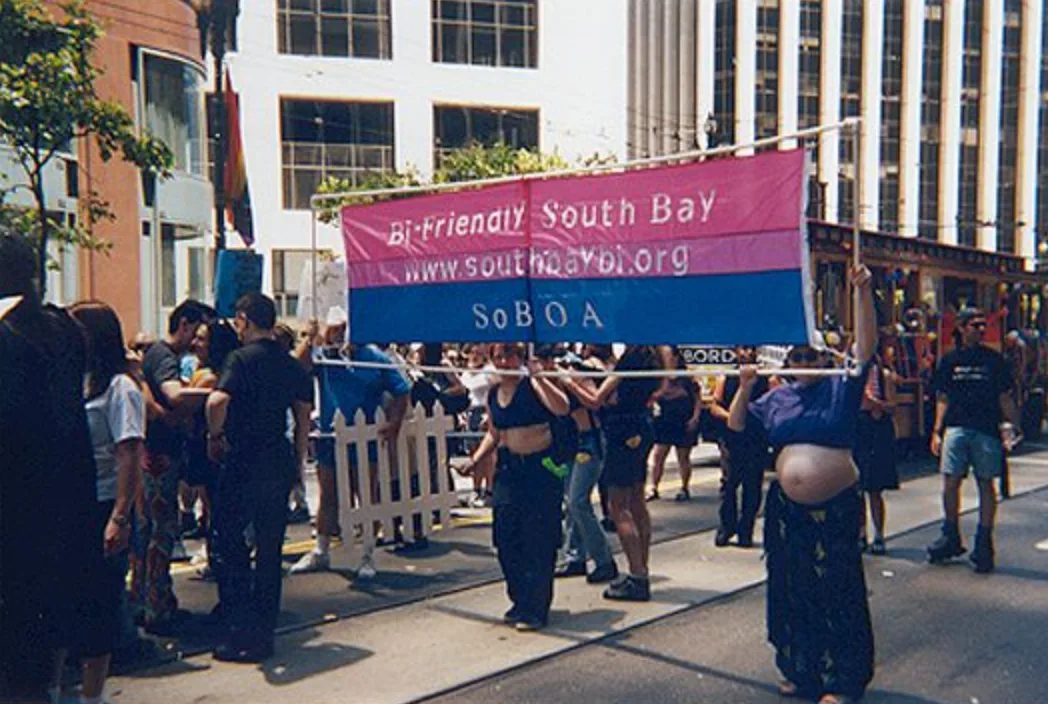
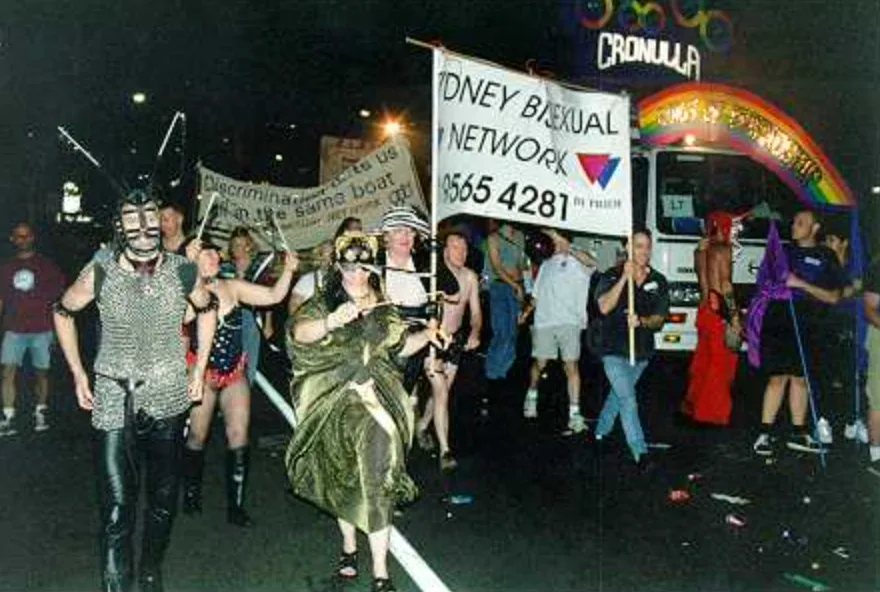
Rome, World Pride 2000
The designer’s own site
The symbol behind the palette
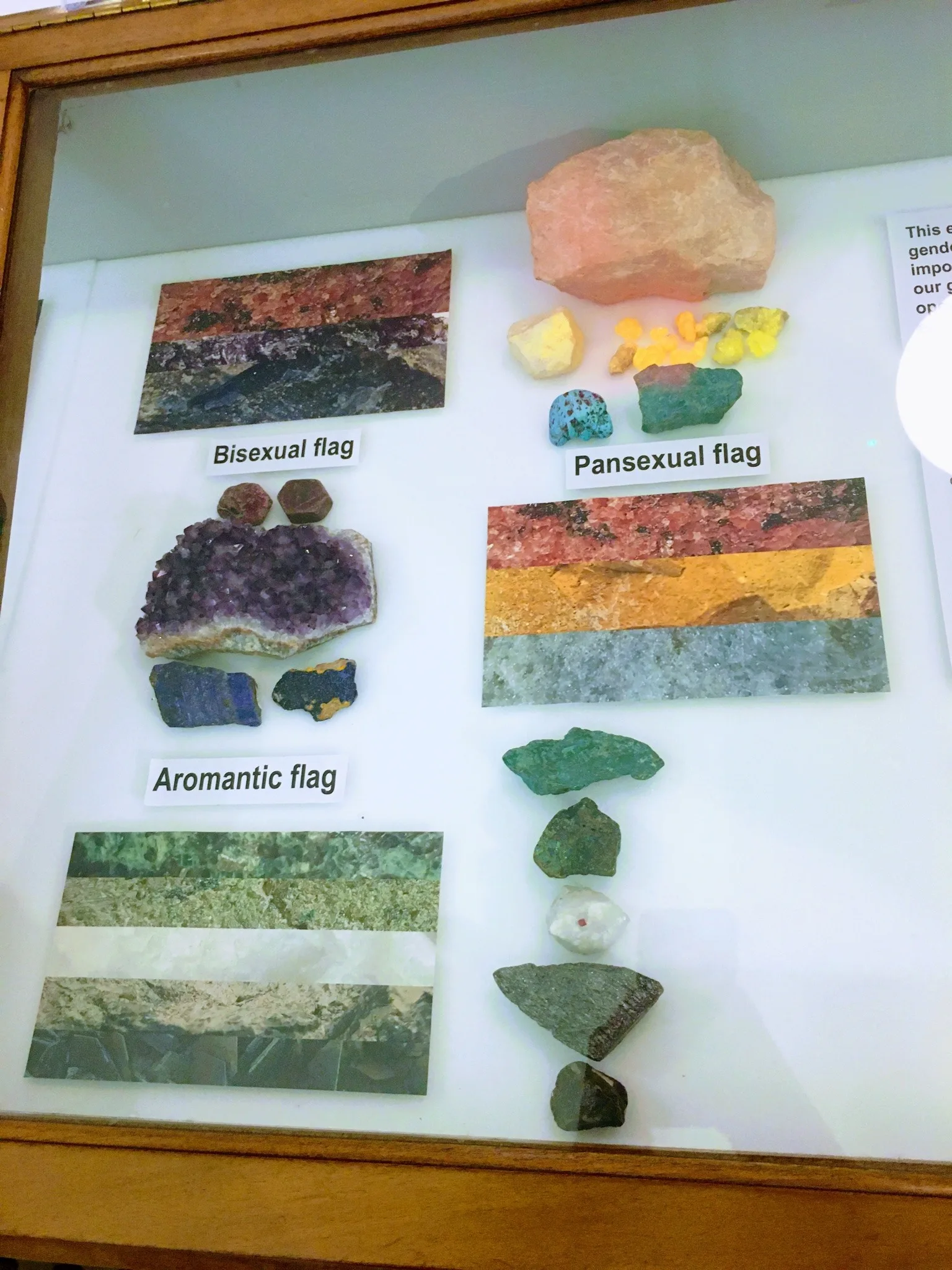
Photograph by the Tumblr user feral-critter. No licence is stated and none has been sought; published at the site owner's direction with the rights status recorded as undetermined.
In-text images
Discourse & Debates
- The purple stripe meaning is sometimes simplified in later sources from 'overlap / both' to 'attraction to all genders,' which broadens the original framing without acknowledging the shift. [10][11]
- Whether the flag's binary color coding (pink for same-sex attraction, blue for different-sex attraction) adequately represents contemporary understandings of bisexuality as attraction to people of more than one gender. Bisexual educator and editor Robyn Ochs is among the most prominent voices on this question. Her widely cited definition frames bisexuality as 'the potential to be attracted, romantically and/or sexually, to people of more than one sex and/or gender, not necessarily at the same time, not necessarily in the same way, and not necessarily to the same degree.' Ochs was among the first couples to legally marry in Massachusetts when same-sex marriage became law there in 2004; she publicly objected when media outlets framed the ceremony as a 'lesbian wedding.' Her edited anthology Getting Bi: Voices of Bisexuals Around the World documents the global breadth of bisexual experience. [15][16]
Common misidentifications
- Bisexuality is frequently oversimplified as attraction to only two genders. The flag's original framing used 'same sex' and 'opposite sex' language, but contemporary bisexual activism and scholarship treat the orientation as encompassing attraction to multiple genders. [10][11]
Criticisms
- In April 2020 BiNet USA, a national bisexual organization, publicly claimed sole copyright over the bisexual pride flag and its colors, a claim advanced by its then-president Faith Cheltenham. It asked activists to stop using the flag, invited reports of unlicensed use, and threatened legal action. The claim drew immediate and widespread backlash: Michael Page had released the flag for free public and commercial use and had assigned rights to no organization. BiNet board member Dr. Lauren Beach said publicly that the board had not been consulted and that she did not share the view that BiNet owned or should license the flag. Monica Helms and Charley Beal of the Gilbert Baker Foundation both rejected the claim, and Beal noted that a flag as such cannot be copyrighted. BiNet USA's own 2018 statement had quoted Page saying the flag "officially belongs to the entire bisexual community." The organization stopped using the flag on 8 May 2020, and its Twitter account was later deleted. [17][8][11] During the dispute BiNet USA also asserted that Page "is not bisexual and doesn't want to be associated with the flag." Nothing located corroborates the assertion, and it runs against Page's own writing about himself: he founded and ran BiCafe as a bisexual community site, described the project as beginning "to discover I was not the only bi person on Earth," volunteered as a BiNet USA regional organizer, and published the flag under his own name for years. [8][4][1]
The flag serves as the primary visual symbol for Celebrate Bisexuality Day (September 23), also known as Bi Visibility Day, co-founded in 1999 by Michael Page, Wendy Curry (then president of BiNet USA), and Gigi Raven Wilbur. The September date was chosen to fall in the birth month of Freddie Mercury, one of the most publicly visible bisexual figures in popular culture, and specifically on Wilbur's birthday. The first observance took place at the International Lesbian, Gay, Bisexual, Trans and Intersex Association (ILGA) Conference in Johannesburg, South Africa, giving the day a global dimension from its inception. [13][7] Dr. Fritz Klein (1932–2006), the Austrian-born American psychiatrist who authored The Bisexual Option (1978) and developed the Klein Sexual Orientation Grid as a multi-dimensional alternative to the Kinsey Scale, endorsed the flag as 'a most important new Bi symbol' in the BiNet USA newsletter (Winter 1998), a validation that carried significant weight given his intellectual authority in bisexual scholarship. [13][15]
Footnotes & Citations
Sources and footnotes 34 sources
- 1. The History of the Bi Pride Flag. Michael Page. BiFlag.com (The Coffee Club, Inc.). Accessed 2026-07-29 · Archived version
- 2. Biangles, bisexual symbol, bi colors, bi history. Liz Nania. liznania.com. Accessed 2026-07-29 · Archived version
- 3. Academic The Epistemic Contract of Bisexual Erasure. Kenji Yoshino. Stanford Law Review (2000). Accessed 2026-03-15
- 4. BiCafe (front page). Michael Page. BiCafe (The Coffee Club, Inc.). Accessed 2026-07-29 · Archived version
- 5. 'Celebrate Bisexuality Day' Exists Because Of These Three LGBT Activists. Alexandra Churchill (for YourTango.com). HuffPost, republished from YourTango (2013-09-24). Accessed 2026-07-30
- 6. Bi Activism: Photos of Events and Conferences (biflag.com). Michael Page. BiFlag.com (The Coffee Club, Inc.). Accessed 2026-07-29 · Archived version
Page’s own archive of the flag’s early appearances, recovered from captures of his site. The photographs are his log, not third-party reporting.
- 7. Articles & Reports A Potted History of the Bi Pride Flag. Biscuit, with Wendy Curry. Biscuit. Accessed 2026-03-15
- 8. Articles & Reports BiNet USA copyright demands (2020). Alex Bollinger. LGBTQ Nation (2020-04-29). Accessed 2026-03-18
- 9. Oral history Monica Helms (oral history interview, on Michael Page). Interviewed by Jack MacCarthy; director of photography Astra Price. The OUTWORDS Archive (2021-11-05). Accessed 2026-07-30
- 10. Pride Flag Guide: Bisexual. Library.LGBT (an initiative of Albany Pride). Library.LGBT Pride Flag Guide (2021-06-11). Accessed 2026-03-09 · Archived version
- 11. Bisexual flag. Wikipedia contributors. Wikipedia (2026-06-12). Accessed 2026-03-09
- 12. Articles & Reports What to Know About the Bisexuality Pride Flag. Olivia B. Waxman. TIME (2022-05-31). Accessed 2026-03-18
- 13. Articles & Reports History of the Bisexual Pride Flag. Bi Visibility Day. Accessed 2026-03-15
- 14. Reference BiPride flag. Steve Kramer, Al Kirsch, António Martins (contributors); Randy Young (editor). Flags of the World (FOTW) (2020-07-11). Accessed 2026-03-18 · Archived version
- 15. Reference Robyn Ochs, Biography and Bisexual Advocacy. Robyn Ochs. robynochs.com. Accessed 2026-03-15
- 16. Report LGBT Identification in U.S. Ticks Up to 7.6%. Jeffrey M. Jones. Gallup (2024-02-21). Accessed 2026-03-15
- 17. Articles & Reports Can Somebody Really Claim Ownership of the Bisexual Pride Flag?. Matt Tracy. Gay City News (2020-04-30). Accessed 2026-03-15
A social-media exchange in the 2020 dispute over the flag. Its account of the design is reported speech at second hand.
- Pride Flags. Human Rights Campaign. Accessed 2026-03-09
- Pride Flags. PrideFlags.org. Accessed 2026-03-09
- Bisexual Pride Flag. Wikidata. Accessed 2026-03-09
- Pride Flags and What They Mean. Outright International. Accessed 2026-03-09
- Reference Bisexual Pride Flag, History and Symbolism. Casey Hoke. Queer Art History (2017-08-25). Accessed 2026-03-15
- Report Bisexual Health Awareness Month: Community Health Disparities. Human Rights Campaign. Accessed 2026-03-15
- Articles & Reports BiNet USA's Copyright Claim Over the Bisexual Pride Flag, Explained. Shannon Keating. BuzzFeed News (2020-04-28). Accessed 2026-03-15
- Articles & Reports Can You Copyright a Pride Flag?. Jonathan Bailey. Plagiarism Today (2020-05-04). Accessed 2026-03-15
- Reference The Bi Flag. LGBT Cultural Heritage. Accessed 2026-03-18
- Interview: Creator of the Pan Flag. Majestic Mess Designs (interview with Jasper). majesticmess.com (2018-12-01). Accessed 2026-07-24
- File:Bi triangles.svg. Fibonacci, after Switchercat; original design by Liz Nania. Wikimedia Commons (2006-07-17). Accessed 2026-07-29
- BiFlag.com domain sale listing. HugeDomains. HugeDomains. Accessed 2026-07-29
- File:Spbpride2014 - 2.jpg. Alek Naza. Wikimedia Commons (2014-07-26). Accessed 2026-07-30
- File:Bisexual Pride Flag.svg. Michael Page (design); Zscout370, Fibonacci, Keymap9, Andreasl01, Smasongarrison (file). Wikimedia Commons (2006-01-22). Accessed 2026-07-30
- File:Orgullo Gay Madrid 2013 (8).jpg. Antonio Tajuelo. Wikimedia Commons (2013-07-06). Accessed 2026-07-30
- File:Capital Pride Parade DC 2016 (27827420056).jpg. S Pakhrin. Wikimedia Commons (2016-06-11). Accessed 2026-07-30
- File:WE ARE PROUD.jpg. May H. Pham. Wikimedia Commons (2019-06-06). Accessed 2026-07-30
Image Sources
- Rendering
- three-stripe standard (40/20/40)
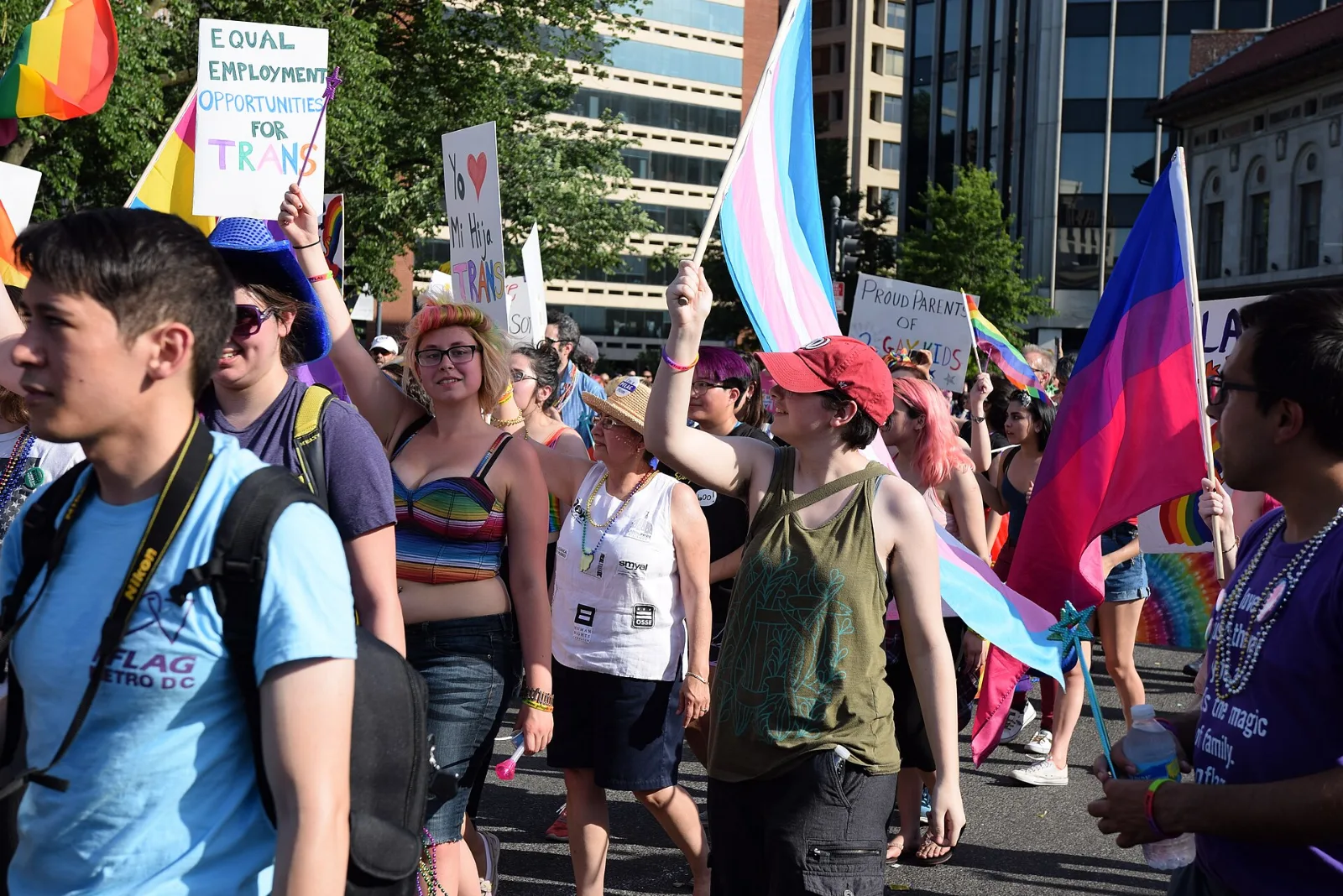
- Capital Pride Parade, Washington, D.C., 11 June 2016. A bisexual flag at right, carried blue-side-up, beside a transgender flag and hand-lettered placards reading "EQUAL EMPLOYMENT OPPORTUNITIES FOR TRANS" and "PROUD PARENTS OF 2 GAY KIDS." · Credit: S Pakhrin, CC BY 2.0 · Wikimedia Commons
- The canonical Wikimedia file, in use on fifty Commons pages and across dozens of Wikipedias, and the file at the center of the 2020 ownership dispute. Its source field cites Page's own Activism page and names him as author; its licence tag declares the design ineligible for copyright. The hex values and 5:3 ratio were set by the editor Keymap9 in April 2018, noted as "Ratio 3:5, more official colors." · Credit: Design by Michael Page; file by Zscout370, Fibonacci, Keymap9 and later editors; tagged public domain · Wikimedia Commons
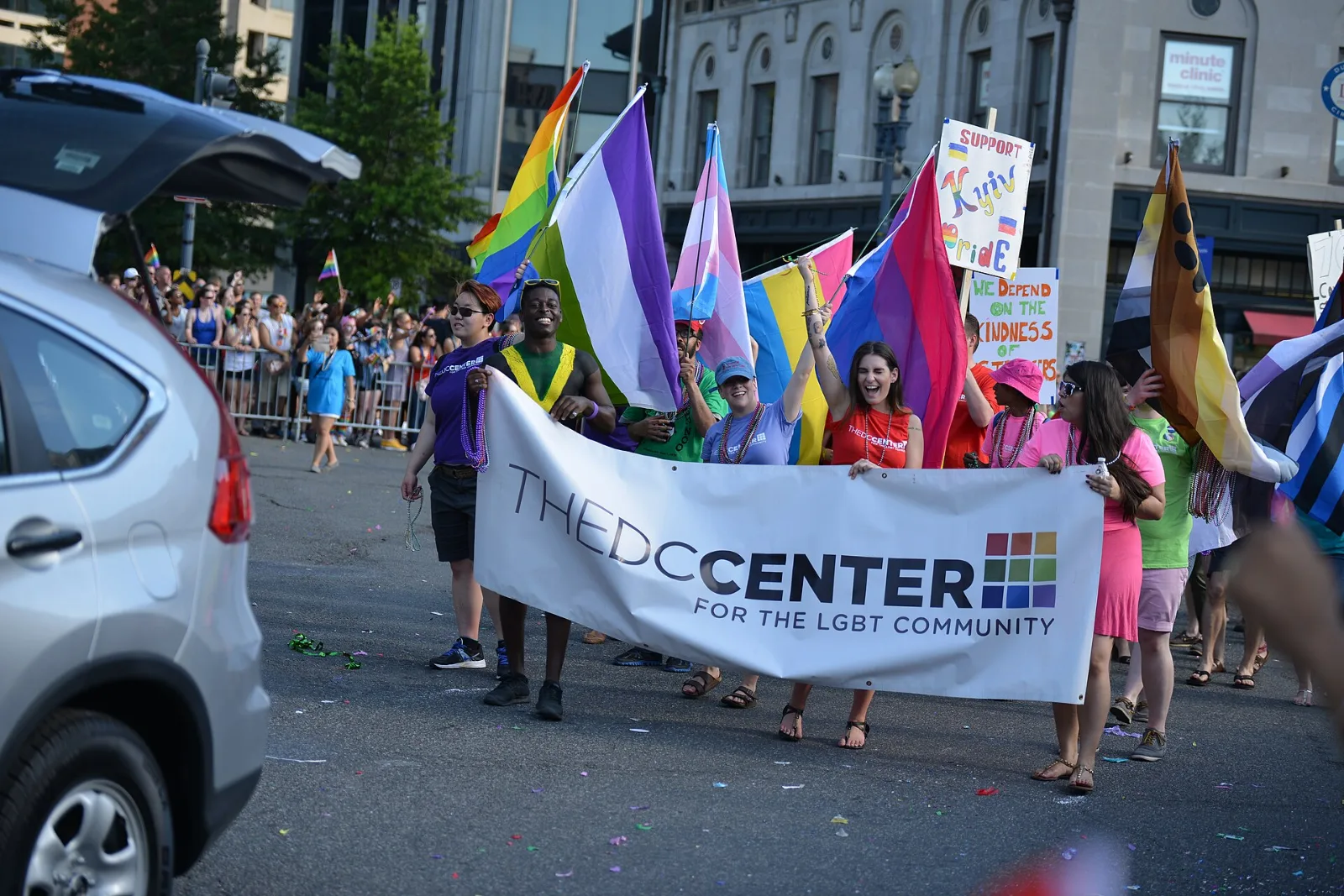
- Capital Pride Parade, Washington DC, 11 June 2016. The Bisexual flag is carried here among bisexual, pansexual, bear and nonbinary flags. Photographed by S Pakhrin. · Credit: S Pakhrin, CC BY 2.0 · Wikimedia Commons
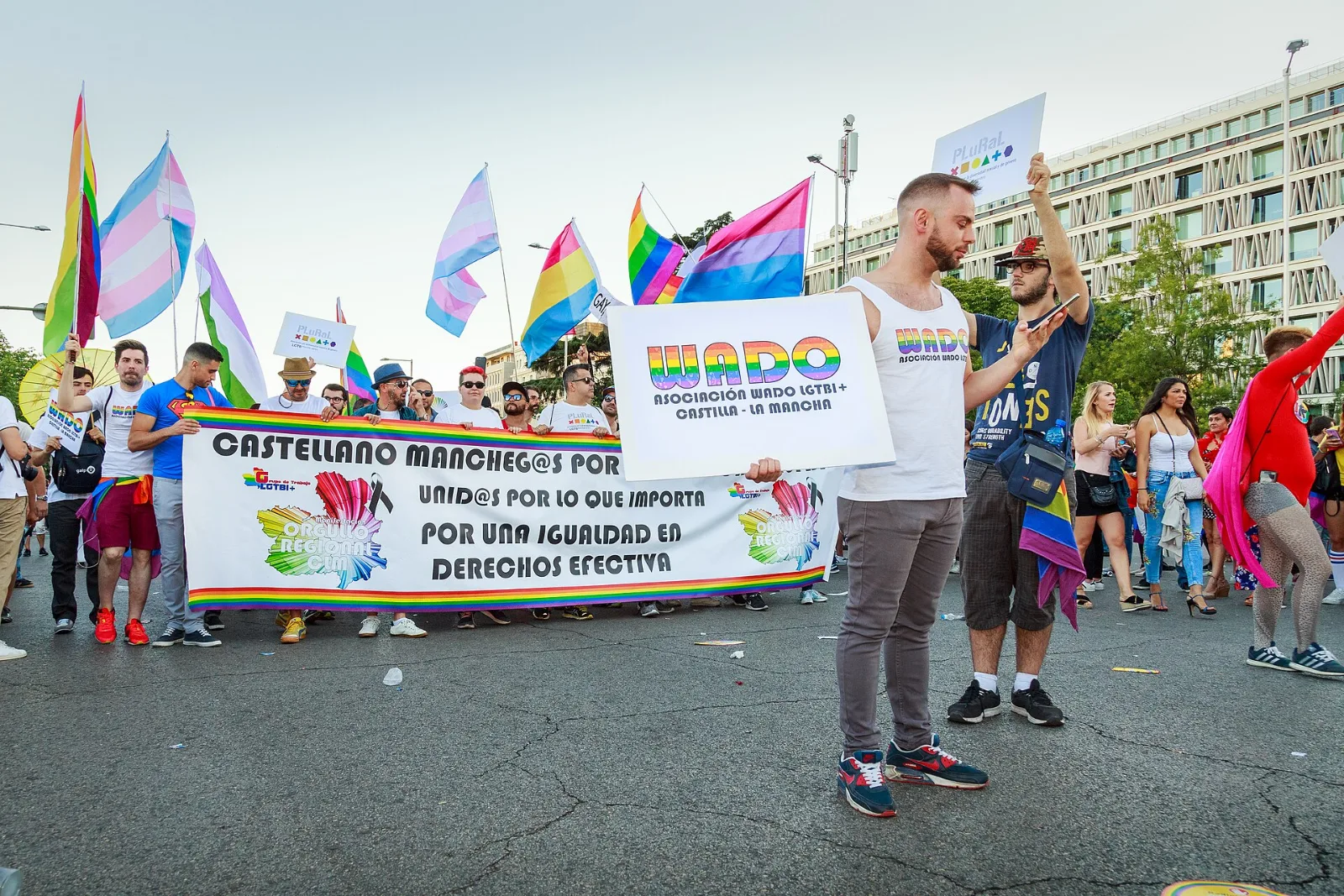
- WorldPride, Madrid, 1 July 2017, with the Asociación WADO LGTBI+ Castilla-La Mancha. The Bisexual flag is carried here among bisexual, transgender and pansexual flags. Photographed by Barcex. · Credit: Barcex, CC BY-SA 3.0 · Wikimedia Commons
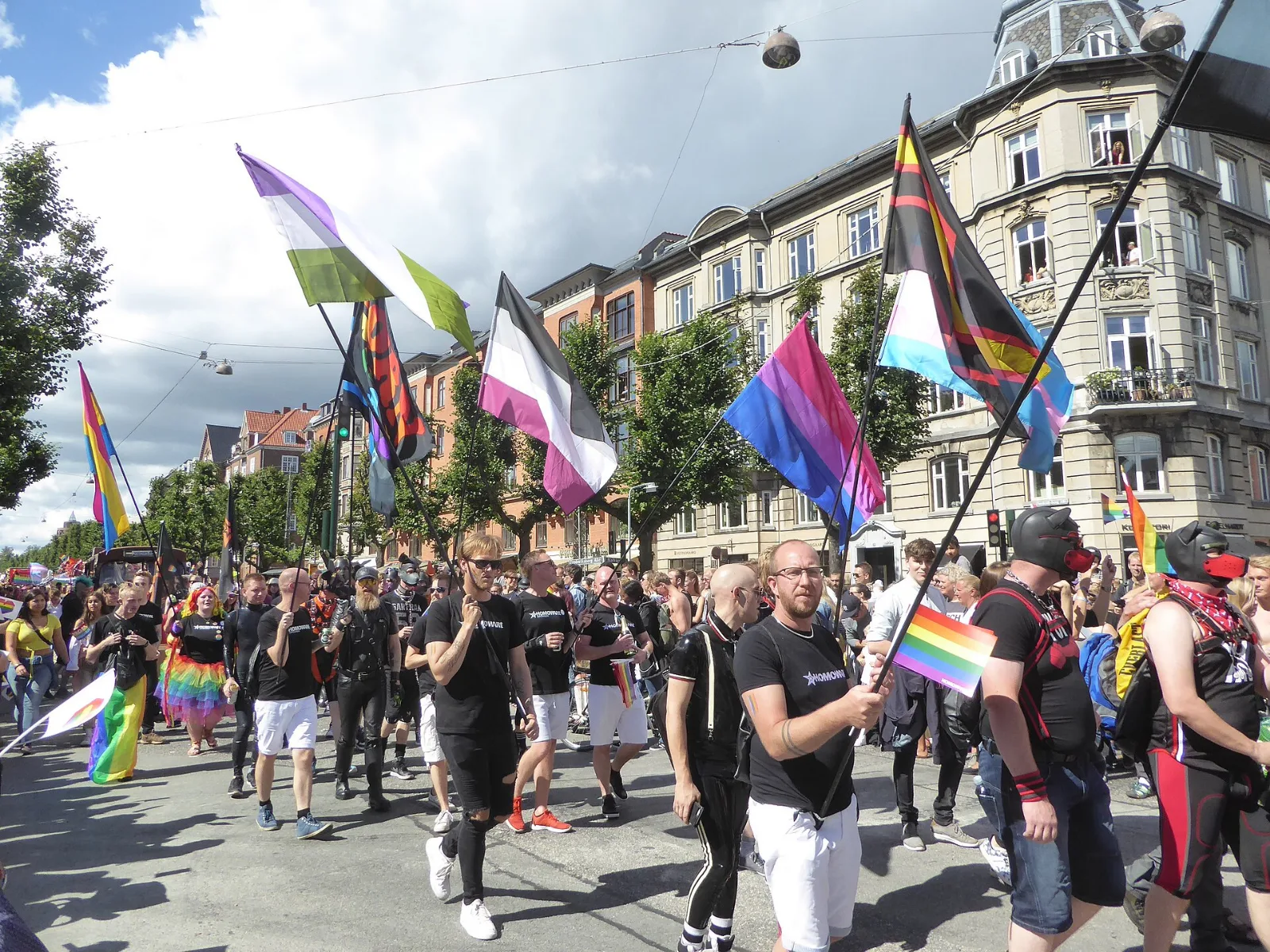
- Copenhagen Pride, Frederiksberg Allé, 19 August 2017. The Bisexual flag is carried here among bisexual, transgender, bear, rubber, asexual and pansexual flags. Photographed by Leif Jørgensen. · Credit: Leif Jørgensen, CC BY-SA 4.0 · Wikimedia Commons
- Michael Page speaking at "Bisexual, the B in GLBT!", the 13th Annual Heritage of Pride in Fort Lauderdale, 22 January 2000, with the flag he designed hanging behind him. He was one of five speakers, alongside Deb Kolodny, Luigi Ferrer and Kris Roehling, before a crowd he put at about 75. He called it "the very first time the bisexuals have been premiered in any (previously named) gay/lesbian event." · Credit: Michael Page / The Coffee Club, Inc. Recovered from Page's own archive, offline since 2012. Fair use pending permission. · biflag.com
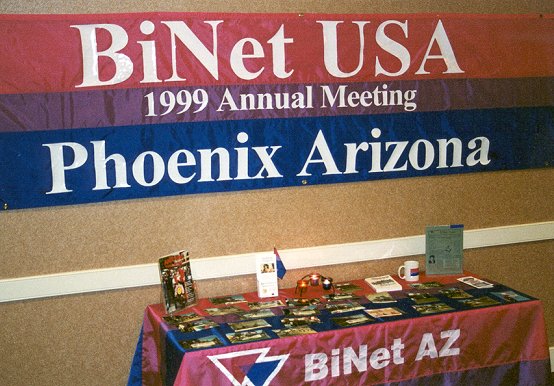
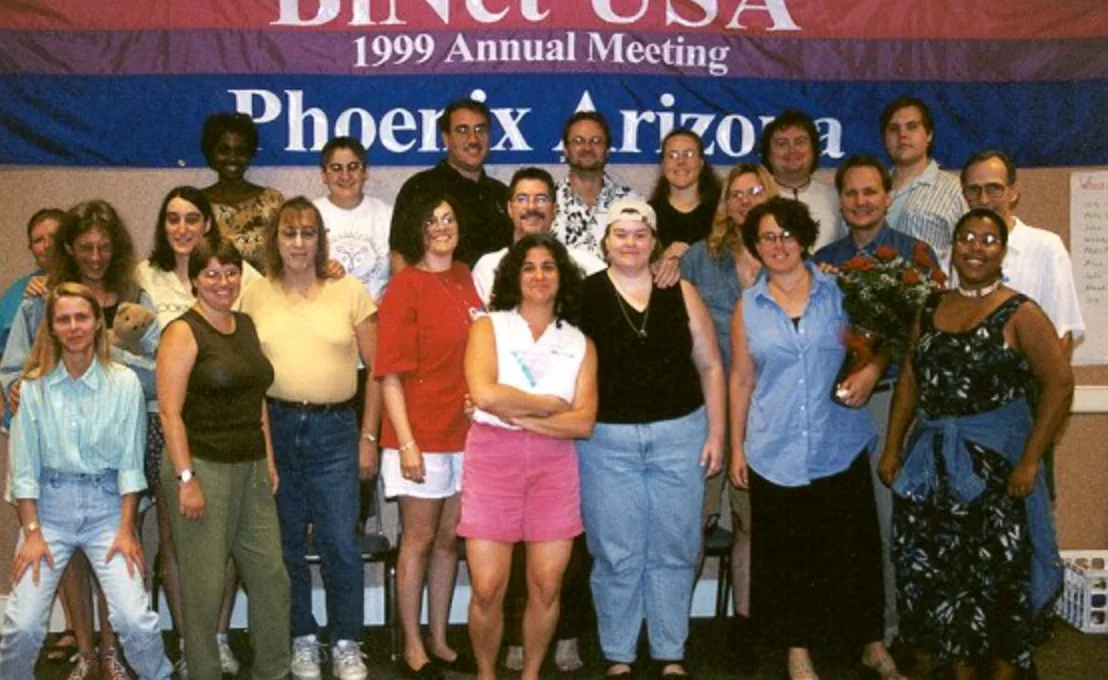
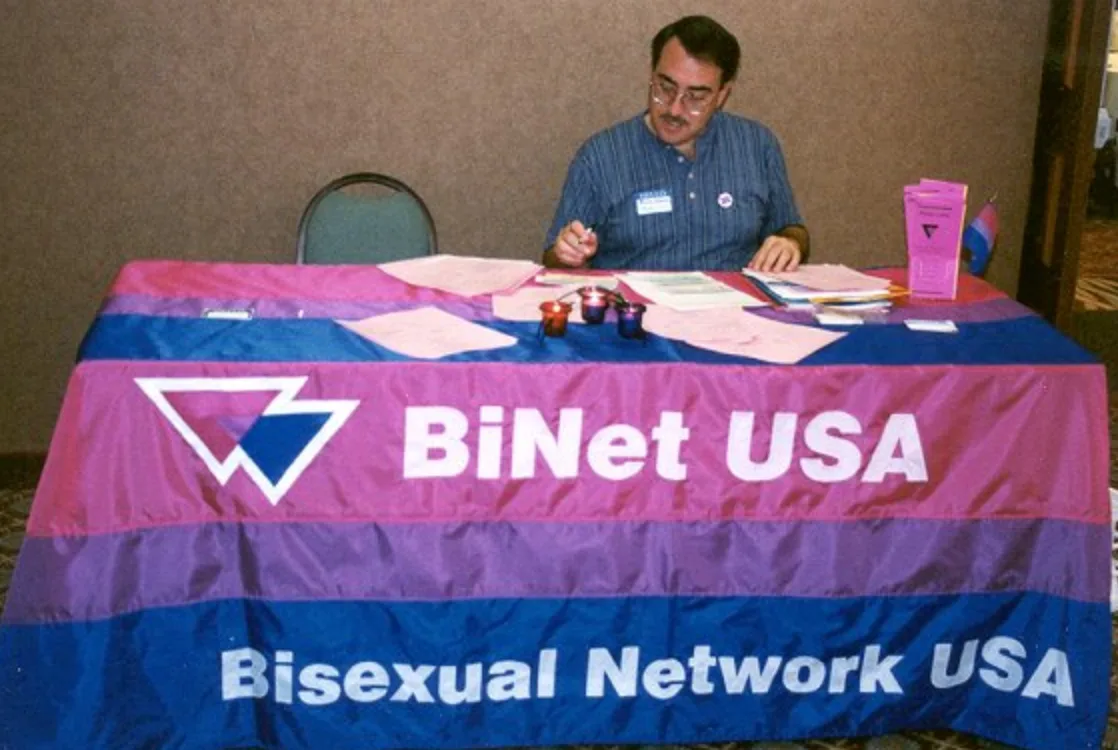
- The BiNet USA annual meeting in Phoenix, 25 July 1999, where Page volunteered as a regional organizer. The banner and the BiNet AZ table covering both carry the flag's magenta, purple and blue, seven months after the flag was unveiled and at the organization whose volunteer work prompted it. · Credit: Michael Page / The Coffee Club, Inc. Recovered from Page's own archive, offline since 2012. Fair use pending permission. · biflag.com
- The BiNet USA annual meeting in Phoenix, 25 July 1999, seven months after the unveiling. The banner behind the group is in the flag’s three colors, which is documentary evidence of institutional adoption by the organization whose volunteer work prompted the flag, and which later claimed to own it. Page attended and volunteered as a regional organizer from that month. Whether he is among those pictured is not established: a clean-shaven man at center right holding red flowers matches the hairline and face shape of his profile portrait, but the group image is too coarse to support an identification and no caption names him. [6] · Credit: Michael Page / The Coffee Club, Inc. Recovered from Page’s own archive, offline since 2012. Fair use pending permission. · biflag.com
- The BiNet USA table at the same 1999 Phoenix meeting. The table covering is made in the flag’s colors and carries the organization’s biangles-derived triangle mark, and a small bisexual flag stands on a desk mount at the right, which is the earliest manufactured flag object visible in the recovered photographs. The man at the table is not identified in what has been recovered. [6] · Credit: Michael Page / The Coffee Club, Inc. Recovered from Page’s own archive, offline since 2012. Fair use pending permission. · biflag.com
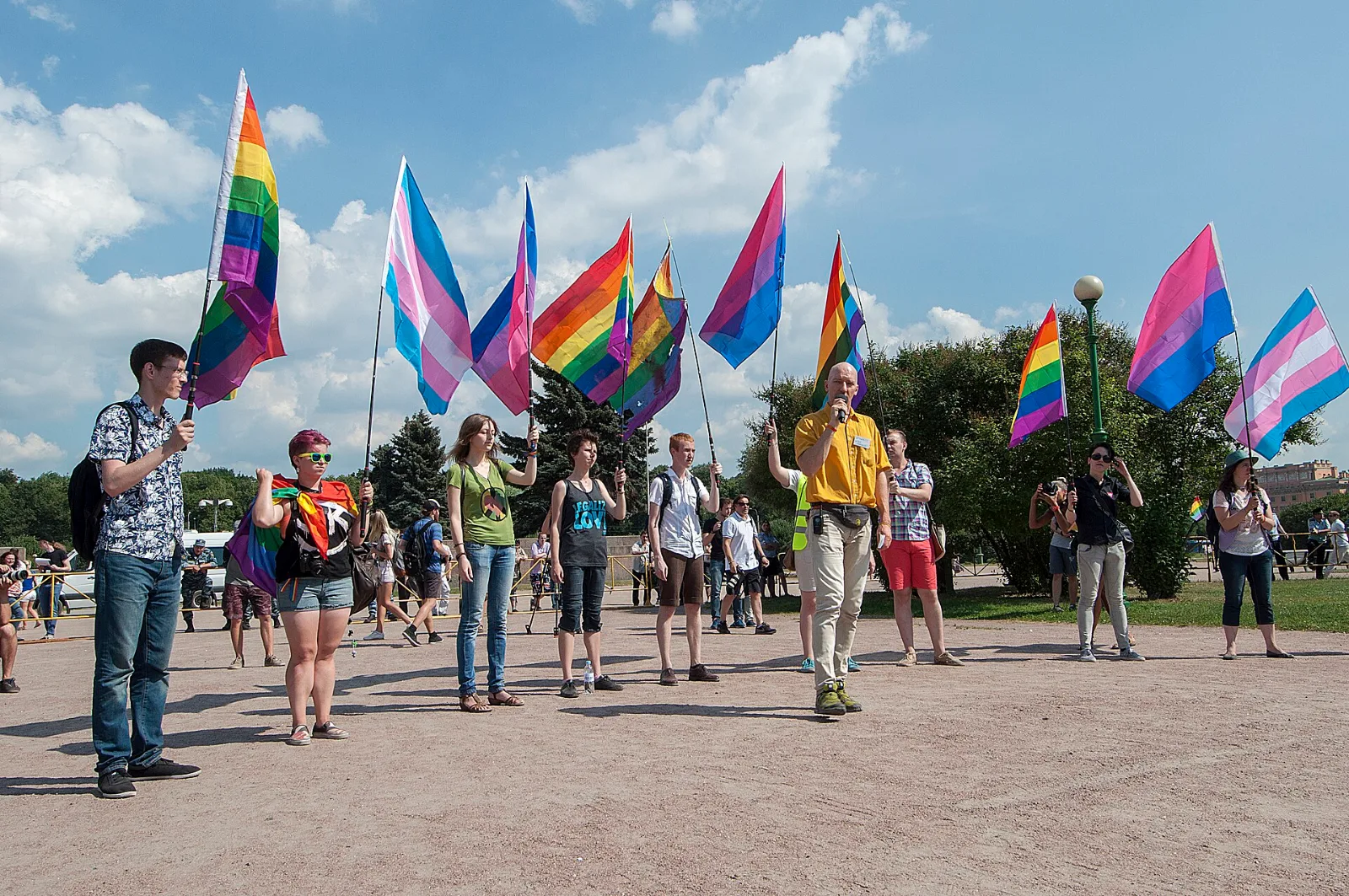
- Bisexual flags flown alongside transgender and rainbow flags at a public action during the Fifth Saint Petersburg Pride, at the Field of Mars, 26 July 2014. Tomislav Todorovic cited this photograph as an example of the bisexual flag appearing in both orientations at one event, which is part of why Flags of the World treats it as having no right side up. · Credit: Alek Naza, CC BY-SA 4.0 · Wikimedia Commons
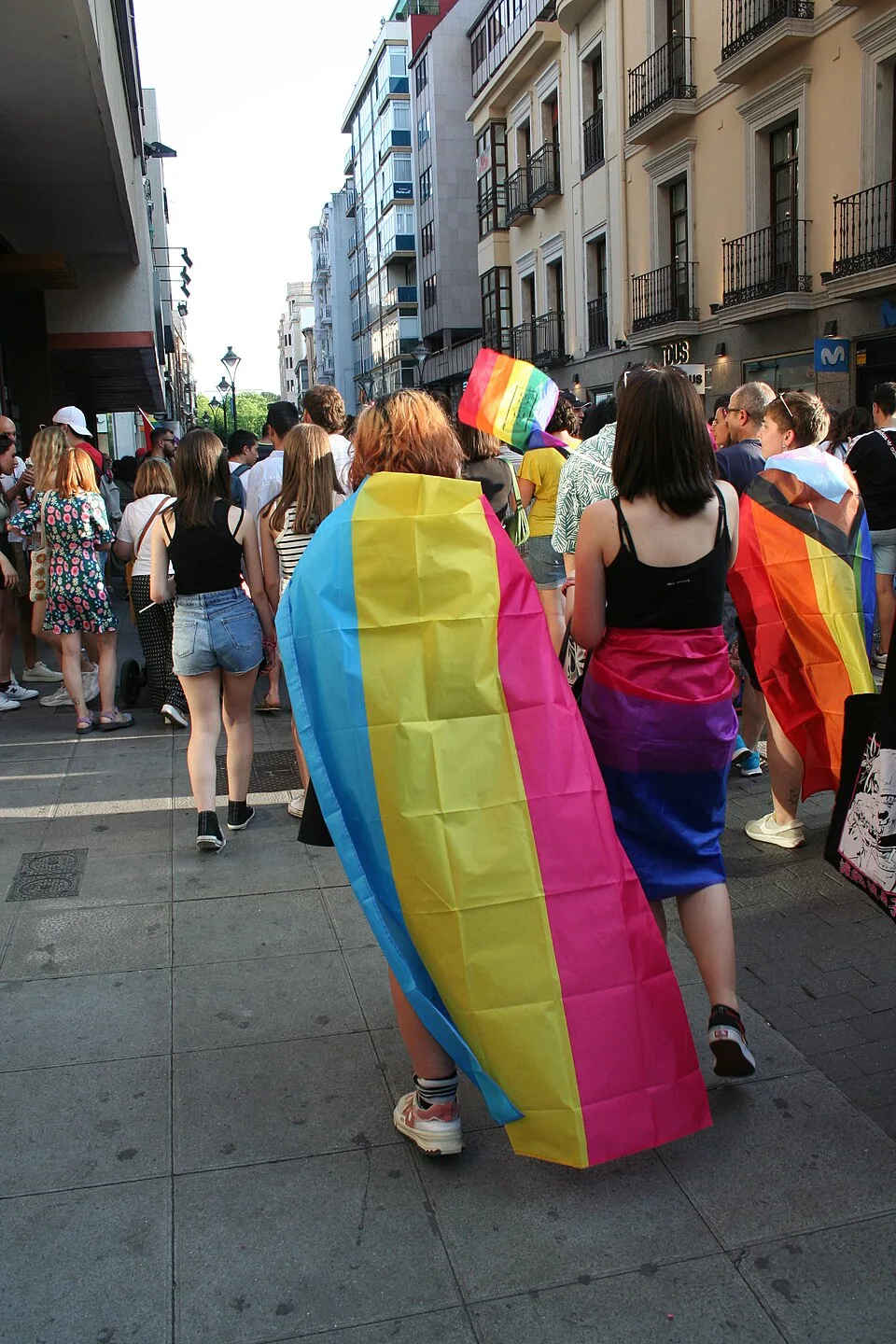
- Marcha del Orgullo LGBT+, Valladolid, 28 June 2023. The bisexual flag worn as a cape, between a pansexual and a Progress flag. · Credit: MiguelAlanCS, CC BY-SA 4.0 · Wikimedia Commons
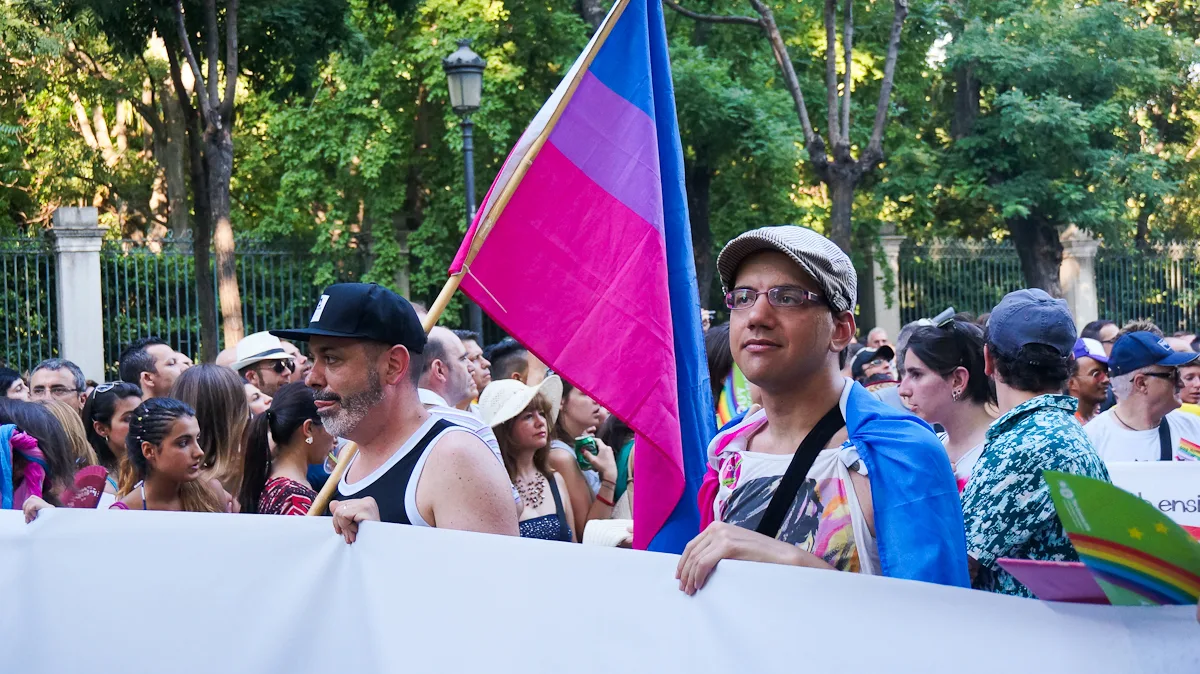
- A bisexual flag at Madrid Gay Pride, 6 July 2013, carried blue-side-up, the reverse of the order Page specified. Flags of the World cites this photograph among its reasons for treating the design as having no right side up. · Credit: Antonio Tajuelo, CC BY 2.0 · Wikimedia Commons
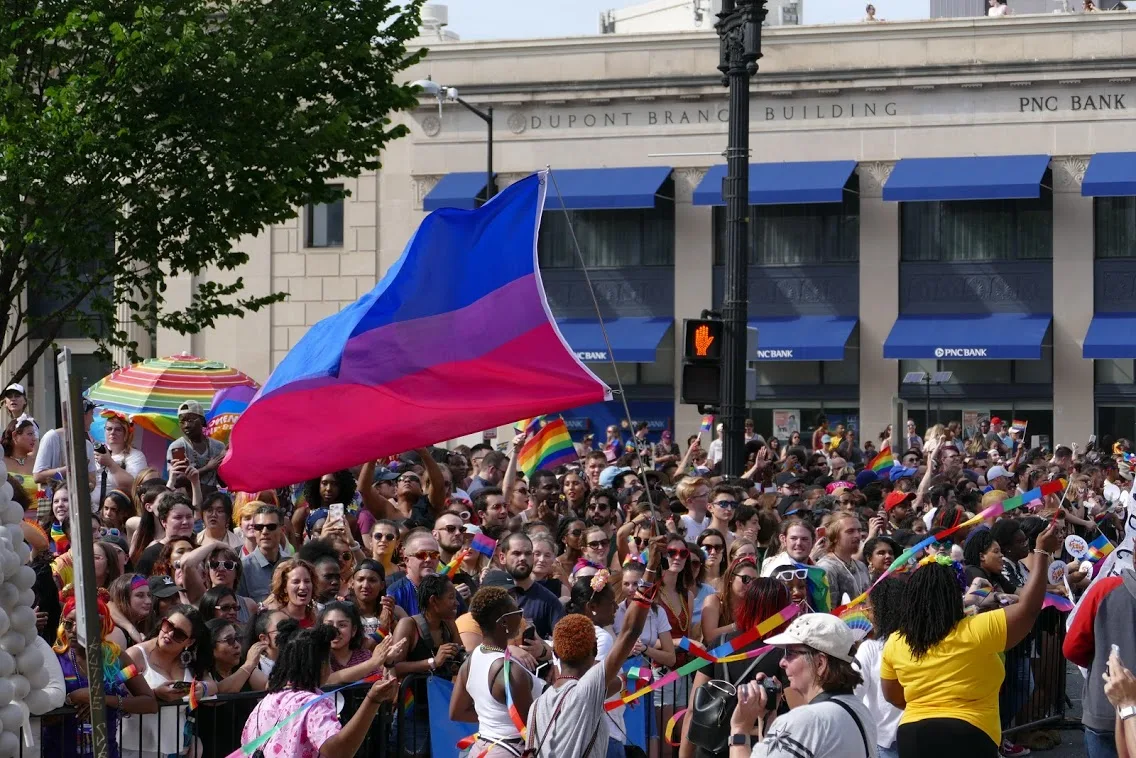
- A bisexual flag flown blue-side-up above the crowd at a Pride parade, 6 June 2019. The photographer, May H. Pham, entered it in Wiki Loves Pride and captioned it: "these people, running with absolute pride in the flag that they identify with." Commons gives the location only as the United States; the visible signage reads Dupont Branch Building and PNC Bank. · Credit: May H. Pham, CC BY-SA 4.0 · Wikimedia Commons
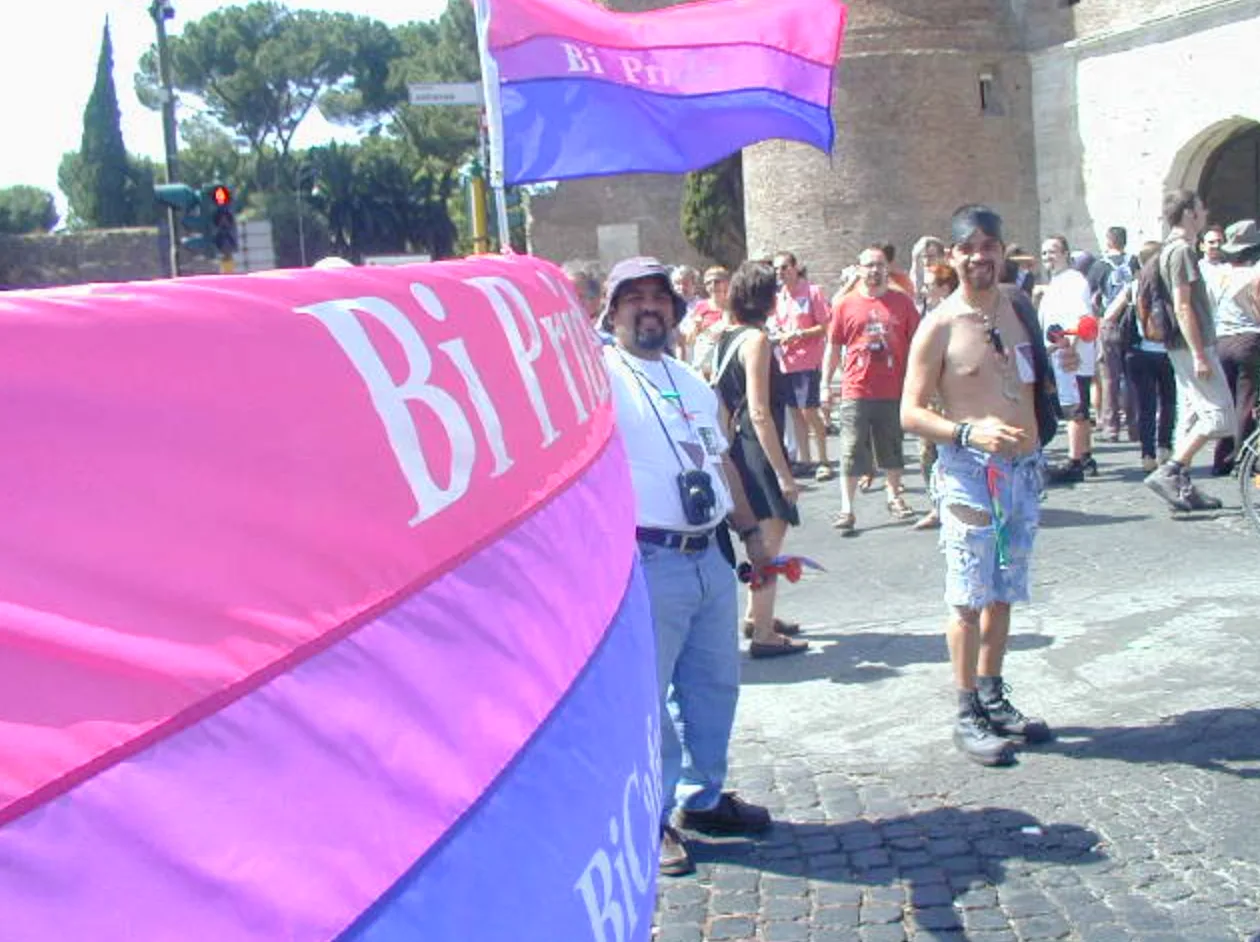
- The "Bi Pride / BiCafe.com" banner carried at World Pride in Rome, July 2000, made in the flag’s colors and lettered with the address of Page’s own site. An Australian banner and a Swedish flag are in the same contingent, which is the international spread Biscuit and Page’s own events log both describe, photographed rather than asserted. This is the banner reproduced in the header strip of biflag.com. [6][7] · Credit: Michael Page / The Coffee Club, Inc. Recovered from Page’s own archive, offline since 2012. Fair use pending permission. · biflag.com
- The same contingent at Rome, with the Australian banner and the Swedish flag legible beside the Bi Pride banner. Biscuit credits the Queensland activist Wayne Roberts with taking the flag to Australia; this photograph shows an Australian bisexual presence marching with it in Rome within twenty months of the unveiling, though it does not identify anyone. [7][6] · Credit: Michael Page / The Coffee Club, Inc. Recovered from Page’s own archive, offline since 2012. Fair use pending permission. · biflag.com
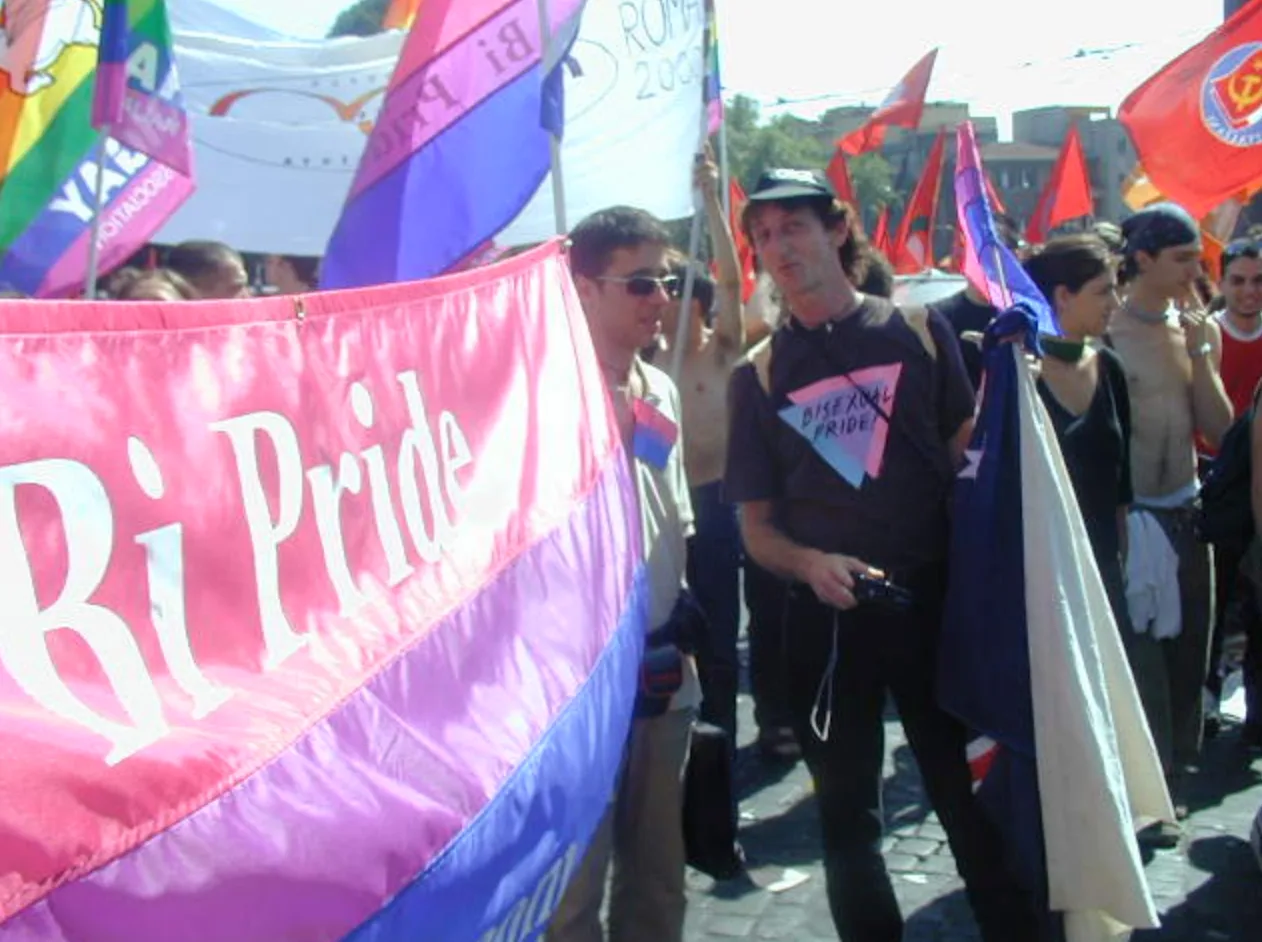
- The Bi Pride banner at close range, with a "ROMA 2000" banner overhead, which dates the set. The man in the black cap wears a t-shirt printed with the biangles under the words "Bisexual Pride," the older symbol whose palette the flag adapted, worn beside the flag itself. He is not Michael Page: the hair is long and wavy where Page’s is short, and the face differs from his profile portrait. He is photographed twice in this set holding a camera, and given the Australian banner nearby he may be an Australian participant, but nothing recovered names him. [6] · Credit: Michael Page / The Coffee Club, Inc. Recovered from Page’s own archive, offline since 2012. Fair use pending permission. · biflag.com
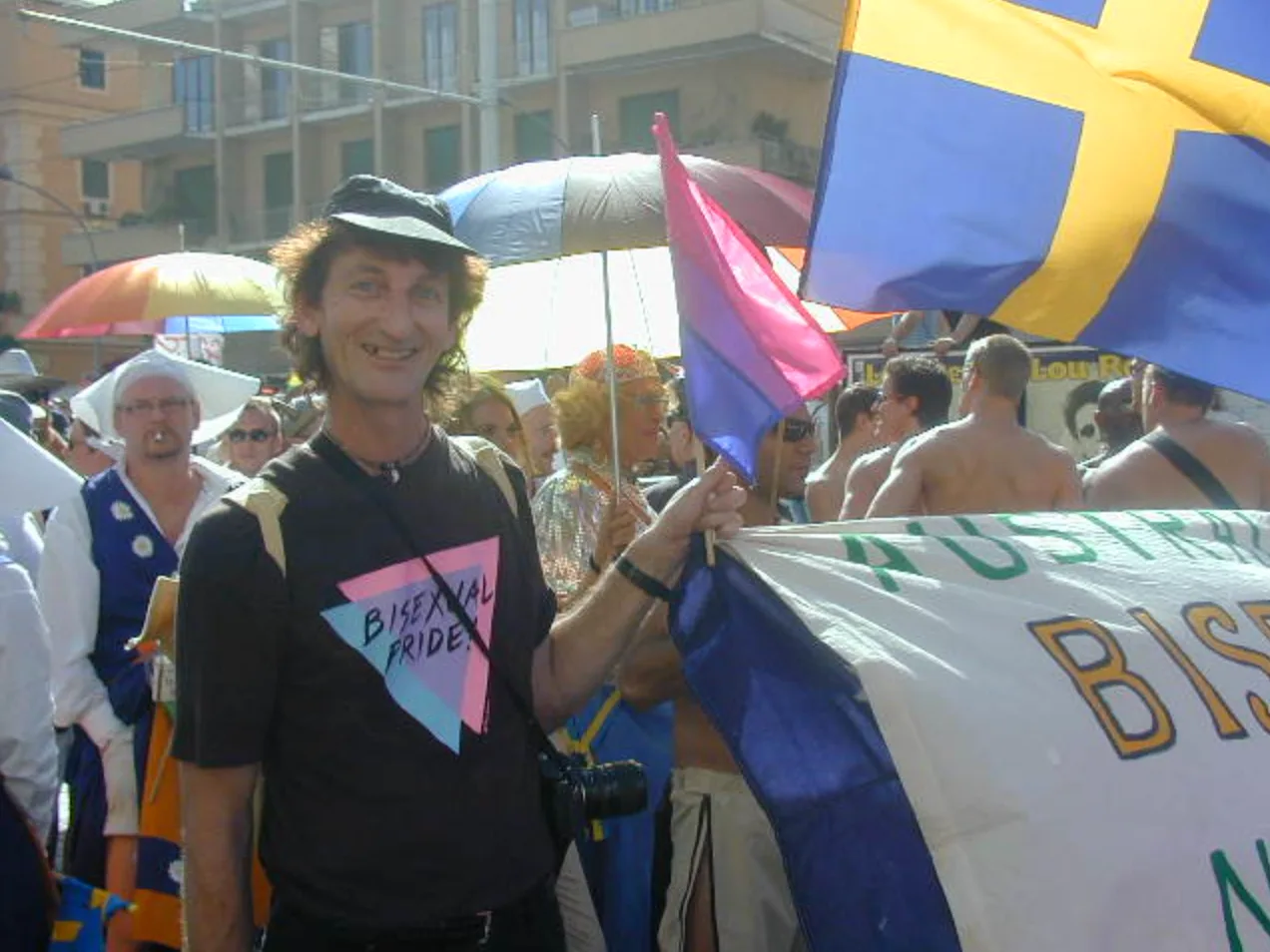
- The same man holding a small bisexual flag beside the Australian bisexual banner at Rome, with the Swedish flag behind. The t-shirt shows the biangles in pink and blue with the lavender overlap, which is the palette Page took for the flag, so both symbols appear together in one frame. Again, no source recovered names him, and he is not Page. [6] · Credit: Michael Page / The Coffee Club, Inc. Recovered from Page’s own archive, offline since 2012. Fair use pending permission. · biflag.com
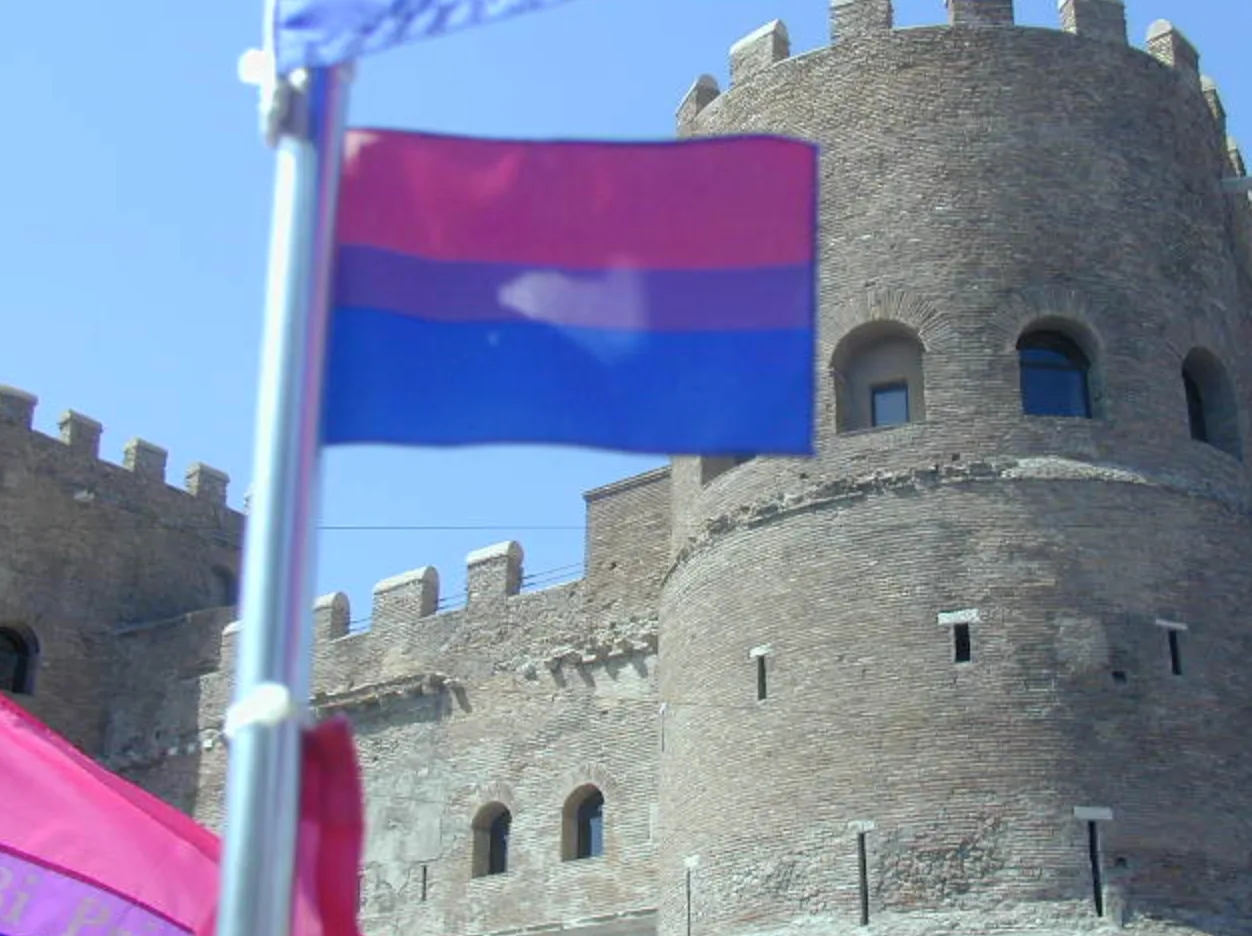
- The flag flown against a crenellated brick fortification in Rome during World Pride, July 2000, with a second bisexual flag and a magenta banner at the edges of the frame. Page recorded Rome in his events log and said he met Gilbert Baker there. The building is not identified in anything recovered, so it is left undescribed beyond what is visible. [6][1] · Credit: Michael Page / The Coffee Club, Inc. Recovered from Page’s own archive, offline since 2012. Fair use pending permission. · biflag.com
- The Bi Pride banner and a bisexual flag at the Roman gate, World Pride 2000. The same brick fortification appears behind the flag elsewhere in the gallery. A marshal in a bucket hat carries a camera and lanyard at center. [6] · Credit: Michael Page / The Coffee Club, Inc. Recovered from Page's own archive, offline since 2012. Fair use pending permission. · biflag.com
- Bi Definition of Milwaukee, with three bisexual flags on poles, a banner in the flag's colors, a hand-lettered BiPride float sign and one marcher wearing a flag as a cape. The camera stamped the frame "6 9 '00", which in the American order reads 9 June 2000, about eighteen months after the unveiling; the stamp is recorded as it appears rather than converted into a documented date. [6] · Credit: Michael Page / The Coffee Club, Inc. Recovered from Page's own archive, offline since 2012. Fair use pending permission. · biflag.com
- Page’s own profile photograph from BiCafe, the site he founded and ran, at the 74 by 74 pixels the site displayed it. It is the image against which the Fort Lauderdale panel photograph was checked: the hairline and its central peak, the brow, the narrow face and the nasolabial folds agree. · Credit: Michael Page / The Coffee Club, Inc. Recovered from Page’s own archive, offline since 2012. Fair use pending permission. · bicafe.com
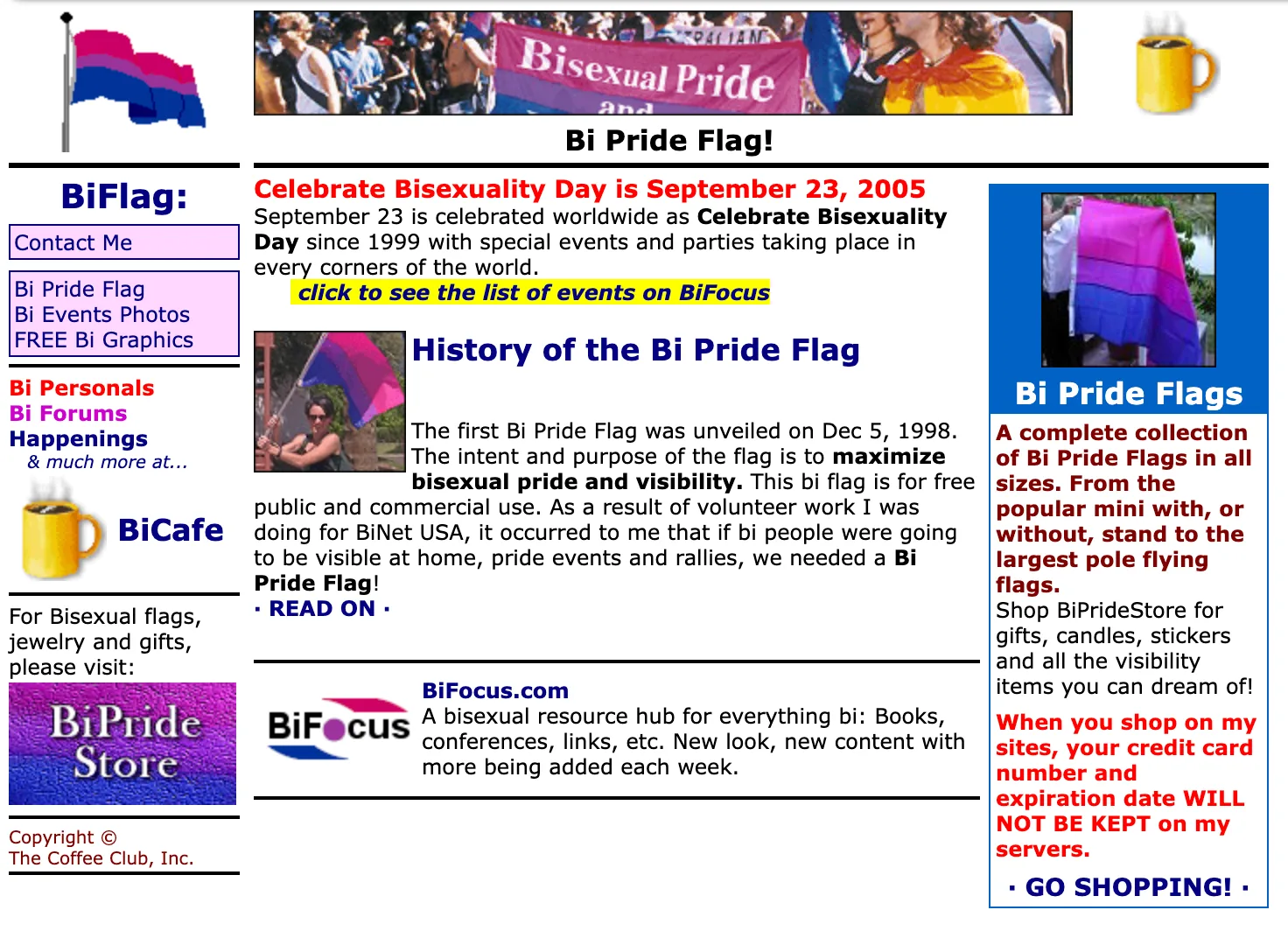
- The front page of Page’s own site, the source for most of what the entry states in his words. It carries the unveiling date, "The first Bi Pride Flag was unveiled on Dec 5, 1998," the purpose, "to maximize bisexual pride and visibility," the free-use terms, "This bi flag is for free public and commercial use," and his reason for making it: "As a result of volunteer work I was doing for BiNet USA, it occurred to me that if bi people were going to be visible at home, pride events and rallies, we needed a Bi Pride Flag!" The page also shows the commercial side running beside the free design, with BiPrideStore, BiCafe and the resource hub BiFocus.com, all under "Copyright © The Coffee Club, Inc." The header strip is the Rome 2000 banner photographed elsewhere in the gallery. [1] · Credit: Michael Page / The Coffee Club, Inc. Recovered from Page’s own archive, offline since 2012. Fair use pending permission. · biflag.com
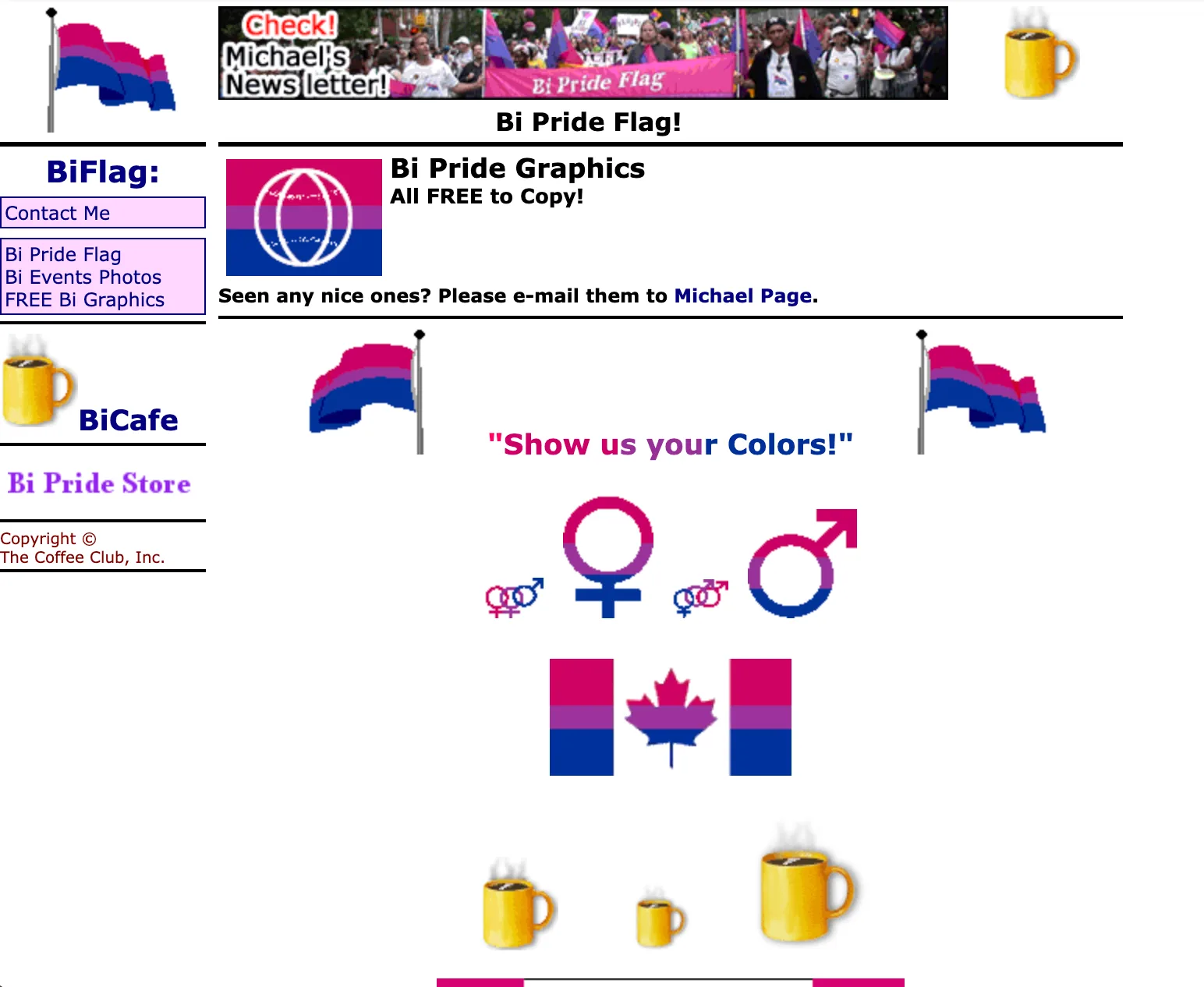
- Page’s "FREE Bi Graphics" page, headed "All FREE to Copy!" and "Show us your Colors!", which shows how far he pushed the free-use position beyond the flag itself: bisexual-colored gender symbols, a bisexual Canadian maple leaf, and the coffee mugs of BiCafe and The Coffee Club, Inc. He invited submissions, "Seen any nice ones? Please e-mail them to Michael Page." The page sits directly beside BiPrideStore in the same navigation, the free graphics and the paid objects on one site. [1] · Credit: Michael Page / The Coffee Club, Inc. Recovered from Page’s own archive, offline since 2012. Fair use pending permission. · biflag.com
- An Australian Bisexual Network vehicle in a night parade, from Page’s archive. A magenta and purple flag flies from the cab and a placard reading "C.L.A.P." stands behind. The Australian Bisexual Network is the organizational context for the flag’s arrival in Australia, which Biscuit dates to the early spread and credits to Wayne Roberts. The photograph carries no date in what has been recovered, and none is asserted here. [6][7] · Credit: Michael Page / The Coffee Club, Inc. Recovered from Page’s own archive, offline since 2012. Fair use pending permission. · biflag.com
- A Bi-Friendly South Bay banner made in the flag's colors, carried at a United States Pride parade. It shows a local group adopting the palette for its own identification within a few years of the design, which is how the flag actually spread: as a color scheme other groups could take up. The photograph carries no date or place in what has been recovered, and none is asserted. [6] · Credit: Michael Page / The Coffee Club, Inc. Recovered from Page's own archive, offline since 2012. Fair use pending permission. · biflag.com
- The Sydney Bisexual Network marching at a night parade, from Page's archive. The banner is worth noting for what it does not use: it carries the biangles, the overlapping-triangle symbol, and not the flag or its colors, which is the older iconography the flag was drawn from. A second banner reads "Discrimination puts us all in the same boat." The photograph is undated in what has been recovered. [6] · Credit: Michael Page / The Coffee Club, Inc. Recovered from Page's own archive, offline since 2012. Fair use pending permission. · biflag.com
- The biangles, the symbol whose palette Page adapted. Liz Nania dates the design to 1985 and describes the lavender overlap as "the wholeness and queerness of bisexuality." This is a 2006 vector reconstruction by the Wikimedia editor Fibonacci, after a public-domain image by Switchercat; its shades are the reconstruction's own and are not the flag's published colors. · Credit: Fibonacci, after Switchercat; released into the public domain · Wikimedia Commons
- Pride flags rendered in rock and mineral specimens in a museum display case, each flag laid out beside the stones its colours were taken from. This case shows the bisexual, pansexual and aromantic flags. The case is most likely in the Cambridge geology museum: the quotation card in it is credited to a Coleridge student in 2022, and Coleridge Community College is a Cambridge school. The museum has not confirmed it. If you can add its formal name or the dates the display ran, contribute. · Credit: feral-critter, via Tumblr · feral-critter on Tumblr