Labrys Lesbian Flag
Identity Pride Flag ·
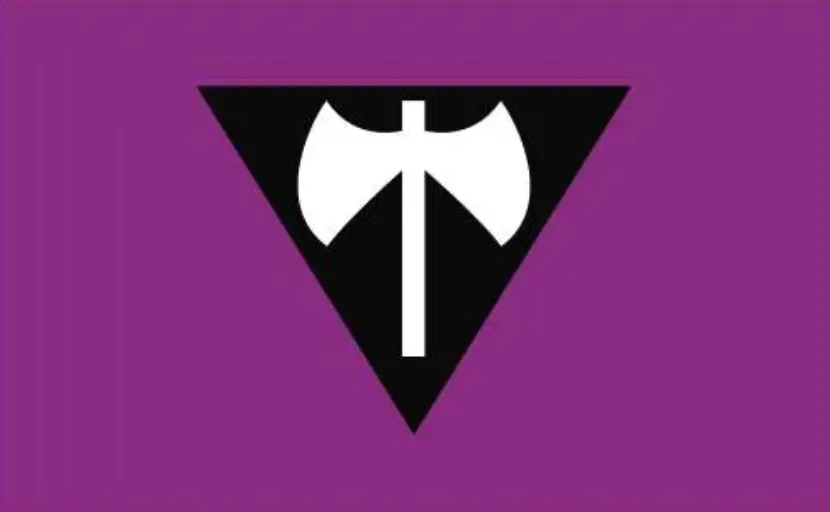
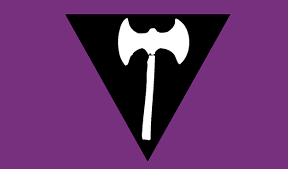
Sean Patrick Campbell's violet flag places a white labrys over an inverted black triangle. Dated 1999 in Campbell's Twilight Guard gallery and first published in the June 2000 Pride edition of Gay and Lesbian Times (Greater Palm Springs Edition), it later became subject to both trans-exclusionary appropriation and trans-inclusive reclamation. [1][2][3][4]
Key facts
- Designer
- Sean Patrick Campbell
- Created
- First documented public use
- June 2000, as a published magazine graphic
- In use
- 2000–present
- Aspect Ratio
- 3:5 · standard
- Stripes
- 0
- Origin
- Palm Springs, California, United States
- Represented Identity
- lesbian
Also known as
- Labrys Lesbian Pride Flag
- Labrys Pride Flag
- Labrys Flag
Status Historical
Archive categories Lesbian Pride Flags · Historical and Early Pride Flags
Overview
Campbell created the flag as a lesbian-specific graphic for the Gay and Lesbian Times Pride issue, using established lesbian-feminist symbols rather than adapting the rainbow flag. [5][6]
The flag was one of four graphics Campbell made for the June 2000 Pride edition of the Gay and Lesbian Times (Greater Palm Springs Edition) after the new regional edition found itself without a photo archive; in Scupham-Bilton's account, "rather than hunt around getting copyright clearance for photos and images Sean came up with the imaginative idea of designing flags for various sections of the lgbt community." [6][2]
Rather than adapt the rainbow format, Campbell assembled the flag from three symbols already in lesbian use, which Scupham-Bilton describes as "composed entirely of established symbols." The design decision is the arrangement, placing "the double-edged axe, the labrys, firmly on top of the triangle," which Scupham-Bilton reads as turning a badge of persecution into "a positive affirmation of female power." [6]
The flag reached the web on the gallery of the club Campbell co-founded within two years of its printing, and later circulated through reference guides, merchandise and photographed use; it is contested on three separate grounds set out below. Campbell's flag work extends beyond this batch: the Twilight Guard gallery marks five designs as his, including the Feather Pride Flag from the same magazine issue, a Cowboy Fetish Flag of 2001 and a bear flag from 1995. [1]
Identity & Context
- Represented Identity
- lesbian
- Subcommunity
- lesbian-feminist
- Movement
- lesbian feminism
Creators
The Creator
Sean Patrick Campbell
Designer
Sean Patrick Campbell (died reportedly summer 2025) was a gay graphic designer from New York who drew a small series of pride flags for one magazine issue. He drew from childhood, "first drawing superheroes as a child (which I still do)," trained in art, illustration and graphic design at Iona College in New Rochelle, New York, graduating in 1989, and studied what was then applied computer science, now desktop publishing, at Mercy College in Dobbs Ferry. He worked in print through the 1990s, and moved from New York to California in July 1999 with his partner at the time, joining a small local gay magazine in Palm Springs as advertising salesman and then designer and editor. At the beginning of 2000 he took a better-paid post at a larger Palm Springs publisher: "Here is where I created my flag designs." He later returned east, to Massachusetts and then New York, and continued in publishing, latterly on project-based science-textbook design. From its founding in 1995 he was also a founding member and resident artist of the Twilight Guard, a leather club whose online gallery preserves this flag and carries Campbell's own dedication of his designs to the public domain. [2][7][8][1]
Sean Patrick Campbell is reported to have died in the summer of 2025. Tony Scupham-Bilton, who published Campbell's guest post and had corresponded with him, reported the death in a blog comment on 12 June 2026: "Sadly, Sean Campbell passed away last summe from cancer" [sic]. [6] No obituary, death notice or exact date has been located; the year is inferred from "last summer" against the date of the comment.
The Leather Journal carried a notice of his death by Michael Conley on 15 September 2025, which gives the cause as a long battle with colon cancer and no exact date. [7]
Here is where I created my flag designs.
Motivations
- To create a lesbian-specific pride flag using established lesbian-feminist symbols instead of a rainbow adaptation
- To provide original graphics for the Gay and Lesbian Times pride issue in place of licensed photography
Stated inspirations
Attribution
- Organization
- Gay and Lesbian Times (Greater Palm Springs Edition)
Attribution notes
Created in-house for the June 2000 Pride edition of the Gay and Lesbian Times (Greater Palm Springs Edition); no formal commission is documented. A 2016 resume attributed to Campbell identifies his Palm Springs publishing employers and supports the sequence in his 2012 account: The Bottom Line Publishing in 1999 and 2000, then Uptown Publications in 2000. [2][7] The exact corporate relationship between Uptown Publications and the Gay and Lesbian Times is not documented. The paper itself was a San Diego title owned by Gay Times, Inc., so the Greater Palm Springs Edition of June 2000 was a four-month-old regional edition of a twelve-year-old newspaper. [10]
Origin
- Country
- United States
- Region / state
- California
- City
- Palm Springs
- Specific Place
- Gay and Lesbian Times (Greater Palm Springs Edition), June 2000 Pride edition
- Origin Type
- first_publication
- Physical Origin Status
- Published as a magazine graphic; no physical flag from the creation period is documented
The flag was first published in Palm Springs, within the Agua Caliente Indian Reservation and the ancestral homeland of the Agua Caliente Band of Cahuilla Indians. [11] Séc-he, "sound of boiling water," names the sacred hot spring at the heart of what is now downtown Palm Springs. [12][13] The reservation was established by executive order in 1876 and expanded in 1877, and its lands lie in a checkerboard across Palm Springs, Cathedral City, Rancho Mirage and unincorporated Riverside County; the Tribe and its members are collectively the largest landowners in the city. [14][12] The Tribe today describes itself as steward of its ancestral land. [11]
Indigenous land context
Agua Caliente Band of Cahuilla Indians — reservation and ancestral homeland (Indigenous name: Séc-he) [11][12][13]
First published in the June 2000 Pride edition of the Gay and Lesbian Times (Greater Palm Springs Edition). [6][2]
Dates & Chronology
- Year Created
- First public use
- June 2000, as a published magazine graphic
- Period in Use
- 2000–present
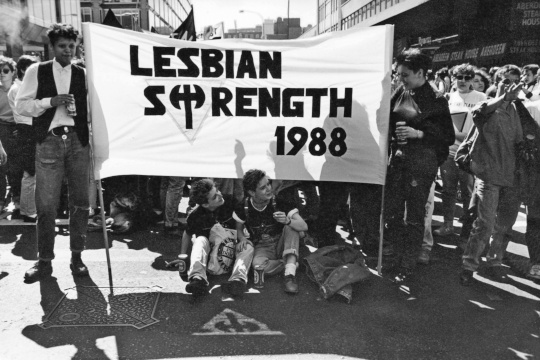
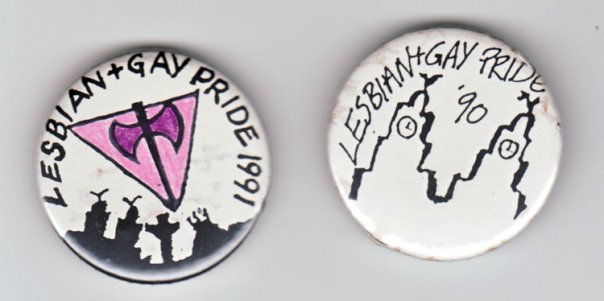

Documented circulation includes the June 2000 publication, online preservation by 2002, later reference guides and merchandise, and photographed use at Pride and civic events between 2019 and 2025. The design was on the web by 8 June 2002: the Commons copy of the original GIF, credited to Campbell, gives its source as a Wayback Machine capture of the Twilight Guard's flag gallery taken that day, on the site of the club Campbell co-founded. [18] The labrys and the triangle had been paired in lesbian contexts before the flag; the banner of the 1988 Lesbian Strength march in London sets a labrys on an inverted triangle as the letter T, and a 1991 Liverpool Lesbian & Gay Pride badge sets a labrys across an inverted triangle in pink. [17][16]
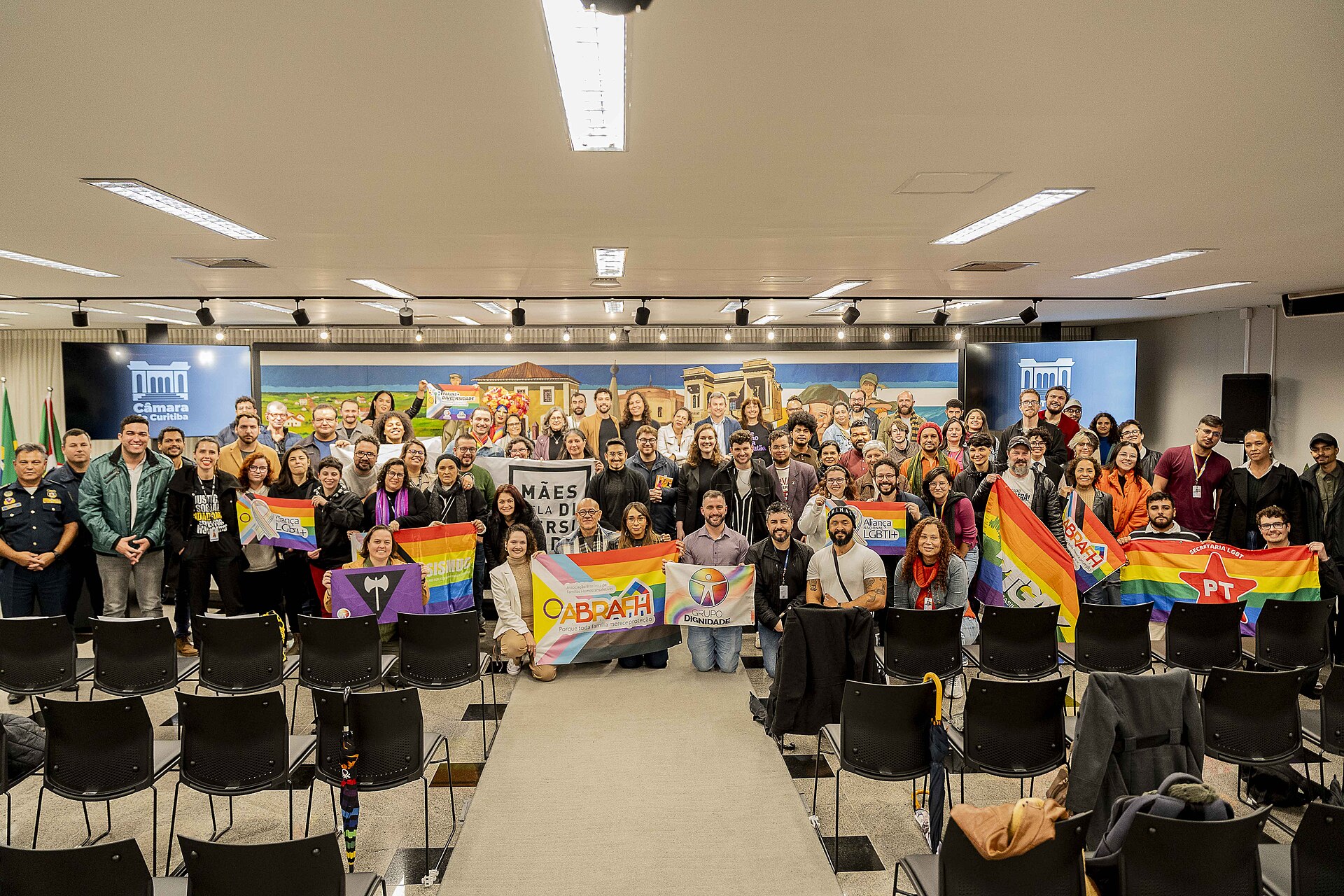

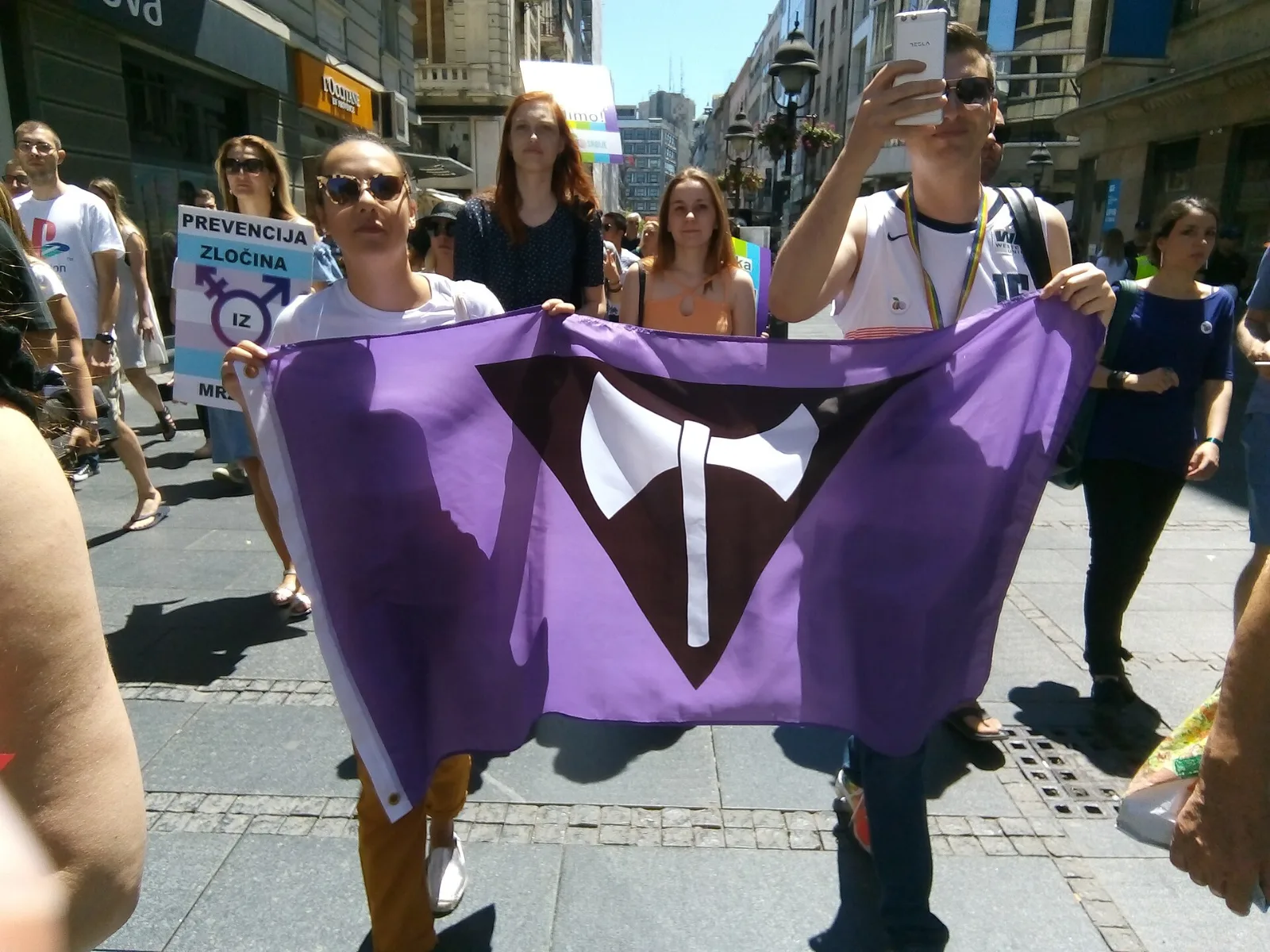
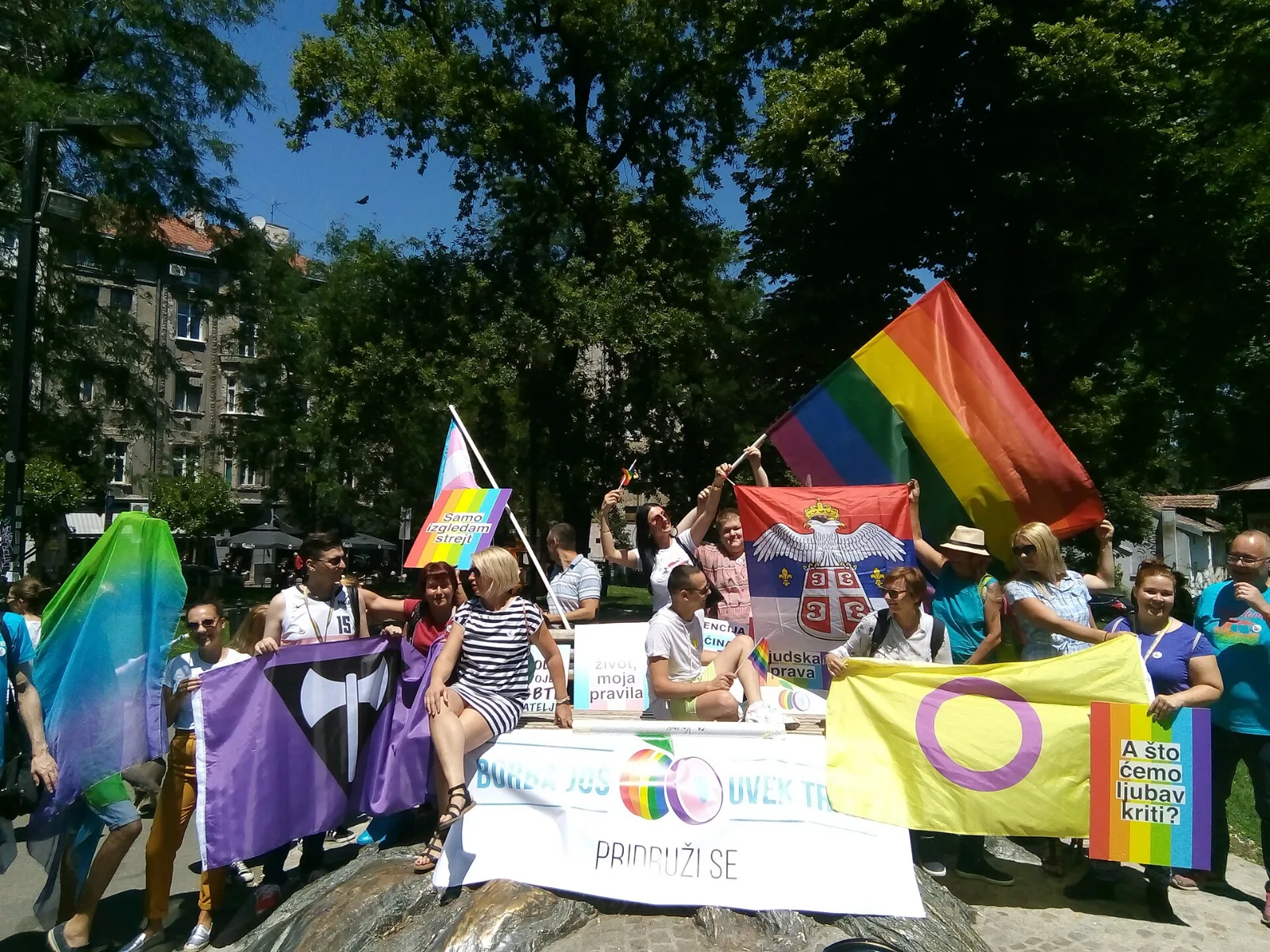
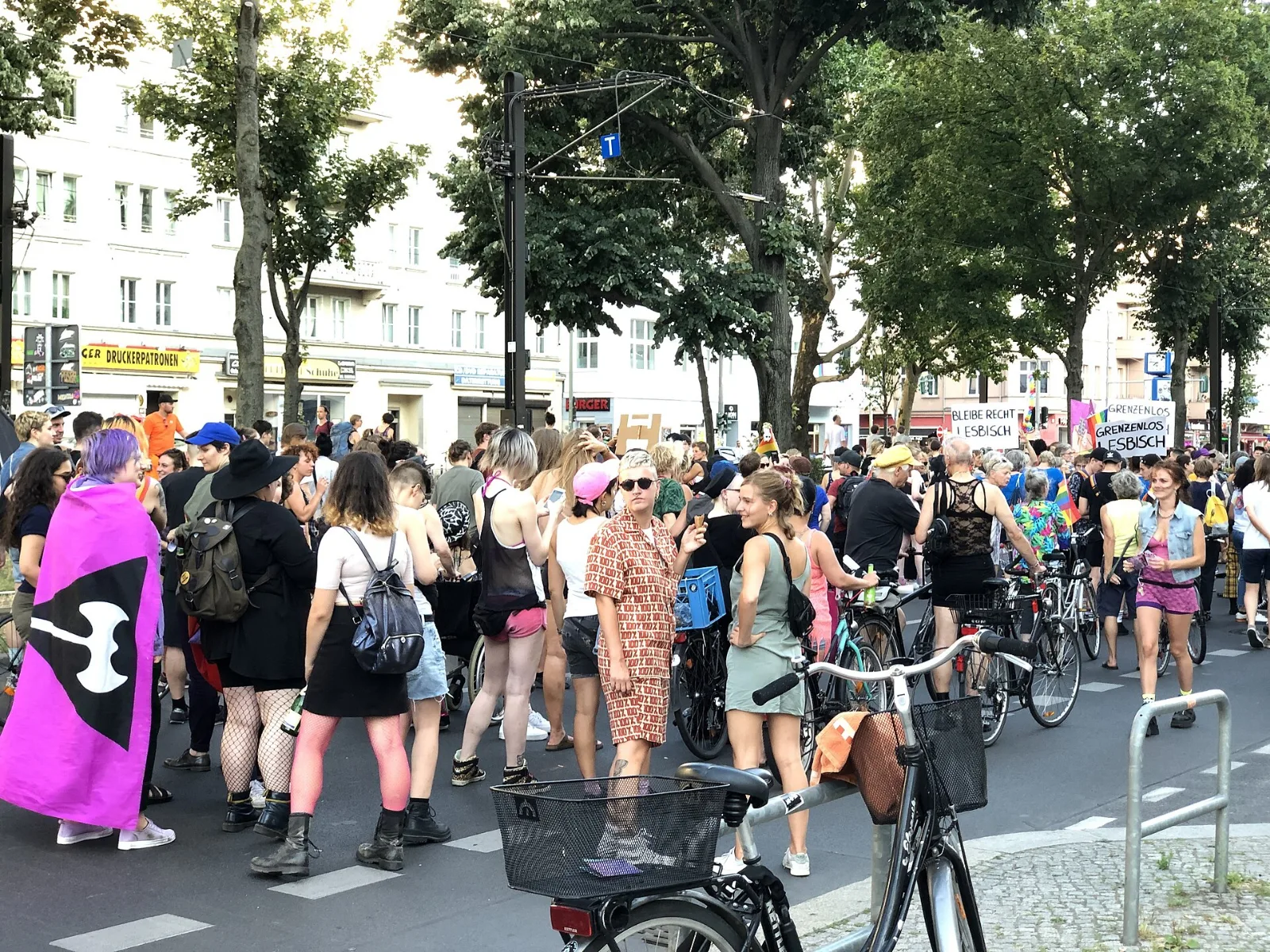
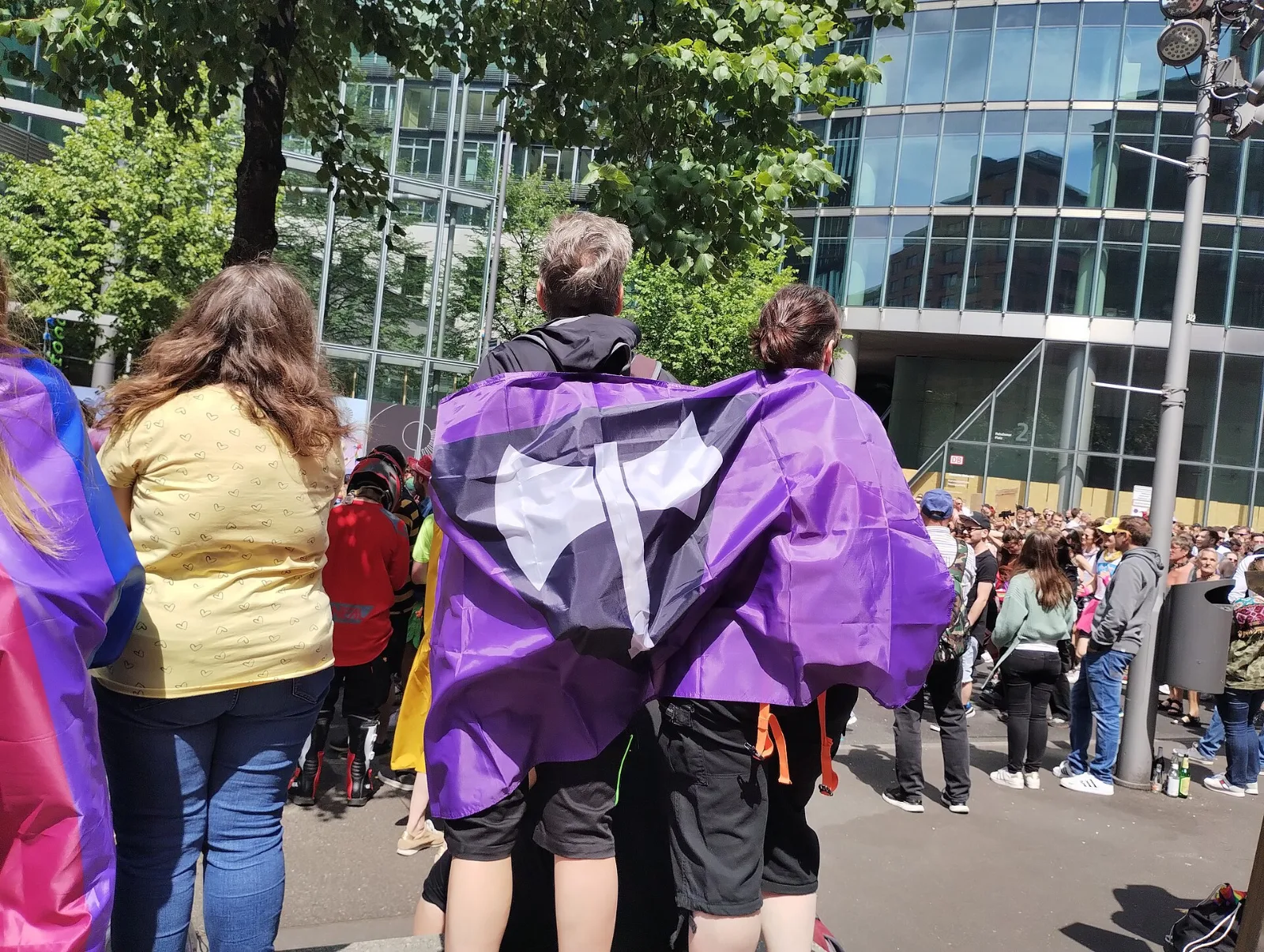
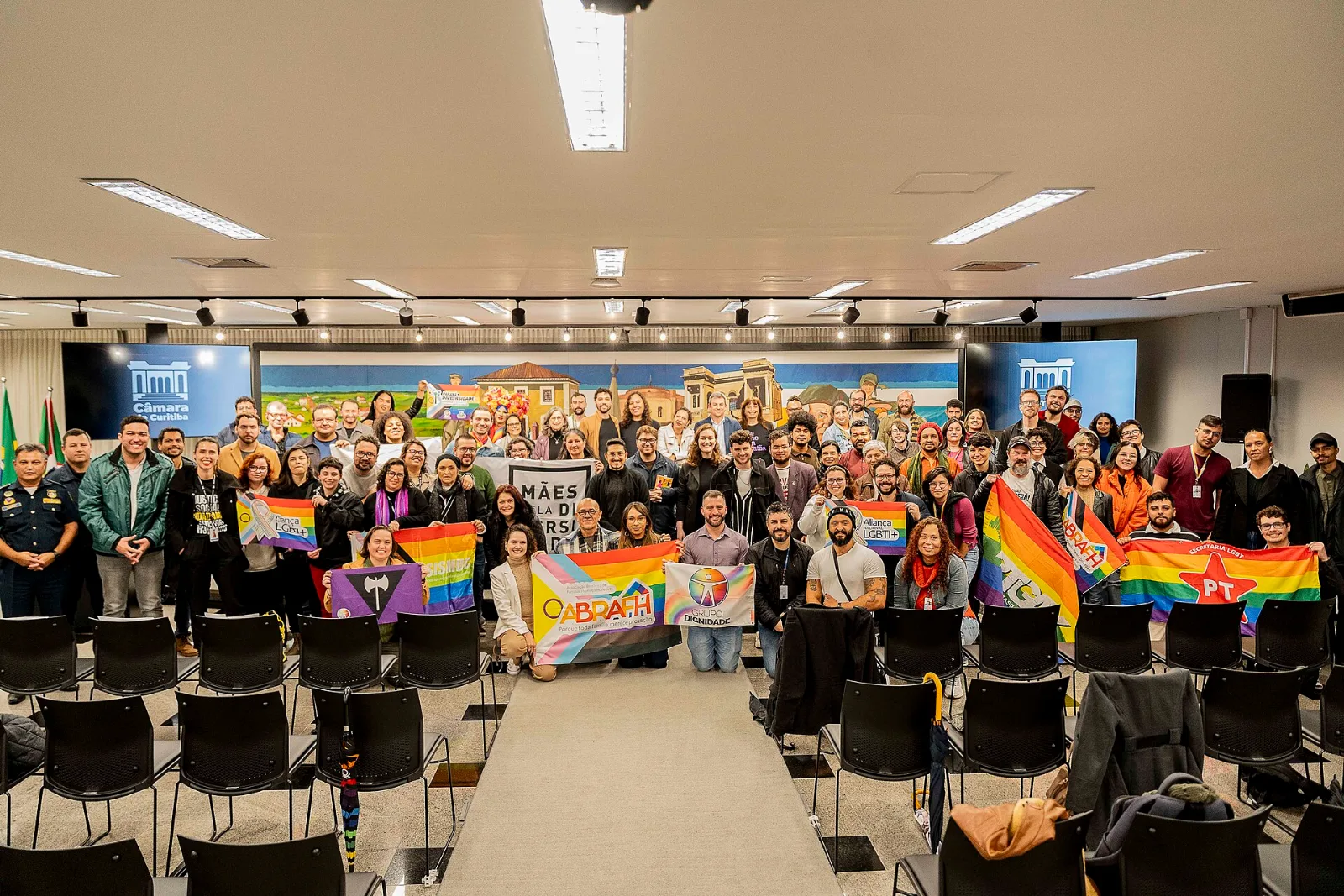
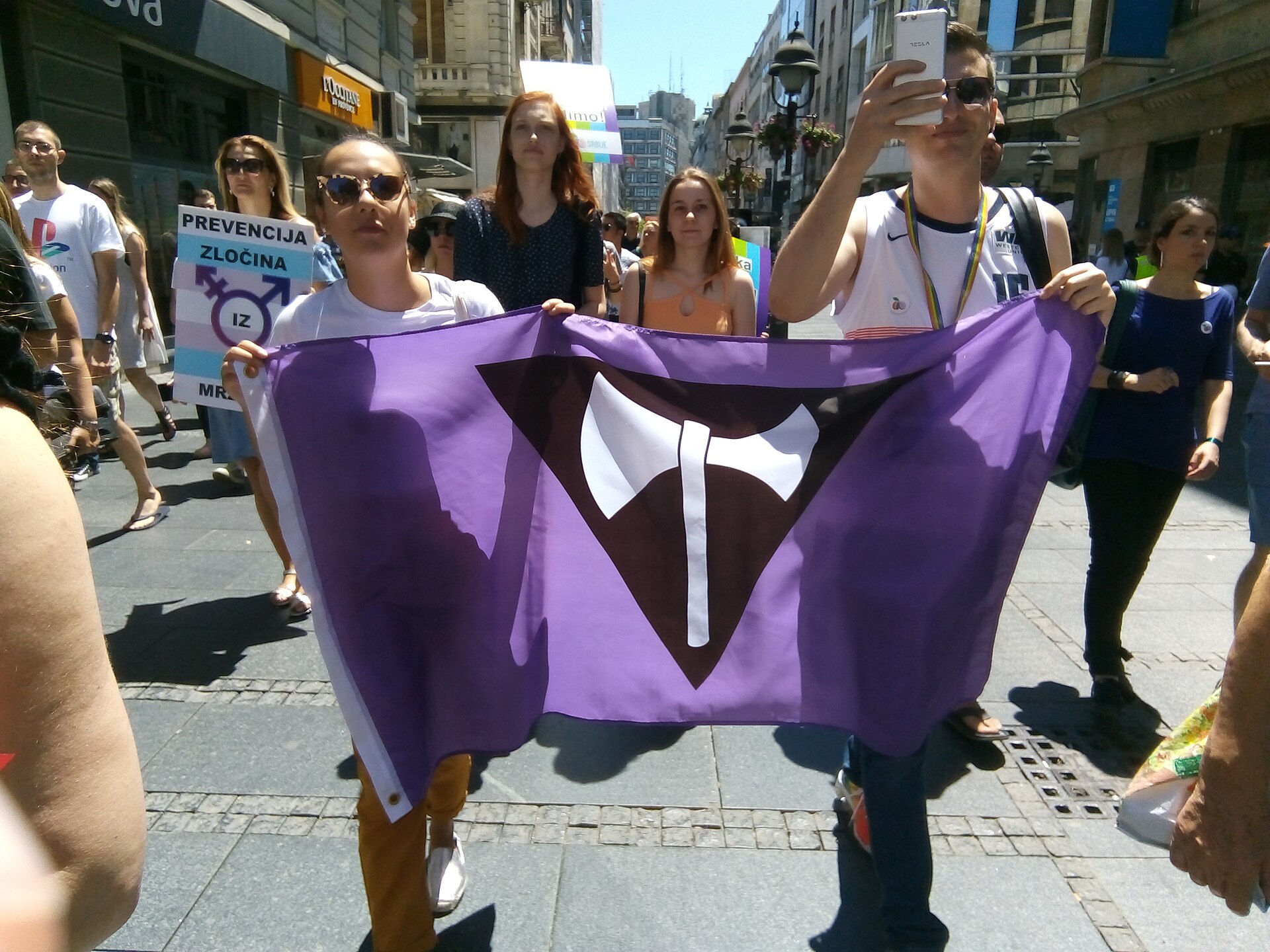
The surviving photographs are illustrative rather than exhaustive and do not establish when physical use began. It is still carried: at the fifth Pride Serbia in Belgrade on 29 June 2019 [20][21], worn as a cape at Christopher Street Day in Berlin on 22 July 2023 [22], and held among the banners of ABRAFH, Grupo Dignidade and Alianca LGBTI+ at a public hearing at the Camara Municipal de Curitiba on 5 June 2025. [19] The orange-pink lesbian flag family is more prominent in many current guides and commercial contexts, though it is not a universal replacement or a community-wide official standard. [5][3]
Campbell's Twilight Guard gallery dates the design to 1999 and its first magazine use to 2000. In a later autobiographical account, Campbell recalled creating his flag designs after joining the publisher in early 2000; the surviving accounts therefore differ slightly on the design date, while the June 2000 publication is secure. [1][2][7]
Timeline: 1988, a labrys and inverted triangle appear together on the Lesbian Strength march banner in London; 1991, the same pairing on a Liverpool Lesbian & Gay Pride badge; 1999, the design year given by Campbell's Twilight Guard gallery; June 2000, first publication in the Gay and Lesbian Times; 8 June 2002, the earliest located archived web copy, on the Twilight Guard gallery; 2011, the original GIF uploaded to Wikipedia; 2012, the earliest located detailed published account of the flag; 2017, Spica Naos publishes a triangle-free variant; 2019, photographed at Pride Serbia and the Dyke March Berlin; 2023, worn at Christopher Street Day Berlin; 2025, held at the Curitiba city-council hearing. [6][18][23][17][16]
Lineage
- Indirect influences
- Labrys as lesbian-feminist symbol, Black triangle reclamation, Violet / Sappho symbolism
The Labrys Lesbian Flag is one of the earliest well-documented lesbian-specific flag designs. It is not a direct visual ancestor of the later striped lesbian flags; the orange-pink lesbian flag family, more prominent in many contemporary guides and commercial contexts, is a separate lineage. [5][9]
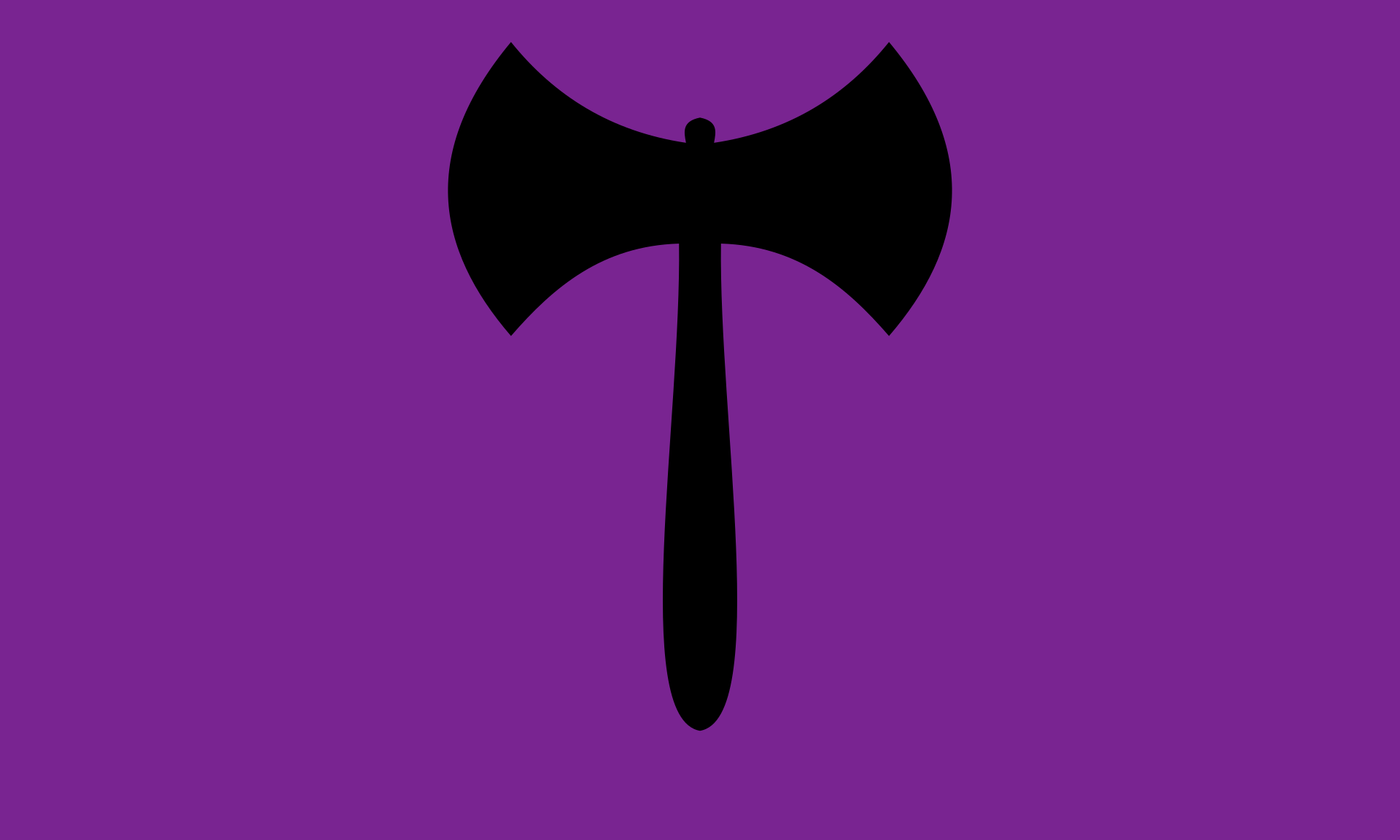
It is a sibling of the Feather Pride Flag, another of the flags Campbell drew for the same June 2000 magazine issue. A direct variant drops the triangle: Spica Naos published a version on 6 August 2017 keeping the violet field and the labrys, describing it as "an adaptation of the original flag design created in 1999 by Sean Campbell" and noting that "the meanings of the labrys and the violet background remain the same." The variant is used on the Spanish, Portuguese and Russian Wikipedias. [23]
Colors & Symbolism
The flag combines three symbols already in lesbian use into a single emblem: a violet field drawing on Sappho and later sapphic violet symbolism; an inverted black triangle reclaimed from a Nazi camp badge; and a white labrys, the double axe taken up by 1970s lesbian feminism. Campbell composed existing symbols rather than inventing new ones. [5][9][24][25][26]
| Colour | Hex | Meaning | Note |
|---|---|---|---|
| Violet | #993399 | Violet draws on Sappho's poetry and on later violet and lavender symbolism among women who love women. Violets became an especially visible sapphic symbol in the late nineteenth and early twentieth centuries, and were read as a lesbian emblem after the 1926 play The Captive used them for love between women. | Community-circulated value (flag-colour sites); not Campbell's. [27] |
| Violet (Wikipedia vector) | #792491 | — | The value in the most-used Wikipedia vector, published on its file page; not Campbell's. [28] |
| Black | #000000 | The inverted black triangle reclaims the badge assigned to concentration-camp prisoners classified by the Nazis as "asocial." The Nazi regime did not systematically imprison women solely for lesbian sexuality, although some lesbians were imprisoned under "asocial," political, racial or other classifications; lesbian communities and meeting places were nonetheless harassed and shut down. Lesbians began reclaiming the badge in the 1980s as a counterpart to the gay pink triangle, and the historical basis and ethics of that reclamation remain contested. | Standard rendering value. |
| White | #FFFFFF | The labrys is an ancient double axe strongly associated with Minoan Crete. Lesbian feminists adopted it in the 1970s, interpreting it through female divinity, the Amazons, strength, self-sufficiency and resistance to patriarchy. Organizations such as Labrys (Kyrgyzstan) and Labrisz (Hungary) still use the symbol. | Standard rendering value. |
This flag has no official digital palette. Color values shown are approximate.
The ancient uses of the labrys and the feminist interpretation adopted in the 1970s are distinct, and the reclamation of the black triangle is disputed. [24][25]
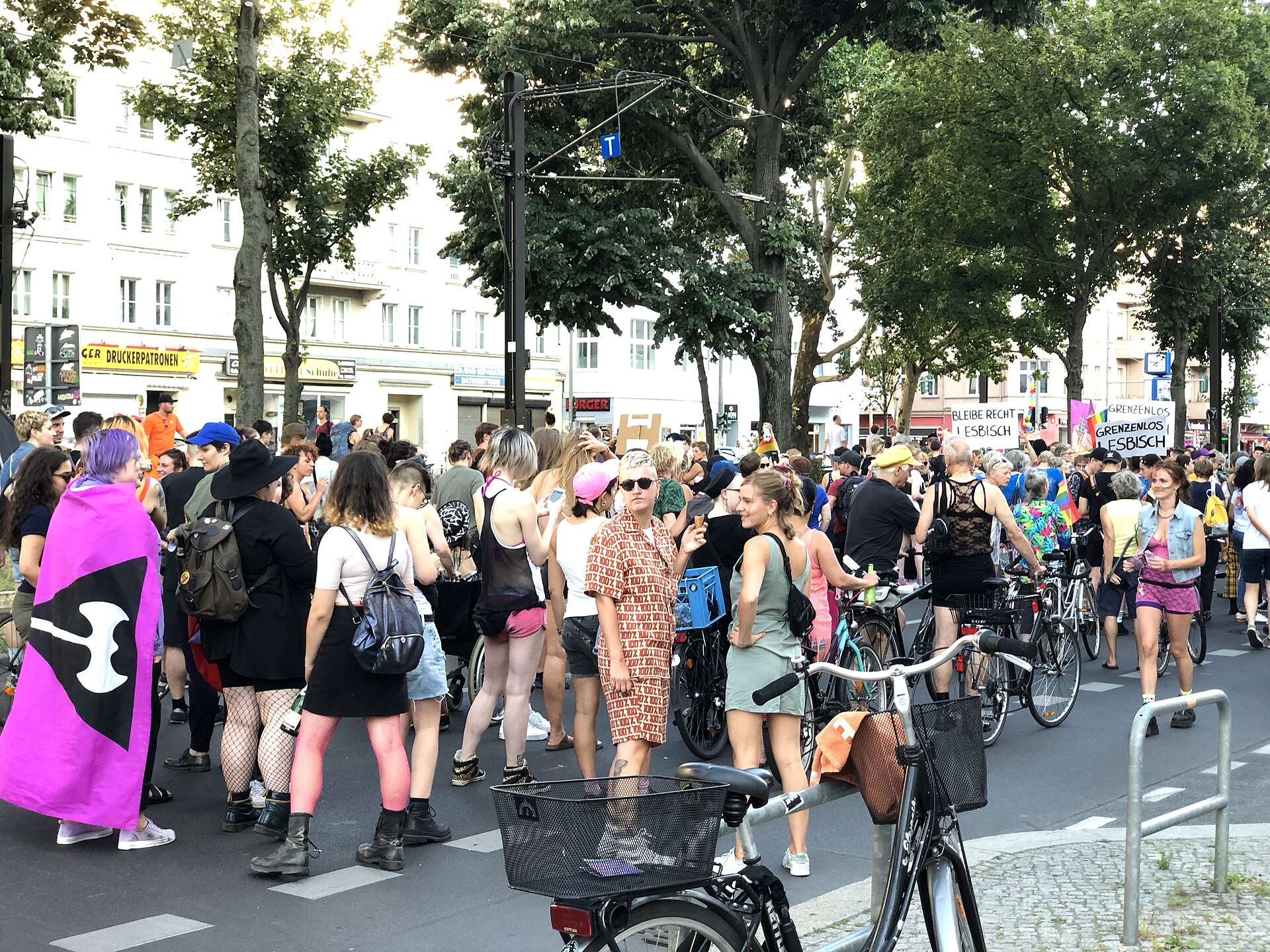

Campbell did not publish numerical colour specifications. The values shown reproduce circulating vectors rather than a creator palette, and the shade varies across reproductions: flag-colour sites give #993399, while the most-used Wikipedia vector renders the field #792491. Printed examples range beyond violet, and the flag at the front of the Dyke March in Berlin on 26 July 2019 has a magenta field. [27][28][29]
Design
- Aspect Ratio
- 3:5 · standard
- Orientation
- horizontal
- Stripe Count
- 0
- Layout
- emblem_on_field
- Center Symbol
- White labrys over black inverted triangle
Violet field with a centered black inverted triangle and a white labrys (double-headed axe) overlaid on the triangle; no stripes. The archive renders it at the standard 3:5 production ratio; the most widely circulated Wikimedia vector is 1000 by 600 pixels, and physical flags are commonly sold in the 3 by 5 foot format.
Usage & Adoption
- Organizations
- Horniman Museum and Gardens (London), which created a version using objects from their collection for LGBT History Month [30], Mid-South Pride (included in their pride flag guide), Sioux Falls Pride (included in their pride flag guide), SexualDiversity.Org (documented in their flags collection), Pitt Rivers Museum, University of Oxford, which displays the flag on a bottle opener and keyring in its Beyond the Binary exhibition [31]
- Geographic Usage
- Serbia: Belgrade [20] [21], Germany: Berlin [22] [29], Brazil: Curitiba, Paraná [19], United Kingdom: London, in the Horniman Museum's LGBT History Month recreation [30], International circulation
- Online Usage
- Wikimedia Commons hosts a standardized SVG of the emblem
- Event Usage
- Fifth Pride Serbia, Belgrade, 29 June 2019, under the slogan "The battle is still ongoing – join in" [20] [21], Dyke March Berlin, 26 July 2019, under the motto "For lesbian visibility and joy of life" [29], Christopher Street Day, Berlin, 22 July 2023, worn as a cape [22], Public hearing on institutional services for diversity, Câmara Municipal de Curitiba, 5 June 2025 [19]
- Current Status
- active
One of the earliest lesbian-specific pride flags; archived as a historical or early design, and still in active but not dominant circulation. The labrys symbol on its own, distinct from the flag, is more widely used, appearing on tattoos, jewelry and in organizational logos. [5][9]
Image Archive
Before the Flag
The Original Flag

Variants and Descendants

The Flag in Use

Carried and Worn
_Park.jpg)

Discourse & Debates
- Authorship: some object that a lesbian flag was designed by a man. Campbell was a gay man, and a recurring defense cites his broader Queer activism rather than the design itself. [3][33]
- The black triangle: lesbians reclaimed a Nazi camp badge assigned to prisoners classified as "asocial." The reclamation is disputed on the historical facts, since the regime did not systematically imprison women solely for lesbian sexuality, and the badge marked a broader group of prisoners; the dispute is over history and ethics rather than a simple question of whether lesbians did or did not wear it. [25]
- Trans-exclusionary appropriation and reclamation: the flag later acquired an association with trans-exclusionary lesbian politics, which PinkNews and the Pitt Rivers Museum report has reduced its use; the association is not universal. Trans lesbians and trans-inclusive users have argued for reclaiming it or produced versions incorporating the transgender flag's colours. The trans-exclusionary association does not appear in Campbell's surviving explanation of the design; the 2019 lesbian-flag history, answering the rumour that he was himself trans-exclusionary, replied, "I can't find any information on Sean Campbell that would suggest this." [3][4][34][31]
Common misidentifications
- A later community account says Campbell created the flag to thank lesbians for caring for gay men during the AIDS epidemic. Campbell's surviving explanation of the magazine series does not state this; the AIDS-specific motivation appears in his account of the Feather Pride Flag, a separate design. [6][2][33]
- The flag is sometimes loosely called the "Lesbian Pride Flag," which can cause confusion with the later, more widely used orange-pink lesbian flag family. [35]
Community reception
In an April 2023 r/actuallesbians thread, lesbians deciding whether to fly the flag disagreed over whether the trans-exclusionary association is a street problem or an online one. Trans commenters split. Cosmic_Hunny, a trans woman, wrote that "if I see someone has the labrys flag I'm going to assume they're a TERF. Which is unfortunate because it is a cool flag design." peace_lily_ wrote, "I actually am trans and got a labrys tattoo, because the TERFs can have the symbol over my dead body," and TheFractangle framed the choice as "reclaiming the labrys flag rather than surrendering it." Several proposed flying it beside the Progress Pride flag or adding trans colours, which is what the trans-recolored variants do. [33]
Footnotes & Citations
Sources and footnotes 35 sources
- 1. Designer page Pride and Fetish Flag Gallery. The Twilight Guard. The Twilight Guard. Accessed 2026-08-03 · Archived version
- 2. Primary statement Drag History Month (Sean Patrick Campbell guest post). Sean Patrick Campbell, published by Tony Scupham-Bilton. The Queerstory Files (2012-01-25). Accessed 2026-08-03
- 3. News The fascinating history of the Labrys Pride flag – and why it's controversial. PinkNews (2025-05-27). Accessed 2026-03-12
- 4. The Labrys Flag (Tumblr reclamation project). Tumblr. Accessed 2026-03-12
- 5. Lesbian flags. Wikipedia. Accessed 2026-03-12
- 6. Blogs & Personal Sources Putting Out Sean Campbell's Flags. Tony Scupham-Bilton. The Queerstory Files (2012-06-21). Accessed 2026-03-12
- 7. Primary statement Résumé & Portfolio: Sean Patrick Campbell. Sean Patrick Campbell. Self-published, twenty pages (2016). Accessed 2026-08-04
- 8. Organizations A Brief History of the Twilight Guard. The Members of the Twilight Guard. Prepared for the Atlantic Motorcycle Coordinating Council, ten pages (2006-03). Accessed 2026-08-04
- 9. Pride Flag Guide: Lesbian (Labrys). Library.LGBT (Albany Pride initiative). Library.LGBT Pride Flag Guide. Accessed 2026-03-09
- 10. Encyclopedias & Reference Gay and Lesbian Times. Wikipedia contributors. Wikipedia (2025-12-05). Accessed 2026-08-04
- 11. Government Agua Caliente Band of Cahuilla Indians. Agua Caliente Band of Cahuilla Indians. Accessed 2026-08-05
- 12. Tribal nation We Are Agua Caliente (Our Story: A New Vision). Me Yah Whae, the magazine of the Agua Caliente Band of Cahuilla Indians, Fall/Winter 2020-2021 (2020). Accessed 2026-08-05
- 13. Tribal nation Cahuilla Territory. Mona de Crinis. Me Yah Whae, the magazine of the Agua Caliente Band of Cahuilla Indians, Fall/Winter 2021-2022 (2021). Accessed 2026-08-05
- 14. Articles & Reports How the Agua Caliente Band of Cahuilla Indians Held On in Palm Springs. Smithsonian Magazine. Accessed 2026-03-19
- 15. Blogs & Personal Sources The Lesbian Flag: "How did we get here?" (text version of the visual essay). lesbianflaghistory; text version edited by immature-techno-geek. Neocities. Accessed 2026-08-04
- 16. Archived Sources And the March Stops. Del LaGrace Volcano. Lesbian Herstory Archives (1988). Accessed 2026-08-04 [no stable URL]
- 17. Image file page File:Liverpool Lesbian & Gay Pride 1990 & 1991 Badges.jpg. Richie wright1980. Wikimedia Commons (2012-05-26). Accessed 2026-08-04
- 18. Image file page File:Labrys Pride Flag.gif. Sean Campbell. Wikimedia Commons (2011-03-30). Accessed 2026-08-04 · Archived version
- 19. Image file page File:Audiência pública- Atendimentos Institucionais à Diversidade - 2025-06-05 - 33.jpg. Câmara Municipal de Curitiba (photograph by Claudio Sehnem). Wikimedia Commons (2025-06-05). Accessed 2026-08-04
- 20. Image file page File:Pride Serbia 2019 - Lesbian Labrys Pride Flag.jpg. Bojan Cvetanović. Wikimedia Commons (2019-06-29). Accessed 2026-08-04
- 21. Image file page File:Pride Serbia 2019 - Academic (Student) Park.jpg. Bojan Cvetanović. Wikimedia Commons (2019-07-05). Accessed 2026-08-04
- 22. Image file page File:CSD Berlin 2023 - Lucas Werkmeister - 16 - Labrys.jpg. Lucas Werkmeister. Wikimedia Commons (2023-07-22). Accessed 2026-08-04
- 23. Image file page File:Lesbian pride labrys flag without triangle.svg. Spica Naos. Wikimedia Commons (2017-08-06). Accessed 2026-08-04
- 24. Labrys. Wikipedia. Accessed 2026-03-12
- 25. Black triangle (badge). Wikipedia. Accessed 2026-03-12
- 26. Queer Botany: The Sapphic Violet. University of Washington Botanic Gardens (2021-12-21). Accessed 2026-03-12
- 27. Labrys Lesbian Flag Color Codes. Flag Color Codes. Accessed 2026-03-12
- 28. Image file page File:Lesbian pride labrys flag.svg. Ensix. Wikimedia Commons (2018-01-21). Accessed 2026-08-04
- 29. Image file page File:Dyke March Berlin 2019 328.jpg. C.Suthorn. Wikimedia Commons (2019-07-26). Accessed 2026-08-04
- 30. A Horniman Lesbian Flag. Horniman Museum and Gardens. Accessed 2026-03-12
- 31. Museums & Exhibitions Beyond the Binary: Labrys. Mara Gold (Beyond the Binary Researcher). Pitt Rivers Museum, University of Oxford. Accessed 2026-08-04
- 32. Image file page File:Labrys Lesbian Flag.svg. Thespoondragon. Wikimedia Commons (2019-02-26). Accessed 2026-08-04
- 33. Social media Is it too controversial to use the Labrys flag?. Foraging-Mountains and commenters, r/actuallesbians. Reddit (2023-04). Accessed 2026-08-04
- 34. Blogs & Personal Sources How Did We Get Here? (lesbian flag history). lesbianflaghistory. Tumblr (2019-06-05). Accessed 2026-08-04 · Archived version
- 35. Blogs & Personal Sources A field guide to Pride flags. Clare Bayley. clarebayley.com (2013-06-27). Accessed 2026-08-04


Image Sources
- Rendering
- standard emblem version
- Credit: Thespoondragon, CC0 1.0, via Wikimedia Commons
- Lesbian Strength march, London, 1988 · Credit: Del LaGrace Volcano, "And the March Stops," 1988, Lesbian Herstory Archives · Lesbian Herstory Archives
- Liverpool Lesbian & Gay Pride badges, 1990 and 1991 · Credit: Richie wright1980, CC BY-SA 3.0, via Wikimedia Commons · Wikimedia Commons
- Earliest located web copy of the flag, archived 2002 · Credit: Sean Campbell, released free of copyright restrictions by the artist, via Wikimedia Commons · Wikimedia Commons
- Spica Naos's triangle-free variant, 2017 · Credit: Spica Naos, CC BY 4.0, via Wikimedia Commons · Wikimedia Commons
- Pride Serbia, Belgrade, 2019 · Credit: Bojan Cvetanović, CC BY-SA 4.0, via Wikimedia Commons · Wikimedia Commons, uploaded for Wiki Loves Pride 2019
- Pride Serbia, Academic Park, Belgrade, 2019 · Credit: Bojan Cvetanović, CC BY-SA 4.0, via Wikimedia Commons · Wikimedia Commons
- Dyke March Berlin, 2019 · Credit: C.Suthorn / cc-by-sa-4.0 / commons.wikimedia.org · Wikimedia Commons
- Christopher Street Day, Berlin, 2023 · Credit: Lucas Werkmeister, CC BY 4.0, via Wikimedia Commons · Wikimedia Commons
- Câmara Municipal de Curitiba public hearing, 2025 · Credit: Câmara Municipal de Curitiba, photograph by Claudio Sehnem, Public Domain Mark · Wikimedia Commons