Transgender Nation Flag
Identity Pride Flag ·
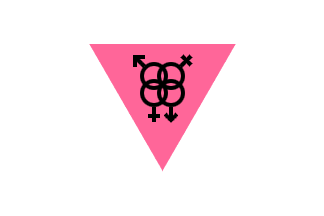
A pink downward-pointing triangle on white charged with a device of interlocked circles, made for Transgender Nation, the transgender focus group of Queer Nation, in about October 1991 in San Francisco. It predates the better-known 1999 transgender pride flag by eight years, though sources disagree on whether the group existed that early. Its authorship is layered: the triangle on white was Queer Nation's, the central device was added by Dawn Holland, and the original T-shirts and banner were made by Anne Ogborn. [1]
Key facts
- Designer
- Dawn Holland (central four-circle device); Anne Ogborn (original T-shirts and banner)
- Created
- In use
- c.1991
- Aspect Ratio
- 3:5 · standard
- Ratio Notes
- The 3:5 shown is the archive's standard presentation ratio. No proportion of the original banner or T-shirts is documented, and the surviving objects have not been measured.
- Stripes
- 0
- Origin
- San Francisco, California, United States
- Represented Identity
- transgender
Also known as
- Dawn Holland's Transgender Nation flag
- Transgender Nation banner
Status Historical
Archive categories Gender Identity Pride Flags · Historical and Early Pride Flags
Overview
To give Transgender Nation its own visual identification within Queer Nation, on the pink triangle the wider group already used.
Transgender Nation, the transgender focus group of Queer Nation, made T-shirts and a banner on Queer Nation's existing pink triangle on white. Dawn Holland added a device at the center: four interlocked circles, "with the cross sticking up and right, the arrow down, the cross down on the left, and the arrow up to left, symbolizing various transgendered people working together." Anne Ogborn, who made the objects, dates it to "about Oct 1991" and places it in a sandwich shop on Castro between 17th and 18th in San Francisco. [1] The white field was the ground of gay liberation, and the pink triangle on it was the reclaimed persecution badge, not a mark particular to this group. Pink triangle on black belonged to ACT UP's SILENCE = DEATH poster rather than to Queer Nation; Queer Nation's own recognizable emblem was its cut-paper wordmark logo. [2][3]
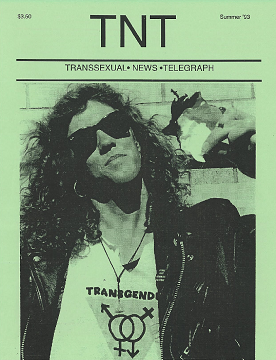
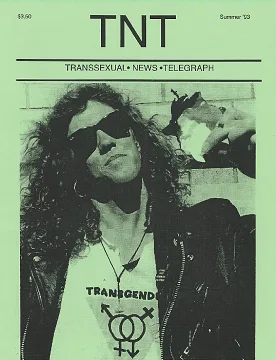
A photograph appears to show the design in use. The cover of TNT: Transsexual News Telegraph for Summer 1993, Ogborn's own magazine, shows an unidentified person in a light T-shirt reading TRANSGEND, the word running off the edge of the frame, over a downward-pointing triangle carrying interlocked circles with four projections: an arrow to the upper left, a cross to the upper right, a cross at the lower left, and an arrow pointing down. Those are the four Ogborn describes, in the positions she gives them, though no source caption identifies the shirt as Transgender Nation's. The cover is printed in two inks, so the triangle reads as a separate field but no color can be taken from it, and the number of interlocked circles cannot be counted at that resolution. [4][1]
Identity & Context
- Represented Identity
- transgender
- Subcommunity
- Transgender Nation, within Queer Nation
- Movement
- Queer Nation-era direct action
- National Context
- United States
Made in the Castro during the period of Queer Nation's activity, by the transgender focus group formed within it.
Creators
The Creator
Anne Ogborn
Made the original T-shirts and banner; co-founded Transgender Nation

Anne Ogborn (born 1959, Salina, Kansas) made the original Transgender Nation T-shirts and banner: "The original T-shirts were printed with a home silk screen kit on the floor of my apartment, and the original banner was created in my back yard." [1] She is not credited with the central device, which is Dawn Holland's. When Queer Nation's San Francisco chapter restarted after a leadership dispute, Ogborn and Carol Klinemeyer brought a trans contingent to the reorganizing meeting; about a dozen trans people came, and Ogborn set three conditions for joining as a focus group, of which she says the first, that Queer Nation would not support anything that was not trans-inclusive, "proved the most effective." [5] She disputes the usual account of the group's origin: "far from being a split from QN in protest, TN was nurtured and given birth by gay men and lesbians." [5] At its working core the group was about four people keeping up a furious pace of direct actions, and Ogborn was arrested at the American Psychiatric Association protest at the Moscone Center in San Francisco on 23 May 1993. [5][6] An early trans direct-action organizer, she edited the magazine that became the Transsexual News Telegraph; Patrick Califia writes that she "should be credited as a forerunner of transgender direct action groups." [7]
For what it's worth, it happened in about Oct 1991 in a sandwich shop (San Francisco, Calif., US) on Castro between 17th and 18th.
Far from being a split from QN in protest, TN was nurtured and given birth by gay men and lesbians.
Dawn Holland
Designed the central device of four interlocked circles
Dawn Holland designed the device at the center of the flag: "4 circles interlocked, with the cross sticking up and right, the arrow down, the cross down on the left, and the arrow up to left, symbolizing various transgendered people working together." [1] The attribution is preserved through Anne Ogborn's 2005 contribution to Flags of the World. No first-person statement from Holland has been located.
Christine Tayleur
Co-founder of Transgender Nation
Christine Tayleur was a Canadian trans woman and a social worker who co-founded Transgender Nation. She was active in San Francisco's transgender scene from the 1970s to the 1990s, a span far longer than the group's, serving as an at-large representative on the San Francisco Task Force on Prostitution and as a board member of Community United Against Violence, and counseling at the Tenderloin Self Help Center. [8][9] At the American Psychiatric Association protest at the Moscone Center on 23 May 1993 she told the San Francisco Chronicle that she had been institutionalized at fourteen for cross-dressing and medicated: "They call it treatment. I call it torture." [10] She deposited her own papers with the GLBT Historical Society before 1997. No source connects her to designing or making the objects.
They call it treatment. I call it torture.
Attribution
- Organization
- Transgender Nation, the transgender focus group of Queer Nation
Attribution notes
The contributions credited here are different in kind. The ground, a pink triangle on white, was Queer Nation's existing design, inherited rather than made for this flag. The central device of four interlocked circles is Dawn Holland's. The T-shirts and banner were made by Anne Ogborn. The full-colour flag-format image is a 2017 reconstruction drawn for Flags of the World by António Martins-Tuválkin, not an original object. Flags of the World titles its section "Dawn Holland's Transgender Nation flag," crediting one of these. [1]
Origin
- Country
- United States
- Region / state
- California
- City
- San Francisco
- Specific Place
- A sandwich shop on Castro Street between 17th and 18th, where Ogborn places the design; the T-shirts were printed in her apartment and the banner made in her back yard
- Place Type
- community organizing
Ogborn is careful about her own certainty, prefacing the account "For what it's worth," and gives the date only as "about Oct 1991." [1]
Dates & Chronology
- Year Created
- Period in Use
- c.1991; later use unknown
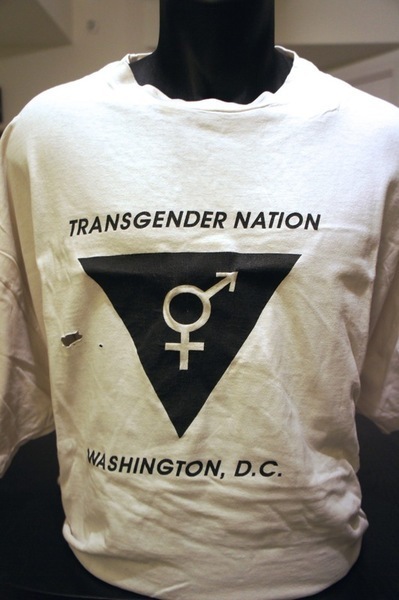
The surviving Washington, DC, chapter shirt uses a different device; no evidence has been located that the San Francisco design was adopted there. A Transgender Nation T-shirt from the Washington DC chapter survives in the Rainbow History Project collection, dated to the mid 1990s: white, reading "Transgender Nation" above and "Washington, D.C." below on the front, "Gender Oppression Affects Us All" on the back. Its device is a solid black downward-pointing triangle with a single combined transgender symbol reversed out of it in white, not the pink triangle and not Dawn Holland's four interlocked circles. The catalog descriptions at both holding institutions transcribe the wording and describe no graphic at all; the device is legible only in the item photograph. [11] Ogborn's remark in 2005 that of the transgender flags then illustrated on Flags of the World "I'd actually never seen the two flags you show" suggests how little any transgender flag circulated in that period. [1]
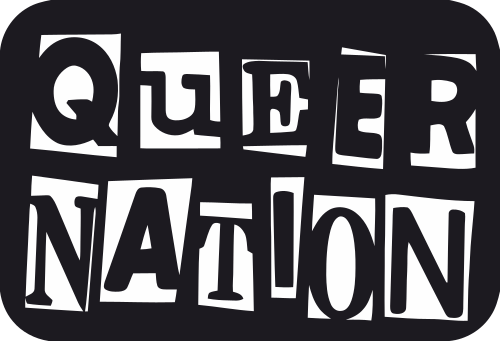
Transgender Nation was a focus group inside Queer Nation San Francisco, not a breakaway from it. Some later accounts describe it as a breakaway group, an account Ogborn disputed; she corrected one such biographical entry in 2010, writing that "Queer Nation is and was a confederation of independent groups. Transgender nation San Francisco was a 'focus group', a part, of Queer Nation San Francisco," and that "far from being a split from QN in protest, TN was nurtured and given birth by gay men and lesbians. They had promised to give us our 'fair share' of their energy. In practice, QN often became an added arm for TN." She had used the same phrase, focus group, in her Flags of the World note five years earlier. [5][12]
The group formed when Queer Nation San Francisco restarted after a leadership dispute, set off by the exclusion of Nancy Burkholder from the Michigan Womyn's Music Festival and the "Letter Wars" that followed in the Bay Area Reporter. Carol Klinemeyer called Ogborn to propose a trans presence at the reorganizing meeting; the two brought a trans contingent to it, and Ogborn set three conditions, of which she says the first, that Queer Nation would not support anything that was not trans-inclusive, "proved the most effective." [5] Queer Nation itself had been founded in New York in 1990; its San Francisco chapter met at the Women's Building in the Mission District, without a leadership structure and by consensus, and took reports from focus groups like this one. [13][14]
The group was small. Ogborn gives the only headcount located: "TN dropped to a small group (4 core members and another 4 or so occasional participants). The core members started and kept up a furious pace of actions, often doing 2 or 3 a week." [5] Surviving sources name several people associated with Transgender Nation, though the evidence does not firmly identify which of them made up Ogborn's precise four-person core. Ogborn made the objects. Christine Tayleur, a Canadian trans woman and a social worker, is recorded as a co-founder by the GLBT Historical Society, which holds the papers she deposited there before 1997; she counseled at the Tenderloin Self Help Center, sat on the San Francisco Task Force on Prostitution and the board of Community United Against Violence, and was active in the city's transgender scene from the 1970s to the 1990s. [8][9] Susan Stryker and Jamison Green are named as figures in the group by a signed 2022 reference article. [10]
The founding date is unsettled. Ogborn's firsthand recollection dates the making of the shirts and banner to about October 1991 and places the group's beginning at the moment Queer Nation San Francisco restarted; the timeline of a 2015 interview also puts it in 1991. [1][15] Susan Stryker, a member, dates the group to 1992 in both her book and a peer-reviewed article, and the 2022 reference article agrees. [16][13][10] The records of Queer Nation San Francisco complicate rather than settle the question: the collection notes a leadership dispute in the summer of 1991, following an action outside Supervisor Roberta Achtenberg's home, and one documented attempt to revive the chapter in 1992, but the papers stop in 1991 and do not file Transgender Nation among the chapter's focus groups. [14][17] No exact creation date or first public use has been established.
The design is eight years older than Monica Helms's 1999 transgender pride flag, which the Smithsonian describes as "the first transgender pride flag." [18] As an earlier transgender organizational emblem, used on shirts and a banner rather than issued as a conventional flag, it complicates that unqualified description; the two have different object histories, purposes and levels of adoption, and no documented line of influence runs between them.
Lineage
- Related flags
- Transgender Pride Flag
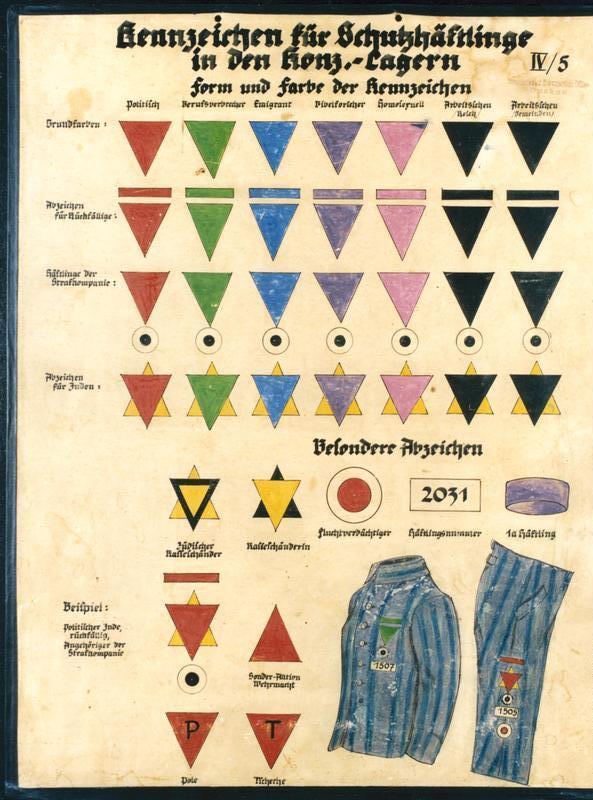
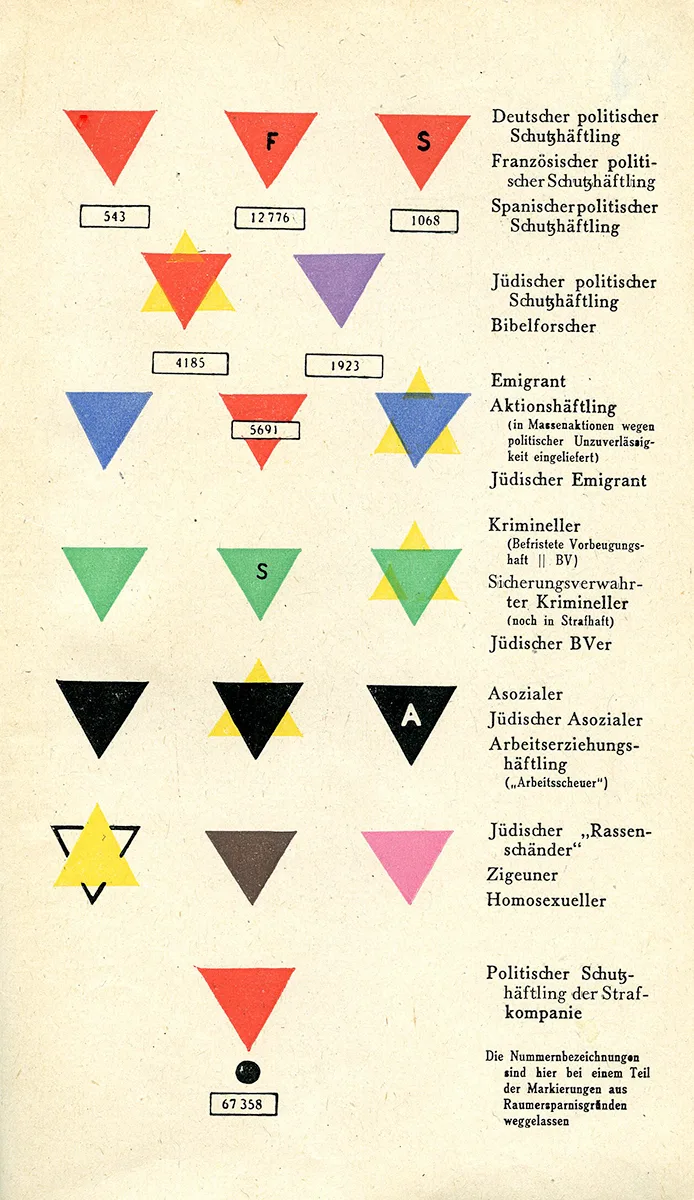
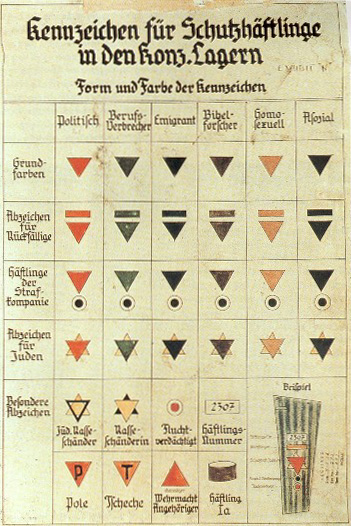
The ground is the pink triangle on white. In the Nazi concentration camps the pink triangle marked prisoners held as "homosexual" offenders, between 5,000 and 15,000 men, many though not all of whom identified as gay; the badge was later reclaimed by gay liberation. [19] No line of descent to the 1999 transgender pride flag has been established, and none should be assumed: Helms has said she arrived at her 1999 flag after Michael Page, the bisexual-flag creator, suggested trans people should have one, and recalls the rainbow and bisexual flags as "the only two that existed then." [20][21] The relationship recorded here is chronological, not genealogical.
Colors & Symbolism
The four interlocked circles were meant, in the words Flags of the World records, as "various transgendered people working together." [1] The pink triangle carries the meaning Queer Nation gave it, a reclaimed persecution badge.
| Colour | Hex | Meaning |
|---|---|---|
| Pink | — | The reclaimed pink triangle carried forward from Queer Nation |
| White | — | Field |
| Black | — | The interlocked-circles device |
This flag has no official digital palette, and no documented color values have been located.
No statement by Dawn Holland herself has been located. The account of the device's meaning reaches this archive through Flags of the World, in a contribution by Anne Ogborn, who made the objects but is not credited with the device. [1]
No creator-issued palette or digital specification has been located. Ogborn's account supports a pink triangle on a white field; the device's black is the colour used in the 2017 flag-format reconstruction drawn for Flags of the World by António Martins-Tuválkin, the only full-colour rendering located. The Summer 1993 TNT cover is printed in two inks and cannot establish the original colours. The colours are named rather than given values, because a silk-screened shirt and a hand-made banner have no issued specification and the surviving objects have not been examined. [1][4]
Design
- Aspect Ratio
- 3:5 · standard
- Ratio Notes
- The 3:5 shown is the archive's standard presentation ratio. No proportion of the original banner or T-shirts is documented, and the surviving objects have not been measured.
- Orientation
- horizontal
- Stripe Count
- 0
- Layout
- emblem on plain field
- Center Symbol
- Four interlocked circles combining two crosses and two arrows, at the center of a pink downward-pointing triangle
Described by Flags of the World as four circles interlocked, "with the cross sticking up and right, the arrow down, the cross down on the left, and the arrow up to left." No measurements or proportions are recorded anywhere located. [1]
The surviving objects are a silk-screened T-shirt and a hand-made banner rather than a manufactured flag. Ogborn printed the shirts "with a home silk screen kit on the floor of my apartment" and made the banner "in my back yard." [1] Whether anything was ever produced as a flag proper is undocumented.
A white field bearing a large pink triangle pointing downward. At the center of the triangle sits a device of four interlocked circles, each carrying either a cross or an arrow, arranged so that the crosses and arrows point outward in four directions.
Usage & Adoption
- First Users
- Transgender Nation, San Francisco
- Organizations
- Transgender Nation
- Geographic Usage
- San Francisco
- Current Status
- historical
Nothing located documents use outside Transgender Nation.
Image Archive
The Pink Triangle
Surviving Objects
Parent Organization
The Design in Use
The People

.jpg)


Discourse & Debates
Common misidentifications
- Not to be confused with the 1999 transgender pride flag by Monica Helms, which is the design almost universally meant by "the transgender flag."
The sources use the period term "transgendered," which is preserved inside quotation and not adopted. GLAAD's guidance is that transgender is an adjective and "never needs an '-ed' at the end."
Footnotes & Citations
Sources and footnotes 23 sources
- 1. Reference Transgender flags (Dawn Holland's Transgender Nation flag). Flags of the World contributors, edited by Randy Young; the account quoted is Anne Ogborn's. Flags of the World (FOTW) (2005-12-12). Accessed 2026-07-31
- 2. Museums & Exhibitions Silence = Death (object 1549.2015). ACT UP (AIDS Coalition to Unleash Power). Museum of Modern Art (1987). Accessed 2026-08-03
- 3. Image file page File:Queer Nation logo.svg. Alan MacDonald and Patrick Lilley; uploaded by Varnent. Wikimedia Commons (2013-01-01). Accessed 2026-08-01
- 4. Image file page TNT: Transsexual News Telegraph, Summer 1993, front cover. Anne Ogborn, publisher and copyright owner; cover photographer unidentified. GLBT Historical Society, via Google Arts & Culture; file page at Wikipedia (1993). Accessed 2026-08-01 · Archived version
- 5. Reference Anne Ogborn (1959- ) activist. Zagria, with substantial corrections in the comments by Anne Ogborn herself. A Gender Variance Who's Who (2010-06-03). Accessed 2026-08-01
- 6. Interview "We Had Some Gender Chaos": Activist Anne Ogborn on rebooting the trans rights movement. Anne Ogborn, as told to Andy Wright. Gender 2.0, on Medium (2015-09-22). Accessed 2026-08-01
- 7. Reference Anne Ogborn. Wikipedia contributors. Wikipedia (2026-04-26). Accessed 2026-08-01
- 8. Archived Sources Tayleur (Christine) Papers, 1977-1993 (collection 1997-40). GLBT Historical Society staff. Online Archive of California; GLBT Historical Society. Accessed 2026-08-01
- 9. Archived Sources Christine Tayleur Papers (collection 1997-40). GLBT Historical Society. Digital Transgender Archive; GLBT Historical Society. Accessed 2026-08-01 · Archived version
- 10. Reference Transgender Nation Holds Its First Protest. K. Surkan. EBSCO Research Starters (2022). Accessed 2026-08-01
- 11. Image file page Transgender Nation [T-shirt]. Rainbow History Project, via Wearing Gay History. Rainbow History Project Digital Collections; also Digital Transgender Archive 3484zg98v. Accessed 2026-08-01 · Archived version
- 12. Reference Pink Triangle Flags (Gay Pride). Flags of the World contributors, including Anne Ogborn. Flags of the World (2020-09-05). Accessed 2026-08-01
- 13. Encyclopedias & Reference Queer Nation. Wikipedia contributors. Wikipedia (2026-07-30). Accessed 2026-08-01
- 14. Archived Sources Guide to the Queer Nation Records, 1990-1996 (bulk dates 1990-1991), collection 1993-02. Processed by Daniel Spencer; finding aid by Gabriela A. Montoya; container list updated by Devin McGeehan Muchmore. Online Archive of California; GLBT Historical Society (1998). Accessed 2026-08-01
- 15. Interview "Listen To Our Voices": 11 activists discuss the past, present, and future of the trans rights movement. Andy Wright, with Anne Ogborn, Susan Stryker and others. Gender 2.0, on Medium (2015-09-22). Accessed 2026-08-01
- 16. Encyclopedias & Reference Transgender Activism. Susan Stryker. glbtq: An Encyclopedia of Gay, Lesbian, Bisexual, Transgender, and Queer Culture (2004). Accessed 2026-08-01
- 17. News When Queer Nation 'Bashed Back' Against Homophobia with Street Patrols and Glitter. Caitlin Donohue. KQED (2019-06-03). Accessed 2026-08-01
- 18. Museums & Exhibitions Who Designed the Transgender Flag?. Smithsonian Institution. Smithsonian (2022-03-29). Accessed 2026-08-03
- 19. Encyclopedias & Reference Gay Men under the Nazi Regime. United States Holocaust Memorial Museum. Holocaust Encyclopedia, United States Holocaust Memorial Museum (2021-05-28). Accessed 2026-08-03
- 20. Interview The story behind the Transgender flag with creator Monica Helms. Monica Helms, as told to Lee Wade. Translucent, WYSO (2025-08-15). Accessed 2026-08-03
- 21. Interview 'Divine Intervention' Helped Monica Helms Create The Transgender Pride Flag. Samantha Allen. The Daily Beast (2017-07-01). Accessed 2026-08-03
- 22. Image file page File:03.LafayettePark.WDC.11August2018.jpg. Elvert Barnes. Wikimedia Commons, from Flickr (2018-08-11). Accessed 2026-08-01 · Archived version
- 23. Image file page File:Trans March San Francisco 20170623-6594.jpg. Pax Ahimsa Gethen. Wikimedia Commons (2017-06-23). Accessed 2026-08-01

Image Sources
- Rendering
- Reconstruction
- The flag shown is a modern reconstruction, drawn in flag format by António Martins-Tuválkin in 2017 for Flags of the World, based on Anne Ogborn's 2005 description of the design. It is not a surviving creator-issued file, and it is not evidence of the original's exact colours, proportions or dimensions. [1] · Credit: Reconstruction by António Martins-Tuválkin, 2017, for Flags of the World · Flags of the World
- A German concentration-camp chart of prisoner badges, 1936/44. The pink triangle, in the "Homosexuell" column, marked prisoners classified as homosexual, the badge gay liberation later reclaimed. [19] · Credit: Bundesarchiv, Bild 146-1993-051-07 / Unknown author / CC-BY-SA 3.0, via Wikimedia Commons · Wikimedia Commons
- The Washington DC chapter's T-shirt, dated to the mid 1990s. A black triangle carrying a single combined transgender symbol, not the pink triangle with four interlocked circles that Anne Ogborn and Dawn Holland made in San Francisco. [11] · Credit: Rainbow History Project Digital Collections, T-shirts Box 2; also Digital Transgender Archive 3484zg98v. Rights recorded by both institutions as copyright undetermined. Reproduced under a fair-use rationale. · Rainbow History Project
- The Queer Nation logo, by Alan MacDonald and Patrick Lilley, 1992. Transgender Nation was a focus group within Queer Nation. [3] · Credit: Alan MacDonald and Patrick Lilley, 1992. Public domain as a text logo, via Wikimedia Commons; provided by WikiQueer for the LGBT Free Media Collective. The mark may still be protected as a trademark · Wikimedia Commons
- A probable photograph of the Transgender Nation design, on the cover of Anne Ogborn's own magazine. The four projections around the interlocked circles match her 2005 description of Dawn Holland's device. No source caption identifies the shirt, and the cover's two-ink printing carries no colour information. [4][1] · Credit: TNT: Transsexual News Telegraph, Summer 1993; copyright Anne Ogborn. Digitized by the GLBT Historical Society. Reproduced under a fair-use rationale. · Google Arts & Culture, GLBT Historical Society
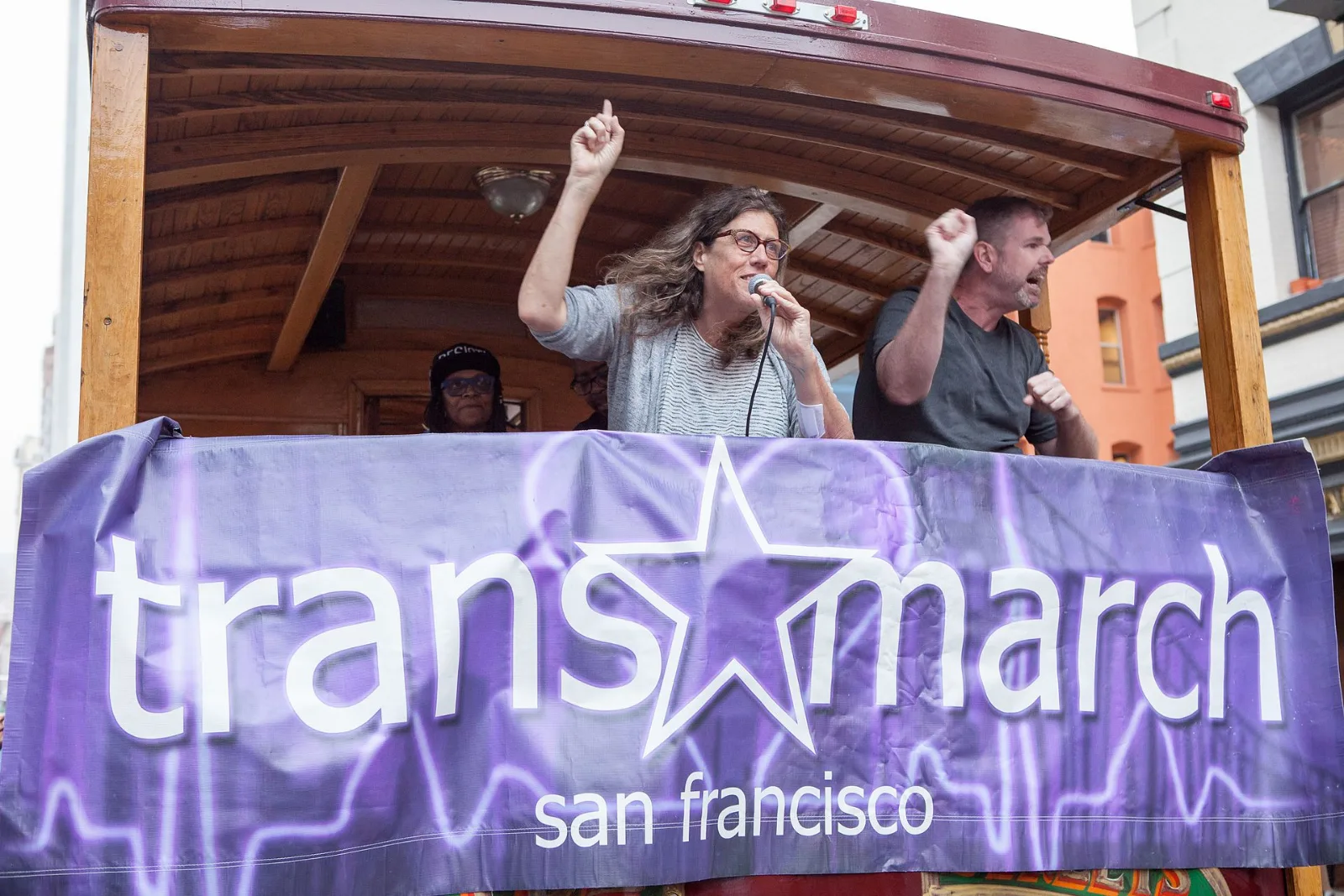
- Susan Stryker speaking at Trans March San Francisco, 23 June 2017. Stryker is named as a member of Transgender Nation and is the source of the 1992 founding date this entry records as disputed. [23][10] · Credit: Pax Ahimsa Gethen, CC BY-SA 4.0, via Wikimedia Commons · Wikimedia Commons
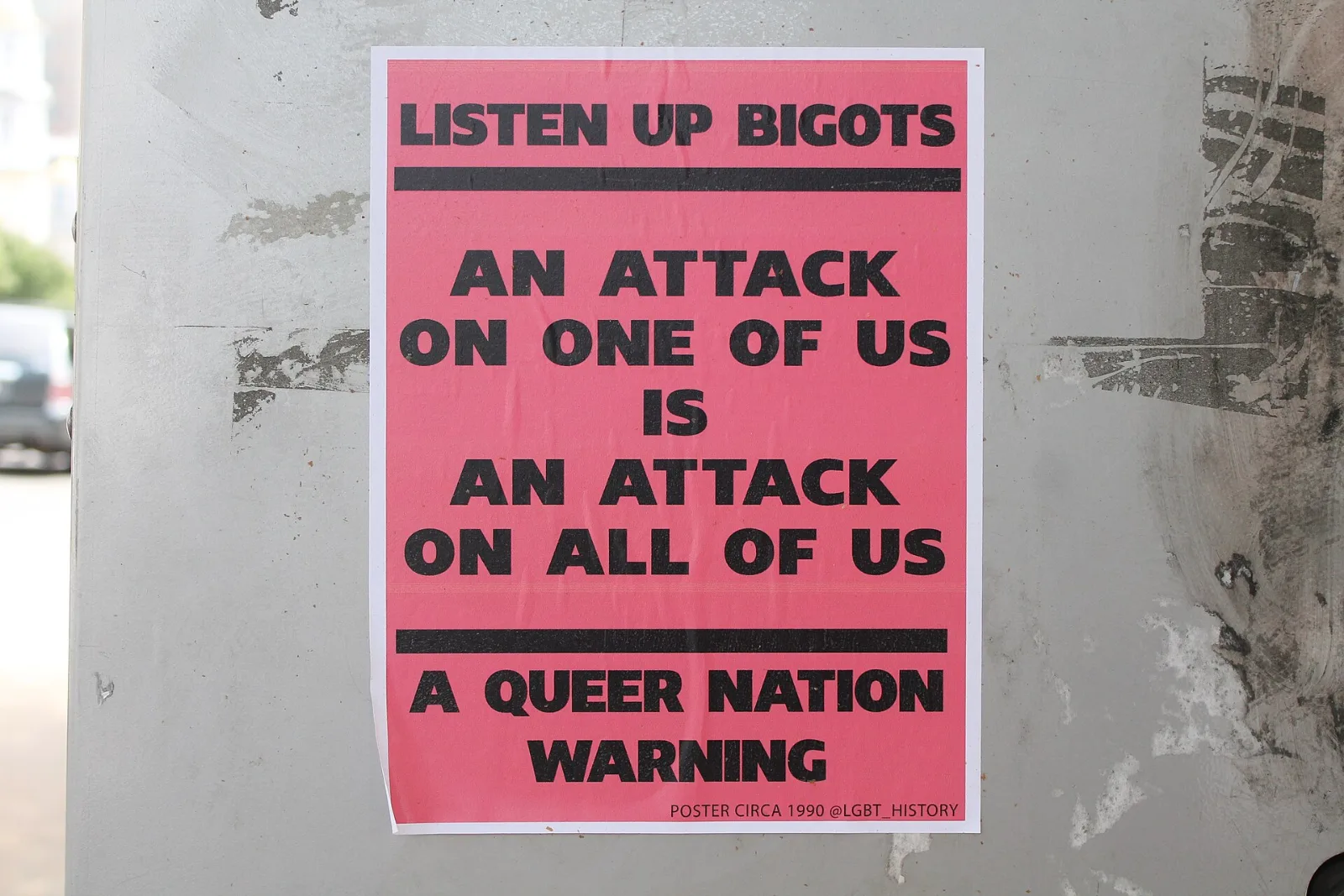
- A Queer Nation poster, photographed at Lafayette Park, Washington DC, on 11 August 2018: "LISTEN UP BIGOTS AN ATTACK ON ONE OF US IS AN ATTACK ON ALL OF US A QUEER NATION WARNING." The photographer dates the poster itself to circa 1990. [22] · Credit: Elvert Barnes, CC BY-SA 2.0, via Wikimedia Commons, from Flickr · Wikimedia Commons
- A modern schematic of the same badge system, redrawn for legibility. Not a period artifact. [19] · Credit: Schematic by Max, from a Holocaust museum exhibit. CC BY-SA 4.0, via Wikimedia Commons · Wikimedia Commons
- The same badge system in a chart held by the United States Holocaust Memorial Museum; public domain. [19] · Credit: United States Holocaust Memorial Museum; public domain, via Wikimedia Commons · Wikimedia Commons