Anarcha-Queer Flag
Political / Protest Flag · Documented from June 2003 to 2021
The anarchist flag halved diagonally, pink for Queer liberation against black for anarchism, the pink taken from the pink triangle and the pink flags. [1] No designer, creation date or place of creation is documented. Its earliest documented use is the Pittsburgh Gay Pride parade on 21 June 2003, photographed by an Indymedia contributor, and Flags of the World traces it through Pride marches, anti-war protests and memorial marches to 2021. [2][1]

Key facts
- First documented public use
- In use
- Documented from June 2003 to 2021
- Aspect Ratio
- 3:5 · standard
- Ratio Notes
- No original specification survives. 3:5 is the archive's practical reference reconstruction, not a creator-specified or official proportion; photographs and source renderings show other shapes.
- Represented Identity
- Queer anarchism
Also known as
- Queer anarchist flag
- Anarcha-queer flag
Archive categories Protest and Political Pride Flags
Overview
Flags of the World states the politics the flag stands for: "Queer anarchism, or anarcha-queer, intends to achieve the queer liberation through the Anarchism. As such, it uses the flags which combine black for the Anarchism with pink for the queer liberation, the latter color being borrowed from the pink triangle and/or the pink flags." No designer, date or place of creation is recorded. [1]
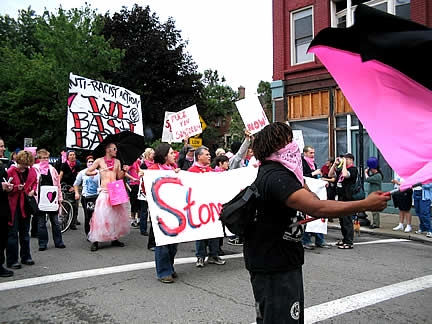
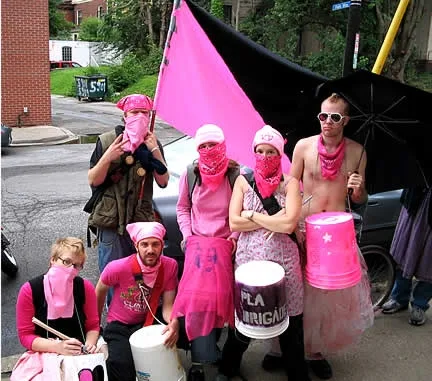
The earliest documented use is the Gay Pride parade in Pittsburgh, Pennsylvania, on Saturday 21 June 2003. The Indymedia contributor TakeWrning photographed it that morning and posted the pictures the same afternoon under the heading "Queer As Fuck!", describing them as "Pictures from Saturday morning's Queer Invasion of the Gay Pride Parade." That is a place of use, not a place of origin. [2]
Identity & Context
- Represented Identity
- Queer anarchism
- Subcommunity
- Queer anarchists, anti-authoritarian Queer activists
- Movement
- Queer anarchism, Queer liberation, anti-state Queer politics
Creators
Creator unknown
No identification located
No designer is documented, and no date or place of creation is recorded. Tomislav Todorović drew the renderings on the Flags of the World page and wrote its text; he is the source's author and illustrator, not the flag's designer. The Wikimedia Commons file was uploaded by the editor Liftarn, which is likewise not evidence of authorship. [1]
Contribute information about who designed this flag.
Origin
Pittsburgh, Pennsylvania, United States (site of first documented use)
Indigenous land context
Seneca, Delaware (Lenape), Shawnee and Mingo peoples — homelands of the region of first documented use. The flag's earliest documented use was in Pittsburgh, which is not a documented place of creation. The University of Pittsburgh's land acknowledgment describes the region as the Seneca's homeland, with Delaware, Shawnee and Mingo peoples also present, and distinguishes the living Nations from the earlier Adena and Hopewell archaeological cultures of the Ohio valley. This entry records that context for the site of first documented use only. [3] [3]
No creation date, place or designer is recorded. The earliest documented use is the Gay Pride parade in Pittsburgh, Pennsylvania, on 21 June 2003, which is a place of use rather than an established origin. [1][2]
Dates & Chronology
- First public use
- Period in Use
- Documented from June 2003 to 2021; current status unknown
Use is not confined to Queer events: Todorović notes the flags "also appear at the other events where their users participate," and the record bears that out, with anti-war protests, memorial marches and international women's day demonstrations alongside the Pride parades. [1]
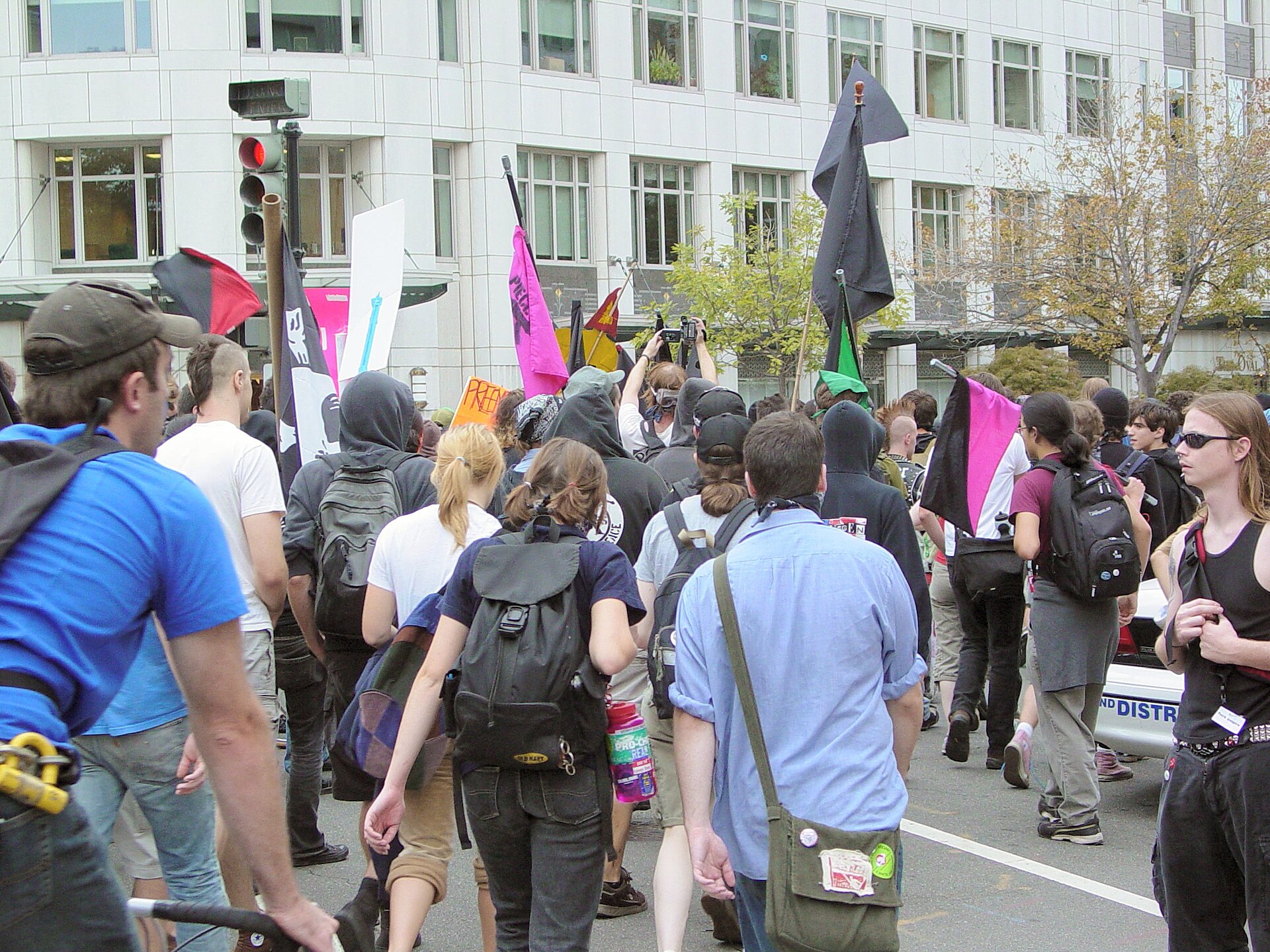

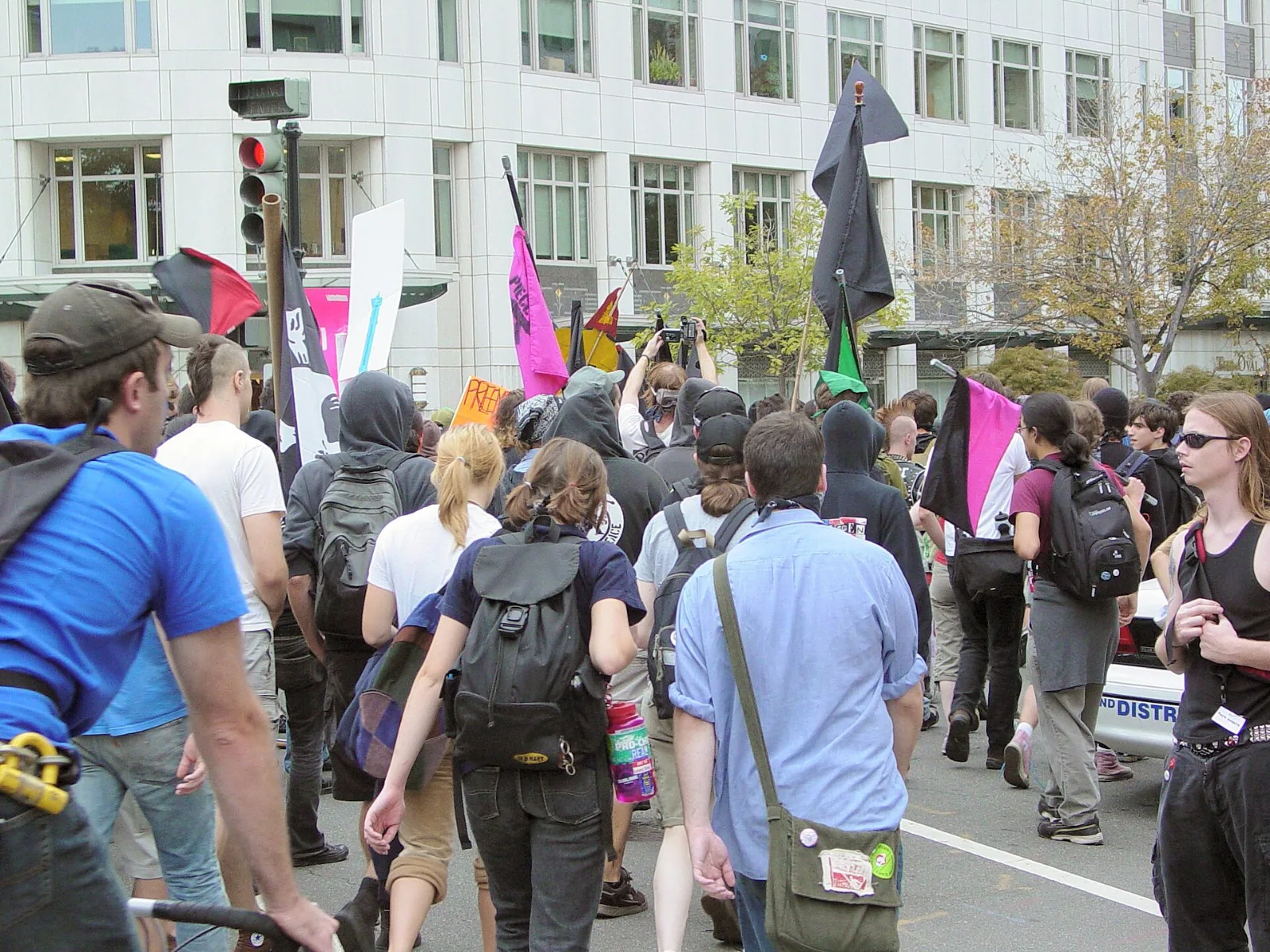
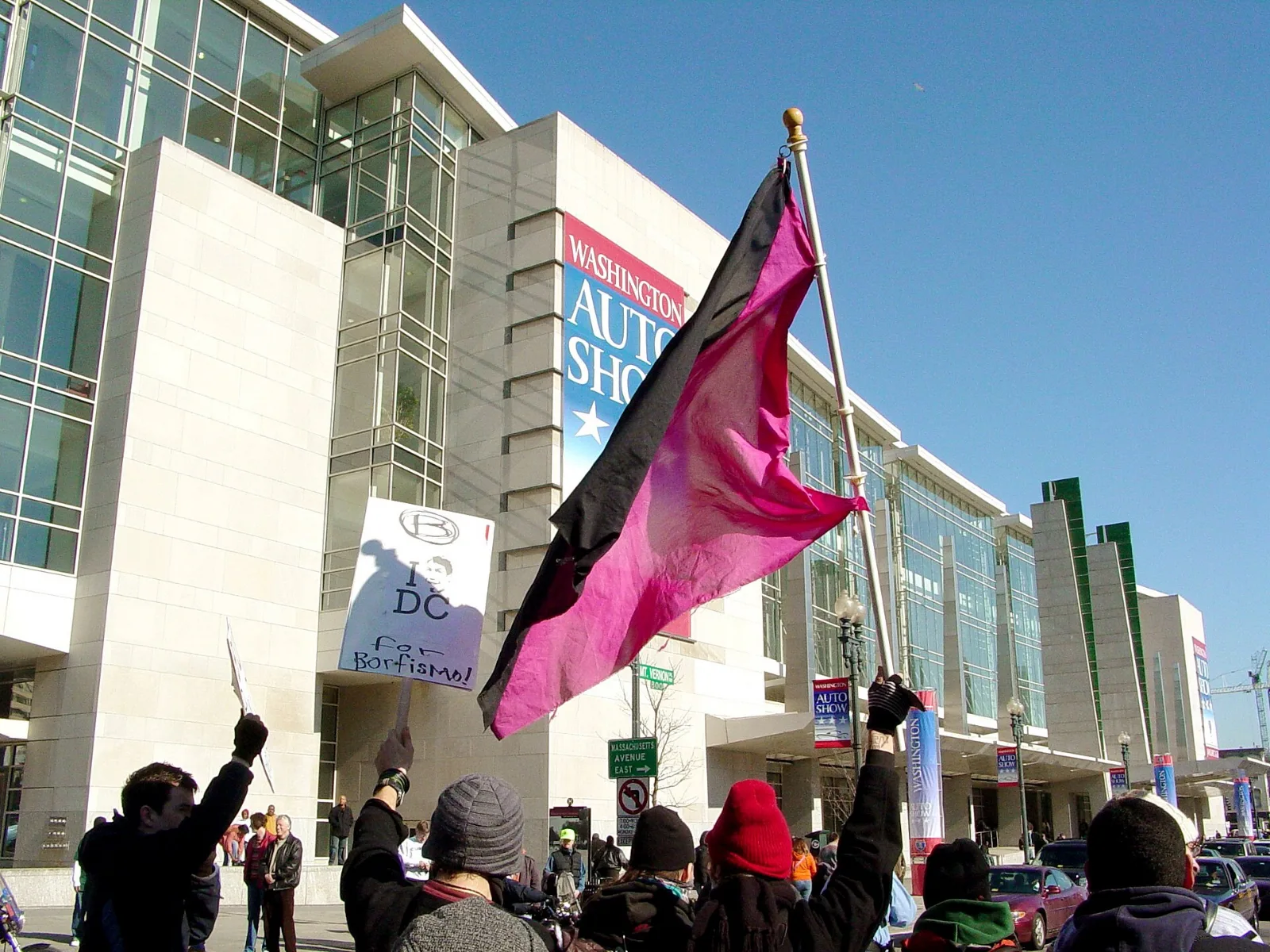
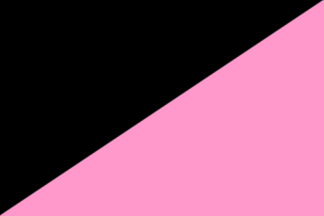
The earliest recorded flag, at Pittsburgh Gay Pride in 2003, was parted from top hoist to bottom fly with black above pink. The same form appeared at anti-war protests in Washington DC on 24 September 2005 and again on 27 January 2007, and at Bucharest Pride on 7 June 2014, that time alongside several anarcha-feminist flags. [1]
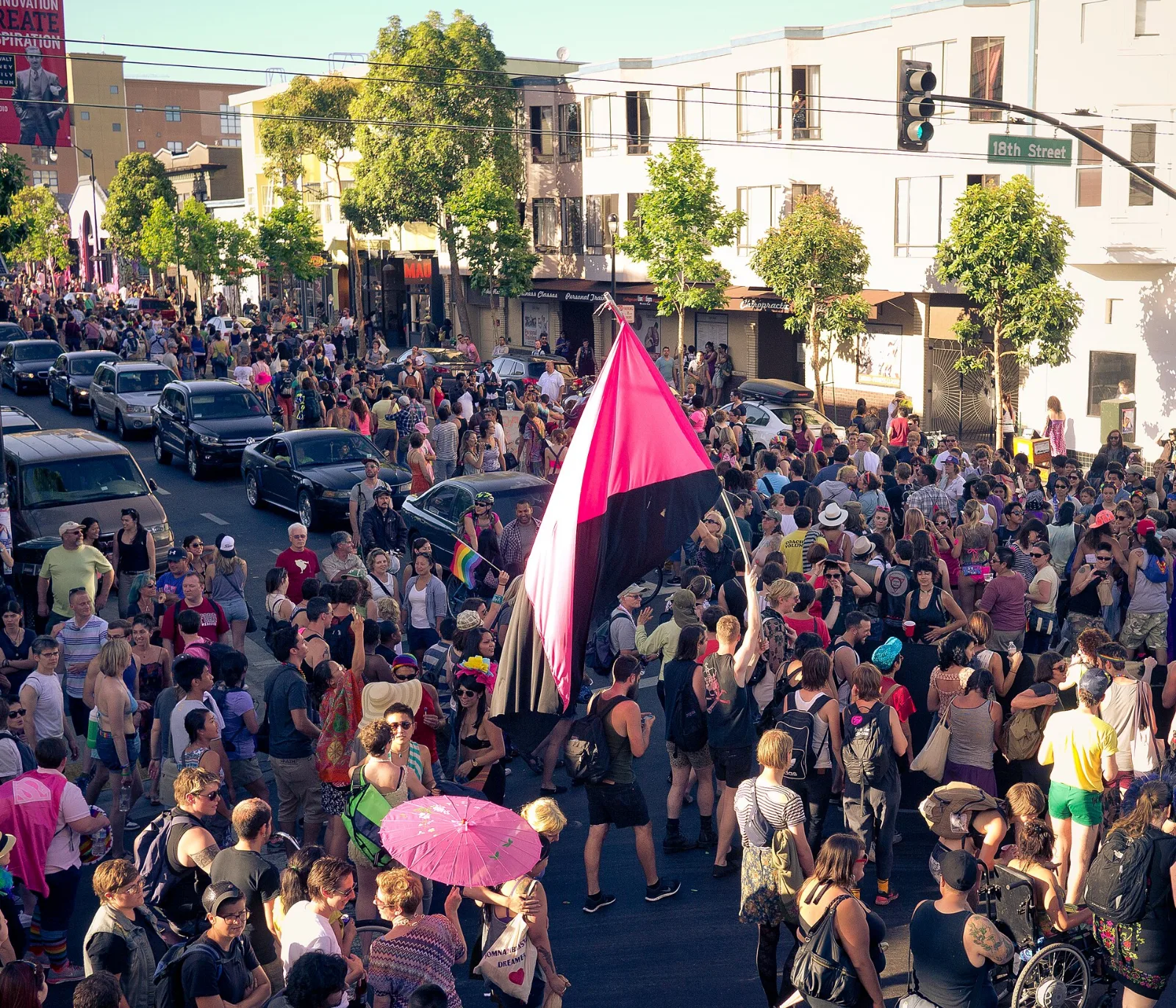
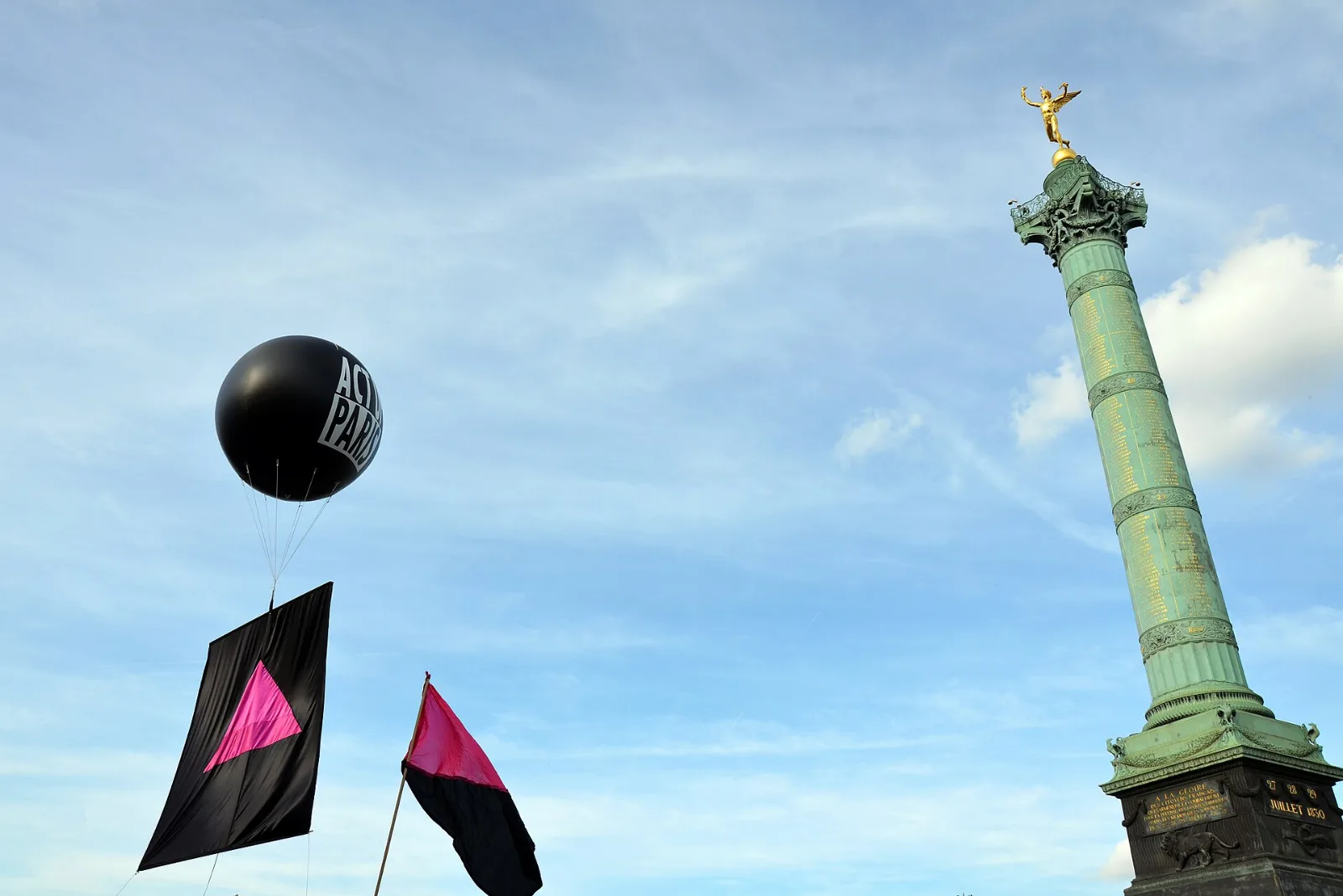
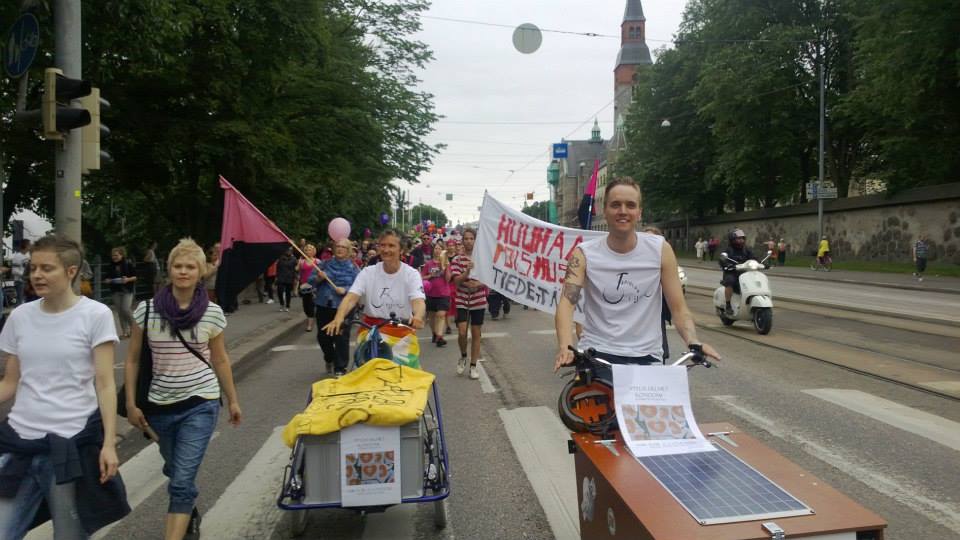
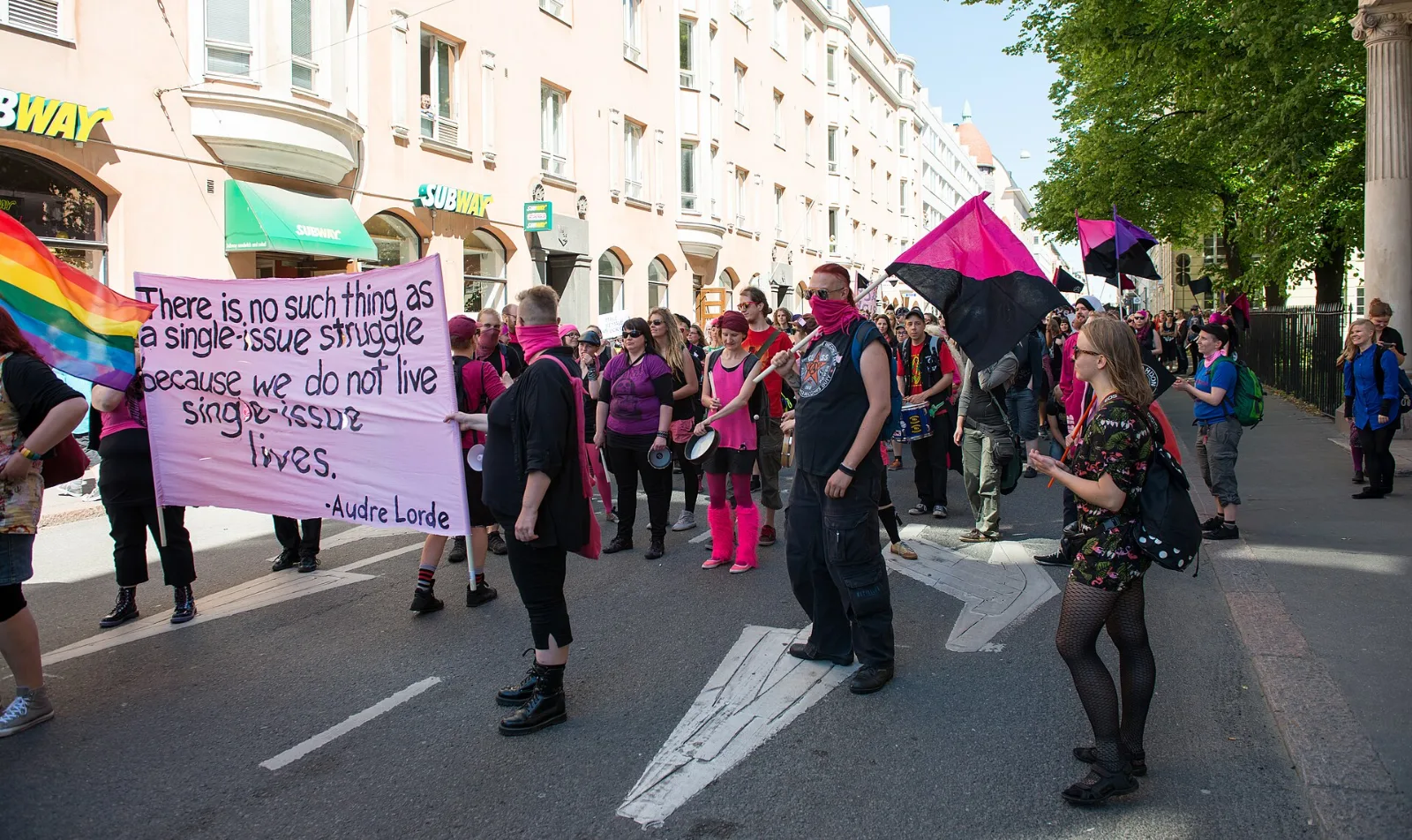
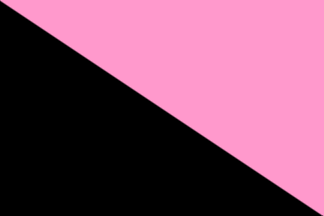
The arrangement Todorović describes as "much more frequently used" is pink above black, parted from bottom hoist to top fly. It is recorded at Southern Maine Pride in Portland on 21 June 2008, the San Francisco Dyke March and Paris Gay Pride both on 29 June 2013, Helsinki Pride on 2 July 2013 and again on 28 June 2014, Haifa Pride on 30 June 2017 and again on 28 June 2019, the Queer May Festival in Kraków on 19 May 2018, and the Pink/Sort Blok demonstration held alongside Copenhagen Pride on 18 August 2018. [1]
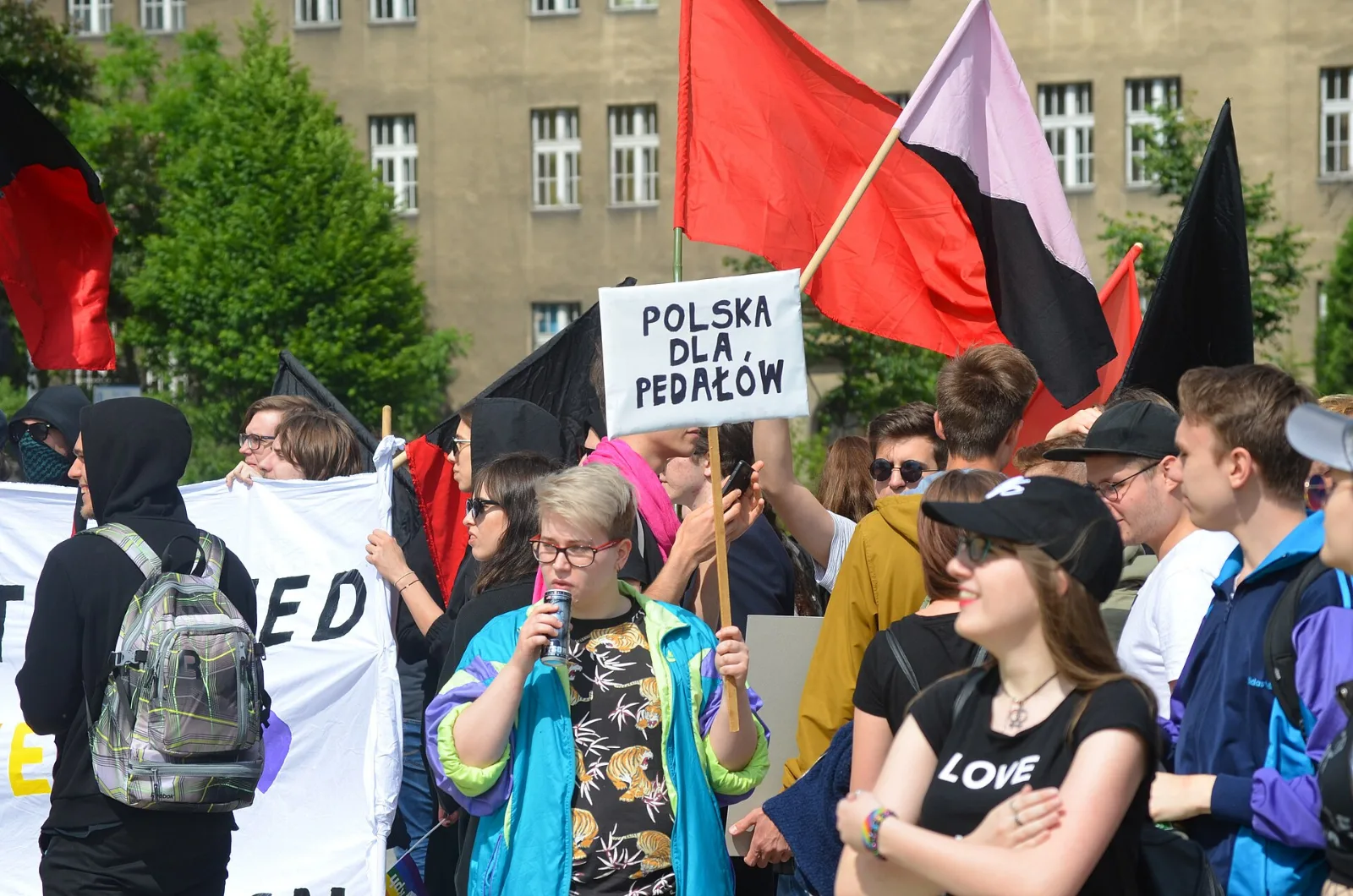
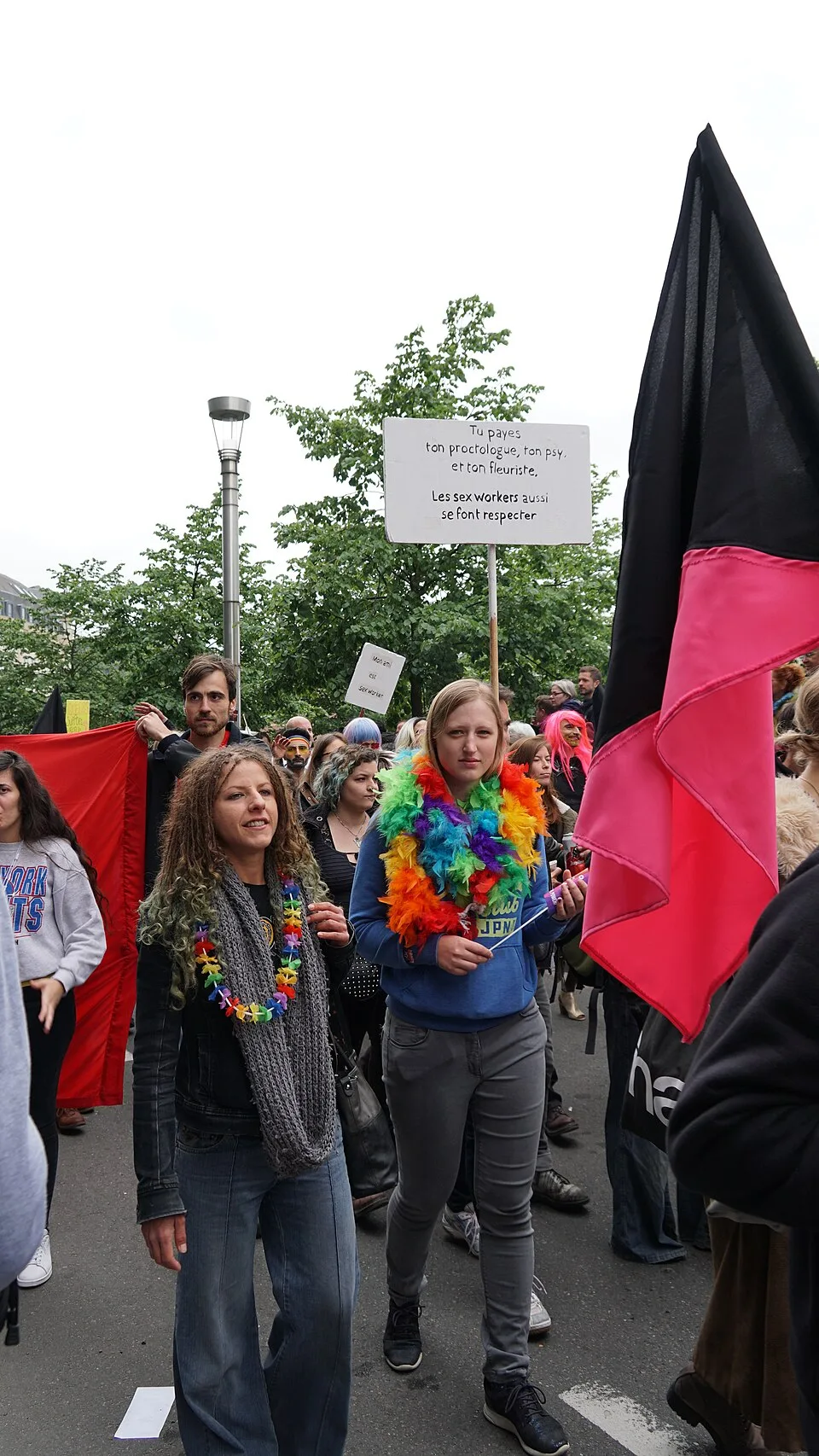
Black above pink, parted from bottom hoist to top fly, is recorded at the Moscow demonstration "For Russia without the Inquisition" on 24 November 2012, at the 8 March demonstration in Ankara in 2013, at the Boris Nemtsov memorial march in Moscow on 1 March 2015, and at Belgian Pride in Brussels on 19 May 2018, where it flew with an anarcho-syndicalist flag. Pink above black parted from top hoist to bottom fly is recorded at Mexico City Pride on 28 June 2014, at the pro-Palestinian protest by LGBT activists during Tel Aviv Pride in 2018, and among anarchists in Warsaw in 2018 and 2021. [1]
No arrangement is standard. All four combinations of partition direction and colour order are recorded, and a fifth form drops the diagonal altogether. No source read here treats the choice as carrying separate meaning. [1]
Lineage
- Related flags
- Rainbow Pride Flag
No parent is documented. The design belongs to the anarchist practice of halving the black flag with a second colour for a particular current, alongside anarcho-communist and anarcho-syndicalist black and red, anarcha-feminist black and purple, and green anarchist black and green. The plain black anarchist flag is not a Pride flag and has no record here, so no parent edge is drawn; nothing in the sources establishes a specific formal ancestor for this design. [1]
Two variants descend from it, each keeping the black half and the diagonal partition while replacing the pink half: the rainbow variant and the transgender variant. [1]
Lineage tree
Every record reachable from this one through documented parent and child relationships: 3 records across 2 generations.
- This record
- Anarcha-Queer Flag
Colors & Symbolism
Black for anarchism and pink for Queer liberation, the pink taken from the pink triangle and from the pink flags. Flags of the World states the derivation of the colour in those terms. [1]
| Colour | Hex | Meaning |
|---|---|---|
| Black | #000000 | Anarchism. |
| Pink | #FF99CC | Queer liberation, the colour borrowed from the pink triangle and the pink flags. |
Working reference values, not a historical specification [1]
Flags of the World gives the derivation of the pink and nothing further: it is "borrowed from the pink triangle and/or the pink flags" of Queer liberation. No maker's statement of meaning has been located. The design belongs to the anarchist practice of halving the black flag with a second colour for a particular current, alongside anarcho-communist and anarcho-syndicalist black and red, anarcha-feminist black and purple, and green anarchist black and green. Anarcha-feminist flags were carried beside these at Bucharest Pride in 2014. No source read here sets that scheme out as a system, or states that pink was chosen to contrast with it. [1]
No historical specification exists for either colour. The values above are working references for reproduction: black as the practical digital standard, and the pink sampled from the Flags of the World rendering, which uses approximately #FF99CC. The Wikimedia Commons file has carried other pinks across its revisions. No source records the unknown maker choosing any particular value. [1][4]
Design
- Aspect Ratio
- 3:5 · standard
- Ratio Notes
- No original specification survives. 3:5 is the archive's practical reference reconstruction, not a creator-specified or official proportion; photographs and source renderings show other shapes.
- Orientation
- horizontal
- Layout
- diagonal_bisection
A rectangular flag divided by a single diagonal into a pink field and a black one. All four combinations of partition direction and colour order are documented and none is standard. The earliest recorded flag, Pittsburgh 2003, was parted from top hoist to bottom fly with black above pink; the arrangement of pink above black, parted from bottom hoist to top fly, is the one Flags of the World describes as much more frequently used. Black above pink parted from bottom hoist to top fly, and pink above black parted from top hoist to bottom fly, are both also recorded. [1]
A fifth form drops the diagonal: a horizontal bicolour of black over pink, following the non-diagonal anarcho-syndicalist flag. Recorded once, at Stockholm Pride on 2 August 2008. [1]
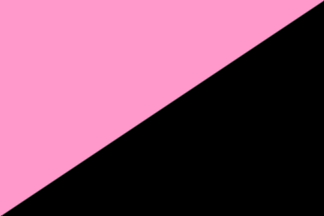
A rectangular flag divided by a single diagonal into a pink half and a black half. Four combinations of partition direction and colour order are documented and none is standard. The flag drawn here is parted from top hoist to bottom fly with black above pink, the arrangement of the earliest documented example, Pittsburgh 2003. [1]
Usage & Adoption
- First Users
- Queer anarchist activists (Pittsburgh, 2003, per Indymedia documentation)
- Geographic Usage
- United States (Pittsburgh 2003; Washington DC 2005 and 2007; Portland, Maine 2008; San Francisco 2013), Sweden (Stockholm 2008), Russia (Moscow 2012 and 2015), Turkey (Ankara 2013), France (Paris 2013), Finland (Helsinki 2013 and 2014), Romania (Bucharest 2014), Mexico (Mexico City 2014), Israel (Haifa 2017 and 2019; Tel Aviv 2018), Poland (Kraków 2018; Warsaw 2018 and 2021), Denmark (Copenhagen 2018), Belgium (Brussels 2018)
- Online Usage
- Anarchist and Queer anarchist forums and social media
- Event Usage
- Pittsburgh Gay Pride parade, June 2003, the earliest use recorded, Washington DC anti-war protests, 24 September 2005 and 27 January 2007, Stockholm Pride, 2 August 2008, Southern Maine Pride, Portland, 21 June 2008, Moscow demonstration "For Russia without the Inquisition", 24 November 2012, San Francisco Dyke March and Paris Gay Pride, both 29 June 2013, Helsinki Pride, 2013 and 2014, Bucharest Pride 2014, alongside anarcha-feminist flags, Mexico City Pride, 28 June 2014, Boris Nemtsov memorial march, Moscow, 1 March 2015, Haifa Pride, 2017 and 2019, Queer May Festival, Kraków, 19 May 2018, Belgian Pride, Brussels, 19 May 2018, Pink/Sort Blok demonstration alongside Copenhagen Pride, 18 August 2018, Pro-Palestinian protest during Tel Aviv Pride, 2018
- Current Status
- active
Carried by individuals and collectives rather than adopted by any organisation, and not confined to Queer events: it appears at anti-war protests, International Women’s Day marches and a memorial march, usually alongside other anarchist flags. [1]
Image Archive
Documented Use

.jpg)

.jpg)
.jpg)

.jpg)
Variants


Discourse & Debates
- The relationship between the anarcha-Queer flag (pink/black) and the anarcha-feminist flag (magenta or purple/black) is sometimes debated. Both use the same diagonal bisection format. The choice of pink versus purple signals different political emphases: Queer liberation versus feminist politics, though many activists see these as deeply intertwined.
Common misidentifications
- May be confused with the anarcha-feminist flag, which uses a similar format but with dark magenta or purple (#88008F) instead of pink.
- The pink in the anarcha-Queer flag is sometimes confused with the purple/magenta of the anarcha-feminist flag, especially in low-quality reproductions.
- The flag is sometimes generically labeled as an "anarchist flag" without the Queer-specific context.
"Anarcha-Queer" (sometimes "Queer anarchism" or "anarcho-Queer") describes the intersection of anarchist anti-state politics with Queer liberation. It is distinct from, though related to, anarcha-feminism. The prefix "anarcha-" follows the convention established by anarcha-feminism.
Footnotes & Citations
Sources and footnotes 4 sources
- 1. Anarcha-Queer (Queer Anarchism) — Pink and black flags of Anarchism. Tomislav Todorović. Flags of the World (FOTW) (2022-11-18). Accessed 2026-08-09
- 2. News Queer As Fuck!. TakeWrning. Pittsburgh Independent Media Center (2003-06-21). Accessed 2026-08-10
An open-publishing Indymedia photo report, and the source Flags of the World cites for the flag's earliest recorded use. The site's notice states that unless an author says otherwise its content is free for non-commercial reuse, reprint and rebroadcast.
- 3. Land Acknowledgment. University of Pittsburgh, Office of Sustainability. University of Pittsburgh. Accessed 2026-08-11
The university's land acknowledgment for the Pittsburgh region, cited for the peoples it names and for its distinction between living Nations and earlier archaeological cultures.
- 4. File:Queer anarchism flag.svg. Wikimedia Commons file record. Wikimedia Commons. Accessed 2026-08-11
A Commons rendering of the design, uploaded by the editor Liftarn, at a nominal 600 by 360. Its colour has been revised more than once. Cited as a rendering, not as a specification or an attribution.

Image Sources
- Rendering
- standardized reconstruction at 3:5
- Standardized reconstruction at the archive’s 3:5 reference proportion, rebuilt from clean geometry. · Credit: Encycloflaggia · Design documented by Flags of the WorldRights Archive rendering. The underlying design has no identified designer and no located rights statement. Tomislav Todorović’s own renderings remain his and are credited to him where they appear in the Image Archive.
- "Anarcho flagger." Pittsburgh Gay Pride parade, Saturday 21 June 2003, photographed by the Indymedia contributor TakeWrning and posted the same afternoon under the heading "Queer As Fuck!" with the line "Pictures from Saturday morning's Queer Invasion of the Gay Pride Parade." This is the earliest recorded use of the flag anywhere. [2][1] · Credit: TakeWrning / Pittsburgh Independent Media Center · Pittsburgh Independent Media Center
- "PLA Bucket Brigade," from the same report on the Queer contingent at Pittsburgh Gay Pride, 21 June 2003. [2] · Credit: TakeWrning / Pittsburgh Independent Media Center · Pittsburgh Independent Media Center
- Anti-war protest, Washington DC, 24 September 2005, in the black-above-pink form. Ben Schumin's caption reads "The Black Bloc continues on its march." Flags of the World cites this photograph as the second recorded use of the flag anywhere. [1] · Credit: Ben Schumin, CC BY-SA 2.5 · Wikimedia Commons
- Radical youth feeder march heading for the main anti-war rally, passing the Washington Convention Center, 27 January 2007. Photographed by Ben Schumin. [1] · Credit: Ben Schumin, CC BY-SA 2.5 · Wikimedia Commons
- San Francisco Dyke March, 29 June 2013, in the pink-above-black form parted from bottom hoist to top fly, the arrangement Flags of the World records as much the more frequent. Photographed by Braden Kowitz. [1] · Credit: Braden Kowitz, CC BY-SA 2.0 · Wikimedia Commons
- Marche des Fiertés, Paris, 29 June 2013. Wikimedia Commons files the photograph under Act Up-Paris and under the pink triangle as an LGBTQ symbol, the source the flag's pink is drawn from. Photographed by Vassil, who released it into the public domain. [1] · Credit: Vassil, CC0 1.0 · Wikimedia Commons
- Helsinki Pride, Mannerheimintie, 2 July 2013. Photographed by Tapiolan Kirjasto. [1] · Credit: Tapiolan Kirjasto, CC BY 2.0 · Wikimedia Commons
- Helsinki Pride, 28 June 2014. Wikimedia Commons also files the photograph under Audre Lorde, for the banner carried alongside. Photographed by Tuomas Puikkonen. [1] · Credit: Tuomas Puikkonen, CC BY 2.0 · Wikimedia Commons
- Queer May Festival, Marsch der Gleichheit, Kraków, 19 May 2018. Photographed by Silar. [1] · Credit: Silar, CC BY-SA 4.0 · Wikimedia Commons
- Belgian Pride, Brussels, 19 May 2018, where Flags of the World records the flag flying with an anarcho-syndicalist flag. Photographed by Miguel Discart. [1] · Credit: Miguel Discart, CC BY-SA 2.0 · Wikimedia Commons
- Pink above black, parted from bottom hoist to top fly. Flags of the World describes this arrangement as much the more frequently used of the two, recorded at Southern Maine Pride in 2008 and afterwards in San Francisco, Paris, Helsinki, Kraków, Copenhagen and Haifa. [1] · Credit: Tomislav Todorović / Flags of the World · Flags of the World
- The non-diagonal form: a horizontal bicolour of black over pink, following the non-diagonal anarcho-syndicalist flag. Recorded once, at Stockholm Pride on 2 August 2008. [1] · Credit: Tomislav Todorović / Flags of the World · Flags of the World
- Black above pink, parted from top hoist to bottom fly. The form of the earliest recorded flag, at Pittsburgh in 2003, and of the Washington DC and Bucharest sightings. [1] · Credit: Tomislav Todorović / Flags of the World · Flags of the World
- Black above pink, parted from bottom hoist to top fly. Recorded at Moscow in 2012 and 2015, Ankara in 2013 and Brussels in 2018. [1] · Credit: Tomislav Todorović / Flags of the World · Flags of the World
- Pink above black, parted from top hoist to bottom fly. Recorded at Mexico City Pride in 2014, at the pro-Palestinian protest during Tel Aviv Pride in 2018, and among anarchists in Warsaw in 2018 and 2021. [1] · Credit: Tomislav Todorović / Flags of the World · Flags of the World