PRIDE USA Flag
Rainbow Pride Flag · 1996–2023 documented
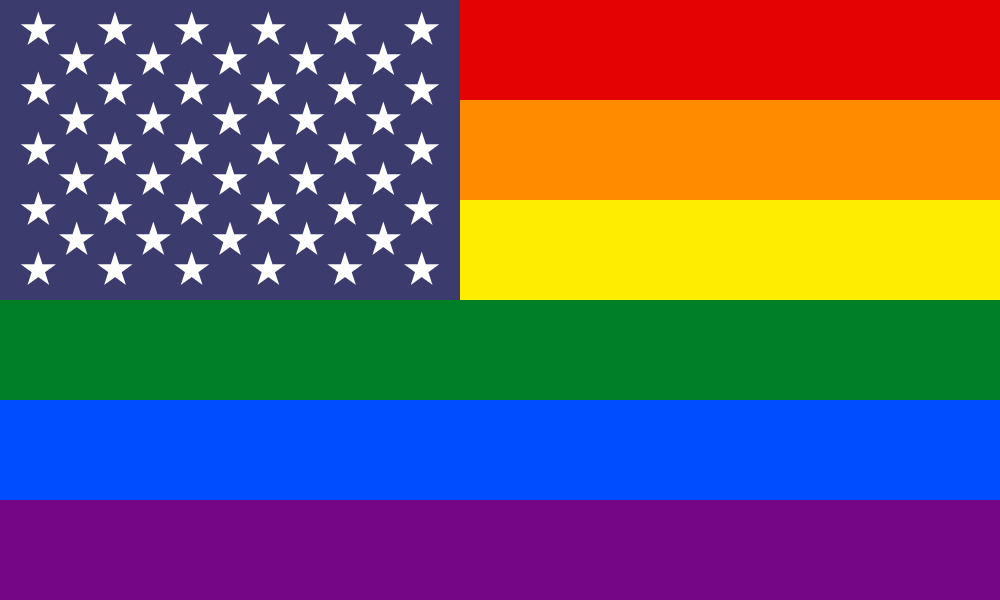
The six-stripe rainbow flag with the blue fifty-star canton of the United States. The exact configuration is documented in writing by May 1996, photographed at a Colorado Rainbow Gathering in 1997, and photographed at Seattle Pride from 2010 onward. [1][2][3] Earlier rainbow-striped United States flags were called New Glory and were reportedly manufactured in California before 1978, but the available sources do not establish that those older flags used this six-stripe construction: the one photograph Flags of the World cites from the older tradition shows thirteen stripes, and a later flag history describes the six-stripe form as the newer of the two. [1][4] No designer is documented.
Key facts
- Designer
- Unknown
- Earliest located written documentation
- Documented circulation
- 1996–2023 documented
- Aspect Ratio
- 3:5 · photographed examples
- Ratio Notes
- 3:5 is Todorović's reading of the photographed manufactured examples, not a published specification. [1] The artwork this entry now shows is an archive reconstruction drawn at that ratio. The rendering the entry previously used is a 534 by 330 pixel WebP, an exact 89:55, with a one-pixel transparent margin and lossy compression throughout. Its stripes fall at exact sixths, but its canton's lower edge sits at about 53.5 per cent of the hoist, roughly a fifth of a stripe below the third stripe boundary, so it does not align with a stripe division as the photographed flags do. Its provenance was never established. Those are measurements of one file, not of the flag.
- Stripes
- 6
- Origin
- United States
Also known as
- Gay pride rainbow flag with a U.S. canton
- Rainbow flag with United States canton
Status Variant
Archive categories Rainbow Pride Flags · Regional and Language-Specific Pride Flags
Overview
No occasion, commission or stated purpose for the design is documented.
Rainbow stripes were combined with the United States canton before the rainbow became a Queer symbol, and the older combination is documented under the name New Glory. What is not documented is when the particular six-stripe form on this page first appeared. The sources for the older tradition describe thirteen stripes; the sources for the six-stripe form begin in 1996. Origin sets out that evidence in order. [1][4]
One further antecedent sits inside the Pride flag's own beginning. Of the two flags Gilbert Baker, Lynn Segerblom and James McNamara flew at United Nations Plaza in June 1978, each thirty by sixty feet and dyed in eight stripes, Smithsonian Magazine records that "One of the flags also featured a riff on the United States' national flag, with blue-and-white tie-dyed stars in its upper corner." [5] That flag had eight stripes and hand-dyed stars. It is an antecedent of the idea of a star canton on a rainbow flag rather than a source for this design.
Identity & Context
The design is read by two communities. Under the name New Glory it belongs to the Rainbow Family of Living Light, which Kevin McNamara described in 1999 as an international, non-hierarchical, loose-knit group whose North American gatherings drew twenty to forty thousand people, adding that "It is not a gay organization." [1] In Pride use it is a Queer flag, and Kramer's 1996 notice is the earliest located record of it in that use. [1]
Creators
Creator unknown
No identification located
No located source names the designer of the six-stripe configuration. The flag reaches the record through the people who described it, photographed it and catalogued it, none of whom claims to have drawn it.
The roles are separable. Steve Kramer described the flag for Flags of the World on 6 May 1996. James Ferrigan supplied a recollection on 20 August 1999 about pre-1978 production of rainbow-striped United States flags. Kevin McNamara supplied an account of Rainbow Family symbolism on 9 September 1999. Tomislav Todorović surveyed the photographic record and the shade variants in 2023. [1] Paramount Flag Company of San Francisco and Colors of the Wind of Santa Monica are the two firms Ferrigan names as makers, and manufacture is not authorship. [1][4] Željko Heimer, António Martins-Tuválkin and Tomislav Todorović drew and revised the renderings on the Flags of the World page; they are image makers, not the flag's designers. [1]
Ferrigan's connection to the trade is documented independently of his recollection. The GLBT Historical Society records that in the 1970s he became a salesman with the Paramount Flag Company in San Francisco and was retail manager of its Polk Street outlet, the Flag Store, where he worked closely with the store's window dresser, Gilbert Baker. [6] That establishes his experience of what Paramount sold. It does not establish the date or the construction of this flag, and his later authentication of the surviving 1978 flag fragment bears on that flag, not on this one.
Contribute information about who designed this flag.
Attribution
- Primary Designer
- Unknown
Origin
- Country
- United States
- Origin Type
- conceptual/cultural
- Physical Origin Status
- Place of design undocumented
The United States is the flag's subject rather than a documented place of design, so the record carries the country and no locality and the origin type is set to conceptual. No source places the design anywhere. [1]
The evidence runs in a definite order, and the order matters more than any single item in it.
The earliest located documentation of this configuration is one sentence. Writing to Flags of the World on 6 May 1996, Steve Kramer recorded that "The gay pride rainbow flag with a U.S. canton is an often seen variation." [1]
Three years later, on 20 August 1999, James Ferrigan wrote that rainbow-striped United States flags "were a regular production item at the Paramount Flag Co. before 1978 and the subsequent adoption of the rainbow as a symbol of Gay Pride", that they were popular with the "Rainbow Children" and similar countercultural groups, that they were used at Rainbow Gatherings, that they were also made by Colors of the Wind in Santa Monica in the 1970s, and that the design "is called 'New Glory' and predated the 'Gay Nation' rainbow by at least six years, probably longer." [1]
Ferrigan's account is a recollection from someone who worked at the firm he names, written roughly two decades after the production he describes. It comes with no catalogue, invoice, surviving labelled example, construction sheet or dated photograph, and it does not describe a stripe count. His own parenthesis that the Colors of the Wind version "started with a purple stripe" indicates that more than one construction was made. [1]
What the older flags looked like is documented, and it is not this. Kevin McNamara pointed readers to the Rainbow Family's 1987 gathering photographs as showing New Glory in use, but Todorović checked them and reported that the flag there "actually displays the flag with a different field - seven colored (pink and six rainbow colors) and six white stripes", thirteen stripes rather than six. He located the six-stripe field instead at the 1997 Colorado summer regional gathering. [1] Pete Loeser's flag history makes the same division explicitly, describing an older New Glory of about 1970 whose thirteen stripes are the national flag's recoloured, and a newer flag in which "these thirteen stripes have been replaced with only the six colored stripes of the Gay Movement." [4]
The older New Glory tradition is a documented antecedent to the six-stripe Pride version, but the surviving sources do not establish when the exact six-stripe construction first appeared.
Dates & Chronology
- Earliest located written documentation
- Documented circulation
- 1996–2023 documented
- Creation Bounds
- Undated as a design. The earliest located documentation, Steve Kramer's note of 6 May 1996, already calls the flag an often seen variation, so it was in circulation before that date rather than originating at it; the date marks the record, not a debut, a first display or an adoption. [1] The earliest located photograph of this exact construction is from the 1997 Colorado summer regional Rainbow Gathering, and the earliest located photograph of it at a Pride event is from Seattle on 27 June 2010. [2][3] Rainbow-striped United States flags are reported in production before 1978, but under a different construction; see Origin.
The chronology of the six-stripe form runs as follows.
6 May 1996. Steve Kramer describes the gay Pride rainbow flag with a U.S. canton as an already familiar variation. [1]
1997. A photograph from the summer regional Rainbow Gathering held outside Fairplay, Colorado, in Pike National Forest at the base of the Buffalo Peaks, shows the flag hung vertically from a line strung between aspens at the Phatter Platter kitchen. Six coloured bands run its length with no white between them, and the canton spans the first three. This is Rainbow Family circulation, not Pride use. [2]
20 August 1999. Ferrigan supplies his account of the older New Glory tradition and its two manufacturers. [1]
9 September 1999. McNamara records a Rainbow Family reading of the stars and the coloured stripes. [1]
1999. Sean Patrick Campbell makes his magenta-canton variation. [7]
June 2000. The Twilight Guard gallery says Campbell's version appeared as a graphic element in the Pride edition of the Gay and Lesbian Times. [7]
27 June 2010. Louis S photographs the blue-canton design at Seattle Pride at 1.20 in the afternoon, carried on a pole among body-painted cyclists on the parade route. This is the earliest located photograph of the flag at a Pride event. [3]
2010 to 2023. Todorović cites fifteen Seattle photographs across three concurrent shade variants, and six more of a further variant whose canton stars are violet. [1]
2023. Todorović synthesises the photographic evidence on Flags of the World, correcting the earlier identification of the 1987 gathering flag. [1]
The design sits at the head of a large family of United States flag variants recorded on the same Flags of the World page. Steve Stringfellow reported from the Halsted Street Market Days in Chicago on 16 August 1999 a version keeping the white stripes and colouring only the red ones. Others replace the stars with pink triangles, colour the canton stars violet, put the rainbow on the thirteen-star Betsy Ross flag, on the First Navy Jack, on the United States yacht ensign, and on the Gadsden flag with its rattlesnake and the words DONT TREAD ON ME. [1]
Two of those carry their own precedence claims, and neither is about this flag. António Martins-Tuválkin wrote in 2007 that the rainbow First Navy Jack "already existed before the creation, in 1978, of the Gay Pride Rainbow Flag", and Ferrigan wrote in 2011, of the variant that recolours the national flag's own thirteen stripes, that "This is not a new variant, and its origins predate the gay use of the rainbow." [1] Both statements concern thirteen-stripe designs.
Lineage
- Indirect influences
- Original Rainbow Flag (1978), Rainbow Pride Flag
- Direct children
- Gay USA Pride Flag (Campbell)
Two components meet in this flag, and the relationship to each is of a different kind.
The canton is the fifty-star union of the flag of the United States, whose own construction is prescribed: Executive Order 10834 fixes thirteen stripes, a union of white stars on blue, and proportions set out in an attachment made part of the order. [8] This flag takes the union and leaves the rest, so the national flag is a component source rather than an ancestor.
The six stripes, red at the top through violet at the bottom, are the sequence of the 1979 six-stripe rainbow flag. That relationship is read off the construction, not from any statement by a designer, and the chronology cuts against treating it as simple descent: rainbow-striped United States flags are reported in production before 1978, and the thirteen-stripe New Glory form is documented earlier than the six-stripe one. The relationship is recorded here as an inferred structural one in the influence layer rather than as documented parentage, which is also why this entry carries no list of sibling flags: it does not share a documented parent with the other rainbow variants. [1][4]
The pre-1978 New Glory tradition is a documented historical antecedent whose exact construction is unresolved. The tie-dyed star canton on one of the two 1978 flags at United Nations Plaza is a contextual antecedent of the same idea and not a predecessor of this design. [5]
One later variation is documented. Sean Patrick Campbell recoloured the canton from blue to magenta and changed nothing else, dated by the Twilight Guard gallery to 1999 and printed in the June 2000 Pride edition of the Gay and Lesbian Times. That gallery calls the blue canton "the traditional" one and Campbell's the variation, which settles the direction between the two, and describes this design as a symbol that "has been seen used by the gay community for years" before his, giving neither a date nor a designer. [7]
Lineage tree
Every record reachable from this one through documented parent and child relationships: 2 records across 2 generations.
- This record
- PRIDE USA Flag
- Children
- Gay USA Pride Flag (Campbell)
Colors & Symbolism
No statement of meaning by a designer has been located, for either the six-stripe form or the older New Glory. The recorded readings are community and secondary interpretations, and are given as such below. [1][4]
| Colour | Hex |
|---|---|
| Red | #E40303 |
| Orange | #FF8C00 |
| Yellow | #FFED00 |
| Green | #008026 |
| Blue | #004DFF |
| Violet | #750787 |
| Canton blue | #3C3B6E |
| Stars | #FFFFFF |
Encycloflaggia reconstruction palette, not a historical specification
- Fifty-star canton
- In Rainbow Family use, and of New Glory rather than of this construction specifically, Kevin McNamara reported in 1999 that the canton of stars "represents all of the constellations - united, or the U.S. depending on who you talk to." [1]
- Rainbow stripes
- In the same 1999 account, "The stripes of many colors represent all of the tribes of the earth", the whole conveying "that all of the different peoples or tribes can come together in peace and harmony." [1]
Both readings come from Kevin McNamara's Flags of the World contribution of 9 September 1999 and describe the Rainbow Family's use of New Glory. McNamara was reporting a community understanding, not a designer's intention, and the flag he was describing is the older tradition rather than this construction. [1]
A separate and later reading belongs to Pete Loeser, who writes that the newer six-stripe form "basically adds a familiar blue canton of 50 stars to the Gay Pride flag to stress that equal rights for gays and lesbians are crucial in all 50 states." That is a secondary interpretation offered by a flag historian, not creator testimony. [4]
No designer-issued palette has been located, and manufactured flags do not hold to one: Todorović separates at least three shade variants photographed concurrently in one city, and records that the canton colour varies as well. [1]
The values above belong to the archive's own reconstruction and are the project's conventional six-stripe reference colours with the blue commonly rendered for the national flag's canton. They are a drawing decision, not a historical specification.
Measured separately, and kept separate: the rendering the entry previously showed gives dominant flat-area values of #E40203 red, #FE8D00 orange, #FFED00 yellow, #008025 green, #004DFF blue, #750787 violet, about #3C3B6C in the canton and #FFFFFF stars. Those are measurements of a lossy, partially transparent file of unestablished provenance, and the same flat areas also carry #FD8D00, #FEEE00, #017F25, #008023, #004EFE, #004EFC, #730985 and #3E3D6D. Their closeness to familiar digital Pride and United States values is an inference that the compression makes it impossible to test.
Design
- Aspect Ratio
- 3:5 · photographed examples
- Ratio Notes
- 3:5 is Todorović's reading of the photographed manufactured examples, not a published specification. [1] The artwork this entry now shows is an archive reconstruction drawn at that ratio. The rendering the entry previously used is a 534 by 330 pixel WebP, an exact 89:55, with a one-pixel transparent margin and lossy compression throughout. Its stripes fall at exact sixths, but its canton's lower edge sits at about 53.5 per cent of the hoist, roughly a fifth of a stripe below the third stripe boundary, so it does not align with a stripe division as the photographed flags do. Its provenance was never established. Those are measurements of one file, not of the flag.
- Orientation
- horizontal
- Stripe Count
- 6
- Layout
- horizontal stripes with canton
- Stripes (Top → Bottom)
- red, orange, yellow, green, blue, violet
- Additional Symbols
- fifty white stars on a blue canton
Six equal horizontal stripes, red at the top through violet at the bottom, with a blue rectangular canton in the upper hoist carrying fifty white five-pointed stars. The stars are in nine staggered horizontal rows alternating six and five, which is the arrangement of the national flag's fifty and gives thirty stars in the six-star rows and twenty in the five-star rows.
In the 2010 Seattle photograph the canton's lower edge meets the top of the green stripe, so it spans exactly the first three of the six. The 1997 Colorado photograph, hung vertically, shows the same span. [2][3]
No official construction sheet or maker's specification has been located. Todorović records the ratio of the photographed flags as typically 3:5 and repeats it for each shade variant he distinguishes, which is read off manufactured flags rather than from a published specification. He also records that the rainbow shades vary between examples and that the canton colour sometimes varies too, distinguishing a version with lighter blue and darker green and violet, another in which those shifted shades appear in the canton as well, and a further one whose canton stars are violet. [1]
The hybrid does not retain the national flag's geometry. Executive Order 10834 prescribes thirteen stripes and a union of white stars on blue, with the proportions of the constituent parts fixed by an attachment made part of the order. [8] This design replaces the thirteen stripes with six and has no comparable specification of its own.
Six equal horizontal stripes in the order red, orange, yellow, green, blue, violet, with the blue fifty-star canton of the flag of the United States set in the upper hoist across the first three.
Usage & Adoption
- Geographic Usage
- Fairplay, Colorado, Seattle, Washington, West Hollywood, California
Image Archive
The design
Discourse & Debates
Common misidentifications
- New Glory is not simply an earlier name for this construction. The name is documented for an older Rainbow Family and countercultural tradition of rainbow-striped United States flags, and the one photograph Flags of the World cites from it shows seven coloured and six white stripes. Pete Loeser's flag history distinguishes the two forms in the same terms. [1][4]
- Distinct from the Gay USA Pride Flag (Campbell), which is this design with the canton in magenta rather than blue. The Twilight Guard gallery describes the blue as the traditional field and Campbell's magenta as the variation. [7]
- Distinct from the variant that keeps the white stripes of the national flag and recolours only the red ones, reported from Chicago in August 1999; and from the variant that recolours all thirteen stripes, which Todorović traces to the Rainbow Family's 1987 gathering in North Carolina. [1]
- A widely circulated photograph of the design worn as a tank-top print is press photography rather than a still from a television production. It is Rodin Eckenroth's picture of the actor Rob McElhenney at the LA Pride Music Festival and Parade in West Hollywood, Getty Images editorial asset 539693380. It shows the design printed on clothing, not a flag being flown, and says nothing about the design's creator. Getty's own metadata dates it inconsistently: the caption dateline reads 12 June, the caption body gives 10 June 2016, and the asset's dateCreated field reads 12 June 2016. [9]
The flag is named differently by the communities that use it. Flags of the World describes it as the gay pride rainbow flag with a U.S. canton; New Glory is the Rainbow Family's name, and belongs in the first instance to the older thirteen-stripe form; the Twilight Guard gallery calls the symbol the Gay USA Pride Flag while illustrating its entry with Campbell's magenta-canton variation. [1][7][4]
Footnotes & Citations
Sources and footnotes 10 sources
- 1. Reference Gay Pride Variations of U.S. Flags - Page 1. Flags of the World contributors (Steve Kramer, James Ferrigan, Kevin McNamara, Steve Stringfellow, António Martins-Tuválkin, Tomislav Todorović); ed. Rick Wyatt. Flags of the World (FOTW) / CRW Flags (last modified 2024-03-23). Accessed 2026-08-14
The substantive record of this flag. Each paragraph is signed and dated, so the page reads as a sequence of datable statements running from 1996 to 2023, including Todorović's 2023 correction of the earlier identification of the 1987 Rainbow Family photograph.
- 2. Image file page Colorado 1997 summer regional gathering photographs. Rob Savoye. Rainbow Family of Living Light Unofficial Home Page (1997). Accessed 2026-08-14
The page is credited to Rob Savoye and its captions are written in the first person; no separate photographer credit is given and no reuse terms are stated. The flag appears in the frame of the Phatter Platter kitchen, which the page's own caption does not mention; Flags of the World cites this page as its evidence for the six-stripe design at a Rainbow Gathering.
- 3. Image file page Seattle Pride 2010 (photograph). Louis S (Flickr account 008subterraneous). Flickr (2010-06-27). Accessed 2026-08-14
Records a capture time of 13:20:44 on 27 June 2010 and is published under a Creative Commons Attribution-NonCommercial-NoDerivatives 2.0 licence.
- 4. Reference Protest and Political Flags of Our Ancestors. Pete Loeser. Historical Flags of Our Ancestors. Accessed 2026-08-14
A secondary flag history that separates the older thirteen-stripe New Glory from the newer six-stripe Pride form in as many words, and offers its own reading of the newer flag's meaning. Useful interpretation, not designer testimony.
- 5. News Long-Lost Fragment of First Rainbow Pride Flag Resurfaces After Four Decades. Nora McGreevy. Smithsonian Magazine (2021-06-16). Accessed 2026-08-14
Cited only for its description of the second of the two flags flown at United Nations Plaza in June 1978, which carried tie-dyed stars in its upper corner.
- 6. Museums & Exhibitions Panel Discussion: Under the Rainbow, How History Is Made. GLBT Historical Society. GLBT Historical Society (2021). Accessed 2026-08-14
Cited only for its biographical note on James Ferrigan, which records that he became a Paramount Flag Company salesman in the 1970s and managed its Polk Street outlet. It establishes his experience of the firm's products, not the date or construction of this flag.
- 7. Designer page Pride and Fetish Flag Gallery. The Twilight Guard. The Twilight Guard. Accessed 2026-08-14 · Archived version
The Twilight Guard's own gallery, which documents Sean Patrick Campbell's magenta-canton variation and, in passing, describes this blue-canton design as a symbol seen in use by the gay community for years before it. The live site is gone; the citation is to the Wayback capture.
- 8. Government Executive Order 10834 - The flag of the United States. Office of the Federal Register. National Archives (1959-08-21). Accessed 2026-08-14
Prescribes thirteen stripes and a union of white stars on blue, and fixes the proportions of the constituent parts by an attachment made part of the order. The codified text on this page does not reproduce the attachment's figures.
- 9. Image file page LA PRIDE Music Festival And Parade 2016 (editorial asset 539693380). Rodin Eckenroth. Getty Images Entertainment (2016-06-12). Accessed 2026-08-14
Cited only to identify a photograph, not for flag history. Rights-managed, editorial use only. Its caption dateline reads 12 June and its caption body 10 June 2016.
- 10. Reference Disclaimers and Copyright. Flags of the World. Flags of the World (FOTW) / CRW Flags (last modified 2023-11-18). Accessed 2026-08-14
The site's reuse terms for contributor material: quote the author, quote the site, alter nothing, stay under five per cent of the site, non-commercial.
Image Sources
- Rendering
- Reconstruction
- Credit: Encycloflaggia reconstruction based on documented examples · Drawn from the construction visible in the 1997 Colorado and 2010 Seattle photographs, at the 3:5 ratio Todorović records · reconstruction
- Archive reconstruction of the six-stripe configuration, drawn at the 3:5 ratio Todorović records for photographed examples, with the canton spanning the first three stripes as the 2010 Seattle photograph shows and fifty stars in nine staggered rows of six and five. It is a rendering made for this entry, not an original file and not an official specification. [1][3] · Credit: Encycloflaggia reconstruction based on documented examples · Flags of the World, Gay Pride Variations of U.S. Flags · reconstruction