Demiboy Pride Flag
Demigender Pride Flag ·
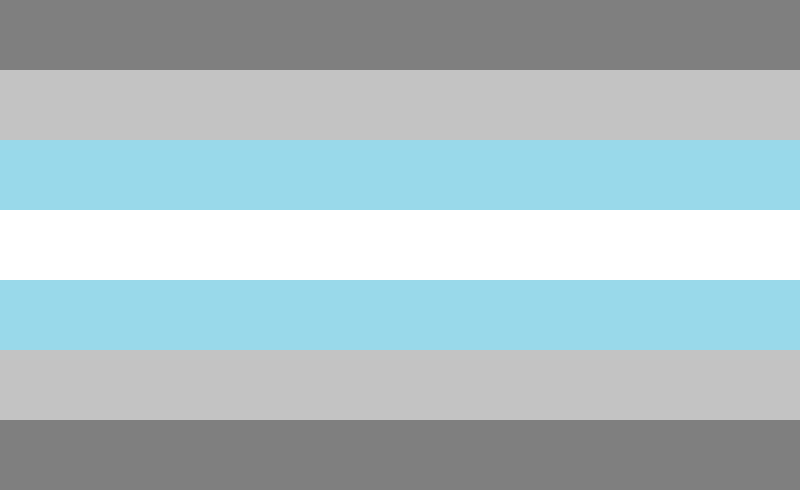
Salem published this design alongside the Demigirl proposal through the Tumblr account transrants on February 18, 2014, originally calling it the Demiguy flag proposal. [1] Its seven-band sequence replaces the companion design's pink with light blue while retaining the same dimensions, stripe boundaries, grays, and white. [1]
Key facts
- Designer
- Salem
- Created
- First published
- In use
- 2014 to the present
- Aspect Ratio
- 3:5 · standard
- Ratio Notes
- Salem's original file is 477 by 336 pixels, about 1.42:1, and no ratio was published for the design. The archive presents its normalized 3:5 rendering at 1000 by 600, scaling the original's unequal stripe boundaries proportionally rather than regularising them into sevenths; the source proportion and depths are recorded in the geometry notes. [1]
- Stripes
- 7
- Represented Identity
- demiboy / demiguy
Also known as
- Demiguy Flag
- Demiboy Flag
Archive categories Gender Identity Pride Flags
Overview
To give demiboy identity its own flag. Salem's post presents the pair as proposals without further statement. [1]
Salem posted this design and the Demigirl proposal together as two flag proposals on February 18, 2014, labelling this one the demiguy flag proposal; "Demiboy" later became the primary title under which the same design circulated. [1] The files have identical dimensions, stripe boundaries, gray bands, and white center; the only color difference is the third and fifth bands, light blue here and pink in the Demigirl version. [1]
A demiboy is someone with a partial connection to masculinity, boyhood, or manhood; the term does not prescribe what, if anything, makes up the rest of a person's gender, and it is used regardless of assigned sex at birth. [2] Salem published the proposals during what they later described as a period of rapid growth in identity language on Tumblr. [3]
Identity & Context
- Represented Identity
- demiboy / demiguy
- Subcommunity
- demigender umbrella
A demiboy is someone with a partial connection to masculinity, boyhood, or manhood, whatever else does or does not make up the rest of their gender. The term is used regardless of assigned sex at birth. The "demi-" vocabulary predates the flag: a 2010 forum post proposed "demiguy" among terms for a partial connection to a gender. [2]
Creators
The Creator
Salem
Designer
Salem published the paired Demigirl and Demiguy flag proposals through the Tumblr account transrants in February 2014, and made the agender flag in the same month. The preserved post supplies both original images and Tumblr's timestamp for the publication. [1] In a 2018 interview Salem used they/she pronouns and gave Staten Island, New York, as their origin. [3]
My name is Salem and I'm from Staten Island NY, and have since lived in almost every borough at some point. I go by they/she pronouns.
From the 2018 Majestic Mess Designs interview.
Tumblr in 2014 (when these flags were created) was seeing a huge influx of identities, pronouns, and other means of personalizing one's identity.
Answering what led them to make the flags.
Motivations
- An effort to increase visibility during a period of rapid identity-term growth on Tumblr. [3]
Attribution notes
Salem designed both proposals and published them through the Tumblr account transrants; the 18 February 2014 post is preserved, with both artwork files, inside a reblog trail, and the blog itself remains live reading "the artist formerly known as transrants." [1] The attribution is confirmed by the preserved post rather than inferred from later reference sites, and the maker of the March 2014 pride buttons credited both designs to transrants. [4] Salem has also been known as Ska and Salem X.
In a December 2018 Majestic Mess Designs interview Salem used they/she pronouns and gave Staten Island, New York, as their origin. Asked about the 2014 flags, Salem described the moment rather than any single design: Tumblr in 2014 "was seeing a huge influx of identities, pronouns, and other means of personalizing one's identity." The interviewer's question grouped four flags together, including druxydeity's deminonbinary recolouring, and the substance of Salem's answer concerns the agender flag. [3]
Origin
- Digital Origin
- Tumblr
Digital origin; no verified physical location.
Published on Tumblr through the transrants account. [1] The physical place where the pair was created is not documented; Salem's later interview gives Staten Island, New York, as their own origin, which does not establish where the artwork was made in February 2014. [3]
Dates & Chronology
- Year Created
- First published
- Period in Use
- 2014 to the present
- Creation Bounds
- Published by Salem through the transrants account on 18 February 2014 at 15:23:33 UTC, the timestamp Tumblr carries for the post holding both the demiguy and demigirl proposals. The timestamp proves publication; the files were created on or before that date, and no source records when they were drawn. [1] This record previously gave 2015, which was the date of a Pride-Flags reupload to DeviantArt rather than of the design. [5]
The paired designs circulated through Tumblr reblogs and were reproduced in later flag guides and community reference resources. [6][2] The earliest documented use is a pair of wearable pride buttons made from the demigirl and demiboy designs on 28 March 2014, credited to transrants. [4] Pride-Flags uploaded later renderings to DeviantArt on July 4, 2015, which explains the incorrect 2015 date repeated by some references. [5]
The flag is one of two proposals Salem posted together on 18 February 2014, the other being the demigirl flag. [1] The deminonbinary flag is a later recolouring of that pair by a different person: Tumblr user druxydeity added a pale-yellow version to the same post on 5 April 2014, prefacing it "i really hope it's not out of my place to make/add this but." All three files share identical pixel geometry, differing only in the third and fifth stripes. [1]
Lineage
- Direct children
- Deminonbinary Pride Flag
- Companion flags
- Demigirl Pride Flag
Companion design to the Demigirl flag: the two were published together in one post on February 18, 2014, and differ only in their third and fifth bands. Druxydeity's Deminonbinary flag followed on April 5 as a recoloring of their shared structure. [1]
Lineage tree
Every record reachable from this one through documented parent and child relationships: 2 records across 2 generations.
- This record
- Demiboy Pride Flag
- Children
- Deminonbinary Pride Flag
Colors & Symbolism
Salem's post presents the two artworks as flag proposals and assigns no meanings to the colors. [1]
| Colour | Hex | Later community reading | Note |
|---|---|---|---|
| Dark Gray | #7F7F7F | Gray areas and partial connection to gender. [7] | The first and seventh bands. Measured from Salem's original 477 by 336 PNG. [1] |
| Light Gray | #C3C3C3 | Gray areas and partial connection to gender. [7] | The second and sixth bands. Measured from the original PNG, and identical in the demigirl proposal. [1] |
| Light Blue | #99D9EA | Masculinity, boyhood, or manhood. [7] | The third and fifth bands, the only values that distinguish this design from Salem's demigirl proposal. Measured from the original PNG. [1] |
| White | #FFFFFF | Agender or nonbinary identity; later sources vary in which they give. [7] | The centre band. Measured from the original PNG. [1] |
The readings in the color table are later community attributions, not Salem's. Later sources read the grays as partial gender connection, the light blue as masculinity, boyhood, or manhood, and the white as agender or nonbinary identity, with sources varying on the white. [7]
Salem did not publish a written color specification. These values are exact samples from the flat-color areas of the original 477 by 336 raster and describe that file rather than a universal production standard. The values that circulate on community reference sites match Salem's file exactly. [1] The demigirl proposal and druxydeity's deminonbinary recolouring share this file's geometry and differ only in the third and fifth stripes, at #FFAEC9 and #FFFFA6 respectively. [1]
Design
- Aspect Ratio
- 3:5 · standard
- Ratio Notes
- Salem's original file is 477 by 336 pixels, about 1.42:1, and no ratio was published for the design. The archive presents its normalized 3:5 rendering at 1000 by 600, scaling the original's unequal stripe boundaries proportionally rather than regularising them into sevenths; the source proportion and depths are recorded in the geometry notes. [1]
- Orientation
- horizontal
- Stripe Count
- 7
- Layout
- horizontal_stripes
- Stripes (Top → Bottom)
- Dark Gray, Light Gray, Light Blue, White, Light Blue, Light Gray, Dark Gray
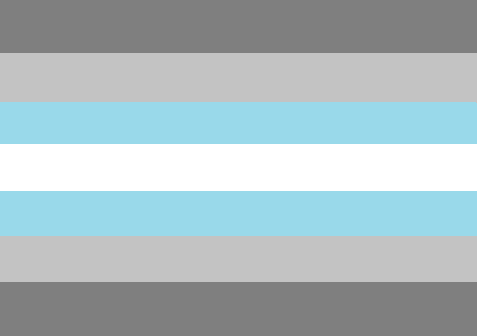
Measured from Salem's original 477 by 336 PNG. The seven stripes are not equal: reading down the centre column their depths are 53, 49, 42, 47, 45, 46, and 54 pixels, beginning at rows 0, 53, 102, 144, 191, 236, and 282, so the outer grays are the deepest bands and the first light blue stripe the shallowest. [1]
Seven horizontal bands in a palindromic sequence: dark gray, light gray, light blue, white, light blue, light gray, dark gray. The colors read symmetrically from the center, but the original raster's stripe depths are slightly unequal. The source file records an image, not a published construction specification. No emblem or additional symbols. [1]
A seven-stripe flag for demiboy identity with a palindromic color sequence. From top to bottom: dark gray (#7F7F7F), light gray (#C3C3C3), light blue (#99D9EA), white, light blue, light gray, dark gray. The original file is 477 by 336 pixels and holds only those four colors, with no anti-aliasing, and stripe depths that vary slightly rather than dividing the canvas evenly. It is the same base artwork as Salem's demigirl proposal with the third and fifth stripes recoloured. [1]
Usage & Adoption
- First Users
- A Tumblr user who made a wearable demiboy pride button from the flag on 28 March 2014, at the same time as a demigirl button, crediting both designs to transrants. [4]
- Geographic Usage
- Internet circulation
- Online Usage
- Circulated through Tumblr reblogs and reproduced in later flag guides and community reference resources. [6][2], Adapted into wearable pride buttons within six weeks of publication. [4]
- Current Status
- active
The earliest documented use is the pair of pride buttons of 28 March 2014, whose maker credited both designs to transrants. [4]
Image Archive
Original Artwork
Archive Reconstruction
In-text images
Discourse & Debates
Common misidentifications
- Salem's post called this the Demiguy flag proposal. The same image later circulated primarily as the Demiboy Pride Flag. [1] Its identifying sequence is dark gray, light gray, light blue, white, light blue, light gray, and dark gray.
- The demiboy and demigirl designs are distinguished only by their light blue or pink interior bands; their dimensions, stripe boundaries, grays, and white are otherwise identical in the preserved source files. [1]
Demiguy is the label Salem's post used for this design; Demiboy is the title under which it now primarily circulates. That is the documented naming history of this flag, not a claim that the identity labels are interchangeable for every person. Demiman appears in the reviewed sources as identity vocabulary rather than as a name for this flag. [1][2]
Footnotes & Citations
Sources and footnotes 10 sources
- 1. Social media transrants, "demigirl & demiguy flag proposals", preserved in a reblog trail. transrants (Salem X). Tumblr (2014-02-18). Accessed 2026-08-14 · Archived version
The post that published both proposals, preserved with Tumblr's own timestamp of 18 February 2014, 15:23:33 UTC, and root post ID 77071883543. It carries both original images at 477 by 336 pixels. The second image is the demiguy proposal, the design this entry documents.
- 2. Demiboy. LGBTQIA+ Wiki. Accessed 2026-03-15
- 3. Interview Interview: Creator of the Agender Flag. Majestic Mess Designs, with Salem. Majestic Mess Designs (2018-12-16). Accessed 2026-08-14
An email interview in which Salem gives their origin and pronouns and describes what prompted the 2014 flags. The four-flag grouping in the interviewer's question includes deminonbinary, which is druxydeity's recolouring.
- 4. Social media demigirl and demiboy pride buttons (root post 80952493576), preserved in the demigenders reblog. Tumblr (2014-03-28). Accessed 2026-08-14
The maker credits both flag designs to transrants. The root blog is deactivated; the handle froakieappreciationblog survives in the post's URL.
- 5. Image file page Demiboy (1). Pride-Flags. DeviantArt (2015-07-04). Accessed 2026-03-18
A later reupload. Its 2015 date belongs to this rendering, not to the design.
- 6. Demiboy. Library.LGBT Pride Flag Guide. Accessed 2026-03-09
- 7. What is the Demiboy pride flag and what does it mean?. Heckin' Unicorn. Accessed 2026-03-31
- Blogs & Personal Sources Demiboy. Pride-Color-Schemes. Pride-Color-Schemes (Tumblr). Accessed 2026-03-09
- Demigender. Nonbinary Wiki. Accessed 2026-03-15
- Demigender. LGBTQIA+ Wiki (Fandom). Accessed 2026-03-18
Image Sources
- Rendering
- 2014 original by Salem (transrants)
- Vector normalization to the archive's 3:5 standard at 1000 by 600, preserving the source file's measured stripe proportions and colour values. [1] · Credit: Encycloflaggia reconstruction after Salem · Normalized from the 2014 original · 477 × 336 · Technical reconstruction; no new rights claimDrawn from measurements of Salem's file, which is published beside it in the Image Archive at its original size and bytes.
- Original Demiguy flag proposal, now commonly called the Demiboy Pride Flag, 477 by 336 pixels, from the 18 February 2014 post carrying both proposals, preserved in a reblog trail after the blog was made private. [1] · Credit: Salem (transrants) · Tumblr · 18 February 2014 · 477 × 336
- Encycloflaggia reconstruction normalized to the archive's 3:5 standard at 1000 by 600, preserving the original's unequal stripe depths rather than regularising them. [1] · Credit: Encycloflaggia reconstruction after Salem · Archive reconstruction · 1000 × 600Rights Technical reconstruction; no new rights claim.