Aromantic Pride Flag
Identity Pride Flag ·
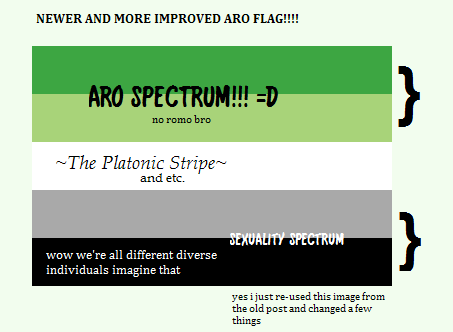
A five-stripe horizontal pride flag in dark green, light green, white, gray, and black, the widely adopted aromantic flag. Cameron Whimsy posted this white-centre version on 16 November 2014, after an anonymous ask pointed out that their earlier yellow-centre design took the colours of Jamaica's flag. [1][2] Whimsy's own post gives the meanings: the greens are the aro-spectrum ("green belongs to us now hell yeah"), the white is the platonic stripe, and the black and grey acknowledge "aro-aces, aromantic allosexuals, and everything in between." [1]

Key facts
- Designer
- Cameron Whimsy
- Created
- First documented public use
- In use
- 2014–present
- Aspect Ratio
- 3:5 · standard
- Stripes
- 5
- Represented Identity
- aromantic
Also known as
- Aromantic Flag
- Aro Pride Flag
- Aro Flag
Status Canonical
Archive categories Sexual & Romantic Orientation Pride Flags
Overview
To provide an aromantic flag that more fully represented the aromantic spectrum and non-romantic forms of love. [2]
The aromantic flag lineage includes an unknown earlier four-stripe design, Cameron Whimsy's February 2014 five-stripe yellow-centre flag, and the November 2014 white-centre version that became the current standard. The yellow-centre version has its own entry. [2][1]
The change is documented in Whimsy's own 2014 posts. On 21 August 2014 Whimsy regrouped the stripe meanings into three bands, colours unchanged. Hours later an anonymous ask objected that the palette took the colours of Jamaica's flag, and Whimsy replied "damnwell that's definitely a problem," proposing a white centre stripe. The dedicated post for the white-centre version followed on 16 November, opening "whoops yeah i just realised i never actually made a proper post for this version of the flag with meanings and stuff" and pointing back to the earlier posts with a warning about their "huge icky yellow stripe." [1] Later guide accounts add that the yellow caused sensory difficulties for some readers; that motive is not in the 2014 record. [3]
The aromantic community developed within broader ace spaces before establishing its own infrastructure. The earliest known use of the word 'aromantic' dates to 2002 on Haven for the Human Amoeba, a Yahoo group, and the term first appeared on AVEN in 2005. [3] Dedicated aro spaces emerged over the following decade: the Aromantic subreddit (2012), Aromantic Talk on Facebook (2013), and Arocalypse.com. [3] The Aromantic-spectrum Union for Recognition, Education, and Advocacy (AUREA) was founded in April 2019. [4] Aromantic Spectrum Awareness Week was first held in November 2014 and moved to the week after Valentine's Day beginning in 2015. [4]
Identity & Context
- Represented Identity
- aromantic
- Subcommunity
- aro spectrum umbrella
Creators
The Creator
Cameron Whimsy
Designer (current version)
Cameron Whimsy (Tumblr handles cameronwhimsy and sporbts) describes themself as "whimsy / cameron | they/them/their | nonbinary | arospec nblesbian | malaysian-australian." [1] Whimsy designed the February 2014 yellow-centre aromantic flag and revised it into the current white-centre version, posting the dedicated explanation on 16 November 2014 with the aside that the earlier posts carried a "huge icky yellow stripe." [1] The earliest aromantic flag (a four-stripe design) was not Whimsy's and remains of unknown origin. [2]
green-light green - the aro-spectrum (and aromanticism itself represented by green because green belongs to us now hell yeah). this covers every identity under the aro umbrella - demi, grey, lith/akoi, wtf/quoiro, cupio etc. EVERYTHING. even ones that don't have names yet.
From the 16 November 2014 post explaining the white-centre flag.
white - basically the 'platonic' stripe - friendship/platonic and aesthetic attraction/queerplatonic relationships/family, the importance and validity of all non-romantic relationships and feelings and non-romantic forms of love etc. etc. etc. etc.
Same post.
black-grey - the sexuality spectrum - acknowledging aro-aces, aromantic allosexuals, and everything in between because we are a diverse lot
Same post.
Motivations
- To provide an aromantic flag that more fully represented the aromantic spectrum
- To represent non-romantic forms of love
Stated inspirations
- Green as opposite of red (romantic love) for aromantic symbolism[2]
Origin
- Digital Origin
- Yes
Digital origin; no verified physical location.
Designed through Tumblr-based aromantic community flag redesign discussions in 2014. [2]
Dates & Chronology
- Year Created
- Exact date
- First public use
- Period in Use
- 2014–present
- Creation Bounds
- Posted at 16:14 UTC on 15 November 2014, which is 16 November in Whimsy's Australian local time; the designer-local date is used here. [1]
The November 2014 white-center version became the widely adopted aromantic flag. [2] Earlier designs remain historically relevant but are not the current standard.
Major revisions
Cameron Whimsy created an earlier five-stripe version with a yellow center stripe.
Cameron Whimsy revised the design, replacing yellow with white to represent platonic love and friendship. This became the current widely adopted version.
Lineage
- Direct predecessors
- Aromantic Pride Flag (Yellow Center, 2014)
- Indirect influences
- Agender Pride Flag, Rainbow Pride Flag
The current white-center design is not the first aromantic flag, but it is the dominant adopted form and the key parent influence on the common demiromantic flag. [2] The Asexual Pride Flag occupies a parallel position on the ace-spectrum branch. The Aroace Pride Flag draws from both ace and aro traditions. [2]
Lineage tree
Every record reachable from this one through documented parent and child relationships: 4 records across 3 generations.
- This record
- Aromantic Pride Flag
Colors & Symbolism
Whimsy's post divides the flag into three sections: "the top pair of colours and the bottom pair of colours being two spectrums," with the white stripe between them. [1] Green was chosen in the February 2014 design partly as the opposite of red, the colour of romantic love. [2]
| Colour | Hex | Meaning |
|---|---|---|
| Dark Green | #3DA642 | Aromanticism, "represented by green because green belongs to us now hell yeah." [1] |
| Light Green | #A8D379 | The aro-spectrum: "every identity under the aro umbrella - demi, grey, lith/akoi, wtf/quoiro, cupio etc. EVERYTHING. even ones that don't have names yet." [1] |
| White | #FFFFFF | The platonic stripe: friendship, platonic and aesthetic attraction, queerplatonic relationships, family, "the importance and validity of all non-romantic relationships and feelings and non-romantic forms of love." [1] |
| Gray | #A9A9A9 | With black, the sexuality spectrum: "acknowledging aro-aces, aromantic allosexuals, and everything in between." [1] |
| Black | #000000 | With grey, the sexuality spectrum: "acknowledging aro-aces, aromantic allosexuals, and everything in between." [1] |
Sampled from Whimsy's artwork in the 16 November 2014 post. Not a published specification. [1]
This flag has no official digital palette. Color values shown are approximate.
The meanings are quoted from Whimsy's 16 November 2014 post, which describes the two greens and the black-grey pair as two spectrums flanking the platonic white stripe. [1]
Whimsy published no hex values, but the artwork in the November 2014 post samples #3DA642, #A8D379, #FFFFFF, #A9A9A9 and #000000. The values that circulate in guides (#3AA640, #A8D47A, #AAABAB) are near-misses of the artwork. [1]
Design
- Aspect Ratio
- 3:5 · standard
- Orientation
- horizontal
- Stripe Count
- 5
- Layout
- horizontal_stripes
- Stripes (Top → Bottom)
- Dark Green, Light Green, White, Gray, Black
Five equally sized horizontal stripes ordered top to bottom: dark green, light green, white, gray, black. No emblem or additional symbols. [2] [5] Current reference sources support 3:5 as the documented proportion.
Usage & Adoption
- Geographic Usage
- International circulation
- Online Usage
- Current widely adopted aromantic flag in community reference resources
- Current Status
- active
This is the current widely adopted aromantic flag, though older designs remain historically relevant. [2]
Image Archive
Original artwork
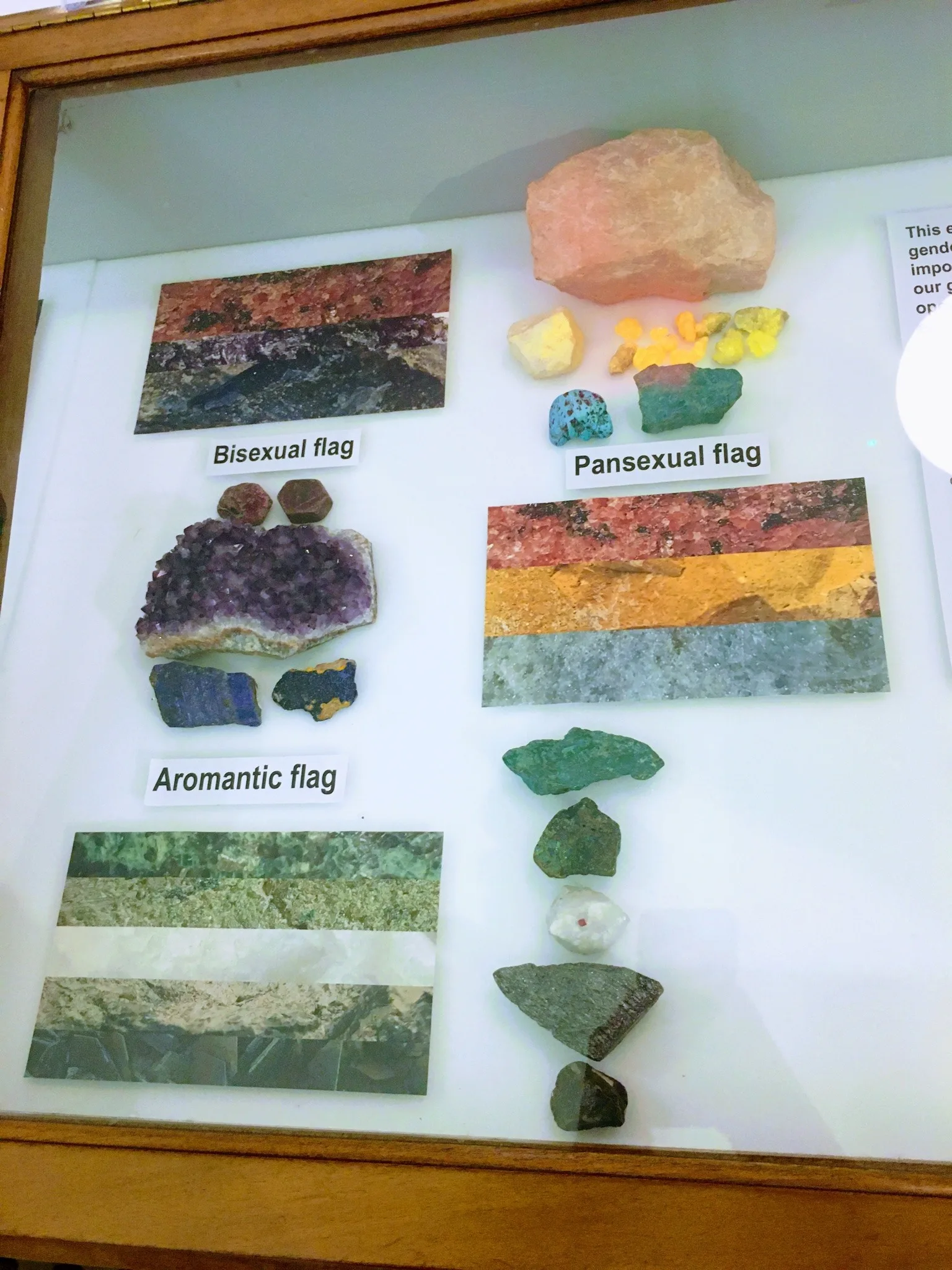
Photograph by the Tumblr user feral-critter. No licence is stated and none has been sought; published at the site owner's direction with the rights status recorded as undetermined.
In-text images
Discourse & Debates
- Earlier aromantic flag designs (four-stripe unknown origin, February 2014 Whimsy yellow-center variant) remain part of the historical record
- The aro community's relationship to ace spaces has been a recurring tension. Because aromantic identity initially developed within asexual communities, aro discussions and resources often defaulted to aroace perspectives, leaving aromantic allosexual (aroallo) people feeling invisible or excluded. The push for distinct aro spaces and organizations (including AUREA's founding in 2019) reflects an ongoing effort to establish aromantic identity as independent from, though historically connected to, the ace spectrum. Yasmin Benoit has been a prominent voice on aro erasure and the need for aromantic visibility on its own terms. [4] [6]
Common misidentifications
- Aromanticism and asexuality are frequently collapsed into one concept in popular coverage, though they represent distinct spectra
- The current white-center version is sometimes confused with the earlier yellow-center variant
Criticisms
- Aromantic people face widespread amatonormativity, a term coined by philosopher Elizabeth Brake (Rice University) in her 2012 book Minimizing Marriage to describe the societal assumption that everyone seeks an exclusive romantic partnership as a central life goal. [7] The 2020 AUREA Community Census (9,758 respondents) found that 82.43% of aromantic-spectrum people reported being dismissed or not taken seriously, and 48.34% reported others attempting to 'fix' their aromantic orientation. [8]
Footnotes & Citations
Sources and footnotes 11 sources
- 1. Social media whoops yeah i just realised i never actually made a proper post for this version of the flag (cameronwhimsy post 102698477928). Cameron Whimsy. Tumblr (2014-11-16). Accessed 2026-08-14
The dedicated post for the white-centre flag, with the meanings in the designer's own words and the artwork. Posted 15 November UTC, 16 November in the designer's Australian local time.
- 2. Aromantic flag. Wikipedia. Accessed 2026-03-09
- 3. The History and Meaning Behind the Aromantic Flag. Vocal Media. Accessed 2026-03-30
- 4. About AUREA. AUREA (Aromantic-spectrum Union for Recognition, Education, and Advocacy). Accessed 2026-03-30
- 5. Pride Flags. PrideFlags.org. Accessed 2026-03-09
- 6. Aromantic Pride Flag. LGBTQ Nation. Accessed 2026-03-30
- 7. Books Minimizing Marriage: Marriage, Morality, and the Law. Elizabeth Brake. Oxford University Press (2012). Accessed 2026-03-30 [no stable URL]
- 8. 2020 AUREA Community Census Results. AUREA (2020). Accessed 2026-03-30
- Aromantic Pride Flag. Wikidata. Accessed 2026-03-09
- Aromantic Flag. CRW Flags / Flags of the World. Accessed 2026-03-30
- Aroace. LGBTQIA+ Wiki. lgbtqia.wiki (2026-01-01). Accessed 2026-07-24
Image Sources
- Rendering
- current 5-stripe white-centre version (Nov 2014), verified against the designer post
- Whimsy's artwork from the 16 November 2014 post that introduced the white-centre flag with its meanings. [1] · Credit: Cameron Whimsy · TumblrRights No licence located.
- Pride flags rendered in rock and mineral specimens in a museum display case, each flag laid out beside the stones its colours were taken from. This case shows the bisexual, pansexual and aromantic flags. The case is most likely in the Cambridge geology museum: the quotation card in it is credited to a Coleridge student in 2022, and Coleridge Community College is a Cambridge school. The museum has not confirmed it. If you can add its formal name or the dates the display ran, contribute. · Credit: feral-critter, via Tumblr · feral-critter on Tumblr