Aegosexual / Autochorissexual Pride Flag (2014, hunterinabrowncoat)
Identity Pride Flag ·
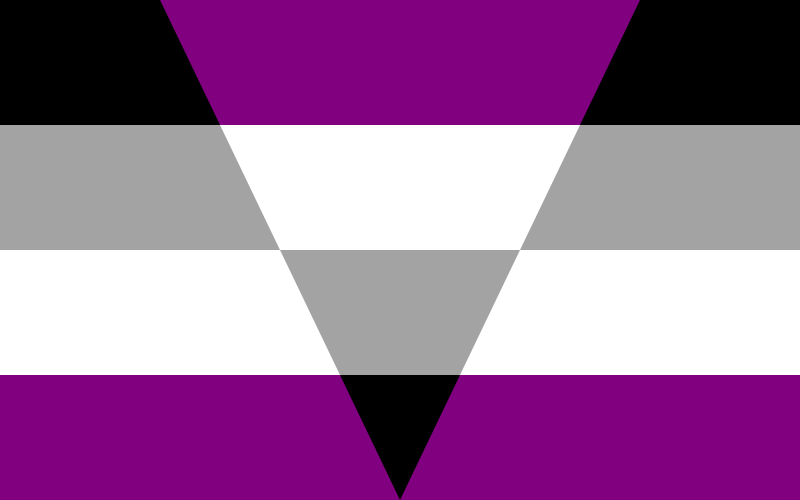
Tumblr user hunterinabrowncoat published this flag for autochorissexuality on 23 July 2014. It takes the black, gray, white and purple bands of the Asexual Pride Flag and reverses their order inside a full-width downward triangle [1]. The design predates the term aegosexual, proposed later that year by the Tumblr user sugar-and-spite as a community alternative to the earlier clinical name [2][3].

Key facts
- Designer
- hunterinabrowncoat
- Created
- First published
- In use
- 2014 to present
- Aspect Ratio
- 3:5 · standard
- Ratio Notes
- A normalised archival rendering. Hunterinabrowncoat's own file is 640 by 360 pixels, a 16:9 proportion, and no flag ratio was prescribed. The archive draws the design at its standard 3:5 for comparison across the collection; the geometry, not the canvas, is what the original fixes. [1]
- Stripes
- 4
- Represented Identity
- aegosexual / autochorissexual
Also known as
- Aegosexual Pride Flag
- Autochorissexual Pride Flag
- Autochorisexual Pride Flag
Status Canonical
Archive categories Sexual & Romantic Orientation Pride Flags
Overview
Hunterinabrowncoat offered the design as a suggestion for the autochorissexual orientation, then understood as part of the asexual spectrum. The creator explained the experience as an inversion, writing that "where asexuals do not feel attraction, but (some) sometimes engage in sexual activities, autochorissexuals feel the attraction, but don't want to engage in sexual activities", and translated that idea visually by reversing the Asexual Pride Flag's colours inside a downward triangle. The post's tags record both the research and the effort: "i looked up the meanings of the colours on the flag", "and was coming up with ideas for AGES", "but i think this is probably the simplest and best one". [1]
The word autochorissexualism came from Anthony F. Bogaert's paper of 11 May 2012, which reported "a disconnection between their identity and a sexual target/object" in some asexual people and named it "autochorissexualism or 'identity-less' sexuality", within a target-oriented paraphilia framework [4]. Later in 2014 the Tumblr user sugar-and-spite proposed aegosexual as a community alternative [2]. Because the flag was published under the older name, its current title records a renaming of the identity rather than a second design event.
Identity & Context
- Represented Identity
- aegosexual / autochorissexual
- Subcommunity
- asexual spectrum
Mogai-library's 2015 entry defines the identity as "a disconnection between oneself and the object of arousal; may involve sexual fantasies or arousal in response to erotica or pornography, but lacking any desire to be a participant in the activities therein" [5]. Individual experiences and uses of the label vary.
Creators
The Creator
hunterinabrowncoat
Flag designer
Hunterinabrowncoat published the flag in July 2014. The post's "mine" and "flag" tags confirm the account's authorship, and its remaining tags show a considered process: the creator looked up the Asexual Pride Flag's colour meanings and had been "coming up with ideas for AGES" before settling on this one. [1] The blog's description currently identifies its owner as Sam and gives they/them pronouns; that is a present-day self-description, read on 14 August 2026, and does not establish where the flag was made in 2014. [6]
I'd like to humbly put forward this flag as a suggestion for the autochorissexual orientation.
Opening line of the post publishing the flag, 23 July 2014. [1]
It's a part of the asexual spectrum, but in many ways it's like an inversion; where asexuals do not feel attraction, but (some) sometimes engage in sexual activities, autochorissexuals feel the attraction, but don't want to engage in sexual activities.
The creator's 2014 explanation of the design, in the same post. It describes their understanding at the time and is not a present-day definition of the identity. [1]
Well... there it is. Take it or leave it.
Closing line of the post. [1]
Motivations
- To give the autochorissexual orientation a flag of its own, built from the Asexual Pride Flag's palette to place it on the asexual spectrum. [1]
Stated inspirations
- The Asexual Pride Flag's four colours and stripe order, which the creator looked up before designing, then reversed inside a downward triangle.[1]
sugar-and-spite
Coiner of the community term aegosexual
Sugar-and-spite proposed the aego- prefix in 2014, after Bogaert's clinical term had been published and disputed. They did not design the flag, which predates the term by several months. In their own account, they coined it "from the Latin a- 'without' and ego 'myself'" and "never expected it to gain popularity". [2][3]
as a response to this I coined the term aego- (as in aegosexual or aegoromantic), from the Latin a- "without" and ego "myself". I honestly never expected it to gain popularity, and I'm absolutely thrilled that it's not only lasted this long, but been introduced to more and more ace spectrum blogs.
The coiner's account, answering a question on Tumblr, 18 May 2015. Retrospective by about six months. [2]
it was specifically because the term autochoris had come from a psychologist and was defined as a paraphilia that i felt someone who actually identified with the sexuality should name it.
The coiner, correcting a widely circulated post, 31 January 2026. [3]
Attribution notes
Designed and published by the Tumblr user hunterinabrowncoat on 23 July 2014. The post is tagged "mine" and "flag", which establishes the account's authorship, and its other tags record that the palette was taken from the Asexual Pride Flag deliberately [1]. Two later community posts credit the same account independently: mogai-library gives "Pride flag credit: hunterinabrowncoat" [5] and pride-color-schemes gives "Designed by: hunterinabrowncoat" [7]. Wikimedia Commons names hunterinabrowncoat as the artist and links to the same 2014 post [8].
Origin
- Digital Origin
- Yes
- Origin Type
- online publication
- Physical Origin Status
- not documented
Published online. The physical place of creation is not documented.
Published on Tumblr by hunterinabrowncoat on 23 July 2014. The physical place of creation is not documented. [1]
Dates & Chronology
- Year Created
- Exact date
- First published
- Period in Use
- 2014 to present
The 2014 design is the version reproduced in a-spec flag guides and community references [5][7]. A standardised SVG uploaded to Wikimedia Commons on 17 November 2025 by the editor OmegaMantis, which credits hunterinabrowncoat and links back to the original post, is in use on eighteen pages across five language editions of Wikipedia, among them the articles Aegosexuality and Gray asexuality in English, Aegosexualidad in Spanish, 회색 무성애 in Korean and แอโกเซ็กชวล in Thai. [8]
The naming sequence runs in three steps. Bogaert published autochorissexualism in Archives of Sexual Behavior on 11 May 2012 [4]. Hunterinabrowncoat published the flag under that name on 23 July 2014, tagging it for the romantic counterpart, autochorisromantic, as well [1]. Sugar-and-spite then proposed the aego- prefix.
The coiner has given their own account of it twice. In May 2015 they wrote that after Bogaert's paper "there was a lot of disapproval on the idea of it being classified as a paraphilia (and thus a choice)", that "a few people tried to reclaim it as 'autochorissexuality', but obviously that was quite a bit of a mouthful", and that "as a response to this I coined the term aego- (as in aegosexual or aegoromantic), from the Latin a- 'without' and ego 'myself'", adding "I honestly never expected it to gain popularity" [2]. In January 2026 they put the reason more directly: "it was specifically because the term autochoris had come from a psychologist and was defined as a paraphilia that i felt someone who actually identified with the sexuality should name it" [3].
The originating post has not been located. Community references date the proposal to November 2014 [9]; the earliest post located on the coiner's own blog referring to the term is dated 1 December 2014, where they note that the aego- prefix "was also intended to be used for a sexuality (as in aegosexual)" [10].
Lineage
- Direct predecessors
- Asexual Pride Flag
The Asexual Pride Flag is the direct visual parent. The flag takes its four colours and its stripe order, then reverses that order inside the triangle. The derivation is stated rather than inferred: hunterinabrowncoat tagged the post "i looked up the meanings of the colours on the flag" [1], and mogai-library describes the result as "reminiscent of the asexual flag but inverted" [5].
The Demisexual Pride Flag is listed alongside it as a visual comparison, since it also builds on the asexual palette with a triangle. No source connects the two designs, and neither is recorded here as influencing the other.
Lineage tree
Every record reachable from this one through documented parent and child relationships: 2 records across 2 generations.
- Ancestor
- Asexual Pride Flag
- This record
- Aegosexual / Autochorissexual Pride Flag (2014, hunterinabrowncoat)
Colors & Symbolism
The flag marks aegosexual and autochorissexual identity on the asexual spectrum. Its four colours are the Asexual Pride Flag's, and its argument is the reversal: outside the triangle the bands run black, gray, white and purple, and inside it the order runs purple, white, gray and black. Mogai-library describes the colours as "reminiscent of the asexual flag but inverted to represented the 'inverted aspect' of autochorissexuality" [5]. Hunterinabrowncoat connected the inversion to their 2014 understanding of the orientation, as an experience in which attraction and participation come apart [1].
| Colour | Hex | Meaning |
|---|---|---|
| Black | #000000 | "Asexuality," in mogai-library's wording. [5] |
| Gray | #A3A3A3 | "Grey- and demisexuality," in mogai-library's wording. [5] |
| White | #FFFFFF | "Sexuality," in mogai-library's wording. [5] |
| Purple | #800080 | "Community," in mogai-library's wording. [5] |
Measured from the creator's original image. [1]
- Full-width downward triangle with the colour order reversed inside it
- Outside the triangle the bands run black, gray, white and purple. Inside it the order reverses to purple, white, gray and black. [7] Mogai-library reads the reversal as representing the "inverted aspect" of autochorissexuality [5]; the creator described the same idea as an inversion between feeling attraction and wanting to act on it [1].
The creator did not assign meanings colour by colour. The readings above are mogai-library's, listed in its 2015 entry as "Black: asexuality / Grey: grey- and demisexuality / White: sexuality / Purple: community" [5]. They follow the Asexual Pride Flag, from which the palette is taken. The design is not the opposite of asexuality: hunterinabrowncoat placed the orientation within the asexual spectrum and used inversion as an explanatory figure. [1]
Hunterinabrowncoat published no hex specification, but tagged the post "i looked up the meanings of the colours on the flag", and the four values in the table are measured directly from the original image [1]. They are the Asexual Pride Flag's colours as that file renders them. The per-colour meanings are not the creator's: they come from later community documentation. [5]
Design
- Aspect Ratio
- 3:5 · standard
- Ratio Notes
- A normalised archival rendering. Hunterinabrowncoat's own file is 640 by 360 pixels, a 16:9 proportion, and no flag ratio was prescribed. The archive draws the design at its standard 3:5 for comparison across the collection; the geometry, not the canvas, is what the original fixes. [1]
- Orientation
- horizontal
- Stripe Count
- 4
- Layout
- stripes_with_emblem
- Stripes (Top → Bottom)
- Black, Gray, White, Purple
- Center Symbol
- Full-width downward triangle, its upper vertices at the two top corners and its point at the bottom centre, containing the same four bands in reverse order
Four equal horizontal bands with a downward triangle laid over them. The triangle is full width: its upper vertices sit at the two top corners of the flag and its point meets the exact bottom centre. Measured on the creator's 640 by 360 original, the bands are 90 pixels each and the triangle's edge falls at x = y x w / 2h at every sampled row. [1] The pride-color-schemes description of 2016 reads the same shape: "a flag with four stripes. Each stripe is two different colors, and looks as though a triangle, point down, was overlaid on the flag. Outside the triangle, the colors, top to bottom, are: black, grey, white, purple. Inside the triangle, the colors, top to bottom, are: purple, white, grey, black." [7]
The full-width triangle is the design. A reproduction that insets the triangle, or narrows its base, is not faithful to the original. The Wikimedia Commons SVG of 2025 uses the same construction, clipping to the polygon 0,0 to 720,0 to 360,432 on a 720 by 432 canvas. [1][8]
Four equal horizontal bands in black, gray, white and purple, the colours of the Asexual Pride Flag, with a downward triangle laid across the whole field. Outside the triangle the bands run black, gray, white, purple from top to bottom; inside it the order reverses to purple, white, gray, black. [1]
Usage & Adoption
- Online Usage
- Tumblr, Wikimedia projects, A-spec flag guides and community references
- Current Status
- active
The inverted-triangle design continues to appear in a-spec flag guides and community references [5][7]. A standardised SVG uploaded to Wikimedia Commons on 17 November 2025 is used on eighteen pages across five language editions of Wikipedia, including the articles Aegosexuality and Gray asexuality in English, Aegosexualidad in Spanish, 회색 무성애 in Korean and แอโกเซ็กชวล in Thai, which documents continued online circulation [8]. Inclusion in a reference guide is not organisational adoption, and the scale of offline use is not established.
Image Archive
Flag design
Discourse & Debates
- The flag's two names mark two stages of its history. It was published for autochorissexuality, a term taken from Bogaert's clinical writing [1][4]. Aegosexual came later, from within the community, and is now the name under which the flag more often circulates [2]. Some references keep both for historical continuity; others prefer aegosexual because it avoids the earlier clinical framing [5][7].
- This is the design that circulates for the identity, and the only one for which a creator and a publication date are documented. That standing is a matter of community circulation; no organisation has designated an official aegosexual flag. [5][7][8]
Common misidentifications
- The design can be mistaken for the Asexual Pride Flag because it uses the same palette. Its distinguishing feature is the full-width downward triangle containing the colours in reverse order.
Aegosexual, autochorissexual and the variant spelling autochorisexual all name the same identity. Aegosexual developed as a community alternative to autochorissexual, and the 2014 flag now circulates under both names. Individual experiences and uses of the label vary, and neither Bogaert's clinical description nor hunterinabrowncoat's short 2014 explanation is a definition binding on everyone who uses the word.
Footnotes & Citations
Sources and footnotes 10 sources
- 1. Social media I'd like to humbly put forward this flag as a suggestion for the autochorissexual orientation. hunterinabrowncoat. Tumblr (2014-07-23). Accessed 2026-08-14
Primary source: the post publishing the flag, timestamped 23 July 2014 at 21:31 UTC, carrying the original 640 by 360 image and tagged "mine" and "flag".
- 2. Primary statement Answer describing the coinage of the aego- prefix. sugar-and-spite. Tumblr (2015-05-18). Accessed 2026-08-14
The coiner's account of proposing aegosexual, given about six months afterwards.
- 3. Primary statement Correction on the coinage of aegosexual. sugar-and-spite. Tumblr (2026-01-31). Accessed 2026-08-14
The coiner restating their authorship and their reason for it, eleven years later.
- 4. Academic Asexuality and Autochorissexualism (Identity-Less Sexuality). Anthony F. Bogaert. Archives of Sexual Behavior, vol. 41, pp. 1513-1514, Springer (2012-05-11). Accessed 2026-08-14
The paper that introduced autochorissexualism, published online 11 May 2012 and in the December 2012 issue. Cited here for its title and its abstract.
- 5. Social media Aegosexuality (formerly: autochorissexuality). mogai-library. Tumblr (2015-08-13). Accessed 2026-08-14
Community documentation. Source for the per-colour meanings and for the "inverted aspect" reading; credits the flag to hunterinabrowncoat.
- 6. Designer page hunterinabrowncoat blog description. hunterinabrowncoat. Tumblr. Accessed 2026-08-14
The designer's current blog description, cited for the name and pronouns it gives. Read 14 August 2026; it carries no date of its own.
- 7. Social media Aegosexual, Autochorissexual. pride-color-schemes. Tumblr (2016-06-26). Accessed 2026-08-14
Secondary description of the design, with a verbatim account of the layout and the designer credit.
- 8. Image file page File:Aegosexual flag.svg. Uploaded by OmegaMantis; design credited to hunterinabrowncoat. Wikimedia Commons (2025-11-17). Accessed 2026-08-14
The Commons SVG: its geometry, upload history, public-domain tag and use across Wikimedia projects.
- 9. Reference Aegosexual. LGBTQIA+ Wiki. Accessed 2026-08-14
Community reference, cited here only for the November 2014 date it gives for the aegosexual proposal.
- 10. Social media Reblog of the Aegoromantic definition, noting the term was also intended for a sexuality. sugar-and-spite. Tumblr (2014-12-01). Accessed 2026-08-14
The earliest post located on the coiner's blog referring to aegosexual.
Image Sources
- Rendering
- hunterinabrowncoat, July 2014
- Original flag image published by hunterinabrowncoat for the autochorissexual orientation, 23 July 2014. 640 by 360 pixels, a 16:9 proportion. · Credit: hunterinabrowncoat · Tumblr, hunterinabrowncoat, 23 July 2014 · Original artifactRights No reuse licence has been located for this image. It is cited here and not reproduced.
- Standardised SVG uploaded to Wikimedia Commons on 17 November 2025, drawn on a 720 by 432 canvas with the same full-width triangle, and in use on eighteen pages across five language editions of Wikipedia. · Credit: Uploaded by OmegaMantis; design credited to hunterinabrowncoat · Wikimedia Commons, File:Aegosexual flag.svg · Later technical rendering · Public domain (PD-shape)Rights The Commons file page tags this SVG as public domain, as simple geometry. That determination applies to this file and does not extend to hunterinabrowncoat's original image or to the design.
- Encycloflaggia reconstruction, drawn at 1000 by 600 to the archive's 3:5 standard from the geometry and measured colours of the 2014 original. · Credit: Encycloflaggia reconstruction after hunterinabrowncoat · Archive reconstruction · Technical reconstructionRights No new rights are claimed in the reconstruction, and drawing it does not license the underlying design.